

7 Fun and Effective T Ball Drills for 3 5 Year Olds (2026 Guide)

Welcome to the world of T-ball, where tiny athletes take their first swings and run their first bases! For 3- to 5-year-olds, the goal isn't hitting home runs; it's about building fundamental motor skills, fostering a love for movement, and celebrating every small victory. A successful T-ball experience at this age focuses on fun, engagement, and safety. The biggest challenge is keeping their short attention spans focused while teaching core concepts like hand-eye coordination, balance, and the basic rules of the game.
This guide provides a curated collection of seven categories of age-appropriate T-ball drills for 3 5 year olds, designed specifically for preschoolers and toddlers. You'll find everything you need to run an effective and enjoyable practice, whether you're a first-time coach or a parent practicing in the backyard. To ensure T-ball remains a positive experience for your little one, remember the importance of incorporating a variety of fun and age-appropriate activities for preschoolers into their routine. This helps develop well-rounded skills and prevents burnout before they even really get started.
Inside, each drill is broken down into simple, actionable steps, complete with:
Coaching Cues: Easy-to-remember phrases to guide your little player.
Equipment & Setup: What you need and how to arrange it.
Progression Tips: How to make drills easier or more challenging.
Safety & Engagement: Key advice to keep things fun and accident-free.
We will cover everything from foundational tee work and hand-eye coordination exercises to dynamic, game-like scenarios that keep kids moving, learning, and, most importantly, smiling. Let's get started.
1. Tee Work & Contact Drills
The absolute cornerstone of all T-ball drills for 3–5 year olds is foundational tee work. This drill strips hitting down to its most essential elements by placing a stationary ball on an adjustable tee. By removing the complexity of a moving pitch, young children can focus entirely on the core mechanics: hand-eye coordination, bat control, and developing a basic swing. For this age group, achieving repeated, successful contact is paramount for building confidence and motor skills.
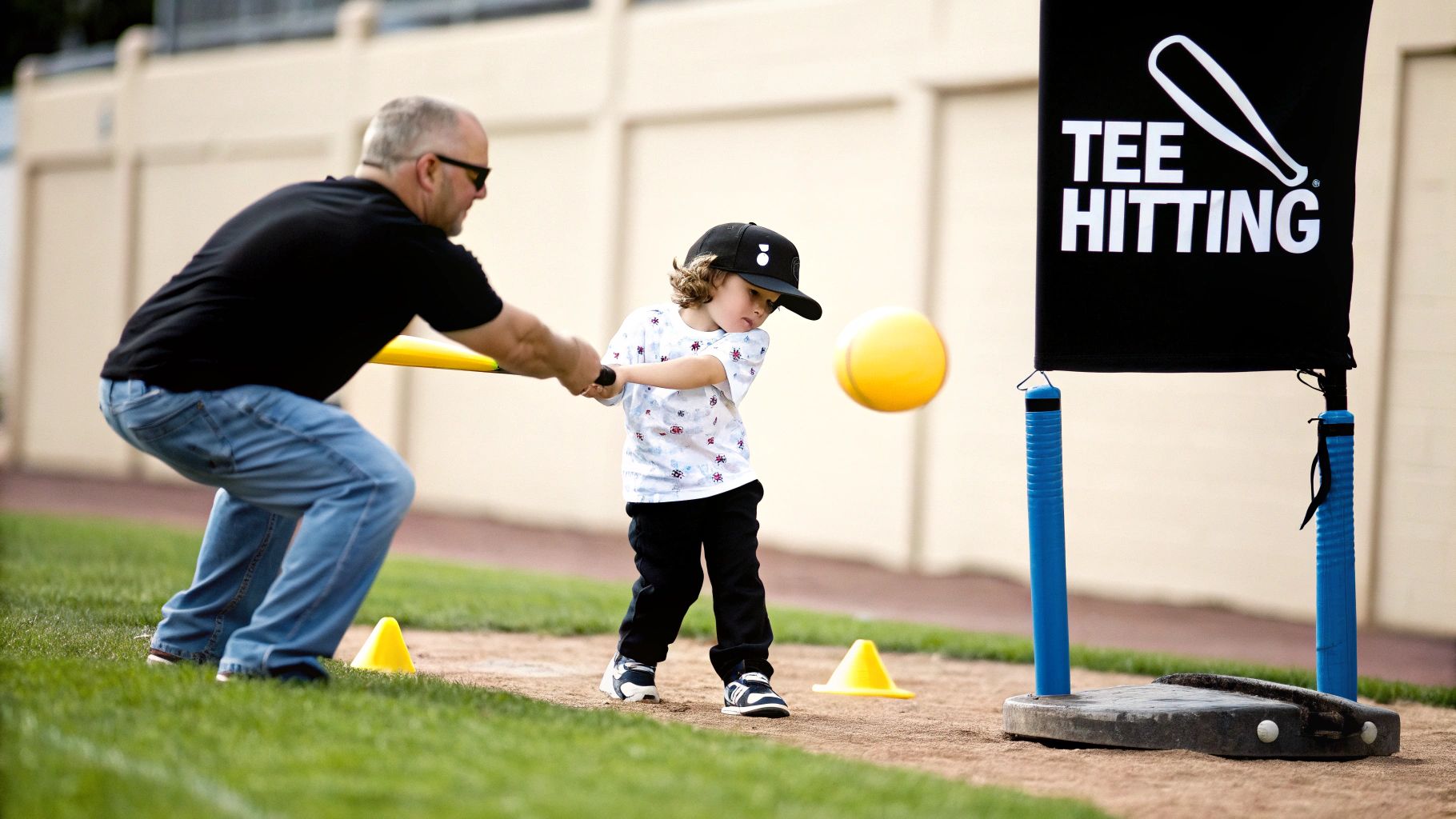
This drill is the starting point for nearly every youth baseball program, including those recommended by Little League International for this age bracket. At JC Sports Houston, we utilize adjustable tees as a primary tool in our beginner T-ball programs, allowing us to tailor the experience to each child’s height and developmental stage.
How to Set Up the Drill
Setting up for tee work is simple, requiring minimal equipment and space.
Equipment: An adjustable T-ball tee, a lightweight bat, and soft T-balls (oversized or foam balls are great for beginners).
Setup: Place the tee on a level surface with enough clear space for a full swing. Set up a bucket of balls nearby for quick repetition. Use two cones or poly spots to mark where the child should place their feet, encouraging a balanced, athletic stance.
Coaching Cues & Tips for Success
Guiding a 3- to 5-year-old requires simple, positive, and actionable instructions.
Stance First: Before they even pick up the bat, help them find their "ready feet" on the markers. Teach them to have "soft knees" (slightly bent).
Tee Height: Adjust the tee so the ball is level with the player's hips or waist. This encourages a level swing path.
"Squish the Bug": Use this classic cue to teach them to pivot their back foot as they swing, introducing the concept of using their lower body.
Focus on Contact: The goal is simply to hit the ball. Celebrate every time the bat makes contact, regardless of how far the ball goes. High-fives and praise for effort are crucial.
Keep it Short: A 15-minute tee work session is plenty for this age. Rotate players between hitting and "shagging" (collecting) the balls to keep everyone active and engaged.
2. Soft Toss & Hand-Eye Coordination Drills
Once a child shows consistent contact with a stationary ball, the next logical progression is the soft toss drill. This exercise introduces the crucial skill of tracking a moving object, bridging the gap between static tee work and more advanced hitting. A coach or parent gently tosses a soft, lightweight ball underhand from a short distance, giving the young player an opportunity to coordinate their eyes, hands, and body to make contact. This is one of the most effective t ball drills for 3-5 year olds to develop foundational timing and reaction skills in a low-pressure environment.
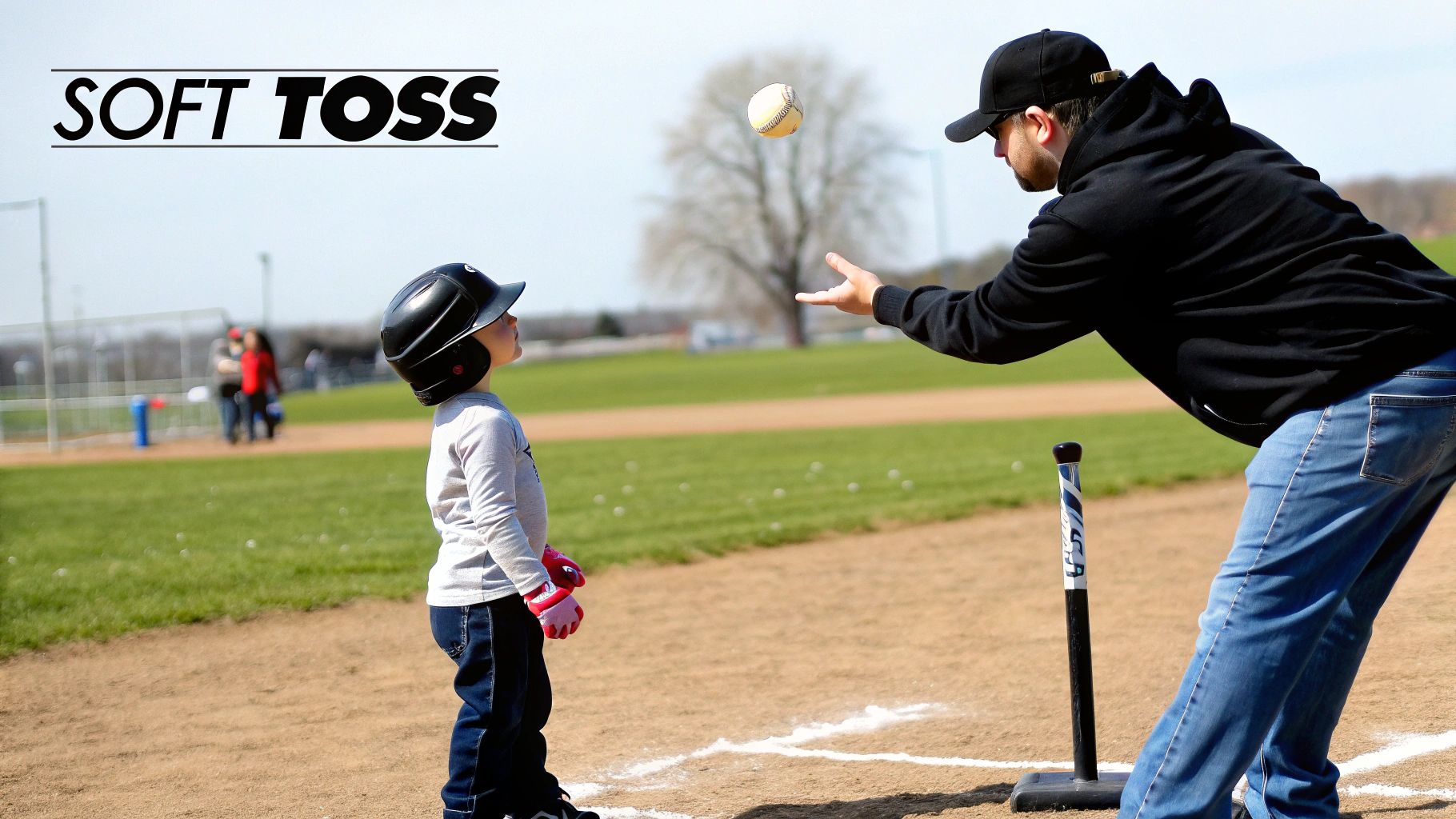
This method is a staple in youth development programs, including those outlined by USA Baseball, because it safely builds upon tee work fundamentals. At JC Sports Houston, we integrate soft toss drills into our toddler sports programs to enhance motor skill development that translates across multiple activities, not just baseball. The slow, high-arcing tosses give children plenty of time to process and react, turning a complex skill into a fun and achievable challenge.
How to Set Up the Drill
The setup for soft toss is straightforward and focuses on safety and consistency to build a young player's confidence.
Equipment: A bucket of soft T-balls or foam balls (4-5 oz maximum), a lightweight bat, and two cones or poly spots.
Setup: Position the player in their batting stance using the cones to mark their feet. The coach should kneel at a 45-degree angle about 15-20 feet away from the batter. This angle ensures the coach is out of the direct path of the swing and any hit balls.
Coaching Cues & Tips for Success
Positive reinforcement and simple, repeatable instructions are key to helping toddlers and preschoolers succeed with this drill.
Underhand Toss Only: Always toss the ball gently underhand with a high arc. This slow, predictable path is essential for this age group to track the ball successfully.
Find a Rhythm: Help the player get ready by saying "Ready... set... swing!" as you toss. This verbal cue helps them anticipate the toss and time their swing.
"Eyes on the Ball": Constantly repeat this simple phrase. Gently tap their helmet or hat to remind them to keep their head down and watch the ball all the way to the bat.
Consistency is Key: In the beginning, aim to toss the ball to the exact same spot every single time, ideally in front of the plate at waist height. This builds confidence through repetition.
Rotate and Engage: Keep soft toss sessions short, around 2-3 minutes per child. Rotate them to another activity like running the bases or fielding to maintain high energy and focus.
3. T-Ball Trotting & Base Running Fundamentals
Once players make contact with the ball, the next big adventure is running the bases. For 3- to 5-year-olds, base running is less about competitive speed and more about understanding the game's flow, building coordination, and experiencing the pure joy of movement. These fundamental trotting and running drills are designed to teach directionality, improve balance, and make being on the baseball diamond an exciting, active experience. The goal is to associate hitting the ball with the fun action of running.
Movement-based games are a core component of many successful youth sports programs. Little League’s "Play Ball" initiative, for instance, heavily promotes running and base games to engage its youngest participants. At JC Sports Houston, our multi-sport classes for toddlers and preschoolers incorporate similar agility and running activities, ensuring that children build a strong foundation of athletic movement that translates directly to T-ball.
How to Set Up the Drill
Setting up base running drills is flexible and focuses on creating a playful, safe environment.
Equipment: A set of brightly colored bases or flat poly spots, and several cones for creating different running paths.
Setup: For a basic "run the bases" drill, simply set up a diamond. For more dynamic activities, you can create a "Follow the Leader" path with cones, arrange them in a zigzag pattern for agility work, or set up a simple "race" line between two bases.
Coaching Cues & Tips for Success
Guiding young runners is all about encouragement, clear direction, and imaginative play.
Make it a Game: Turn running into a story. "The floor is lava, and the bases are safe islands!" or "Let's run like a superhero to the next base!" This imaginative framing keeps children engaged and motivated.
Use Visuals: Brightly colored cones and bases are essential for this age group. They provide clear, simple targets for kids to run toward. Point directly to the next base and say, "Run to the orange one!"
Follow the Leader: One of the most effective t ball drills for 3 5 year olds is having them follow a coach around the bases. This demonstrates the correct path and provides a moving target for them to chase, making it more fun than running alone.
Celebrate Effort: Cheer for every player as they cross a base. The focus should be on participation and completing the run, not on who is fastest. High-fives at home plate are a must.
Keep it Short & Sweet: Young children have short attention spans. Keep running segments to just a few minutes at a time before switching to another activity to maintain high energy and focus.
4. Fielding & Ground Ball Tracking Drills
After hitting, the next fundamental skill in T-ball is learning how to field the ball. For 3- to 5-year-olds, fielding drills are less about making perfect plays and more about building comfort, coordination, and the ability to track a moving object. These drills introduce the basic concepts of getting in front of the ball, using two hands, and watching the ball all the way into the glove in a fun, low-pressure environment. The goal is to make fielding a game, removing any fear of the ball and encouraging confident movement.
This foundational approach is a core component of early development programs like those outlined in USA Baseball's Development Program for Level 1 instruction. At JC Sports Houston, our beginner baseball programs emphasize these simple ground ball drills to ensure our youngest players develop a positive association with defense, focusing on effort and participation over flawless execution.
How to Set Up the Drill
The setup for ground ball drills should be simple and focused on repetition and safety.
Equipment: A bucket of soft T-balls (foam or safety balls are ideal), small gloves (optional, as using two hands is the primary skill), and cones or poly spots.
Setup: Place a cone where the child will stand in their "ready position." The coach or parent will kneel about 10–15 feet away. Create a clear, open space free of distractions or obstacles.
Coaching Cues & Tips for Success
Positive and imaginative coaching cues are key to teaching fielding skills to this age group.
Ready Position: Teach them to be an "athletic alligator" or a "ground ball monster" with bent knees, a flat back, and hands out in front and low to the ground.
Use Two Hands: Cue them to make an "alligator mouth" with their hands (or glove and bare hand) to "chomp" the ball. This encourages them to get their body behind the ball and secure it with both hands.
Track the Ball: Use brightly colored balls to make tracking easier. Tell them to "keep your eyes on the treasure" all the way into their hands.
Start Simple: Begin by rolling the ball very slowly and directly to the child. As they get comfortable, you can introduce slight rolls to their left or right to encourage small movements.
Make it Fun: Frame the drill with imaginative language. They aren't just fielding grounders; they are "stopping the runaway balls" or "collecting dragon eggs."
Keep Stations Short: Limit fielding drills to 5–7 minute stations. Repetition is important, but so is maintaining a high level of engagement and energy.
Below is a great visual example of how to introduce these basic fielding mechanics in an engaging way for young children.
5. Small-Sided Games & Mini-Game Competitions
Once a child has a grasp on hitting off the tee and basic fielding, it's time to put those skills into a fun, game-like context. Small-sided games and mini-game competitions are modified T-ball games with fewer players (3v3 or 4v4), shorter distances, and simplified rules. These drills are designed to keep young players fully engaged while building practical skills in a dynamic, fast-paced environment that mimics a real game but eliminates the long periods of inactivity common in traditional T-ball.
This approach is highly recommended by top youth sports organizations. USA Baseball's Play Ball initiative and Little League's 'Tee Ball Essentials' program both heavily emphasize small-sided games to maximize player involvement. At JC Sports Houston, our developmental T-ball leagues are structured around these mini-games, ensuring every child is an active participant. To discover more about how we integrate these effective formats into our programs, explore the benefits of our T-ball and baseball developmental leagues this season.
How to Set Up the Drill
Setting up a mini-game requires a bit more organization but creates an incredibly rewarding practice experience.
Equipment: A T-ball tee, soft T-balls, lightweight bat, and at least four cones or bases.
Setup: Create a mini-diamond with bases set 30-40 feet apart. Divide players into small teams of three or four. If you have enough coaches and space, you can run multiple games simultaneously to keep every child active. A continuous batting order ensures no one waits long for their turn.
Coaching Cues & Tips for Success
The goal of mini-games is participation and fun, not winning. Your coaching should reflect this priority.
Simple Rules: Keep scoring very simple, focusing only on 'runs' and 'outs'. Consider playing with unlimited outs to maximize at-bats and fielding opportunities for everyone.
Rotate Positions: Ensure every player gets a chance to play different positions in the field and bat multiple times. Regular rotation prevents boredom and exposes them to various aspects of the game.
Short Duration: Keep individual games short, around 5 to 10 minutes maximum. This matches the attention span of 3- to 5-year-olds and keeps the energy high.
Focus on Fun: This is the most important rule. Celebrate good plays, great effort, and teamwork from both sides. The objective is to build a love for the game, and positive reinforcement is the best tool for the job.
All Players Involved: With small teams, every player is directly involved in the action, whether they are batting, running, or fielding. This constant engagement is a key benefit of small-sided T-ball drills for 3-5 year olds.
6. Balance & Coordination Stations (Multi-Sport Approach)
Foundational athleticism is the bedrock upon which all specific sports skills are built. For 3- to 5-year-olds, developing balance, coordination, and general motor skills is far more critical than mastering a perfect T-ball swing. A multi-sport station approach addresses this by creating a fun, engaging circuit of activities that build the physical literacy needed for baseball and beyond. This method prevents boredom and develops well-rounded movement patterns that translate directly to hitting, throwing, and running.
This station-based format is a core component of how we structure our multi-sport toddler programs at JC Sports Houston. Experts like the International Youth Conditioning Association (IYCA) also advocate for these "movement stations" for young athletes, as they promote holistic development over early specialization. By incorporating elements from soccer, basketball, and general athletic movements, we create a dynamic environment where kids learn to control their bodies in various ways.
How to Set Up the Drill
Creating a coordination circuit is about variety and flow. Design 4-5 simple stations in a circular or sequential layout around your practice space.
Equipment: A mix of simple items like agility ladders (or chalk lines), low balance beams (or a painted line on the ground), small hurdles or cones, and targets for throwing (like a bucket or net).
Setup: Arrange the stations with enough space between them to prevent collisions. Use brightly colored cones or poly spots to clearly mark the start and end of each station. A visual chart or whiteboard with simple drawings of each activity can help kids understand what to do next.
Coaching Cues & Tips for Success
The goal is movement exploration, not perfect execution. Keep instructions simple, imaginative, and focused on the action.
Use Imaginative Themes: Frame the activities with fun scenarios. "Walk the tightrope" on the balance line, "jump over the crocodile river" with hurdles, or "weave through the forest" around the cones.
Keep it Moving: Limit time at each station to just 3-4 minutes to maintain high energy and focus. Use a whistle or a fun sound to signal when it's time to rotate to the next station.
Focus on Foundational Movements: Emphasize core actions. For a throwing station, focus on pointing the front shoulder at the target. For jumping, cue them to have "frog legs" and land with soft knees.
Celebrate Effort: Praise the attempt, not just the outcome. A child who tries to balance but wobbles is still learning and deserves encouragement. High-fives for trying are just as important as those for success.
Incorporate Rest: Build a designated water break or rest spot into the circuit. This is a key part of making sports fun and safe for young learners. Exploring the best sports for 3-year-olds often highlights the value of these varied, play-based activities.
7. Parent-Child Interactive Drills & Home Practice Activities
The learning process for T-ball doesn't have to stop when formal practice ends. Structured, simple drills designed for parents to do with their children at home are incredibly effective for reinforcing skills. These activities bridge the gap between organized sessions, transforming skill development into quality family time. By using minimal equipment and space, parents can extend learning and strengthen their child’s confidence in a familiar, low-pressure environment.
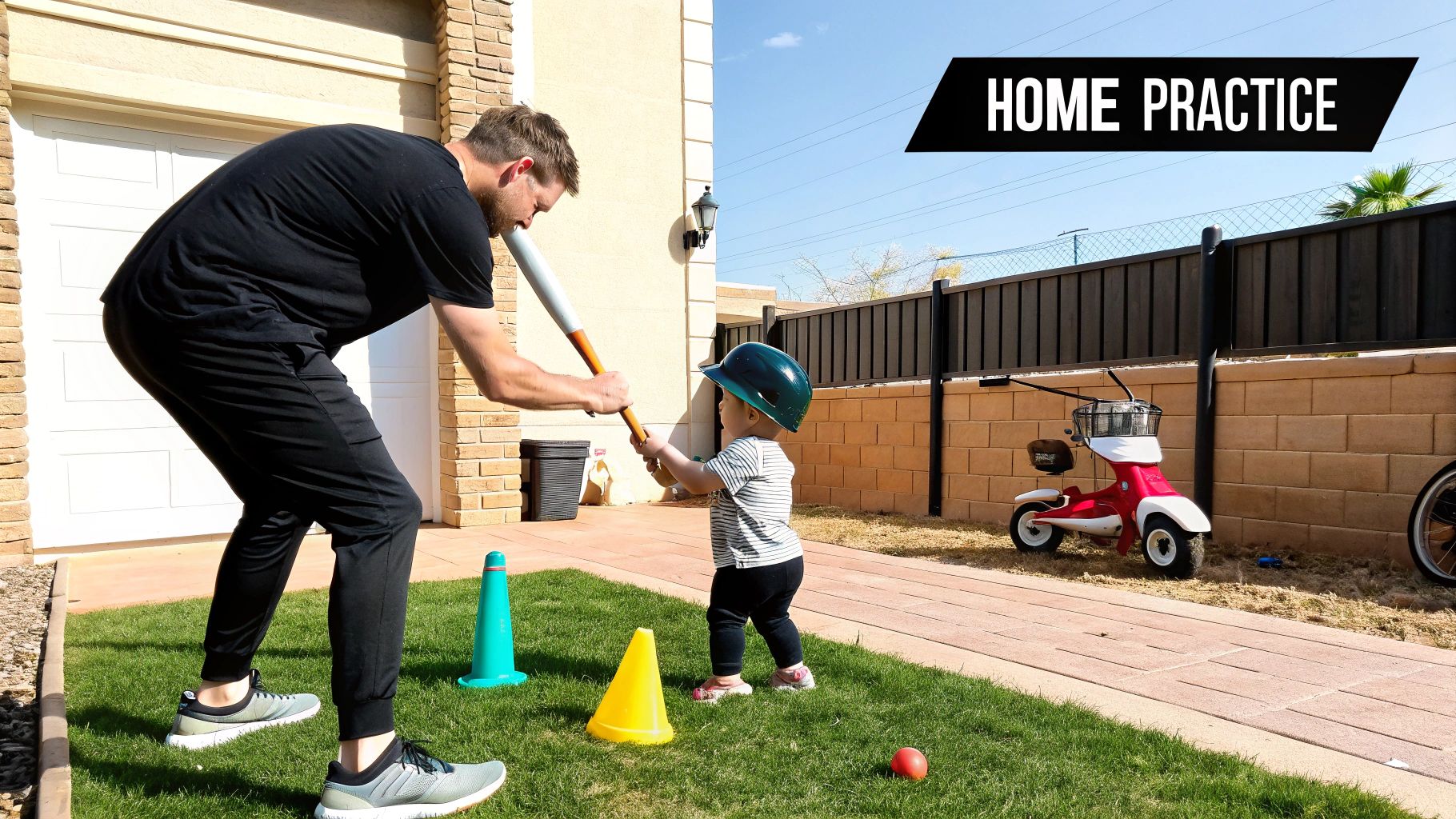
This approach is highly recommended by youth development programs like USA Baseball and Little League, which provide parent guides to encourage home practice. At JC Sports Houston, we emphasize this parent-coach partnership, recognizing that consistent, positive reinforcement at home accelerates a child's love for the game. These shared experiences are not just about sports; they are a fun, safe way to build confidence and create lasting memories.
How to Set Up the Drill
The key to successful home practice is simplicity and accessibility. Parents can easily create a mini-practice field in their backyard or a local park.
Equipment: A soft T-ball or foam ball, a lightweight bat, a portable tee, and two cones or household items (like shoes or water bottles) to use as bases.
Setup: For hitting, set up the tee in an open area away from windows. For throwing and catching, simply stand a few feet apart. For base running, place the "bases" 10-15 feet apart to create a short running path.
Coaching Cues & Tips for Success
Parental guidance should be encouraging and playful, focusing on participation over perfection.
Keep It Short & Sweet: Aim for 5- to 10-minute sessions. For a 3- to 5-year-old, multiple short bursts of activity are far more effective than one long, grueling practice.
Use Playful Language: Frame activities as games, not drills. Instead of "let's practice hitting," try "let's see if we can hit the ball to the magic tree!"
Focus on One Skill: Dedicate each short session to a single skill. One day might be hitting off the tee, the next could be playing catch, and another could be racing between the "bases."
Celebrate Effort: Praise the attempt, not just the outcome. High-fives for a big swing (even if it's a miss) or for trying to catch the ball are essential for keeping spirits high.
Participate Actively: The most important tip is for the parent to play too. Run the bases with your child, take turns hitting, and be an active participant. This transforms a drill into a shared, joyful activity.
T-Ball Drills Comparison for Ages 3–5
Drill | 🔄 Implementation complexity | ⚡ Resource requirements | 📊 Expected outcomes | 💡 Ideal use cases | ⭐ Key advantages |
|---|---|---|---|---|---|
Tee Work & Contact Drills | Low — simple setup, repeatable | Minimal — tee, bat, soft balls, cones | Basic swing mechanics, hand‑eye coordination, confidence | Intro sessions; ages 3–5; first skills | Very high success rate; easy repetition |
Soft Toss & Hand‑Eye Coordination Drills | Low–Medium — coach needs consistency | Low — soft balls, helmet, coach time | Ball tracking, timing introduction, reaction time | Progression from tee work; small groups; ages 4–5 | Bridges stationary work to moving balls; adjustable |
T‑Ball Trotting & Base Running Fundamentals | Low — game‑style, easy to run | Minimal — cones, bases, open space | Balance, leg strength, base awareness, agility | Warm‑ups, group play, developing athleticism | Highly engaging; builds movement confidence |
Fielding & Ground Ball Tracking Drills | Medium — needs one‑on‑one progression | Low — soft balls, cones; coach attention | Ready position, scoop technique, spatial awareness | Defensive basics; short stations; ages 3–5 | Teaches defensive fundamentals early and safely |
Small‑Sided Games & Mini‑Game Competitions | Medium — organization and rotations required | Medium — more space, multiple coaches/equipment | Game awareness, situational play, higher repetitions | Apply skills in context; end of session; ages 4–5 | High engagement; more touches per child; fun |
Balance & Coordination Stations (Multi‑Sport) | Medium — multiple stations to manage | Medium — varied simple equipment, space | Broad motor skills, injury prevention, athletic base | Multi‑sport development, mixed ability groups | Builds comprehensive athletic foundation; adaptable |
Parent‑Child Interactive Drills & Home Practice | Low — simple but relies on parent consistency | Minimal — ball, bat, 2 cones; backyard friendly | Increased repetitions, family engagement, confidence | Between practices; home reinforcement; ages 3–5 | Reinforces learning at low cost; strengthens family bonds |
Putting It All Together: From Drills to Lifelong Development
You now have a comprehensive playbook filled with engaging and effective t ball drills for 3 5 year olds. From the focused precision of Tee Work to the energetic chaos of Small-Sided Games, each activity is a building block in your child's athletic journey. We've explored how to teach hitting fundamentals, cultivate hand-eye coordination with Soft Toss, introduce the excitement of base running, and make fielding a fun-filled treasure hunt. By integrating multi-sport balance stations and parent-child activities, you're doing more than just teaching baseball; you're nurturing a well-rounded, confident little athlete.
The real magic happens when you weave these individual drills into a cohesive, fun, and fast-paced practice. The key isn't to run one drill for 30 minutes, but to create a dynamic circuit that holds a preschooler's attention. Remember the principles we've discussed: keep instructions simple, use imaginative language, celebrate effort relentlessly, and prioritize safety above all else.
Your Blueprint for Success: Core Takeaways
As you step onto the field with your little player, keep these foundational concepts at the forefront of your coaching philosophy:
Fun is the Foundation: For this age group, enjoyment is non-negotiable. If the kids are laughing and moving, they are learning. Frame every drill as a game, and you'll unlock their enthusiasm.
Variety is Vital: A 3- to 5-year-old's attention span is short. Rotate through different types of activities (hitting, running, fielding) every 5-7 minutes to maintain engagement and prevent boredom.
Focus on 'One Thing': During any given drill, concentrate on a single, simple coaching cue. For hitting, it might be "eyes on the ball." For fielding, it could be "get your glove down." Overloading them with information is counterproductive.
Praise the Process, Not Just the Result: A mighty swing that misses the ball is still a mighty swing. A dive for a grounder that rolls past is still an incredible effort. Celebrating these attempts builds the resilience and confidence needed to keep trying.
Key Insight: Mastering the art of coaching toddlers in T-ball is less about technical perfection and more about creating a positive and encouraging environment. Your role is to be their biggest cheerleader, guiding them through playful activities that secretly build fundamental skills.
Actionable Next Steps: Building Your First Practice
Feeling ready to get started? Don't overthink it. Your first practice doesn't need to be perfect; it just needs to be fun.
Choose Three Drills: Select one hitting drill (like Tee Work), one running drill (like the 'Animal Race to First Base'), and one fielding drill (like the 'Roll and Trap' game).
Set a Short Time Limit: Aim for a 20-30 minute session. Quality over quantity is the mantra here.
Gather Simple Equipment: All you need is a tee, a bat, some soft T-balls, and a few cones or bases.
End on a High Note: Always finish with something universally positive, like a team cheer, running through a high-five tunnel, or a fun, non-baseball game like 'Red Light, Green Light'.
By following this simple plan, you can transform the collection of t ball drills for 3 5 year olds from this guide into an unforgettable experience. You are not just coaching a sport; you are creating core memories, fostering a love for physical activity, and teaching invaluable lessons about teamwork, effort, and sportsmanship that will extend far beyond the baseball diamond.
Ready to give your child a head start with professional, fun, and age-appropriate coaching? The expert coaches at JC Sports Houston specialize in creating positive multi-sport experiences for toddlers and preschoolers, using many of the drills and philosophies discussed here. Explore their programs and see how they can help your little one build a love for the game in the Humble, Kingwood, and Atascocita areas by visiting JC Sports Houston today.
Comments