

7 Fun and Foundational 6-8 Year Old Basketball Drills to Build Skills in 2026

For 6-8 year olds, the basketball court is more than just a place to play; it's a laboratory for learning. At this crucial age, the focus isn't on complex plays or perfect execution, but on building a joyful relationship with the sport through foundational skills. The right 6-8 year old basketball drills can transform a frustrating experience into a fun challenge, teaching coordination, body control, and confidence one dribble at a time.
This guide moves beyond generic advice to provide a curated list of seven engaging, age-appropriate drills designed to make learning basketball an adventure. We will break down each activity with step-by-step instructions, coaching cues, and practical tips to help you, whether you're a parent in the driveway or a youth coach, lay a solid groundwork for a lifelong love of the game. These drills, many of which we use in our youth programs, prioritize movement, engagement, and skill acquisition in a way that feels like pure play.
The goal is to cultivate fundamental motor skills and ball familiarity through games that kids genuinely enjoy. Beyond basketball, ensuring kids develop overall athletic abilities is crucial. For instance, understanding how to start with the basics is key to building a solid athletic foundation in any sport. This collection of drills embraces that philosophy, focusing on creating positive early experiences. Readers will learn how to implement activities like "Red Light, Green Light Dribbling" and "Sharks and Minnows," turning essential practice into the best part of their day.
1. Red Light, Green Light Dribbling
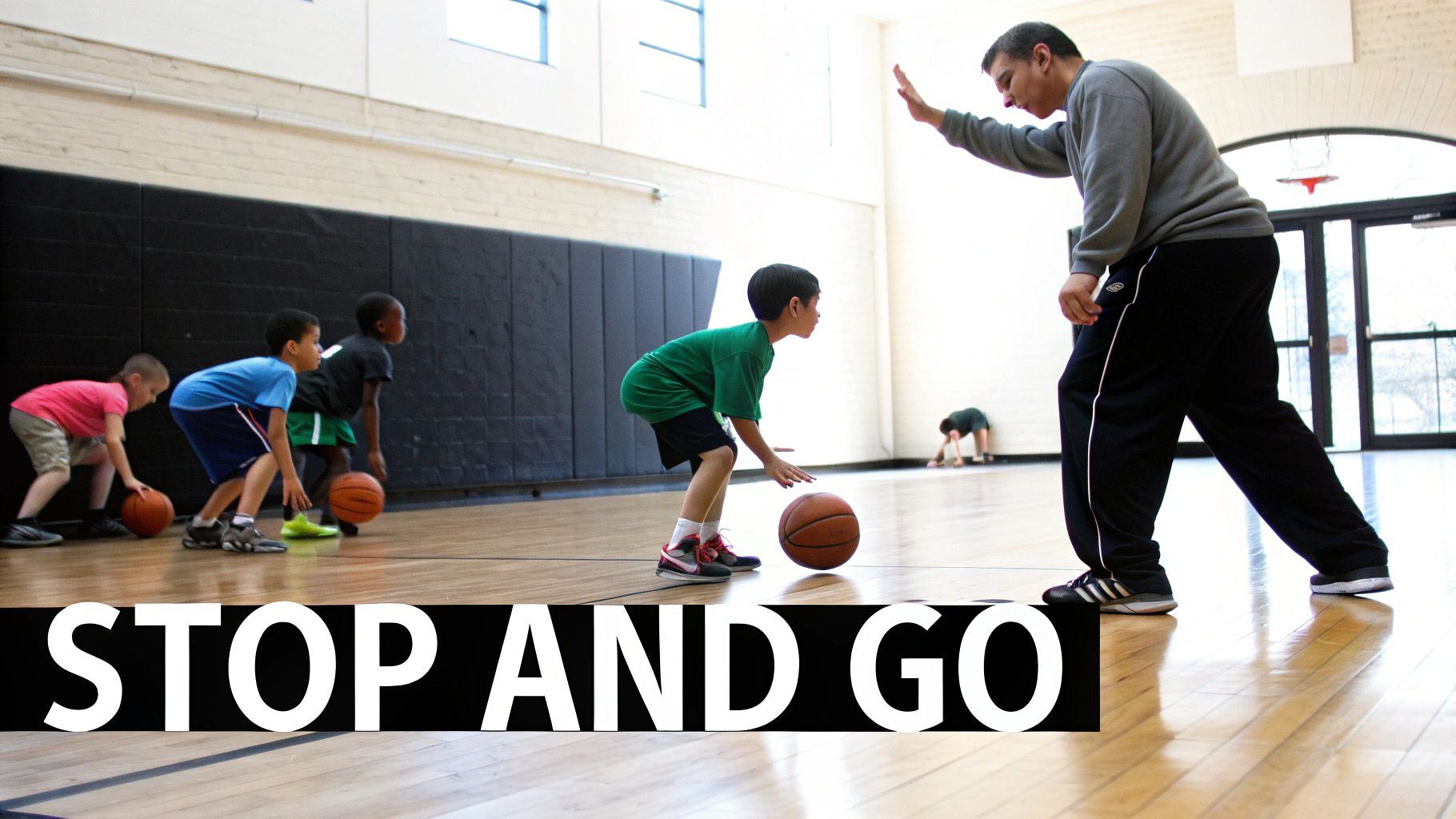
This drill transforms the classic children's game into one of the most effective and engaging 6-8 year old basketball drills for developing foundational skills. "Red Light, Green Light Dribbling" teaches young players how to start, stop, and control the basketball while moving, all within a fun, game-like structure. It is a staple in youth programs, including USA Basketball's youth development modules, because it simplifies complex concepts into intuitive actions.
The premise is simple: players line up on the baseline, and a coach or parent acts as the "traffic light." When they shout “Green Light,” the kids dribble forward. When they yell “Red Light,” players must stop their feet and the ball as quickly as possible, securing the basketball without traveling. This drill is fantastic for building ball control, improving reaction time, and teaching players to listen for coaching cues while handling the ball.
Why It Works for This Age Group
At 6 to 8 years old, children learn best through play. This drill eliminates the pressure of perfect technique and focuses on the joy of movement and response. It simultaneously builds critical motor skills, such as hand-eye coordination and balance, in a low-stress environment. Because the rules are already familiar to most kids, they can focus entirely on the basketball-specific actions.
Coaching Insight: The primary goal isn't speed; it's control. Praise players for a quick, controlled stop more than for dribbling the fastest on "Green Light." This reinforces the core skill being taught.
How to Implement the Drill
Setup: Have players line up along the baseline of the court, each with their own basketball. The coach stands at the opposite end, facing them.
Execution: The coach calls out the commands. * "Green Light!": Players begin dribbling toward the coach. * "Red Light!": Players must stop immediately, maintaining their dribble in a stationary position. The focus is on a "jump stop" landing on two feet for balance.
Progression: Introduce a "Yellow Light" command, where players must slow down and use controlled, lower dribbles while walking slowly. This adds a layer of complexity and teaches them to change pace.
Common Mistakes and Coaching Cues
Mistake: Looking down at the ball. * Cue: "Try to see me!" or "Chin up, so you don't miss the red light!"
Mistake: Slapping at the ball instead of using fingertips. * Cue: "Push the ball down with your fingertips like you're pushing a button."
Mistake: Traveling on the stop. * Cue: "Freeze your feet like statues on 'Red Light'!"
This drill is an excellent warm-up to get kids energized and focused at the start of practice. For even more ways to build dribbling confidence, you can explore other beginner-friendly basketball drills to add to your coaching toolkit.
2. Cone Weaving Race
This drill introduces a dynamic element to dribbling, making it one of the most valuable 6-8 year old basketball drills for developing agility and ball control simultaneously. The "Cone Weaving Race" challenges young players to navigate a series of obstacles while maintaining their dribble, teaching them to change direction and keep their eyes up. It's a foundational drill used in programs ranging from local YMCA youth leagues to specialized camps like those at JC Sports Houston, as it adds a fun, competitive twist to skill development.
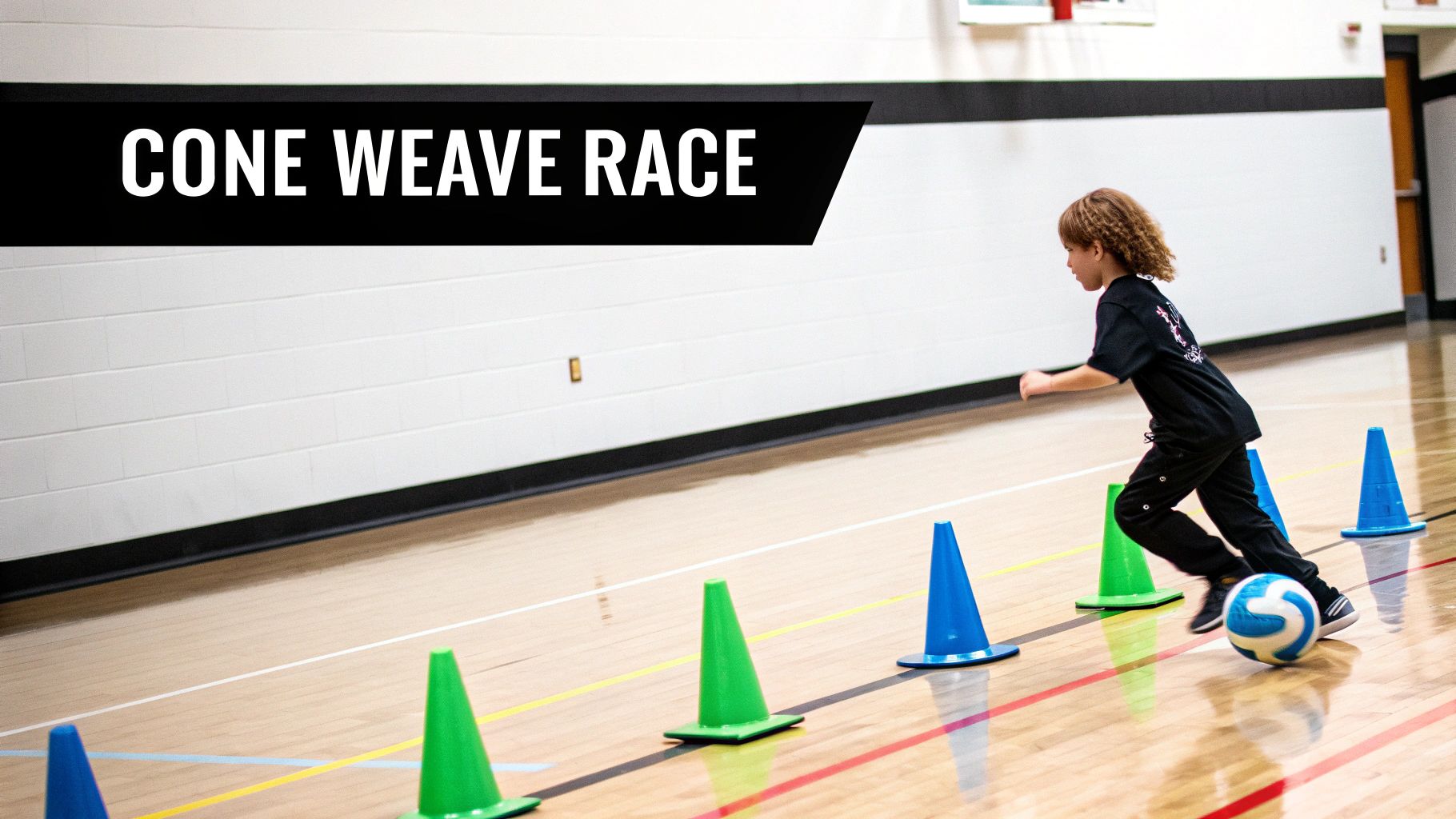
The setup is straightforward: a line of cones creates a slalom course for players to dribble through. This simple drill is incredibly effective at building hand-eye coordination, improving footwork, and teaching players to maneuver the ball in tight spaces. By turning it into a race against the clock or other players, it keeps kids engaged and motivated to improve their control and speed.
Why It Works for This Age Group
Children aged 6 to 8 are developing their spatial awareness and ability to perform multiple tasks at once. Cone weaving directly targets these skills by forcing them to dribble, move their feet, and look ahead to the next cone. The race component taps into their natural love for competition, turning a repetitive practice into an exciting challenge. It's a perfect drill for channeling their energy productively while embedding crucial basketball movements.
Coaching Insight: Emphasize "clean" dribbling over speed initially. A player who completes the course without losing the ball is more successful than one who rushes through and makes mistakes. Celebrate control first, then encourage them to increase their pace.
How to Implement the Drill
Setup: Place 5-7 cones in a straight line, about 3-4 feet apart. Have players line up at the start of the cone line, each with a basketball.
Execution: On the coach's signal, the first player begins dribbling, weaving in and out of the cones. They should try to switch dribbling hands as they change direction around each cone.
Progression: Once players are comfortable, introduce a timer to make it a race against the clock. You can also set up two identical cone lines side-by-side for head-to-head races, which significantly increases engagement and effort.
Common Mistakes and Coaching Cues
Mistake: Stopping the dribble to change direction. * Cue: "Keep the ball bouncing! Your feet move around the cone, but the ball keeps its rhythm."
Mistake: The ball getting too far away from their body. * Cue: "Keep the ball in your 'pocket,' close to your hip so you can protect it."
Mistake: Using only their dominant hand. * Cue: "Switch hands like a windshield wiper when you go around a cone." or "Feed the ball to your other hand."
3. Sharks and Minnows Dribble
This drill turns a playground favorite into one of the most dynamic and exciting 6-8 year old basketball drills available. "Sharks and Minnows" builds on basic dribbling by adding defensive pressure and spatial awareness in a high-energy, game-based format. It's a fantastic way to teach players to dribble with their heads up, protect the ball, and navigate traffic, all while having a blast. The game is a staple in many youth camps, like those at JC Sports Houston, for its ability to combine skill development with pure fun.
The concept is straightforward: the "minnows" (most of the players) try to dribble from one baseline to the other, while one or two "sharks" in the middle try to steal or knock the basketballs away. It’s an organized chaos that forces young athletes to solve problems on the move, making it a powerful tool for developing game-like instincts without the pressure of a formal scrimmage.
Why It Works for This Age Group
Children aged 6 to 8 are developing their ability to multitask and process multiple streams of information. "Sharks and Minnows" challenges them to dribble, look for open space, and avoid a defender simultaneously. This drill excels because it disguises repetition as a thrilling game of chase, keeping players fully engaged and eager to participate. The added element of defense introduces a competitive, yet friendly, aspect that motivates them to improve their ball-handling skills.
Coaching Insight: Emphasize ball protection, not just evasion. Encourage players to use their body and non-dribbling arm to shield the ball from the shark. This plants the seed for more advanced ball-handling techniques.
How to Implement the Drill
Setup: Designate an area of the court, typically between the baselines, as the "ocean." Select one or two players to be the "sharks," who start in the middle. The rest of the players, the "minnows," line up on one baseline, each with a basketball.
Execution: On the coach’s signal (e.g., "Go!"), the minnows begin dribbling across the ocean to the opposite baseline. The sharks move around and attempt to poke the ball away from the minnows.
Progression: If a minnow loses their ball, they can become "seaweed." Seaweed players must stay in one spot but can pivot and try to bother other minnows who dribble near them, adding another layer of obstacles. After each round, rotate who gets to be the shark to give everyone a chance at both offense and defense.
Common Mistakes and Coaching Cues
Mistake: Dribbling too high and out of control. * Cue: "Keep the ball low, below your waist! Protect it from the shark's bite!"
Mistake: Stopping and panicking when a shark approaches. * Cue: "Keep your feet and your dribble moving! Dribble away from the pressure."
Mistake: Players looking only at their ball. * Cue: "Scan the ocean! Find the safe water where the sharks aren't!"
This drill serves as an excellent mid-practice energizer, helping to refocus a group and burn off excess energy while reinforcing crucial dribbling and defensive principles.
4. BEEF Form Shooting Progression
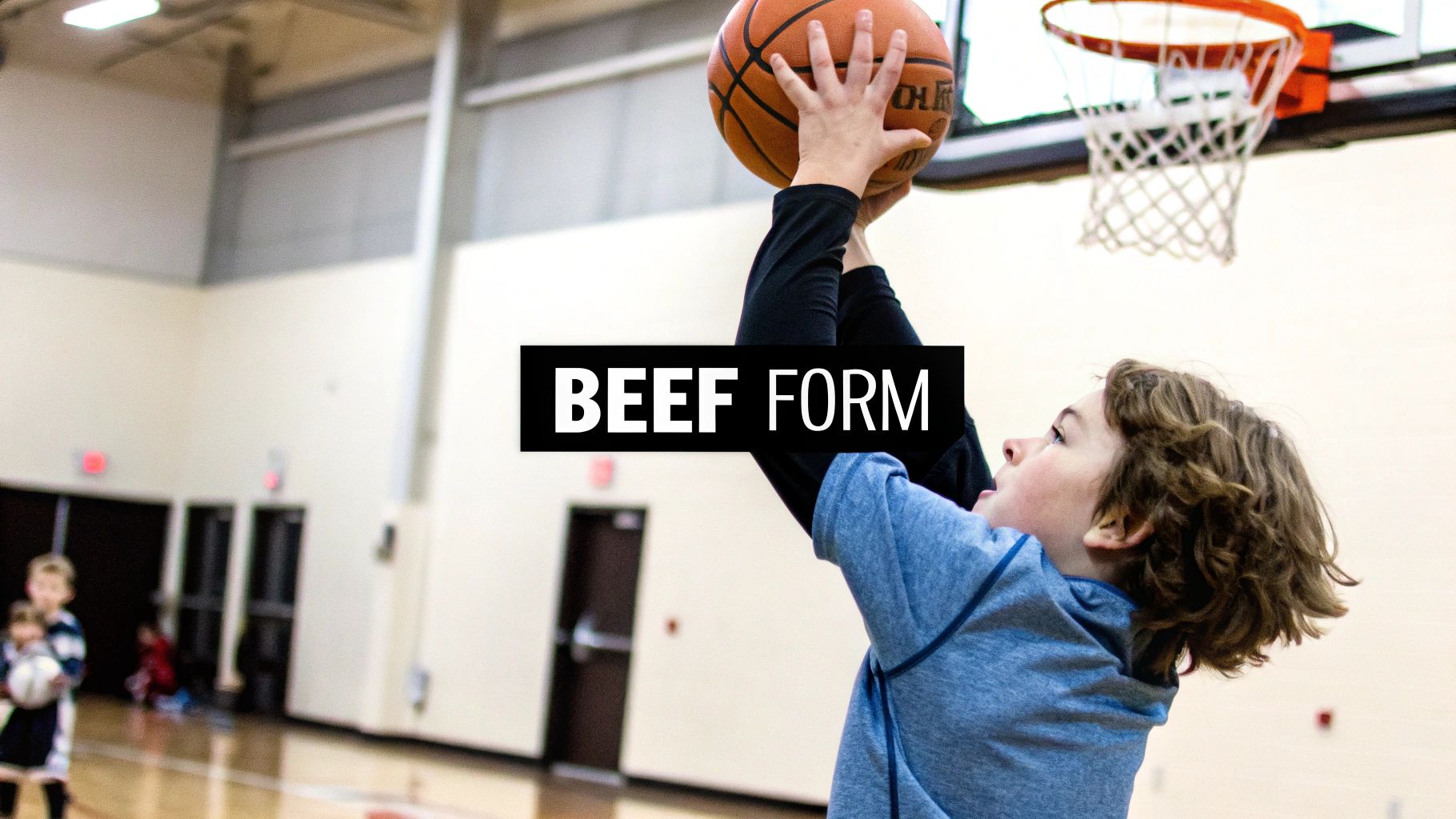
This foundational shooting drill is one of the most crucial 6-8 year old basketball drills for building a correct and repeatable shooting motion from the very beginning. The "BEEF Form Shooting Progression" breaks down the complex act of shooting into a simple, memorable acronym: Balance, Eyes, Elbow, Follow-through. This method, endorsed by USA Basketball and countless NBA coaches, focuses on muscle memory and proper mechanics at close range before adding distance.
The drill starts with players just a few feet from the basket, eliminating the need to generate power and allowing them to focus solely on form. By isolating each component of the BEEF acronym, kids can build a strong foundation without developing bad habits. It is a core component of many youth programs, like the weekly skill sessions at JC Sports Houston, because it systematically teaches the fundamentals of one of basketball's most important skills.
Why It Works for This Age Group
At this age, players lack the strength to shoot from far away with good form, often leading them to "heave" the ball with two hands from their chest. The BEEF method counteracts this by starting close to the hoop, making proper form the priority over making the shot. The acronym is easy for young minds to remember, giving them a mental checklist to run through every time they shoot. This builds confidence and correct habits simultaneously.
Coaching Insight: Celebrate perfect form, not made baskets. When a player holds their follow-through beautifully on a miss, praise that action enthusiastically. This teaches them what truly matters at this developmental stage.
How to Implement the Drill
Setup: Have each player stand about two to three feet directly in front of the basket with a small, age-appropriate basketball.
Execution: Guide the player through each step of the BEEF acronym before they shoot. * B - Balance: "Get your feet shoulder-width apart, slightly staggered, with knees bent. Be strong like a statue!" * E - Eyes: "Find your target on the rim. Keep your eyes locked on it." * E - Elbow: "Tuck your shooting elbow in, directly under the ball, making an 'L' shape with your arm." * F - Follow-through: "Shoot up and over the rim, snapping your wrist like you're reaching into a cookie jar on a high shelf. Hold your follow-through until the ball hits the ground."
Progression: Once a player consistently demonstrates good form and makes several shots in a row, allow them to take one step back. Continue this gradual progression as their strength and form improve.
Common Mistakes and Coaching Cues
Mistake: Elbow flying out to the side (a "chicken wing"). * Cue: "Keep your elbow under the ball and point it at the rim!"
Mistake: Shooting with two hands. * Cue: "Your other hand is just a helper. It sits on the side of the ball to balance it."
Mistake: Not holding the follow-through. * Cue: "Pose for the camera! Hold that gooseneck until the ball lands."
This focused shooting work builds a solid base that will pay dividends for years. As players grow, you can explore more advanced drills for slightly older kids to continue their development.
5. Partner Passing Circuit
This drill introduces the fundamental concepts of passing and receiving while incorporating movement, making it one of the most dynamic 6-8 year old basketball drills for teamwork and coordination. The Partner Passing Circuit gets kids working together in pairs, rotating through different stations that each focus on a specific type of pass (chest, bounce, overhead) combined with simple footwork. This approach keeps players engaged and moving, preventing the static, repetitive nature of traditional line passing drills.
The circuit format is fantastic for managing a group of young players, as seen in many grassroots basketball clubs and small-group classes like those at JC Sports Houston. By rotating pairs through stations, every child gets numerous repetitions in a short amount of time. It teaches them not only how to pass accurately but also how to move their feet to get open and receive the ball, simulating real game situations in a simplified, controlled manner.
Why It Works for This Age Group
At this age, learning to interact with teammates is as important as individual skill development. Partner passing builds communication and cooperation. The circuit structure adds an element of fun and variety that holds a 6 to 8-year-old's attention far better than a single, monotonous drill. It also introduces the idea that basketball skills are not performed in isolation; passing is always connected to movement and footwork.
Coaching Insight: Focus on the quality of the pass and the receiver's readiness. A good pass is only successful if the teammate is ready to catch it. Encourage players to make eye contact and have their "hands ready" before every pass.
How to Implement the Drill
Setup: Arrange 3-4 stations in a line or circle using cones. Pair players up, with each pair starting at a different station.
Execution: Each station focuses on a specific pass and footwork combination. Rotate pairs every 45-60 seconds. * Station 1 (Chest Pass): Players take one step toward their partner and make a strong chest pass from their chest to their partner's chest. * Station 2 (Bounce Pass): Players practice a bounce pass, aiming for a spot on the floor about two-thirds of the way to their partner. * Station 3 (Overhead Pass): Players use two hands to pass the ball from over their head, great for teaching them how to inbound the ball.
Progression: As players improve, add a footwork element to each station. For example, have players perform a jump stop before receiving the pass or an L-step to create space before calling for the ball. You can also use small hoops or chairs as targets to improve accuracy.
Common Mistakes and Coaching Cues
Mistake: Pushing the ball with palms instead of extending arms. * Cue: "Finish with your thumbs pointing down like you're pouring out two water bottles."
Mistake: Passing to a partner who isn't ready. * Cue: "Always look at your target! Call your partner's name before you pass."
Mistake: Catching with stiff hands ("stone hands"). * Cue: "Catch the ball with soft hands, like catching an egg."
6. Defensive Slide Freeze Tag
This dynamic game cleverly introduces fundamental defensive principles by adapting a playground classic. "Defensive Slide Freeze Tag" is one of the most effective 6-8 year old basketball drills because it teaches proper defensive posture and footwork-the defensive slide-in a chaotic, fun, and competitive environment. Instead of a boring slide drill, kids are motivated by the familiar goal of a tag game, making it a favorite at youth camps like those run by JC Sports Houston.
The concept is straightforward: a few players are designated as "taggers" (defenders), while the rest are dribblers. The taggers must remain in a low defensive stance and use defensive slides-without crossing their feet-to tag the dribblers. When a dribbler is tagged, they must freeze in place, holding their basketball, until a free teammate "unfreezes" them by completing a pass to them. This drill simultaneously works on defense, dribbling under pressure, and passing with a purpose.
Why It Works for This Age Group
At 6 to 8 years old, the concept of staying low and sliding can feel unnatural and tiring. This drill distracts from the physical exertion by giving kids a clear objective: tag someone or avoid being tagged. It promotes teamwork by requiring players to help their frozen teammates, introducing the concept of passing to an open player. The game-based format keeps energy and engagement high from start to finish.
Coaching Insight: Emphasize and celebrate the "unfreeze" pass as much as a successful tag. This shifts the focus from individual play to teamwork and encourages players to look for passing opportunities, a critical habit to build early.
How to Implement the Drill
Setup: Define a clear area, such as the space between the free-throw lines. Select 2-3 players to be the "defenders" (they don't need a ball). All other players have a basketball and start inside the area.
Execution: On "Go!", the dribblers move around the area while the defenders try to tag them. * Defenders: Must stay in a low, athletic stance and only use defensive slides. * Dribblers: Must keep their dribble alive while avoiding the taggers. * The Freeze: If tagged, a dribbler freezes with their ball. They can be unfrozen if a free teammate passes them their ball (a simple chest or bounce pass).
Progression: As players improve, you can make the area smaller to increase the difficulty for the dribblers. You can also add a rule that defenders must touch the player's basketball, not their body, to make the tag.
Common Mistakes and Coaching Cues
Mistake: Defenders stand up straight or cross their feet when sliding. * Cue: "Sit in your chair!" or "Don't let your feet click together!"
Mistake: Dribblers stop dribbling to pass or look for teammates. * Cue: "Keep that ball bouncing while you find a friend!"
Mistake: Frozen players are not ready for a pass. * Cue: "Show your hands! Give your teammate a good target!"
This drill is a fantastic way to teach multiple skills at once while ensuring every child is actively involved. For parents exploring more structured skill development, looking into a guide to youth basketball training programs can provide further insight into building a strong foundation.
7. Knockout Shooting Game
This classic elimination game is one of the most exciting 6-8 year old basketball drills for practicing shooting under pressure. "Knockout" (also known as "Lightning") transforms repetitive shooting practice into a thrilling, fast-paced competition. It is a favorite in school P.E. classes and youth camps, like those at JC Sports Houston, because it keeps every player engaged, whether they are shooting or waiting for their turn.
The concept is straightforward: players line up at a designated shooting spot, and the first two players in line each have a basketball. The first player shoots, and the second player can shoot as soon as the first player's ball leaves their hands. If the second player makes a basket before the first player, the first player is "knocked out." This continues until only one player remains. The drill is exceptional for developing shooting accuracy, rebounding skills, and performing under a bit of fun pressure.
Why It Works for This Age Group
The game-based format of Knockout taps into a 6- to 8-year-old's natural competitive spirit in a positive way. The simple rules and immediate consequences (getting "knocked out") are easy for them to understand and follow. It teaches them to focus on their shot while being aware of their surroundings, and it also introduces the crucial skill of rebounding their own miss and quickly attempting a put-back. The high energy of the game ensures kids stay active and entertained.
Coaching Insight: Emphasize sportsmanship above all. Celebrate good shots and quick rebounds, and encourage eliminated players to cheer for those still in the game. This builds a supportive team environment.
How to Implement the Drill
Setup: Have players form a single-file line at a designated spot on the court, like the free-throw line. Give a basketball to the first two players in line. For younger 6-year-olds, consider using a lowered rim.
Execution: The first player shoots. As soon as their ball is in the air, the second player can shoot. * If Player 1 makes their shot, they get their own rebound and pass the ball to the next person in line without a ball, then go to the back of the line. * If Player 1 misses, they must rebound and score before Player 2 does. * If Player 2 scores before Player 1, Player 1 is "knocked out" and exits the game. Player 2 then passes their ball to the next person in line.
Progression: As players improve, start the line from different spots on the floor, such as the wing or the block. This challenges them to make shots from various angles and distances.
Common Mistakes and Coaching Cues
Mistake: Rushing the shot due to pressure. * Cue: "Take your time and use your good form! A good shot is better than a fast shot."
Mistake: Watching the ball instead of rebounding. * Cue: "Follow your shot! Go get that rebound right away!"
Mistake: Getting discouraged after being eliminated. * Cue: "Great effort! Now be a good teammate and cheer for your friends!"
Knockout is a perfect way to end a practice session on a high note, leaving kids excited and eager to come back for more. It masterfully combines skill development with pure fun.
7 Basketball Drills Comparison for Ages 6–8
Drill | 🔄 Implementation Complexity | ⚡ Resource / Setup Efficiency | 📊 Expected Outcomes & ⭐ Quality | Ideal Use Cases | 💡 Key Tips |
|---|---|---|---|---|---|
Red Light, Green Light Dribbling | 🔄 Low — simple rules, easy to run | ⚡ Very efficient — just balls and floor | 📊 Builds dribble control + listening; ⭐⭐⭐⭐ | Warm-up, beginner classes, camps | Start high then progress to low dribble; keep head up; add “Yellow Light” |
Cone Weaving Race | 🔄 Medium — cone layout and timing management | ⚡ Moderate — requires 5–7 cones and space | 📊 Improves change-of-direction dribbling & speed control; ⭐⭐⭐⭐ | Skill progression, competitive drills, small-group reps | Begin without timer, demonstrate crossovers, encourage elbows out |
Sharks and Minnows Dribble | 🔄 Medium–High — group control and safety focus | ⚡ Moderate — low equipment but high supervision | 📊 Teaches ball protection under pressure & spatial awareness; ⭐⭐⭐⭐ | Mid-practice energizer, large-group engagement | Limit sharks, enforce low dribble, rotate roles frequently |
BEEF Form Shooting Progression | 🔄 Low — structured, repetitive reps | ⚡ Highly efficient — focused technique practice | 📊 Instills shooting mechanics and consistent form; ⭐⭐⭐⭐⭐ | Technique sessions, early-stage shooting development | Use child-size ball, record video for feedback, reward form progress |
Partner Passing Circuit | 🔄 Medium — station rotation and monitoring needed | ⚡ Moderate — needs ≥2 balls per pair and stations | 📊 Reinforces pass types, footwork, and communication; ⭐⭐⭐ | Small-group drills, passing fundamentals, rotating classes | Have partners call pass type, use small targets, time stations 30–45s |
Defensive Slide Freeze Tag | 🔄 Medium–High — rule complexity and spacing control | ⚡ Moderate — minimal gear, requires clear boundaries | 📊 Builds defensive slide mechanics and teamwork; ⭐⭐⭐ | Defensive warm-up, agility/footwork focus, team drills | Teach “choppy” steps first, set clear boundaries, reward unfreeze assists |
Knockout Shooting Game | 🔄 Low — simple rules but needs flow management | ⚡ Efficient for reps but can cause idle time | 📊 High-volume, pressure shooting practice; ⭐⭐⭐⭐ | End-of-session game, pressure shooting, fun competition | Rotate shooting spots, allow re-entry via assists, lower rim for youngest players |
Putting It All Together: Your Next Steps on the Court
You now have a complete toolkit of seven dynamic, age-appropriate basketball drills designed specifically for players aged six to eight. From the foundational control learned in "Red Light, Green Light Dribbling" to the competitive excitement of "Knockout," each activity serves a distinct purpose. These drills are more than just exercises; they are the building blocks for creating confident, skilled, and enthusiastic young athletes.
The journey of a young basketball player is built on small, consistent victories. Mastering a crossover in "Cone Weaving," escaping a defender in "Sharks and Minnows," or sinking a shot with proper form in the "BEEF Progression" are moments that build momentum. These drills provide a structured yet playful environment where such victories can happen regularly. They transform the complex game of basketball into a series of manageable, fun challenges that are perfect for this developmental stage.
The Philosophy: Fun as the Foundation
The single most important takeaway from this guide is the principle of fun-first coaching. At this age, a child's relationship with a sport is fragile. A positive, encouraging environment is non-negotiable. If players are laughing, moving, and high-fiving, they are learning, even if their dribble isn't perfect or their shot misses the rim.
Remember these core principles as you implement these 6-8 year old basketball drills:
Patience is Paramount: Motor skills develop at different paces. A child struggling with dribbling today might be your most confident ball-handler in two months. Avoid pressure and focus on gradual improvement.
Celebrate Effort, Not Just Results: Acknowledge the player who hustles back on defense in "Defensive Slide Freeze Tag" just as much as the one who scores a basket. Effort is the one variable they can always control.
Adapt and Improvise: If players are losing focus, shorten the drill or inject a new, silly rule. If they master a skill, introduce the progression. Your ability to read the room is your most powerful coaching tool.
Building a Practice That Works
Integrating these drills effectively is the key to sustained development. Avoid the temptation to run players through monotonous, repetitive sequences. Instead, think of your practice time as a story with a beginning, a middle, and an end.
A balanced session could look like this:
Warm-Up (5-10 minutes): Start with a dynamic game like "Sharks and Minnows" or "Defensive Slide Freeze Tag." This gets their bodies moving and their minds engaged immediately, burning off initial energy in a productive way.
Skill Focus (15-20 minutes): Dedicate this block to more technical work. Focus on one or two key areas. Pair "Red Light, Green Light" with "Cone Weaving" for a dribbling-focused day, or combine the "BEEF Progression" with the "Partner Passing Circuit" for a shooting and teamwork session.
Game-Based Learning (10-15 minutes): End on a high note with a competitive, fun game like "Knockout." This allows players to apply the skills they just practiced in a low-stakes, high-energy environment. It ensures they leave the court excited for the next practice.
By structuring practices with this flow, you create a predictable yet engaging rhythm that kids will respond to. The goal is not to create professional athletes overnight but to foster a lifelong love for being active and being part of a team. The skills they learn from these 6-8 year old basketball drills extend far beyond the court, teaching them resilience, discipline, and the joy of improvement. Keep it simple, keep it positive, and watch them grow.
Ready to take your child's skills to the next level in a fun, structured, and professional environment? The expert coaches at JC Sports Houston specialize in creating positive sports experiences for young athletes, using age-appropriate drills just like these to build confidence and a love for the game. Explore our youth basketball programs today and give your child the foundation they need to succeed on and off the court at JC Sports Houston.
Comments