

BlastBall Game: Toddler Baseball That Builds Confidence

BlastBall is a simplified tee-based baseball format for children ages 3 to 5, teaching hitting, throwing, catching, running, and fielding in short, inclusive sessions. Instead of asking toddlers to manage a full diamond, it uses a tee, soft equipment, a single base, and constant participation.
You may be looking at your child holding a plastic bat in the backyard and wondering whether they're ready for an organized sport. They can run, chase a ball, and swing with enthusiasm, but a conventional baseball practice may involve too much waiting, too many rules, and skills that haven't developed yet. A well-run BlastBall game meets children at their current stage.
For parents, the most useful question isn't whether a child can hit every ball. It's whether they're becoming more willing to enter the field, follow a simple sequence, take turns, and try again after an awkward swing. Over the first six to eight sessions, those small changes often tell you more about development than runs or catches.
What Is the BlastBall Game for Toddlers
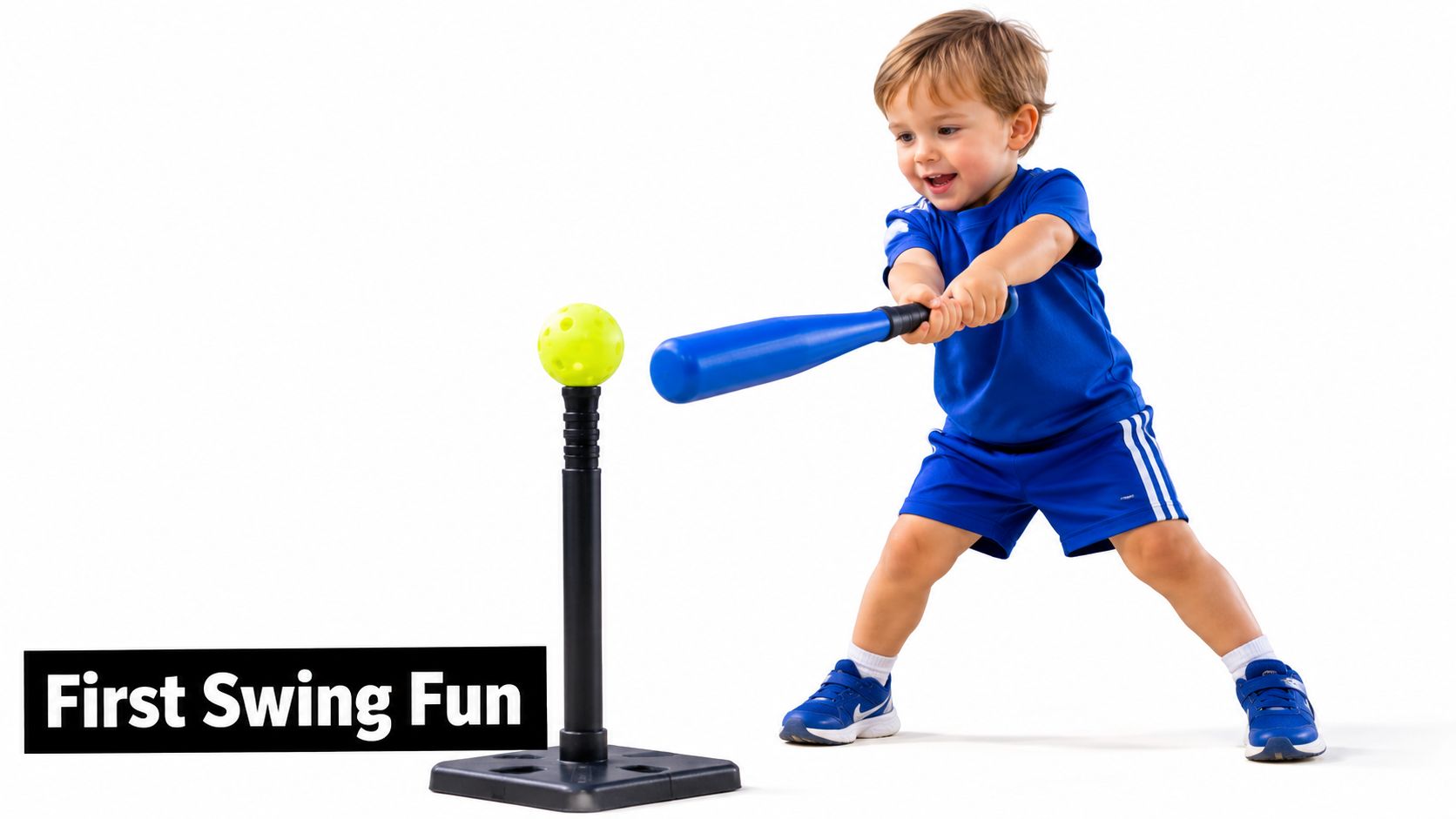
A parent arrives at a first practice expecting baseball. Instead, they see a small group of preschoolers moving between a batting tee and a compact field. One child swings, another runs toward a single base, and the fielders hurry after the soft ball. Nobody stands around waiting for a pitched strike, and nobody is eliminated after missing.
That's the central idea behind the BlastBall game. It's a developmentally simplified form of baseball for very young beginners, generally ages 3 to 5. The activity introduces five foundational movements, hitting, throwing, catching, running, and fielding, without asking children to understand the full structure of organized baseball. Baseball Canada's introductory program description places the format within an early entry point before conventional tee-ball or youth baseball.
Why the format fits preschoolers
A full baseball diamond asks a young child to remember several bases, track a moving pitch, understand outs, and wait through other players' turns. BlastBall removes much of that load. Children usually use a batting tee, a soft or oversized ball, a lightweight bat, a small group, and one base.
The result is less intimidating and more active. Every child gets repeated opportunities to swing, run, pick up a ball, and return to the group. The format also gives coaches room to offer immediate help, such as showing a child where to place their feet or reminding them to run toward the base.
Parent perspective: At this age, confidence often develops before polished technique. A child who eagerly tries three imperfect swings is making meaningful progress.
Programs commonly position BlastBall as a first baseball experience for children around 3–4 or 4–5 years old, before a more traditional tee-ball setting. That doesn't mean every child must follow the same path. Some children will be ready for more structure quickly, while others will benefit from staying with a simple, playful format longer.
The best sign of readiness is not a powerful hit. Look for curiosity, willingness to join a group, and the ability to respond to one short instruction at a time. If a child can try, pause, and rejoin the activity with encouragement, BlastBall can provide a welcoming starting point.
Basic BlastBall Rules and Game Setup
Parents usually want to know what happens after the child puts on a helmet and walks onto the field. The sequence is straightforward, and the simplicity is deliberate.
How one play works
The batter hits from a tee. The ball rests on a tee rather than coming from a pitcher. This lets the child concentrate on stance, swing, and contact without trying to judge a moving pitch.
The runner heads to one base. Instead of navigating a complete diamond, the child runs to a single base. Depending on the program, the base may make an audible sound when stepped on, helping children connect the action with a clear finish.
The fielders retrieve the ball. Defensive players may catch the ball or field it and call “BLAST” before the runner reaches the base. The exact rule can vary by local program, so parents should ask for the adopted version before the first session.
The next child participates quickly. Many recreational versions avoid strikeouts, walks, and long defensive delays. The emphasis stays on movement and repetition rather than early competition.
The base is commonly placed about 30–50 feet from the tee, although programs use different layouts. Documented BlastBall program rules describe the compact field and the small-sided structure that make the activity suitable for preschoolers, indoor spaces, and backyard instruction.
What the group looks like
Team sizes are often small. One documented 5U program uses 4–6 players, while an official-style framework allows a maximum of 5 players per side, with smaller groups also functioning effectively. A half-inning may finish after each child bats once or after 3 outs, depending on the rules in use.
That flexibility matters because young children don't all move at the same pace. A coach can shorten a turn, move a defender closer, or repeat the same cue without disrupting a formal lineup.
Before registering, ask three practical questions:
What equipment is provided? Find out whether the program supplies a tee, soft ball, bat, and helmets.
What field dimensions are used? Local layouts differ, so don't assume every BlastBall field looks the same.
How does the program handle missed swings? A child should receive another opportunity without being embarrassed or removed from play.
For equipment ideas suited to young children, this guide to balls for toddlers can help families compare softness, size, and ease of handling.
Developmental Benefits Beyond Basic Skills
The visible skills are easy to name. A child swings, throws, runs, and gathers the ball. The deeper gains appear in the sequence around those actions.
A young player learns to listen for a cue, organize a movement, stop at a destination, and return attention to the group. Those are early developmental outcomes, not just baseball techniques. The single-base format creates a manageable loop: hit, run, stop, retrieve, and reset.
What parents can observe
During the first six to eight sessions, look for changes in behavior rather than expecting steady technical improvement. Development at this age is uneven. A child may catch successfully one day and avoid the ball the next, especially when tired or distracted.
Useful indicators include:
Following a sequence: The child waits for the cue, swings, runs, and returns with less adult prompting.
Stopping safely: The child slows at the base or boundary instead of running through people or equipment.
Tracking the ball: The child watches the ball after contact and moves toward it with growing purpose.
Taking turns: The child waits briefly, accepts a teammate's turn, and rejoins the activity.
Choosing where to run: The child begins to identify the base without being physically directed.
Building confidence: The child enters the field, attempts a swing, or asks to try again after missing.
These milestones give families a better way to judge progress than counting hits. Guidance on building confidence in young athletes supports the same practical approach, celebrate effort, attention, and willingness to participate before performance.
Movement habits matter
BlastBall also contributes to a wider conversation about organized activity in the preschool years. A 2025 population study found that about 43% of preschool children participated in organized sports. Among participants, children averaged 2.8 additional minutes of daily moderate-to-vigorous physical activity and had 40% higher odds of meeting World Health Organization activity recommendations. The study in BMC Pediatrics provides context, but it doesn't mean one program guarantees a particular outcome for every child.
The useful lesson is simpler. A good class gives children a positive reason to move, while avoiding pressure to perform like older athletes. Parents can reinforce that experience by asking, “What was fun today?” or “Which part did you want to try again?” rather than focusing only on whether the child hit the ball.
The strongest early result may be a child who feels comfortable moving, listening, and trying in front of other people.
Sample BlastBall Session Structure
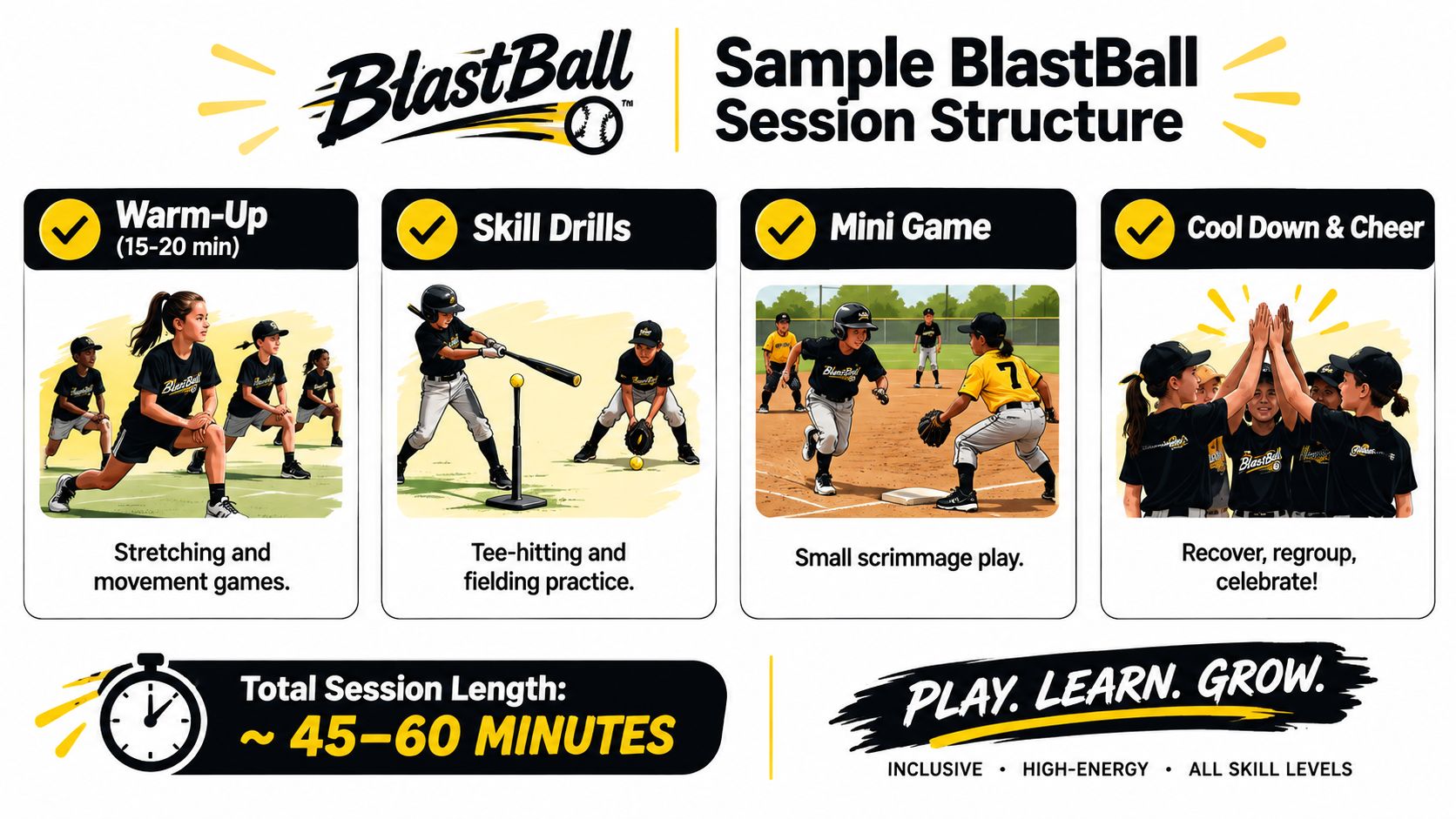
A representative session has a clear rhythm, but it shouldn't feel like a formal lesson for older players. Children move often, instructions stay short, and coaches return quickly to an activity after demonstrating it.
A documented 5U format begins with 15–20 minutes of warm-ups and skill practice, followed by approximately 30–40 minutes of game play. That structure gives children time to settle in before the game while preserving enough active play to keep the session meaningful.
A practical flow
Warm-up and movement: Children might jog, change direction, carry a ball, or respond to simple stop-and-go cues. The purpose is to help them become comfortable in the space and ready to listen.
Skill practice: The coach introduces one action at a time. For hitting, that may mean standing beside the tee, looking at the ball, and making a controlled swing. For fielding, children may roll or gently toss balls before trying to catch.
Mini game: Players rotate between hitting and fielding. Every child bats during each inning, so a missed swing doesn't end the child's involvement. The format also removes conventional barriers such as strikeouts, walks, and prolonged defensive inactivity.
Cool-down and closing routine: A short cheer, high-five circle, or equipment-gathering task helps children finish calmly and recognize that participation matters.
One base may include an audible signal when stepped on. Other programs use a single BlastBase positioned roughly 30–50 feet from the tee. The sound or visible destination gives a young runner an immediate answer to the question, “Where do I go now?”
Coaching cues that work
Preschoolers respond better to one clear cue than to a long technical explanation. A coach might say, “Eyes on the ball,” then later, “Run to the base.” Repeating the same language helps children connect words with actions.
A strong session also limits standing time. While one child bats, fielders should have a simple job, such as watching the ball, moving toward it, or returning it to the coach. That keeps attention connected to the game rather than to the bench.
Here's an example of the activity in motion:
The goal isn't to make every child execute the same movement perfectly. It's to create enough successful repetitions that children understand the sequence and want to participate again.
How JC Sports Houston Runs BlastBall Classes
A family in Humble, Kingwood, or Atascocita may find that the difference between a positive first sports experience and a frustrating one comes down to the environment. Indoor space, predictable routines, patient instruction, and activities scaled to young children can make the first class feel manageable.
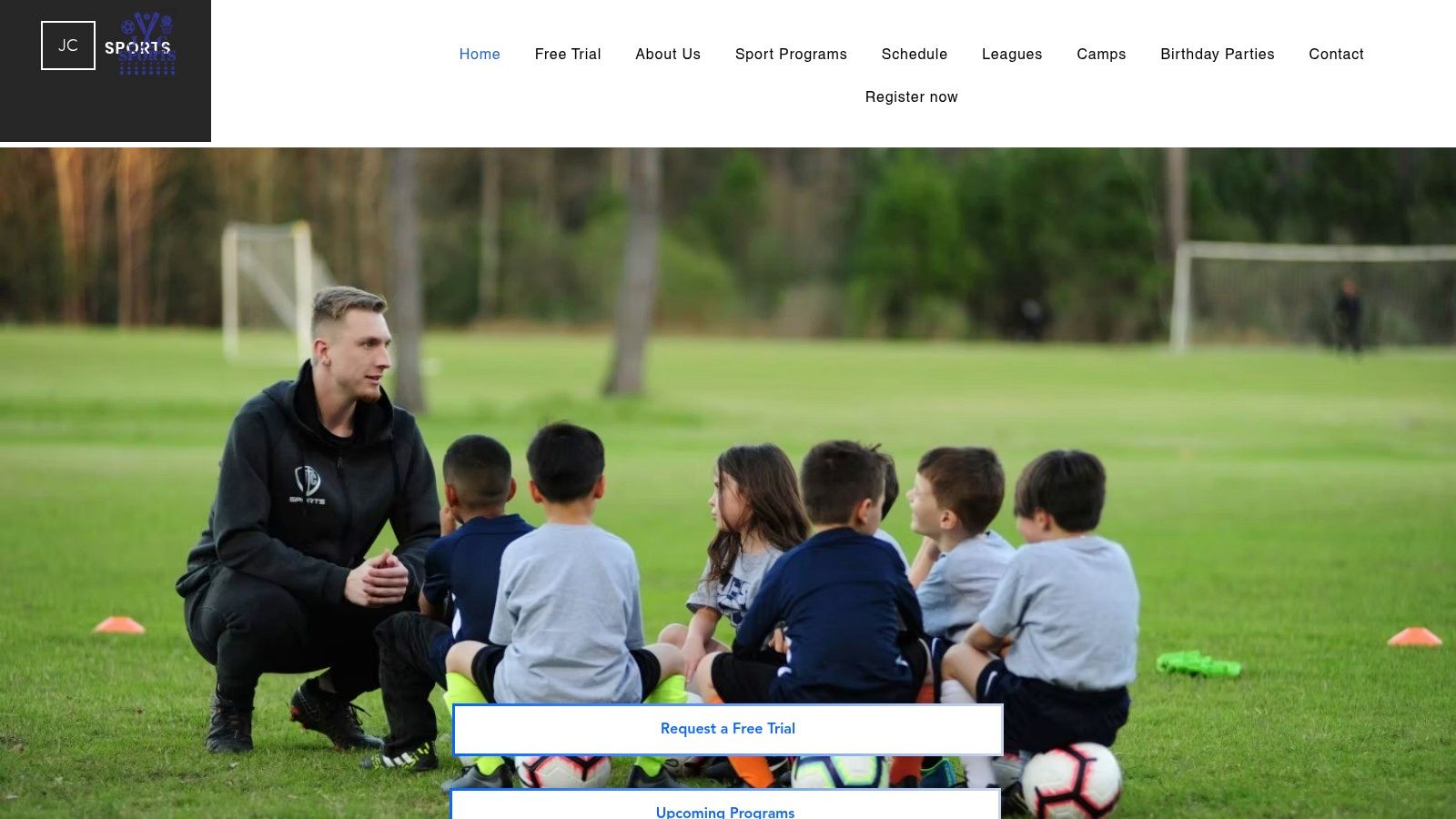
JC Sports Houston offers beginner-friendly BlastBall for children ages 3–4, with one-hour weekly sessions led by JC Sports staff. The program introduces hitting from a tee, throwing, catching, running bases, and fielding through a developmental game without complex rules or umpires.
What families can expect
The coaching approach emphasizes small-sided play, creativity, and progressive instruction. Rather than asking a preschooler to master a complete baseball system, instructors can build from a familiar action, such as swinging at a stationary ball, then add running and fielding when the child is ready.
For parents, that often means observing different kinds of progress from week to week:
A hesitant child walks onto the field without holding a caregiver's hand.
A distracted player responds to the same coaching cue more consistently.
A child who once dropped the bat begins releasing it safely and moving toward the base.
A young fielder starts bending down to stop a rolling ball instead of stepping away.
These are practical markers of growing readiness. They also help coaches adjust an activity for a child who needs more space, more repetition, or a simpler instruction.
Families can use the facility's online registration process to review scheduling and policies, and new families may request a free trial to experience the coaching approach firsthand. Parents evaluating any youth program may also want to ask how staff screening is handled. For broader context, Background checks for gymnastics coaches offers a useful overview of why youth-sports organizations should take screening seriously, even when the activity is informal and play-based.
The right questions before enrollment are practical: Is the class appropriate for my child's current comfort level? What equipment does the facility provide? How are mixed abilities supported? What happens when a child needs a break?
A clear answer to those questions gives parents confidence that the program values development, not just attendance.
BlastBall vs Traditional Tee-Ball for Young Kids
BlastBall and tee-ball both introduce baseball through a tee, but they don't ask young children to manage the same amount of information. Conventional tee-ball may involve multiple bases, larger teams, formal scoring, and longer stretches between turns. BlastBall usually narrows the experience to one base, small groups, short rotations, and repeated participation.
That difference matters for toddlers and preschoolers. A child who is still learning to stop safely and follow one instruction may find a compact BlastBall game easier to understand than a full diamond. The simplified setup also gives coaches more chances to repeat the bat-to-run-to-field sequence without turning mistakes into public failures.
BlastBall | Traditional tee-ball |
|---|---|
One base is commonly used | Multiple bases may be introduced |
Small-sided participation | Groups may be larger |
Soft or oversized equipment is common | Equipment and ball types vary |
The focus is movement and confidence | The format may include more formal game structure |
Rules can be adapted for the group | Rules may be more fixed |
Neither format is automatically right for every child. A confident preschooler may enjoy tee-ball, while another child may need the smaller steps of BlastBall first. Parents should compare the actual class, not just the label.
Safety still deserves attention. Simplified rules don't remove the need for supervision, spacing, appropriate balls, defensive positioning, and suitable helmets. Pediatric baseball guidance recommends considering protective equipment such as faceguards and safety balls, while current youth rules require double-earflap helmets for batters, runners, and players on deck. A large Little League survey found that being hit by the ball caused 62% of acute injuries, and 68% of ball-related injuries occurred to defensive players. BlastBall safety guidance explains why inexperienced fielders need careful positioning and close supervision.
Families may eventually want matching shirts for a team or class. A resource such as T-Shirt Envy custom apparel can help with that practical detail, but clothing should never replace safe equipment or clear coaching.
For parents comparing early baseball options, this guide to tee-ball for two-year-olds can also help clarify how age, attention, and readiness affect the choice.
JC Sports Houston offers beginner-friendly BlastBall classes for young children, with tee-based hitting, fielding, running, and small-sided instruction designed around early development. Visit JC Sports Houston to review class details, check registration options, and ask about a free trial for your child.
Comments