

How to Improve Soccer Dribbling for Young Players

When it comes to improving soccer dribbling, it all boils down to one thing: making the ball an extension of your foot. This happens through thousands and thousands of purposeful touches. It’s less about fancy, highlight-reel moves and much more about mastering the simple things—close control, smart body positioning, and quick thinking—to create space and move the game forward.
The Foundation of Unstoppable Dribbling
So many young players, and their parents too, think that learning complicated tricks is the secret to becoming a great dribbler. A well-timed step-over can definitely be useful, but real dribbling mastery is built on a simpler and far more powerful idea: ball mastery.
Ball mastery is the art of keeping the ball so close and under such tight control that it almost feels like it's tied to your shoelaces. It's what separates good players from truly great ones. It isn't about that one amazing move they pull off; it's about the hundreds of tiny, instinctive adjustments they make with the ball every single minute of a game.
Here at JC Sports Houston, our entire youth soccer philosophy is built around this concept. We draw from proven, structured methods like Coerver to instill these core habits from a player's very first touch.
Rethinking What Dribbling Really Means
Before we jump into drills, let's reframe what successful dribbling actually looks like on the field. It’s not always about beating a defender one-on-one. More often, effective dribbling is a practical tool used to solve problems and create opportunities.
Creating Space: A simple body feint or a quick touch into open grass can give a player the split second they need to get a pass off or take a shot.
Maintaining Possession: Just shielding the ball under pressure is a form of dribbling. It’s what keeps your team in control of the game’s tempo.
Driving Forward: Carrying the ball up the field with speed and control forces the other team to react, which pulls defenders out of position and opens up chances for your teammates.
When kids understand why they're dribbling, their practice becomes much more focused and meaningful. Every touch suddenly has a purpose.
The Building Blocks of Elite Control
To help your child achieve true ball mastery, we need to focus on four connected skills. Think of them as the pillars holding up every successful dribble. If one is weak, the whole thing can crumble under pressure.
We've put together a quick table to break down these core components. Mastering these basics is the first step before moving on to more advanced techniques. You can find more foundational ideas in these 7 Essential Football Drills for Beginners.
Core Components of Effective Dribbling
Component | What It Means | Why It's Critical |
|---|---|---|
Close Control | Keeping the ball within a playable distance, using soft touches with all surfaces of the foot. | This prevents defenders from easily poking the ball away and allows for quick changes of direction. |
Body Positioning | Using your body to shield the ball and maintaining a low center of gravity for balance. | It makes a player harder to knock off the ball and gets them ready to accelerate away from pressure. |
Spatial Awareness | Keeping your head up to see the field, track defenders, and spot open space. | This turns a simple dribble into a smart, strategic move. It's about anticipating threats and seeing opportunities. |
Decision-Making | Knowing when to dribble, pass, or shoot based on what the game is giving you. | The goal isn't just to keep the ball; it's to use it to create a positive outcome for the team. |
Understanding and practicing these four elements together is what transforms a player from just a "runner with the ball" into a true dribbler.
Practice Overrides Physicality
For young players, there is no substitute for consistent, focused practice. It's the single most important factor.
In fact, a recent study of over 180 youth players confirmed this, finding that a player's age—which really represents years of accumulated practice—was a much better predictor of dribbling skill than their physical size. The research pointed to sprint speed and drills that force players to use both feet and change direction as the strongest signs of high-level dribbling ability.
What does this mean for your child? Dedicated training over time is way more important than just growing bigger or stronger.
The most creative players are the ones who have mastered the fundamentals so deeply that they no longer have to think about them. Their feet just know what to do, freeing their minds to see the game.
This is exactly why our programs in Houston are built on thousands of purposeful repetitions. We start with simple touches and gradually add layers of complexity, making sure every player develops that natural, instinctive relationship with the ball. This is how raw talent becomes a refined, reliable skill that creates confident and creative players ready for any challenge the game throws at them.
Building Skill with Age-Specific Dribbling Drills
Theory is one thing, but real dribbling improvement happens out on the grass. The secret is matching the right drills with the right age. A drill that challenges a 10-year-old will just frustrate a 5-year-old, and what's perfect for a first-grader is way too easy for a fifth-grader.
Becoming a great dribbler is all about layering skills over time. You start with just getting comfortable with the ball, then you add the technical foundation, and finally, you introduce dynamic, game-like scenarios. This progression keeps kids engaged, builds their confidence, and makes sure they develop the right habits from day one.
This is the core thought process every effective dribbler goes through, whether they realize it or not.
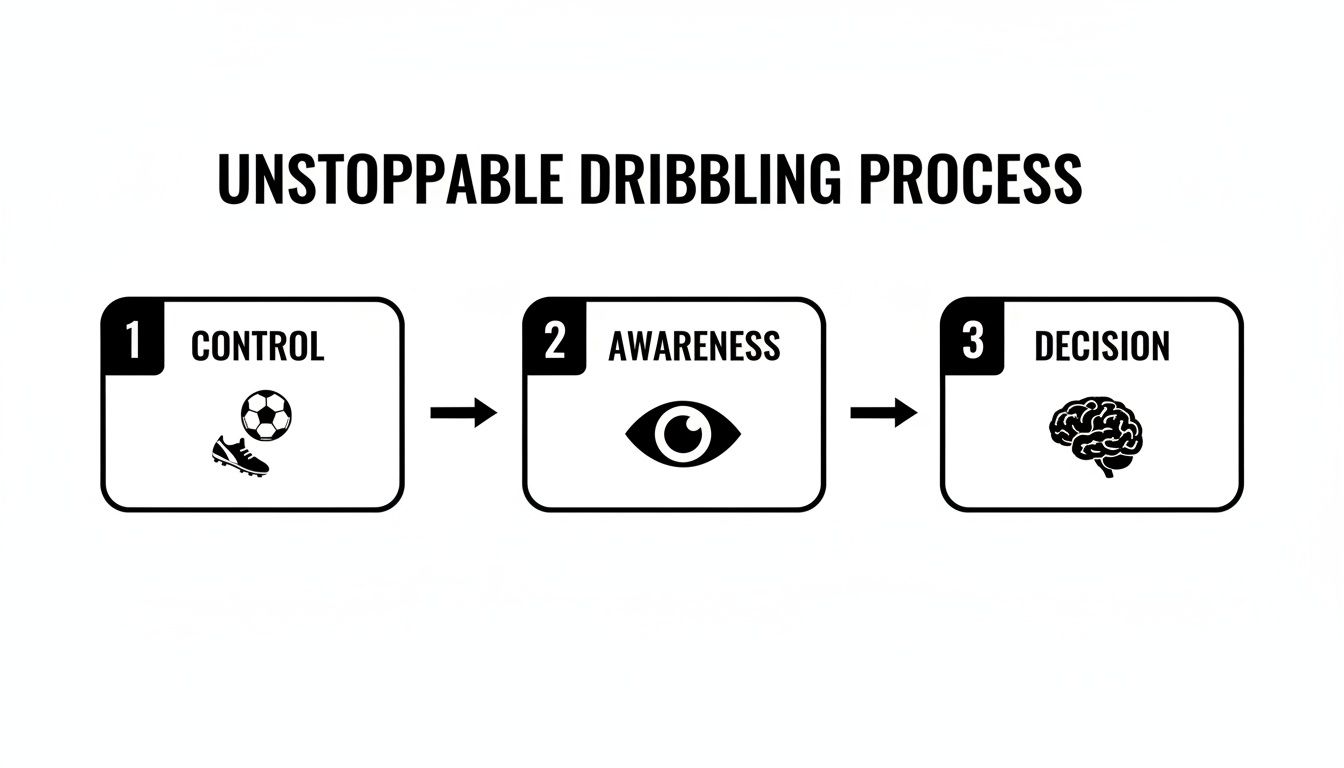
As you can see, great dribbling is so much more than fancy footwork. It's a lightning-fast cycle of controlling the ball, seeing the field, and making a smart decision.
Toddler Dribbling Fun (Ages 3-5)
At this age, the mission is simple: make the ball a friend. Forget perfect technique. The entire focus is on building comfort, coordination, and a positive feeling about having a soccer ball at their feet. The best "drills" are the ones that are actually just games.
Red Light, Green Light is a classic for a reason.
Green Light: Players dribble their ball around a small area. Tell them to use lots of little taps to keep their "puppy" (the ball) right beside them.
Red Light: When you yell "Red Light!" they have to stop the ball as fast as they can by putting their foot right on top of it.
This one simple game teaches the two most fundamental parts of control: moving with the ball and stopping it on command. It’s all about having fun and getting tons of repetition.
Another favorite is Animal Dribbling. Call out different animals and have the kids dribble like them. A mouse might mean tiny, quick touches, while an elephant would be slow, heavy steps. It sparks their imagination and gets them moving with the ball in all sorts of new ways.
Foundational Footwork (Ages 6-8)
Kids in this age bracket are ready for a bit more structure. Their coordination is getting better, and they can start building real muscle memory. This is the perfect time to introduce the foundational ball mastery exercises you see in methods like Coerver Training.
The goal here is maximizing touches in a small space. We want players to get completely comfortable using all the different surfaces of their feet to manipulate the ball.
Key Drills for This Age:
Toe Taps: Standing still, the player lightly taps the top of the ball with the sole of their right foot, then their left, back and forth in a quick rhythm. The challenge is to get faster while keeping the ball perfectly still.
Boxes (Foundations): The player taps the ball back and forth between the inside of their right foot and the inside of their left. It should create a little "box" shape on the ground.
Pull-Backs: Start with the sole of the foot on top of the ball. Roll it backward, then tap it forward with the inside of that same foot. Switch feet after each one.
Coaching Cue: "Keep your knees bent and your head up!" Even now, encourage them to peek up every few touches. This builds the critical habit of spatial awareness right from the start.
These drills might seem repetitive, but they are the absolute bedrock of close control. You can see how this philosophy is built into our Coerver soccer programs in Houston, which are designed to build these skills one step at a time.
Dynamic Dribbling Drills (Ages 9-12)
By now, players should have a solid base of ball control. It’s time to make their dribbling more dynamic and closer to what they'll face in a real game. Drills should now involve changes of speed, changes of direction, and simple moves to beat imaginary defenders.
We're shifting from stationary ball mastery to dribbling with a purpose.
Cone Weaving Variations:A line of 5-6 cones is a staple, but we can make it much more effective.
Inside-Outside: The player weaves through the cones using only the outside and inside of their dominant foot. On the way back, they switch to their non-dominant foot.
Slalom Speed Change: Players should dribble slowly and tightly as they approach a cone, then burst with speed into the open space right after they pass it. This mimics the rhythm of beating a defender.
The "L" Turn Drill:This move teaches a player how to change direction sharply to protect the ball from a defender.
The player dribbles straight at a cone.
Just before they get there, they pull the ball back with the sole of their foot.
They then use the inside of that same foot to push the ball behind their standing leg, creating an "L" shape and exploding away in a new direction.
The impact of this kind of targeted practice isn't just a coaching opinion. One study split 30 young players into two groups. The first group did specific dribbling drills, while the control group just played games. The drill group dropped their average time on a dribbling course to 5.88 seconds, while the other group finished in 6.32 seconds. That 7.0% improvement is a massive advantage in a one-on-one situation.
By moving from fun games to foundational footwork and finally to dynamic, game-like drills, you create a complete roadmap. This age-specific approach makes sure every practice is productive, engaging, and perfectly suited to where a player is in their development.
Why Small-Sided Games Are a Dribbling Game-Changer
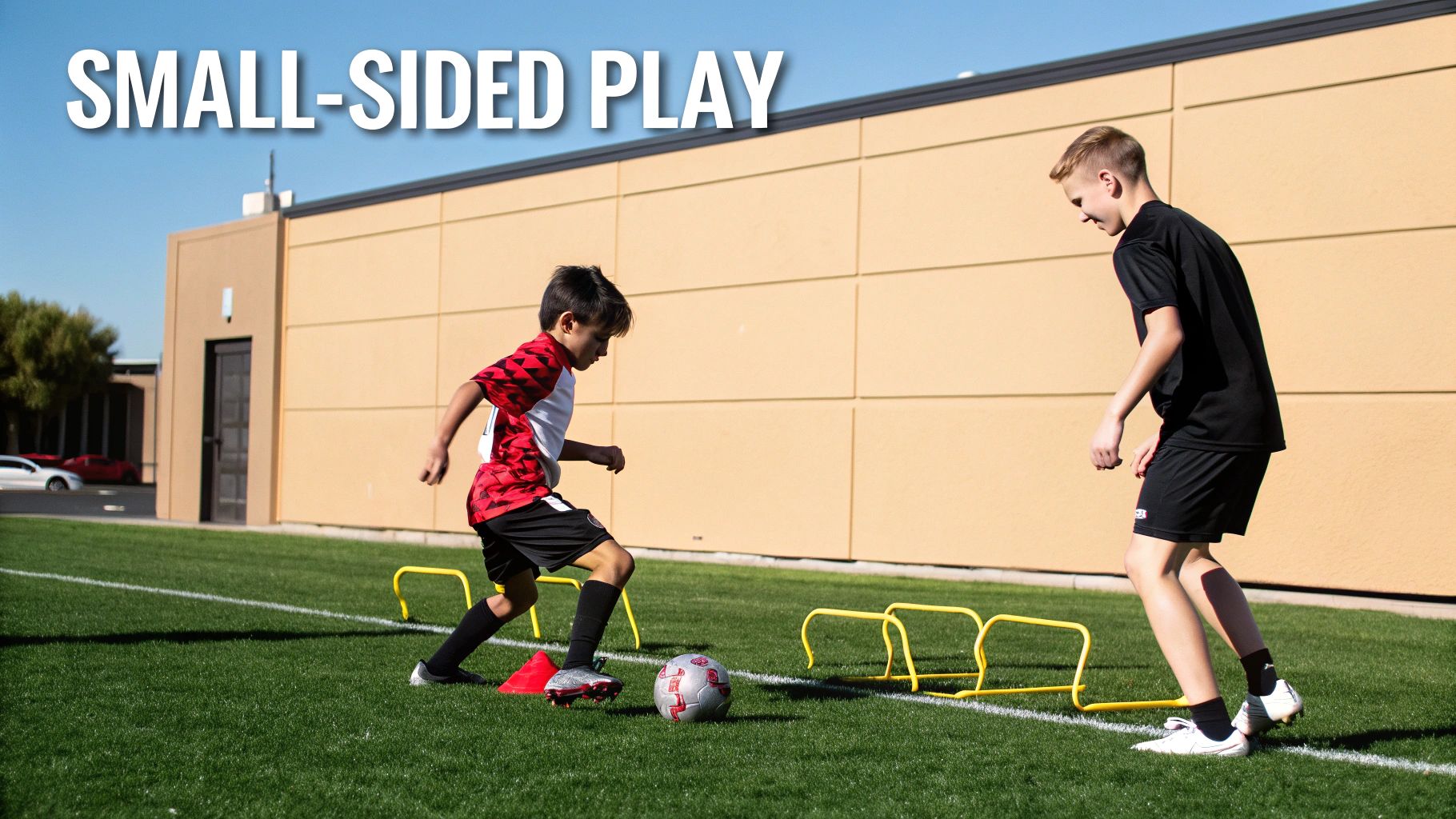
Drills are fantastic for building muscle memory and getting comfortable with the ball. But let's be honest—the real test happens when a defender is breathing down your neck, space is disappearing, and you have to make a decision right now. This is where small-sided games transform a player's development.
Games like 1v1, 2v2, and 3v3 are the ultimate dribbling classrooms. They perfectly bridge the gap between static cone drills and a full-blown 11v11 match by creating non-stop, high-pressure situations. In a small space, every player is involved, touches on the ball skyrocket, and there's simply nowhere to hide.
This is exactly why we integrate this game-based approach into our Houston-area youth leagues. It fosters a dynamic, competitive environment where technical skills don't just get practiced; they flourish under pressure.
The Power of Pressure and Quick Decisions
So, what makes these mini-games so effective? They replicate the intensity of a real match in a controlled setting. A player isn't just weaving through cones anymore; they're trying to outsmart a thinking, reacting opponent who wants that ball.
This constant pressure forces players to lift their heads, read their opponent's body language, and choose the right moment to explode with speed, cut sharply, or shield the ball. These are the instincts that you just can't develop when practicing alone.
Small-sided games teach players to solve problems with the ball at their feet. They learn that dribbling isn't just about the move itself, but about using the right move at the right time to win the moment.
High-Impact Games for Your Next Practice
The best part? You can set these up anywhere—in your backyard, at a local park, or before a team practice. Here are two of our favorites that teach critical, yet different, dribbling skills.
Game 1: King of the Ring
This classic is an absolute blast and is second-to-none for teaching players how to shield the ball and keep it close in tight spaces. It’s a fun, chaotic battle that builds strength, balance, and pure close control.
Setup: Mark out a 10x10 yard square with cones. Every player needs their own soccer ball.
How to Play: Everyone dribbles inside the square. The goal is simple: protect your own ball while trying to poke other players' balls out of the ring.
The Goal: The last player with their ball still inside the square is crowned the "King" or "Queen."
What It Teaches:
Shielding: Players instinctively learn to use their bodies to get between the ball and a defender.
Close Control: Big, heavy touches won't work here. Kids are forced to use small, soft touches to keep the ball safe.
Awareness: You have to keep your head up to spot threats and opportunities, all while protecting your own ball.
Game 2: Gates Dribbling
This game shifts the focus from just protecting the ball to actively scanning the field and making smart, forward-thinking decisions. It’s a fantastic drill for improving vision and dribbling with a purpose.
Setup: Scatter several pairs of cones (about a yard apart) throughout a larger grid, maybe 20x20 yards. These are the "gates." Each player has a ball.
How to Play: On "Go," players dribble through as many gates as they can in 60 seconds. The only rule is you can't go back through the same gate twice in a row.
The Goal: The player who gets through the most gates wins!
What It Teaches:
Vision and Awareness: Players have to get their eyes up to find the next open gate instead of staring at their feet.
Change of Direction: To get to the next gate efficiently, players must use sharp cuts and turns.
Decision-Making: They learn to quickly choose the best route based on where they are and where other players are going.
By weaving these games into any practice routine, you stop just teaching a player how to dribble. You start teaching them when and why to dribble—and that's what turns a basic skill into a true game-changing weapon.
Measuring Dribbling Progress to Keep Kids Motivated
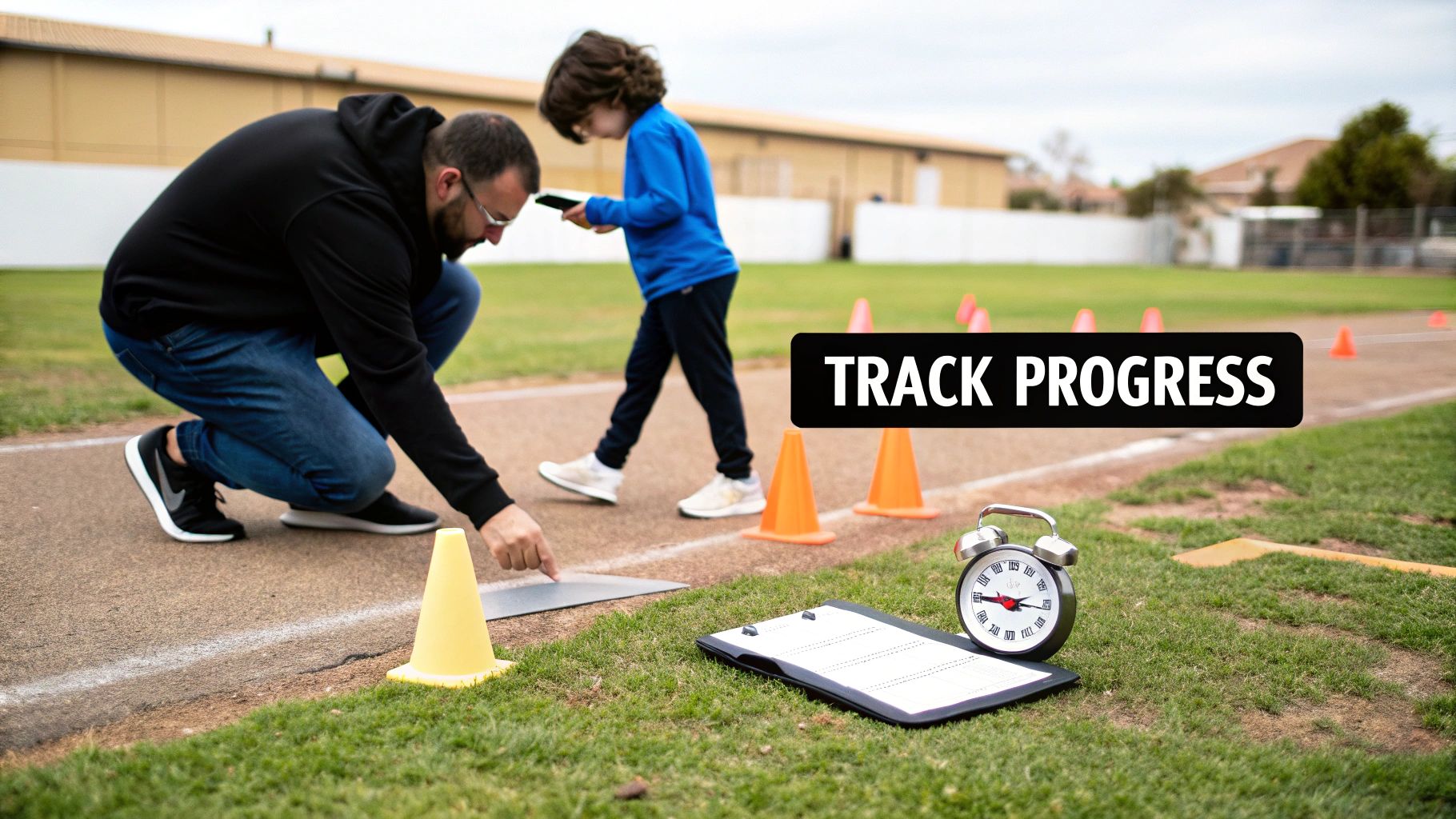
How do you know if all that practice is actually paying off? For young players, feeling like they're getting better is the single most powerful motivator. Without seeing clear improvement, even the most fun drills can start to feel like a chore.
That’s why measuring progress is such a game-changer. It gives kids the tangible, positive feedback they need to stay engaged and excited. It turns an abstract goal like "get better at dribbling" into something concrete they can see and celebrate. When a player knows their hard work is leading to real results, their confidence skyrockets.
This isn't about creating a high-pressure environment. It's about showing them a clear path forward, celebrating every small win, and building a love for the process of getting better.
Simple Ways to Track Improvement
You don't need fancy equipment to see how far a player has come. A few simple, consistent metrics can tell you everything you need to know. The key is to make it objective and fun, turning measurement into a mini-game.
Grab a stopwatch and a few cones. Set up a simple slalom drill—maybe six cones in a straight line—and time how long it takes your child to weave through it. Do this once every couple of weeks and just jot down the results.
Actionable Tracking Methods:
Timed Cone Drills: Record the time it takes to complete a standard cone-weaving course. Seeing their time drop by even half a second is a huge win for a young player.
Repetition Count: In a 60-second window, how many "L" turns or pull-backs can they complete successfully? This measures both their speed and technical consistency.
In-Game Success: Casually keep an eye on successful take-ons during a game. A simple, "Hey, you beat your defender three times today, that was awesome!" provides powerful, game-relevant feedback.
Introducing the Dribbling Success Rate
In the pros, one of the clearest ways to measure dribbling effectiveness is the Dribbling Success Rate (DSR). It’s calculated as successful dribbles divided by total attempts, multiplied by 100. For parents in soccer hubs like Houston, structured technical programs that regularly test and track dribbling success mimic this data-driven approach, helping young players steadily raise their personal DSR over time. You can discover more insights about DSR on Sportmonks.com and see how it's used at the highest levels.
For kids, we can simplify this. The focus isn't on the math but on the core idea: completing a move successfully is more important than just attempting it. It shifts the goal from "trying cool tricks" to "making things happen on the field."
The goal is to nurture a resilient mindset where mistakes aren't failures—they're just information. Each time a player loses the ball, it’s a chance to ask, "What could I try differently next time?"
The Psychology Behind It All
Tracking progress is only half the battle; how you frame it is what truly builds a resilient, motivated player. The numbers are just tools to support a positive growth mindset.
Always celebrate effort over pure results. Praise the hard work they put in during practice, not just the new record time they set. This teaches them to love the process of development.
Set small, achievable goals together. Instead of aiming to become the best dribbler on the team overnight, maybe the goal for the month is to master the "L" turn with their non-dominant foot. When they get it, celebrate that specific win. This creates a cycle of achievement and confidence that fuels a long-term passion for the game.
Your Weekly Dribbling Training Plan
When it comes to getting better at dribbling, consistency is the secret sauce. A few sharp, focused sessions every week will always beat one long, exhausting practice. The key is to build a routine that feels like fun, not a chore.
This flexible plan gives you a simple structure you can easily fit into your family’s schedule, mixing technical work with the pure joy of the game. We want kids excited to grab their ball and head outside, which is the same philosophy we use in our Houston programs—purposeful practice that feels like play.
Structuring Your Week for Success
A great starting point is aiming for three dedicated dribbling sessions per week, each lasting about 20-30 minutes. That's the sweet spot—enough time to build muscle memory without burning out.
To wrap up the week, let them have some free play or a small-sided game where they can test their new moves without any pressure. This approach covers all the bases, building both isolated technique and real in-game instincts.
A Sample Weekly Dribbling Schedule
Think of this as a template, not a strict set of rules. Feel free to move the days around to fit your life. What matters most is the type of work you're doing.
Monday (20 Minutes): Ball Mastery Focus * Warm-up (5 mins): Get the blood flowing with some light jogging and dynamic stretches. * Drills (15 mins): The goal here is getting as many touches on the ball as possible. Stick to foundational drills like toe taps, foundations (or "boxes"), and pull-backs to build rhythm and close control.
Wednesday (20 Minutes): Dynamic Dribbling & Change of Direction * Warm-up (5 mins): If you have a footwork ladder, this is a great time to use it. * Drills (15 mins): Set up a simple line of cones for a slalom. Encourage your player to use different parts of their feet (inside, outside) and to change their speed—dribble slow into the cone, then explode out.
Friday (30 Minutes): Game-Based Drills * Warm-up (5 mins): Keep it light and fun to get them ready to compete. * Games (25 mins): Time to bring the fun! Small-sided games like "King of the Ring" or "Gates Dribbling" are perfect. If it's just you and your child, a simple 1v1 in the backyard is one of the best ways to improve.
Pro Tip: Always end on a high note. Let them finish with their favorite drill or by taking a few shots on goal. Creating that positive feeling keeps them hungry for the next session.
From the Backyard to the Next Level
An at-home plan like this is the perfect way to build a solid technical foundation. As your child’s skills and confidence grow, they'll thrive in a more structured setting with professional coaches and other kids to play with.
When they're ready for that next step, our Soccer Lab private sessions are designed to offer that personalized feedback to help them improve even faster.
To keep practices fresh and find new ideas, you can also explore the Saucial app for more drills and training plans. It's a great tool for tracking progress and making sure training never gets stale.
Your Dribbling Questions, Answered
As a parent, you're your child's biggest supporter, and it's natural to have questions about how to best help them on their soccer journey. When it comes to a skill as crucial as dribbling, a little guidance goes a long way. Here are some of the most common questions we get from parents just like you.
What Is the Best Age to Start Dribbling Drills?
We find the sweet spot for introducing structured dribbling drills is right around 6 or 7 years old. At this age, most kids have the coordination and attention span to start learning the basics, like toe taps or pull-backs, without it feeling like a chore.
For the little ones (ages 3-5), the focus should be 100% on fun and exploration. Forget the drills. Let them just get a feel for the ball with playful games like "Red Light, Green Light" or simply kicking it around the yard. The only goal is to make the ball their friend.
How Can I Encourage Creativity in Dribbling?
True creativity on the ball comes from confidence. A player needs to feel safe to try things and, yes, even fail, without pressure.
The absolute best way to foster this is through small-sided games in the backyard. Setting up a quick 1v1 or 2v2 game creates a natural laboratory where clever moves and quick decisions are rewarded. Let them figure it out on their own.
Resist the urge to be a sideline coach. Instead of shouting, "Do a step-over!" try praising their effort. A simple, "That was a cool turn you tried!" gives them the green light to experiment and develop their own flair.
A player's creativity is directly tied to their confidence. When they stop worrying about making a mistake, they start seeing possibilities. This freedom is where real skill development happens.
How Often Should My Child Practice Dribbling?
When it comes to building skill, consistency always wins over cramming.
Short, focused sessions are far more effective than one long, draining practice. We recommend aiming for 20-30 minutes of dedicated dribbling practice, about three times a week. That’s enough to build the muscle memory and touch they need without risking burnout.
The perfect recipe is mixing those drill sessions with plenty of unstructured free play. Drills give them the tools; free play teaches them when and how to use them in a game. For a deeper look at striking this balance, check out our guide on how to improve soccer skills.
At JC Sports Houston, we’re all about building confident, creative players from their very first touch. Our programs are designed to teach technical mastery in an environment that’s supportive and, most of all, fun.
See how our professional coaching can make a difference for your child by exploring our programs at https://jcsportshouston.com.
Comments