

The Ultimate Guide to 7 Fun 3 Year Old Sports Activities for 2026

Welcome to the exciting world of toddler sports! As a parent, you know your 3-year-old is a bundle of boundless energy. Channeling that enthusiasm into positive, structured activities is a fantastic way to support their development. But what do 3 year old sports actually look like? It’s not about complex rules or intense competition; it’s about play, exploration, and building fundamental motor skills that create a foundation for a healthy, active life.
The key to a successful introduction to athletics at this age is focusing on fun and fundamental movement rather than competitive performance. Understanding how to approach age-appropriate training progressions is crucial to ensuring a positive experience from the very start. The goal is to nurture a love for being active, not to create a star athlete overnight.
This guide dives into seven excellent sport and movement options specifically tailored for toddlers. We'll explore what each activity entails, its unique developmental benefits, and how to identify the right fit for your child's personality and readiness. From multi-sport classes that keep things fresh to specialized programs like BlastBall and Coerver-based soccer, you'll gain actionable insights to make an informed choice. We’ll also highlight how programs like JC Sports Houston are designed to nurture the youngest athletes in communities like Humble, Kingwood, and Atascocita, ensuring their first sports experience is filled with fun, growth, and confidence.
1. Multi-Sport Introduction Classes
For many parents considering 3 year old sports, the idea of choosing just one can feel premature. A multi-sport introduction class solves this dilemma perfectly by offering a sampler of different athletic activities, all packaged within a structured, play-based environment. Rather than focusing on mastering the specific rules of soccer or baseball, these programs prioritize the development of fundamental movement skills that are transferable across all sports.
Think of it as a physical literacy primer. In a single class, a 3-year-old might practice kicking a soccer ball, tossing a beanbag into a hoop, and running between cones. The goal isn't to create a future superstar but to build a foundation of coordination, balance, and spatial awareness while exposing them to various activities to see what sparks their interest.
What to Expect in a Multi-Sport Class
These programs are designed with a toddler's attention span in mind. Activities are short, engaging, and centered around imaginative play. A coach might lead a game of "Red Light, Green Light" to practice starting and stopping, or ask children to "stomp like a dinosaur" to work on balance and leg strength. The focus is on fun and exploration, ensuring a positive first experience with organized sports.
Many reputable organizations offer this model, recognizing its effectiveness for early childhood development.
JC Sports Houston: Our multi-sport toddler classes are specifically designed for ages 2-4, providing a dynamic introduction to soccer, baseball, basketball, and more in a supportive, indoor environment.
Local YMCA and Recreation Centers: These community hubs often provide excellent, cost-effective preschool sports programs that introduce basic skills for several different sports.
National Franchises: Programs like Little Kickers, while often soccer-focused, incorporate multi-sport principles of foundational movement into their curriculum for the youngest age groups.
Key Insight: The primary benefit of a multi-sport class for a 3-year-old is not athletic specialization, but the development of gross motor skills and a love for movement. It's about building confidence in their physical abilities through positive, varied experiences.
How to Choose the Right Program
When evaluating a multi-sport program for your 3-year-old, look for key indicators of quality. A low child-to-coach ratio (ideally no more than 8:1) is crucial for ensuring each child gets individual attention and support. The best instructors are not just athletes; they are trained in early childhood development and understand how to communicate with and motivate toddlers effectively.
Finally, prioritize programs that emphasize participation and fun over competition. At this age, the scoreboard is irrelevant. The real win is a child who leaves class smiling, feeling successful, and excited to come back next week.
2. BlastBall Baseball Introduction
For parents looking to introduce their toddler to America's pastime, traditional T-ball can still feel a bit advanced. BlastBall is the perfect solution, acting as a simplified, high-energy precursor to baseball and T-ball specifically designed for the youngest players. This introductory sport uses oversized, soft equipment and modified rules to focus on core actions: hitting, running, and fielding, all without the pressure of a formal game.
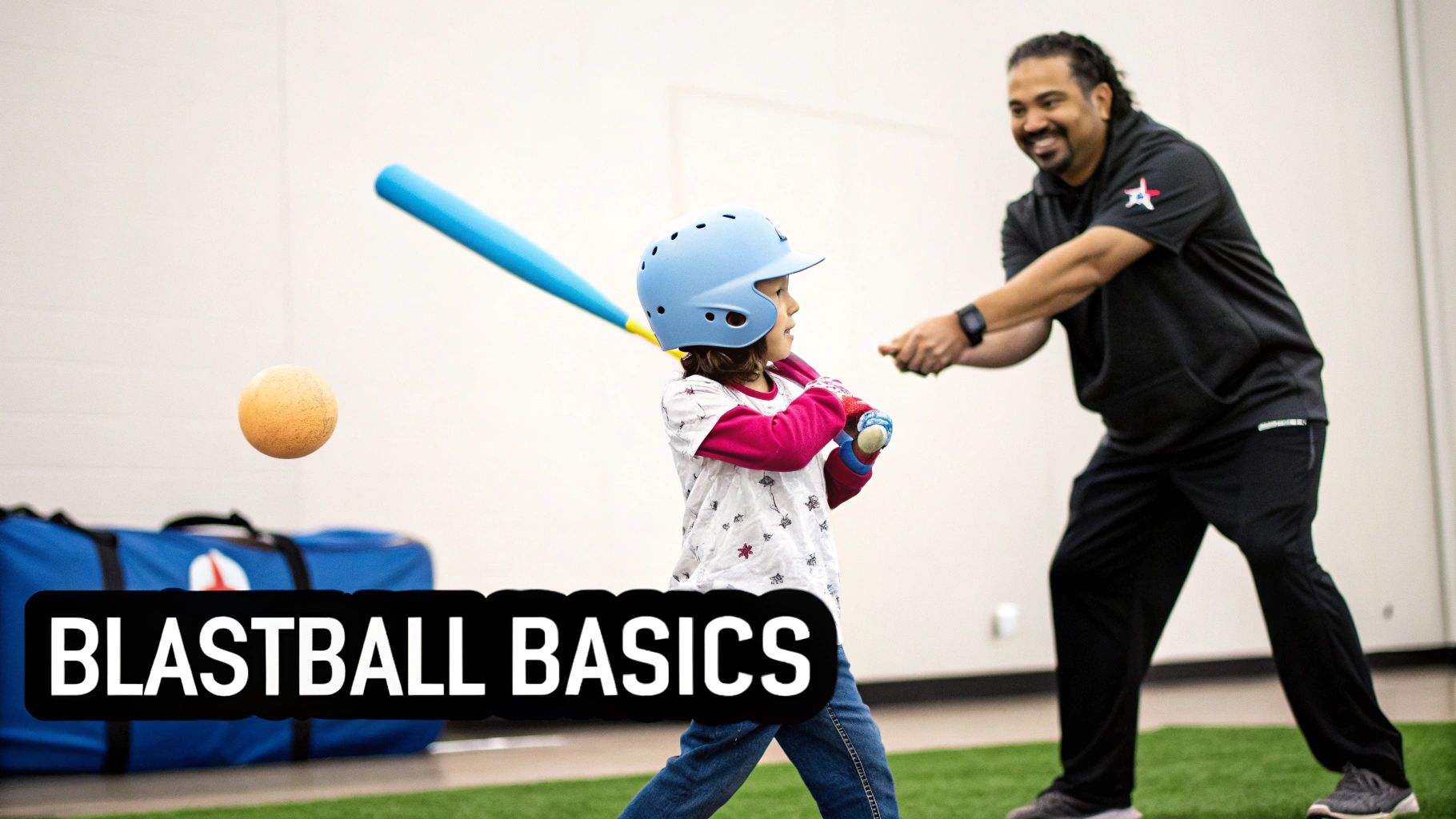
The game is brilliantly simple: a player hits a foam ball off a tee and runs to a single base, which honks or "blasts" when they step on it. This immediate, auditory reward makes the experience thrilling for a 3-year-old. BlastBall removes complex rules like strikeouts and multiple bases, allowing children to focus on the pure fun of hitting a ball and running as fast as they can. It's an ideal entry point into 3 year old sports that builds confidence and fundamental skills.
What to Expect in a BlastBall Class
BlastBall programs are all about action and engagement. A typical session involves a series of dynamic drills disguised as games. Coaches will guide children through the basics of holding a bat, swinging at the ball on the tee, and the exciting dash to the "blasting" base. Fielding is introduced gently, often by having kids practice stopping soft, slow-rolling balls.
The environment is non-competitive and highly encouraging, celebrating every swing and run. Many reputable programs use this model to make baseball accessible and fun from the very beginning.
JC Sports Houston: Our BlastBall program is a cornerstone of our offerings for toddlers, providing a safe, indoor setting where they learn baseball fundamentals through play, laughter, and that satisfying "honk" of the base.
Local Recreation Leagues: Many community-based T-ball programs now offer a BlastBall or "first-pitch" style division for the 3-4 year old age group.
Little League: While typically for older kids, some local chapters offer introductory clinics based on BlastBall principles to prepare them for future T-ball leagues.
Key Insight: BlastBall’s genius lies in its simplicity. By focusing on a single base and a successful hit every time, it guarantees a positive experience, teaching hand-eye coordination and the basic concept of batting and running without intimidation.
How to Choose the Right Program
When selecting a BlastBall program, look for an environment that prioritizes positive reinforcement. Coaches should be enthusiastic and patient, with a clear understanding of how to engage toddlers. The equipment should be age-appropriate: soft foam bats, oversized lightweight balls, and low-profile tees are non-negotiable for safety and success.
Look for classes with short, varied activities to hold a 3-year-old’s attention. A good program will mix hitting drills with running games and basic fielding exercises. For those looking to practice at home, explore some fun and effective T-ball drills for 3-5-year-olds to reinforce these skills. Ultimately, the right program is one where your child develops a love for the game in a supportive, fun-filled setting.
3. Soccer-Focused Ball Control Games
For parents drawn to the world’s most popular sport, introducing soccer through 3 year old sports programs can be incredibly rewarding. Instead of formal drills and team play, the most effective approach for this age is through soccer-focused ball control games. This method prioritizes developing a child's comfort and familiarity with the soccer ball, treating it less like a piece of equipment and more like a fun toy.
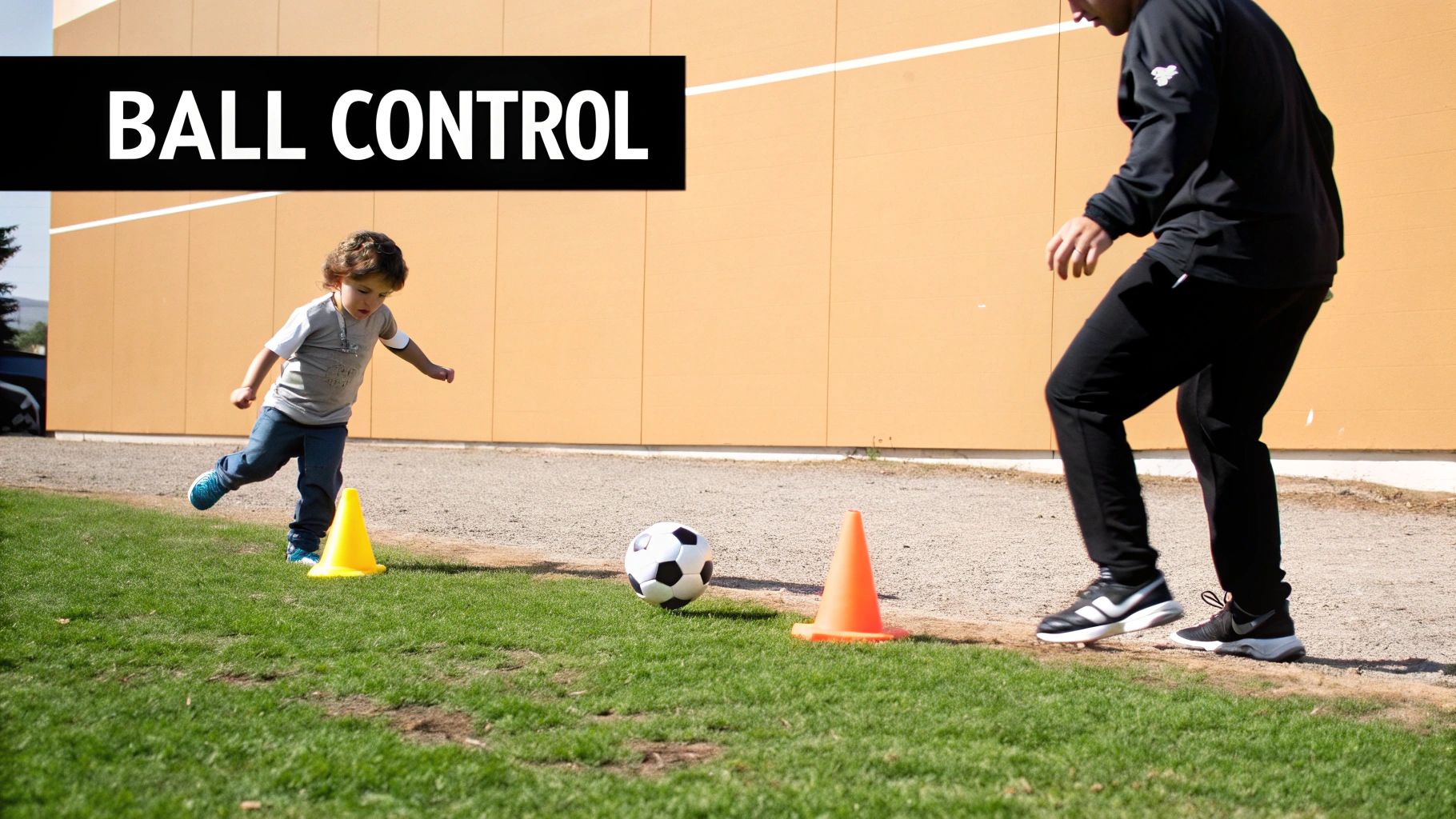
The core idea is to build a foundation of "ball mastery" through playful, imaginative activities. In these classes, a 3-year-old learns to touch, tap, and move the ball with their feet in a low-pressure setting. This builds the fundamental motor patterns for future dribbling and control, all while disguised as a game. The focus isn't on scoring goals but on the joyful discovery of what their feet can do.
What to Expect in a Ball Control Class
These programs are built on repetition through play. Coaches use creative scenarios to encourage constant interaction with the ball. A child might be asked to “walk their pet soccer ball” on a leash (gently tapping it forward), “keep their ball safe from the shark” (keeping it close to their feet), or “drive their race car” around cones. This game-based learning makes technical practice feel effortless and fun.
Many world-class methodologies are built on this principle of early ball mastery.
JC Sports Houston: Our soccer programs for toddlers, including our popular Just for Girls soccer training, are heavily influenced by the Coerver method, emphasizing individual ball control and creative footwork through age-appropriate games.
Coerver Coaching Programs: As a global standard, Coerver’s curriculum for the youngest players focuses almost exclusively on developing a confident first touch and ball mastery.
Local Soccer Clubs: Many youth soccer organizations offer "pre-U6" or "mini-kickers" programs that adopt this play-based philosophy before introducing formal team concepts.
Key Insight: At age 3, the goal of soccer is not to learn positions or complex rules, but to develop ball familiarity and individual confidence. A child who is comfortable with a ball at their feet is more likely to enjoy the sport for years to come.
How to Choose the Right Program
When selecting a soccer-focused program, look for coaches who are not just skilled players but are also trained in early childhood education. They should be energetic, patient, and able to command a group of toddlers with positivity and encouragement. The program should use age-appropriate equipment, such as a lightweight size 3 soccer ball, and have a low child-to-coach ratio.
Most importantly, the environment should be free from competitive pressure. The focus must be on individual development and having fun. For more tips, you can explore our comprehensive parent's guide to 3-year-old soccer success. A great program makes every child feel like a star every time they touch the ball.
4. Movement and Motor Skills Development Classes
Before a child can master the specifics of any sport, they must first master their own body. For parents exploring 3 year old sports, movement and motor skills development classes offer the perfect starting block. These programs are not about teaching a specific game; instead, they focus on building the universal physical literacy that underpins all future athletic activity through structured, play-based exploration.
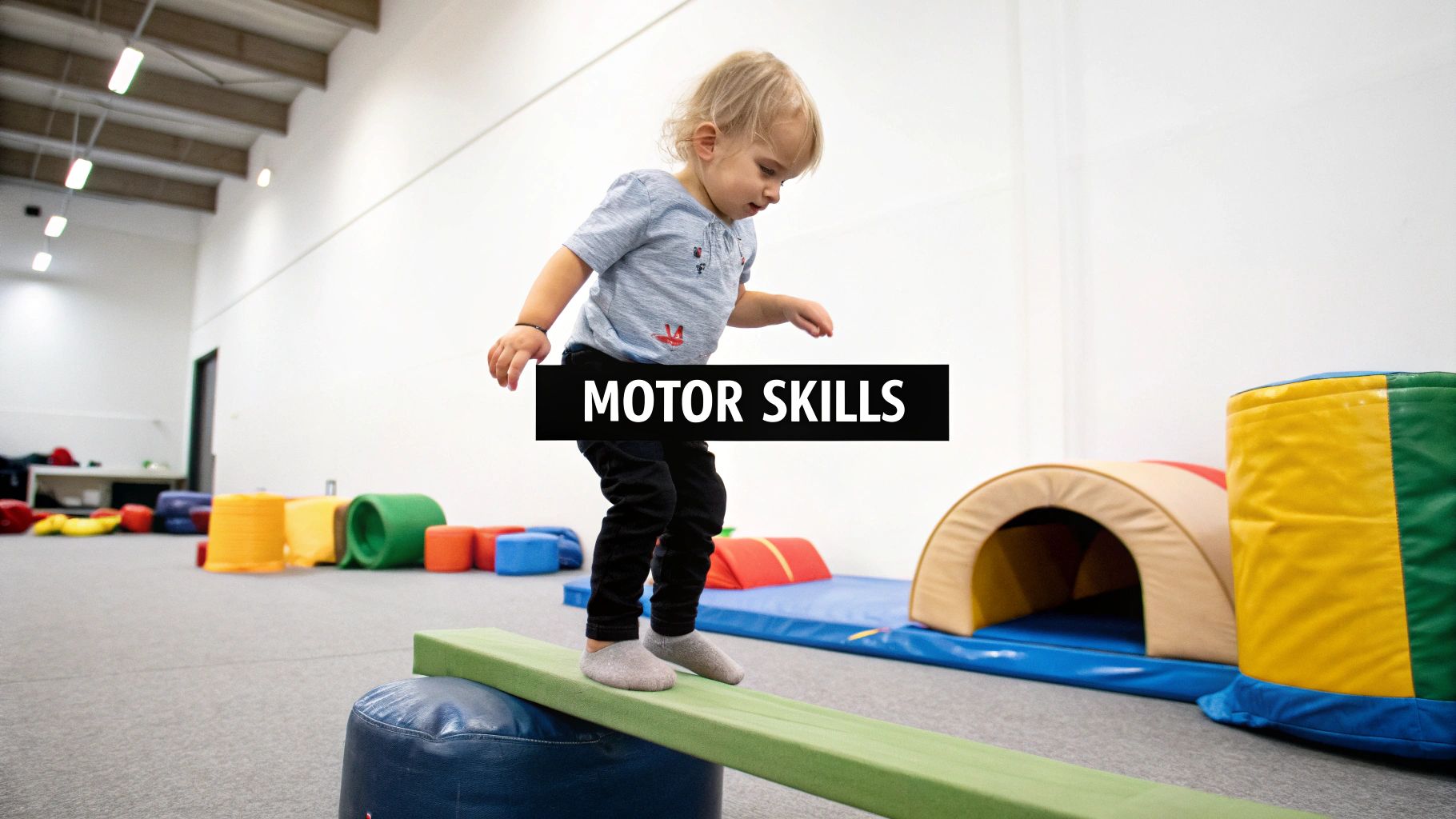
The core objective is to develop gross motor skills like running, jumping, balancing, climbing, and coordination. In these classes, a 3-year-old learns how their body moves through space, building a strong foundation of physical confidence and capability. Understanding the importance of body awareness and spatial orientation, often referred to as proprioceptive input, is crucial for developing this confidence in physical activities.
What to Expect in a Movement Class
Imagine a vibrant, soft-padded environment filled with low balance beams, colorful tunnels, small obstacle courses, and soft mats. Guided by an instructor trained in early childhood development, children are encouraged to explore movement in a safe and engaging way. A typical session might involve a warm-up with music and dance, followed by a circuit where they practice climbing over soft blocks, walking along a line on the floor, and jumping into a cushioned pit.
These classes are designed to be fun and non-competitive, making them ideal for even the most hesitant toddlers.
Local Gymnastics Centers: Many gymnastics facilities offer "parent-and-tot" or preschool programs that focus purely on foundational movements like rolling, balancing, and jumping.
Gymboree Play & Music: A well-known franchise that blends music with age-appropriate physical challenges to foster motor skill development.
YMCA and Community Centers: These organizations often provide excellent and affordable motor skills classes designed specifically for toddlers, emphasizing play and social interaction.
Key Insight: The goal of a movement class is not to create a gymnast or an athlete, but to build a child's physical confidence and body awareness. It's about teaching them to trust their bodies and enjoy the feeling of movement.
How to Choose the Right Program
When searching for a motor skills class, prioritize a play-based philosophy over a performance-focused one. The environment should feel like a playground, not a training facility. Look for a program with a wide variety of equipment and activities to keep your 3-year-old engaged and challenged. An excellent child-to-coach ratio (ideally 6:1 or lower) ensures that each child receives the guidance they need to explore safely.
Ask the instructors how the curriculum progresses. A quality program will build skills incrementally, introducing new challenges only when a child is developmentally ready. The ultimate measure of success is a child who is excited to participate, willing to try new things, and leaves class with a smile, feeling proud of what their body can do.
5. Parent-Participatory Sports Playdates and Classes
For many 3-year-olds, entering a new environment with unfamiliar faces can be intimidating, even with the promise of fun games. Parent-participatory classes eliminate this hurdle by inviting parents directly onto the field or court to play alongside their child. This approach transforms a potentially stressful new experience into a shared adventure, strengthening the parent-child bond while introducing athletic fundamentals.
This model is less about formal instruction and more about guided play. Parents become active role models, demonstrating movements, offering high-fives, and providing a constant source of comfort and encouragement. The focus is on creating positive, joyful first memories associated with sports, ensuring that a child’s initial foray into organized activities is built on a foundation of security and fun.
What to Expect in a Parent-Participatory Class
These sessions are designed for connection and interaction. A coach will lead the group through simple, imaginative games, but the parent is the child’s primary partner. You might be asked to hold your child's hands while they practice balancing on one foot, or work together to roll a ball towards a target. The environment is collaborative, social, and low-pressure, designed for toddlers and their grown-ups.
This hands-on approach is a hallmark of many high-quality early childhood programs that understand the value of parental involvement.
JC Sports Houston: Our toddler programs often encourage parent participation, especially in the younger age groups, to help ease children into the class structure and ensure they feel comfortable and supported.
Local YMCA and Community Centers: These organizations frequently offer parent-child swim, gymnastics, and general movement classes that are perfect for this age.
Gymboree Play & Music: A pioneer in this space, Gymboree has built its model around structured parent-child classes that focus on cognitive and physical development through play.
Key Insight: The primary benefit of a parent-participatory class is emotional security. When a child sees their parent happily engaging in an activity, it reduces anxiety and builds their confidence to try new things, making them more receptive to learning.
How to Choose the Right Program
When selecting a parent-involved program for your 3-year-old, observe the coach’s interaction style. A great instructor will guide the parents, giving them clear instructions on how to support their child without taking over. They should foster a community feel, encouraging interaction among all the families.
Be prepared to participate fully. Wear comfortable clothing and shoes you can move in, and model a positive, enthusiastic attitude. Your engagement is the key to your child's enjoyment. Finally, look for programs that offer trial classes, allowing you to assess if the dynamic is a good fit for you and your little one before committing.
6. Sports-Themed Birthday Parties and Social Events
Introducing 3 year old sports doesn't always have to happen in a formal class setting. A sports-themed birthday party or social event offers a fantastic, low-pressure way to expose toddlers to athletic activities. By framing movement and simple sports games within a celebration, children associate physical activity with fun, friends, and positive reinforcement, which can be a powerful motivator for future participation.
These events transform a standard birthday party into an active playground. Instead of just passive entertainment, coach-led activities get kids moving, laughing, and working together. A soccer-themed party might involve a game of "Red Light, Green Light" with a ball, while a multi-sport event could feature mini-obstacle courses and parachute games, all tailored to the developmental stage of a 3-year-old.
What to Expect in a Sports-Themed Party
A well-run sports party for toddlers is organized chaos at its best. Coaches trained to work with this age group lead short, high-energy games that keep little ones engaged. The focus is never on rules or competition but on pure participation and enjoyment. Activities are designed to build fundamental skills like running, kicking, and throwing in a playful, festive atmosphere where every child feels like a winner.
Many facilities offer comprehensive packages that make planning easy for parents.
JC Sports Houston: We specialize in customizable, coach-led birthday parties that can feature soccer, baseball, or a mix of sports. Our indoor facility ensures the fun happens rain or shine, and we handle the activities so parents can enjoy the celebration.
Local Gymnastics Centers: These venues are experts at hosting active parties, often including obstacle courses, trampolines, and foam pits that are perfect for energetic toddlers.
Community Recreation Centers: Many local centers offer affordable party packages that utilize their gyms or fields, providing a great space for organized sports games.
Key Insight: A sports-themed party is less about teaching a specific sport and more about building positive social associations with physical activity. It shows a 3-year-old that being active is a fun way to celebrate and connect with friends.
How to Choose the Right Party Package
When planning a sports-themed event for your 3-year-old, look for a venue that understands the needs of this age group. Confirm that the coaches have experience with toddlers and can manage a group with varying energy levels and attention spans. The ideal guest list size is typically between 8 and 15 children to keep the event manageable and ensure everyone gets to participate.
Ask about the structure of the party. A good package will balance high-energy field time with calmer moments for cake and presents in a separate party room. This prevents overstimulation and keeps the event flowing smoothly. For more inspiration on themes and activities, check out our guide on 10 unforgettable sports-themed birthday party ideas. The goal is a memorable, stress-free celebration that leaves your child and their friends with happy, active memories.
7. Small-Sided Beginner Leagues (Mini-Leagues)
Once a child shows a spark of interest in a specific activity, a small-sided beginner league can be the perfect next step in their journey with 3 year old sports. These "mini-leagues" are carefully structured, non-competitive introductions to team play. With modified rules, smaller teams, and a heavy emphasis on participation, they offer the fun of a "real" sports season without the pressure of winning or complex strategies.
The primary goal is to introduce concepts like teamwork, taking turns, and following simple directions from a coach in a game-like setting. For a 3-year-old, this might mean learning to run to the correct base in T-ball or understanding which goal to kick the soccer ball towards. It’s a gentle, supportive way to experience the rhythm and excitement of a sports season.
What to Expect in a Mini-League
Unlike highly competitive leagues for older kids, these programs are all about positive exposure and equal playing time. Games are short, often with just 4 to 6 players per side to maximize each child's involvement. Coaches act more like guides, encouraging participation and celebrating effort over outcomes. You won't find strict rule enforcement or scorekeeping; instead, the focus is on fun, movement, and building social skills.
These leagues provide a fantastic opportunity for young children to feel part of a team for the first time.
JC Sports Houston: Our seasonal soccer, basketball, and baseball leagues for ages 3 and up are designed with this philosophy, featuring small teams and a curriculum that prioritizes fun and fundamental skill development.
Local Recreation Departments: Community centers in areas like Humble and Atascocita often run excellent spring and fall mini-leagues for sports like T-ball and soccer.
Youth Sports Organizations: Groups like the American Youth Soccer Organization (AYSO) or local Little League T-ball divisions offer programs specifically structured for the U4/U5 age groups.
Key Insight: The value of a mini-league for a 3-year-old is not in mastering the sport but in learning social skills like cooperation and sharing, while also building sport-specific confidence in a supportive, low-pressure team environment.
How to Choose the Right Program
When selecting a beginner league, ask about the organization's core philosophy. The best programs will openly state that their primary goals for this age group are fun, participation, and skill development, not winning. Confirm that an equal playing time policy is in place and actively enforced, ensuring every child gets a chance to play regardless of skill level.
Look for well-organized communication regarding schedules, uniforms, and expectations. A good league will also have a clear policy on coach training and background checks for all volunteers. Ultimately, the right mini-league is one where your child feels included, successful, and excited to put on their jersey each week to play with their friends.
3-Year-Old Sports: 7-Option Comparison
Program | Implementation Complexity 🔄 | Resource Requirements ⚡ | Expected Outcomes 📊 | Ideal Use Cases 💡 | Key Advantages ⭐ |
|---|---|---|---|---|---|
Multi-Sport Introduction Classes | Moderate 🔄 — multiple rotations, coach training for varied activities | Moderate ⚡ — equipment for several sports, indoor space management | 📊 Broad motor skill base; sport sampling; social play | 💡 Exploratory toddlers; undecided families | ⭐ Variety-led engagement; identifies natural sport interests |
BlastBall Baseball Introduction | Low 🔄 — simplified rules, predictable flow | Low ⚡ — soft oversized balls, lightweight bats, small field | 📊 Early baseball fundamentals, hand‑eye coordination, confidence | 💡 Low‑pressure baseball intro; first‑time participants | ⭐ Low fear factor; success‑oriented structure |
Soccer-Focused Ball Control Games | Low–Moderate 🔄 — coach consistency needed to avoid bad habits | Low ⚡ — small balls, cones; can be indoor/outdoor | 📊 Improved dribbling, touch, bilateral foot coordination | 💡 Technical development; kids who enjoy ball play | ⭐ High touch volume; strong technical transfer to soccer |
Movement & Motor Skills Development Classes | Moderate 🔄 — varied progressions and safety supervision | Moderate–High ⚡ — obstacle equipment, space, trained staff | 📊 Foundational balance, coordination, physical literacy | 💡 Children needing general motor foundations before sport | ⭐ Builds transferable athletic base for any sport |
Parent-Participatory Sports Playdates & Classes | Low–Moderate 🔄 — scheduling and guidance for parent role | Low ⚡ — minimal equipment; requires parent presence | 📊 Stronger parent–child bonding; reduced separation anxiety | 💡 Families wanting involvement; anxious or very young kids | ⭐ Teaches parents to reinforce skills at home; boosts retention |
Sports-Themed Birthday Parties & Social Events | Low 🔄 — one‑off event logistics and party flow | Moderate ⚡ — multiple activity stations, party room setup | 📊 Positive sport associations; social exposure in fun setting | 💡 Celebratory introductions; guest children new to sports | ⭐ Memorable, low‑pressure exposure; minimal planning for parents |
Small-Sided Beginner Leagues (Mini‑Leagues) | Moderate 🔄 — seasonal schedule, volunteer/coach coordination | Moderate ⚡ — regular field/court access, uniforms, scheduling | 📊 Consistent practice, team concepts, peer friendships | 💡 Families seeking regular, social play with light structure | ⭐ Regularity and community; reinforces commitment and skills |
Your Next Play: Nurturing a Lifelong Love of Movement
Embarking on the journey of introducing 3 year old sports is less about scouting future all-stars and more about planting the seeds for a lifetime of health, confidence, and joy in movement. As we've explored, the world of toddler athletics is not a miniature version of professional leagues. Instead, it's a vibrant, play-based universe designed to build foundational skills in a nurturing and encouraging environment. The goal is simple but profound: to make your child’s first encounter with sports so positive that they see physical activity as a source of fun and accomplishment, not pressure.
This initial step is about celebrating the small victories. It’s about the joy on their face when they make contact with a BlastBall, the giggle that escapes when they successfully dribble a soccer ball a few feet, or the pride they feel after navigating an obstacle course in a motor skills class. These moments are the true trophies of early childhood sports.
Key Takeaways for Your 3-Year-Old's Sports Journey
Reflecting on the options, from multi-sport introductions to parent-and-me classes, several core principles emerge as non-negotiable for success. Keeping these at the forefront of your decision-making process will ensure you find the perfect fit for your family and your aspiring little athlete.
Fun is the Primary Goal: At this age, enjoyment is the engine of learning. If your child isn't having fun, they won't absorb the skills or develop a positive association with the activity. Look for programs that prioritize laughter, imagination, and play over rigid drills and competition.
Focus on Foundational Skills, Not Specific Sports: The most valuable "sport" for a 3-year-old is the development of fundamental movement skills. Agility, balance, coordination, and spatial awareness are the building blocks for any athletic endeavor they may pursue later.
Safety and Environment Matter Most: A safe, age-appropriate environment is paramount. This includes soft equipment, a low coach-to-child ratio, and instructors who are trained specifically in early childhood development. Indoor facilities, like those at JC Sports Houston, offer a controlled, weather-proof setting where toddlers can focus on learning without external distractions or dangers.
Social and Emotional Growth is a Major Benefit: Organized 3 year old sports provide one of the first opportunities for structured social interaction. Children learn to listen to a coach, take turns, and navigate being part of a group, all of which are crucial skills for preschool and beyond.
Your Actionable Next Steps
Now that you're equipped with the knowledge of what to look for, it's time to take action. Don't let analysis paralysis set in. The best way to know what will click with your child is to try it.
Observe Your Child's Natural Inclinations: Do they love kicking balls around the yard? Are they constantly climbing and jumping? Observing their free play can provide powerful clues about whether they might enjoy a soccer-focused program or a more general movement class.
Schedule a Trial Class: Most reputable programs for toddlers understand that parents need to see the environment and coaching style firsthand. Take advantage of free trial opportunities. This is your chance to assess the atmosphere, the coach’s interaction with the kids, and your own child's reaction.
Talk to Other Parents: Ask for recommendations in local parenting groups or from friends whose children are slightly older. Real-world feedback can provide insights you won’t find on a website, especially concerning the program's culture and coaching consistency.
Embrace the Process: Remember, the first class or sport you try might not be the one that sticks, and that's perfectly okay. The journey is about exposure and discovery. Your role is to be your child’s biggest cheerleader, celebrating their effort and participation, regardless of the outcome.
By prioritizing a positive, development-focused introduction to the world of 3 year old sports, you are giving your child an incredible gift. You are not just signing them up for an activity; you are investing in their physical literacy, their social confidence, and their future well-being. You are laying the groundwork for a healthy, active lifestyle and showing them that moving their body can be one of life’s greatest joys.
Ready to take the first step in your child's athletic journey? JC Sports Houston offers a premier indoor facility with specialized programs designed for toddlers, including multi-sport classes, BlastBall, and Coerver-based soccer that make learning fun. Discover their unique, development-focused approach by scheduling a free trial class at JC Sports Houston and see firsthand how they nurture a love for the game.
Comments