

8 Can't-Miss Beginner Basketball Dribbling Drills for Young Athletes

Learning to dribble a basketball is the foundational skill that unlocks every other aspect of the game, from driving to the hoop to setting up a perfect pass. For a beginner, however, a basketball can feel awkward and unpredictable. The key is to transform that uncertainty into control through focused, repetitive, and fun practice. This guide provides eight essential beginner basketball dribbling drills designed to build muscle memory, improve hand-eye coordination, and make handling the ball feel like second nature.
Each drill is broken down with step-by-step instructions, specific coaching cues, and common mistakes to avoid, giving parents and coaches the tools they need to foster a love for the game in young athletes. Mastering these skills not only builds court confidence but also contributes to a player's overall growth. Beyond the court, fostering a strong sense of self is crucial for young athletes; explore additional resources such as these 10 Empowering Self Esteem Activities for Children to support their development off the court as well.
At JC Sports Houston, we see firsthand how mastering these fundamentals helps young players in Humble, Kingwood, and Atascocita grow into well-rounded, creative athletes. Let’s get started on that journey.
1. Stationary Ball Handling (Figure-8 Dribble)
The Figure-8 Dribble is a cornerstone of beginner basketball dribbling drills, designed to build a strong foundation of ball control and coordination without the added complexity of movement. It's an excellent starting point for any young player learning to handle a basketball because it isolates hand-eye coordination and builds a "feel" for the ball in a controlled, stationary position.
This drill involves standing with feet shoulder-width apart and knees bent in an athletic stance. The player then dribbles the ball in a figure-8 pattern around and through their legs. The continuous motion forces the player to use both their right and left hands, promoting ambidextrous skill development from day one.
How to Perform the Figure-8 Dribble
Get into Stance: Stand with your feet slightly wider than your shoulders and bend your knees. A low center of gravity provides better balance.
Start the Dribble: Begin by dribbling with your right hand on the right side of your body.
First Pass-Through: Dribble the ball from front to back through your right leg, receiving it with your left hand behind your body.
Complete the "8": Dribble the ball around your left leg with your left hand, then pass it from front to back through your left leg, receiving it again with your right hand.
Continue the Motion: Repeat this fluid motion, creating a continuous figure-8 pattern.
Coaching Cues and Common Mistakes
Keep Your Head Up: A common mistake is watching the ball. Encourage players to look forward, which builds the crucial court awareness needed in game situations.
Use Fingertips: Dribble with the pads of your fingers, not the palm of your hand. This provides superior control and a softer touch.
Low and Controlled Dribbles: The ball should not bounce higher than the knee. Keeping the dribble low and tight makes it harder for a defender to steal.
This fundamental drill is a staple in quality youth basketball training programs, helping new players develop the confidence and muscle memory needed for more advanced moves. By mastering the Figure-8, a beginner establishes the essential building blocks for becoming a skilled ball handler.
2. High-Low Dribble Exchange
The High-Low Dribble Exchange is a fundamental drill that introduces beginners to the critical concept of varying their dribble height. This exercise teaches players to control the ball both at a low, protective level (near the knee) and a higher, faster level (near the waist or chest). It's one of the most practical beginner basketball dribbling drills because it directly translates to game situations, helping players learn to shield the ball from defenders or to advance it quickly in open space.
This drill focuses on developing a player's ability to change their dribbling rhythm and height on command, a skill essential for navigating different types of defensive pressure. By practicing this exchange, young athletes build the versatility needed to maintain control whether they are in a crowd or breaking away for a layup.
How to Perform the High-Low Dribble Exchange
Get into Stance: Begin in a solid athletic stance with feet shoulder-width apart and knees bent.
Start with Low Dribbles: Begin dribbling the ball with one hand, keeping the bounces low and controlled, no higher than your knee. Focus on keeping the dribbles quick and tight.
Transition to High Dribbles: After a few seconds or on a coach's cue ("High!"), transition to a higher dribble, bringing the ball up to waist or chest height. This dribble should be more powerful.
Return to Low Dribbles: On another cue ("Low!"), immediately bring the dribble back down to knee height, regaining that quick, protective control.
Switch Hands and Repeat: Perform the drill for a set time (e.g., 30 seconds) with one hand, then switch to the other hand and repeat the entire sequence.
Coaching Cues and Common Mistakes
Pound the Ball: Encourage players to dribble with force, especially on the high dribble. This teaches them to handle the ball confidently and not just tap at it.
Maintain Stance: A common mistake is for players to stand up straight during the high dribble. Emphasize staying low in their athletic stance regardless of the dribble's height.
Use Verbal Cues: Call out "High" and "Low" to help players develop rhythm and react instinctively. Gradually decrease the time between cues to challenge their control.
By mastering the High-Low Dribble Exchange, a beginner develops the adaptability needed to protect the ball under pressure and to attack when an opportunity arises, making it a crucial step in their ball-handling journey.
3. Cone Weave Dribble
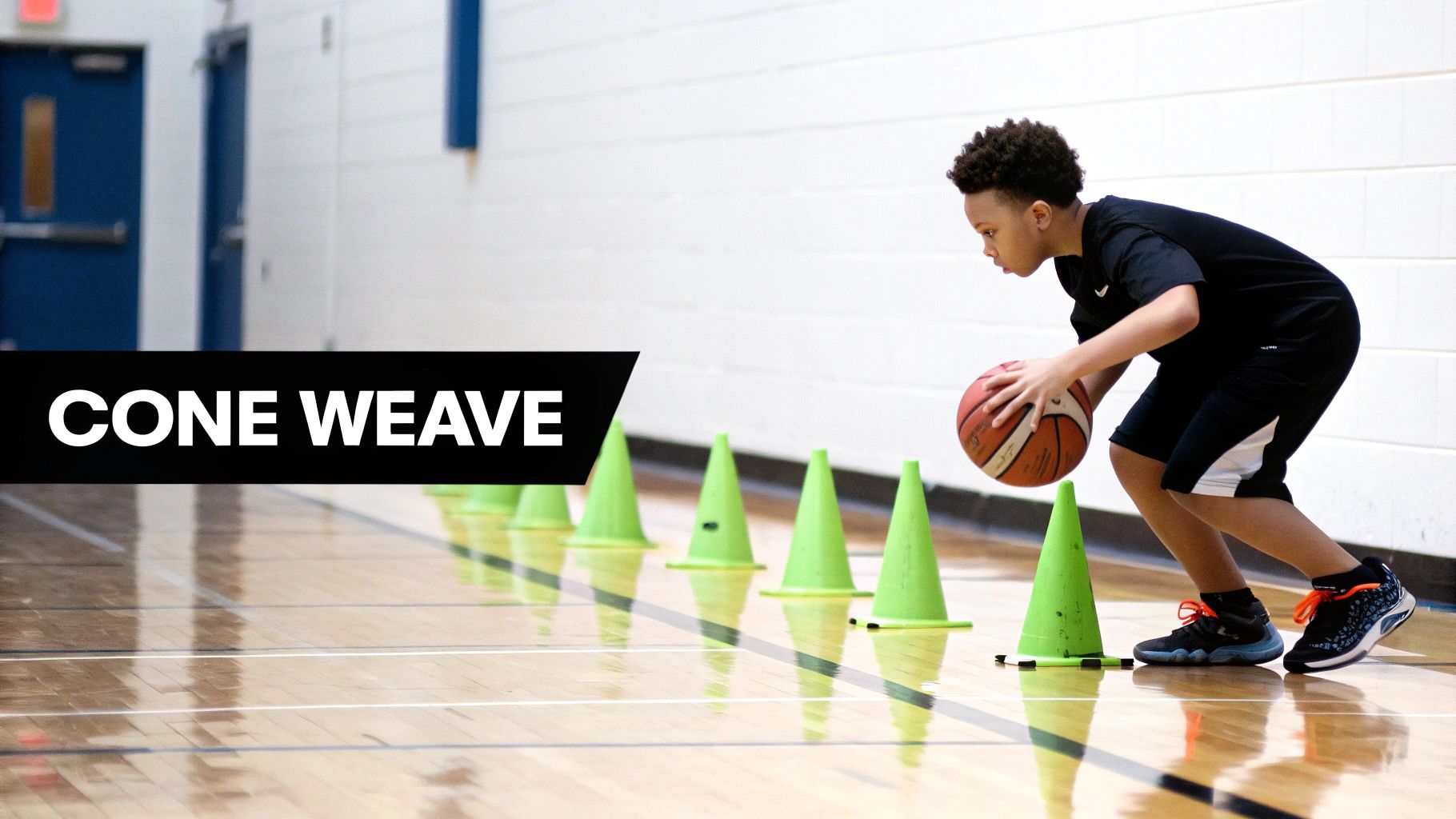
The Cone Weave Dribble introduces movement, a critical step up from stationary drills. It is a foundational exercise in nearly all basketball training programs because it teaches players to control the ball while changing direction, a skill essential for navigating the court and evading defenders. This drill bridges the gap between basic ball handling and game-like scenarios, building a player's confidence to dribble on the move.
This drill involves setting up a line of cones and having the player dribble in a weaving or serpentine pattern through them. By forcing the player to change their dribbling hand and body position at each cone, it naturally develops coordination, footwork, and spatial awareness. It’s one of the most effective beginner basketball dribbling drills for preparing young athletes for the dynamic nature of a real game.
How to Perform the Cone Weave Dribble
Set Up the Cones: Place 5-8 cones in a straight line, spacing them about 6-8 feet apart.
Start the Weave: Begin at one end of the line. Dribble forward with your right hand toward the right side of the first cone.
Crossover and Change Direction: As you approach the cone, perform a crossover dribble (switching the ball from your right hand to your left) to change direction and move toward the left side of the next cone.
Continue the Pattern: Continue this weaving motion, using a crossover dribble at each cone to switch hands and direction.
Return Trip: After reaching the last cone, turn around and weave back to the start. For an added challenge, dribble back using only your non-dominant hand.
Coaching Cues and Common Mistakes
Look Ahead, Not Down: A beginner’s instinct is to watch the ball. Encourage players to keep their eyes up to see the next cone, which simulates seeing the court and defenders.
Protect the Ball: The ball should be kept close to the body, especially during the crossover. A wide dribble is easy for a defender to steal.
Synchronize Feet and Hands: Players should focus on their footwork, ensuring their feet and the ball are working together as they change direction. The dribble should happen in sync with their steps.
The Cone Weave Dribble is a versatile and scalable drill that remains valuable as players advance. By mastering this fundamental movement, beginners build the coordination and control needed to become effective ball handlers in any situation.
4. Two-Ball Dribble (Alternating Hands)
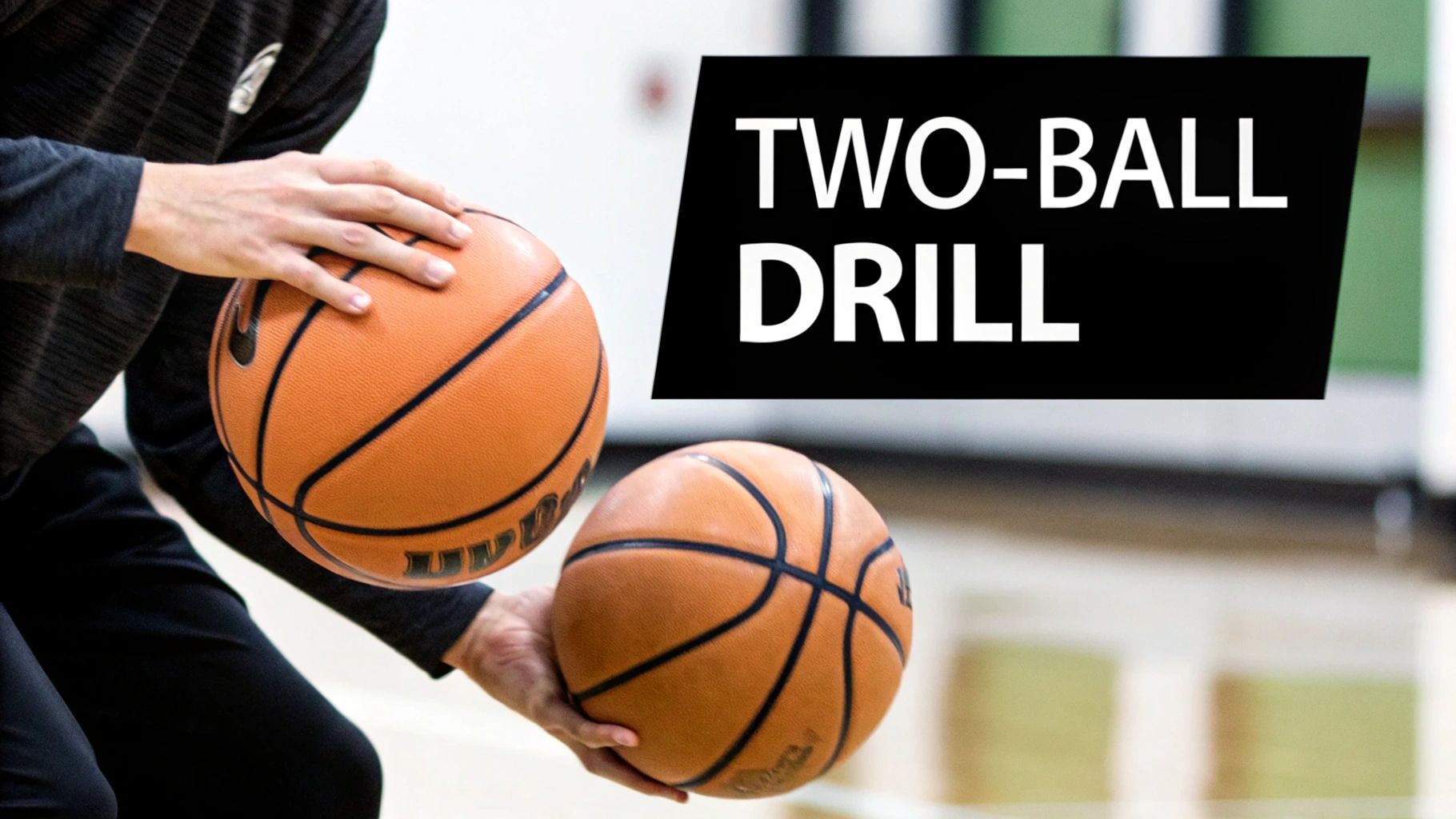
The Two-Ball Dribble is a powerful, advanced-beginner drill that significantly accelerates skill development by forcing both hands to work independently and simultaneously. This drill requires a player to manage two basketballs at once, dramatically increasing hand-eye coordination, ambidextrous control, and overall confidence. It’s one of the most effective beginner basketball dribbling drills for breaking through early-stage skill plateaus.
By dribbling two balls in an alternating rhythm, a player’s brain is trained to multitask, making single-ball dribbling feel much easier in comparison. This challenge strengthens weaker hands and builds a balanced, reliable dribble that is essential for game situations where players must react without thinking about the ball.
How to Perform the Two-Ball Alternating Dribble
Get into Stance: Assume a low, athletic stance with feet shoulder-width apart, knees bent, and back straight. Hold one basketball in each hand.
Start the Dribble: Begin by dribbling the right-hand ball, followed immediately by the left-hand ball.
Find the Rhythm: Continue this alternating pattern: right, left, right, left. The balls should bounce like a piston, with one ball going up as the other comes down.
Maintain Control: Focus on keeping both dribbles at a consistent, knee-high level.
Increase Intensity: Once comfortable with the stationary dribble, try walking forward, then jogging, while maintaining the alternating rhythm.
Coaching Cues and Common Mistakes
Don't Chase the Balls: Beginners often lunge after stray balls. Encourage them to reset their stance and start again. Control is more important than speed.
Pound the Ball: Dribbling too softly with two balls leads to a loss of control. A firm, consistent "pound" helps maintain the rhythm.
Eyes Up, Always: It is very tempting to stare at the basketballs. Remind players to look forward to build court vision and develop a true feel for the ball.
This drill is an excellent progression after mastering basic stationary and movement drills with one ball. It builds the coordination necessary for more complex moves and is a staple for developing truly ambidextrous ball handlers.
5. Crossover Dribble Drill
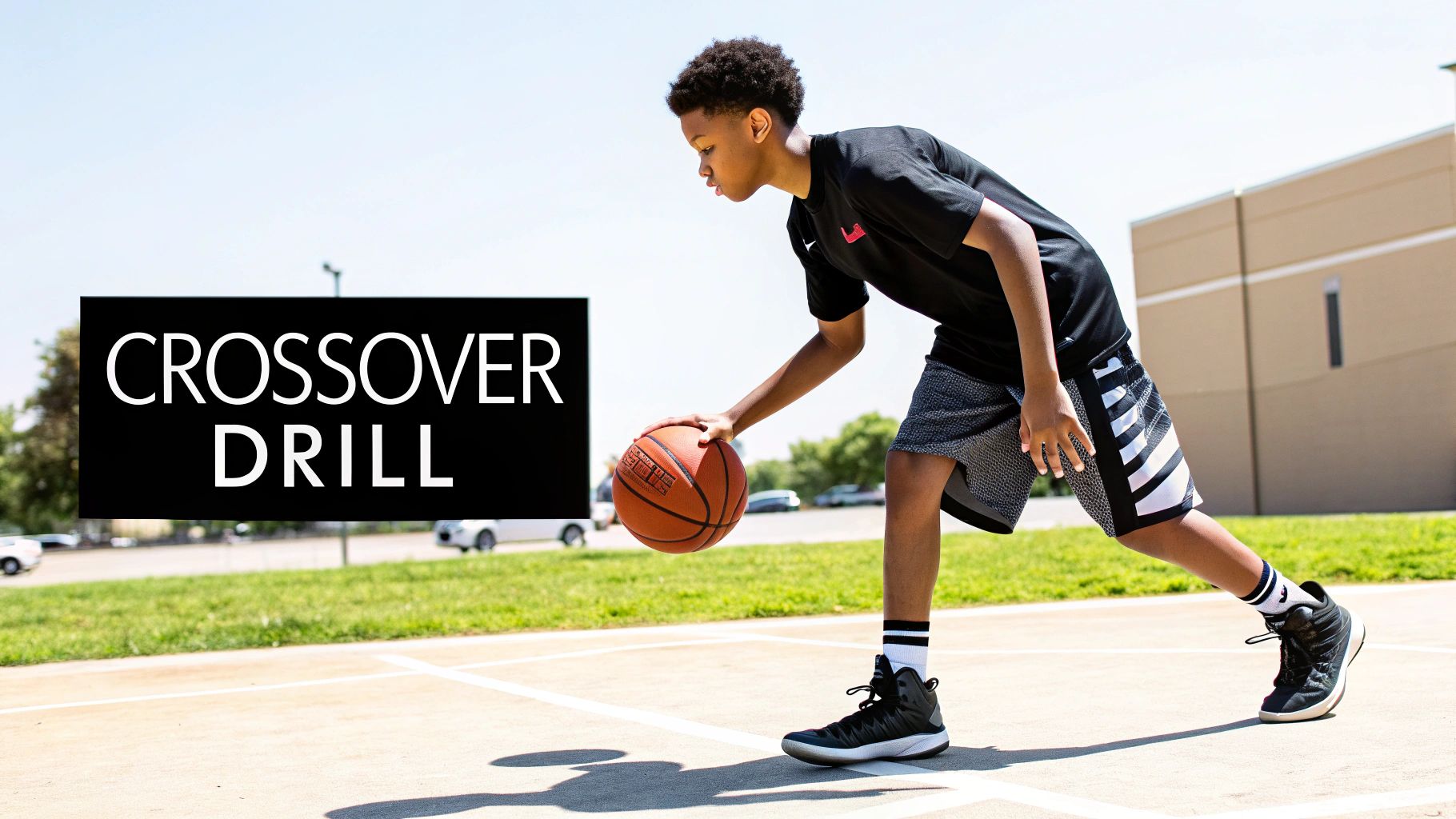
The Crossover Dribble is one of the most iconic and effective moves in basketball, making it an essential part of any list of beginner basketball dribbling drills. It serves as a player's primary tool for changing direction, creating space from a defender, and attacking the basket. The drill involves dribbling the ball from one hand to the other in a quick, "V"-shaped motion across the front of the body.
For beginners, mastering the crossover builds confidence and introduces the concept of using dribble moves to gain an advantage. Popularized by players like Allen Iverson and Kyrie Irving, this fundamental move is the building block for more complex combinations and is crucial for developing a dynamic offensive skill set. It teaches players to be deceptive and react quickly to defensive pressure.
How to Perform the Crossover Dribble Drill
Get into Stance: Start in a low athletic stance with feet shoulder-width apart and knees bent. This provides balance and power.
Start the Dribble: Begin dribbling the ball with your right hand on the right side of your body. The dribble should be at about knee height.
Initiate the Crossover: Push the ball firmly from your right hand across the front of your body toward your left hand. The bounce point should be in the middle of your stance.
Receive the Ball: As the ball bounces, receive it with your left hand. Immediately control it and continue dribbling on your left side.
Continue the Motion: Repeat the process, crossing the ball back over from left to right. Practice this back-and-forth motion to build a rhythm. For a more complete understanding of how this move fits into player development, discover our approach to basketball training.
Coaching Cues and Common Mistakes
Keep Your Head Up: As with all dribbling, looking at the ball is a common mistake. Players must learn to feel the ball's position while scanning the court.
Low and Wide: The crossover should be low (below the knees) and wide enough to clear the defender’s reach. A high, narrow crossover is easily stolen.
Pound the Ball: Encourage players to dribble the ball with force. A powerful dribble is quicker and harder for a defender to predict and intercept.
This drill is fundamental for any aspiring player. By mastering a controlled and explosive crossover, a beginner unlocks the ability to navigate the court effectively and become a legitimate offensive threat.
6. Zig-Zag Dribble Drill
The Zig-Zag Dribble Drill is a crucial next step in a player's development, transitioning them from stationary control to dynamic, game-like movement. This drill teaches beginners how to change direction while maintaining possession of the ball, simulating the cuts and advances needed to navigate the court against defenders. It is one of the most effective beginner basketball dribbling drills for building a foundation of controlled movement with the ball.
This exercise requires players to dribble in a diagonal, zig-zag pattern, typically from one baseline to the other using cones as markers. The focus is on executing a sharp change of direction at each cone, pushing off the outside foot and using a crossover or another basic move to protect the ball while switching hands and direction.
How to Perform the Zig-Zag Dribble Drill
Set Up Cones: Place 5-6 cones in a zig-zag pattern down the length of the court. Each cone should be about 10-15 feet apart, creating 45-degree angles.
Start Dribbling: Begin at the first cone, dribbling with the hand furthest from the next cone. For example, if the next cone is to your right, dribble with your left hand.
Change Direction: As you approach a cone, plant your outside foot and perform a crossover dribble, switching the ball to your other hand. Explode off that foot toward the next cone.
Repeat the Pattern: Continue this pattern, changing hands and direction at each cone until you reach the end of the line.
Focus on Form: Walk through the drill first to master the footwork and dribble timing before increasing speed.
Coaching Cues and Common Mistakes
Stay Low and Athletic: Players often stand up straight when changing direction. Remind them to keep their knees bent and their center of gravity low for better balance and power.
Protect the Ball: Emphasize keeping the body between the ball and an imaginary defender. The change-of-direction dribble should be quick and low.
Don't "Carry" the Ball: A common mistake is for a beginner's hand to go under the ball during the crossover. Ensure they are pushing the ball from the side, not scooping it.
By incorporating the Zig-Zag Dribble Drill, young players learn the essential skill of moving with the ball purposefully. It builds the coordination, footwork, and confidence needed to become an effective ball handler in any game situation.
7. Dribble Tag Game
The Dribble Tag Game transforms fundamental skill practice into an exciting, competitive activity. This drill is one of the most effective beginner basketball dribbling drills for youth players because it masks repetitive practice with the fun of a classic playground game. It teaches players to dribble with their heads up, change directions quickly, and maintain ball control while reacting to an opponent in a dynamic environment.
In this drill, players dribble within a defined space while one player, designated as "it," tries to tag another. Both the chaser and the players being chased must maintain a legal dribble at all times. This game-based approach naturally builds court awareness, evasive maneuvers, and dribbling under pressure, making it a favorite for coaches looking to keep young athletes engaged.
How to Play Dribble Tag
Set the Boundaries: Use cones to mark a clear, safe playing area. A smaller space increases the difficulty, while a larger one is better for younger beginners.
Assign Roles: Choose one player to be "it." All other players, each with their own basketball, spread out inside the boundaries.
Start the Game: On the coach's signal, all players begin dribbling. The player who is "it" must dribble while chasing and attempting to tag another player with their free hand.
Tag and Switch: Once a player is tagged, they become the new "it," and the game continues without interruption.
Establish Rules: If a player dribbles out of bounds or loses control of their ball (a double dribble or carry), they automatically become "it."
Coaching Cues and Common Mistakes
Keep Your Head Up: This is the most critical skill reinforced by the game. Players cannot avoid being tagged if they are staring at their basketball.
Use Your Body to Protect the Ball: Encourage players to use their non-dribbling arm and body to shield the ball from the person who is "it."
Change Speeds and Directions: Players will quickly learn that simply dribbling fast in a straight line isn't enough. Quick stops, crossovers, and directional changes are key to evasion.
Dribble Tag is a perfect drill to end a practice session on a high note, burning off any remaining energy while reinforcing core skills. It's a fantastic way to assess which players can handle the ball under pressure and who still needs to work on looking up. Many youth programs, like those found in a well-structured basketball league, use this game to build foundational skills in a fun, stimulating setting.
8. Mirror Dribbling (Partner Drill)
Mirror Dribbling is a dynamic and engaging partner drill that shifts the focus from solo practice to reactive ball handling. It's one of the most effective beginner basketball dribbling drills for developing a player's ability to watch an opponent while maintaining control of the ball. This drill introduces an element of unpredictability, forcing young players to adapt their dribble on the fly.
In this drill, two players face each other, each with a basketball. One player acts as the "leader," performing various dribbling moves, while the other player acts as the "mirror," attempting to replicate the leader's actions in real-time. This interactive setup builds not only dribbling skills but also crucial observation and reaction time, simulating the experience of facing a live defender.
How to Perform Mirror Dribbling
Set Up: Two players stand facing each other, about 6 to 8 feet apart, both in a low athletic stance. Each player has a basketball.
Designate Roles: One player is the "leader," and the other is the "mirror."
Start the Drill: Both players begin dribbling. The leader initiates a move, such as a crossover, a side-to-side dribble, or changing dribble height.
Mirror the Action: The mirror player must watch the leader closely and immediately replicate the same move.
Switch Roles: After a set amount of time (e.g., 30-60 seconds), the players switch roles so both get a chance to lead and follow.
Coaching Cues and Common Mistakes
Head and Eyes Up: This drill naturally forces players to look up at their partner instead of down at the ball, reinforcing a critical habit.
Start Slow: Leaders should begin with slow, deliberate movements to give their partner a chance to succeed before increasing the speed and complexity.
Exaggerate Movements: Encourage leaders to make their moves big and clear. This helps the mirror player identify the action and react appropriately.
Stay in Stance: A common mistake is for players to stand up straight, especially when they are focused on their partner. Remind them to stay low in their athletic stance for balance and power.
Mirror Dribbling is a fantastic way to break up the monotony of individual drills and introduce a fun, competitive element to practice. It effectively teaches young athletes to handle the ball while processing external information, a skill essential for game-day success.
8-Drill Beginner Dribbling Comparison
Drill | Implementation Complexity 🔄 | Resource Requirements ⚡ | Expected Outcomes ⭐📊 | Ideal Use Cases 💡 | Key Advantages |
|---|---|---|---|---|---|
Stationary Ball Handling (Figure-8 Dribble) | Low — stationary, beginner-friendly | 1 ball, minimal space | ⭐⭐ — finger control, ambidexterity, muscle memory | Beginners, warm-ups, small spaces | Safe, easy progress tracking, low injury risk |
High-Low Dribble Exchange | Moderate — timing & height changes | 1 ball, open lane; optional cones | ⭐⭐⭐ — adaptive dribbling, rhythm control under pressure | Skill camps, game-prep drills | Direct game transfer, adjustable difficulty |
Cone Weave Dribble | Moderate — directional movement & navigation | Cones (6+), court space | ⭐⭐⭐ — footwork, spatial awareness, directional control | Progression to game-like navigation, group drills | Game-realistic movement, clear visual markers |
Two-Ball Dribble (Alternating Hands) | High — strong hand independence required | 2 balls, open space | ⭐⭐⭐⭐ — rapid ambidexterity and hand strength gains | Intermediate players, advanced skill-building | Fast measurable improvement, strengthens weak hand |
Crossover Dribble Drill | Moderate — timing & coordination focus | 1 ball, moderate space | ⭐⭐⭐ — change-of-direction, space creation | Core training, offensive move development | High game applicability, foundation for advanced moves |
Zig-Zag Dribble Drill | Moderate — continuous directional changes | Half/full court space | ⭐⭐⭐ — endurance, court awareness, controlled movement | League prep, conditioning + skills | Builds endurance while training ball control |
Dribble Tag Game | Low — game-based, rule-driven | Multiple balls, confined area | ⭐⭐ — decision-making, dribbling under pressure | Youth sessions, engagement-focused practice | High engagement, fun pressure simulation |
Mirror Dribbling (Partner Drill) | Low–Moderate — depends on leader complexity | 2 players, 1 ball each, small space | ⭐⭐⭐ — responsiveness, observational learning | Small-group or private training, peer learning | Immediate feedback, builds communication and accountability |
Putting It All Together: Your Next Steps on the Court
You've just explored a comprehensive toolkit of foundational basketball drills, from the Stationary Figure-8 to the dynamic Mirror Dribbling partner exercise. Each one serves a unique purpose, building hand-eye coordination, ambidextrous control, and on-court awareness. The journey from a beginner who nervously watches the ball to a confident player who dribbles with their head up starts right here, with these fundamental movements.
The real key to progress isn't just knowing these drills; it's understanding how to use them effectively. Remember, consistency is far more valuable than intensity. Short, focused practice sessions several times a week will yield better results than one long, exhausting session on the weekend. This approach helps build muscle memory without leading to burnout, which is especially important for young athletes.
From Drills to On-Court Confidence
As you or your young player becomes more comfortable, the next step is to combine these skills. Think of each drill as a single word in a new language. Your goal is to start forming sentences.
Combine Movements: Try performing the Cone Weave Dribble, but execute a Crossover Dribble at each cone.
Vary the Speed: Practice the Zig-Zag Dribble, alternating between a slow, controlled pace and a quick burst of speed.
Add a Challenge: Can you perform the Two-Ball Dribble while walking, or even jogging lightly in place?
This process of integration is where true skill development happens. It transforms mechanical repetition into fluid, instinctive action. A player who can seamlessly transition between a High-Low Dribble and a Crossover to evade a defender is a player who is truly in control. For those looking to optimize their movements and prevent injury, a deeper understanding of the science of movement and sports biomechanics can provide a significant advantage, helping you understand why certain techniques are more effective.
Embracing the Learning Curve
Finally, remember that progress is never a straight line. There will be days when the ball feels like a friend and days when it seems to have a mind of its own. This is a normal and essential part of the learning process. The most important takeaway from this guide to beginner basketball dribbling drills is to foster a love for the game.
Celebrate small victories, like completing a drill without losing the ball or executing a crossover more smoothly than last week. By focusing on gradual improvement and maintaining a positive attitude, you are building not just a skilled basketball player, but a resilient and confident individual. The court is a classroom for life lessons, and the dribble is your first step onto it.
Ready to take your child's skills from the driveway to a dedicated, supportive team environment? At JC Sports Houston, we specialize in developing young athletes in Humble, Kingwood, and Atascocita through fun, engaging, and fundamentally-sound basketball programs. Visit our website to learn more about our leagues, camps, and training sessions designed to build confidence and a lifelong love for the game.
Comments