

A Parent’s Guide to the Long Term Athlete Development Model

When you build a house, you don't start with the roof. You pour a solid, reliable foundation first. Rushing that critical first step might look like fast progress, but it’s a surefire way to guarantee structural problems down the road.
The Long Term Athlete Development (LTAD) model applies this exact same logic to our kids. Think of it as the essential blueprint for a child’s entire athletic journey. It’s a research-backed framework designed to build athletes from the ground up, the right way.
Building Athletes for Life, Not Just for a Season
This child-first approach is all about prioritizing broad physical skills—like running, jumping, throwing, and balance—and a genuine love for movement before pushing intense, sport-specific training.
The goal isn't to create a seven-year-old champion who burns out by age twelve. Instead, it’s about nurturing a healthy, capable, and confident person who enjoys being active for life, whether they become a pro athlete or just play in a fun rec league as an adult.
A Marathon, Not a Sprint
At its core, the LTAD philosophy is simple: becoming an athlete is a long-term process. It's not a race. This globally recognized framework, pioneered by sport scientist Istvan Balyi, is the gold standard used by top sports nations like Canada, the UK, and Australia because it just plain works.
It recognizes that reaching peak performance is a journey that often takes 8 to 12 years of deliberate, well-planned training. You can learn more about the framework's origins and its global impact here.
This patient, smart approach sets our kids up for lasting success by:
Preventing Burnout: By keeping things fun and varied in the early years, it avoids the mental and physical fatigue that comes from specializing too soon.
Reducing Injury Risk: A strong foundation of fundamental movement skills creates more coordinated and durable athletes who are far less likely to suffer from overuse injuries.
Maximizing Potential: It lines up specific types of training with key developmental windows, making sure kids learn the right skills at exactly the right time.
The LTAD model completely shifts the focus from winning at all costs to developing the whole child. It asks a powerful question: are we preparing our kids for a single season, or are we preparing them for a lifetime of health, confidence, and achievement?
Ultimately, the Long Term Athlete Development model gives parents and coaches a proven roadmap. It ensures every stage of the journey is purposeful, positive, and designed to help young athletes reach their full potential without sacrificing their long-term well-being.
Breaking Down the LTAD Model: Stage by Stage
The Long Term Athlete Development model isn't some rigid, complicated rulebook. It’s better to think of it as a roadmap for your child's athletic journey, with different stages designed to meet them exactly where they are. We’re not trying to create mini-professionals; we’re building a foundation of fun, skill, and confidence that lasts a lifetime.
At JC Sports Houston, this philosophy is at the heart of everything we do. It’s a coach-driven, kid-focused approach that has been adopted by thousands of sports leaders around the world because it’s backed by decades of research. While the full model has evolved over time—from 7 stages to more detailed 9-stage versions for specific sports—the core principles for young children remain the same.
For your toddler in a multi-sport class or your preschooler just starting BlastBall, this means we focus on the first few building blocks. It's all about nurturing a love for movement through play.
This simple pyramid visualizes the entire journey perfectly.
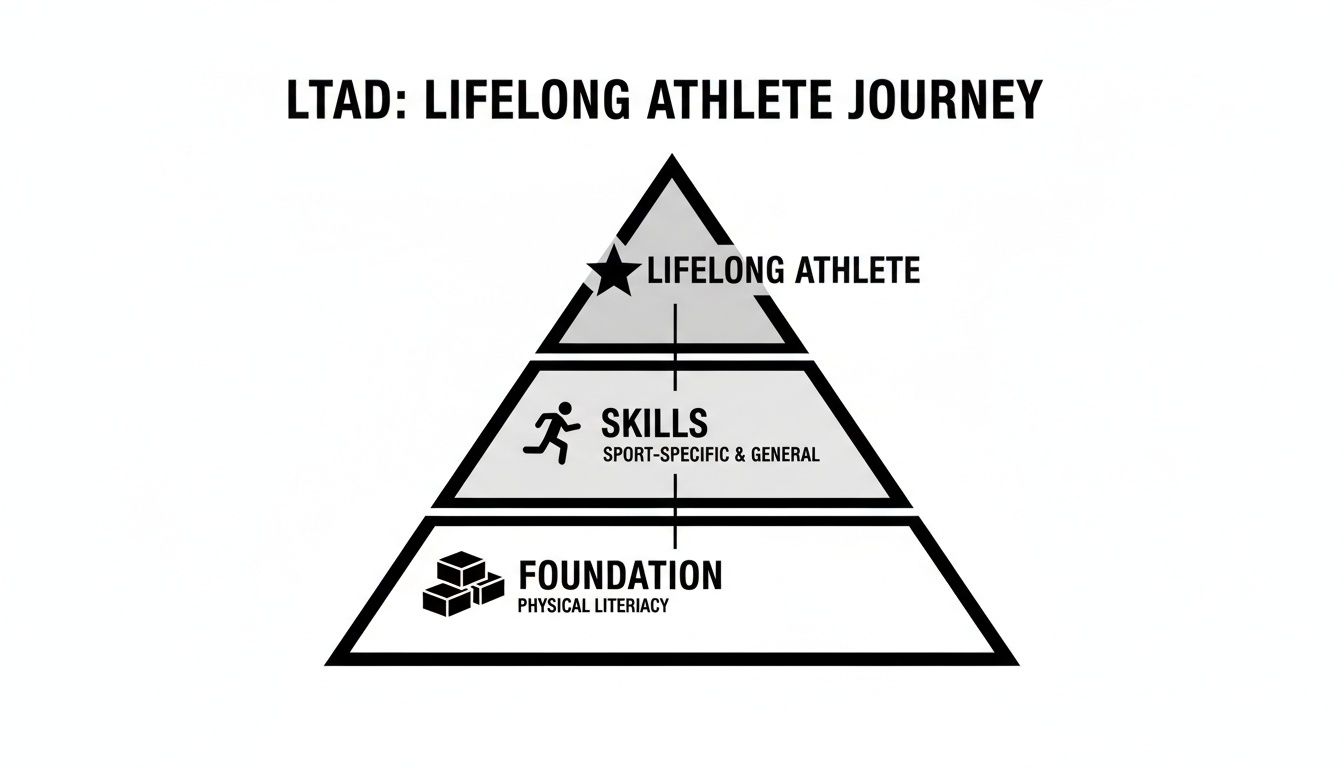
As you can see, a broad base of fundamental movements is the critical starting point. You can't build a strong house on a shaky foundation, and the same goes for athletic development. It all leads to lifelong enjoyment of sports and physical activity.
Active Start: The Joy of Movement (Ages 0-6)
This first stage has one simple goal: fun. We’re not trying to teach complex rules or create the next soccer star. We’re just helping kids fall in love with being active. Think of it as learning the “alphabet” of movement.
During these early years, children should be exploring basic actions like running, jumping, and throwing in a playful, unstructured way. It’s about discovery, not drills.
What we’re building: Fundamental movement skills—running, hopping, catching, and throwing.
The feeling we want: Confidence and a big smile. We want kids to associate activity with joy.
How we do it at JC Sports: Our multi-sport classes for toddlers are the perfect example. We use imaginative games, colorful equipment, and tons of encouragement to make learning these core skills feel like an exciting adventure.
FUNdamentals: Nurturing Athletic ABCs (Ages 6-9)
Once a child has the basics down, we move into the FUNdamentals stage. If Active Start was about learning the letters, this stage is about turning them into simple words.
Kids are now ready for a little more structure, but the focus remains squarely on fun and skill-building, not winning or losing. This is where they learn the real ABCs of athleticism: Agility, Balance, and Coordination.
The FUNdamentals stage is arguably the most important window for skill development. If kids miss out on building this foundation, it can be much harder for them to reach their full athletic potential later on.
This is the perfect time to let them try a bunch of different things. If you're looking for ideas, check out our guide on 8 awesome sports for 5-year-olds to try in 2026.
Learning to Train: Building the Engine (Ages 8-12)
As kids approach their pre-teen years (roughly ages 9-12 for boys and 8-11 for girls), they enter the "Learning to Train" stage. The focus begins to shift from general movement skills to more sport-specific abilities. This is where structured practice starts to play a bigger role.
In this phase, young athletes learn how to train. They start developing the work habits, focus, and discipline needed for more advanced play down the road, all while continuing to build their physical skills in a positive and supportive environment.
Why Timing Is Everything in Youth Sports
Ever tried to plant a garden in the middle of winter? You wouldn't just throw seeds on frozen ground and hope for the best. To grow strong, plants need the right conditions at the right time—good soil, warm sun, and plenty of water. A child's athletic potential develops in a very similar way.
The Long Term Athlete Development model shows us that there are specific periods in a child's growth, which experts call windows of trainability. Think of these as moments when their bodies are perfectly primed to develop certain physical skills. During these windows, the "soil" is fertile for planting the seeds of speed, flexibility, and coordination.
Getting the timing right doesn't just make training more effective; it unlocks a child's full potential in a way that’s both safe and natural.
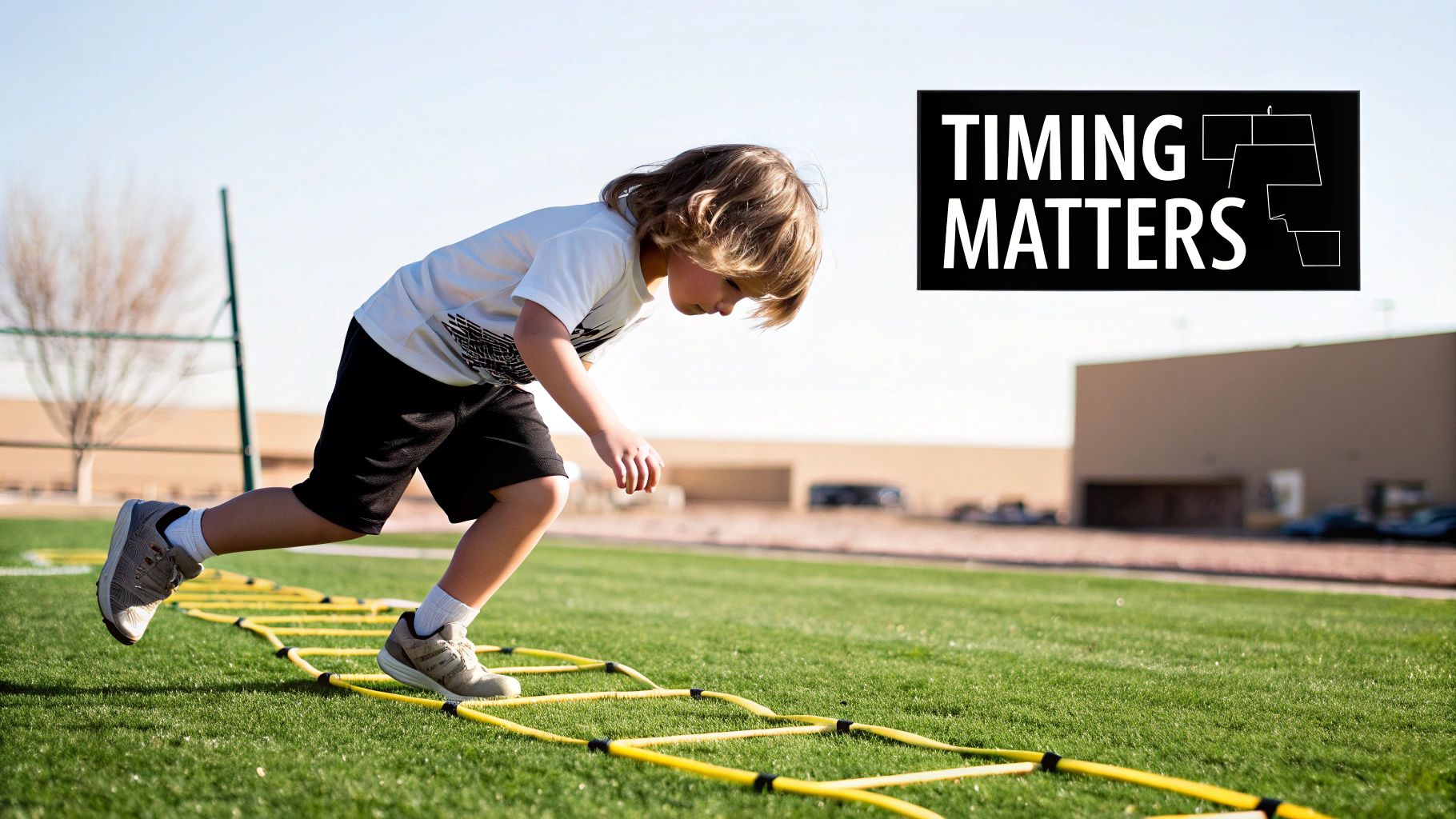
Unlocking Potential with Trainability Windows
These windows aren’t about rushing kids or pushing them too hard. It’s about being smart and working with their natural biological clock. To really nail this, it helps to have a basic understanding of general child development stages by age, since those milestones tell us when a young athlete is ready for different types of training.
Here are a few key windows to keep in mind:
Suppleness (Flexibility): The sweet spot is usually between ages 6 and 10. This is the perfect time for activities like gymnastics or martial arts that build a great foundation of mobility for life.
Speed: This one actually has two windows. The first is for agility and quickness, typically around ages 7-9. The second, which is more about pure sprinting speed, pops up right after a child’s major growth spurt.
Skill: The golden age for learning complex movements is right before puberty, from about ages 8-12. This is exactly why getting kids to play multiple sports during these years is so incredibly powerful.
The LTAD model is built on a simple truth: real success comes from matching training to a child's biological age, not just their calendar age. If you miss a window, it's not the end of the world, but it often takes a lot more work to get the same results later on.
Navigating Growth Spurts with Care
One of the most critical moments in a young athlete's journey is the adolescent growth spurt, which coaches track using Peak Height Velocity (PHV). This is that phase where kids seem to grow an inch overnight. Their bodies are changing rapidly, which can make them clumsy and more prone to injury.
Why? Because their bones are growing faster than the muscles and tendons that support them. You might notice their coordination takes a temporary hit as they get used to their longer limbs.
A smart, LTAD-based program knows this. Instead of pushing intense competition or heavy lifting during PHV, the focus shifts. We work on maintaining skills, building core strength, and reinforcing proper movement patterns to keep the athlete safe. This science-backed timing is key to preventing burnout and injury.
If you’re wondering where to begin for your child, our article on the best age to start soccer for kids is a great resource.
Putting the LTAD Model into Practice at Home
Understanding the theory behind the long term athlete development model is one thing, but the real magic happens when you start bringing its principles into your everyday life. And the good news? You don’t need a professional training facility or expensive gear to give your child a head start.
Simple, playful activities at home are more than enough to build a powerful foundation for future athletic success. The whole idea is to make it feel like fun, not like a chore. For a young child, the world is their playground, and every moment is a chance to develop the agility, balance, and coordination that underpin every sport imaginable.
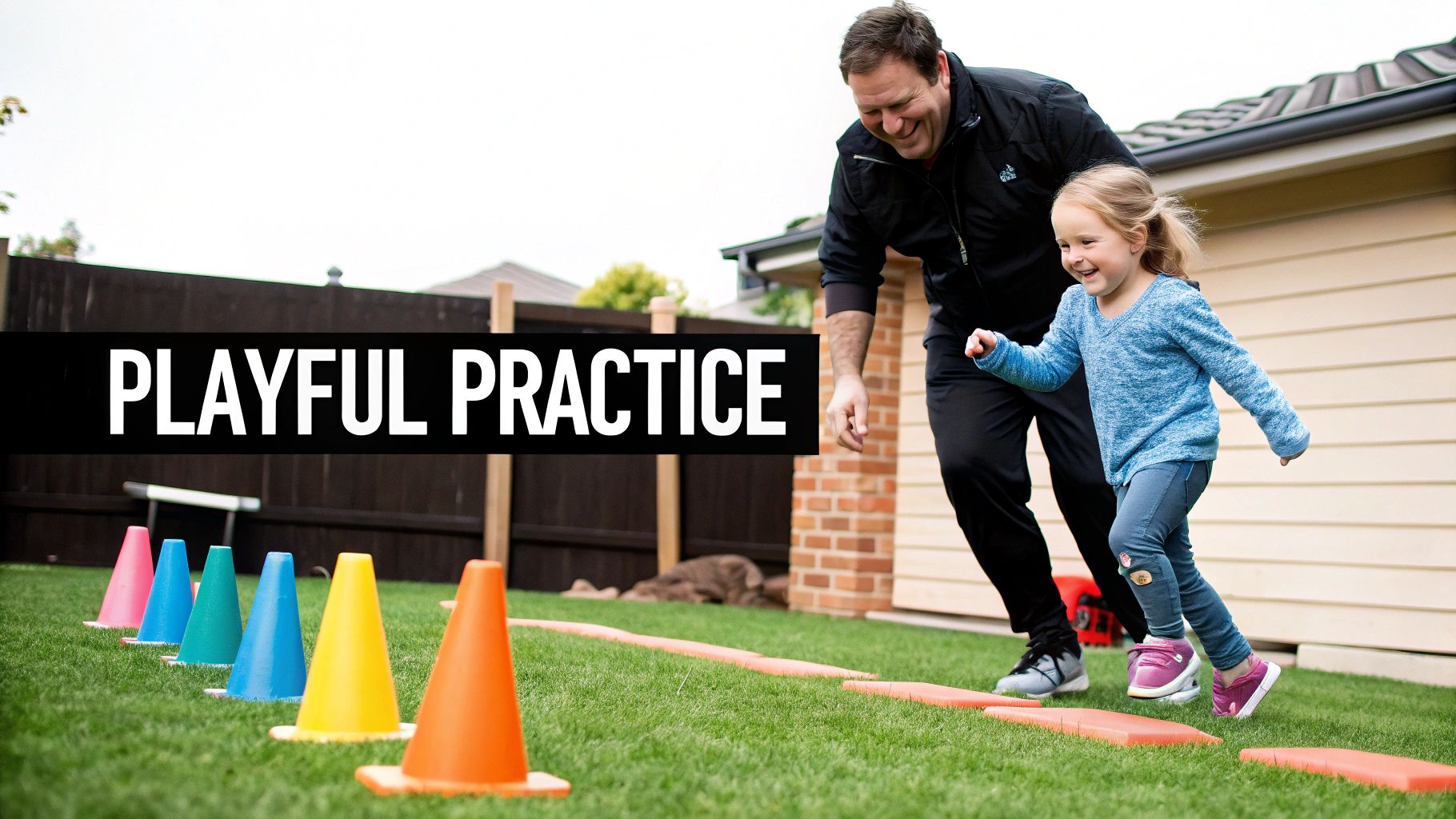
Simple Activities for Every Age
Weaving LTAD principles into your home life is probably easier than you think. It really just comes down to embracing play and encouraging a wide range of movements.
For Toddlers (Active Start Stage):At this age, it’s all about exploration. Your main goal is to make movement a joyful, natural habit.
Backyard Obstacle Course: Use pillows to crawl over, a small stool to step on, and a line of tape to balance across. This builds body awareness and gets them problem-solving without even realizing it.
Balloon Toss: Hitting a balloon back and forth is a fantastic, low-pressure way to develop hand-eye coordination. There's no fear of getting hit by a hard ball, just pure fun.
For Preschoolers (FUNdamentals Stage):Now you can introduce slightly more structured games that continue building on those core movement patterns.
Animal Walks: Challenge them to hop like a frog, crawl like a bear, or waddle like a duck. These goofy movements are incredible for developing core strength, balance, and coordination.
Ball Bonanza: Play catch with all kinds of different balls—big, small, bouncy, and soft. This helps their brain and body learn to adapt to different speeds, weights, and textures.
For School-Aged Kids (Learning to Train Stage):Here, the focus shifts toward refining skills and, most importantly, fostering a genuine love for being active. The single best thing you can do is resist the urge to specialize in one sport too early.
Multi-Sport Mentality: Encourage them to try a different sport each season. The skills learned in soccer (footwork), baseball (throwing), and basketball (jumping) all complement one another, building a far more resilient and well-rounded athlete. Our guide to strength and conditioning offers more insight on creating this versatile base.
What to Look For in a Youth Sports Program
As you start looking at programs outside the home, keep these LTAD principles in your back pocket. A great program should feel like a natural extension of the positive, play-based environment you’re building.
A program's philosophy is so much more important than its win-loss record. Look for coaches who prioritize skill development, positive reinforcement, and equal playing time, especially for younger kids.
Here’s a quick checklist to help you out:
Is the focus on fun? Kids who actually enjoy what they're doing are the ones who stick with it long-term.
Do coaches teach the fundamentals? Look for an emphasis on proper technique, not on complex plays or winning at all costs.
Is multi-sport participation encouraged? The best programs understand that a diverse athletic background is a huge asset.
Are the activities age-appropriate? The demands of the program should match your child's physical and emotional readiness.
Finally, remember that all this amazing activity needs the right fuel. Providing good nutrition is a key part of the puzzle. Having access to healthy recipes for athletes can make a huge difference in their energy and recovery. By pairing smart play with good food, you create an unbeatable environment for your child to thrive.
Creating the Right Environment for Young Athletes
Understanding the theory behind the Long Term Athlete Development model is a great start. But how does it actually look on the field?
At JC Sports Houston, we don’t just talk about these principles—we build our entire coaching philosophy around them. Every camp, class, and league is designed to be the real-world application of this smart, sustainable approach to youth sports.
It’s about way more than just teaching kids how to kick a ball or swing a bat. We’re focused on creating an environment that nurtures their overall development, ensuring they build both skill and a genuine passion for being active. This is where the concepts of LTAD truly come to life.
More Touches, More Decisions, More Fun
One of the cornerstones of our program is the use of small-sided games. Instead of having young players wander aimlessly on a huge field, we shrink the playing area. This simple change has a massive impact.
In a small-sided game, every child is constantly involved. They get far more touches on the ball, make more decisions, and have more opportunities to succeed (and fail!) in a low-pressure setting. This method perfectly aligns with the ‘FUNdamentals’ and ‘Learning to Train’ stages of the LTAD model, accelerating skill acquisition in a way that just feels like pure play.
A young athlete's confidence is their most valuable asset. Our primary goal is to protect and grow that confidence by creating a positive, encouraging atmosphere where kids feel safe to try new things and make mistakes without fear.
Building Resilience, Not Resumes
Youth sports burnout is a real problem, often stemming from too much pressure and not enough fun. We see our positive, confidence-building atmosphere as the best defense against it. Our motto, “Developing well rounded, creative players,” guides every single interaction our coaches have with your child.
We focus on celebrating effort, creativity, and teamwork over just the final score. This approach ensures that kids associate sports with positive feelings, which is the key to fostering a genuine, lifelong love for the game.
Positive Reinforcement: Our coaches are trained to use encouragement and specific, constructive feedback that builds kids up.
Emphasis on Creativity: We want players to be creative and try new moves! This isn't just about sports; it's about fostering problem-solving skills they can use anywhere.
Focus on the Process: We define success by personal improvement and having fun, not just by winning or losing.
By making every session an enjoyable experience, we help children build the physical skills and the emotional resilience they need for long-term participation. This is how the Long Term Athlete Development model moves from a theoretical framework to a practical, powerful tool for raising happy, healthy, and capable young athletes.
Your Top Questions About Athlete Development, Answered
Jumping into the world of youth sports can feel like a lot, especially when you start hearing terms like "long term athlete development." It's totally normal to wonder how these big ideas apply to your kid. We get these questions all the time from parents, so we’ve put together some straight answers to the most common ones.
Our goal is to help you feel confident and equipped to make the best decisions for your young athlete. Let's clear up some of the things you might be thinking about on the sidelines or in the car after practice.
My 5-Year-Old is Great at Soccer. Should We Just Focus on That?
This is probably the #1 question we hear from parents, and the LTAD model is really clear on this: no, not yet. Pushing a child to specialize before they're 12 or 13 can backfire, leading to a higher risk of physical burnout and mental fatigue. The early years—the Active Start and FUNdamentals stages—are all about building a wide foundation of skills, not drilling down on just one.
This is exactly why our multi-sport classes at JC Sports Houston are so popular. We want kids to try everything! This approach doesn't just build better all-around athleticism; it helps them figure out what they truly love to do, which is the key to staying active for life.
Is My 10-Year-Old Too Old to Start a New Sport?
Absolutely not! In fact, 10 is a fantastic age to jump into something new. The long term athlete development model isn't a strict rulebook; it's a flexible guide. A 10-year-old falls right into the "Learning to Train" stage, which is the perfect time to start building sport-specific skills and a real passion for a game.
Our coaches are pros at welcoming new players and getting them up to speed in a way that’s encouraging, not intimidating. The focus is always on personal progress and having fun. It’s never, ever too late to discover a new sport.
How Does This LTAD Thing Actually Prevent Burnout?
Burnout is a real problem in youth sports. It happens when the pressure to win and the intensity of training get cranked up way too early. The LTAD framework is the perfect antidote because it’s designed around age-appropriate development and, most importantly, fun.
By making sure the training load matches where a child is at physically and mentally, the model keeps sports from feeling like a job.
Burnout isn't just about being tired. It's about losing the joy of playing. LTAD is all about protecting that joy by putting skills and positive experiences first, not pressure.
This philosophy is at the heart of everything we do. We focus on building a love for the game first, creating a positive foundation that keeps kids happy, healthy, and playing for years to come.
What Is "Physical Literacy" and Why Does It Matter?
Think of physical literacy like learning the ABCs before you can read a book. It’s the absolute foundation for all athletic skills. In short, it’s about mastering fundamental movements—running, jumping, throwing, catching, and kicking.
A child who develops physical literacy has the confidence and ability to try any sport or activity and feel successful. Our toddler and preschool programs are built specifically to teach these building blocks, giving kids the tools they need to thrive in whatever sport they choose down the road.
At JC Sports Houston, we don’t just talk about these principles—we put them into practice every single day to help your child grow. We’re all about building confident, well-rounded players who truly love the game.
Ready to see how it all works? Sign up for a free trial session and let your child experience our positive, skill-building environment for themselves
Comments