

How to Improve Soccer Skills A Parent's Practical Guide

If you're trying to figure out how to improve soccer skills, the path forward is simpler than you might think. It all comes down to mastering the four fundamental pillars of the game: dribbling, passing, shooting, and first touch. Consistent, focused practice in these areas is what builds a reliable foundation for success on the field.
Building a Strong Foundation in Core Soccer Skills
Every great soccer player, from the local youth leagues to the world stage, is built on a solid mastery of the same core abilities. Before you even think about complex formations or tactical schemes, the real work begins with the ball at your feet.
For young players, the journey to becoming a confident, creative player starts with thousands of touches. Each touch reinforces the crucial connection between their mind, their feet, and the ball. This section will break down the essentials into practical drills you can use right away.
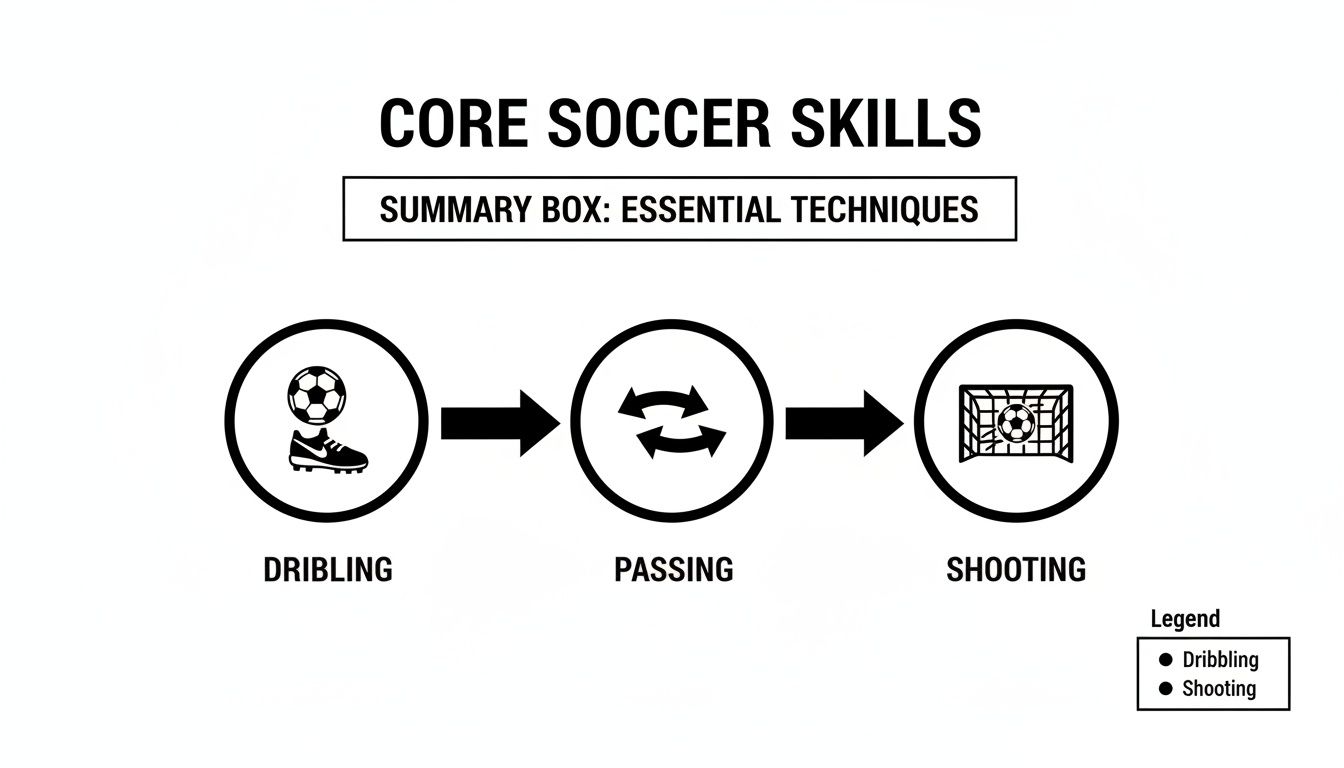
It's important to remember that dribbling, passing, and shooting are all connected. Developing them together is what creates a truly well-rounded and dangerous player.
Drills for Young Players Ages 3-5
For our littlest athletes in the 3-5 age range, the goal isn't technical perfection—it's about making the soccer ball a friend. The entire focus should be on fun, movement, and developing basic motor skills.
Red Light, Green Light: A classic game that gets kids to start and stop dribbling on command. It’s fantastic for teaching them to control the ball while listening for instructions.
Follow the Leader: You dribble slowly around the yard, and your child follows. This is a great, low-pressure way to encourage them to keep their head up and the ball close.
Animal Dribbling: Make it a game! Call out different animals. A "mouse" means tiny, quick touches. An "elephant" means big, slow touches. It turns a foundational skill into a playful activity.
At this age, every minute spent with the ball is a victory. Keep sessions short and sweet (15-20 minutes) and always celebrate the effort, not the outcome. The number one goal is to make them love having a ball at their feet.
Drills for Developing Players Ages 6-12
As kids get older, they’re ready for more structured drills that start to mimic real-game situations. This is the prime time to introduce more technical details, like using different surfaces of the foot to control and pass the ball.
For players in the 6-12 age group, skill development becomes more intentional. Here are a few drills that really move the needle:
Cone Weaving: Set up a line of 5-8 cones about two feet apart. Have your child dribble through them using only their right foot, then only their left, and finally weaving with both. This is a must-do drill for building close control and agility.
Partner Passing Gates: Use cones to set up several small "gates." With a partner, players pass the ball back and forth, trying to get it through a gate. This sharpens passing accuracy and teaches them how to weight a pass correctly.
First Touch Boxes: Create a small square with cones (about 5x5 yards). Stand outside the box and pass the ball to your child inside. Their goal is to control the pass with their first touch and keep it inside the square. It’s a simple but powerful drill for a crucial skill.
These exercises are designed to improve not just physical skills but also soccer IQ. They teach players to think ahead, control the ball under pressure, and make quicker decisions.
To take it a step further, integrating these soccer-specific drills with a dedicated strength and conditioning program for young athletes can significantly boost their power, speed, and even help prevent injuries. Consistency here is everything.
Age-Appropriate Soccer Skill Focus
To help you put it all together, this table breaks down where the focus should be for each age group. It’s a great way to set realistic expectations and find the right training environment.
Age Group | Primary Skill Focus | Drill Example | JC Sports Program Match |
|---|---|---|---|
3-5 | Fun, coordination, basic ball familiarity, and listening skills. | "Red Light, Green Light" Dribbling Game | Toddler Multi-Sport or Soccer Sprouts |
6-8 | Dribbling with all surfaces of the feet, introductory passing, and basic shooting. | Cone Weaving for close control | Youth Soccer League or Skills Clinics |
9-12 | First touch under pressure, passing accuracy/weight, and game-like decision-making. | "First Touch Boxes" or Partner Passing Gates | Advanced Skills Training or Competitive League Preparation |
Using this as a guide ensures that practice stays both fun and effective, helping your young player build skills progressively without feeling overwhelmed.
Designing a Weekly Practice Plan That Actually Works
Individual drills are great, but the real magic happens with consistency. A structured weekly plan is what turns random practice sessions into real, noticeable improvement. Without a routine, it's just too easy to skip days, neglect certain skills, or lose momentum altogether.
A great plan doesn't have to be complicated. All it needs is balance and purpose. The goal is to build a habit of deliberate practice that feels productive but, just as importantly, is still fun.
Structuring Your Training Sessions
Every single practice, whether you've got 45 minutes or a full 90, should have a logical flow. A well-designed session gets a player warmed up, mentally dialed in, and gives them a chance to use their new skills in a game-like setting. This structure is key to maximizing learning without causing burnout.
Here’s a simple, effective blueprint we use all the time:
Dynamic Warm-Up (5–10 minutes): Get moving from the start. Think high knees, butt kicks, and leg swings—not static stretching. This warms up the muscles properly and helps prevent injuries.
Ball Mastery (15–20 minutes): This is non-negotiable. Spend focused time on foundational touches like toe taps, tick-tocks, and box patterns. This phase wakes up the brain-to-foot connection and builds massive confidence on the ball.
Skill Focus of the Day (15–20 minutes): Now, zero in on one specific skill. Maybe Monday is all about passing accuracy. Wednesday could be shooting technique, and Friday could be focused on 1v1 dribbling moves.
Small-Sided Game (10–15 minutes): Always end with a fun, competitive game like 2v2 or 3v3. This is where it all comes together. It forces players to use their skills under pressure, which is crucial for building game intelligence and spatial awareness.
This layered approach ensures every session reinforces the fundamentals while pushing the player to apply them in scenarios that feel like a real game.
Sample Weekly Practice Templates
Let's be realistic—not every player has the same schedule. The key is to find a rhythm that fits your family's life while still getting consistent, quality touches on the ball. Whether you can commit to two days a week or four, having a plan keeps you honest.
A good plan is the bridge between knowing what to do and actually doing it. It removes the guesswork and builds a routine that fosters discipline and long-term skill acquisition.
Here are two simple templates you can adapt. Feel free to swap the "Skill Focus" days based on what your child needs to work on most.
The "Twice a Week" Player Template
This schedule is perfect for players who are balancing soccer with other activities, focusing on the highest-impact skills.
Day | Session Focus (45-60 Minutes) | Key Objective |
|---|---|---|
Day 1 | Warm-Up, Ball Mastery, Dribbling & 1v1 Moves, Small-Sided Game (1v1) | Improve confidence and creativity on the ball under pressure. |
Day 2 | Warm-Up, Ball Mastery, Passing & First Touch, Small-Sided Game (2v2) | Develop quicker, more accurate ball movement and control. |
The "Dedicated Player" Template
For the young athlete who wants to practice more often, this plan adds agility work and varies the skill focus throughout the week.
Day | Session Focus (60-75 Minutes) | Key Objective |
|---|---|---|
Day 1 | Warm-Up, Ball Mastery, Dribbling & Agility Drills (ladders/cones), Small-Sided Game | Enhance close control, foot speed, and change of direction. |
Day 2 | Warm-Up, Ball Mastery, Passing & Receiving Drills, Small-Sided Game | Increase accuracy, first touch quality, and speed of play. |
Day 3 | Warm-Up, Ball Mastery, Shooting & Finishing Drills, Small-Sided Game | Build power, precision, and composure in front of goal. |
By committing to a structured weekly plan, you're giving your player a clear roadmap. They'll be able to see and feel their own progress, which is the most powerful motivator there is for learning how to improve soccer skills for the long haul.
Using Targeted Drills for Rapid Skill Improvement
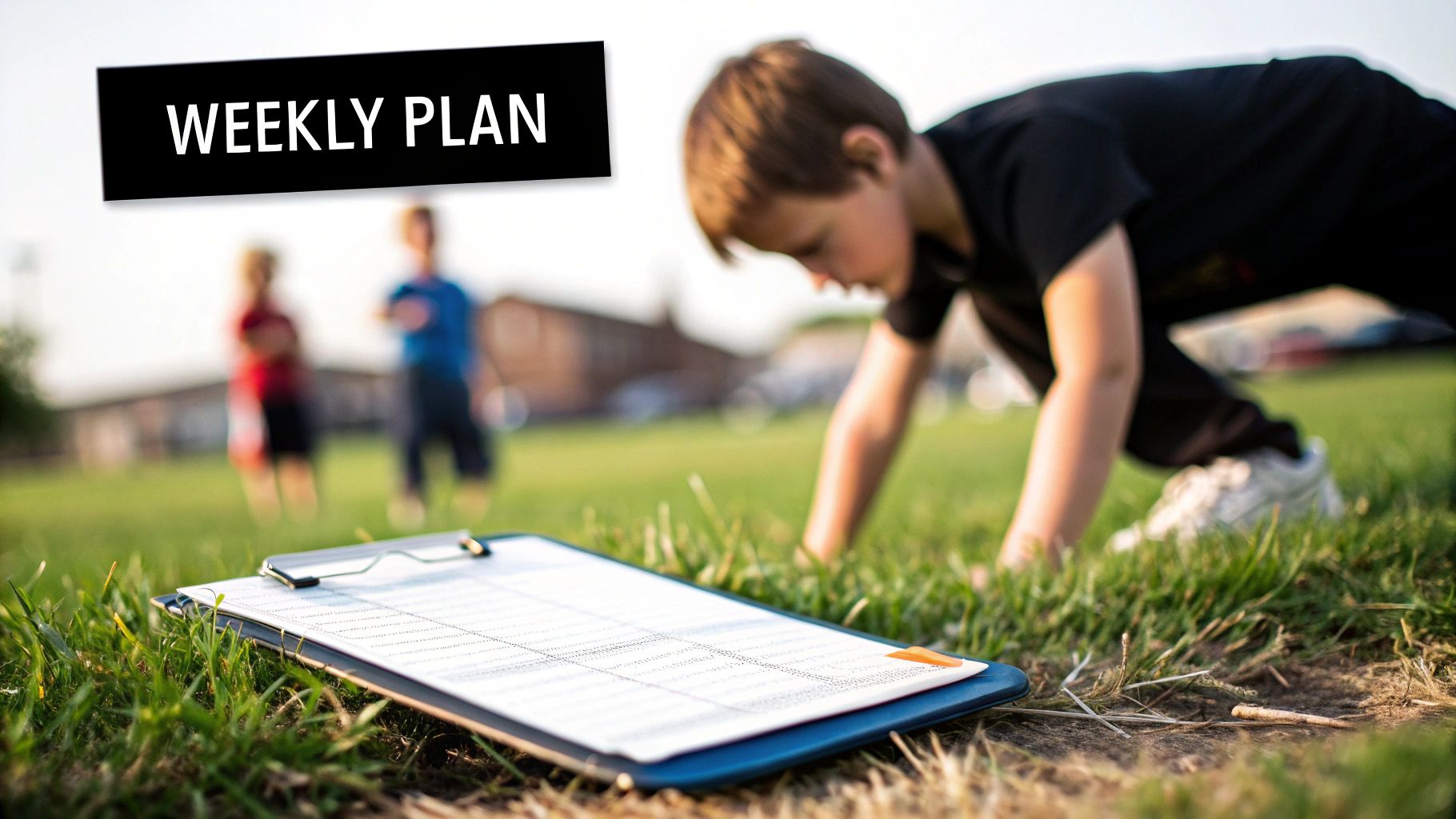
Scrimmages and small-sided games are absolutely essential for learning how to play the game. But let's be honest—they don't provide nearly enough reps to truly master a specific technique. A player might only get a handful of real chances to shoot or make a game-changing pass.
This is where targeted drills become a game-changer for any player who's serious about how to improve soccer skills quickly.
By isolating one single skill and repeating it with intense focus—a concept coaches call deliberate practice—players can fast-track their development. Instead of just hoping for an opportunity in a game, they create hundreds of those moments in a controlled practice session. This high-volume approach is the secret to building muscle memory and turning a weakness into a reliable strength.
High-Impact Drills for Passing Accuracy
Passing is the glue that holds a team together. It connects every player on the field, and when it breaks down, so does everything else. The good news? It’s one of the easiest skills to sharpen with focused repetition.
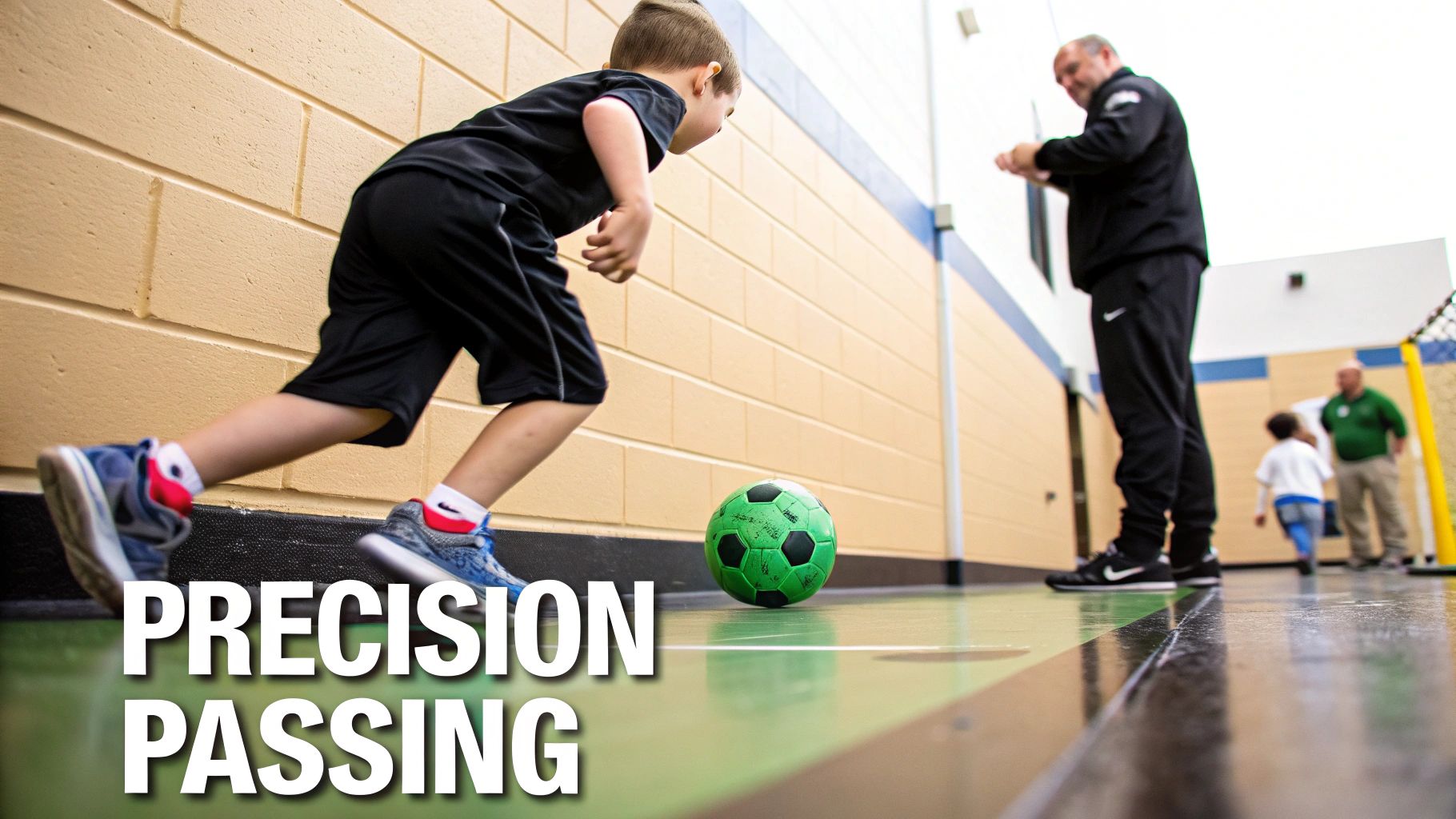
One of the simplest and most effective drills is wall passing. All you need is a player, a ball, and a solid wall. This drill forces a player to zero in on the core mechanics of a great pass:
Lock the ankle: This creates a firm, crisp contact on the ball.
Use the inside of the foot: This surface gives you the most control and accuracy.
Follow through: Pointing the passing foot toward the target is key for guiding the ball.
The wall is the perfect training partner. It sends the ball back instantly, demanding a good first touch to keep the rhythm going. Start with stationary passes, then progress by having the player jog parallel to the wall, passing and receiving on the move.
Mastering the First Touch with Purpose
A player’s first touch dictates everything that happens next. A great touch creates time and space, while a poor one invites pressure and kills the play before it even starts. The goal isn't just to stop the ball; it's to guide it into a useful space to set up the next move—whether that's a pass, a shot, or a dribble.
A player's technique is their toolbox. Deliberate practice through targeted drills is how they fill that box with reliable, high-quality tools they can pull out under pressure without a second thought.
To really sharpen this skill, the "First Touch Box" drill is fantastic. Just set up a small square with cones (about 5x5 yards). Have the player stand inside while you serve them the ball from different angles and speeds. Their challenge is to control the ball with one touch and keep it inside that box. This is a perfect simulation of receiving a pass in tight spaces and forces them to be clean and precise.
This whole philosophy is backed by research, too. In one study, a group of elite youth players who focused on Passing-Skill Training (PST) showed huge gains in side-foot kick accuracy compared to a group that just played small-sided games. It's clear that technical skills like passing are major predictors of a player's long-term success. You can dive deeper into how targeted training builds better young players in the full research on youth soccer skills.
Tapping into Modern Tools and Training Methods
Drills and practice are still the bedrock of great soccer, but today’s tools can seriously accelerate a player's growth. We now have access to data-driven feedback that, not long ago, was only available to pro academies. Weaving these resources into your training gives players a real edge.
Believe it or not, the smartphone in your pocket is one of the most effective coaching tools you have. Record your child’s shooting technique, then play it back in slow motion. Suddenly, you can both see the small details that make a huge difference.
Is their ankle locked at the moment of impact? Is their plant foot in the right spot? This simple video review turns abstract feedback like "follow through more" into a visual lesson they can immediately understand and start to correct. It’s a fast track to refining those crucial motor skills.
Going Beyond the Eye Test
Simple video playback is great, but specialized apps and wearable tech can offer even deeper insights. These tools can track metrics like speed, distance covered, and the number of touches on the ball during a session, painting a clear picture of a player’s effort and involvement.
Advanced systems are taking this even further. Some modern training tools can instantly flag a flawed first touch or a split-second delay in decision-making, giving the player immediate feedback to foster technical, tactical, and mental growth right on the spot.
Building the Complete Athlete
Real player development goes way beyond what happens on the pitch. The best training programs today take a holistic view, knowing that nutrition, mental toughness, and tactical IQ are just as vital as physical skills. Simply teaching a young player about proper hydration and what to eat before a game can have a massive impact on their stamina and focus.
A player's growth is an ecosystem. Technical skills, physical conditioning, mental resilience, and soccer intelligence must all be nurtured together. Neglecting one area will eventually limit the potential of the others.
This big-picture approach is central to proven methodologies that prioritize both ball mastery and smart decision-making. You can see how this kind of structured, progressive learning works in programs like the Coerver method at JC Sports Houston, which is designed to build creative and confident players from the ground up.
To make these off-field lessons stick, try using some powerful microlearning examples. Breaking down a complex topic like sports psychology into short, digestible bits makes it far easier for young minds to absorb. When you combine smart on-field practice with modern tools and a focus on the complete athlete, you’re giving them a powerful framework to truly improve their soccer skills and thrive.
Knowing When to Bring in Expert Soccer Coaching
Practicing at home and running through drills every week is the bedrock of any young player's development. But even the most dedicated parent-coach routine can hit a wall.
Knowing when to bring in an expert is a game-changer. It’s often the key to unlocking a young player's full potential and keeping their love for the game burning bright.
So, how do you know when it’s time? Usually, the signs are pretty clear. You might notice your child has hit a frustrating plateau. They're putting in the work but just aren't seeing real improvement in a specific area, like using their non-dominant foot or mastering 1v1 attacking moves.
Another tell-tale sign is when a player shows talent that’s starting to outpace what you can teach at home. Maybe they consistently outperform their peers and are clearly hungry for a bigger challenge. This is the perfect moment for a professional coach to step in and introduce more advanced concepts and a higher level of play.
Identifying the Need for Specialized Training
Sometimes, the need for expert coaching isn’t just about skill development—it's about a player's unique learning style or even their social needs. Some kids just come alive in a more structured, group-based setting where they can learn alongside their teammates.
Keep an eye out for these common scenarios:
Stubborn Technical Flaws: A professional coach can spot and correct small, ingrained habits in shooting form or defensive posture that are tough for an untrained eye to catch.
A Dip in Confidence: A supportive, expert coach can be an incredible mentor, helping build a player's self-belief and encouraging them to take risks on the field.
Craving a Team Environment: For some kids, the social dynamic of a clinic or camp is the biggest motivator. It pushes them to work harder and learn from others.
Expert coaching isn't just about more practice; it's about smarter practice. It turns raw effort into refined, effective technique and helps players make more intelligent decisions on the field.
When a player is ready to zero in on specific weaknesses or just wants to accelerate their growth, professional guidance is invaluable. The focused attention they get in a structured setting can make all the difference.
If you’re seeing these signs, it might be time to explore options like private soccer lab sessions. This kind of one-on-one instruction can provide the breakthrough needed to smash through barriers and reignite a player’s passion for soccer. It’s the perfect next step for a player who’s ready to level up.
Answering Your Top Questions About Soccer Skill Development
As you navigate your child's soccer journey, questions are bound to come up. You're putting in the time with drills and following the practice plan, but it's totally normal to wonder what's next or if you're doing things right. Let's tackle some of the most common questions we hear from parents.
How Much Practice is Too Much?
This is a big one. For young players, especially those under 12, the goal is always quality over quantity. A couple of focused sessions a week, maybe two or three, mixed in with plenty of unstructured free play, is more than enough. The biggest thing to avoid is burnout. We've seen it happen—it can completely extinguish a child's love for the game.
How Do We Balance Individual Skills and Team Practice?
Team training is obviously essential for learning positioning, tactics, and how to play with others. But here's the thing: it rarely provides the sheer number of touches on the ball needed to truly master a skill.
Think of it like a musician practicing scales before joining the orchestra. That at-home practice is where the real technical foundation is built.
How Can I Support My Child Mentally?
Many parents want to know how they can help build confidence and mental toughness. This is where your role beautifully shifts from "coach" to "supporter." The single most important thing you can do is praise effort and resilience, not just goals and wins.
Did they try that new move they've been practicing? Did they hustle back on defense after a mistake? Celebrating the process is what builds a strong, lasting mindset.
If you want to dive deeper, understanding a parent's guide to sports psychology for young athletes is a game-changer. It gives you the tools to create a positive environment where kids feel safe to fail, learn, and grow.
Remember, your behavior on the sidelines has a massive impact. Positive reinforcement and unconditional support are far more powerful than yelling instructions or critiquing them right after a game.
My Child is Excelling. What's the Next Step?
So, your child has a real knack for the game. They've got the fundamentals down and are hungry for a bigger challenge. What now?
When you see that exceptional skill and dedication, it's often the right time to seek out more specialized coaching. A dedicated program can introduce them to advanced techniques and a more competitive environment, giving them the push they need to see just how far they can go.
Ready to take that next step in your child's development? At JC Sports Houston, we provide expert coaching in a supportive environment that builds both skill and passion for the game. Explore our programs and sign up for a free trial today!
Article created using Outrank
Comments