

Indoor Soccer for Toddlers How It Builds Skills Safely

Your toddler runs toward the ball, stops too late, laughs, and tries again. A parent claps from the edge of the room while a coach gently turns the moment into a game. That's often what indoor soccer for toddlers looks like, and it's much less about scoring than learning how to move with confidence.
For children in the toddler and preschool years, soccer can be one enjoyable part of a full day of movement. A short class can support running, balancing, turning, and kicking, but it shouldn't replace free play, active family time, or exploration. The right program keeps expectations realistic, equipment soft, the space controlled, and the experience positive.
Welcome to Indoor Soccer for Toddlers
A first class may begin with children wandering around the room rather than forming a perfect line. One child taps the ball immediately. Another stays close to a parent. A third watches for several minutes before joining. All of those responses can be normal for young children meeting a new coach, a new space, and a new group.
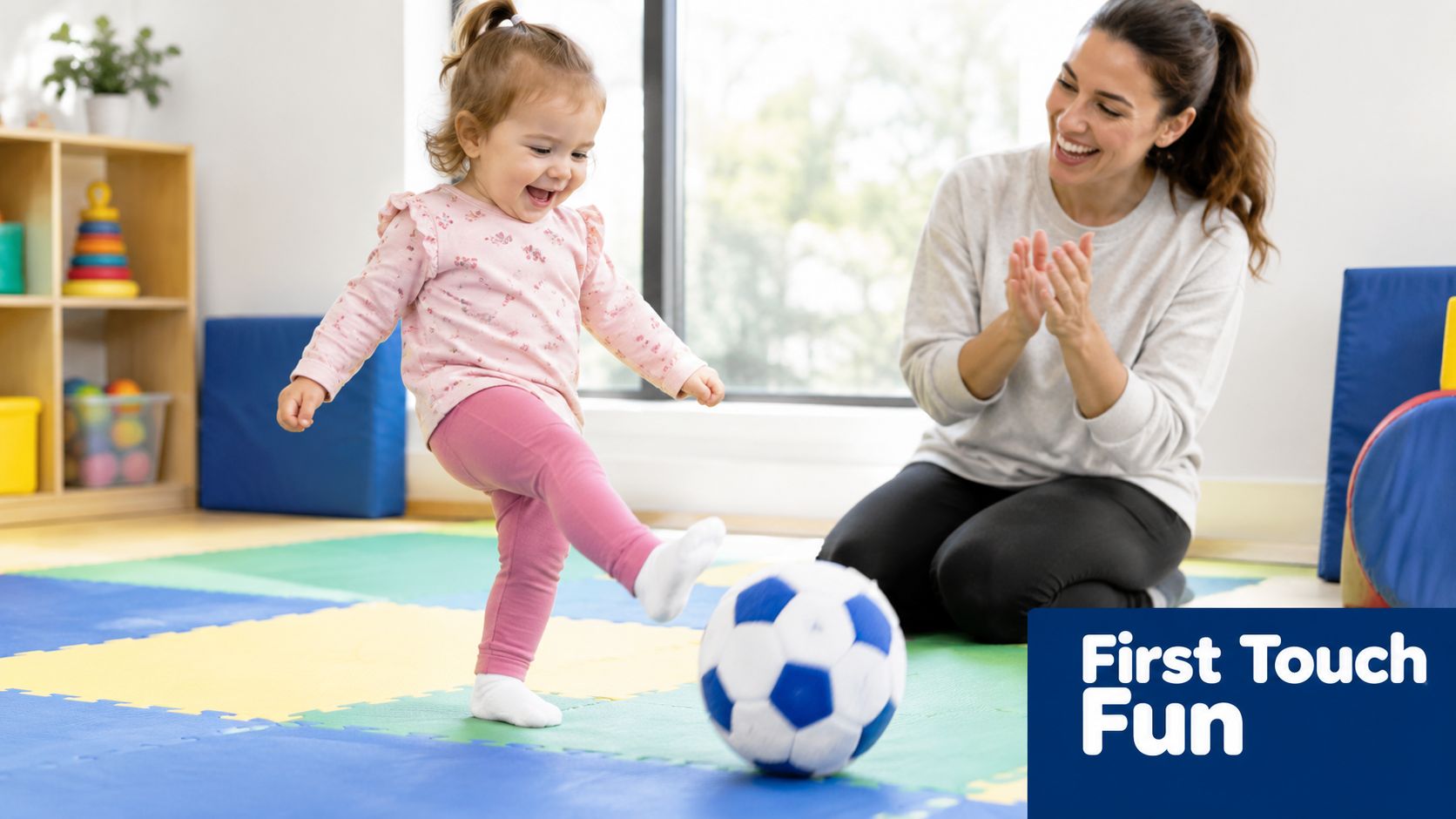
The coach's job isn't to create miniature professionals. It's to invite children into movement through simple games, friendly encouragement, and repeated opportunities to try. A toddler might chase a ball through a cone path, stop it with a foot, or kick toward a small goal. The activity may look simple, but each attempt gives the child practice with balance, timing, body control, and awareness of nearby people.
A better expectation for the first class
Parents sometimes expect a toddler soccer class to resemble an older child's training session. It usually shouldn't. Young children learn through imitation, movement, repetition, and pretend play, not through long explanations or pressure to perform a technique correctly.
Indoor space can be especially useful for families in Houston communities such as Humble, Kingwood, and Atascocita. Weather, heat, and other outdoor conditions can make plans unpredictable, while a controlled indoor setting gives children a consistent place to move. The space still needs to be well managed, but the environment can help a class continue without relying on outdoor conditions.
Who this guide is for
This guide is for parents considering organized soccer for children roughly in the toddler and preschool years. It focuses on confidence-first participation, not early competition. Your child doesn't need to know soccer rules, stay engaged every minute, or make a clean kick every time.
Look for small wins instead. Your child may become more willing to separate from you, follow a simple direction, stop without falling, or return to the ball after missing. Those moments are meaningful signs that the activity feels safe enough for learning.
What Indoor Toddler Soccer Looks Like in Practice
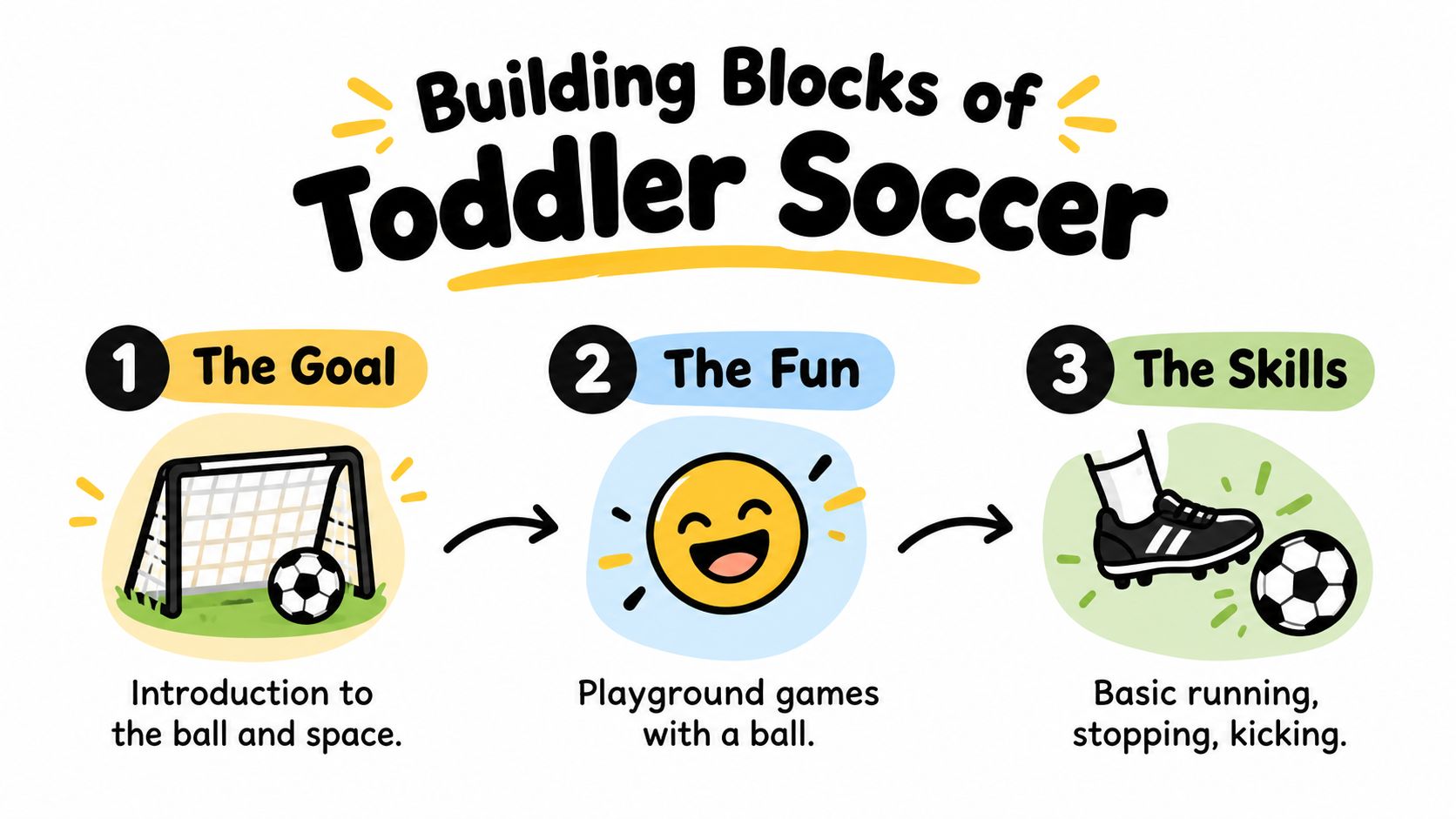
Toddler soccer works best when parents think of it as a building-block activity. Older players may practice passing patterns, positions, and tactical decisions. Toddlers are still learning the pieces underneath those skills, such as how to move forward, slow down, change direction, and coordinate a foot with a moving object.
A typical class uses a small playing area rather than a full outdoor field. Children may move between stations, follow a coach through a simple game, or play a short activity where they carry, chase, stop, or kick the ball. Small-sided games keep the environment easier to understand and give children more chances to participate instead of waiting for a turn.
The three building blocks
The goal is familiarity. Children learn that a ball can be chased, stopped, carried with the feet, and sent toward a target. The coach creates an inviting environment where touching the ball feels easy and interesting.
The fun comes through playground-style games. A coach might ask children to become animals, run to colored markers, or “rescue” balls from one side of the room. These stories give a movement task a purpose that toddlers can understand.
The skills appear inside those games. Running, stopping, turning, kicking, and balancing are practiced without making the child feel as though they're completing a technical test.
Why short bursts work
Toddlers can move intensely for a moment, pause to observe, then rejoin when something catches their attention. A strong class respects that rhythm. Demonstrations stay brief, activities change before children become frustrated, and the coach uses the same simple instruction more than once.
A child who leaves the ball to explore the room hasn't necessarily failed. The coach can bring the child back through a playful invitation, while the parent can offer calm encouragement without forcing participation. That flexibility is part of developmentally appropriate instruction.
For examples of activities that fit this format, families can explore small-sided soccer games for young players. The important question isn't whether a toddler follows the game exactly. It's whether the game gives the child safe opportunities to move, explore, and try again.
How Play Builds Motor Skills and Confidence
A toddler kicking a ball is solving a small movement puzzle. The child locates the ball, chooses an approach, places a foot, shifts weight, and regains balance. A missed kick still gives useful feedback. Changing speed, angle, or foot position can change the next result.
This is task-specific motor learning. Repeated ball play connects visual tracking, foot placement, balance, and movement control. In a small, controlled space, children can repeat these actions without long waits or the confusion of a large game.
A study of a 10-week soccer program reported stronger results in locomotion, object manipulation, balance, and overall gross motor quality among participating preschoolers than among children in a control group. The finding supports a measured view of toddler soccer. An age-appropriate class can build foundational movement while introducing the sport.
From movement to body awareness
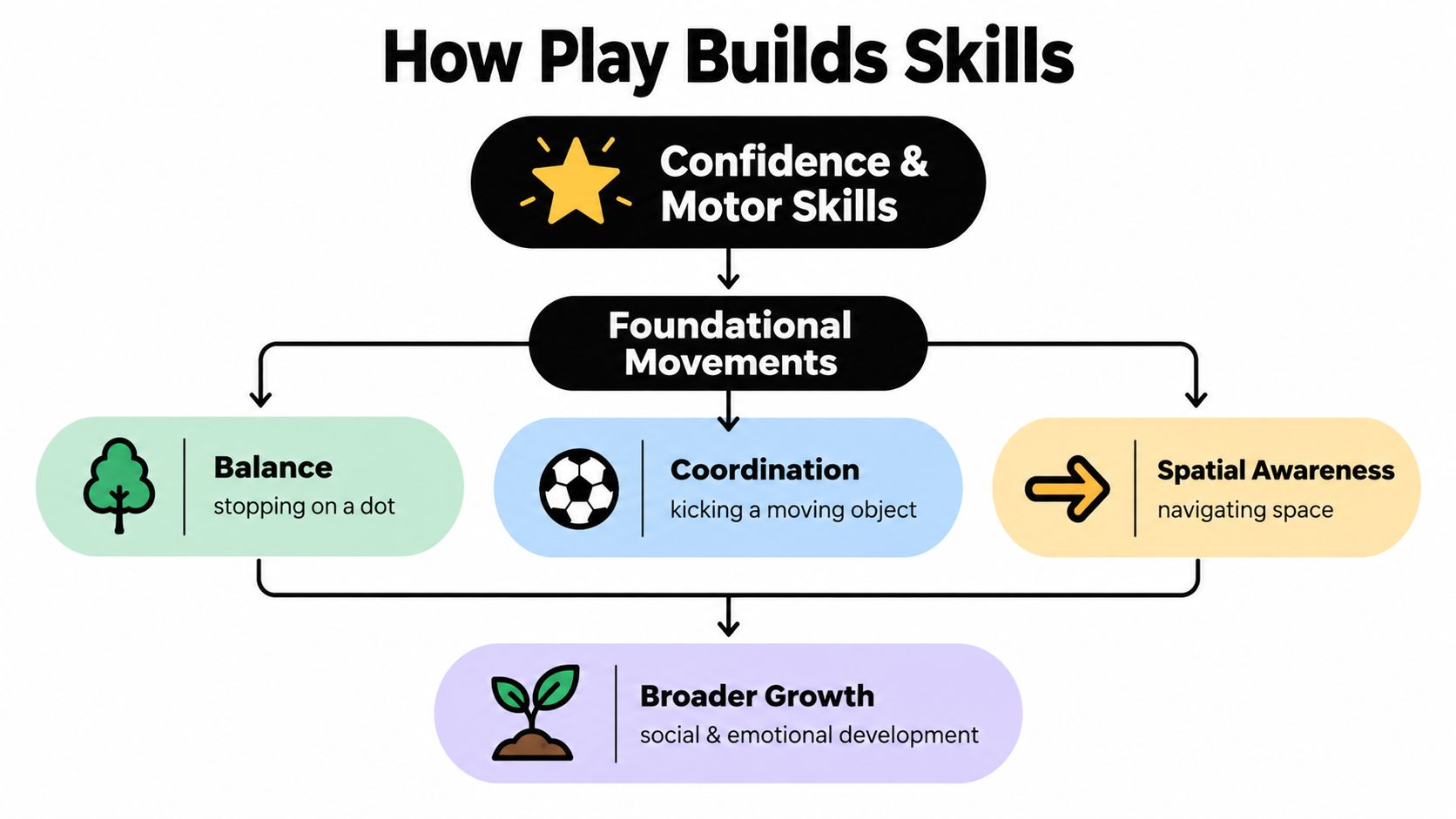
A cone activity shows how several abilities develop together:
Running: The child travels toward a visible target and adjusts speed.
Stopping: The child reduces momentum instead of moving straight through the space.
Turning: The child changes direction and begins to sense where others are.
Kicking: The child experiments with force, timing, and foot contact.
Balancing: The child briefly supports the body on one leg while touching the ball.
These abilities extend beyond soccer. Stopping and turning can help a child feel more capable on a playground. Balancing during a kick builds control that supports later sports and everyday movement.
Indoor soccer is one small piece of a toddler's daily movement picture. A playful class can provide focused practice, while the rest of the day may include walking, climbing, dancing, and outdoor play. The goal is a varied, active day, not early competition.
Confidence grows through manageable challenges
Confidence develops when a child tries, misses, and gets another chance without embarrassment. Coaches support that process by setting tasks within reach while leaving room for different solutions.
Group play also offers social practice. Children listen briefly, share space, wait for a natural pause, and observe others. These skills grow gradually. A toddler does not need to cooperate for an entire class to benefit.
Parents can explore this guide to toddler motor skills and development. At home, specific encouragement helps: “You stopped the ball,” or “You tried again.” Such comments help children notice progress without turning play into a performance review.
Inside a Safe and Age Appropriate Class
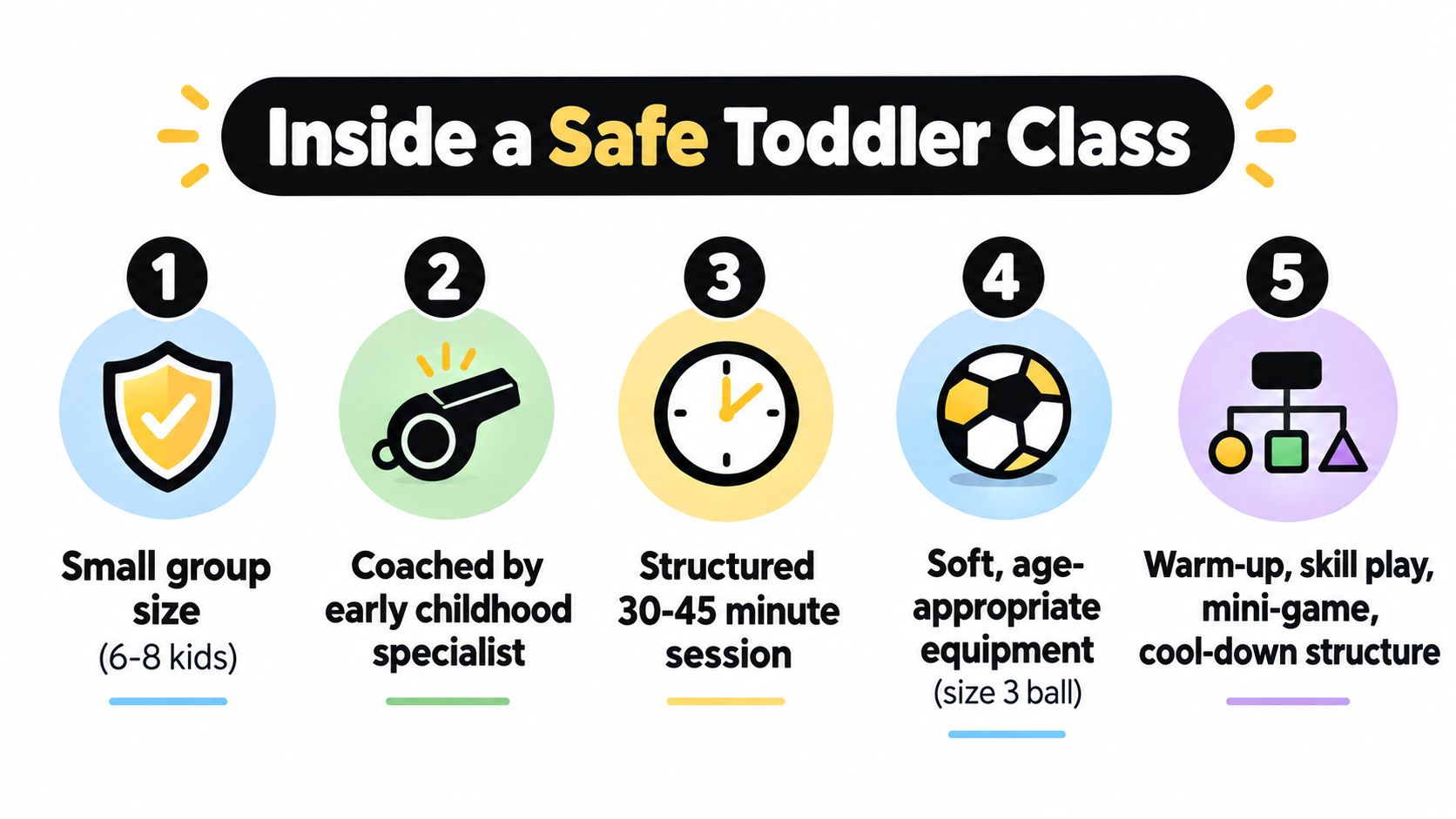
A safe toddler soccer class begins before the coach speaks. The room should have a clearly bounded activity area, non-slip flooring, and enough open space for children to move without running into furniture or fragile objects. Equipment should match the children's size and control, with a soft or low-bounce ball preferred for early practice.
The setup matters because toddlers don't yet control speed and direction consistently. A ball that rebounds sharply can create sudden chases, collisions, or falls. A softer ball and predictable boundaries give children more time to respond.
A class should match toddler attention
Youth indoor-session guidance commonly recommends whole-group demonstrations of about 5 to 12 minutes and small-group practice of about 6 to 8 minutes. These figures are described in indoor soccer workout guidance for youth players. Short segments allow the coach to explain one idea, let children try it, and change the activity before attention and movement quality drop.
Useful activities may include:
Toe taps: Children place alternating feet on the top of a stationary ball.
Cone dribbling: Children gently move the ball around visible markers.
Wall passes: Children send the ball toward a safe wall and watch its return.
Target kicks: Children kick toward a small goal or marked target.
Stop-and-go games: Children respond to a simple cue by moving or freezing.
The coach should demonstrate rather than lecture. Instructions need to be short, positive, and easy to copy. A child who needs to watch first should have that option.
Signs of thoughtful pacing
Water breaks, pauses, and transitions aren't wasted time. They help children reset, manage excitement, and return to the activity with better control. A coach should also watch for signs of fatigue, distress, overheating, or repeated loss of balance.
Practical rule: A toddler should leave feeling proud of participating, not pressured to prove athletic ability.
Parents can ask how the program handles a child who cries, refuses an activity, or needs a break. A respectful answer will include patience, redirection, and communication with the parent. The video below can also help families visualize the kind of movement-focused activities used in youth soccer settings.
How to Choose the Right Toddler Soccer Program
Choosing a program is less about finding the most advanced drills and more about checking whether the adults, space, and schedule fit a young child. Ask to observe a class if possible. Watch how the coach responds to hesitation, how much time children spend moving, and whether the atmosphere feels calm enough for beginners.
A strong program makes room for different temperaments. Some children jump into every game. Others need a parent nearby or several visits before they participate freely. The coach should invite involvement without treating shyness as disobedience.
Compare the details that affect experience
What to Look For | Why It Matters | Good Sign |
|---|---|---|
Small activity groups | Fewer children competing for attention can create more chances to move and receive guidance. | The coach can notice individual behavior and adjust an activity. |
Early-childhood experience | Toddlers need communication and pacing suited to their development, not just soccer knowledge. | The coach uses brief demonstrations, encouragement, and flexible transitions. |
Play-based curriculum | Young children learn through active exploration and repetition. | Games include running, stopping, turning, balancing, and kicking. |
Safe indoor facility | A controlled environment reduces avoidable hazards and helps children move with confidence. | The area is uncluttered, bounded, and equipped with child-appropriate balls. |
Beginner-friendly culture | Children shouldn't feel ranked against more experienced players. | Coaches welcome observation, mistakes, breaks, and gradual participation. |
Convenient schedule | A class that clashes with naps or daycare can create avoidable stress. | The available time fits the child's normal energy pattern. |
Trial or observation option | Parents can assess fit before making a larger commitment. | Staff explain what families should expect during a first visit. |
Questions to ask before enrolling
Ask about the intended age range, coach-to-child supervision, class flow, equipment, parent involvement, and what happens when a child needs a break. Also ask whether the program emphasizes small-sided play and progressive instruction rather than competition.
Families in Humble, Kingwood, and Atascocita can use a soccer training center guide as a starting point when comparing facilities and program options. JC Sports Houston offers toddler multisport classes for children ages 2 to 3, alongside other youth sports programs, so parents should still confirm current schedules and class details directly.
The best fit is the program where your child can participate safely and return with a positive association with movement. A technically impressive curriculum won't help if the environment overwhelms the child.
Fitting Soccer Into Your Toddlers Active Day
Your toddler may spend part of the morning running between rooms, climb at the playground, dance while music plays, and then join a short soccer class. All of those moments belong to the same movement picture. A class is one piece of the day, not the whole puzzle.
Guidance from the World Health Organization recommends at least 180 minutes of physical activity each day for children under 5, with limits on sedentary time. The UK NHS also describes 180 minutes of daily activity for toddlers, including time at moderate to vigorous intensity. These figures describe a full day, not a target that one lesson must provide.
Walking, climbing, dancing, carrying toys, outdoor play, active errands, and free movement all count. Indoor soccer supplies a short period of planned activity, while the rest of the day can remain flexible and child-led.
Structured play and free play work together
Early-childhood guidance in the Be Active Kids early childhood physical-activity guide separates structured activity from unstructured movement. One recommendation gives toddlers at least 30 minutes of structured activity and 60 minutes or more of unstructured movement daily. For preschoolers, it advises at least 60 minutes of structured physical activity each day.
Use these points to shape a balanced routine, not to fill every hour with classes. Daycare, naps, meals, temperament, and spontaneous play all affect how much activity feels right. A child coming from a tiring day may benefit more from a quiet walk or relaxed ball play than another demanding activity.
Watch the child, not the calendar
A child who is comfortable may gradually join sooner, move with less hesitation, or bring soccer play home. Consistent distress, unusual fatigue, or resistance before class suggests that the schedule, setting, or intensity needs adjustment.
Soccer should add joy and movement to the day. It shouldn't turn the daily movement target into another performance demand.
Break up long periods of sitting where possible. The Canadian Paediatric Society guidance on healthy physical activity emphasizes active routines and limiting prolonged sitting for young children. Rest, sleep, family interaction, free play, and a playful class can fit together like pieces of a daily rhythm. The goal is a varied day in which movement feels natural, not a competition to complete every activity target.
Starting Your Toddlers Soccer Journey With Confidence
Your toddler doesn't need polished technique before joining a class. The first signs of progress may be subtle: standing more steadily, changing direction with less hesitation, listening for a short instruction, or smiling after trying a new movement.
Prepare. Choose comfortable clothing, bring water, arrive with enough time for your child to look around, and explain that they can watch before joining. During class, offer encouragement without directing every kick. The coach should lead the activity, while you provide a secure and positive presence.
A development-first indoor program gives children room to build movement skills before competition enters the picture. Safe equipment, thoughtful pacing, experienced instructors, and playful games create the conditions for children to associate soccer with curiosity and confidence. That foundation can support future participation in soccer, other sports, and everyday active play.
After class, ask what felt fun rather than whether your child scored or followed every instruction. You might play a gentle stop-and-go game at home, roll a soft ball back and forth, or invite your child to dribble around safe household obstacles. Keep it brief and playful. The point is to make movement feel like something your child wants to return to.
JC Sports Houston offers toddler multisport classes for children ages 2 to 3, with age-appropriate games, drills, and exercises in a youth indoor sports setting. Visit JC Sports Houston to review current program information and find a welcoming way to add playful soccer movement to your toddler's active day.
Comments