

Summer Sports Camps for 5 Year Olds: A Parent's Guide

You're standing in the kitchen in June, comparing camp tabs while your five-year-old races through the house. This is the same child who never wants to leave the playground but loses patience when someone explains a game for too long. You need summer childcare, they need movement, and you're wondering whether signing up for sports camp will make everyone happy or leave you collecting an exhausted, upset kid.
My advice is straightforward: choose the camp that fits your child's development, not the camp with the longest sports list. When you compare summer sports camps for 5 year olds, watch how coaches give directions, help hesitant children, and keep everyone involved. Those details matter more than a tournament theme or a polished brochure.
Why a Five-Year-Old Needs a Play-Led Camp, Not a Mini League
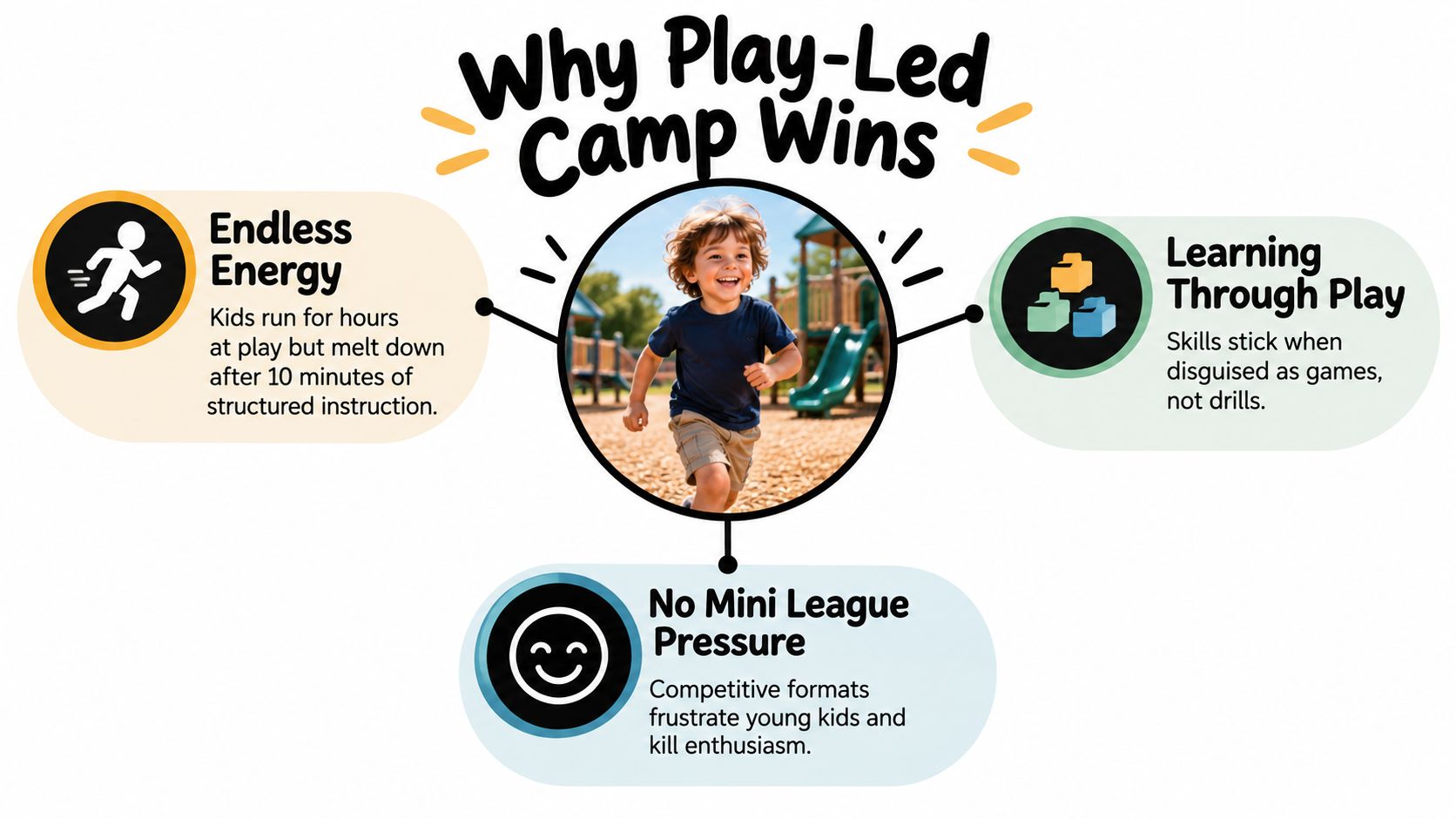
A child's willingness to run isn't the same as readiness for organized sports. Playground play lets children choose their pace, change direction, and stop when they need to. A formal drill asks them to listen, remember instructions, wait, and perform on someone else's cue.
The American Academy of Pediatrics cautions that before age 6, most children haven't developed all the motor, visual, attentional, and social skills required for organized sports, and recommends foundational activities such as running, swimming, tumbling, throwing, and catching in its preschool sports guidance. That's a reason to adapt the activity, not exclude the child.
This graphic captures the distinction between playful movement and miniature league expectations.
Look for Teaching That Starts With Play
A suitable coach can introduce throwing through a pretend delivery game or balancing through an imaginary river crossing. The child still practices a movement skill, but doesn't need to absorb a technical lecture before getting started.
Watch the coach's response when an activity doesn't work. I'd choose the instructor who changes the challenge, demonstrates again, or offers an easier entry point over the instructor who repeats the same command louder.
Instructions lead quickly to movement. Children get a clear task they can try, rather than a speech they must remember.
Mistakes remain ordinary. A missed catch leads to another attempt, not public correction or a comparison with another camper.
The activity has room for different abilities. A beginner can roll a ball while another child practices throwing toward the same target.
Parent-to-parent advice: A camp shouldn't require your child to behave like an older athlete before it lets them enjoy being active.
Choose Fit Over Prestige
A technically focused program can be a good choice later. Right now, don't confuse advanced branding with appropriate instruction.
Ask whether coaches can make the activity simpler without making a child feel singled out. A camp that does that well offers something more useful than early competitive experience: a welcoming place to try, struggle, and return willingly.
What a Good Daily Schedule Actually Looks Like
Request a sample day before you register. A list that says “soccer, baseball, basketball” tells you almost nothing about how your child will spend the morning.
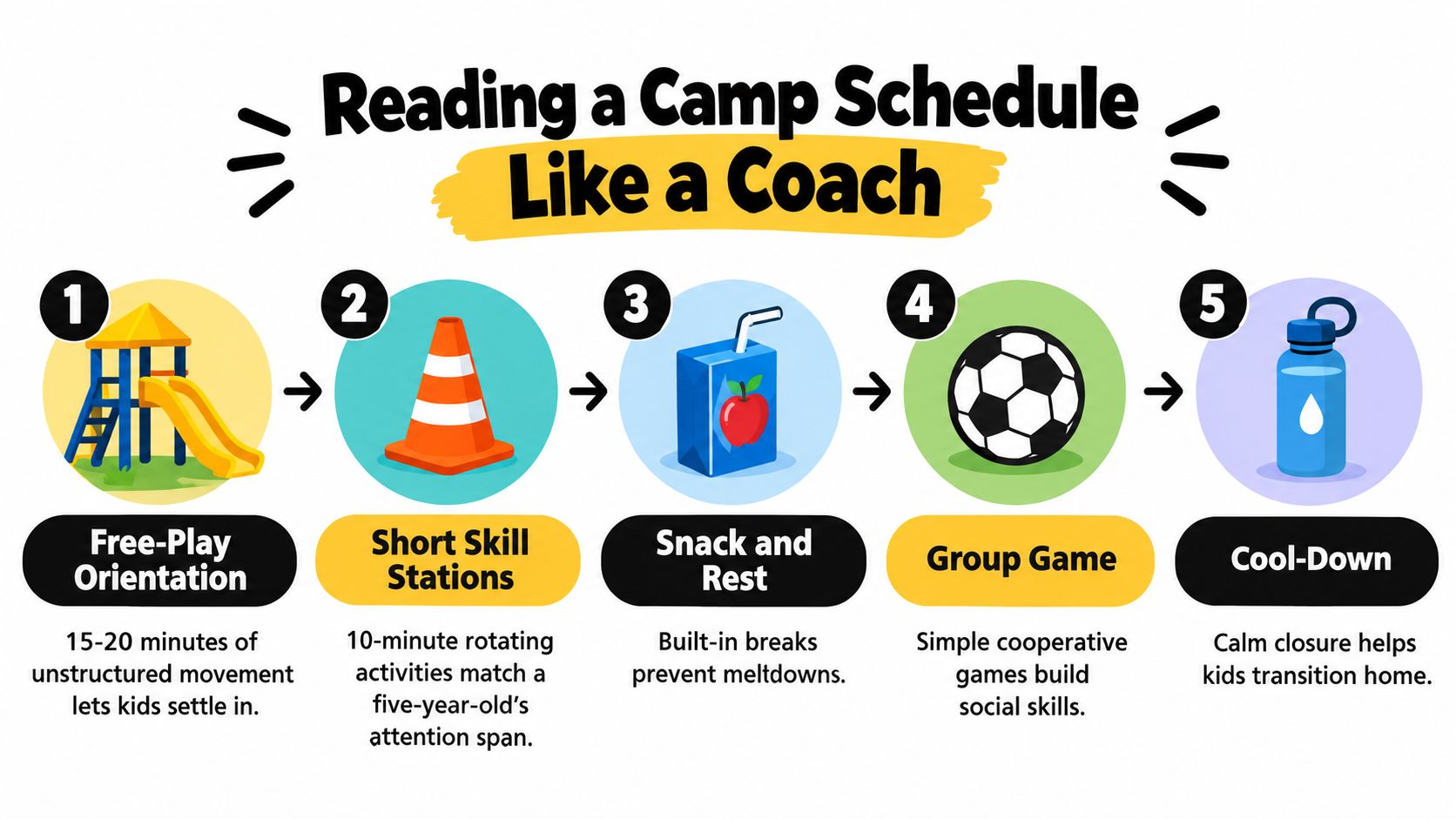
Read for transitions, actual participation, and recovery, not just activities. The AAP's preschool guidance suggests no more than 15–20 minutes of structured activity followed by about 30 minutes of free play in its recommendations for organized sports and young children. Treat that as a reminder to protect free play, not as permission to fill every other moment with coaching.
Use this visual to recognize the components of a child-friendly schedule, rather than treating it as a rigid timetable.
Read the Day From Your Child's Position
My recommended sequence starts with free-choice movement and a welcoming coach. It then moves into running, hopping, skipping, or jumping games before children explore object-control stations with large, soft balls.
Next come small-sided games with simple rules, followed by hydration and a calm close. This emphasis on varied movement is consistent with CDC guidance that preschoolers should be active throughout the day.
Schedule feature | What I'd look for | What I'd question |
|---|---|---|
Arrival | An activity children can join comfortably | Everyone waiting for late arrivals |
Skill practice | Several places to attempt the movement | A single line behind one coach |
Group play | Simple rules and frequent involvement | Elimination or lengthy scorekeeping |
Recovery | Planned drinking and quiet opportunities | Breaks only after children complain |
Ask What Happens Between Activities
Transitions deserve as much attention as the games. Who gathers equipment? Where do children wait? Can coaches start the next activity without losing track of a reluctant camper?
Review the published summer camp schedules, then ask staff to describe the youngest group's day in practical terms. A booking timetable won't necessarily show the activity blocks, so request those separately.
Regular sitting and waiting are warning signs. So are adult-sized equipment, extended demonstrations, and games that leave eliminated children watching from the side.
The useful daily measure is engagement: did your child attempt the skill, repeat it, and remain willing to participate? Wins and trophies can't answer that question.
Safety, Staffing, and the Questions That Reveal a Real Camp
A friendly welcome doesn't replace a supervision plan. Before discussing uniforms or themes, ask who will be responsible for your child and how that person responds when something goes wrong.
For Houston families, I'd insist on specific answers about drinking access, shade, indoor recovery, and weather-related changes. Outdoor movement is valuable, but it doesn't justify keeping children outside when staff should change the plan.
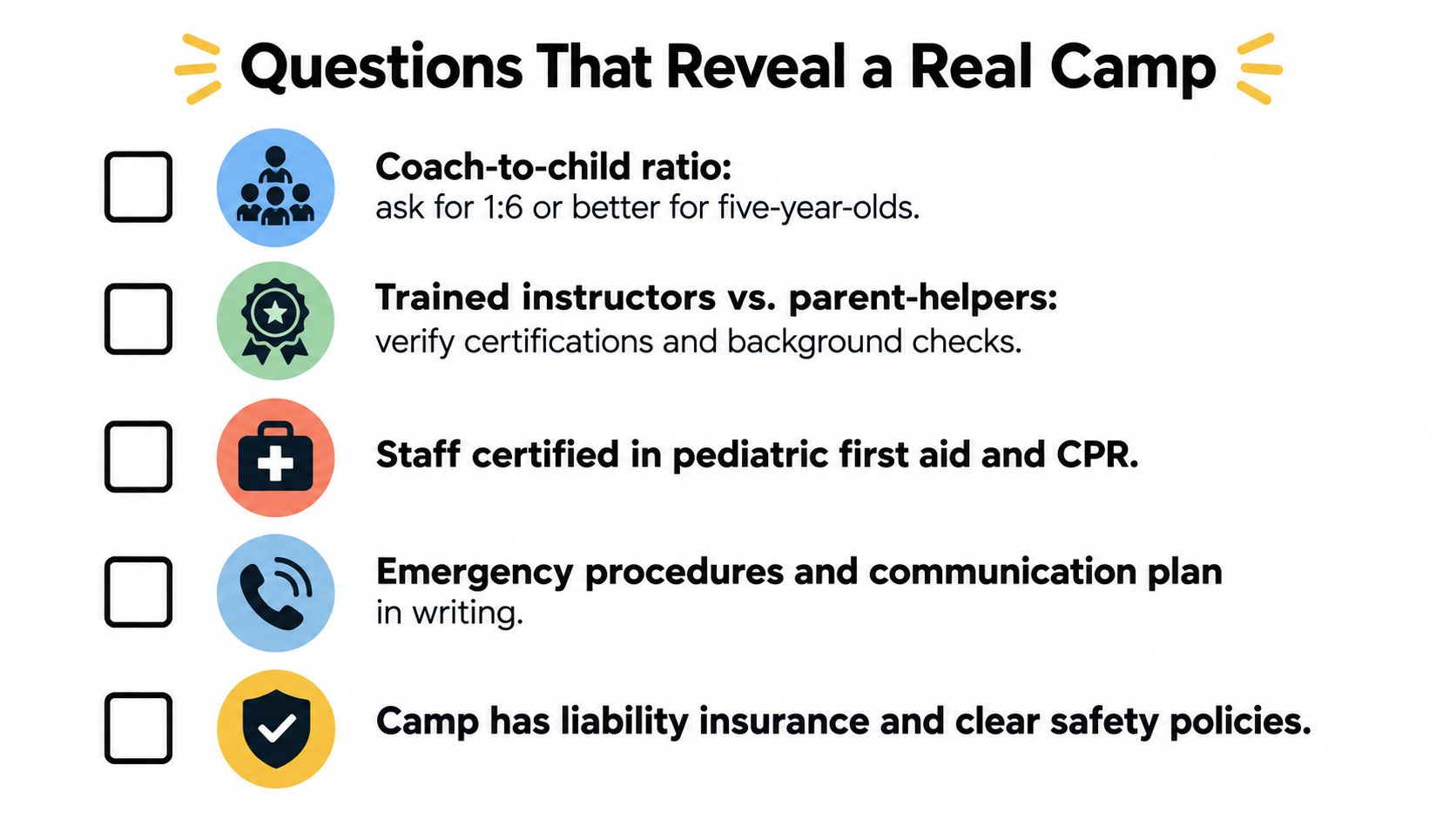
Bring a written checklist rather than relying on whatever you remember during a busy visit.
Grade the Answers, Not the Sales Pitch
Ask for the actual coach-to-child ratio during activities, including what happens when someone accompanies a child to the bathroom. Don't accept a staffing total that includes people who aren't supervising your child's group.
Ask this | A useful answer | An answer that needs follow-up |
|---|---|---|
How are coaches vetted? | A clear screening and training process | “They're great with kids” |
Who handles an injury? | Identified staff and documented procedures | “Someone will take care of it” |
How do you manage heat? | Defined breaks, cooling options, and activity changes | “We remind them to drink” |
Can a child pause? | A supervised recovery space and reentry plan | “Everyone has to participate” |
How do you contact parents? | A specific notification and pickup process | “We'll call if necessary” |
A parent-helper can contribute warmth and encouragement. That doesn't tell you whether they've received training in supervision, first aid, or managing distress.
Watch How Adults Respond
During a visit, notice whether coaches crouch to speak with children, recognize confusion, and help someone rejoin without embarrassment. Review the coaching philosophy, then ask staff to show how those principles work with the youngest campers.
Use the video as a conversation starter, not a substitute for observing your own child with the coaches.
Ask about equipment requirements for the activities your child will do. If you need help deciding whether dental protection is appropriate, Eric Wiitala DDS's resource on mouthguards for active patients is a starting point for a discussion with your child's dentist.
A reassuring camp can explain who acts, what they do, and how they tell you. “Don't worry” isn't a safety procedure.
Getting Ready for Camp Week Without the Stress
Start with your child's readiness, then tackle registration. A camp can accept a child's age without offering the right day length or level of support.
I'd start with a half-day or trial when group-care stamina is untested. A full day is a bigger commitment, and more childcare hours don't automatically mean a better first sports experience.
Check What Your Child Can Manage
Use these questions to identify support needs, not to create a pass-or-fail test.
Separation: Can your child stay with a trusted adult outside the family, and what helps when goodbye is difficult?
Brief directions: Can they follow a simple group request, or do they need an adult to repeat it individually?
Bathroom support: Can they manage independently, and does the camp provide the assistance they still need?
Drinking access: Can they open their bottle and recognize when they need help?
Transitions: How do they respond when a preferred activity ends or an unfamiliar one begins?
Tell staff what works at preschool or another group setting. Don't leave them to discover a predictable challenge during drop-off.
Get the Financial Terms in Writing
Ask about registration deadlines, deposits, the payment balance, and whether sibling or multi-week discounts exist. Confirm the full cost, including any equipment, extended care, or other required charges.
Read the cancellation, illness, refund, and makeup policies before paying. Choose clear, all-inclusive pricing over an attractive headline price with unanswered questions. A more expensive camp still has to demonstrate better support; price alone proves nothing.
Pack together so your child recognizes their own belongings.
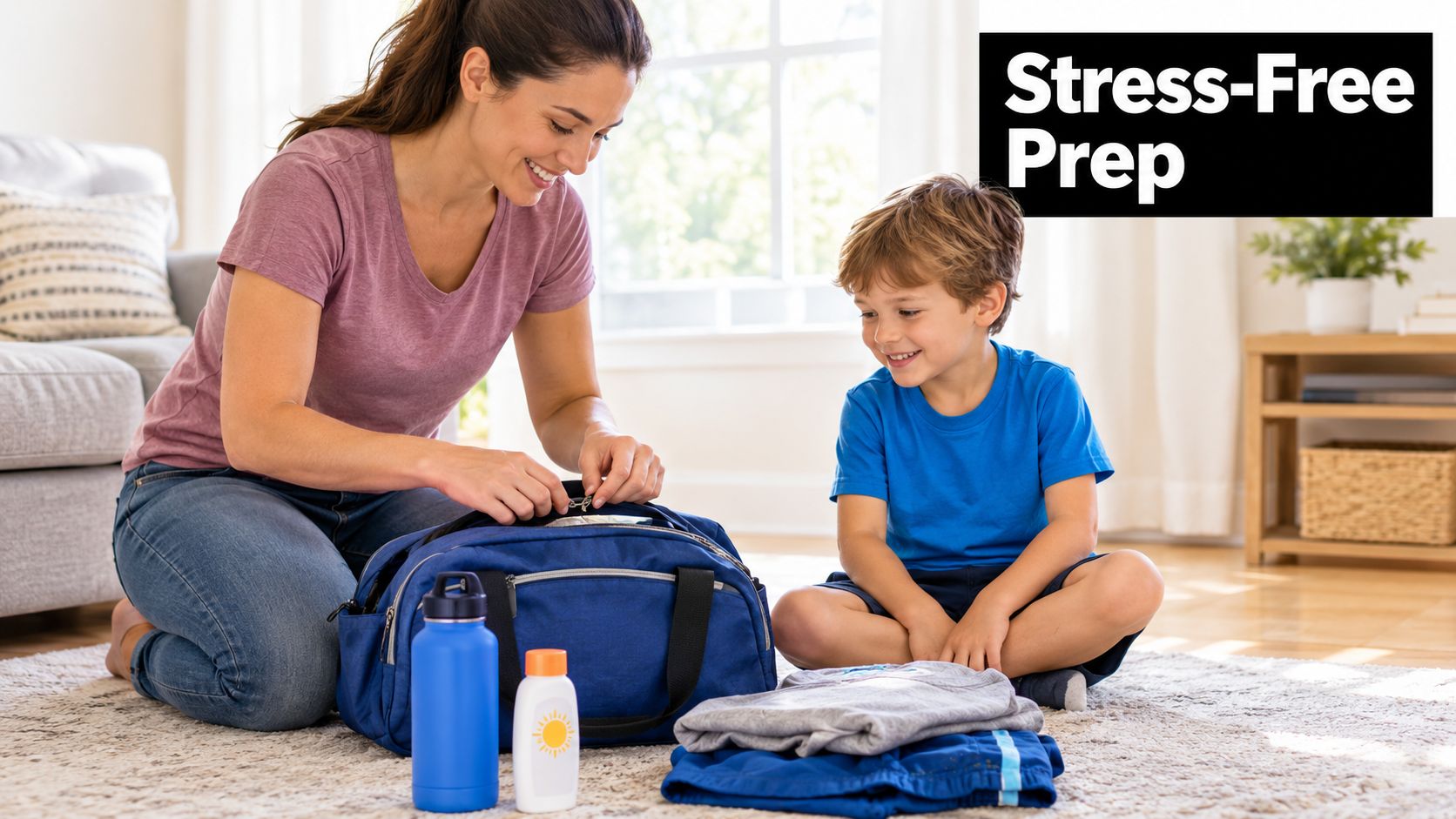
Bring a labeled water bottle, suitable shoes, spare clothes, and the food and sun-protection items the camp requests. Give staff medications through their required process rather than leaving them loose in a bag.
Urban Totes' packing cubes for travel tips offers an organizational idea you can borrow: keep spare clothing together in a separate pouch so it's easy to find.
For goodbye, use a short script: “Your coach will help you get started. I'll be back after camp.” Agree on the handoff with staff, say goodbye openly, and leave once the coach takes over; don't disappear or keep restarting the farewell.
Why More Sports Is Not Always Better at Age Five
The camp with the longest sports menu isn't automatically the most developmentally varied. Children can move through several branded activities while repeating the same pattern of waiting, listening, and taking a brief turn.
Variety should describe what children do with their bodies, not how many sports appear on the flyer. Rolling, chasing, balancing, kicking, and experimenting can offer a useful range without rushing children through a packed curriculum.
Distinguish Exploration From Training
The AAP guidance cited earlier favors variety over early single-sport specialization and warns about repetitive training, overuse, stress, and burnout. For a kindergartener, I'd prioritize a program that lets children explore movement without expecting them to identify as a soccer player or baseball player already.
A child who enjoys soccer can still benefit from different movement challenges. The discussion of playing multiple sports can help you think beyond committing to a single sport.
But don't turn that recommendation into a demand to sample everything immediately. Repeating a familiar game can be valuable when a child is still learning how to participate.
Practical rule: Leave room in the week for your child to choose movement without a coach directing it.
Judge the Total Load
There isn't a universal camp-hours allowance I'd apply to every five-year-old. Count the whole schedule: camp, lessons, other organized activities, travel, and the recovery time your child gets.
If you need consecutive camp weeks for childcare, protect downtime outside camp instead of adding evening training. Ask whether the daytime program includes quiet recovery, not merely another supervised task.
Watch for changes that deserve a pause:
Pain or altered movement: Stop the activity and seek appropriate medical advice rather than asking your child to push through.
Persistent exhaustion: Reconsider the day length when your child repeatedly struggles to recover.
Sustained reluctance: Look for a specific cause instead of assuming they need firmer encouragement.
Lost enjoyment: Reduce formal demands if every movement activity has begun to feel like an assignment.
A tired child doesn't need another motivational speech. They need adults willing to change the plan.
The sharper question for any camp is “What does my child do when they need a moment?” A supervised, respectful answer tells you more than another sport added to the schedule.
How JC Sports Houston Fits the Readiness Model
For families in Humble, Kingwood, and Atascocita, JC Sports Houston is one local option to assess through this developmental-fit lens. Its offerings include multi-sport classes for toddlers, Coerver-based soccer training with Just for Girls options, beginner-friendly BlastBall, and school-break camps.
The center emphasizes small-sided play, creativity, and progressive instruction. Those are relevant features, but the deciding evidence is how your child responds to the coach and the activity during a visit.
Use the Trial to Test the Approach
New families may request a free trial. Use it to answer a practical question: can your child join this environment comfortably enough to learn?
Watch the first interaction closely. Does the instructor give your child an accessible starting task, or expect immediate participation in an unfamiliar group?
For a hesitant newcomer: Look for a gradual invitation to join without public pressure.
For an energetic child: Check whether the coach channels movement into an activity rather than repeatedly demanding stillness.
For a child interested in soccer: Ask how technical instruction is adapted for a beginner who still needs playful exploration.
A class trial and a summer camp aren't identical. Ask how camp grouping, staffing, day length, and breaks compare with what you've observed.
Separate Useful Features From Assumptions
Indoor space gives families an important option to investigate alongside the heat-safety questions already discussed. Clear policies, online registration, and real-time field status can also make participation easier to manage.
None of those features tells you everything about a particular camp session. Confirm the current camp format, age grouping, available day lengths, and activity plan before booking.
The broader sports-participation figures aren't a reason to hurry your child into competition. HRSA reports that 56.7% of U.S. youth ages 6–17 participated in a sports team or lessons during 2023–2024, but that population doesn't establish preschool readiness, as the National Survey of Children's Health sports brief makes clear through its age range.
Choose the entry point your child can enjoy now. There's no need to treat summer camp as a deadline for becoming an athlete.
Your Next Move Before Summer Starts
You don't need another evening of comparing camp themes. You need a short list of unanswered questions and a chance to see your child with the adults who will coach them.
Developmental fit is something you can observe. It shows up in the child's entry into an activity, the coach's response to difficulty, and the plan for taking a break.
Make This Week's Decision Practical
Write down your child's support needs. Use the readiness markers to identify what staff should know before arrival.
Request the youngest group's activity schedule. Look beyond opening and closing times to the actual experience between them.
Get safety answers directly. Confirm supervision, cooling, emergency communication, and the opt-out process.
Request a free trial. Observe the coaching interaction before committing to a summer camp booking.
Choose a manageable first commitment. Don't book a long stretch because it solves the calendar neatly.
Treat the trial as information, not an audition your child must pass. If they need a different format or more preparation, you've learned something useful before paying for camp.
Keep the Right Standard
A first session doesn't have to be effortless. Your child may watch before joining, dislike an activity, or need reassurance at a transition.
What matters is whether the adults respond constructively and your child remains willing to return. Don't judge the experience by a completed skill checklist or a photograph of everyone holding a trophy.
The outcome I'd want is simpler: a child who feels comfortable trying, knows a coach will help, and runs back to the car asking when they can go again.
JC Sports Houston offers youth sports programs, summer camps, and a free trial that lets new families experience its coaching approach. Visit JC Sports Houston to request a trial and ask which current camp format fits your five-year-old's readiness and support needs.
Comments