

Soccer for Kids Near Me: A Local Parent's Guide

You're standing in a Humble grocery aisle, your child is asking for soccer shoes, and your phone is full of tabs for leagues, clubs, and classes you can't tell apart. I've done that same search between school pickup and dinner. The parents who end up happy don't pick the shiniest logo. They pick the program their child likes, their calendar can survive, and their budget can repeat next season.
What Soccer for Kids Near Me Actually Means
Searching soccer for kids near me at 9 p.m. on a Sunday usually means one thing. You need an answer before registration closes, your child keeps asking, and every result claims to build skills, confidence, and character. You're scrolling league sites on your phone, comparing practice nights, and trying to guess which option is worth driving across town for.
Reframe the search. Closest isn't the same as best fit. A program five minutes farther away that matches your child's age, temperament, and your family's routine will beat a nearby program that frustrates everyone by week three.
Six Filters to Apply Before You Book
Program type: Is it a league, a skills class, a camp, or a mix?
Age fit: Does the group match your child's stage, not just their birth year on paper?
Location and convenience: Can you get there on a normal weeknight without heroic effort?
True cost: What's the all-in price after gear, uniforms, and travel?
Coaching quality: Do coaches teach technique through play or park kids in lines?
Ease of registration: Can you try a class, understand the policies, and sign up without phone tag?
You don't need to be a soccer expert to use those filters for a 4 year old, a 7 year old, or an 11 year old. Soccer is a mainstream choice, not a niche gamble. Outdoor soccer participation among Americans age 6 and older reached nearly 14.1 million in 2023, an 8.1% jump from 2022, with children ages 6 to 12 making up the largest single age segment, according to participation data summarized from the Sports and Fitness Industry Association. Plenty of families are making this same decision. Make yours with a checklist, not a guess.
Program Types Parents Will Find Nearby
Google lumps very different products under the same search. A Saturday rec league, a weekday technical class, and a travel club can all serve a 7 year old, but they feel nothing alike once your child steps on the field.
Rec leagues are built around teams and games. Volunteer or staff coaches vary, playing time is usually broad, and the point is a low pressure first taste of competition. They're a sensible starting point if your child mainly wants to play with friends.
Travel and select clubs add tryouts, multiple practices, weekend tournaments, and real travel. Some families love that intensity. Others discover too late that the commitment was the product. Don't start there unless your child is asking for more soccer than you're currently giving them.
Development Focused Options
Coerver and private technical training flip the priority. Instead of preparing for Saturday's opponent, sessions concentrate on ball mastery, first touch, dribbling, and decisions in small sided games. Choose this route if your child needs touches and confidence more than a trophy chase.
Indoor multi sport facilities sell predictability. Weather doesn't cancel practice, schedules stay put, and younger siblings aren't melting on a sideline. For suburban Houston families, that reliability is a development feature because consistent attendance is how skills stick.
Just for Girls programs give girls a training environment built for them rather than asking them to adapt to a boys' group. For a shy beginner or a girl who wants more touches without fighting for the ball, that setting changes how quickly she settles in.
Program type | Best for | Typical commitment | Coaching focus |
|---|---|---|---|
Rec league | First team experience | Seasonal games and practices | Team play, fun |
Travel or select club | Highly motivated players | Multiple weekly sessions, tournaments | Competition, tactics |
Coerver or private training | Skill building at any level | Ongoing weekly classes | Technique, creativity |
Indoor multi sport | Busy families, young children | Predictable weekly slot | Fundamentals, consistency |
Just for Girls | Girls wanting focused reps | Weekly training | Technique, confidence |
Read every search result through that table. Once you know what you're buying, half the listings eliminate themselves.
Matching the Right Class to Your Child's Age
Most parents search by grade or birth year, and that's fine, as long as you read what the age bracket means in practice. A class can accept your child and still be the wrong starting point.

Ages 3 to 5 Build Movement First
Toddlers and preschoolers don't need tactics. Look for multi sport exposure and short, playful soccer activities that build running, balance, coordination, and listening skills. If a program for this age talks mostly about positions and winning, walk away.
Ages 6 to 8 Need Fundamentals Without Pressure
This is the sweet spot for beginner soccer and introductory Coerver fundamentals. Your child should touch the ball constantly, try both feet, and play small sided games where mistakes are cheap. An outdoor league format such as MLS GO for ages 4 to 12 can pair well with a skills class, because games give context and training builds the tools to enjoy those games.
For a plain language breakdown of how levels progress, read this guide to youth soccer levels explained for parents before you let a league label rush your decision.
Ages 9 to 12 Can Handle Progression
Older elementary players are ready for more deliberate technical work, scanning before receiving, passing under pressure, and off ball movement. Girls at this stage often benefit from a dedicated Just for Girls pathway that keeps reps high and confidence growing. Teens who aren't chasing a club roster still fit in small sided, skill focused sessions that respect their school load.
Start low rule: Put your child in the youngest group they qualify for. Confidence built there transfers up. Discouragement from playing up too early usually transfers home.
One facility offering toddler classes, a youth league, technical training, and girls only sessions lets you move your child up a level without restarting your whole search each season.
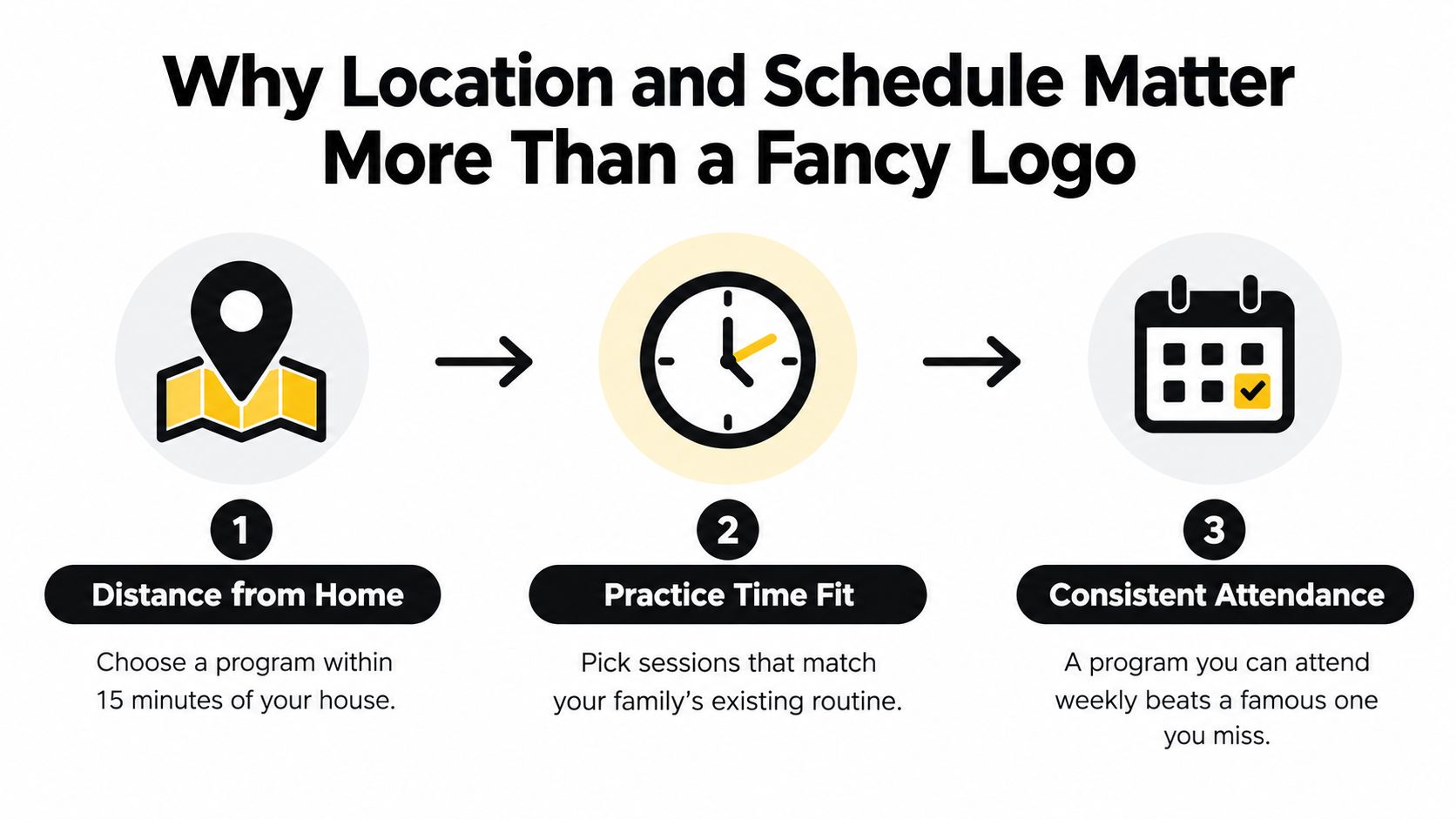
Why Location and Schedule Matter More Than a Fancy Logo
I'll say the unpopular part plainly. For most Humble, Kingwood, and Atascocita families, the program you attend consistently beats the famous program you miss. Development follows attendance, not branding.
Run your real week, not your ideal one. School ends, homework starts, someone has a dentist appointment, traffic on the way home eats your buffer, and dinner still has to happen. If practice requires a long cross town drive on a weeknight, week three is when the excuses start and week five is when you've stopped paying attention to the schedule.
What a Sustainable Week Looks Like
A workable setup has one predictable practice slot, a drive you can repeat in bad traffic, and a start time that doesn't force a choice between eating and arriving. Non travel formats help because your weekend stays yours. Indoor facilities help because rain, heat, and field closures don't turn your calendar into a guessing game, and siblings can wait somewhere comfortable.
This isn't just a preference. Access shapes who plays at all. CDC data show youth sports participation in the U.S. South at 48.7%, compared with 58.4% in the Northeast, 58.6% in the Midwest, and 56.0% in the West, a gap detailed in the CDC National Health Interview Survey data brief. Houston sits in that Southern picture, so practical barriers aren't abstract here.
The best program is the one still on your calendar in month three.
Before you register, drive the route at the actual practice hour once. If that test drive annoys you, believe it. Your child won't develop in a program your family resents reaching.
What Soccer Really Costs Around Houston
Registration is the headline price. It is rarely the full price. The question parents need answered is simple. What will this cost our family each month, all in, and can we manage the commute that comes with it?
Costs That Hide Behind the Sign Up Fee
Uniforms and kits: Ask what's included, what's required, and whether you'll buy it again next season.
Gear: Separate required items like shin guards and appropriate shoes from optional extras pushed at checkout.
League and facility fees: Confirm whether games, referees, and field use sit inside the quoted price.
Coaching add ons: Private sessions and extra clinics are fine when chosen, not when they're expected.
Travel: Fuel, meals, tournament weekends, and your time are real costs even when nobody invoices you for them.
Missed sessions: A strict no makeup policy means you're paying full price for a partial season.
Fees themselves are normal. A 2025 National Recreation and Park Association report found 98% of agencies charge fees for youth sports, while transportation and financial obstacles remain documented gaps in programming access, as summarized in the Aspen Institute youth sport funding research brief. Normal doesn't mean transparent, so ask anyway.
Compare formats. A clear priced, indoor, once a week program shows you nearly the whole bill on day one. Travel and select pricing often looks tidy at registration and grows through kits, tournaments, and driving. Neither is wrong for every family, but only one lets you budget without surprises.
Insist on three things before you pay. A free trial class, written refund and cancellation terms, and a weather policy you can find without emailing anyone. If a program can't explain its total cost in plain language, that's your answer about how it'll communicate later.
How to Judge Coaches and Safety in a Free Trial
Don't treat a free trial as a vibe check. Treat it as an inspection. You can learn most of what matters in the first ten minutes if you know where to look.
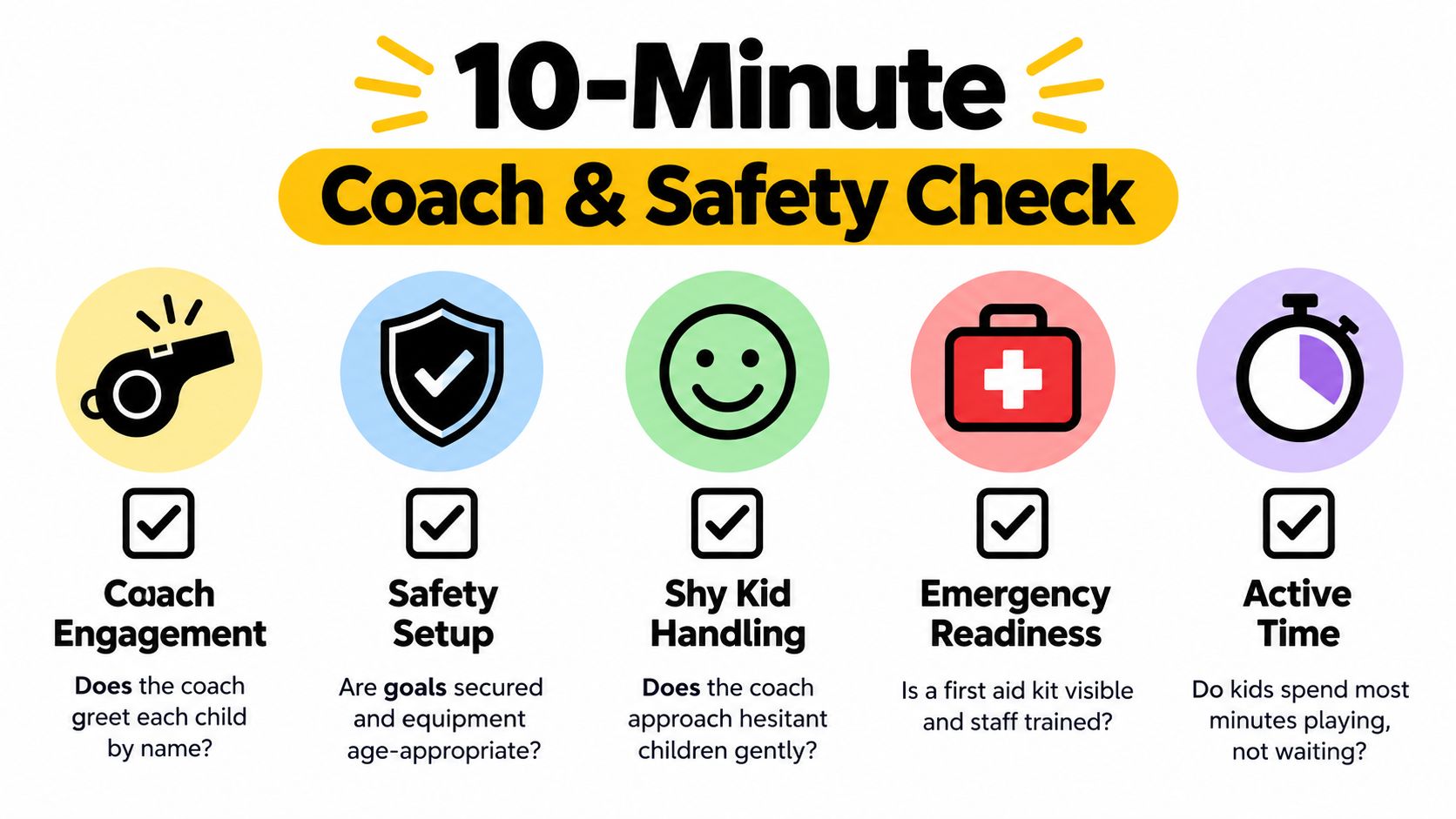
Watch how the coach handles the shyest child, not the loudest one. Good coaches greet kids by name, crouch to eye level, and pull hesitant players in with a job rather than a spotlight. Then watch the session shape. You want ball mastery to open, then 2v2 or 3v3 games with targets, then a constrained game that rewards scanning, passing, and movement. Long lines and scripted drills mean your child is paying to wait.
That's what Coerver based training should look like in person. Repeated touches, quick decisions, and freedom to try a move without getting corrected into caution. This overview of a coaching philosophy built on creative player development shows the standard to hold any trial against.
Safety Questions to Ask Out Loud
Ask when heading is introduced for your child's age group and expect a specific, age appropriate answer. Ask how injuries are handled, where first aid supplies are, and how water breaks are scheduled. Ask whether sessions start with a structured warm up, because that detail matters. A randomized youth soccer trial found a 38% overall reduction in injury incidence for groups using a structured neuromuscular warm up, with acute injury risk dropping 43%, in research published in the British Journal of Sports Medicine.
Green flags: Secured goals, age appropriate balls, active kids, specific feedback, calm corrections.
Red flags: Yelling as instruction, children standing idle, vague safety answers, pressure to enroll before the trial ends.
If your child leaves tired, smiling, and describing something they tried, that's data. Trust it over a brochure.
Registering and Planning the Season
Registration should take minutes, not a week of back and forth. Use a local indoor provider such as JC Sports Houston as your worked example for how smooth this can be, then hold every other program to the same standard.
From Free Trial to First Session
Request the free trial online: Pick the age group your child qualifies for at the youngest eligible level and choose a slot that matches your real weekly routine.
Confirm placement after the trial: Ask the coach directly whether the group fits or whether a different class, such as Coerver training or Just for Girls, suits your child better.
Read the registration details before paying: This walkthrough of youth soccer registration and season sign up steps covers the information you should have ready and the policies worth checking.
Block the slot immediately: Put practice, drive time, and a buffer on the family calendar before anything else claims that hour.
Prep the night before: Lay out gear, fill the water bottle, and confirm field status so the first session starts calm.
Planning Around School Breaks
Seasons end. Momentum doesn't have to. February break, spring break, and summer break camps bridge the gaps between league seasons and give your child concentrated touches without a weekly commute commitment. They're also a low risk way to test whether your child wants more soccer before you upgrade to an additional weekly class.
Private sessions fit best as a targeted tool, for a child rebuilding confidence after time away or working on one specific skill. Coach led sports birthday parties solve a different problem, but they're a useful sign that a facility can manage groups of children safely and energetically. That organizational competence shows up in regular classes too.
Re enroll early when a season works. Preferred time slots fill first, and holding your child's existing slot protects the routine you've already built around it. Switching nights mid year sounds minor until it collides with tutoring, a sibling's activity, or your work schedule.
Book the second session before the first one ends, and the season plans itself around a habit instead of a hope.
Your Seven Day Decision Checklist
Confirm the age group: Youngest eligible level first.
Request one free trial: Judge coaching and safety in person.
Ask three questions: What's the all in cost, what's the makeup policy, and how is heading handled at this age?
Test the drive: Do it at practice hour, not on a quiet Sunday.
Lock the calendar: Practice, travel, and buffer, all blocked.
Line up the backup: Note camp dates and makeup options for weeks you'll miss, especially with siblings in tow.
Do those six things this week and you're done searching. Your child gets consistent, age appropriate soccer, and you get a season your family can sustain.
If you're in Humble, Kingwood, or Atascocita and want indoor, small sided soccer with Coerver based training, Just for Girls sessions, and a beginner friendly youth league on a predictable schedule, start with a free trial. Visit JC Sports Houston to view current class schedules and request your child's first session.
Comments