

8 Fun and Effective Basketball Drills for 8 10 Year Olds
- cesar coronel
- Jan 25
- 17 min read
For 8 to 10-year-olds, basketball is more than just a game; it's a dynamic classroom for developing coordination, teamwork, and confidence. The right drills can transform a simple practice into an engaging adventure, turning fundamental skills into lifelong passions. This guide moves past generic advice, offering a comprehensive roundup of age-appropriate basketball drills for 8 10 year olds designed to build well-rounded, creative players. We'll break down each drill by skill, providing coaching cues, progressions, and tips to keep young athletes motivated and having fun.
The goal is to foster a love for the sport by focusing on what matters at this age: building a strong foundation through repetition, positive reinforcement, and game-like scenarios. Instead of complex plays, we emphasize core competencies that directly translate to on-court success. You will find actionable instructions for everything from ball handling and shooting form to defensive positioning and passing accuracy. This comprehensive article focuses on a variety of exercises designed for young athletes, promoting a foundational approach to developing basketball skills that will serve them for years to come.
Whether you're a parent coaching from the driveway or a youth league coach managing a full team, this is your blueprint for creating effective and memorable training sessions. Inside, you will discover a structured collection of drills that are not only productive but also genuinely enjoyable for kids. We cover everything from essential warm-ups to small-sided games, ensuring every practice is a step forward in a young player's basketball journey. Let’s get started.
1. HORSE/PIG Shooting Game
This classic game is a fantastic way to introduce competitive shooting in a fun, low-pressure environment, making it one of the most effective basketball drills for 8 10 year olds. The premise is simple: one player takes a shot from anywhere on the court. If they make it, the next player must replicate the exact same shot. If they miss, they get a letter (e.g., "H"). The game continues until a player spells out "HORSE" and is eliminated.
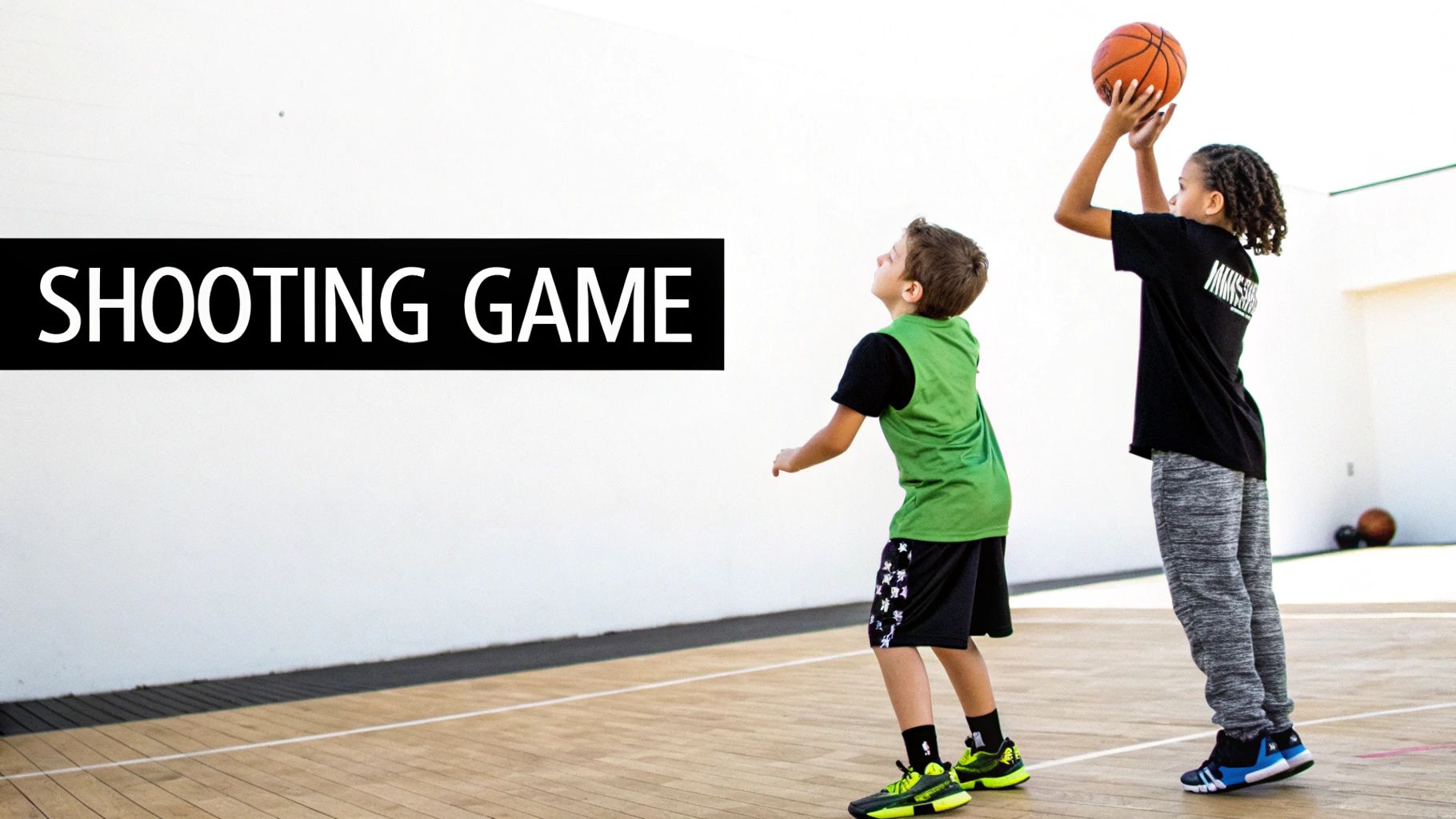
This drill teaches young players to shoot from various spots and angles, encouraging creativity and shot-making ability. It also introduces the concept of performing under pressure, as missing a shot has a direct consequence. The game’s simplicity and competitive nature keep kids engaged far longer than static shooting drills.
How to Implement the Drill
Setup: All you need is a basketball and a hoop. It can be played with two players or a whole team.
Execution: The first player chooses and attempts a shot. If they make it, every other player must attempt the same shot. Players who miss receive a letter. If the first player misses, the next player in line gets to choose a new shot.
Winning: The last player remaining who has not spelled out the full word is the winner.
Coaching Insight: For this age group, start with "PIG" (3 letters). It’s a faster-paced version that prevents kids from getting discouraged by early elimination, ensuring everyone gets more shooting reps and stays involved.
Key Benefits and Coaching Tips
This game shines as both a warm-up activity and a fun way to end practice, reinforcing shooting fundamentals without feeling repetitive.
Boosts Creativity: Players are free to attempt layups, bank shots, or even trick shots, fostering a creative approach to scoring.
Improves Range and Accuracy: By attempting shots from all over the court, players naturally learn their shooting range and work on their accuracy from unfamiliar spots.
Adaptable: Use cones to define specific shooting areas (e.g., "all shots must be taken from a marked spot"). This adds structure and focuses the drill on particular skills, like shooting from the block or elbow.
2. Ball Handling and Dribbling Ladder Drills
Structured dribbling exercises using cones or agility ladders are foundational basketball drills for 8 10 year olds. These drills combine footwork and ball control, teaching players to move their feet quickly while maintaining a steady dribble. By navigating through specific patterns, young athletes develop hand-eye coordination, ambidexterity, and the ability to handle the ball under dynamic conditions, which is crucial for becoming a well-rounded player.
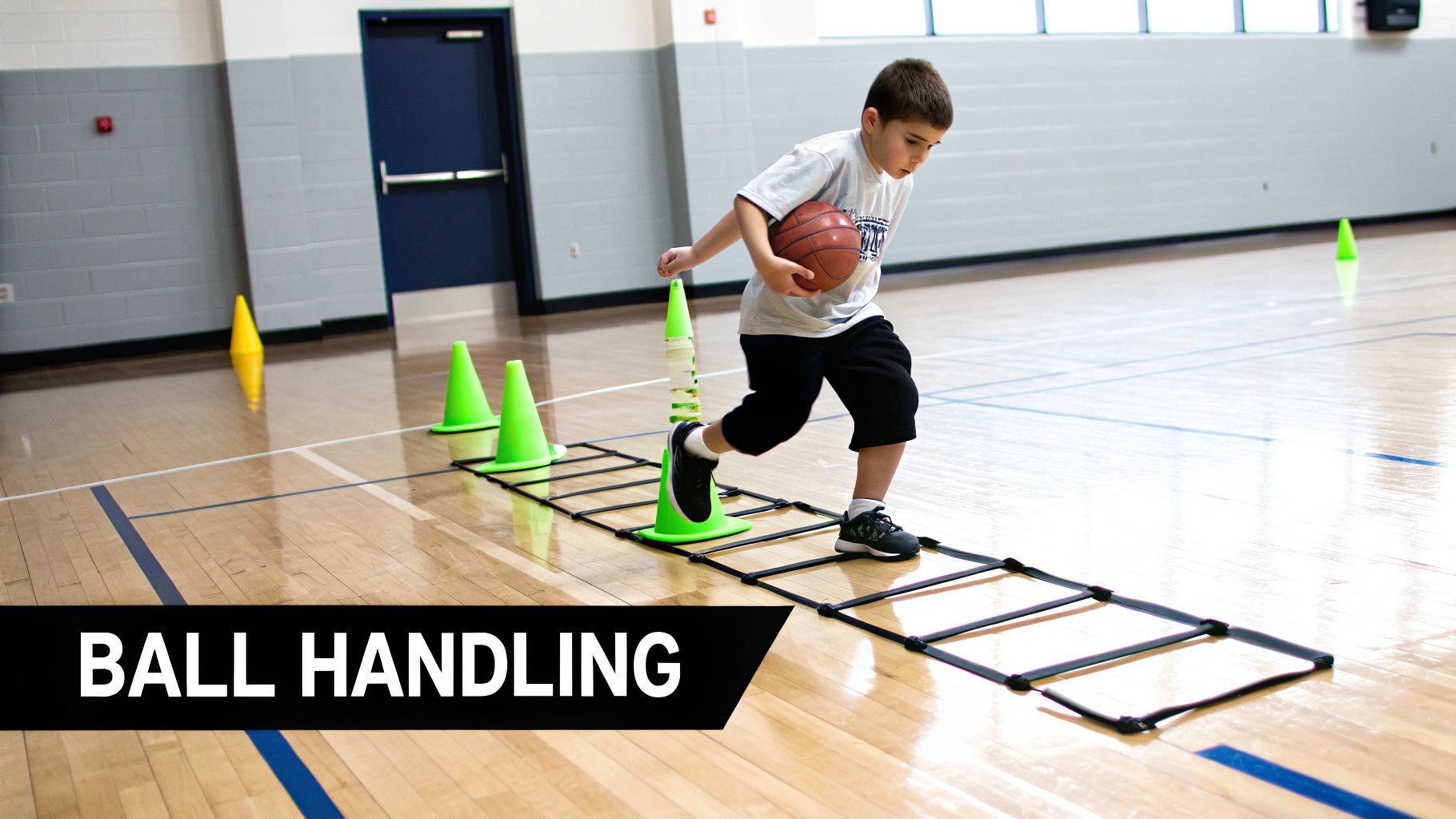
This method is a staple in development programs from USA Basketball to AAU elite youth training because it builds an essential skill base. The focus is on synchronizing the hands and feet, which is necessary for executing advanced moves like crossovers and drives to the basket later on. The ladder provides a clear visual guide for foot placement, making complex movements easier for kids to understand and master.
How to Implement the Drill
Setup: Lay an agility ladder flat on the court. If you don't have one, use tape or cones to create a similar pattern of squares. Each player needs a basketball.
Execution: Players dribble through the ladder using various footwork patterns. Examples include: one foot in each square, two feet in each square, or lateral shuffles. The goal is to keep the dribble alive and controlled while moving through the pattern.
Winning: This is not a competitive drill but a skill-building one. Success is measured by clean execution, maintaining ball control, and improving speed over time.
Coaching Insight: Start with the basics. Have players walk through the ladder patterns first without a ball. Once they understand the footwork, add the basketball and have them perform the drill slowly. Speed will come naturally as their coordination and confidence improve.
Key Benefits and Coaching Tips
Ladder drills are excellent for warm-ups and dedicated skill sessions. They are highly effective at building the neuromuscular connections needed for high-level basketball.
Develops Coordination: This drill forces players to think about their hands and feet simultaneously, which significantly improves overall body control.
Builds Ambidexterity: Require players to dribble through the ladder with their non-dominant hand. For more detailed instructions on building ball-handling skills, you can explore these beginner basketball dribbling drills for young athletes.
Improves Footwork: Quick, precise footwork is a non-negotiable skill in basketball. Ladder drills directly train the fast-twitch muscles required for explosive movements on the court.
Adaptable: Add challenges as players progress. Have them keep their eyes up and look at a coach or a target, or introduce a second ball for an advanced coordination challenge.
3. Cone Weaving and Change of Direction Drills
Mastering how to change direction with speed and control is fundamental to basketball, and cone weaving is one of the most effective basketball drills for 8 10 year olds to develop this skill. These drills force players to navigate through a set course, making sharp cuts and changing pace while maintaining control of the basketball. This builds agility, footwork, and ball-handling confidence simultaneously.
This drill teaches young athletes how to stay low, protect the ball, and use explosive movements to get past defenders. It directly translates to in-game situations like driving to the basket or creating space for a shot. The structured nature of cone patterns helps instill muscle memory for crucial movements like crossovers and inside-out dribbles.
How to Implement the Drill
Setup: Place 5-8 cones in a straight line, about 8-10 feet apart. For variety, arrange them in a zigzag or "L" shape.
Execution: Players start at one end and dribble through the cones, weaving in and out. They should focus on using different dribble moves (crossover, between-the-legs) at each cone to change direction.
Winning: This is typically a skill-focused drill, not a game with a winner. However, you can add a competitive element by timing players or having them race in pairs.
Coaching Insight: Emphasize keeping their eyes up, not looking at the ball. At first, they will be slow and focused on the cone. Encourage them to scan the "court" ahead as they navigate the pattern, which builds court awareness.
Key Benefits and Coaching Tips
Cone weaving is a versatile drill that can be used for warm-ups, conditioning, or skill-specific training, making it a coaching staple.
Builds Agility and Coordination: The constant change of direction and speed improves a player's overall body control and footwork.
Enhances Ball Control: Forcing players to dribble while navigating obstacles is excellent for developing a tighter, more secure handle under pressure.
Highly Adaptable: Increase the difficulty by placing cones closer together, requiring different dribble moves at each cone, or adding a defensive player to apply light pressure after the last cone.
4. Small-Sided Game Play (3v3 and 4v4)
Moving beyond isolated drills, small-sided games like 3v3 and 4v4 are arguably one of the most comprehensive basketball drills for 8 10 year olds. This approach shrinks the court and reduces the number of players, which naturally increases each child's involvement. It transforms practice into a dynamic, game-like environment where kids get more touches on the ball, make more decisions, and learn to play creatively in tighter spaces.
This method is a cornerstone of modern youth development, heavily promoted by USA Basketball and NBA academies. By creating more game-realistic scenarios, small-sided play teaches kids how to read defenders, move without the ball, and communicate with teammates. It’s the perfect bridge between practicing a skill in isolation and applying it in a real game.
How to Implement the Drill
Setup: Divide the court in half using cones or tape. Form teams of three or four players. You can run two games simultaneously on a full court, one at each basket.
Execution: Games are typically played to a set score (e.g., first to 7) or for a specific time (e.g., 5-minute intervals). The coach can introduce specific rules to emphasize certain skills, like requiring three passes before a shot.
Winning: The team that reaches the target score or has more points when time expires wins. The focus should always be on development and participation over the final score.
Coaching Insight: Implement a scoring system that rewards teamwork. For example, a regular basket is worth 1 point, but a basket that comes from an assist is worth 2 points. This immediately incentivizes unselfish play and passing.
Key Benefits and Coaching Tips
Small-sided games are the ultimate tool for teaching the "why" behind the skills, making them a staple for any youth practice. They are perfect for teaching concepts within a competitive and fun framework.
Increases Player Engagement: With fewer players on the court, everyone is more involved. There's no hiding, which means more touches, more shots, and more defensive plays for every child.
Accelerates Decision-Making: The fast pace forces young players to think quickly. They must decide whether to pass, shoot, or dribble in a split second, honing their basketball IQ.
Develops Well-Rounded Players: Players naturally learn to handle every aspect of the game, from ball-handling and scoring to defending and rebounding. To see how these concepts are integrated into structured play, explore the framework of a well-organized basketball league.
5. Passing and Catching Accuracy Drills
Effective passing and catching are the foundation of team basketball, and structured partner drills are the best way to build these skills. This series of drills focuses on teaching young players how to deliver crisp, accurate passes and receive them with soft hands, making it a cornerstone of any collection of basketball drills for 8 10 year olds. By practicing chest, bounce, and overhead passes, players develop the court awareness and technical precision needed for effective teamwork.
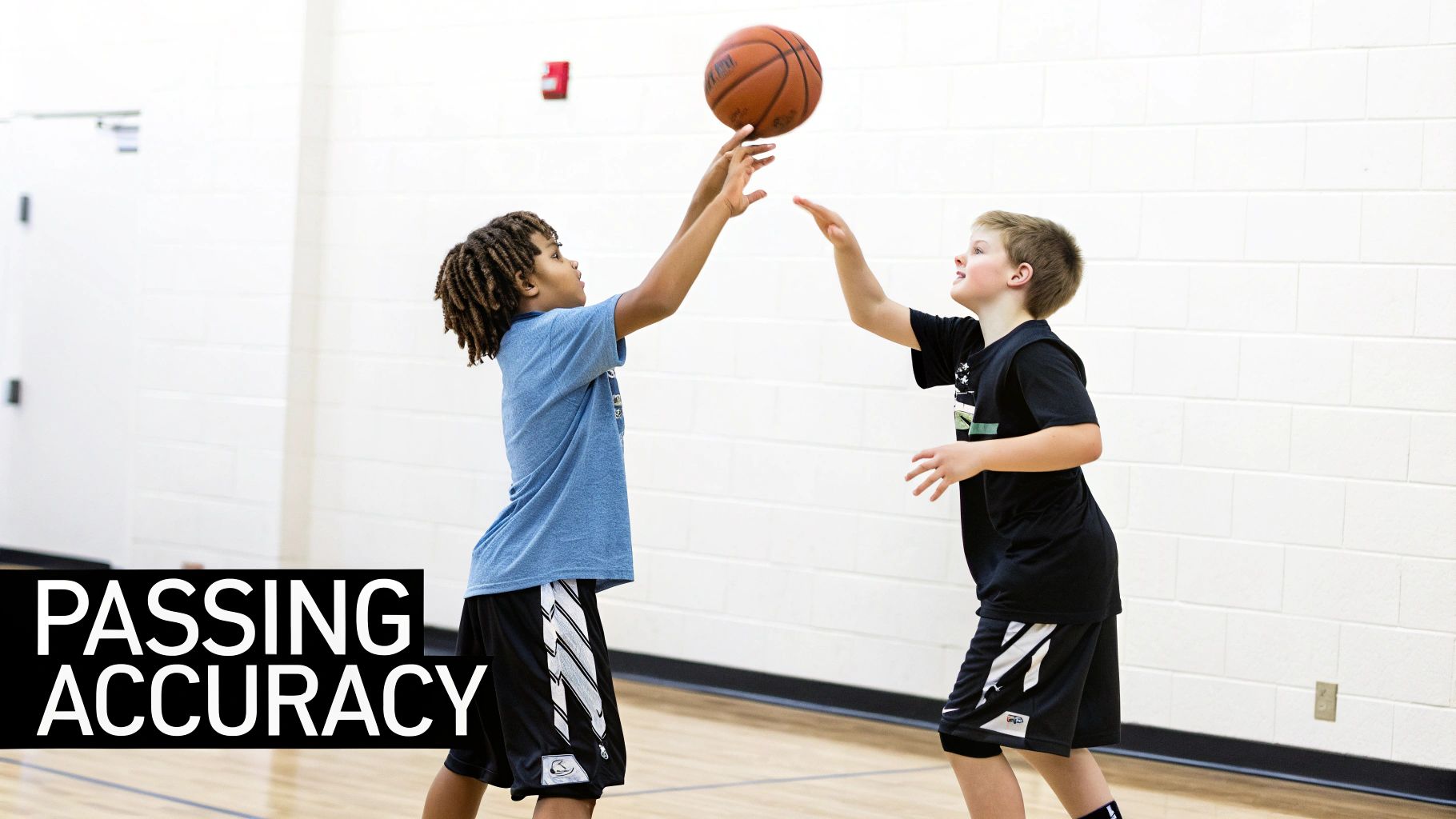
These drills move beyond simply throwing the ball back and forth. They emphasize proper footwork, such as stepping into the pass for power and accuracy, and proper catching technique, like meeting the ball with your hands to absorb its force. The ability to execute these fundamentals is crucial for running an offense and preventing turnovers.
How to Implement the Drill
Setup: Players pair up and stand facing each other, approximately 8-10 feet apart. One basketball is needed per pair.
Execution: Players practice passing back and forth, focusing on a specific pass type. Start with stationary chest passes, then move to bounce passes, and finally overhead passes. The receiving player should present a clear target with their hands.
Winning: The goal is not competition but repetition and perfection. Success is measured by the number of consecutive successful passes and catches a pair can complete without dropping the ball or making a bad pass.
Coaching Insight: Emphasize "soft hands" when catching. Tell players to imagine they are catching a water balloon they don't want to pop. This visual cue helps them understand the need to absorb the ball’s impact rather than fighting it with stiff hands.
Key Benefits and Coaching Tips
This drill is essential for building the connective tissue of a team. It can be used as a warm-up or as a dedicated skill-development station during practice.
Develops Team Chemistry: Constant communication and repetition build trust and understanding between teammates on the court.
Improves Hand-Eye Coordination: Both passing and catching require precise timing and coordination, which these focused drills directly enhance.
Adaptable: Start with stationary passing. Once players show proficiency, add movement by having them pass while sliding side-to-side or advancing up the court. You can also add a soft defensive presence to simulate game pressure.
6. Defensive Stance and Footwork Fundamentals
Defense is half the game, and introducing proper defensive habits early is a cornerstone of developing well-rounded players. This set of drills focuses on the foundational skills of defense: maintaining a low athletic stance, using quick lateral footwork, and understanding body positioning. These are among the most crucial basketball drills for 8 10 year olds because they build the discipline and physical literacy needed to stop an opponent.
While less glamorous than shooting, these drills teach players how to control space, stay in front of their matchup, and play defense without fouling. The focus is on body mechanics and anticipation, building a strong base that translates directly into game situations. Instilling a "pride in defense" mentality at this age creates players who contribute on both ends of the court.
How to Implement the Drill
Setup: You'll need cones or lines on the court (like the free-throw lane lines or baseline). A coach or partner can act as the offensive player.
Execution: Start by teaching the stance: feet shoulder-width apart, knees bent, back straight, and weight on the balls of the feet with arms out wide. Players then practice defensive slides back and forth between two cones without crossing their feet. Progress to "closeout" drills, where a player slides to an offensive player, chopping their feet and putting a hand up to contest a shot.
Winning: Turn it into a game. See who can perform the most defensive slides across the lane in 30 seconds without losing their form. Or, have players try to stay in front of a dribbler for 10 seconds.
Coaching Insight: Use the phrase "nose on the ball" to teach kids to keep their body centered on their opponent's chest. For footwork, a great cue is "don't let your feet click," which encourages them to keep a wide, stable base and slide rather than hop.
Key Benefits and Coaching Tips
This drill is a fundamental building block for every practice, teaching the effort and technique required to be a successful team player.
Builds Athleticism: The low stance and lateral movements improve balance, agility, and core strength, which benefit all aspects of the game.
Reduces Fouls: By learning to move their feet to stay in front of an opponent, young players rely less on grabbing or reaching, leading to fewer fouls.
Instills Discipline: Defense is about hard work and focus. These drills teach players the importance of commitment and effort even when they don't have the ball.
7. Transition and Fast Break Drills
Teaching kids to play with pace is crucial, and these drills are a cornerstone of modern basketball. This is one of the most exciting basketball drills for 8 10 year olds because it simulates the high-energy moments of a real game, focusing on the quick switch from defense to offense. It teaches players to grab a rebound, make a good outlet pass, and push the ball up the court for an easy scoring opportunity before the defense can get set.
These dynamic drills develop quick thinking, decisive passing, and controlled finishing at speed. By creating advantage situations like 2-on-1 or 3-on-2, players learn to read the defense, make the right pass, and attack the basket effectively. The constant movement and game-like scenarios keep kids highly engaged and improve their overall basketball IQ.
How to Implement the Drill
Setup: Start with a simple 2-on-1 drill. One defender starts at the free-throw line, and two offensive players start at half-court. The coach or another player takes a shot.
Execution: On the rebound, the offensive players sprint down the court, staying wide to create passing lanes. The defender sprints back to protect the basket. The offensive players must work together to score before a second defender (or the coach) can recover.
Winning: The goal is for the offense to score. You can make it a competition by having teams switch between offense and defense, keeping track of successful fast breaks.
Coaching Insight: Emphasize making a decision before you get to the three-point line. Young players often wait too long, allowing the defense to recover. Teach them to recognize the advantage early and decide whether to pass or shoot quickly.
Key Benefits and Coaching Tips
This drill is perfect for teaching teamwork and conditioning simultaneously, reinforcing the value of running hard after a rebound or turnover.
Improves Decision-Making: Players learn to quickly assess a numbers advantage and decide the best way to score, whether it's a pass for a layup or taking it themselves.
Develops Conditioning and Speed: The drill is non-stop action, requiring players to sprint the length of the floor, which builds game-specific stamina.
Adaptable: Start with a 2-on-1 and progress to a 3-on-2 as players become more comfortable. You can add a time limit (e.g., "score within 5 seconds") to increase the pressure and encourage faster play. Reward good passes just as much as a made basket.
8. Footwork and Finishing Around the Basket
Developing strong footwork is the foundation for scoring effectively, and mastering finishing techniques around the basket is a non-negotiable skill. This focus makes it one of the most crucial basketball drills for 8 10 year olds, teaching them how to control their bodies, create space, and convert high-percentage shots. The goal is to build muscle memory for essential movements like the jump stop, pivot, and a soft touch on layups.
This drill set moves beyond just shooting by teaching players how to get to the hoop under control and finish through contact or from awkward angles. By practicing these fundamentals, young athletes build the confidence needed to attack the rim in game situations, a skill famously emphasized by legends like Kobe Bryant. It translates directly to more points and fewer turnovers.
How to Implement the Drill
Setup: Place cones at different spots around the paint, like the block, the short corner, and the elbow. One player starts at a cone with a ball, or a coach can be ready to pass them the ball.
Execution: The player drives from a cone toward the basket. They must perform a specific footwork skill, such as a two-foot jump stop or a one-two step into a layup. They then finish with a specific shot, like a right-handed layup, a left-handed layup, or a small floater. Repeat from different spots on both sides of the hoop.
Winning: The focus is on perfect repetition rather than winning. Set a goal for a certain number of successful makes with proper form from each spot before moving on.
Coaching Insight: Emphasize the "why" behind the footwork. Explain that a jump stop creates balance and prevents traveling violations, while a pivot helps protect the ball and find new passing or shooting angles. Making these connections helps kids understand the game on a deeper level.
Key Benefits and Coaching Tips
This drill is perfect for developing a player's offensive confidence inside the key and can be easily scaled up or down in difficulty. For more hands-on guidance, consider specialized basketball training programs that focus on these foundational skills.
Prevents Traveling: Correctly teaching the jump stop and pivot is the number one way to eliminate traveling calls, a common issue for this age group.
Builds Ambidexterity: Force players to finish with their non-dominant hand. Start close to the basket to build confidence before adding movement.
Improves Body Control: Proper footwork teaches young athletes how to decelerate, land balanced, and stay in control of their movements, which is critical for both offense and injury prevention.
Adaptable: Start with no defense. Progress by having a coach stand in the way with a pad or pool noodle to simulate light pressure. Eventually, you can add a live defender to make it more game-like.
8-Drill Comparison for 10-Year-Olds
Drill | 🔄 Implementation Complexity | ⚡ Resource Requirements | ⭐ Expected Outcomes | 📊 Ideal Use Cases | 💡 Key Advantages / Tip |
|---|---|---|---|---|---|
HORSE / PIG Shooting Game | 🔄🔄 Low–Moderate — simple rules, needs turn management | ⚡ Minimal — ball + hoop | ⭐⭐⭐⭐ Improves shooting accuracy, range & creativity | Warm-ups, camps, engagement for 8–10 y/o | 💡 Highly engaging; use PIG (3 letters) & rotate players frequently |
Ball Handling & Dribbling Ladder Drills | 🔄🔄 Moderate — progressive patterns & coaching | ⚡⚡ Low — cones/ladder/tape | ⭐⭐⭐⭐ Builds ball control, ambidexterity & footwork | Skill sessions, individual practice, foundation training | 💡 Start slow, use both hands equally and time progress |
Cone Weaving & Change of Direction Drills | 🔄🔄🔄 Moderate–High — technical cuts & setups | ⚡⚡ Low–Medium — cones, space | ⭐⭐⭐⭐ Improves lateral quickness, first step & agility | Agility/conditioning phases, perimeter development | 💡 Emphasize form before speed; vary patterns to avoid overuse |
Small-Sided Game Play (3v3 / 4v4) | 🔄🔄 Moderate — organization and rule modifications | ⚡⚡⚡ Medium — multiple courts or divisions | ⭐⭐⭐⭐⭐ Maximizes touches, decision-making & creativity | Game-based learning, team play, tactical development | 💡 Use rule tweaks to target skills; keep short rotations (5–7 min) |
Passing & Catching Accuracy Drills | 🔄 Low — straightforward partner/group progressions | ⚡ Minimal — balls, targets | ⭐⭐⭐⭐ Improves passing accuracy, timing & court vision | Partner drills, warm-ups, team skill sessions | 💡 Start stationary, add movement and gradually add defensive pressure |
Defensive Stance & Footwork Fundamentals | 🔄🔄 Moderate — requires technical coaching & repetition | ⚡ Minimal — space, coach feedback tools | ⭐⭐⭐⭐ Builds reliable defensive habits and positioning | Fundamental training, defensive clinics, complete player development | 💡 Use video/mirrors for feedback; prioritize stance before speed |
Transition & Fast Break Drills | 🔄🔄🔄 Moderate–High — dynamic scenarios and safety control | ⚡⚡ Medium — space, organized groups | ⭐⭐⭐⭐ Develops outlet mechanics, quick decisions & finishing | Conditioning, tempo teams, advanced youth groups | 💡 Progress from 2v1 to 3v2; teach score/pass/reset decision-making |
Footwork & Finishing Around the Basket | 🔄🔄 Moderate — technical repetition with progression | ⚡ Minimal — ball, basket, coach cues | ⭐⭐⭐⭐ Increases high-percentage scoring and finishing touch | Near-basket scoring work, finishing development for all positions | 💡 Practice both hands, start stationary then progress to game-speed |
Putting It All Together: From Drills to Game-Ready Skills
Mastering the game of basketball is a journey, not a destination, especially for young, developing athletes. The extensive collection of basketball drills for 8 10 year olds detailed throughout this guide provides a powerful and comprehensive toolkit. We have explored everything from foundational Ball Handling and Dribbling Ladder Drills to the game-simulating intensity of Small-Sided Game Play (3v3 and 4v4). Each drill, whether focused on Defensive Stance fundamentals or the dynamic energy of Transition and Fast Break Drills, serves as a crucial building block in your child's athletic development.
The true magic, however, happens when these individual exercises are woven together into a thoughtful, engaging, and consistent practice routine. The goal is not simply to execute a Cone Weaving drill perfectly but to understand how that change of direction translates into creating space on the court. It's about connecting the precision of Passing and Catching Accuracy Drills to the successful execution of a fast break. This synthesis of skills is what transforms a young player from someone who can perform a drill into a true basketball player who understands the game.
Key Principles for Lasting Success
As you implement these drills, remember the core principles that will make the biggest impact on players in the 8 to 10-year-old age group. The ultimate objective is not to create a perfect player overnight but to cultivate a deep and lasting love for the sport.
Prioritize Fun Above All: The fastest way to disengage a young athlete is to make practice a chore. Weave in games like HORSE and PIG to keep shooting practice light and competitive. Celebrate effort, not just outcomes, and create an environment where mistakes are seen as opportunities to learn.
Focus on Foundational Skills: At this age, fundamentals are everything. A solid defensive stance, proper footwork, and confident ball-handling are the bedrock upon which all future skills will be built. Resist the temptation to jump to complex plays and instead dedicate ample time to mastering these core competencies.
Adapt and Be Flexible: Every child learns at a different pace. Be prepared to adapt any drill to match the energy and ability level of your players. A drill that is too difficult will lead to frustration, while one that is too easy will lead to boredom. The sweet spot is a challenge that is achievable with focused effort.
Coaching Insight: The most effective coaches for this age group are not just teaching basketball; they are building confidence. A player who feels successful and supported is more likely to stay engaged, work hard, and remain passionate about the game for years to come.
From Drills to Game-Ready Confidence
By consistently practicing the drills outlined in this article, you are giving your young player a significant advantage. They are not just learning how to shoot, dribble, and pass; they are developing a higher basketball IQ. They will start to see the court differently, anticipate plays, and understand the importance of spacing and teamwork. These basketball drills for 8 10 year olds are designed to be progressive, building from simple motor skills to more complex, game-like scenarios.
The journey from learning Footwork and Finishing Around the Basket to applying it seamlessly in a game is a gradual process. It requires patience, repetition, and positive reinforcement. Remember to celebrate the small victories along the way: the first perfect crossover, the crisp chest pass that leads to a score, or the defensive stop made with perfect footwork. These moments build the resilience and self-belief that are just as important as any physical skill. Keep practicing, stay positive, and watch your young hooper's abilities and their smile grow with every practice.
Ready to take your child's skills to the next level in a structured, fun, and supportive environment? JC Sports Houston offers specialized basketball programs designed to build technical skills and a love for the game in young athletes. Explore our programs and discover how expert coaching can help your child thrive by visiting JC Sports Houston today.