

8 Fun & Effective Baseball Drills for 6 Year Olds (2026 Guide)

Welcome to the exciting world of youth baseball! For many 6-year-olds, this is their first real introduction to the game, a time where building a foundation of fun, confidence, and basic skills is far more important than hitting home runs. A positive early experience can ignite a lifelong passion for the sport, while a frustrating one can extinguish it before it even begins. This guide is designed to cut through the noise and provide a clear, actionable collection of the best baseball drills for 6 year olds, tailored specifically to their developmental stage.
Our focus is on turning practice into play. Instead of complex, rigid exercises, we will explore dynamic, game-based activities that naturally build coordination, introduce proper mechanics without overwhelming young players, and, most importantly, keep smiles on their faces. As a leader in Houston youth sports, we at JC Sports understand that creating well-rounded, enthusiastic athletes starts with positive reinforcement and engaging activities. This listicle will provide you with a toolkit of drills covering everything from hitting off a tee and fielding ground balls to proper base running and introductory throwing mechanics. Beyond traditional field drills, innovative tools like a dedicated Baseball Simulator Hire can offer a dynamic and safe environment for young players to practice their swing and experience the game in a new way.
This comprehensive roundup will equip you, whether you're a parent coaching from the sidelines or a new coach leading a team, with practical, step-by-step instructions to make every practice a win. Let's dive into these fun-filled drills and set your young player up for a grand slam start.
1. Tee Ball Foundation Drill
The Tee Ball Foundation Drill is the cornerstone of youth baseball training, especially for new players. It uses a stationary batting tee to isolate the core mechanics of hitting, allowing 6-year-olds to develop a proper swing without the pressure of timing a pitched ball. This drill focuses on building a solid foundation in stance, grip, and follow-through, making it one of the most effective baseball drills for 6 year olds to build both skill and confidence.
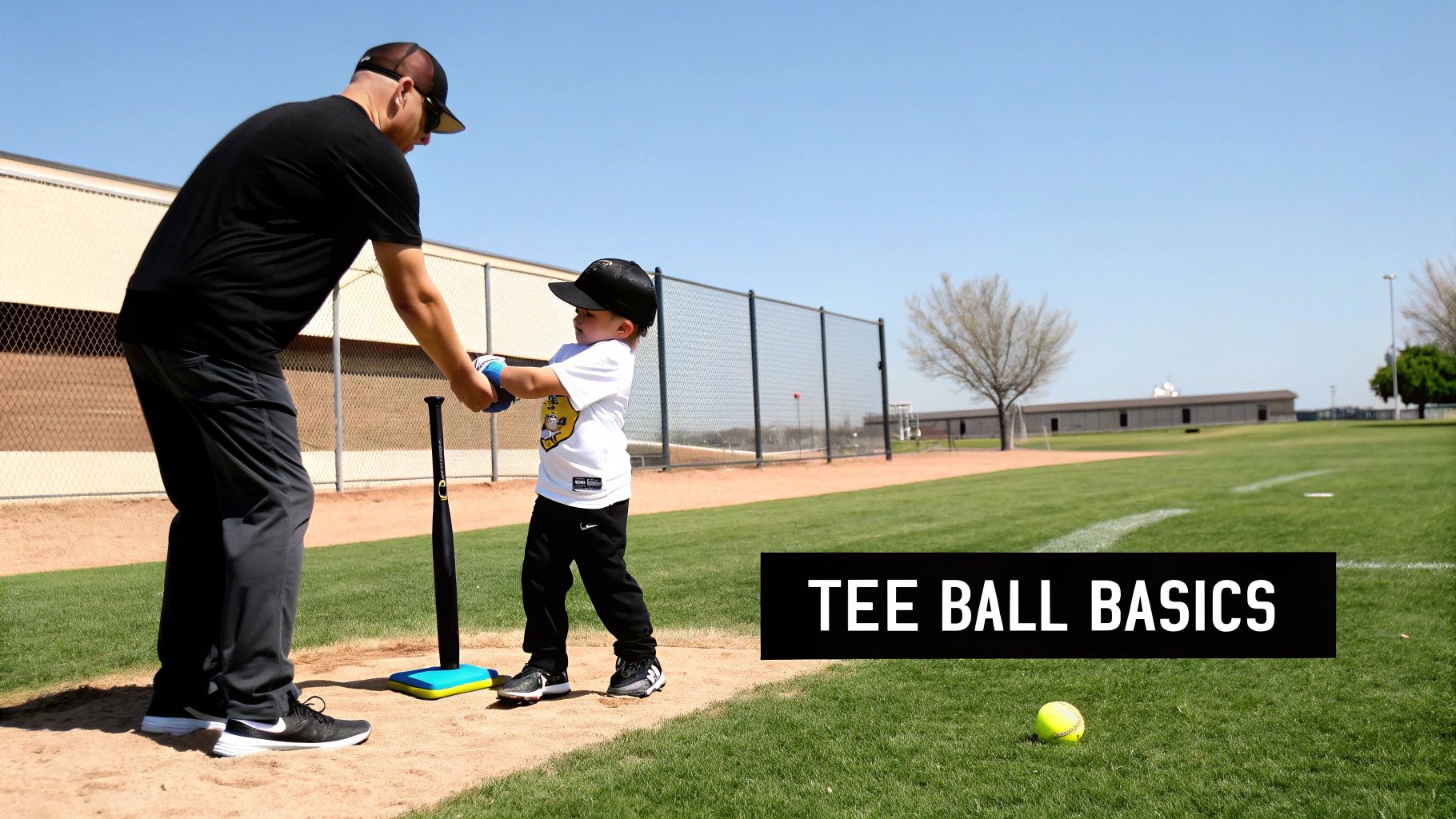
This method is essential for beginners as it removes variables like pitch speed and location. It allows a young player to concentrate solely on their body movements, fostering muscle memory and hand-eye coordination. Programs like Little League Baseball and USA Baseball have built their entire introductory levels around this concept, and it remains a staple in youth camps across Houston.
Why This Drill Works
At six years old, developing motor skills is paramount. The tee provides a consistent, predictable point of contact, giving children the chance to repeat a successful motion. This repetition is key to learning. The drill breaks down a complex action into simple, manageable steps, preventing overwhelm and encouraging a positive experience with the sport.
How to Implement the Drill
Follow these steps to set up a successful tee-ball station:
Set the Tee: Adjust the tee height so the ball is level with the player's waist or belt buckle. This promotes a level swing path.
Establish Stance: Have the player stand sideways to the tee with their feet shoulder-width apart and knees slightly bent. Their front shoulder should point toward the field.
Check Grip: Ensure the player holds the bat with their non-dominant hand on the bottom and their dominant hand on top. Their "knocking knuckles" should be roughly aligned.
Swing and Follow Through: Encourage a smooth, level swing through the center of the ball. The player should finish with their hands high and their back foot pivoted.
Coaching Tips for Success
One Focus at a Time: Dedicate each set of swings to a single mechanical element. Start with just the stance, then add the grip, and finally, the swing.
Use Soft-Core Balls: To reduce fear and the risk of injury, always use "safety" or soft-core baseballs.
Visual Cues: Place a cone or marker on the ground to show players where the bat should make contact with the ball.
Celebrate Effort: Praise good swings and effort, not just powerful hits. Positive reinforcement keeps young athletes engaged and motivated.
For parents looking to build on these fundamentals, you can find more age-appropriate activities and learn about 7 fun and effective t-ball drills for 3-5 year olds, as many of the principles apply to early learners of all ages.
2. Soft Toss Underhand Feed
The Soft Toss Underhand Feed drill is the natural next step after a player has built confidence on the batting tee. In this drill, a coach or parent gently tosses soft-core baseballs underhand from a close distance, helping 6-year-olds develop timing and pitch recognition. It bridges the gap between hitting a stationary object and a live pitch, making it one of the most crucial baseball drills for 6 year olds for building hitting mechanics against a moving target.
This method introduces the critical element of timing in a controlled, non-threatening way. The underhand toss is slower and has a more predictable arc, allowing young hitters to track the ball from the coach's hand to the hitting zone. Youth programs across Houston, from Little League to specialized camps, use soft toss stations to transition players from static to dynamic hitting environments.
Why This Drill Works
For a 6-year-old, tracking a moving object and coordinating a swing is a complex neurological task. The soft toss simplifies this process. The slow, gentle arc of the ball gives the player’s eyes and brain more time to process information, calculate the meeting point, and initiate the swing. This builds the foundational hand-eye coordination needed for more advanced hitting, all while keeping the experience positive and fun.
How to Implement the Drill
Follow these steps for an effective soft toss session:
Set Up: The coach should kneel or sit on a bucket about 10-15 feet away from the batter, positioned at a 45-degree angle to the side of home plate. This keeps the coach safe from batted balls.
Establish Stance: The player should get into their ready stance, just as they did for the tee drill, with their feet set and hands back.
Toss the Ball: Use a gentle underhand motion to toss the ball into the player’s strike zone. The goal is a soft, arcing toss that "floats" toward the plate.
Swing and Connect: The player tracks the ball from the coach's hand and swings to make contact out in front of the plate.
Coaching Tips for Success
Focus on Rhythm: Use a consistent rhythm and verbal cues like "Ready... set... hit!" to help the player time their load and swing.
Throw to a Spot: Aim for the player’s front hip. This encourages them to hit the ball out in front and drive it up the middle.
Keep It Short: Limit soft toss sessions to 5-7 minutes or 10-15 good swings per player. Young children have short attention spans, and keeping drills brief maintains focus and energy.
Positive Feedback: Praise the player's focus and timing, not just the result of the hit. Comments like "Great job watching that ball all the way!" build confidence.
3. Ground Ball Fielding Fundamentals
Ground Ball Fielding Fundamentals are crucial for developing a young player's defensive skills. This drill involves rolling soft grounders at controlled speeds to teach the basic mechanics of fielding. Players practice getting into a low, athletic stance, tracking the ball with their eyes, using "soft hands" to receive it, and transitioning quickly to a throwing position. This is one of the most important baseball drills for 6 year olds as it builds hand-eye coordination, spatial awareness, and a strong defensive foundation.
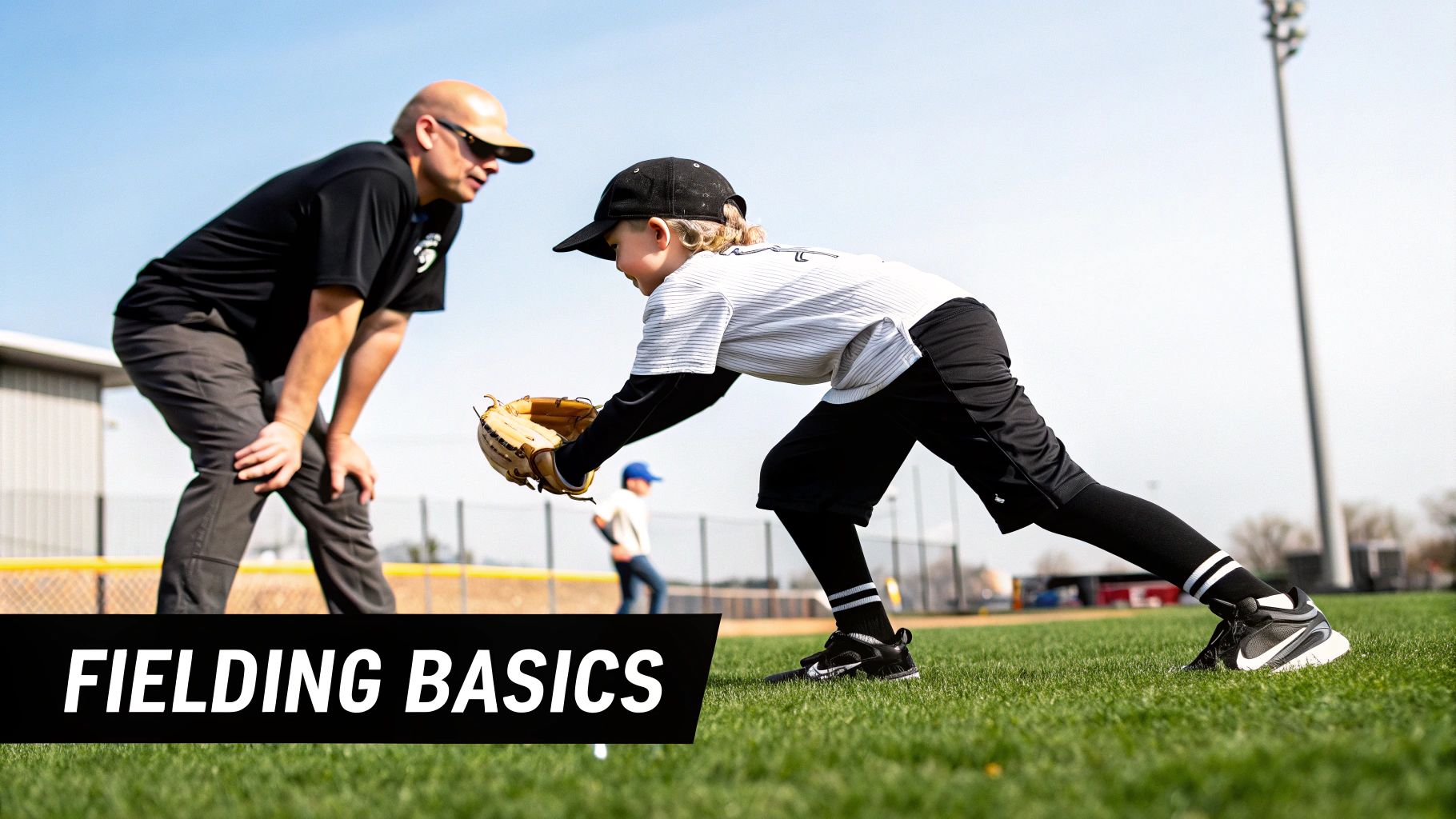
This drill teaches children how to approach the ball, get their body in front of it, and secure it properly in their glove. It’s a core component of defensive training you’ll see in Little League fielding clinics and community baseball camps across Houston. Even professional player academies build their daily routines around mastering these ground ball basics, proving its value at every level of the game.
Why This Drill Works
For 6-year-olds, catching a moving object can be intimidating. By starting with slow, predictable ground balls, this drill removes the fear of being hit by a hard-hit ball and allows them to focus on body positioning. It teaches the concept of using their body as a "backstop" and building good habits from the very start, which is essential for preventing errors and building defensive confidence.
How to Implement the Drill
Follow these steps to set up a ground ball station:
Get in Ready Position: Have the player stand with their feet slightly wider than their shoulders, knees bent, and their bottom down. Their glove should be on the ground in front of them, open and ready.
Roll the Ball: From about 10-15 feet away, roll a soft-core baseball directly to the player. The roll should be gentle and easy to track.
Field and Secure: Instruct the player to watch the ball all the way into their glove. Once they catch it, they should bring their throwing hand over the top of the glove to "secure" the ball, like closing an alligator's mouth.
Transition to Throw: After securing the ball, have them stand up and get into a throwing position, reinforcing the connection between fielding and throwing.
Coaching Tips for Success
Start Close: Begin with very soft rolls from a short distance (10-15 feet) to build confidence.
Emphasize "Eyes on the Ball": Remind players to keep their head down and watch the ball all the way into their glove.
Use Cues: Fun cues like "get your nose behind the ball" or "be a brick wall" help them understand the goal of getting their body in front of the ball.
Add Variety Later: Once they master straight-on grounders, progress to rolling balls to their left and right to introduce movement.
Praise Mechanics: Celebrate proper form and effort, even if they miss the ball. Positive reinforcement is key to keeping them engaged.
4. Fly Ball Tracking and Catching
The Fly Ball Tracking and Catching drill is a fundamental exercise designed to teach young players how to judge, move to, and secure balls hit in the air. This drill starts with simple, soft tosses and gradually increases in difficulty, helping 6-year-olds develop crucial spatial awareness and hand-eye coordination. It's one of the most important baseball drills for 6 year olds for building outfield skills and the confidence needed to make a play.
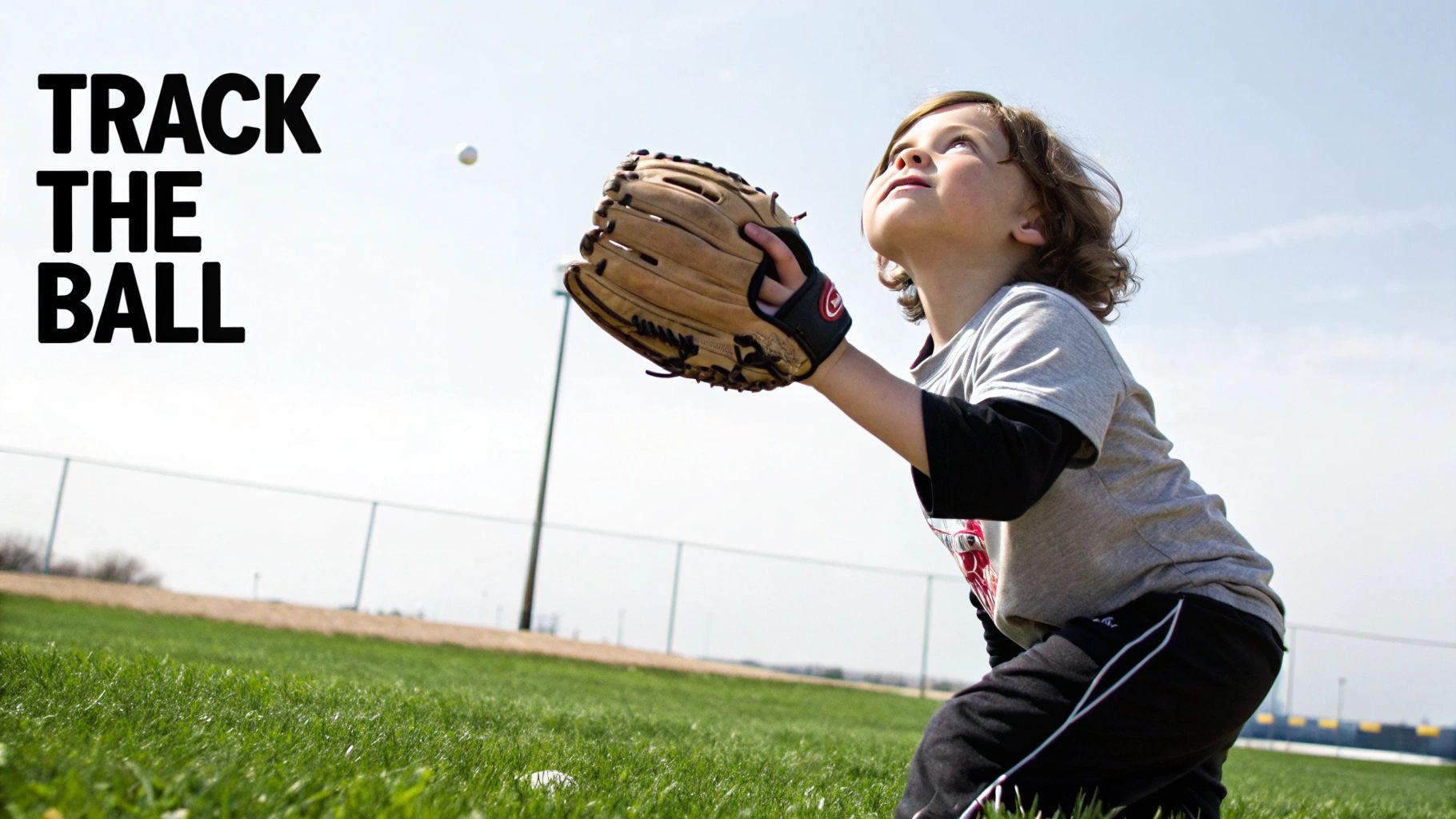
Learning to track a fly ball is a complex skill that involves predicting an object's trajectory while moving your body to intercept it. By starting with manageable tosses, this drill breaks down the process, preventing young players from becoming intimidated. This progressive approach is a cornerstone of youth baseball camps, including those in the Houston area, and is essential for developing well-rounded defensive players.
Why This Drill Works
At age six, a child's ability to judge depth and speed is still developing. This drill provides a controlled environment to practice these skills without the pressure of a game situation. By starting close and using soft balls, it eliminates fear and allows children to focus entirely on watching the ball into their glove. Repetition builds the visual tracking skills and footwork patterns necessary for future success in the outfield.
How to Implement the Drill
Follow these steps to teach fly ball fundamentals effectively:
Starting Position: Have the player stand in a ready athletic stance, about 15-20 feet away from you.
Initial Tosses: Begin with gentle underhand tosses that have a slight arc, aimed to land just in front of the player. This teaches them to move forward.
Introduce Movement: Gradually mix in tosses to their left, right, and slightly behind them, encouraging them to take a few steps to get under the ball.
Proper Catching Technique: Instruct the player to get their body behind the ball and make the catch with two hands, using their glove and bare hand to secure it.
Increase Difficulty: As their confidence grows, you can gradually increase the distance and the height of the arc on your tosses.
Coaching Tips for Success
Use Soft-Core Balls: Always start with safety baseballs or even tennis balls to remove any fear of being hit by the ball.
Keep Your Eyes on the Ball: Teach players to keep their "two eyes on the ball" all the way into the glove.
Verbal Cues: Use simple commands like "Watch it!" as you toss and "Move your feet!" to encourage proper footwork.
Short Rotations: Keep drill sessions short, around 5 minutes at a time, to maintain focus and prevent physical or mental fatigue.
Positive Reinforcement: Cheer for the effort of tracking the ball, not just successful catches. This keeps the drill fun and engaging.
5. Base Running Form and Speed Development
Base Running Form and Speed Development is a crucial component of training that transitions a young player from a hitter to a complete baseball player. This drill set focuses on teaching the fundamental mechanics of running the bases, including proper form, footwork around the bags, and an introduction to safe sliding. Using tools like cone courses and relay races, it transforms a basic run into a strategic skill, making it one of the most dynamic baseball drills for 6 year olds.
This drill is vital because it introduces the excitement and athletic demands of the game beyond hitting. For a 6-year-old, running is a natural and enjoyable activity, and channeling that energy into purposeful base running builds coordination, leg strength, and game awareness. Many Houston-area youth speed and agility camps integrate baseball-specific base running to teach these foundational skills in a fun, competitive environment.
Why This Drill Works
At this age, players are developing their coordination and ability to follow multi-step instructions. This drill breaks down the complex act of rounding the bases into simple, repeatable actions. It teaches kids to run with their heads up, listen for coaching instructions, and understand the flow of the game, which builds confidence and on-field intelligence.
How to Implement the Drill
Follow these steps to set up a productive base running session:
Set Up a Cone Course: Place cones to create a path that shows players the proper arc to take when rounding a base. This teaches them to touch the inside corner of the bag without losing momentum.
Demonstrate Form: Show players how to run with high knees and a slight forward lean. Emphasize pumping their arms from "cheek to cheek" (hip to cheek) to generate speed.
Run Through First Base: Teach players to run hard through first base, not just to it. Place a cone or marker about 10 feet past the bag as a target.
Introduce Relay Races: Divide the team into two lines at home plate. On "go," the first player in each line runs the bases. The next player goes once the first one crosses home plate. This adds a fun, competitive element.
Coaching Tips for Success
Small Steps, Big Speed: Encourage small, quick steps rather than long, bounding strides, as this is more efficient for young athletes.
Look and Listen: Teach players to find the third base coach as they round second base to look for signals to stop or keep going.
Safe Sliding Practice: Introduce sliding on a slip-and-slide or wet grass first to build confidence before moving to a dirt infield.
Praise Improvement: Celebrate effort and improved form over just being the fastest. Positive reinforcement encourages all players to participate fully and try their best.
6. Hand-Eye Coordination Ladder Drills
Hand-Eye Coordination Ladder Drills are a dynamic way to merge athletic footwork with essential ball-tracking skills. This method uses a flat agility ladder laid on the ground, guiding players through various foot patterns while they simultaneously focus on catching or tossing a ball. It’s a fantastic way to develop quick feet, balance, and the ability to process multiple actions at once, making it one of the more advanced and beneficial baseball drills for 6 year olds.
This drill trains a young athlete's brain and body to work together under pressure, mimicking the complex movements required on the baseball field. Many professional baseball academies and youth camps in the Houston area incorporate these drills to build a strong foundation of athleticism. By combining lower-body agility with upper-body coordination, players develop a more holistic skill set.
Why This Drill Works
At age six, children are rapidly developing their neuromuscular pathways. Ladder drills challenge them to think about their foot placement while reacting to an external object like a ball. This dual-task approach accelerates the development of coordination, reaction time, and body control, which are critical for fielding grounders, running bases, and making plays.
How to Implement the Drill
Follow these steps for an effective ladder drill session:
Master Footwork First: Begin with basic ladder patterns without a ball. Have the player practice simple movements like running through with one foot in each square or two feet in each square.
Introduce the Ball: Once the footwork is comfortable, stand at the end of the ladder. As the player moves through the pattern, gently toss a soft-core baseball or tennis ball for them to catch.
Self-Toss Progression: For a greater challenge, have the player toss the ball up to themselves, clap once, and catch it while continuing their footwork pattern through the ladder.
Vary the Patterns: Introduce more complex patterns like the "in-in-out-out" or lateral shuffles as the child’s skill improves.
Coaching Tips for Success
Verbal Cues: Use simple, rhythmic cues like "step-step" or "in-out" to help players sync their movements.
Keep it Short: Limit each turn to one or two passes through the ladder. This maintains focus and prevents frustration.
Use Soft Balls: Always use tennis balls, soft-core baseballs, or even beanbags to ensure safety and build confidence.
Focus on Fun: Turn the drill into a game. Play music or challenge players to create their own footwork patterns to keep them engaged and excited.
7. Small-Sided Game Play and Situational Drills
Small-Sided Game Play integrates hitting, fielding, and baserunning into realistic, modified game scenarios appropriate for this age group. By using reduced field sizes and simplified rules, this approach keeps players engaged while developing crucial decision-making skills. These are among the most dynamic baseball drills for 6 year olds because they bridge the gap between practicing isolated skills and understanding the flow of a real game.
This method is essential for teaching young athletes how to apply their skills in a live-action context. It moves beyond static drills to create a fun, competitive environment where kids learn situational awareness. Youth baseball leagues across Houston, including JC Sports Houston's seasonal leagues, emphasize small-sided participation to build a foundational love for the game and improve player retention.
Why This Drill Works
At six years old, children learn best through play. Small-sided games transform practice into an exciting event, which enhances focus and participation. Simplifying the rules prevents young players from feeling overwhelmed and allows them to grasp core concepts like making an out, running the bases correctly, and backing up teammates. This format inherently teaches teamwork and sportsmanship in a practical way.
How to Implement the Drill
Follow these steps to set up a successful small-sided game:
Modify the Field: Use cones to create a smaller diamond with shorter base paths (45-50 feet is ideal).
Simplify the Rules: Start with a coach pitching or use a tee. Implement rules like "every player bats each inning" and "no strikeouts" to maximize action.
Rotate Positions: Ensure every child gets a chance to play multiple infield and outfield positions throughout the game. This builds versatility and keeps everyone involved.
Focus on Situations: After a play, briefly pause to explain the outcome. For example, "Great job throwing to first base for the out!" This reinforces learning.
Coaching Tips for Success
Continuous Batting Order: Let every player on the team bat in each inning, regardless of outs, to maximize participation.
Keep Score Loosely: Avoid keeping score in early sessions to emphasize development and fun over winning.
Encourage, Don't Correct: Use positive reinforcement to guide players during the game. Save detailed mechanical feedback for individual drills.
Keep it Short: Limit games to 3-4 innings or a set time (e.g., 45 minutes) to maintain high energy and focus.
These games are a cornerstone of effective youth development. You can see these principles in action and understand why to choose JC Sports for T-ball and baseball developmental leagues this season by looking at how they structure their programs for maximum fun and learning.
8. Throwing Accuracy and Distance Progression
The Throwing Accuracy and Distance Progression drill is a fundamental method for teaching young players how to throw a baseball correctly and safely. It focuses on mastering proper mechanics at short distances before gradually increasing the length of the throws. This structured approach builds arm strength, reinforces correct footwork, and develops accuracy, making it one of the most critical baseball drills for 6 year olds for long-term player development.
This progression-based system prevents young athletes from developing bad habits like overthrowing, which can lead to injury or inaccuracy. By prioritizing control over raw power, it ensures that a player's arm develops properly. Esteemed organizations like Little League Baseball and youth baseball academies across Houston build their arm development programs around this very concept of gradual progression.
Why This Drill Works
For a 6-year-old, coordinating the entire body to throw a ball is a complex task. This drill breaks it down into manageable steps, starting close and simple. This builds confidence and muscle memory for proper form: pointing the front shoulder, stepping toward the target, and following through. The gradual increase in distance provides a natural challenge that grows with the player's skill level, keeping them engaged without causing frustration or fatigue.
How to Implement the Drill
Follow these steps for an effective throwing progression session:
Start Close: Have players stand just 10-15 feet apart. The goal is not distance, but to make a soft, accurate toss to their partner's chest.
Focus on Grip: Teach the four-seam grip (fingers across the "horseshoe" of the seams). This grip provides the most control and a straight flight path for the ball.
Teach Footwork: Instruct players to point their non-throwing shoulder toward the target. They should take a small step with their glove-side foot directly at their partner as they throw.
Gradually Increase Distance: After several accurate throws, have players take one or two steps back. Continue this process, ensuring they maintain proper form and accuracy before adding more distance. Stop when form begins to break down.
Coaching Tips for Success
Form Over Force: Always praise good mechanics over a hard throw. Use cues like "point your shoulder" and "step to your target."
Keep It Short: Limit dedicated throwing sessions to 10-12 minutes to avoid arm fatigue. A tired arm often leads to poor mechanics.
Use Targets: Place a cone or even the partner's glove as a visual target. This helps players focus on a specific destination for the ball.
Check the Follow-Through: Ensure the player's throwing arm finishes across their body, near their opposite knee. This helps decelerate the arm safely.
This approach aligns with a healthy, long-term view of athletic development, which is crucial for young players. You can learn more by exploring a parent's guide to the Long-Term Athlete Development model to understand how these foundational skills contribute to a child's overall athletic journey.
8-Drill Comparison: Baseball for 6-Year-Olds
Drill | Implementation Complexity 🔄 | Resources & Safety ⚡ | Expected Outcomes ⭐📊 | Ideal Use Cases 💡 | Key Advantages ⭐ |
|---|---|---|---|---|---|
Tee Ball Foundation Drill | Low — simple setup, coach-led repetition | Minimal: batting tee, soft balls; very safe | High ⭐ — builds stance, grip, swing mechanics; confidence | Beginners (age ~6), first sessions, motor-skill focus | Focused mechanics practice; high success rate; easy coach feedback |
Soft Toss Underhand Feed | Low–Medium — requires consistent tosses from coach | Soft-core balls, coach/toss partner; small group recommended | Medium–High ⭐ — develops timing and pitch recognition 📊 | Progression from tee toward live pitching; small groups | Controlled moving-pitch practice; quick skill progression |
Ground Ball Fielding Fundamentals | Low–Medium — needs patient coach rolling grounders | Soft grounders, cones; small groups; safe when supervised | High ⭐ — teaches ready position, soft hands, footwork 📊 | Infield fundamentals, defensive clinics | Builds foundational defensive mechanics; confidence-building |
Fly Ball Tracking and Catching | Medium — space and careful toss control required | Soft tosses, open field; manage fear of overhead balls | Medium–High ⭐ — vertical tracking, footwork, outfield readiness 📊 | Outfield prep, spatial-awareness drills | Teaches tracking and positioning; transferable to other sports |
Base Running Form and Speed Development | Low — simple drills but supervision for sliding | Cones, bases, open space; safety emphasis for sliding | Medium ⭐ — improves running mechanics, agility, base turns 📊 | Conditioning, base-running clinics, relay races | Enhances speed and base-running confidence; fun and inclusive |
Hand-Eye Coordination Ladder Drills | Medium — complex sequencing may need demos | Agility ladder, soft balls/bean bags; risk of trips if crowded | High ⭐ — improves reaction time, coordination, agility 📊 | Small-group agility stations, multisport development | Integrates footwork with ball skills; high transfer to gameplay |
Small-Sided Game Play & Situational Drills | Medium–High — requires organization and rule adjustments | Field space, multiple players/coaches; supervision to reduce risk | High ⭐ — develops game sense, decision-making, skill application 📊 | Team practices, end-of-session application, engagement-focused | Most engaging format; applies skills in realistic context; builds teamwork |
Throwing Accuracy & Distance Progression | Low–Medium — needs careful coaching to prevent overuse | Cones, partners; monitor volume (overuse warning) ⚡ | Medium–High ⭐ — builds throwing mechanics, accuracy, arm stability 📊 | Arm development sessions, partner drills, measurable progress | Teaches control-first progression; measurable and motivating results |
Bringing It All Together: Your JC Sports Houston Practice Plan
You now have a comprehensive playbook filled with effective, fun, and age-appropriate baseball drills for 6 year olds. We've covered everything from the foundational Tee Ball Foundation Drill to the dynamic Small-Sided Game Play, ensuring each activity builds a specific skill while keeping young athletes excited and engaged. The journey from hesitant first swings to confident base running is built one practice at a time, using the very drills we've detailed.
Remember, the magic isn't in a single drill but in the blend. A successful practice for this age group is a tapestry woven from hitting, fielding, throwing, and running. By combining a Soft Toss Underhand Feed session with Ground Ball Fielding Fundamentals, you’re creating a holistic learning experience. The key is to keep the energy high, the instructions simple, and the focus squarely on effort and enjoyment.
Key Takeaways for Your Next Practice
As you head to the field or our indoor facility, keep these core principles at the forefront of your coaching strategy:
Variety is Vital: Repetition builds muscle memory, but variety prevents boredom. Rotate stations, mix in games like the Hand-Eye Coordination Ladder Drills, and always end on a high note. A 45-minute session can feel like an eternity to a six-year-old if it's monotonous.
Focus on the "Why": Instead of just saying "keep your eye on the ball," explain why it helps. Simple cues like, "Watch the ball hit the bat so you can send it flying!" connect the action to a fun outcome, making the instruction more memorable.
Celebrate Small Wins: Did a player stop a ground ball with their chest instead of their glove? Great! Praise the effort to get in front of the ball. Celebrating progress, not just perfection, builds the confidence needed to tackle more complex skills later on.
Safety and Fun are Non-Negotiable: Using soft baseballs, ensuring proper spacing, and maintaining a positive, encouraging atmosphere are paramount. A child who feels safe and is having fun is a child who will want to come back to practice next week.
Your Actionable 45-Minute Practice Blueprint
Putting these ideas into action is the next step. Don't feel overwhelmed by the number of drills; instead, use them as building blocks. Here is the sample practice plan from our introduction, expanded with a bit more detail, perfect for creating a structured yet fun session.
Sample JC Sports Houston Practice Plan (45 Minutes)
Dynamic Warm-Up (5 Minutes): * Activity: "Animal Runs." Call out different animals and have the kids mimic their movements across the field (e.g., bear crawls, frog jumps, cheetah sprints). This gets their bodies moving and their minds engaged.
Skill-Building Stations (30 Minutes - 10 Minutes Each): * Station 1: Hitting Fundamentals. Use the Tee Ball Foundation Drill. Focus on a level swing and watching the ball. Each child gets 5-7 swings before rotating. * Station 2: Fielding Position. Practice the Ground Ball Fielding Fundamentals. Use soft baseballs and roll them gently. Emphasize the "alligator hands" and "eyes behind the glove" techniques. * Station 3: Athletic Movement. Set up a simple Base Running Form and Speed Development relay. Have them run to first base and back. Focus on running through the base.
Game Application (10 Minutes): * Activity: Small-Sided Game. A simple 3-on-3 game where every batter hits off the tee. This is their chance to put all the skills from the stations together in a low-pressure, exciting game environment.
This structured approach ensures every player gets ample repetitions without standing around. It’s a model we successfully use at JC Sports Houston to maximize learning and fun. By adopting this plan, you are not just teaching baseball; you are fostering a love for the game, building resilience, and creating positive memories that will last far beyond the baseball diamond.
Ready to see these drills in action with expert guidance? At JC Sports Houston, our coaches specialize in developing young athletes in a fun, positive, and climate-controlled indoor environment, making it the perfect place for your child to begin their baseball journey. Explore our youth baseball programs and give your child the foundation for a lifetime of success and love for the game.
Comments