

Basketball Skills Development for Young Players

Your child misses a layup in Saturday morning's game, and the obvious conclusion is that they need more shooting practice. So you add repetitions at the hoop, perhaps a private lesson, and another basket-focused session during the week. Then the same child loses balance on a defensive slide, struggles to stop under control, or looks exhausted after a few possessions.
The problem may not be a lack of basketball effort. Many young players need a broader movement base before more advanced dribbling and shooting work can transfer to games. Basketball skills development works best as a progression: movement readiness, basic fundamentals, sport-specific skill, then decision-making under pressure.
What Most Basketball Skills Guides Get Wrong About Young Players
A child misses a right-handed layup in a Saturday game. The instinct is to schedule more layups. Yet the core problem may be confused footwork, poor takeoff timing, uncontrolled speed, or eyes fixed on the ball. Ten extra attempts will not correct all four.
For children under 10, ask a broader question before counting shots: can the player balance, stop, turn, coordinate both sides of the body, and control an object while moving? Those abilities determine whether basketball-specific practice will transfer.
Skill development is layered
Movement comes first. Watch whether the player can land under control, slow down without falling forward, shuffle in both directions, and coordinate a skip or hop. Then add basic basketball actions, including receiving, stopping on two feet, pivoting, passing, and finishing near the basket. Increase complexity only when those actions remain controlled.
Application comes after the foundation. Players must recognize a defender, locate an open teammate, decide when to pass, and move after releasing the ball. A stationary drill introduces technique. Small-sided games and guided pressure teach timing, spacing, and choice.
Practical rule: If a child cannot perform a movement slowly and under control, adding speed usually creates noise instead of progress.
Organized sport does not guarantee broad movement competence. A 2025 cross-sectional study of fundamental motor skills examined 1,332 students aged 10 to 14 and found insufficient proficiency in both specialized sport and traditional physical-education programs. In specialized programs, 72% of boys and 77% of girls failed to reach adequate proficiency levels. The figures were 90% of boys and 92% of girls in traditional programs.
Parents should read that finding carefully. A child can attend organized basketball and still need work on balance, landing, object control, and general coordination. Basketball practice should expose those gaps rather than hide them behind repeated shooting.
Confidence affects whether a young player attempts unfamiliar movements, accepts correction, and keeps working after a mistake. Practical confidence-building approaches for young athletes therefore belong beside technical instruction. Basketball skills development is not a shopping list of drills. Each exercise should match the player's current foundation, then progress toward decisions under pressure.
The Four Skill Families Every Young Player Needs
Use four categories to judge whether a drill deserves a place in your child's week. If an exercise trains only one family, balance it with activities that develop the others.
Ball handling
This family includes dribbling, passing, and receiving. For a young player, good ball handling doesn't mean performing a complicated combination. It means keeping the ball protected, changing hands when needed, receiving a pass with prepared hands, and making a simple pass to a teammate who can use it.
Begin with control. A player should be able to dribble with the eyes occasionally lifted, stop the ball safely, and pass with enough force for a teammate to catch it without reaching or chasing. Add movement only after the player can repeat the action without staring at the ball.
Shooting and finishing
Shooting includes body alignment, touch, balance, distance selection, and finishing from different angles. Early success comes from shots the player can take with sound mechanics, not from forcing a full-length shot that changes the release.
For beginners, look for a stable base, a controlled lift, and a finish that uses the correct hand and foot relationship. A layup is more than putting the ball through the hoop. The player must approach, gather, take off, protect the ball, and land safely.
Footwork
Footwork supports every possession. It includes stance, jump stops, pivots, starts, stops, defensive slides, and changes of direction. A player who can dribble but can't stop or pivot becomes easy to pressure.
Teach footwork at a pace that lets the player feel the position. Have the child catch, land on two feet, pivot both ways, and return to a balanced stance. Later, add a defender, a closeout, or a decision.
Decision-making
Decision-making is the family most drill lists leave out. It includes reading space, recognizing help defense, timing a pass, cutting after a pass, and choosing whether to attack, shoot, or reset.
A player with average dribbling who sees open teammates can help a team more than a player with flashy handles who misses every passing window. Put young players in small-sided games, such as one-on-one, two-on-one, or three-on-three, so they must solve problems rather than repeat movements without context.
When evaluating an online drill, ask one question: What does the player have to notice and decide? If the answer is nothing, treat the exercise as preparation, not complete basketball training.
A Readiness Check Before Adding More Reps
Before adding more basketball drills, watch how the child moves without the ball. A short, playful screen shows whether the player can control basic positions, stop safely, and coordinate both sides. Stop if the child reports pain. This is an observation, not an injury diagnosis.
Five checks for home
Single-leg balance: Ask the child to stand tall on one leg with a softly bent knee. Look for a steady torso and only minor foot movement. Repeated taps or a leaning trunk suggest more balance practice through games, low skipping patterns, and controlled step-downs.
Deceleration: Mark a short lane and have the child jog through it, then stop inside the target area. Quiet feet, bent hips and knees, and a controlled finish show useful braking ability. Falling forward, taking several extra steps, or locking the knees calls for marching stops, snap-downs, and short accelerations followed by controlled braking.
Lateral movement: Ask for a side shuffle in both directions. The player should stay low, keep the feet from crossing, and avoid turning the shoulders fully. If balance disappears or the feet cross, keep defensive-slide practice slow and short before adding speed.
Bilateral coordination: Use skips, alternating hops, or a simple rhythm pattern. Polished technique is unnecessary, but both sides should contribute. When one side repeatedly breaks down, use animal walks, rhythm games, and cross-body movements before demanding quick crossover dribbles.
Object control: Toss a soft ball and ask the child to catch it, then throw it toward a target. Check whether the hands prepare early, the eyes follow the ball, and the throw has useful direction and pace. Inconsistent control calls for partner passing and target games before faster passing drills.
These checks matter because basketball practice can hide movement gaps. As noted earlier, research on students aged 10 to 14 found insufficient fundamental-motor-skill proficiency among many children in both specialized and traditional programs. A child may know where to stand or imitate a drill while lacking the balance, braking, or coordination underneath it.
Readiness test: Progress when the player can perform the movement slowly, repeat it on both sides, and keep attention available for a simple instruction.
A weak result is not a reason to remove basketball. Keep the ball involved while strengthening the base. Play tag with stops, pass while balancing, dribble through wide gates, or use a small-sided game with fewer rules. These activities build control without turning every practice into an examination. Add complexity only when the child can keep the movement organized under a little pressure.
Age-by-Age Focus for Basketball Skill Development
A four-year-old and a fourteen-year-old may both enjoy basketball, but they shouldn't receive the same practice. The younger player needs exploration and coordination. The older player can handle more deliberate technique, provided the movement foundation and recovery habits remain in place.
Ages 4 to 6
At this stage, movement variety matters more than polished shooting. Use running, jumping, landing, rolling, balancing, throwing, catching, and simple dribbling games. A short activity where children dribble to a color, stop on a signal, and pass to a partner develops more useful control than a long line of forced shots.
Formal shooting volume is usually a poor investment for preschool players. Lower baskets, soft balls, target throws, and close finishes can introduce the sport without making accuracy the only measure of success. Small-sided games should have simple rules and frequent turns.
Ages 7 to 9
Children can begin learning a consistent layup approach, jump stops, triple-threat position, basic pivots, passing angles, and defensive stance. Keep coordination and change-of-direction work in the program instead of replacing it with basketball-only repetitions.
Use short blocks. A player might work on stationary control, then attack a cone, then finish against a passive defender, then play a game where the finish appears naturally. The coach should correct one or two priorities, not interrupt every possession.
Ages 10 to 14
Older players can tolerate more structured form shooting, closeouts, passing under pressure, ball-screen concepts, spacing, and position flexibility. They still need free play and exposure to movements outside basketball. A growing athlete who trains only one set of patterns may become technically narrow and less adaptable.
Early specialization also creates workload concerns, particularly after injury or a long break. A 2025 study of youth female basketball players found that previous injury significantly affected later training loads, including acute and chronic load, skill-based training load, training monotony, and training strain. The higher-risk group also experienced significantly more non-contact injuries.
That doesn't mean girls should avoid demanding practice. It means coaches and parents should rebuild tolerance progressively, monitor fatigue, and avoid sudden increases in private lessons, camps, practices, and games. For practical examples of age-appropriate organization, see basketball training for kids, then adapt the workload to the individual child.
Building a Weekly Practice Schedule That Actually Sticks
A good schedule survives school, weather, family commitments, and the player's energy level. It also leaves room for recovery. The templates below are starting points, not mandatory quotas.
Age Band | Sessions per Week | Session Length | Primary Focus | Rest Days |
|---|---|---|---|---|
Ages 4 to 6 | 2 | 30 minutes | Movement play, ball familiarity, small-sided games | At least 2 between structured sessions |
Ages 7 to 9 | 3 plus 1 league game | 20 to 35 minutes | Fundamentals, coordination, finishing, simple decisions | At least 2 lighter or recovery days |
Ages 10 to 14 | 4 | 30 to 60 minutes | Two skill sessions, two game-focused sessions | At least 1 full rest day |
For ages 4 to 6, make both sessions movement-led. Spend most of the time on races, balance games, throwing, catching, dribbling challenges, and short play. Shooting can appear, but it shouldn't dominate.
For ages 7 to 9, use three short sessions with different purposes. One can emphasize ball control and passing, another can combine footwork with finishing, and the third can use small-sided games. Keep the league game separate from extra conditioning.
For ages 10 to 14, schedule two focused skill sessions and two game-based sessions. A skill session might include form shooting, footwork, and one decision drill. A game session should include live defense, transition, spacing, and opportunities to solve problems without constant coach interruption.
Build in a light day
A light day can include mobility, easy ball handling, shooting close to the basket, or relaxed play. It shouldn't become a hidden conditioning session. Warm up with jogging, skips, lateral movement, balance, and controlled stops before faster work.
After illness, vacation, or injury, restart below the child's normal intensity. Reduce the complexity and amount of work, watch movement quality, and add challenge only when the player finishes comfortably. Previous injury can change training tolerance, so a return plan should involve the child's healthcare professional when appropriate.
Families managing multiple activities can use a calendar that handles recurring lessons to keep practices, games, and lighter days visible. The tool won't decide the correct workload, but a clear calendar makes accidental overbooking easier to spot.
A Small Drill Library You Can Run Anywhere
A useful drill library should be small enough to remember and flexible enough to adjust. Use cones, a ball, a wall or partner, and a hoop when available. Stop a drill when technique falls apart, then simplify the task instead of demanding tired repetitions.
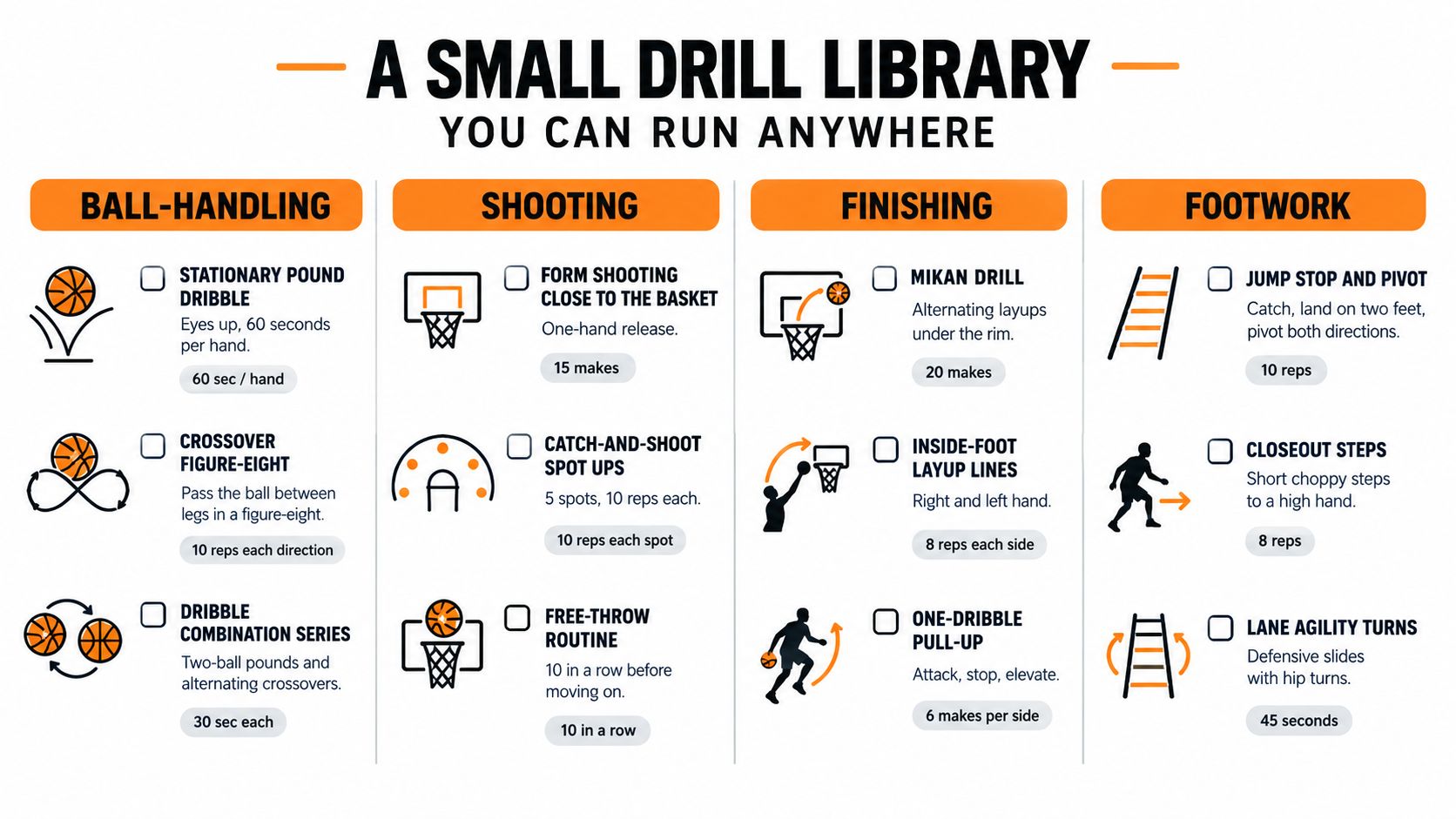
Ball handling
Stationary pound dribbles: Use one ball. Work for a short timed interval with eyes periodically up. Younger players can use one hand at a time, while older players can add rhythm changes. Improvement looks like relaxed shoulders and fewer glances downward.
Crossover figure-eight: Move the ball between the legs in a figure-eight pattern. Begin standing still, then add a slow step. Count controlled repetitions rather than rushing.
Combination series: Combine two-ball pounds and alternating crossovers for brief intervals. Use this with players who can already control a single ball. Improvement shows when the player can change rhythm without losing posture.
For more progressions, use this guide to improve basketball dribbling, but don't skip the readiness checks when a player struggles with balance or coordination.
Shooting and finishing
Close form shooting: Stand close enough to the basket that the player can use one-hand release and finish balanced. Count makes only when the motion stays controlled.
Elbow close-outs: Start in a stance, close out with short steps and a high hand, then receive a shot or pass. The player should arrive under control rather than flying past the shooter.
Three-spot layup circuit: Use the right and left sides, then add a central approach. Begin without defense, progress to a passive contest, and finish with a live decision.
Footwork
Cone slide and finish: Slide between two cones, turn the hips, then finish at the basket. Keep the distance short until the player can change direction without standing upright.
Drop-step pivots: Catch or simulate a catch, establish a pivot foot, and turn away from pressure. Practice both directions.
Ladder patterns: Use a floor ladder or tape lines for in-and-out steps, lateral patterns, and controlled exits. The ladder is preparation for foot speed, not a substitute for basketball decisions.
Decision-making
Two-on-one advantage: Give the offense a numerical advantage and require the ball handler to read the defender. Rotate roles so every player passes, cuts, and finishes.
Three-pass-and-cut: After passing, the player must cut or screen rather than watch the ball. Add a shot only after the group maintains spacing.
Find the open teammate: Use a rule that rewards a pass to an open player before a shot. Change the restriction so players learn to recognize space rather than memorize a pattern.
A drill has done its job when the player can bring the behavior into a live possession. If the skill disappears as soon as a defender moves, reduce the pressure, narrow the decision, and rebuild the progression.
How to Measure Progress Beyond the Scoreboard
Points and wins are noisy measures for young players. A child may score less after moving into a role that requires passing, defending, or playing against stronger competition. Track behaviors that show whether the player is becoming more capable.
Use a repeatable monthly check
Choose three activities and keep the setup consistent:
Form shooting: Use the same close-range spots and observe balance, release, and follow-through.
Ball-handling circuit: Use the same sequence and note control, posture, and ability to keep the eyes up.
Defensive movement: Add a slide, stop, and direction change, then observe whether the player stays under control.
Record observations in plain language. “Stops with two balanced feet” is more useful than “looked better.”
Add video and coach feedback
Record a short clip from the same angle during a similar activity. Compare posture, foot placement, and decision timing rather than focusing only on whether the shot went in. Video makes gradual changes visible and gives the player a concrete point to discuss.
Ask the coach three focused questions:
What skill is becoming more reliable?
What breaks down when pressure increases?
What should we practice at home without adding excessive workload?
Qualitative markers matter too. Notice whether the player is willing to attack a defender, recovers after a turnover, communicates on defense, and looks for teammates. Those behaviors often appear before a change in the box score.
Move to a harder progression when the player performs the current skill with control, can repeat it under mild pressure, and begins making the correct decision without a prompt. A private lesson or more competitive league should solve a specific development need, not add more activity to the calendar.
JC Sports Houston offers age-appropriate basketball programs built around dribbling, shooting, passing, teamwork, layups, decision-making, and small-sided play. If your child needs a movement-first starting point or a clearer next step in basketball skills development, visit JC Sports Houston to explore programs and request a free trial.
Comments