

8 Warm Up Drills for Soccer: Age-Based Youth Routines

A Saturday practice starts with the familiar scramble. Players arrive carrying water bottles, parents call goodbye from the sideline, and the first ball rolls away before everyone is ready. The opening minutes can turn into aimless chasing, or they can help children move confidently, find the ball, and focus on the session.
The best warm up drills for soccer aren't miniature adult workouts. Toddlers need simple movement and ball awareness. Preschoolers need playful coordination and short challenges. School-age players can gradually add balance, controlled acceleration, passing under pressure, and changes of direction.
This list sorts eight drills by age band and session phase. For every drill, start with a walk-through, add a comfortable jog, and reach full speed only when the player can keep good control. A warm-up should prepare children for soccer, not leave them tired before the main activity.
1. Dynamic Stretching and Leg Swings
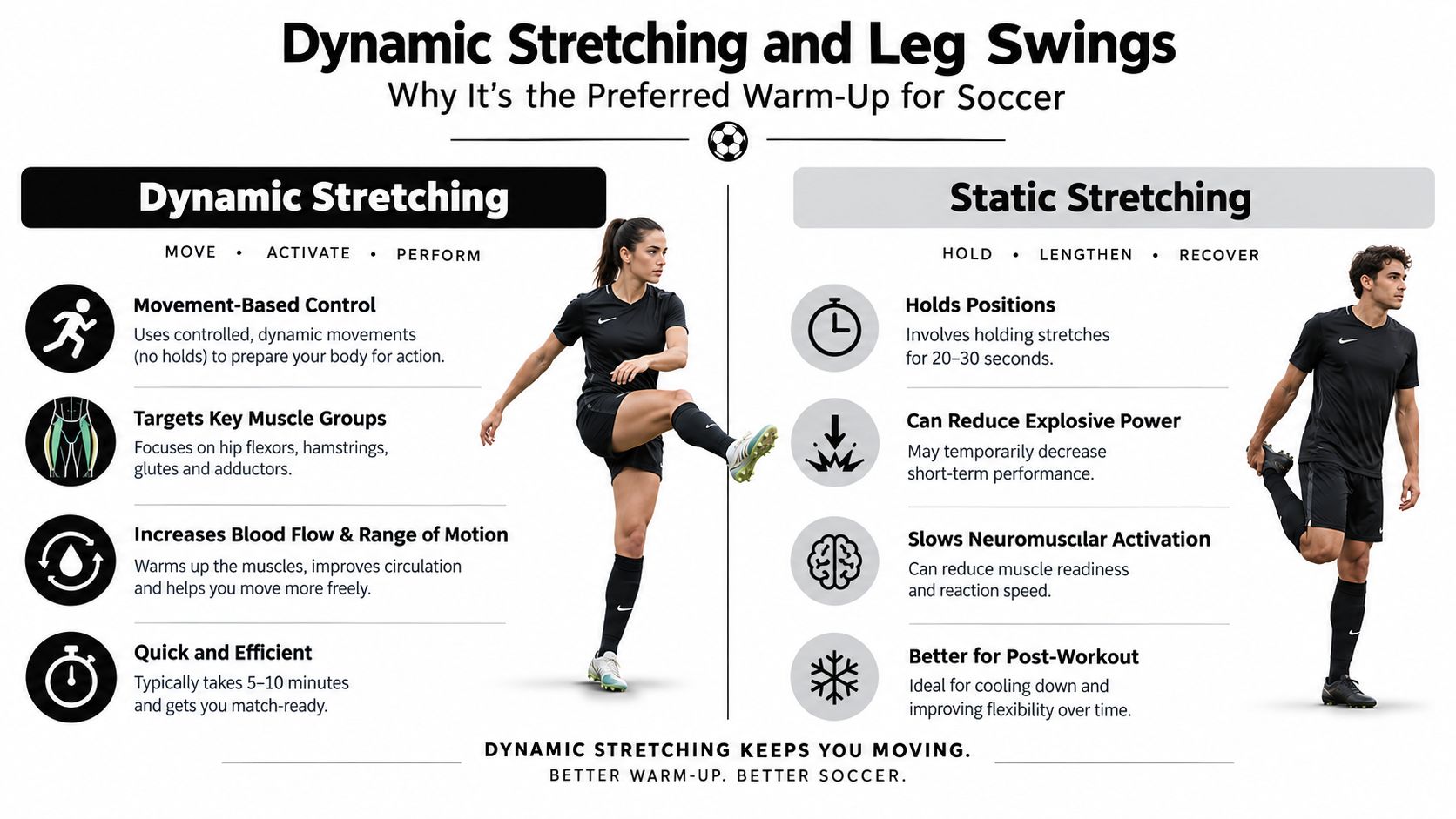
Start with movement rather than long-held stretches. Players can walk around the area while circling their arms, rotating their shoulders, lifting their knees gently, and taking controlled steps into a lunge. Add forward-and-back leg swings while they hold a teammate's shoulder or a fence for balance, then use side-to-side swings with a smaller range at first.
For toddlers, turn the drill into an animal walk or “wake up your legs” game. Preschoolers can copy the coach through marching, gentle skips, and low leg swings. School-age players can perform controlled leg swings, walking lunges, lateral shuffles, and trunk rotations before moving toward quicker soccer actions.
Progress from control to speed
Use this sequence:
Walk-through: Keep the leg swing small and slow. Ask players to stay tall and avoid forcing the range.
Jog phase: Add a light jog between movements, then repeat the leg swing with a slightly larger range.
Soccer phase: Follow with short accelerations, lateral movement, or gentle dribbling. The child should look ready, not fatigued.
Dynamic mobility fits before skill work because it prepares players for movement in several directions. Evidence discussed in a review of warm-up methods supports combining dynamic mobility with soccer actions, while cautioning that performance effects aren't uniform across every study. The running-stretch guidance from Thermo Recovery Wear also provides a useful reference for movement-based preparation.
Coach's cue: Smooth movement matters more than forcing a bigger stretch.
Don't make a child hold a painful position or swing aggressively. Static stretching has a place in separate flexibility work, but the opening phase should help children move, balance, and prepare for the actions they'll perform next.
2. Cone Weaving and Agility Ladder Footwork
Set cones in a straight or gently curved line and ask players to weave through them without racing. Begin without a ball. The player watches the next cone, takes short steps, and changes direction under control. A flat agility ladder can add simple foot-placement patterns, but it should support coordination rather than become a speed contest.
Toddlers can walk around large cones or step over flat lines with a coach nearby. Preschoolers can use two feet in each ladder space, then try a simple in-and-out pattern. School-age players can progress from forward steps to lateral movement, backward footwork, and a ball after they can complete the pattern without looking down constantly.
Make the ladder serve the player
The walk-through phase should be deliberately slow. Next, use a light jog through the cones while keeping the upper body relaxed. Full speed belongs at the end, and only for players who can plant safely and keep their knees aligned with their feet.
Add the ball after the footwork is familiar. A preschooler might roll the ball through the cone path with the sole. An older player can dribble with the inside and outside of both feet, then react to a coach's color or direction cue.
For girls' programs, emphasize repeatable technique and confidence rather than comparing times. Speed is useful only when the player can stop and redirect without losing balance. This guidance on agility training for soccer can help coaches connect footwork patterns with soccer-specific movement.
A common mistake is timing every attempt before children understand the pattern. Teach the route first, then add speed, then introduce the ball. That order keeps the drill active without turning warm-up time into a stressful test.
3. Ball Familiarization and First Touch Drills
Give each child a ball and begin with quiet touches. Players can roll the ball forward and stop it with the sole, tap the top of it with alternating feet, and move it gently from side to side. These actions build comfort before children have to receive a pass, protect possession, or make a decision in a crowded space.
For toddlers, the first target is ball awareness. Let them roll the ball to a parent, stop it, or chase it and place a foot on top. Preschoolers can add toe taps, sole rolls, inside-foot touches, and short dribbles inside a clear area. School-age players can move from stationary touches to figure-eight dribbling, changes of direction, and receiving a pass across the body.
Use a clear progression
Start with a walk-through while the ball stays close. Move to a slow dribble with frequent stops. Finish with a faster dribble, a turn on a cue, or a pass to a partner. The player shouldn't need maximum speed to show a soft first touch.
A useful coaching phrase is “soft feet.” Ask children to cushion the ball instead of letting it bounce away. Demonstrate the inside, outside, and sole of the foot, then give one correction at a time.
Ball work turns waiting time into learning time, but the touches must stay simple enough for every child to succeed.
JC Sports Houston's guidance on improving ball control for young players offers a practical model built around close touches and gradual progression. For a mixed group, give confident players a direction change while newer players repeat straight-line touches. Everyone stays involved without forcing the youngest child into an advanced pattern.
4. Passing and Receiving Circuits
A passing circuit becomes more useful when players move after the pass. Set up a simple square or triangle with clear lanes. One child passes, receives a return ball, and moves to a new cone. Keep the first round predictable so players learn where to stand and where the next pass should go.
Toddlers can roll the ball to a coach or parent and run after it. Preschoolers can pass over short distances with the inside of the foot, then stop the ball before returning it. School-age players can use a triangle rotation, receive across the body, and pass with a two-touch rhythm before trying one-touch play.
Build decisions in small steps
The first phase is a walk-through. Players name the teammate, pass gently, and walk to the next station. Add a jog once the receiving foot is positioned correctly. Full speed should mean quick movement between actions, not rushed passes that force teammates to chase the ball.
A 2v2 or 3v3 game can follow the circuit. Use a small area and a clear direction of play. The children now have to decide whether to pass, dribble, or move into space. That makes the warm-up feel like soccer instead of a line exercise.
Use constraints sparingly:
Two-touch start: Receive, then pass. This gives newer players time to control the ball.
Direction cue: Call a color or cone so players scan before moving.
Movement after passing: Require the passer to find a new space instead of standing still.
Passing should feel encouraging, especially in girls' sessions where a coach may need to reward confident attempts rather than only perfect execution. Rotate positions often, keep lines short, and stop the circuit if the passing distance is too difficult.
5. High-Intensity Interval Training and Running Drills
Save intense running for the final phase, and only use it with children who have the movement foundation to handle it. Toddlers and preschoolers don't need formal sprint intervals. They can play short chase games, run to a colored cone, or stop on a coach's signal. School-age players can add shuttle runs, acceleration and deceleration, and brief game-like races.
Start with an easy jog or active movement. Then ask players to accelerate toward a ball, slow down under control, and return at an easy pace. A full-speed effort should be brief, technically clean, and followed by enough recovery for the child to listen and reset.
Adapt the effort to the session
A school-age player might sprint to a cone, decelerate before reaching it, and receive a pass. Another option is a transition game where a player reacts to a loose ball and chooses which gate to attack. These drills prepare children for soccer decisions without making the warm-up a conditioning test.
Watch for heavy breathing, poor coordination, repeated stumbling, or a child who stops responding to instructions. Heat, cold, surface conditions, previous activity, and individual fitness all affect how much intensity a player can manage. A child returning from illness or injury needs individual guidance from a qualified professional, not a harder warm-up.
Practical rule: Intensity belongs at the end of preparation, never at the beginning.
The evidence base for structured injury-prevention warm-ups is strongest in older youth and adults, not toddlers. A 2017 review of FIFA 11+ evidence combined 6,344 soccer players and found injuries in 24% of players assigned to the program compared with 40% in control groups, with an estimated 30% reduction in overall injury risk. The systematic review in the National Library of Medicine supports progressive neuromuscular preparation, but coaches should simplify the drills for younger children rather than copy an advanced protocol.
6. Possession Drills and Rondos
A rondo gives players a reason to move, scan, and pass before the main game. Put players around a small area with one defender in the middle. The outside players keep the ball, move to support the passer, and react when possession changes.
For toddlers, use a cooperative keep-away game with an adult as the gentle defender. Preschoolers can play 4v1 with a large space and no pressure to pass quickly. School-age players can use 5v1, then progress to 5v2 or 4v1 when the group understands spacing and support.
Start with success, then add pressure
The walk-through phase has no defender or a defender who moves slowly. Players pass, follow the ball, and find an open angle. In the jog phase, the defender applies light pressure. Full speed means realistic pressure and quicker decisions, but not reckless tackling.
Use a small circle for younger children and a larger area for older or more experienced players. Rotate defenders often enough that everyone stays engaged. Introduce one-touch passing only after players can control the ball with two touches and recognize where support is available.
Spain's player-development tradition is often associated with possession games, but the drill only works when the rules match the group. A preschooler who loses the ball repeatedly may need a bigger area, an extra outside player, or a cooperative target. An older player may need a direction rule or a transition goal.
The warm-up should leave players ready for the session's main challenge. If the rondo becomes a competitive battle that produces frustration, reduce the pressure and restore passing quality before increasing difficulty.
7. Coordination and Proprioceptive Drills
Balance work doesn't need expensive equipment. A painted line, a flat cone lane, or a series of floor markers can give young players enough information to practice control. Ask children to walk along the line, stop on one foot, step over a marker, and regain balance before continuing.
Toddlers can balance with one hand held by an adult. Preschoolers can walk heel-to-toe along a line, freeze like a statue, or carry a ball while stepping between markers. School-age players can add single-leg reaches, controlled hops, landing positions, and a pass after they regain stable footing.
Protect quality during every progression
Begin stationary. Then add movement. Only after the child can land softly and stay balanced should you add a ball, a partner, or a faster reaction cue. Do not place a young player on an unstable surface just because it looks challenging. A stable line exercise often teaches better control than a difficult device used without supervision.
Coach three details:
Quiet landing: The player lands softly instead of locking the knees.
Aligned knee: The knee tracks in the same direction as the foot.
Controlled trunk: The chest stays balanced rather than falling sharply to one side.
For a circuit, keep stations brief and rotate children before boredom replaces concentration. You can pair balance with a soccer action, such as receiving a gentle pass after a single-leg stand. The ball adds purpose, but it shouldn't distract from safe mechanics.
These balance exercises for kids provide an accessible starting point for parents and coaches. Balance training can also fit a multi-sport class because the underlying skills, body awareness, stable landings, and controlled movement, apply beyond soccer.
8. Directional Running and Cut-Based Drills
Soccer players rarely run in a straight line for long. They slow down, turn, shuffle, and accelerate toward a new space. Directional drills prepare those actions, but the coach should teach the pattern before asking for speed.
Use a simple L shape for younger players. The child walks to the first cone, turns at a right angle, and walks back. Preschoolers can jog the route after they understand it. School-age players can progress to a T pattern with a forward run followed by lateral shuffles, or a star pattern with controlled movement toward several cones.
Teach the cut before the sprint
The walk-through phase is about foot placement. Players lower their center of gravity, shorten the final steps before the cone, and push away under control. During the jog phase, they keep the same mechanics while moving faster. Full speed comes last, and recovery between attempts matters, especially for younger players.
Give each drill a soccer purpose. Call a color and ask the player to attack that gate. Place a ball at the final cone and ask for a controlled touch. Add a passive defender when the group can change direction without crossing feet or losing balance.
A fast turn that the player can't control isn't useful speed.
Change the pattern occasionally, but don't change it before children have learned it. Competitive players may enjoy tracking times, yet the more valuable observation is whether the player brakes under control, keeps the knee aligned, and accelerates after the turn. For younger children, praise a clean decision and balanced movement before praising a fast result.
Comparison of 8 Soccer Warm-Up Drills
Drill | Implementation 🔄 | Resources & Setup ⚡ | Expected Outcomes 📊 | Ideal Use Cases 💡 | Key Advantages ⭐ |
|---|---|---|---|---|---|
Dynamic Stretching and Leg Swings | Low complexity; requires coaching on proper form | Minimal equipment; 5–10 minutes; needs supervision for quality | Improved ROM, blood flow, neuromuscular activation | Pre-training/match warm-up for all ages (4+) | Primes explosive power and reduces injury risk |
Cone Weaving and Agility Ladder Footwork | Medium complexity; setup and pattern progression needed | Cones and ladder; small space; low cost; time-flexible | Enhanced foot speed, coordination, change-of-direction | Technical warm-ups, footwork sessions, youth academies | Improves quick feet and sport-specific coordination |
Ball Familiarization and First Touch Drills | Low complexity; highly scalable by age/skill | Requires one ball per player; 3–5 minutes typical | Better first touch, ball confidence, fine motor control | Early-session touch work; toddlers → advanced technique | Builds foundational ball control and confidence |
Passing and Receiving Circuits (2v2/3v3) | Medium–high complexity; coaching and zone setup | Cones, multiple balls, small groups; moderate space | Frequent touches, passing accuracy, tactical awareness | Small-sided warm-ups, skill-development sessions | Combines cardiovascular warm-up with decision-making |
High-Intensity Interval Training (HIIT) and Running Drills | Medium–high complexity; intensity control essential | Minimal equipment (cones/lines); 5–15 minutes; strict supervision | Rapid HR elevation, anaerobic capacity, fast‑twitch activation | Conditioning phases for ages 8+; late warm-up segments | Efficiently prepares cardiovascular system and speed |
Possession Drills and Rondos (Keep-Away) | Medium complexity; rule clarity and rotation required | Small area, 4–6 players, 1–2 balls; minimal gear | Passing under pressure, spatial awareness, quick decision-making | Warm-ups and technical-tactical training for 5+ | High engagement; simulates real-game pressure on skills |
Coordination & Proprioceptive Drills (Balance/Wobble) | Medium complexity; safety and progression important | Balance tools (BOSU, wobble board) or simple line work; 3–5 minutes | Improved joint stability, injury prevention, body control | Rehabilitation, injury prevention, young athletes (3+) | Reduces ankle/knee injury risk; enhances movement quality |
Directional Running and Cut-Based Drills (T/L/Star) | Medium complexity; cone layouts and timing | Cones only; 5–10 minutes; measurable via timing | Multi-directional agility, deceleration control, conditioning | Agility-focused warm-ups, combine with ball work (6+) | Specific prep for sport‑typical directional demands |
Build a Warm-Up Routine You Can Repeat Every Week
A reliable warm-up doesn't need eight drills in every session. Choose two or three from different categories, such as mobility, ball work, and running, then use them in a familiar order for the age group. A toddler class might begin with animal walks, continue with ball rolling, and finish with a stop-start game. A school-age group might use dynamic movement, first-touch work, and a controlled directional game.
Keep the progression visible to coaches. Start each drill at a walk-through pace. Move to a jog when players understand the task. Use full speed only when they can keep balance, control the ball, and respond to instructions. If technique breaks down, lower the speed or simplify the pattern. That isn't a setback. It's the correct adjustment.
Structured programs work best when coaches deliver them consistently rather than treating injury prevention as an occasional add-on. FIFA 11+ was developed in 2006, its first randomized controlled trial in young female players was published in 2008, and FIFA began worldwide dissemination in 2009 across its 209 member associations. This review of FIFA 11+ development and implementation also describes the importance of regular use and adherence. Those milestones concern a structured program and don't prove that an advanced routine can be copied directly for preschoolers.
The children in front of you determine the right version. A three-year-old may need a game with one simple rule. A seven-year-old can handle a short circuit with choices. A twelve-year-old can combine balance, landing control, passing, and directional acceleration. The objective stays consistent, but the instructions, space, pressure, and speed change with the player.
Don't promise that a warm-up will prevent every injury. A 2025 review of 19 randomized studies involving 28,200 youth soccer players reported beneficial injury effects in 12 studies, while four found no significant difference, showing why implementation and individual context matter. The review in the National Library of Medicine supports a measured approach: use evidence-informed movements, observe technique, and keep the routine practical enough to repeat.
For families in Humble, Kingwood, Atascocita, and nearby Houston communities, JC Sports Houston offers age-appropriate sports programs, Coerver-based soccer training, Just for Girls sessions, multi-sport classes, leagues, and seasonal camps. New families can request a free trial at JC Sports Houston to see how coaches use progressive instruction, small-sided play, and movement games with young athletes.
JC Sports Houston offers age-appropriate soccer coaching with ball work, coordination games, and progressive warm-up activities for toddlers, preschoolers, and school-age players. Visit JC Sports Houston to explore local programs in Humble, Kingwood, Atascocita, and surrounding Houston communities, and request a free trial for your child.
Comments