

Soccer for 7 Year Olds Near Me: A Parent's Guide

You've searched “soccer for 7 year olds near me”, opened six tabs, and still don't know what you're comparing. One program is five minutes away, another has shinier photos, and a third promises “elite development” before your child has even decided whether soccer is fun. If you're in Humble, Kingwood, Atascocita, or nearby Houston, the closest field may be convenient, but convenience alone is a poor way to choose a child's first serious sports experience.
A seven-year-old needs a program that makes the ball feel familiar, keeps practice active, welcomes beginners, and leaves room for school, free play, rest, and other interests. Outdoor soccer participation among people aged six and older reached nearly 14.1 million players through 2023, and children ages 6–12 represented roughly one-third of that total, so age seven sits inside a major entry point for the sport, not at its edges (U.S. Soccer participation data).
The right question isn't “Which club is closest?” It's “Which environment fits my child this season?” Before you register, answer six questions: How does the program coach beginners? What does a typical session look like? How much training does it require? Is free play still part of the week? What will the full cost be? Can my child try it before we commit?
Starting the Search with Your Child in Mind
Saturday morning exposes the key choice. Your child may arrive with borrowed cleats and plenty of excitement, or with nerves and no clear opinion about soccer. One program starts nearby, another offers a free trial, and a competitive academy asks for a longer commitment. Before comparing those offers, decide what your seven-year-old needs from this season.
Start with your child's current experience. A beginner needs an easy entry point, short instructions, frequent ball contact, and permission to make mistakes. A child already dribbling in the backyard may want more challenge, but still needs coaches who keep the game enjoyable and the workload appropriate. Neither child needs adult-level pressure.
Identify the decision behind the search
Choose the purpose first, then judge local programs against it:
A first experience: Pick a beginner-friendly class or recreational league with low pressure, clear expectations, and a simple trial or registration process.
More ball confidence: Look for sessions built around dribbling, turning, receiving, and small-group play, rather than long lines and speeches.
A social routine: Prioritize a welcoming setting, reliable scheduling, and coaches who learn children's names and include new players.
A stronger technical base: Consider a skills clinic or progressive training program only if your child enjoys practice and can handle the added commitment.
A broader activity plan: A multi-sport program may fit a child who likes to move but has not chosen soccer as a main interest.
The national youth-sports picture supports making that first experience accessible. In 2023–2024, 56.7% of U.S. children ages 6–17, nearly 28 million young people, participated in a sports team or lesson during the previous year, and participation among children ages 6–8 was also 56.7% (Youth Sports Data Brief). Those figures describe the country, not Humble or Houston. They do show that age seven is a normal starting point for organized activity, so your decision should focus on fit rather than pressure to specialize.
Use the website to make a shortlist, not a final decision. Watch a session if possible. Check whether children stay active, whether beginners receive encouragement, how much training the week requires, whether free play still has room, and whether the full cost is explained before registration. Location matters, but a slightly longer drive can be worthwhile if the environment suits your child's confidence and schedule.
Parents comparing soccer with other youth activities can apply the same developmental lens found in this directory for evaluating kids' BJJ academies. Coaching style, age-appropriate expectations, and the child's comfort deserve as much attention as distance.
Parent's rule: Choose the program your child can enjoy, understand, and sustain this season. Marketing should come last.
What Good Coaching for a 7-Year-Old Looks Like
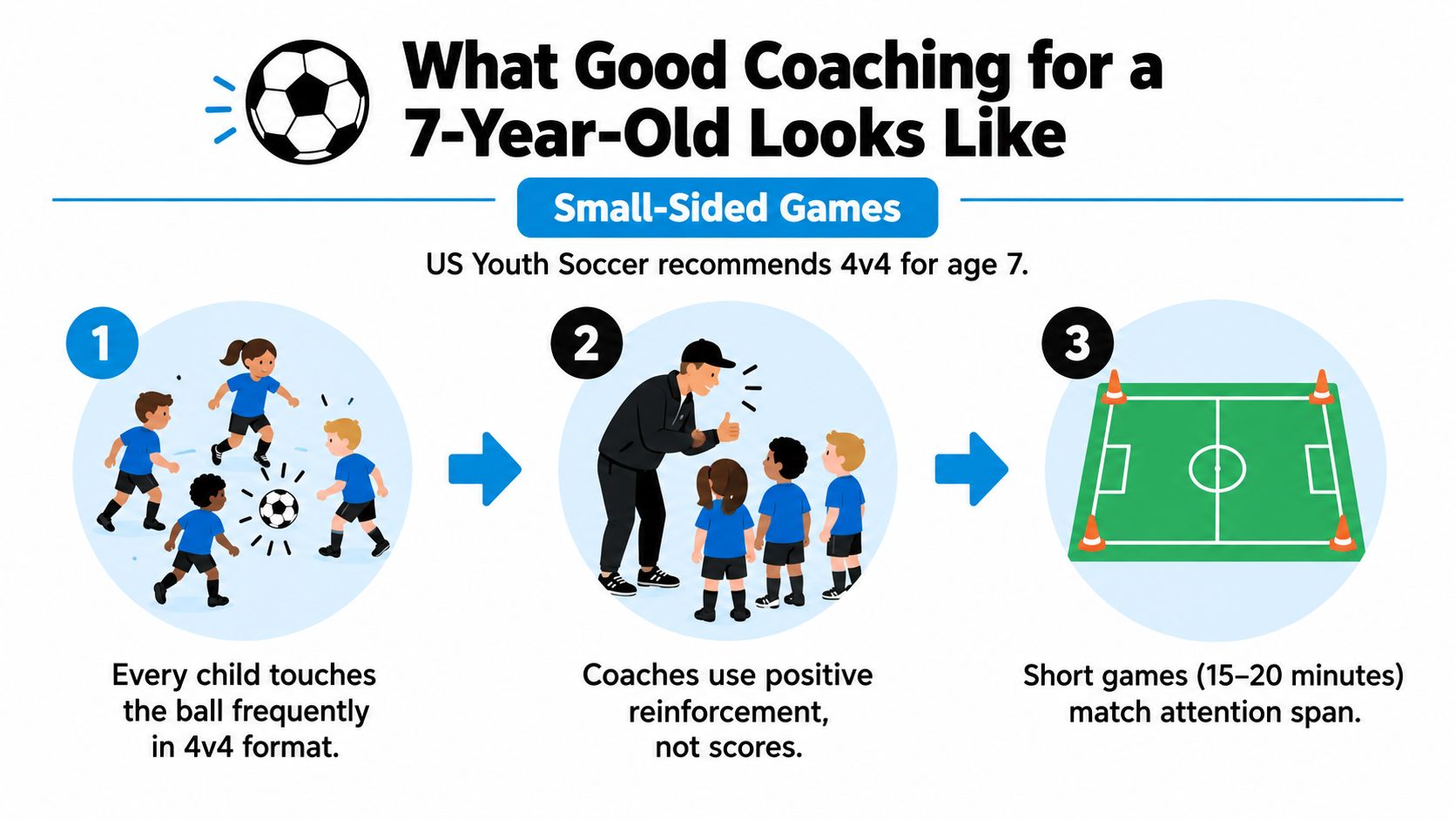
Good coaching at age seven looks busy, playful, and organized. Children should spend most of the session moving, making decisions, and interacting with the ball. They shouldn't spend the evening waiting behind cones while one child performs a drill.
US Youth Soccer's guidance recommends 4v4 play at U8, a practical benchmark for children near age seven. The same guidance supports a session built around movement, individual ball challenges, directional games, and 15–20 minutes of small-sided match play, rather than full-field games (US Youth Soccer coaching manual).
Read the session from the sideline
A technically sound practice can fit into roughly 35–45 minutes:
Movement and ball familiarity: Begin with running, skipping, changes of direction, and simple ball touches.
Individual challenges: Have children dribble with both feet, stop the ball, turn, shield, and try to solve small tasks.
Directional games: Use 2v1 or 3v2 situations so players learn when to attack, pass, support, and recover.
4v4 play: Finish with short-sided games, frequent rests, and questions that help children notice options.
The exact clock matters less than the activity pattern. Every child should receive meaningful ball contact, and the coach should adjust the challenge without turning the session into a lecture.
Watch how the coach talks. A seven-year-old needs specific encouragement such as “Good idea, try that turn again,” not a constant stream of criticism. The coach should rotate positions, allow children to experience attacking and defending, and avoid treating speed or match results as the main evidence of progress.
You can also review a provider's stated approach before visiting. JC Sports Houston's soccer coaching philosophy gives parents an example of the kind of information to look for, including how a program thinks about creativity, progression, and player development.
Know the red flags
Skip programs where:
Long lines dominate practice: Waiting reduces touches and hides whether children can use a skill under pressure.
The coach controls every decision: Players need chances to choose when to dribble, pass, turn, or protect the ball.
Winning drives every correction: A seven-year-old's development shouldn't be reduced to goals, speed, or the scoreboard.
Beginners receive public criticism: Nervous children need clear instruction and a safe way to try again.
Full-field play replaces learning: A larger field can leave young players far from the ball and reduce decision opportunities.
A good trial class should feel slightly chaotic in the healthy sense. Children will make mistakes, chase loose balls, laugh, and solve problems. That's far better than a perfectly quiet practice where they barely touch the ball.
Comparing the Program Models in Your Area
Not every soccer option serves the same purpose. A recreational league, academy program, weekly clinic, multi-sport center, and private session can all be useful, but they place different demands on a seven-year-old and on the family driving to practice.
Youth Soccer Program Models at a Glance
Program Type | Typical Schedule | Skill Focus | Pressure Level | Best For |
|---|---|---|---|---|
Recreational league | Seasonal team practices and games | Basic skills, teamwork, game awareness | Low to moderate | Beginners and children testing their interest |
Academy-style travel program | More frequent training, games, and travel | Technical development and competition | Moderate to high | Children already committed to regular soccer |
Weekly clinic | One recurring instructional session | Ball mastery and specific skills | Low | Children who need a flexible introduction |
Multi-sport developmental center | Rotating activities across sports | Motor skills, coordination, confidence | Low | Children who enjoy variety or need a broader foundation |
Private session | Individual or small-group appointment | Targeted technical work | Depends on coach and goals | Children needing focused support or extra challenge |
For most first-time seven-year-olds, a non-travel recreational league or weekly clinic is the sensible starting point. It offers enough structure to learn the game without turning a child's calendar into a soccer schedule. If your child consistently asks for more practice and enjoys organized play, you can add a technical clinic later.
Travel or academy-style programs can make sense for a child who already wants a higher challenge, but don't confuse intensity with quality. Ask how often the child trains, how much travel is involved, how the program handles rest, and whether the coaches still use small-sided games. A young athlete who loves soccer can burn out in a program that treats every week like a tryout.
A private session is also easy to misuse. It can help a child who needs confidence with a specific skill, but it shouldn't replace free play, peer interaction, or game decisions. A coach can polish a technique in isolation, yet children still need to learn when and why to use that technique around other players.
The family's lifestyle matters too. A program that fits your calendar consistently will usually serve your child better than a prestigious option that creates constant rushed meals, missed sessions, and resentment. The same principle applies to any family activity, whether you're planning a soccer season or researching something as different as Florida paddleboard fishing. The activity only works when the schedule and the people involved can sustain it.
Running the Local Search the Smart Way
Your child's age, experience, and current stamina should shape the search before distance does. Open Google Maps and search “soccer for 7 year olds near me,” then try “beginner soccer,” “U8 soccer,” “youth soccer clinic,” “indoor soccer,” and “soccer trial class.” Search around Humble, Kingwood, Atascocita, and the broader Houston area separately. A wider search prevents a convenient map result from becoming your only option.
Local listings will be crowded. Filter them by developmental signals: clear age placement, a real beginner pathway, small-sided play, and a schedule your family can sustain. Elementary-age children are a major entry point for outdoor soccer, so programs should explain how they introduce new players rather than assuming prior team experience.
Use the website as a screening tool
Skip pages filled only with team photos and registration buttons. Look for a curriculum you can understand before you call. A useful program page should answer these questions:
Age placement: Does it clearly include seven-year-olds or an appropriate U8 group?
Beginner access: Can a child join without previous team experience?
Session design: Does the provider describe small-sided games, ball work, or progressive instruction?
Coach involvement: Are coaches identified, trained, and present for the full session?
Policies: Are schedules, fees, make-ups, cancellations, and weather procedures easy to find?
Parent reviews matter when several describe the same pattern. Read for communication, punctuality, coach behavior, beginner support, and whether children remain engaged. “Convenient” says little. A review explaining how a nervous child was welcomed gives you a better reason to investigate.
Make the trial class do the work
A free trial lets you judge the program in real conditions. Watch how often your child gets near the ball, whether players rotate positions, and how the coach responds to mistakes. A seven-year-old should be active, coached, and comfortable asking questions.
Ask these questions before registering:
Who leads the session? Confirm that the person you meet will coach regularly.
How are beginners placed? Ask whether children can change groups as they develop.
What happens after an absence? Confirm the make-up or credit policy.
How does the program communicate? Ask where weather updates and schedule changes appear.
What should my child bring? Clarify footwear, shin guards, water, and clothing.
Small details affect the first few weeks. A clearly labeled bag can prevent lost equipment and rushed arrivals, so these InchBug soccer bag tag recommendations may help organize gear. Compare each option's actual schedule and format with soccer leagues near me, then watch at least one session before paying for a longer commitment. Choose the program that fits this season's needs, not merely the one with the shortest drive.
Understanding the Real Cost Beyond Registration
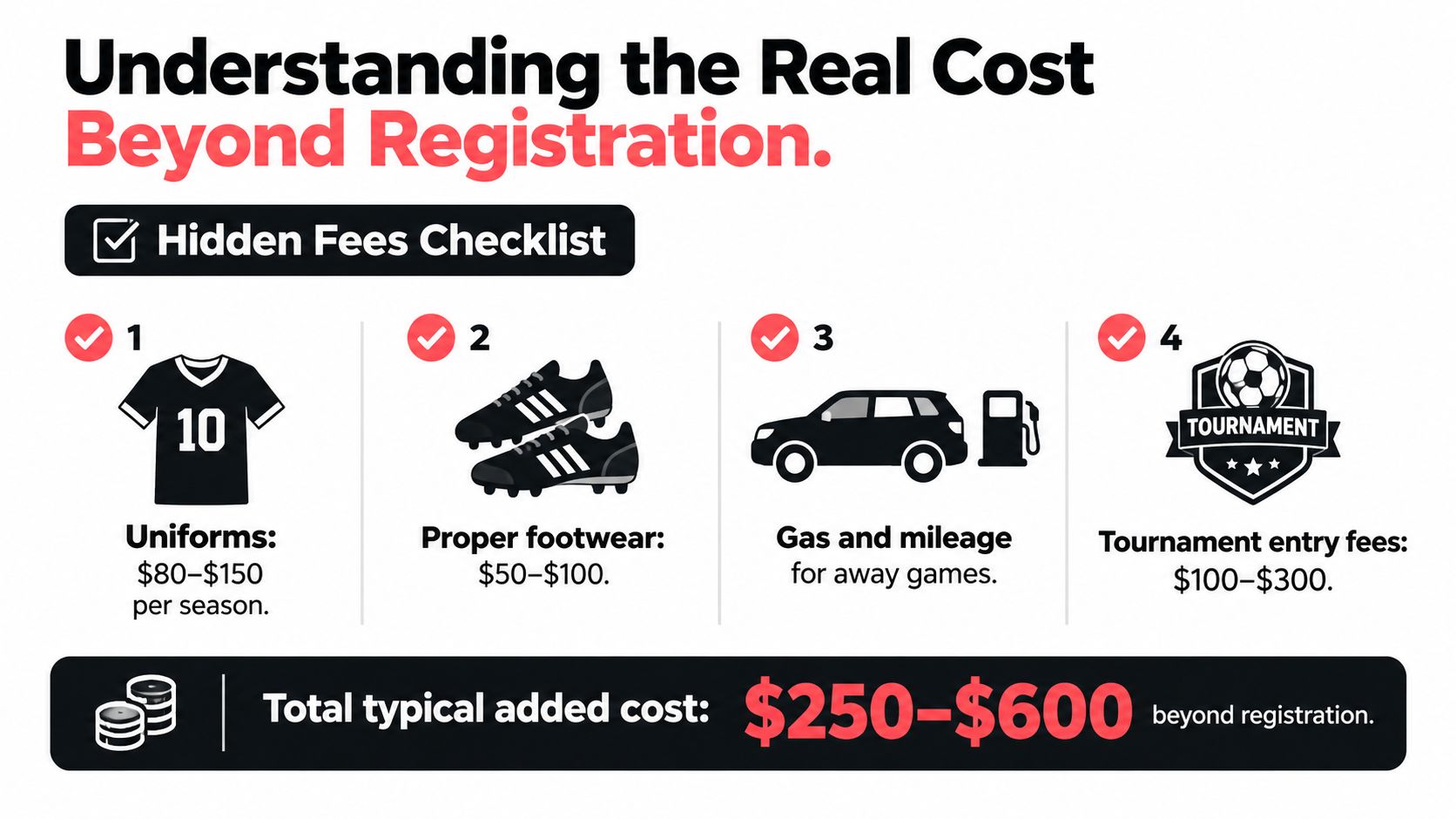
The registration fee is only the first line on the family budget. Before you pay, ask for the full seasonal cost, including uniforms, shin guards, cleats, transportation, optional tournaments, photographs, and any fees attached to missed sessions or make-ups.
The Aspen Institute's 2025 participation analysis highlights a substantial income gap in youth sports participation and identifies cost, scheduling, and a sense of belonging as factors that often determine whether families stay enrolled (Aspen Institute participation analysis). A program that makes the total commitment hard to understand creates stress before the first practice.
Ask for the complete price in writing
Use a simple checklist:
Required gear: Find out whether the uniform is mandatory, whether cleats are required, and whether used equipment is acceptable.
Travel expectations: Ask whether away games or tournaments are optional, local, or built into the program.
Sibling policies: Check for sibling discounts, shared equipment options, or family registration limits.
Missed sessions: Confirm whether the program offers make-up classes, credits, or no adjustment.
Refund terms: Read cancellation deadlines and ask what happens if your child decides soccer isn't a fit.
Support options: Ask whether financial assistance, trial sessions, or payment plans are available.
Transparent pricing is a quality signal because it shows that the program respects the family's planning needs. Hidden costs don't necessarily mean a program is dishonest, but unclear communication should make you slow down and ask direct questions.
Don't let a low advertised fee make the decision for you. A modestly priced program that requires frequent travel may cost more in time and transportation than a nearby option with clearer policies. Conversely, an expensive program may provide services your child doesn't need yet, especially if the added price reflects travel, tournaments, or advanced training rather than better instruction.
Choose the option your family can sustain without financial anxiety. Your child benefits from consistent attendance, and consistency is difficult when every unexpected charge creates a new argument.
Protecting Your Child's Long-Term Development
Age seven is a foundation-building year. The priority is not producing a polished player quickly. It's helping a child develop balance, coordination, ball familiarity, decision-making, confidence, and a positive relationship with movement.
That means soccer should have room alongside other activities and unstructured play. Research on youth training loads found that athletes with an organized-training-to-free-play ratio exceeding 2:1 had higher odds of injury, while sports-medicine guidance generally favors multisport participation over early specialization. The evidence is nuanced, and a 2025 review did not clearly associate specialization with overuse injury specifically among soccer athletes, so parents should evaluate the whole program rather than label every intensive soccer option harmful (review of youth sport specialization and injury).
Inspect the warm-up
Ask whether the program runs a structured, playful warm-up at every practice. A large controlled youth-soccer trial found that a 20-minute coach-led neuromuscular warm-up performed two to three times per week reduced acute noncontact lower-extremity injuries by roughly 32% compared with controls, with adherence to at least two sessions per week identified as the key implementation benchmark (youth soccer injury-prevention trial).
For seven-year-olds, the routine should be simple enough to perform well:
Movement: Running, skipping, and changes of direction.
Balance: Landing and single-leg games.
Strength: Low-level squats, lunges, and controlled bodyweight tasks.
Agility: Short accelerations, stops, and direction changes.
Ball movement: A playful transition into soccer activity.
The coach should progress only when children can stop under control and land gently with their knees aligned over their feet. Stretching alone isn't a substitute for movement preparation.
Ask about the weekly load
Find out how many organized sessions the program recommends, how it handles rest, and whether children are expected to attend extra training. A healthy program won't treat missed practice for family needs as a character flaw, and it won't push a seven-year-old into a year-round schedule before the child has shown sustained interest.
Look for coaches who celebrate effort, rotate positions, welcome different abilities, and encourage children to play outside the formal session. A program that develops technique progressively, as described in this resource on technical development, should also leave space for creativity rather than scripting every movement.
Making the Final Call and Re-Evaluating After One Season
Use a trial class to choose, not to hear a sales pitch. Watch your child's reaction, ask for the full cost, and commit to one season rather than a multi-year package. Pick small-sided play, frequent ball contact, a manageable load, and room for free play and rest.
At season's end, check enjoyment, ball contact, skill growth, belonging, and time for other activities. Earlier national context is useful, but fit matters more than participation totals (national youth-sports data).
JC Sports Houston offers age-appropriate training, an 8U league for ages 6–8, small-sided development, and a free trial in nearby Houston communities. Visit JC Sports Houston to review programs.
Comments