

10 Best Youth Soccer Drills to Build Skills and Confidence

A coach asks a five-year-old to play a passing rondo designed for an under-fourteen team. The child chases the ball, misses the passing cues, and eventually wanders away. Later, the same coach gives experienced twelve-year-olds a basic game of Red Light, Green Light, and wonders why they're barely trying.
Neither activity is bad on its own. The mismatch is the problem. The best youth soccer drills meet children where they are, then introduce a challenge they can understand and attempt without constant adult instructions.
For a toddler, that might mean stopping a rolling ball without falling over. For a confident school-age player, it might mean receiving across the body while a defender closes down. Age helps you choose a starting point, but coordination, confidence, and previous experience should determine the next step.
Choose the challenge, not the reputation. A simple game children can actually play is more useful than an academy exercise they can't understand.
Keep equipment straightforward, too. A ball, flat cones, suitable footwear, and comfortable clothing are enough for many activities below. The Mystershirt guide to kids football kits offers a separate starting point for families sorting out soccer clothing.
These drills progress from first touches to pressure-based finishing. Each includes a practical setup, coaching adjustments, and an honest limitation, because good training should maximize touches, decisions, and fun, not the time children spend listening.
1. Red Light, Green Light (Dribbling Version)
Start here when a child is learning to move with the ball. Mark a clear starting edge and a nearby finish area, leaving enough space between players that they won't immediately collide. Give every child a ball.
Demonstrate each command before playing. Green means dribble forward, yellow means slow down, and red means stop the ball gently with the sole of the foot. Let children practice stopping while stationary before asking them to do it while moving.
Make stopping the achievement
For a preschooler who keeps kicking the ball away, shorten the crossing and walk alongside them. Praise a controlled stop rather than the speed of the journey.
Keep commands predictable. Don't add turns, jumps, and animal movements until children understand the basic game.
Offer leadership. Let a willing child call the colors while you demonstrate.
Avoid elimination. A missed stop should lead to another attempt, not a seat on the sideline.
Build in soft knees and balanced stopping rather than stamping on the ball. If a child repeatedly loses balance, slow the activity down and let them steady the ball before resting a foot on it.
The limitation: children are reacting to your voice rather than reading opponents. Once stopping becomes comfortable, introduce a game that asks them to notice other players.
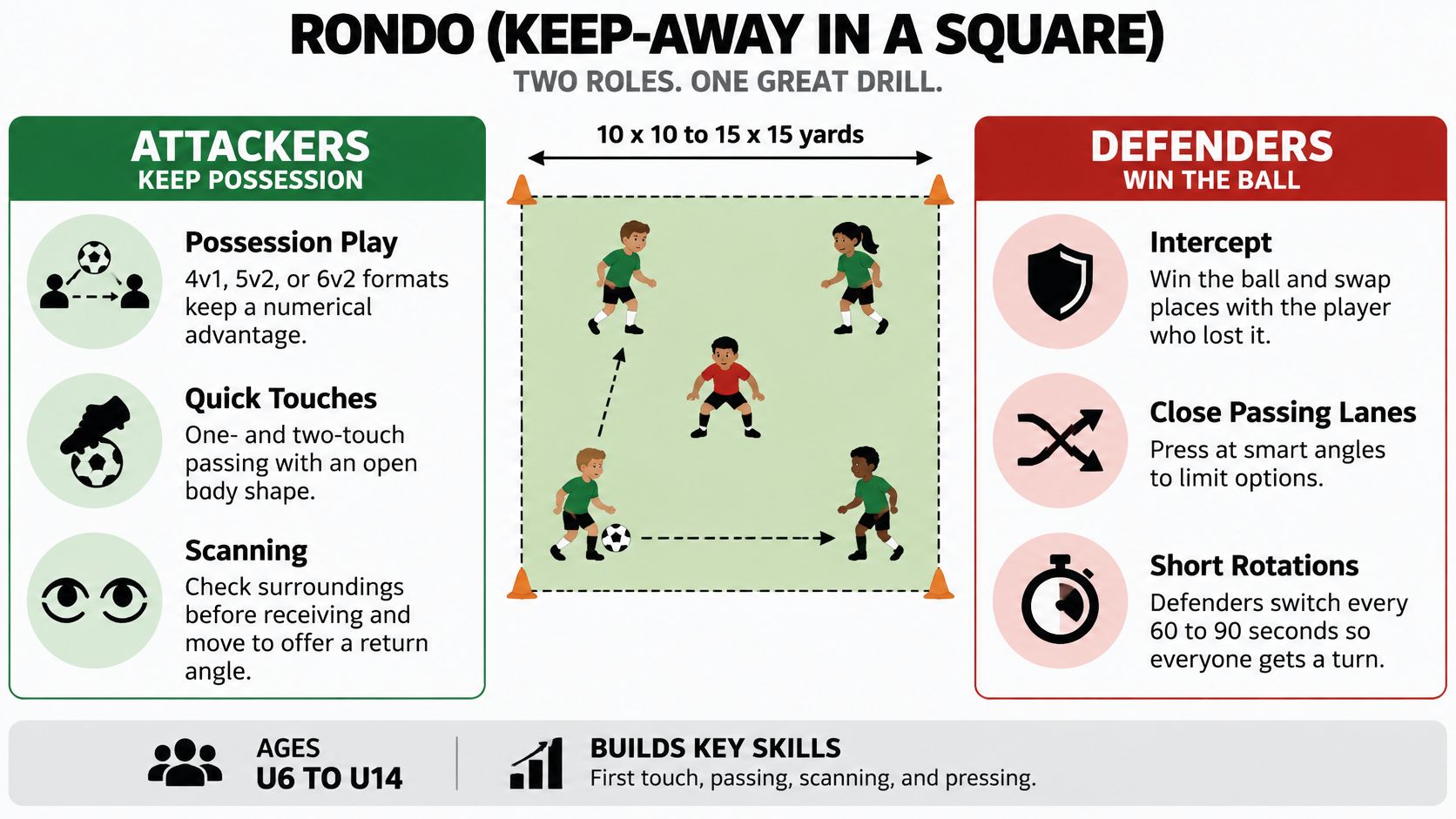
The possession diagram below illustrates a later-stage challenge, not the starting setup for preschoolers.
2. Sharks and Minnows
A child who can stop on command is ready to start noticing pressure. In Sharks and Minnows, dribblers cross a marked area while a shark tries to intercept their balls.
Keep the crossing wide enough for players to choose different routes. Begin with a coach as the shark, moving slowly and making the pressure easy to understand. Each minnow needs a ball, and sharks should challenge the ball rather than push, grab, or chase bodies.
For a hesitant beginner, leave an obvious escape route. A successful crossing gives that child a reason to try a sharper turn on the next attempt.
Keep everyone involved
Reset instead of eliminate. If a ball leaves the area, the player retrieves it and rejoins the next crossing.
Rotate the shark. Don't leave the most confident child defending throughout.
Protect control. Encourage a bigger touch into open space and smaller touches near the shark.
If children are booting balls across the grid and sprinting after them, make the challenge easier before asking them to move faster.
You can eventually invite children to escape using their less comfortable foot, but don't demand complicated foot patterns while they're still learning to recognize danger.
The trade-off: the game is exciting, but too much defensive pressure turns it into survival. Keep enough successful crossings that children still want the ball.
3. Coerver-Style Ball Mastery Circuit
Some children can run enthusiastically with a ball but struggle when they need to move it sideways or bring it back underneath them. Ball mastery gives them time to explore those movements without a defender.
Use a clear practice area where every player has a ball and room to move. The image below shows an individual dribbling setup that can sit alongside a mastery station.
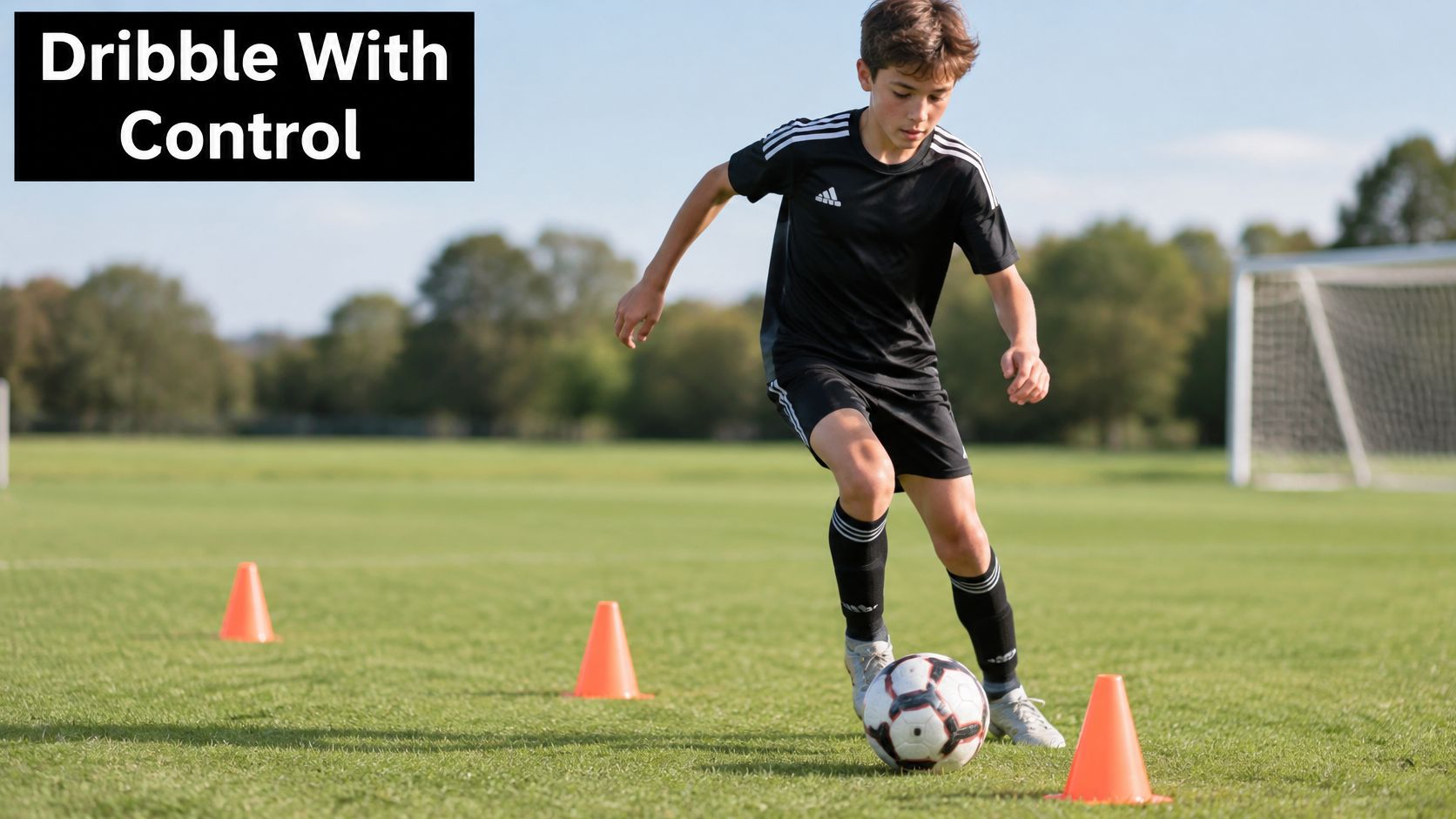
Demonstrate toe taps, inside touches, sole rolls, and inside-outside touches slowly. Choose movements the player can control, rather than moving through an entire catalog of tricks. Our Coerver soccer training guide gives families more context for this technique-focused approach.
Move from repetition to an exit
Say a player can roll the ball across the body but stops afterward. Ask them to follow the roll with a controlled push into open space, so the movement becomes an escape rather than a stationary trick.
Coach posture. Keep knees soft and the body balanced over the supporting leg.
Use both feet. Let players slow down when working on their less comfortable side.
Add looking up. Ask them to notice your hand signal between touches, not stare ahead while losing control.
This demonstration provides a visual reference for ball-mastery practice.
The limitation: smooth footwork without opposition doesn't automatically become useful match play. Follow it with a route choice or an opponent.
4. Gate Dribbling
Gate dribbling adds navigation to ball control. Scatter pairs of flat cones around a grid, leaving room between gates for players to turn. Each child dribbles through an available gate, looks up, and chooses another.
Make the openings generous for beginners. Narrow them only when players can pass through without repeatedly striking cones or stretching awkwardly after the ball.
This practice image highlights the next challenge, keeping control when another player occupies the space.
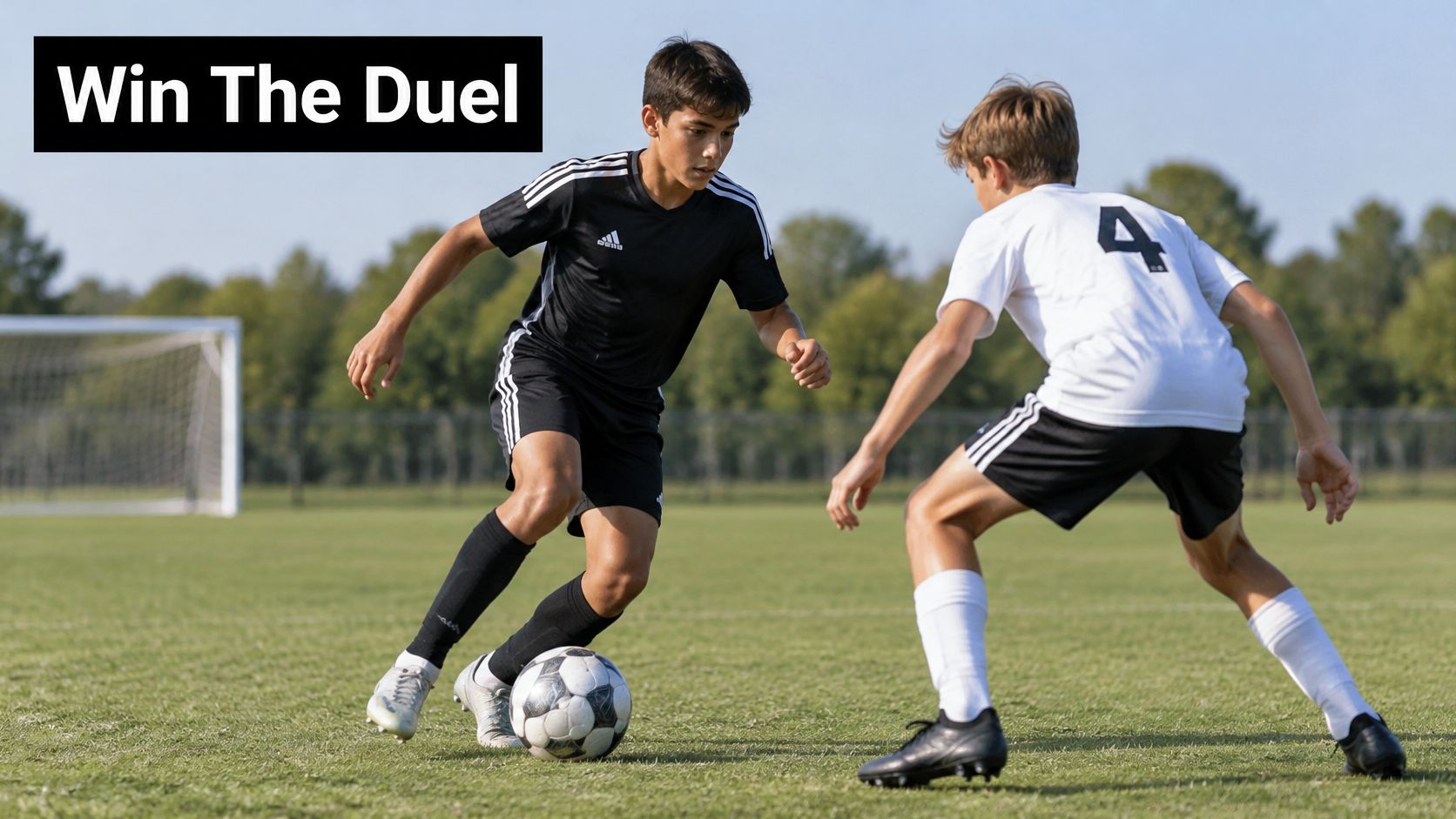
For example, a player who always follows a friend can be asked to find an empty gate in a different direction. That's a useful decision without needing a complicated scoring system.
Reward the route, not just the total
Scan before leaving. Ask players to locate their next gate before accelerating.
Change the exit. Alternate between continuing forward and turning after a gate.
Add gentle pressure. Let a coach block a route without tackling, prompting players to choose another opening.
Our youth soccer dribbling drills offer additional ways to vary the ball-control challenge.
The trade-off: counting completed gates can motivate children, but it can also encourage rushed touches and crowded routes. Compare players with their own previous attempts, and stop scoring if they sacrifice control to reach another gate.
5. Figure-8 Dribble Through Cones
When a player turns comfortably in open space but loses the ball in tighter areas, use a figure-eight dribble. Set up opposing cone markers with a clear channel between them, then demonstrate a looping path around each end.
Begin with broad curves. Players should be able to keep moving without reaching across their bodies or twisting sharply to rescue the ball.
A useful home-practice scenario is a child who always turns with the inside of the same foot. Let them repeat the route slowly, then change the instruction so they explore outside-foot touches and the opposite turning direction.
Look closely at the exit touch
The important moment isn't just getting around the cone. Watch whether the player brings the ball back onto a useful path afterward.
Widen the route if children keep knocking the markers.
Reduce the pace if their feet move quickly but the ball escapes.
Change direction so the same side doesn't do all the work.
Practical rule: a clean turn followed by a controlled exit is worth more than a fast lap full of recovery touches.
The limitation: the route is predictable, so players can complete it without looking up. Once the movement is comfortable, stand near an exit and ask them to turn away from your position. That creates a reason to observe rather than just memorize.
6. Passing Pairs (Partner Passing with Movement)
Passing becomes useful when the receiver can do something with the next touch. Pair players at a distance where they can pass along the ground without swinging wildly or taking a running start.
Begin with a pass, a controlled reception, and a return. Then ask the passer to move sideways into a new supporting position rather than remaining planted behind the ball.
The practice setting below shows why spacing matters when several pairs share a field.
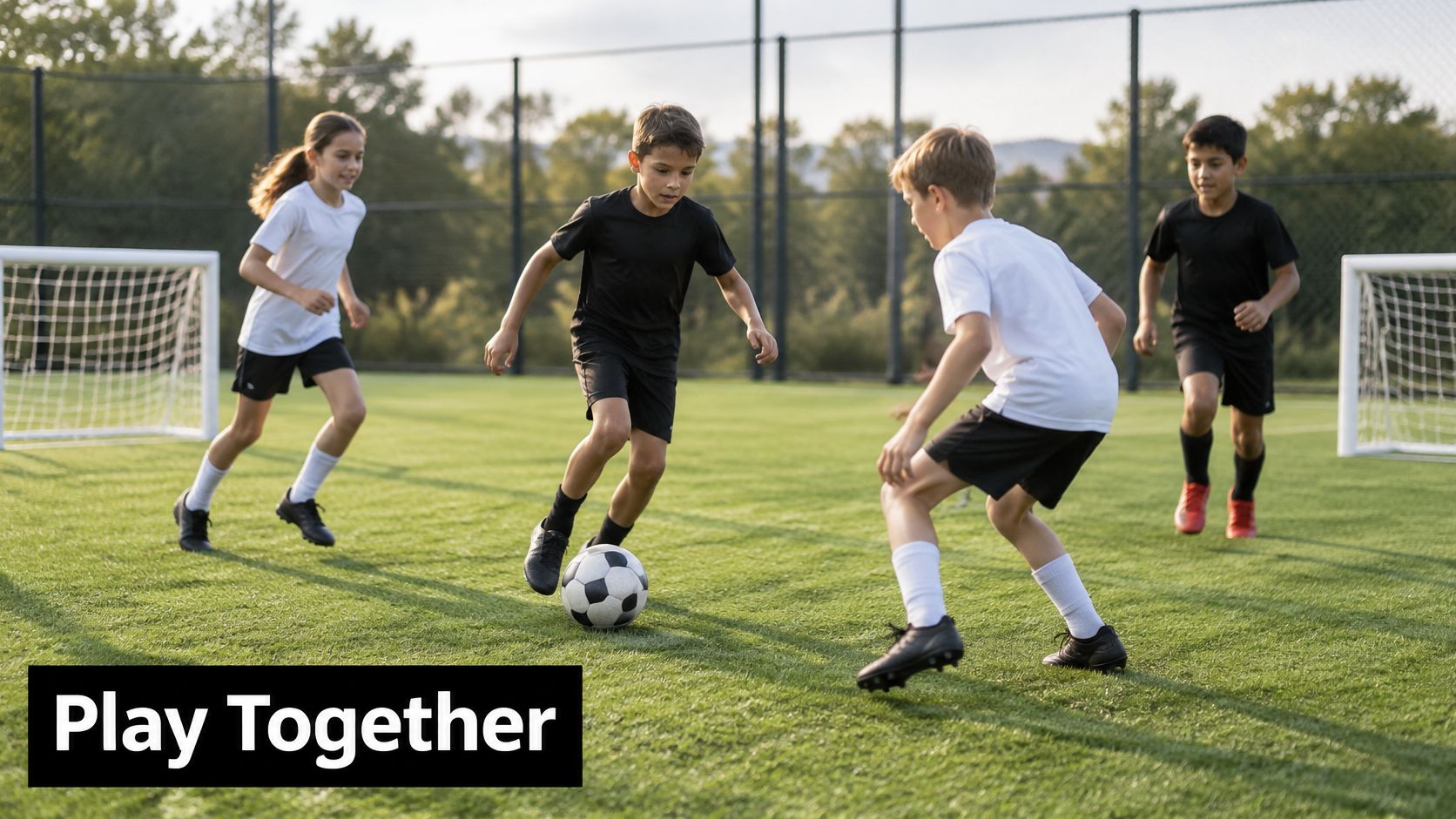
For a beginner pair, place a cone gate between them. Ask the receiver to cushion the ball into nearby space, look at their partner, and return it through the opening.
Coach the pass and the reception
Passing foot: use the inside surface for a straightforward ground pass, with the ankle firm.
Supporting foot: place it beside the ball, pointing generally toward the target.
Receiving position: turn slightly sideways when useful, so the next touch doesn't trap the player facing backward.
The types of kicks in soccer provide terminology for discussing different striking surfaces, but beginners don't need every technique at once.
The limitation: an unopposed partner won't punish a slow decision. Add movement first, then introduce interception pressure. Don't impose a touch restriction before children can consistently control the pass.
7. Rondo (Keep-Away in a Square)
A rondo belongs in practice when players can already exchange manageable passes. Put supporting attackers around a square and a defender inside, then make the space generous enough that a receiver has time to control the ball.
The attackers keep possession by creating passing lanes. The defender tries to intercept, not crash through the receiver.
For example, if an attacker hides directly behind the defender, pause briefly and show how a sideways step opens a lane. Resume quickly so the player can try the adjustment rather than listen to a long explanation.
Make the defender's job fair
Rotate deliberately. Don't use a mistake as punishment that leaves a struggling child defending indefinitely.
Allow enough touches. Reduce touches only when players can receive and scan without panicking.
Adjust the square. Enlarge it when every possession ends immediately; reduce it when nobody needs to make a decision.
The trade-off: rondos can sharpen passing choices, but a technically uneven group can become a demonstration by confident players while newcomers barely participate. Smaller groups, easier pressure, and patient service are better than demanding faster play.
A rondo also lacks a goal to attack. Use it to teach support angles and receiving under pressure, then give players a directional game where they must decide when to advance.
8. 1v1 Attacking and Defending Duel
A dribbling move becomes useful when it changes what a defender does. Mark a channel with an attacking end line or small goal, and start an attacker with the ball facing a defender.
Give the attacker enough width to threaten different routes. If the channel is too narrow, the exercise becomes a collision rather than a chance to deceive.
For a reluctant player, start the defender farther away and ask them to apply controlled pressure. Let the attacker experience a successful change of direction before making the duel fully competitive.
Coach both sides of the contest
Ask attackers to approach under control, suggest a direction with their body, then accelerate into the available space. Defenders should slow down as they approach, stay balanced, and guide the attacker away from the most dangerous route.
Reward decisions. Praise recognizing an open side, not merely performing a named trick.
Rotate roles. Every player should experience attacking and defending.
Control contact. Stop lunging, pushing, and reckless tackles immediately.
The limitation: repeated mismatches can make children avoid taking risks. Match players thoughtfully and adjust the starting advantage rather than publicly ranking them.
Let a defender who wins possession attack the opposite end. That makes the transition meaningful and prevents the attacker from switching off as soon as they lose the ball.
9. 3v3 Small-Sided Game
Separate skills become connected decisions. Mark a compact field with goals at opposite ends, create balanced teams, and keep spare balls nearby so restarts don't become long interruptions.
A systematic review and meta-analysis of youth players pooled six studies involving 172 players and found a positive effect on technical execution from small-sided-game training compared with control training, with an effect size of 0.59. That supports using games as part of technical development, not treating them solely as a reward afterward.
Change a rule only to solve a problem
If everyone crowds the ball, widen the field or add wider scoring targets. If a newcomer rarely receives, use a supporting neutral player or rebalance the teams.
Keep direction clear. Players need to know which goal they're attacking.
Praise useful attempts. Recognize a brave turn, recovery run, or well-chosen pass.
Avoid excessive conditions. Mandatory passing rules can stop a child from taking a sensible open shot.
Our small-sided soccer games guide provides additional practice options.
The trade-off: games expose problems but don't always resolve them. If a player repeatedly loses possession because of an uncontrolled first touch, offer a brief technical cue and another attempt. Don't stop every attack to correct everyone's positioning.
10. Shooting Under Pressure (Finishing Drill)
Finishing practice should ask when to shoot, not just how hard to strike. Start with a server passing into an attacker's path and a clear shooting lane toward a securely positioned goal.
Allow an unopposed reception first. When the attacker can set the ball into a useful position, introduce a recovering defender who applies light, controlled pressure.
Say a player takes a large touch straight toward the defender. Adjust the service and ask them to receive across the defender's path or into the open side before finishing. The correction concerns the opportunity they create, not their kicking power.
Keep the service realistic and safe
Make passes playable. Poor service shouldn't force beginners into desperate shots.
Use visible targets. Mark safe finishing areas within the goal without obstructing the goalkeeper.
Separate active lanes. Waiting players and spare balls must stay clear of shots.
Rotate responsibilities. Players can serve, finish, and defend rather than spend practice in a shooting queue.
Accuracy under manageable pressure is a better starting point than power under panic.
The limitation: a preset shooting pattern can teach children to fire regardless of the situation. Let the defender sometimes block the shot and allow the attacker to change direction. Also permit an extra settling touch when needed, rather than enforcing rushed finishing that rewards neither control nor good judgment.
Best Youth Soccer Drills at a Glance
Drill | Age Range | Primary Skills | Main Benefit |
|---|---|---|---|
Red Light, Green Light (Dribbling Version) | U4 to U6 | Ball control, listening, stopping, coordination | Builds basic control and responsiveness through play |
Sharks and Minnows | U5 to U8 | Dribbling under pressure, agility, awareness, direction changes | Makes close control and evasive movement fun |
Coerver-Style Ball Mastery Circuit | U6 to U12 | Ball control, touch, weak-foot development, coordination | Develops confident, precise two-footed technique |
Gate Dribbling | U6 to U12 | Dribbling, close control, agility, head-up awareness | Improves controlled dribbling while scanning |
Figure-8 Dribble Through Cones | U6 to U12 | Turning, close control, balance, two-footed dribbling | Strengthens control and balance during turns |
Passing Pairs (Partner Passing with Movement) | U6 to U12 | Passing accuracy, first touch, receiving, communication | Builds accurate passing and effective movement to receive |
Rondo (Keep-Away in a Square) | U6 to U14 | First touch, passing, scanning, pressing | Improves possession skills and quick decisions under pressure |
1v1 Attacking and Defending Duel | U6 to U14 | 1v1 attacking, defending, feints, tackling technique | Builds confidence and skill in individual duels |
3v3 Small-Sided Game | U6 to U12 | Decision-making, team play, creativity, tactical awareness | Increases involvement and develops game understanding |
Shooting Under Pressure (Finishing Drill) | U8 to U14 | Finishing, shooting technique, composure, decision-making | Develops accurate, composed finishing under pressure |
Putting the Drills Together From First Touch to First Goal
You don't need to run every drill in the same practice. Choose a starting skill, add a manageable decision, and finish with a chance to use it. A child who is still learning to stop the ball doesn't need to reach the pressure-finishing stage that day.
For preschoolers, begin with playful movement and Red Light, Green Light, then try an easy crossing game. For school-age beginners, combine ball mastery, gate dribbling, partner passing, and a small-sided game. More confident players can move from mastery into receiving work, a rondo or attacking duel, and finishing under pressure.
Build progression without overloading children
Use the opening activity to watch balance, stopping, and control. Include gentle direction changes and controlled deceleration rather than sending children straight into maximum-speed contests.
A systematic review of youth-soccer injury-prevention programs found that structured programs reduced injury risk by roughly 35–39% overall, although outcomes varied between studies. That finding doesn't mean a casual warm-up guarantees protection, or that toddlers should copy an adolescent conditioning routine.
For early learners: use playful walking, stopping, reaching, and balancing.
For developing players: add controlled sideways movement and stable changes of direction.
For adolescents: progress structured strength, landing, and deceleration work to suit their ability.
Stop an activity for pain, limping, dizziness, or distress. If technique deteriorates because children are tired, reduce the challenge or take a break rather than insisting they finish the planned repetitions.
Protect confidence as carefully as technique
The same core drills can serve girls and boys, but the coaching environment matters. A qualitative study of girls' soccer participation and dropout identified negative experiences involving specialization pressure, inappropriate coaching, teammate conflict, and access barriers among dropout players.
Offer choices, rotate roles, and make newcomers welcome. Dedicated girls' sessions can provide another route into training without assuming girls need different soccer skills.
For families in Humble, Kingwood, and Atascocita, our indoor programs at JC Sports Houston serve children 24 months and up, with Coerver-based soccer training, private sessions, and seasonal leagues. New families can request a free trial to explore an age-appropriate starting point.
Repetition and enjoyment matter more than complexity. Pick two drills from this list for the next session, make the first comfortable and the second slightly more demanding, and watch whether the child wants another attempt.
At JC Sports Houston, we offer age-appropriate indoor sports programs, Coerver-based soccer training, private sessions, and seasonal leagues for developing players. Visit us to explore the soccer options and request a free trial so your child can try progressive, confidence-building practice firsthand.
Comments