

Youth Baseball Fundamentals by Age: Skills and Drills

A six-year-old swings at a ball on a tee, misses by a foot, and grins anyway. A nine-year-old fields a ground ball cleanly and then throws it into the dirt halfway to first. A parent watching both wonders the same thing: is my child behind?
Almost never. What looks like a skill gap is usually a mismatch between the task and the child's body. A nine-year-old asked to throw 90 feet with a hard ball isn't failing at fundamentals. He's being asked for a skill his arm and his footwork haven't finished building. The answer isn't more effort or more reps. It's the right skill at the right age, practiced with a workload the child can recover from between sessions.
That's the order of business here: what youth baseball fundamentals entail, what each age band should be working on, how to teach throwing and hitting in a sequence that sticks, and where the line sits between healthy repetition and too much throwing.
What Youth Baseball Fundamentals Cover
The tee is set at hip height and the bat is light enough to swing with one hand. Your six-year-old misses four times before clipping the ball on the fifth swing, and it rolls six feet. That rep counts. It teaches more than a technically perfect swing would at that age, because the child is learning to track a ball, start a motion, and finish balanced.
Youth baseball fundamentals are the core motor skills the sport runs on: throwing, catching, hitting, running and fielding. Teamwork and game awareness sit on top of them, which is why a child who knows where to throw before the ball arrives looks more advanced than a child with a prettier arm and no plan.
Little League began in Williamsport, Pennsylvania, in 1939, when Carl E. Stotz organized three teams for children approximately 9 to 12 years old. Lundy Lumber beat Lycoming Dairy 23 to 8 in the first game on June 6 that year, and Little League's official history records that the original field was smaller than a regulation professional diamond. Decades later, the 50/70 program for 12- and 13-year-olds applied the same logic with a 50-foot pitching distance and 70-foot base paths, an intermediate step between the small diamond and full-size baseball.
That's the reusable pattern: shorter distances and slower speeds first, then a gradual increase as the body catches up.
Participation numbers explain why the pattern matters. Among 6- to 12-year-olds, baseball participation fell from 16.5% in 2008 to 12.4% in 2016, roughly 800,000 fewer players, then rebounded to 12.6% in 2021, according to NBC Philadelphia's reporting on Little League participation. Children who feel incompetent in the first two seasons rarely stay long enough to become competent.
The two-question test for any drill: does the child succeed often enough to want another turn, and does the skill transfer to a game situation?
Apply those questions to the drills you see at practice:
Success rate: a child failing more than half the reps is being asked for a skill that's one step too far ahead.
Transfer: if the drill never appears in a game, it's conditioning or entertainment, not a fundamental.
Scale: smaller ball, lighter bat, shorter distance and a smaller field are adjustments, not concessions.
Core Skills by Age, From Tee Ball to Age 12
Three age bands cover most of the range you'll meet at a recreational program. The table describes a direction of travel, not a grade. A seven-year-old who throws 60 feet with good mechanics is ahead of schedule; a seven-year-old throwing 30 feet accurately is right on time.
Age group | Throwing | Catching | Hitting | Running and fielding |
|---|---|---|---|---|
Ages 4 to 6 | Overhand tosses of 20 to 30 feet with a small crow-hop | Two-hand catches of large soft balls at chest height | Tee hits with a light bat, balanced stance, safe swing | Running bases in simple games, fielding rolling balls |
Ages 7 to 9 | Throws of 40 to 60 feet to a partner's glove | Two-hand grounder fielding and glove-side catches | Tee and soft toss with contact in front of the body | Base running with leads and tags, backhand basics |
Ages 10 to 12 | Throws to a base at 60 to 90 feet with a full crow-hop | Fly balls in the air and blocking balls in the dirt | Front toss and live batting practice adjusting to pitch speed | Reads on balls in play, cutoff throws and steal timing |
How to read each band
Look at the distance column first, because throwing distance is the clearest signal of arm and coordination maturity. A four-year-old physically cannot generate the sequence that sends a ball 90 feet with any accuracy. By ten, most children can, provided someone taught the footwork.
Catching follows the same curve. Large soft balls at chest height come first because the child doesn't have to judge a small moving object or reach across their body. Two-hand grounders at seven to nine teach the glove-and-bare-hand partnership that makes clean transfers automatic later.
How to tell a child is ready to move up
Readiness isn't a birthday. Three signs tell you more than an age chart:
Accuracy holds up: the child hits the target most of the time at the current distance before you add ten feet.
Form survives fatigue: mechanics stay recognizable in the last five reps of a drill, not just the first five.
The child stays engaged: they ask for another turn rather than drifting toward the water bottle.
How to Teach Throwing and Catching Step by Step
Six steps build a throw a child can repeat. Teach them in order, and resist the urge to work on all of them in one session.
Here's the sequence laid out as a single flow:
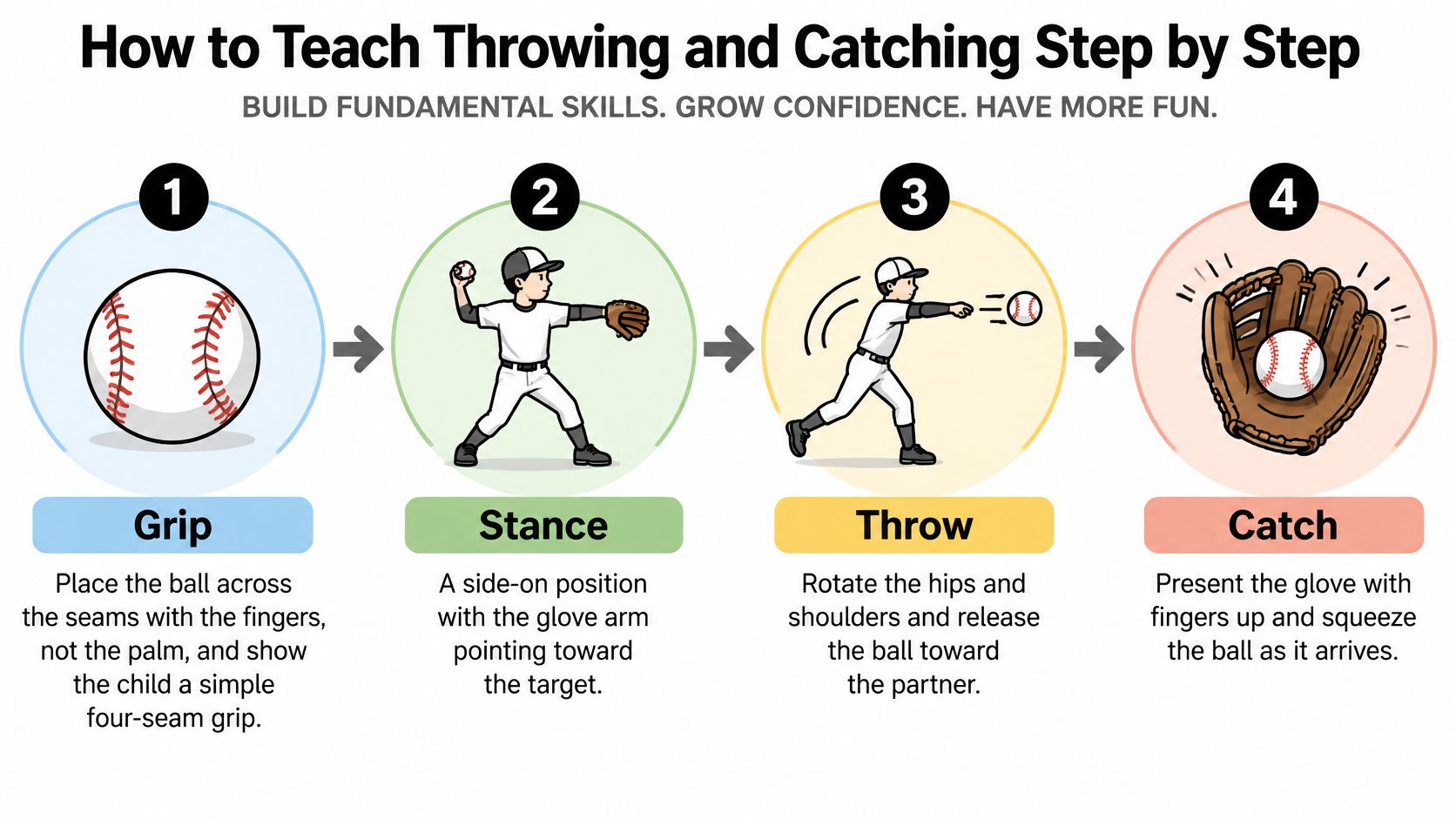
Grip the ball across the seams. The fingers sit on the leather with the palm off the ball. The reason is consistent release: a four-seam grip leaves the hand the same way every time, so the ball flies straight. The common error is palming the ball, which kills spin and pushes throws to the side.
Set a side-on stance. The glove arm points at the target and the throwing shoulder sits back. This gives the arm room to travel in a straight line instead of around the body. Watch for a child standing square to the target, which forces a push instead of a throw.
Add the crow-hop. A small step toward the target lets hips and shoulders rotate together so power comes from the legs and trunk. Stepping across the body is the error to catch, because it closes the hips and loads the arm alone.
Train the release. The elbow stays at shoulder height, the front foot lands toward the target, and the ball leaves the fingers. Dropping the elbow below the shoulder is the most common fault, and it turns a throw into a shot put. If you want a deeper breakdown of the mechanics behind a repeatable baseball throwing technique, that walkthrough covers the arm path and footwork in more detail.
Teach the catch with two hands. Fingers up above the waist, fingers down below it, glove and bare hand closing together. Soft hands that give with the ball stop it from bouncing out. The error is stabbing at the ball with stiff arms, or turning the head away at the last moment.
Throw slightly off target on purpose. Have the partner toss a foot to either side so the child has to move the feet rather than reach with the arms. Reaching is the habit that produces dropped balls in games.
Ten to fifteen accurate throws in a row is a good sign the motion is ready to repeat at a greater distance.
Hitting Progression From Tee to Live Pitch
The tee is where a young hitter learns posture, bat path, balance and where the contact point sits relative to the front foot. Then a real pitch arrives, and the same child freezes or swings late.
A boy working on his swing with a coach nearby is the picture of where this progression starts.
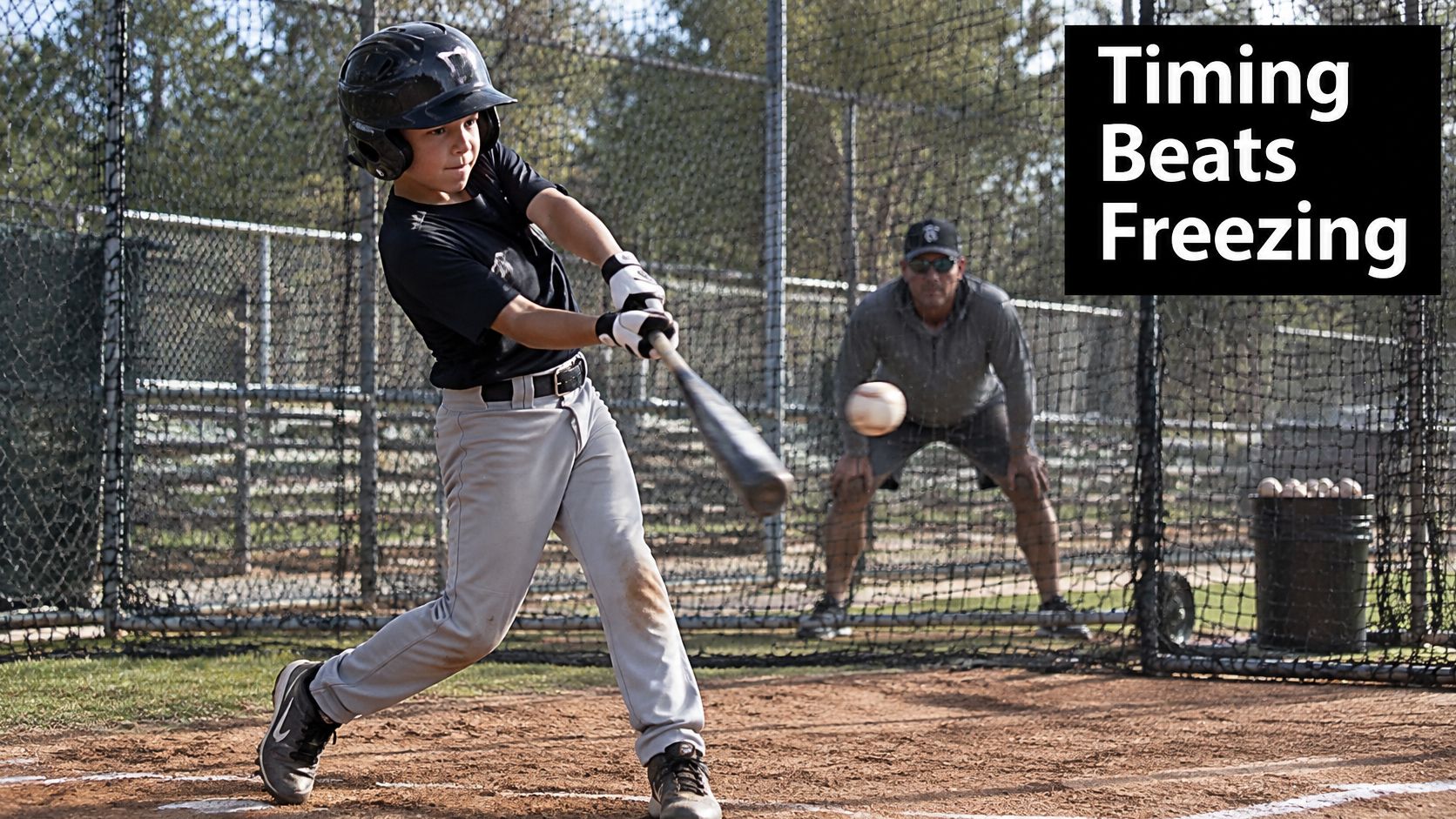
The freeze isn't a discipline problem. A study of youth hitters published in the International Journal of Sports Medicine tracked 20 youth baseball athletes averaging 14.3 years old and found that trunk movement differed significantly between tee swings and front toss. Tee swings showed greater backward trunk rotation during preparation and through roughly 67% of the acceleration phase, while front toss required movement adapted to a ball that was arriving. A player can look technically clean on a stationary tee and still struggle to organize timing against flight.
The three stages
Tee work. Use it for posture, bat path, balance and contact point. Set the tee so the hitter makes contact slightly in front of the body, and check that the finish is balanced rather than falling forward.
Front toss. A coach kneels behind a screen and tosses underhand from close range. This stage builds visual tracking, rhythm and the ability to adjust when the ball isn't in the spot you expected.
Controlled live at-bats. Real pitching, with a coach calling out counts and situations. Here the child decides whether to swing, which is a skill no tee can teach.
At home, a soft ball tossed underhand into a net or against a wall covers stage two in ten minutes. Keep it light and keep it short.
How to judge progress
Judge by outcomes, not by identical body positions. Solid contact, a balanced finish, a consistent contact point and visible adjustment from swing to swing tell you more than a frozen photograph of the trunk. One warning sign deserves attention: a child who swings at every pitch regardless of location is guessing rather than seeing the ball, and that habit gets harder to break each season.
For a fuller set of progressions you can run in a gym or a backyard, these youth baseball hitting drills pair well with the three stages above.
Sample Practice Plans for Each Age Group
A practice plan is a container, not a script. What changes with age is how long each container holds attention. The minutes below assume a session that runs 45 to 60 minutes.
Session block | Ages 4-6 | Ages 7-9 | Ages 10-12 |
|---|---|---|---|
Warm-up and movement | 5 min | 8 min | 10 min |
Throwing and catching | 10 min | 15 min | 15 min |
Hitting station | 10 min | 15 min | 20 min |
Fielding and base running | 10 min | 12 min | 10 min |
Game-like scrimmage | 10 min | 10 min | 5 min |
Total session | 45 min | 60 min | 60 min |
Why the minutes split this way
Younger children get proportionally more time in movement and short-range play because their bodies need the general coordination work and their attention resets every few minutes. Older players can hold a technical idea in their heads long enough to drill it, so hitting and fielding earn more of the clock. The scrimmage shrinks for the oldest group because they've already learned the game shape and gain more from repetitions at a station.
Two drills fill the biggest blocks:
Distance-call partner toss (throwing block): the coach calls out a distance, the pair moves back or forward, and every throw must hit the partner's chest. It builds accuracy at varying effort levels instead of one fixed distance.
No-strike scrimmage (game block): every child runs the bases after a hit and nobody is called out on strikes. It keeps the game moving, teaches base recognition, and gets every player moving in the final minutes.
Rotate the emphasis across the week. If Tuesday is throwing-heavy, make Thursday the hitting day.
Watch for arm complaints. A child who says the shoulder is sore should stop throwing for the rest of that session and throw less for the remainder of the week. Pain isn't a sign of toughness in a nine-year-old; it's a signal that the volume was wrong.
Pitching Workload and Equipment Basics
There is no single pitch count that's universally safe for every child. That's the first thing to understand, because it changes what you monitor. A repeatable throwing sequence and a sensible total weekly load protect a young arm far better than chasing one magic number.
A systematic review of youth pitching mechanics examined healthy pitchers aged 10 to 15 and found stride length commonly falling between 66% and 85% of body height, with peak elbow valgus torque averaging approximately 18 ± 4 N·m immediately before maximum shoulder external rotation. In plain terms, the arm takes its heaviest load just before the shoulder rotates fastest, and the legs and trunk are supposed to have done their share of the work by then. A short stride or poorly timed hip-to-trunk rotation shifts more of that load onto the elbow and shoulder.
What to check on video
Film a few throws from the side, then look for three things:
Direction: the stride travels toward the target rather than drifting open.
Bracing: the front leg firms up on landing instead of collapsing.
Delay: the arm accelerates after the hips open, not before.
Don't force one visual model onto every child. The same review notes substantial individual variation in how young pitchers move, and the goal is efficiency for that child, not a copy of a professional.
The review also found that fastballs generally produce greater elbow and shoulder forces than curveballs. That doesn't make curveballs the safe option; it means pitch type is a smaller factor than total workload.
The workload rules parents can apply
A literature review of youth baseball development summarizes injury-prevention guidance worth writing on the fridge:
At least four months away from throwing each year, including two to three consecutive months.
Ages 9 to 12: no more than 80 innings in 12 months, counting practices, games and catcher innings.
Rest days after consecutive pitching days, with high-school data linking consecutive-day rest rules and daily maximums of 105 pitches or fewer to lower shoulder and elbow injury rates.
Equipment matters less than workload but still matters. A glove that fits the hand closes around the ball instead of spinning on it. A bat should reach roughly the child's hip when stood on end, and the grip should be small enough for fingers to wrap. A helmet goes on for batting and base running, every time. Footwear is part of the safety picture too: children need proper athletic shoes rather than sandals or flip-flops, which is the standard we hold at JC Sports Houston, where we supply the training and baseball equipment children use in class.
How Parents Can Build Confidence at Home
A child can drop every ball in practice and still love the game. The reason children drift away from sports is rarely a lack of ability. Youth sports survey evidence compiled by the Aspen Institute identifies cost, time constraints, fear of not being good enough and lack of information about available programs as reasons children don't take part, and cost and time are barriers families commonly report.
Look at that list again. Cost shrinks when the equipment is a rolled sock. Time shrinks when practice fits in the yard between dinner and homework. And fear of not measuring up fades fastest when the first repetitions happen where nobody is keeping score.
Technical instruction alone doesn't reach any of those barriers. What reaches them is making the first steps cheap, short and socially comfortable.
A home routine that costs nothing
Ten to 15 minutes, three times a week, is enough at the start. Scale it to the child's age: a four- or five-year-old loses focus well before a ten-year-old does, so younger children get the shorter end of that range and the softest equipment you own.
Tossing: a rolled sock or a foam ball, thrown underhand at a wall target.
Striking: a wiffle bat and a soft ball, off a tee made from a bucket and a pool noodle.
Catching: a rolled towel held out as a target, so the child aims rather than just throws.
Running: base races between two markers in the yard, with turns practiced at full speed.
Small-sided games beat waiting for a full team. Two-player catch-and-run, where a clean catch earns a sprint to a marker, teaches baseball decisions without nine other children.
One caution on volume: home throws count toward the same weekly total a young arm absorbs, so end the session while the child still wants one more rep. Stopping early leaves them eager for the next one.
Praise the process, not the result
Name the specific thing you saw. "You stepped right at the target that time" does more than "great throw," because the child knows exactly what to repeat on the next rep. At practice, the adult's job is to watch and encourage. Save the coaching for home, and let the coach run the session.
If something at practice worries you, take it to the coach or the program director rather than to your child.
Parents and caregivers with a concern should consult the coach or the director. That is the policy at JC Sports Houston, and it fits the way the curriculum is built: the child stays at the center of the game, and motor skills, self-confidence and technique grow through interactive games and drills.
After a hard game, ask what the child enjoyed, name one thing they did well, and pick one small skill from their age group to work on that week. Then let it go. Confidence builds the same way skills do: one short session, one specific compliment, one small skill at a time.
Choose a Program That Builds Fundamentals
Three things separate a program that teaches fundamentals from one that just runs games. Ask whether the curriculum moves children from tee and toss toward live play in a planned sequence. Ask whether the coaches are trained in that curriculum rather than improvising week to week. And watch whether small-sided games give each child many touches instead of long lines and long waits.
JC Sports Houston is one local option for families in Humble, Kingwood and Atascocita, where the baseball league for kids and a free trial let you see the coaching approach before committing. To request a trial, families fill out a short form with the child's name, age and favorite sport.
Use this checklist on your first visit:
Does the coach explain what each drill builds? If nobody can tell you why the drill exists, it probably doesn't transfer.
Do children rotate through skill stations? Rotations beat queues.
Is there a clear path to the next level? Ask what a child needs to show before moving up.
Pick one skill from the age table that fits your child, practice it for two weeks at home, then go watch a session and see how a coach builds on it.
JC Sports Houston runs baseball leagues and age-appropriate classes for children 24 months and up, with trained coaches who teach throwing, hitting, fielding and base running in the same short-distance-first order described here. If your child is ready to move from backyard reps to a real practice, request a free trial with their name, age and favorite sport, and we'll match them to the right group. Visit JC Sports Houston to see the baseball league schedule and get started.
Comments