

Birthday Party Packages Guide for Active Kids

You've agreed to host your child's birthday party, and suddenly you're comparing room rentals, coaches, food, decorations, invitations, cleanup, and a guest list that keeps changing. You want the children to have fun, but you don't want to spend the celebration refilling drinks or separating arguments over whose turn it is.
That's where birthday party packages can help. A well-designed package bundles the venue, equipment, activities, and support into one experience. For families in Humble, Kingwood, and Atascocita, coach-led sports parties can add something a basic room rental often misses, a clear plan that keeps children moving and included.
Introduction to Stress Free Birthday Celebrations
A parent planning a party from scratch usually starts with a simple idea: invite friends, serve cake, and play a few games. Then the practical questions arrive. Who sets up the equipment? What happens if the children finish the planned activity early? How do you keep a mixed group engaged while food is being prepared?
DIY parties can work well for small gatherings, especially when a family enjoys hosting. But the organizer becomes the venue manager, activity leader, food coordinator, and cleanup crew at the same time. A package shifts those jobs to a team, giving parents more opportunity to watch the birthday child enjoy the day.
Birthday celebrations are a major part of the party-supplies economy. One industry summary projects that birthdays will represent 34.8% of occasion share in the global party supplies market in 2026, while another fact-checked summary reports that 68% of consumers buy party supplies for birthdays and that the average American spends $85 per celebration. These figures come from the party supplies market summary, and they help explain why package-based birthday experiences are so common.

For active children, a coach-led party can be especially useful. Instead of relying on decorations to create a theme, the experience uses soccer, basketball, baseball, or multi-sport games as the centerpiece. Coaches can adjust rules, divide children into small groups, and change the pace when younger players need simpler challenges or older children want more competition.
This guide will help you compare packages by looking beyond the room and cake. You'll learn how to review inclusions, match activities to age, understand pricing and capacity, evaluate add-ons, and follow the booking process without unpleasant surprises. JC Sports Houston is one local example of a facility offering customizable, coach-led sports parties, but the comparison principles apply to any venue.
What Birthday Party Packages Actually Include
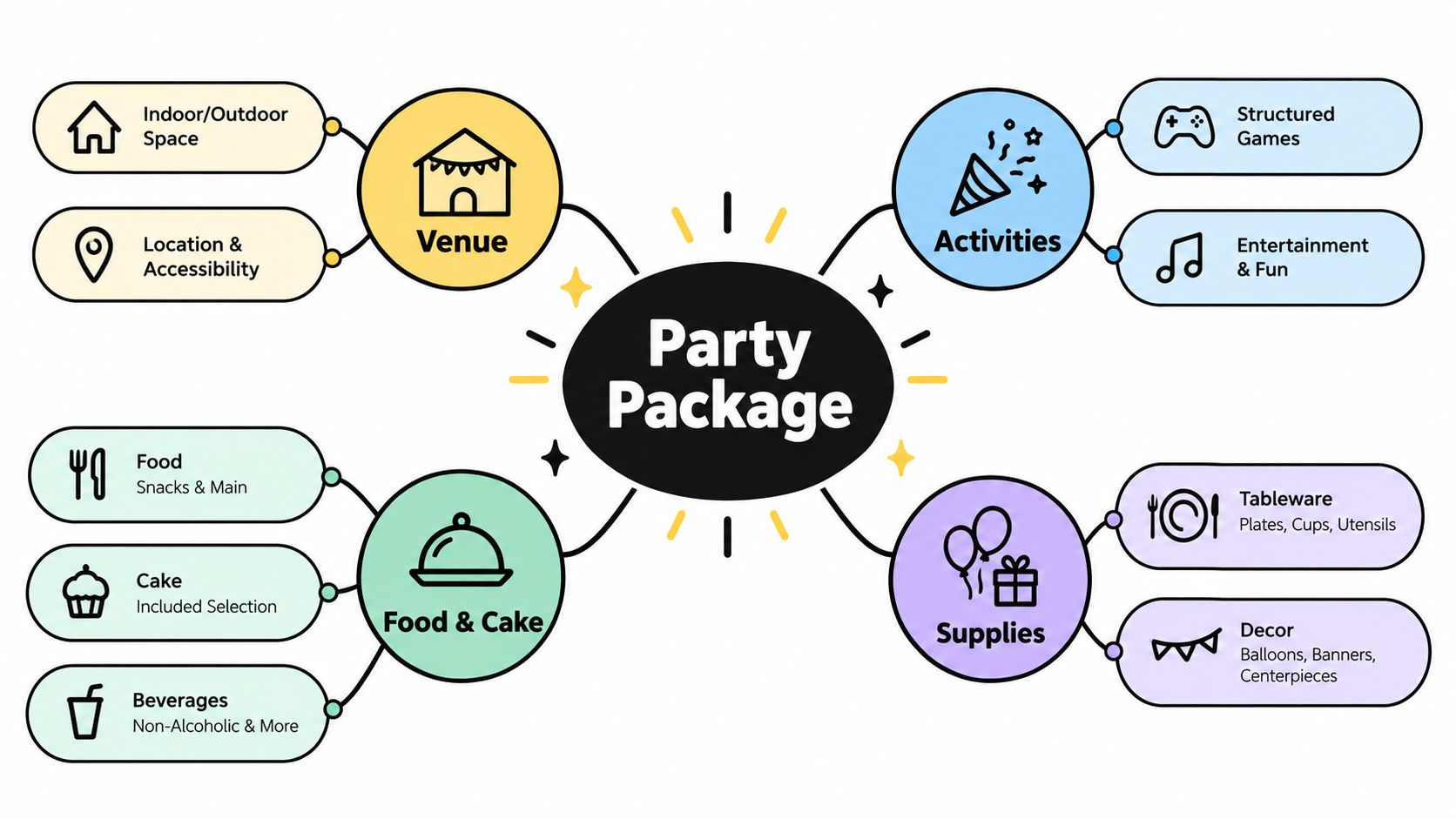
A birthday package should read like a game plan. The venue provides the playing field, the coach organizes the action, equipment makes each activity possible, and the host keeps transitions orderly. If one of these roles is missing, parents often end up filling it during the celebration.
The core parts of a package
A package usually starts with a reserved facility or party area. Confirm whether the space is private, partly shared, or a reserved section. That detail affects how easily staff can guide children between activities and how comfortable younger guests feel.
Activities form the center of a sports package. Look for a written list of games rather than a general promise of “sports fun.” A useful plan might include warm-ups, skill stations, relay games, and a short team challenge. The activities should match the children's ages and abilities, so they can participate instead of spending long periods waiting.
Equipment should support the listed program. Soccer balls, cones, small goals, basketballs, bats, soft baseballs, and markers can turn an empty room into an organized play space. The sports birthday party supplies guide helps parents review the equipment and supplies that support an active theme.
Setup and cleanup also belong on the checklist. Staff may arrange equipment, prepare tables, collect supplies, and reset the area after the party. If those tasks are excluded, ask who handles them and whether a separate fee applies.
A dedicated host can manage check-in, direct families to the correct area, coordinate food, and protect the activity schedule. The coach and host may be the same person or separate staff members. Confirm each role before booking.
Practical rule: Read the package as an operations checklist, not as a theme description.
Base inclusions versus upgrades
The base price may cover active play without covering decorations, food, cake, drinks, favors, extra coach time, or additional room access. Upgrades can be useful, but only after you know what the base package already provides.
Compare packages using the same categories:
Space: Confirm the private area, party table, and access time.
Play: Ask how much coach-led activity is included and whether equipment is provided.
Food: Check whether the venue supplies snacks, pizza, drinks, or only the room.
Celebration: Find out whether cake service, tableware, candles, and decorations are covered.
Support: Confirm who welcomes guests, leads games, serves food, and cleans up.
A room rental with parent-supplied entertainment may show a lower initial quote, while leaving more work for the family. A structured package earns its value when staff keeps children active, manages safety, and limits long stretches of waiting. Compare the full cost and the parent's workload, not just the room fee.
Choosing Themes and Age Fit That Keep Kids Engaged
A sports theme should do more than decorate the cake table. It should determine how children move, what skills they practice, and how the coach keeps the group involved. The right theme feels like a familiar game made easier and more playful. The wrong theme can ask young children to wait, follow rules, or perform skills they aren't ready to manage.
A 2026 survey reported that 34% of parents said more games and activities would have most improved their child's previous birthday party, according to coverage of the parent survey. That finding points to a useful standard: compare packages by the quality and variety of active play, not by the appearance of the party room.
Soccer
Soccer works well when children need frequent movement and simple choices. Younger players can chase, stop, dribble, and shoot at small targets. Older children can add passing, teamwork, and mini matches.
A coach can keep the game flowing by using small groups instead of one large match. While one group shoots, another can dribble through cones, and another can complete a movement challenge.
Basketball
Basketball suits children who enjoy throwing, aiming, and short competitive rounds. Younger participants may focus on rolling or tossing toward a target, while school-age players can practice dribbling, passing, and shooting.
The activity should use child-friendly equipment and adjusted goals where appropriate. A long line at one basket isn't a complete program, so ask how the venue prevents waiting.
Baseball
Baseball-themed parties can include soft-ball throwing, running bases, hitting from a tee, and fielding games. These activities give children clear roles, which helps children who prefer a slower rhythm than continuous running.
Safety depends on soft equipment, generous spacing, and close supervision. The coach should explain where children stand and how players rotate before the game begins.
Multi-sport
Multi-sport packages give families flexibility when guests have different interests. A group might rotate through soccer shooting, basketball targets, and a baseball station, then finish with a cooperative game.
This option often works well for mixed groups because children get more than one way to participate. It also gives the coach a backup activity if one game isn't holding attention.
Match the plan to the children
Toddlers and preschoolers usually need brief activities, clear demonstrations, and frequent changes. They may enjoy animal movements, color-based games, gentle ball rolling, and simple obstacle courses more than formal competition.
School-age children can handle rules, teams, skill challenges, and scorekeeping, although the coach should still avoid letting one skilled player dominate. Mixed-age parties need flexible stations so older children can add challenge while younger guests receive simpler instructions.
Ask three questions before choosing:
What does the birthday child enjoy? A child who loves kicking may prefer soccer, while another who loves several games may enjoy multi-sport.
What can the guest group manage? Consider ages, confidence, and whether everyone knows one another.
How much space does the activity need? Running games require clear paths, safe boundaries, and room for coaches to supervise.
The strongest theme is the one that creates repeated turns, not just the one that matches the decorations.
Pricing Duration and Capacity Made Clear
Parents often compare the headline price first, but the useful comparison is the total experience. A lower package can become more expensive after food, cake, decorations, extra activity time, and cleanup are added. A higher package may provide stronger value if it removes work and gives children a carefully managed program.
Children's entertainment centers provide a useful market reference. A report says premium birthday packages in the United States average $35 to $55 per child and can generate 15% to 25% of total site revenues at many multi-concept family entertainment centers, as described in the children entertainment centers market report. These figures show that package pricing is an established business model, not an unusual add-on.
Recent U.S. survey coverage places the average kids' birthday party at about $314, with venue parties commonly costing $300 to $800 all-in. The same coverage reports a broad range from $10 DIY gatherings to $7,000 luxury events, which is why parents should ask for the full invoice rather than relying on a starting price. See the birthday party cost overview for that pricing context.
Compare the package structure
Package Tier | Typical Inclusions | Best For |
|---|---|---|
Activity-focused | Coach-led games, equipment, and reserved activity space | Families prioritizing movement and structured play |
Celebration bundle | Activity time, party area, food or drinks, and basic supplies | Parents wanting fewer vendors and simpler coordination |
Expanded experience | Longer activity access or selected upgrades | Larger groups or children who need more variety |
Custom package | Chosen theme, activity mix, food, and optional extras | Families with specific interests or mixed-age guests |
Treat these as comparison categories, not universal industry standards. Every venue defines its own package, so the written quote matters more than the tier name.
Duration is a pacing tool
A party lasting around 90 minutes to two hours can feel full when the schedule has a rhythm. Active play may come first, followed by food and cake, with transitions built into the plan. Ask whether setup and cleanup happen outside the booked time or consume part of the party window.
Capacity also needs careful attention. Event-safety guidance recommends calculating how many people an area can safely accommodate, setting an admissions limit, and controlling and counting entrants through event safety management guidance. One planning baseline uses 0.5 square meters per person for standing audiences, but a party area must deduct space for seating, tables, equipment, activity stations, circulation, and exits.
That means a room's advertised maximum isn't automatically a safe birthday-party capacity. Every game station and food table takes space, and crowded routes can become difficult during arrival, snacks, and pickup.
For an additional budgeting reference, parents can check activity booking prices on Samba and compare how different activities present time, group size, and package costs. Use it as a comparison tool, then request a venue-specific quote.
How Booking Works and Smart Add Ons to Consider
Booking becomes easier when you treat it like a short timeline rather than one large decision. Start with the date, child's age, expected guest count, preferred sport, and spending limit. That gives the venue enough information to recommend a realistic package instead of sending a generic menu.
Begin with the inquiry
Ask about available dates, private-space access, activity duration, food rules, cake policies, staffing, and the maximum safe group size. Request a written list of inclusions and exclusions. Clarify the deposit, payment schedule, cancellation policy, rescheduling terms, and deadline for the final headcount.
Once you find a workable date, secure it according to the venue's process. A date isn't confirmed because someone replied to an email. Make sure you receive written confirmation and understand what happens if attendance changes.
Finalize the experience
Choose the theme after confirming the age and guest mix. Give the coach useful information, such as whether several children are toddlers, whether guests have played the sport before, and whether anyone needs a quieter entry into the activity.
Online registration can reduce errors when families enter their own information, but parents should still review the final plan. Confirm arrival time, parking, footwear, water access, food timing, and the person responsible for bringing the cake.
The following video can help families think through the practical flow of a sports celebration:
Choose add-ons for a reason
Extra coach time helps when children have high energy or the package schedule feels tight.
Decorations add visual polish, but they won't replace an activity plan.
Pizza and drinks simplify serving and reduce the number of errands parents handle.
Goodie bags give guests a take-home reminder, though they're optional if the activity itself feels special.
Extended room time makes sense when the group needs a slower meal or when younger children need more transition time.
On party day, send guests simple arrival instructions and identify the check-in point. Ask children to arrive in clothing suited for movement, then let the coach lead the shift from play to food and cake. Clear transitions protect the birthday moment because children aren't being pulled away from a game at random.
Sample Schedules That Show the Party in Action
A package feels easier to evaluate when you can see the sequence. The following examples aren't promises of a specific venue schedule. They're planning models that show how a coach can alternate movement, instruction, recovery, and celebration.
A preschool multi-sport rhythm
A party for toddlers and preschoolers might begin with a calm welcome and a short movement warm-up. Children can follow the coach through animal walks, gentle stretches, and a simple ball activity that lets everyone join without needing prior sports experience.
The next block can use rotating stations. One station might involve kicking a ball toward a large target, another might use beanbags or soft balls for throwing, and a third might offer a short obstacle path. Each station should be brief enough to hold attention and simple enough for children to understand after a demonstration.
After the active stations, the coach can lead a cooperative game with no elimination. Children might collect colored objects, move through a cone path, or work together to complete a team challenge. A snack and drink break follows while the children are already expecting a change of pace.
The final moments include the birthday song, cake, photos, and a gentle free-play option before pickup. Parents can focus on conversations and pictures because the coach has already handled the activity transitions.
A school-age soccer and basketball rotation
Older children may begin with a faster warm-up, followed by a soccer dribbling challenge. Instead of removing players who miss, the coach can give each child another attempt or assign a new target. That keeps the line moving and protects confidence.
A basketball station can follow, with passing, shooting, and a team relay. The coach can adjust the challenge by changing distance, using smaller groups, or giving children different roles. A short small-sided match then gives players a chance to use the skills in a game.
Food and cake work best after the most energetic activities. Children can sit, refuel, and talk about the games before the birthday song. The event can close with a final cooperative challenge or a few minutes of supervised free play.
Parents looking for a more focused example can review this indoor soccer birthday party guide. The main lesson is simple: children don't need nonstop intensity. They need a steady rhythm of doing, watching briefly, recovering, and getting another turn.
Finding the Right Package for Your Family
The right package isn't automatically the largest or most decorated option. It matches the child's interests, the group's ability level, the available space, and the amount of planning the parents can comfortably manage.
Use this decision check before paying a deposit:
Theme: Does the activity reflect what the birthday child enjoys?
Age fit: Can younger guests understand the games, and will older guests receive enough challenge?
Guest count: Does the package support a safe, comfortable group rather than just the venue's marketing maximum?
Duration: Is there enough time for play, food, cake, and transitions without rushing?
Total cost: Have you included food, drinks, cake, supplies, add-ons, deposits, and any service charges?
Staffing: Will a coach lead the games, and who handles check-in, food, and cleanup?
Policies: Do you understand cancellation, rescheduling, headcount, and arrival requirements?
A tour can reveal details that a package page can't show. Look at the distance between activity stations, seating areas, exits, storage, and bathrooms. If possible, request a free trial class or another opportunity to meet the coaches. Your child's response to the teaching style can tell you whether the environment feels welcoming.
Families comparing local options can use this guide to find sports places for birthday parties and then ask each venue the same questions. Booking early is sensible for popular weekend times, but the key is still fit, not speed.
A successful sports party gives children meaningful turns, manageable challenges, and a memorable celebration. It also gives parents permission to be guests at their own child's party. Choose the package that makes both outcomes possible.
JC Sports Houston offers customizable, coach-led sports birthday parties with active games and a dedicated celebration space for families in Humble, Kingwood, Atascocita, and surrounding Houston communities. Review the activity format and booking details, then visit JC Sports Houston to check availability and request the option that fits your child's age and interests.
Comments