

How Much Do Soccer Players Run in Training? Data by Age

One under-17 training session reached 9,767 meters, more than double that age group's 4,413-meter average, in a 2025 study of 50 male youth players across 145 training sessions.
That gap is the warning label on every mileage number. Training distance is measurable, but it is not self-explanatory. A session total can describe a demanding afternoon or a comparatively gentle one; without the session design, the same figure supports opposite conclusions.
Soccer isn't cross country. Meters accumulate because of what the coach asks players to do: the size of the grid, how many players share it, whether a ball is involved and how long breaks last. A final distance works like the total on a receipt. It shows the amount, not the items that created it.
The honest answer to how much do soccer players run in training therefore has two parts. Start with the measured distance. Then place it in the lookup table that gives it meaning: age group, format, pitch size, playing role and planned session intensity.
Change one variable and the same mileage can represent a different load. Any benchmark that leaves those details out is easy to quote and easy to misuse.
Typical Training Distance by Age Group
Most tracked youth sessions fall between 3,964.5 and 6,500 meters, or about 2.5 to 4.0 miles, according to a systematic review of training loads in young male soccer players. The authors screened 2,404 studies and fully analyzed the 8 that reported comparable tracking data, so the range summarizes the best measurements available rather than one club's habit.
Group | Average per session | Observed session range | Context |
|---|---|---|---|
Youth male players, typical sessions | 3,964.5-6,500 m (2.5-4.0 miles) | 11.8-250 m of that total above 18 km/h | Systematic review of tracked training sessions |
Under-15 | 4,518 m | up to 8,530 m | 2025 study, 50 male youth players, 145 sessions |
Under-17 | 4,413 m | up to 9,767 m | Same 2025 study |
Under-19 | 4,359 m | up to 9,648 m | Same 2025 study |
The averages sit within 160 meters of each other. The ceilings don't. Peak sessions climb from 8,530 meters in the under-15 group to 9,767 in the under-17 group, then hold near 9,648 for the under-19s. Older players didn't cover more ground on a typical night. Their hardest nights got harder.
Why the averages drift rather than climb
Distance follows the coach's plan more closely than it follows a birth year. A squad that spends 25 minutes on shape and set pieces records fewer kilometers than a squad that finishes with 20 minutes of 4v4, whatever their ages. Older teams often tilt toward tactical work, video and match preparation, which trims the average while leaving room for one very big session in the week.
That's not a flaw in the data. It's the reason a fixed mileage target fails. Set a number and the easy way to hit it is adding laps, which adds distance at the slowest possible speed.
A session in the middle of these ranges is normal. A session at the top is not automatically better, and a session at the bottom is not automatically wasted.
The same review adds one detail that reframes every mileage target. Only 11.8 to 250 meters per session were covered above 18 km/h. Everything else was walking, jogging and moderate running. A session sitting at the very top of the distance range can still contain less than one full lap of genuine sprinting, which is why volume and intensity are separate questions with separate answers.
For a youth program, that argues for reading volume beside intensity, recovery and technical goals rather than instead of them. A coach chasing mileage alone can double a session's distance without adding a single sprint, a single decision or a single touch under pressure.
How Training Distance Compares With Match Play
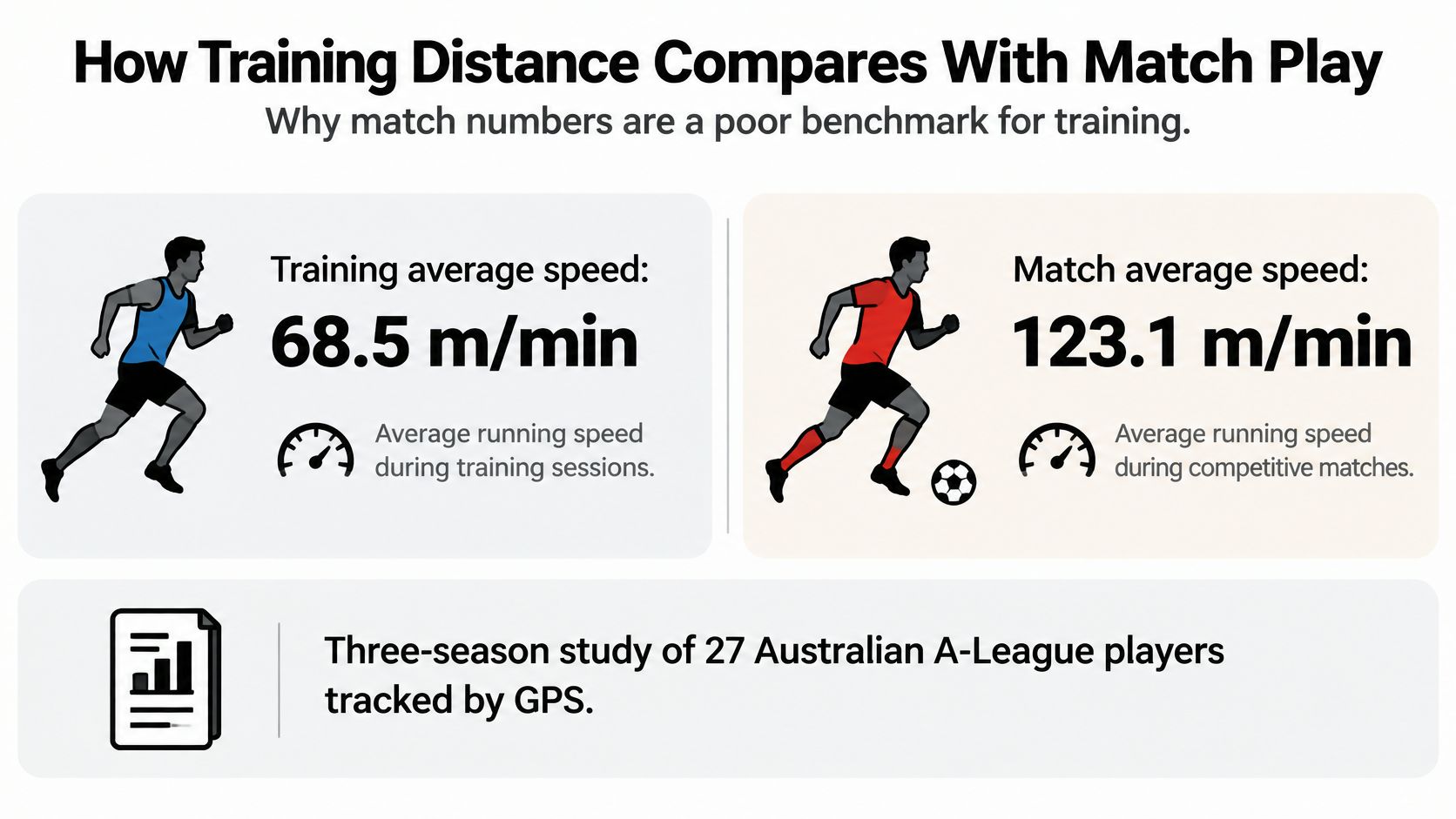
Match distance is the number everyone quotes and the worst possible template for a training session. A three-season GPS study of 27 Australian A-League players found an average speed of 68.5 m/min in training against 123.1 m/min in matches (Murdoch University research portal). Training isn't a scaled-down match. It's a different activity with a different shape.
The panel below sets the two side by side.
Measure | Training | Match |
|---|---|---|
Average movement speed | 68.5 m/min | 123.1 m/min |
Sprints per hour | 2.1 | 8.3 |
Share of time spent standing | 48.0% | 2.7% |
Nearly half of a professional training session is spent standing still. In a match, that figure drops to 2.7%. Sprint frequency roughly quadruples on game day. Whatever a session is for, it isn't a rehearsal of match running volume.
Where the gap comes from
Training includes instruction, demonstrations, stoppages and recovery intervals, and every one of those lowers movement density. A coach freezing play to correct positioning is doing the job properly, and the GPS chart records it as a lull. Matches create the opposite: repeated high-speed transitions with no one pausing to teach.
A technically demanding session can look lazy on a GPS chart and still be the best hour of a 10-year-old's week.
For youth programming, the practical benchmark is not to chase professional match distance. It's to watch the structure underneath the session: work-to-rest ratio, repeated accelerations, and age-appropriate high-speed actions inside small-sided games. A session built on rondos and 3v3 transitions adds touches, perception-action decisions and movement quality while producing fewer total meters.
For older players, tracking data helps with planning. For younger children, observable fatigue, movement mechanics, engagement and how quickly they recover between repetitions say more than a distance total ever will.
Factors That Change How Far Players Run
Here's the finding that should end the search for one magic number: there is no universal distance target for a youth soccer player, as a 2025 study of U16 and U19 players in 7-a-side small-sided games makes clear. Five variables move the total before anyone's fitness comes into the conversation.
Factor | Effect on distance | Example |
|---|---|---|
Pitch size | Larger pitches raise total distance, high-intensity running and maximum speed | 7-a-side games on larger versus smaller pitches |
Playing position | Wide players generally need more high-speed running than central defenders | Wide player versus central defender |
Session format | Small-sided games build load through starts, stops and changes of direction | Small-sided games versus continuous laps |
Number of players | More players in the same area means shorter runs and less ground per player | 4v4 in a 30-by-20-yard grid versus 7v7 on half a field |
Session length | Longer sessions add total distance but usually lower average intensity | 90-minute technical session versus 60 minutes of small-sided games |
Pitch size is the variable coaches notice first. In that study, larger pitches produced higher total distance, high-intensity running, high-metabolic-load distance and maximum speed than smaller pitches. Same players, same rules, different lawn.
Playing position sets the shape of the workload. Wide players generally need more high-speed running than central defenders because the job is to stretch the pitch and recover its length. A winger and a center back in the same session are not doing the same workout, so handing them identical targets treats a job description as an accident.
Session format decides whether the meters look like soccer. Small-sided games generate load through repeated starts, stops and direction changes. Continuous laps generate load through steady jogging. Both add distance, and only one of them resembles the sport.
Number of players is the quiet one. Crowd the same grid and each player touches the ball more but covers less ground, because the space per player shrinks. A 20-minute 4v4 and a 20-minute 7v7 are different physical sessions even when the clock reads the same.
Session length is the most deceptive of the five. Ninety minutes of technical work can log more distance than 60 minutes of small-sided games while producing less of the fast running that matters, because the extra half hour often goes to queuing and listening.
So compare like with like. A session only means something next to sessions of the same format, on the same pitch size, for players in the same role. Building a week that varies those on purpose, rather than repeating one template, is the difference between a planned soccer training schedule and a routine.
How to Measure Running Load in Training
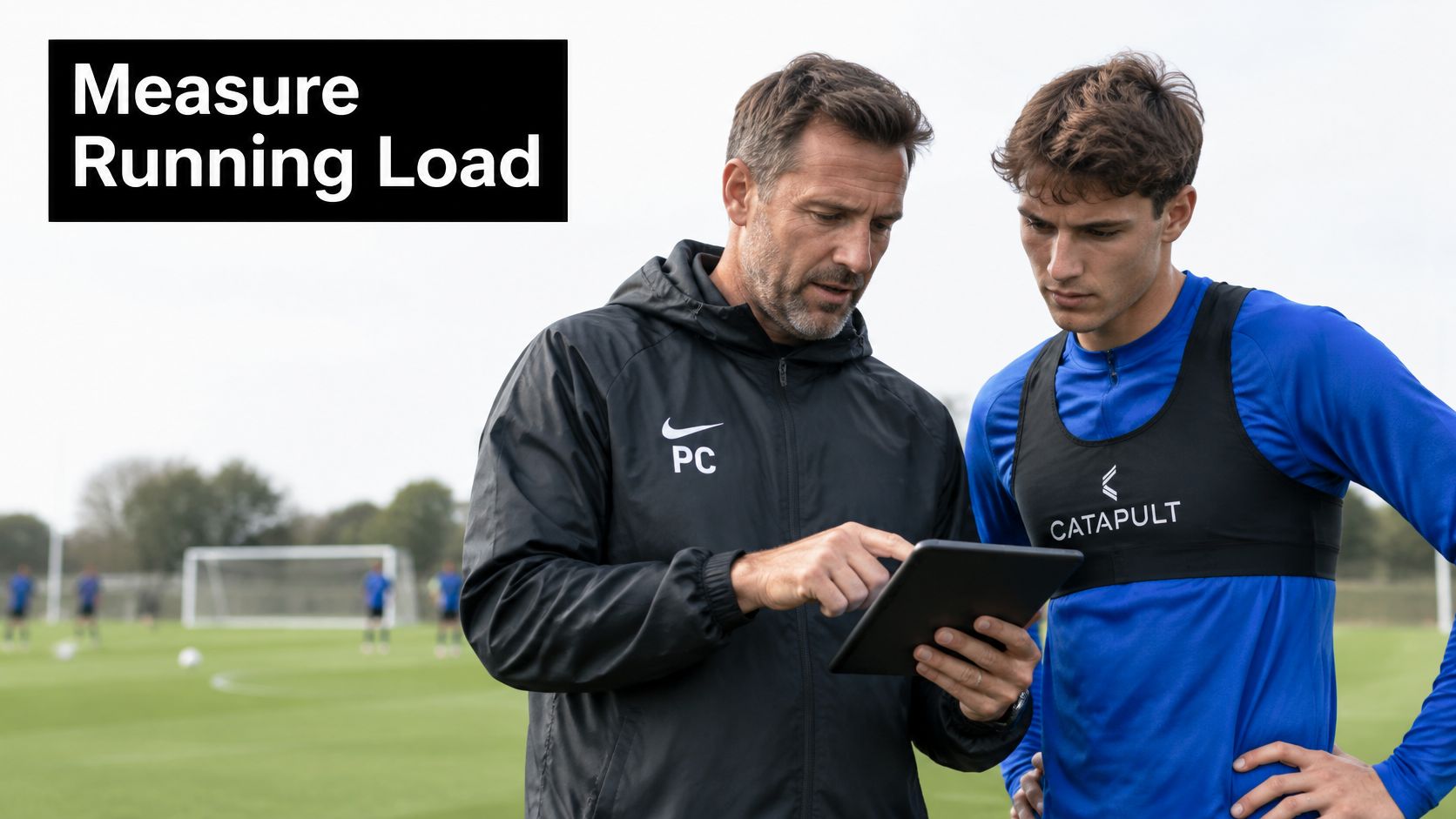
Two sessions with identical totals are not identical loads, so the method you choose determines what you can see. A GPS vest and a step counter pointed at the same session return different answers, and both can be accurate. Reading a distance figure without knowing how it was collected is like hearing a price without the currency. Pick one method and keep it consistent, because a rough number collected every week beats a precise number collected twice.
Method | What it captures | Strength | Limit |
|---|---|---|---|
GPS tracker | Distance, speed, accelerations and sprints | Objective and detailed | Costly and needs interpretation |
Pedometer or step counter | Steps and rough distance | Simple and inexpensive | Misses speed and direction changes |
Session RPE | Effort rating after training, multiplied by duration | Works at any age | Subjective; ratings vary widely between athletes and sessions |
Heart-rate monitor | Cardiovascular demand | Shows internal load | Says little about distance covered |
Structured observation | Movement quality, fatigue and engagement | No equipment needed | Hard to turn into a number |
GPS delivers distance, speed bands, acceleration counts and sprint totals, per session or per minute. That detail suits players from around under-15 upward, where the question shifts from "did they play?" to "is this week's load right?" It also costs money, needs a vest that fits properly and produces numbers somebody has to interpret.
A pedometer answers a narrower question for a fraction of the price. Steps and rough distance confirm a child is moving. They say nothing about how fast, or in which direction.
Session RPE asks for one rating after training and multiplies it by duration. It works at any age, needs no equipment and captures the internal side of load that distance misses. Because the rating is subjective, two players can post different scores for identical sessions. That spread is the honest signal that effort and distance are different currencies, so a weekly trend from the same player tells you far more than any single number.
Heart rate shows how hard the cardiovascular system worked. It won't tell you how far anyone ran, and it drifts with heat, nerves and caffeine. Paired with an effort rating, though, it separates a hard session from one that merely felt hard.
Structured observation is the method that matters most with young children. A coach watching for movement quality, fatigue signs, engagement and recovery between repetitions sees things no wearable reports, which is why it earns a place in the table despite never producing a figure.
Whichever method you choose, the log only matters if someone acts on it. A coach and a player reviewing the week's data is either the most useful conversation of the week or decoration, depending on whether it changes the next session.
A quick walkthrough of how session structure turns into load is worth ten minutes of your week:
Then run a three-step routine. 1. Record the same method every session, even if it is only an effort rating and a session length. 2. Compare only sessions of the same format, so a small-sided night is never measured against a technical night. 3. Note how the child felt the next morning, because that is the outcome the numbers are supposed to predict.
Running Load for Youth Players by Age
Almost every youth program inherits a number from somewhere: three miles, five miles, a lap count, a beep test standard. The table below swaps the number for a focus and a thing to watch.
Age group | Running focus | Monitor most |
|---|---|---|
Ages 4-6 | Play-based chasing, relays and short movement games | Enjoyment and movement variety |
Ages 7-12 | Brief bursts, small-sided games and technical repetition | Fatigue signs and engagement |
Under-15 and under-17 | Repeated accelerations, transition runs and weekly load spacing | Recovery between sessions and soreness |
Under-19 | Position-specific high-speed running and easier sessions before matches | Weekly high-speed volume and match-day readiness |
The reason to plan exposure rather than accumulate it comes from tracking 18 professional players across 15 weeks. Weekly high-speed-running volume showed a moderate positive relationship with the high-speed running completed in matches (r = 0.497, p < 0.01), and weekly acceleration volume related to match accelerations (r = 0.367, p < 0.01), per the Journal of Men's Health study. Controlled exposure to faster running helps preserve match capacity. Excessive or badly timed loading gets in the way of recovery.
Ages 4 to 6. Running is play, and the session is a series of games: chase, relay, tag, "get to the other side before the coach does." No distance target belongs anywhere near this age group. Watch whether they're laughing and whether they move in different ways.
Ages 7 to 12. Brief bursts and small-sided games do the heavy lifting here. Variety is the whole point: walking, jogging, accelerations, decelerations, changes of direction, short sprints. A child who does all of that in 45 minutes has trained better than one who jogged a mile.
Under-15 and under-17. Add repeated accelerations and transition runs, and start watching how load stacks across a week rather than within a single session. Two hard nights back to back is a planning choice, not a badge. Keep the easier session before competition, and keep technique good when fatigue arrives.
Under-19. Build position-specific high-speed running and protect the sharp end of the week. Weekly high-speed volume and match-day readiness are the numbers to review, and wide players will need more of the fast work than central defenders.
One caution on this table: the studies behind it cover under-15 to under-19 players and professionals. The 4 to 6 and 7 to 12 rows are coaching judgment rather than measured benchmarks, which is exactly how they should be presented to parents. If you're unsure which band your child sits in, our guide to how soccer age groups are organised explains the groupings.
Recovery, Injury Risk and a Parent Checklist
A weekly distance total is a weather report, not a diagnosis. It tells you what the session asked of a child, and nothing about whether they coped, enjoyed it or should train again tomorrow. Two players can log the same mileage in the same session and wake up feeling completely different, which is why every number from earlier sections needs to be read alongside recovery.
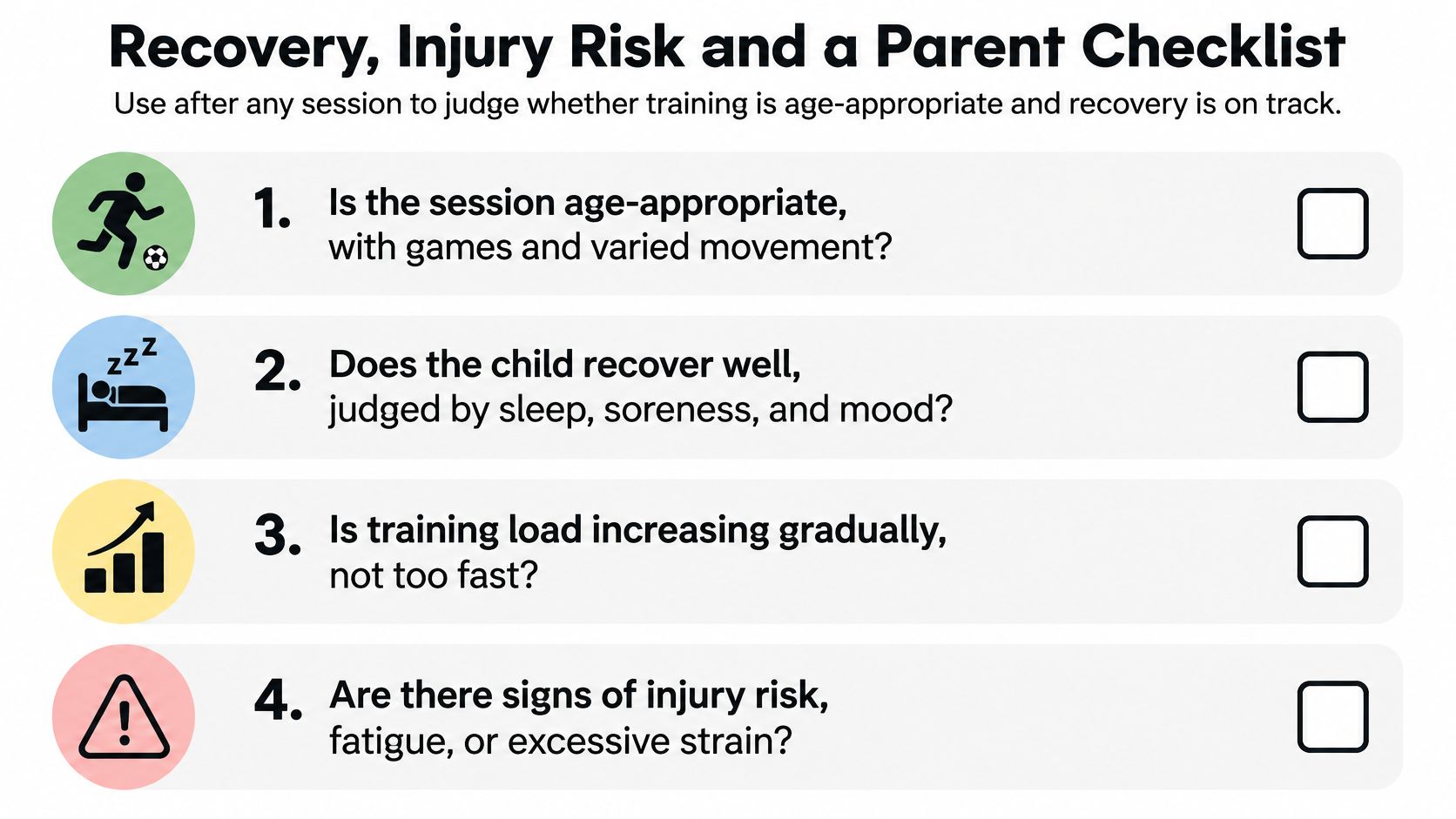
Four questions cover most of what a parent needs to know:
Is the session age-appropriate, with games and varied movement? A young child doing laps for an hour is not training for soccer. A young child playing small-sided games in short bursts is.
Does the child recover well? Sleep, soreness and mood the next morning tell you more than any weekly total. A child still dragging three days after a session is being loaded too fast.
Is load increasing gradually? Sudden jumps matter more than absolute numbers. Adding a second hard session in the same week is a bigger change than adding ten minutes.
Are there signs of strain? Limping, wincing on turns, losing technique late in a session and complaining of the same sore spot three weeks running all deserve a conversation, not another rep.
Why mileage is a poor proxy for effort
In a 2025 study of elite youth players tracked across 145 training sessions and 33 matches, perceived exertion was associated not only with total distance but also with accelerations, decelerations, medium-speed running, sprint distance per minute and deceleration frequency. Two practices can cover the same ground and feel completely different. Repeated stop-start games can load the body harder than steady jogging at a higher total, so a distance figure only becomes meaningful once you know what filled it.
What the injury research does and doesn't say
The popular rule about keeping acute workload close to chronic workload is repeated far more confidently than the evidence supports. A systematic review found moderate evidence of no association between several cumulative-distance measures, one-week workloads or four-week acute-to-chronic ratios and injury risk in elite youth soccer, while the evidence for other relationships stayed insufficient or conflicting. Training load still matters. What it means is that no single ratio should drive decisions about a child.
The night after training
Sleep is where the session gets absorbed, and it is the part parents control most directly. If bedtime drifts on training nights, the load conversation changes entirely, and steady nightly habits for better athletic recovery do more for next-day readiness than any tracker.
Two scheduling habits help more than any metric: keep at least one or two days off per week, and coordinate with the other coach when a child plays club and school soccer at the same time. A tournament weekend followed by a Monday fitness session is a planning failure. In a well-run program, players check in with their coach each week, and a parent who spots any of the warning signs above should raise it with the coach or the director rather than waiting for a limp. Practical guidance on sports injury prevention covers the rest.
JC Sports Houston builds its classes around age-appropriate games, drills and exercises from around the globe that introduce soccer, football and baseball skills, and programs are offered for children 24 months and up. Families can request a free trial by filling out a form with the child's name, child's age and favorite sport, then watch one session against the checklist above. Visit JC Sports Houston to see current class times and pick one that fits your week.
Comments