

7 T Ball Practice Ideas That Keep Kids Engaged

Ten minutes into a T-ball practice, the line tells you everything. One child swings at the tee while nine others wait. By the third turn, half of them are drawing in the dirt with their gloves.
These players stay when every minute has a job. Tell them what to do next, keep them moving, and end with a game that makes the work feel like play. That is what good T-ball practice design looks like: one skill at a time, and nobody parked in a long line.
The seven stations below run in order. Put them together and you have a 45-minute session that moves from hitting to fielding to throwing to catching to running to a game, with no line longer than three kids. I would run each idea as one station inside that session rather than as a standalone drill. Short, purposeful blocks beat one long grind, the same logic behind workout planning for busy professionals.
Keep the fun part in view. Preschool sports should emphasize enjoyment over competition, and the Kessler Pediatrics guide to sports and your child notes that baseball participation reportedly declines from 18% at age 6 to 12% at age 17. The first season is where that curve gets set.
1. Tee Hitting Stations
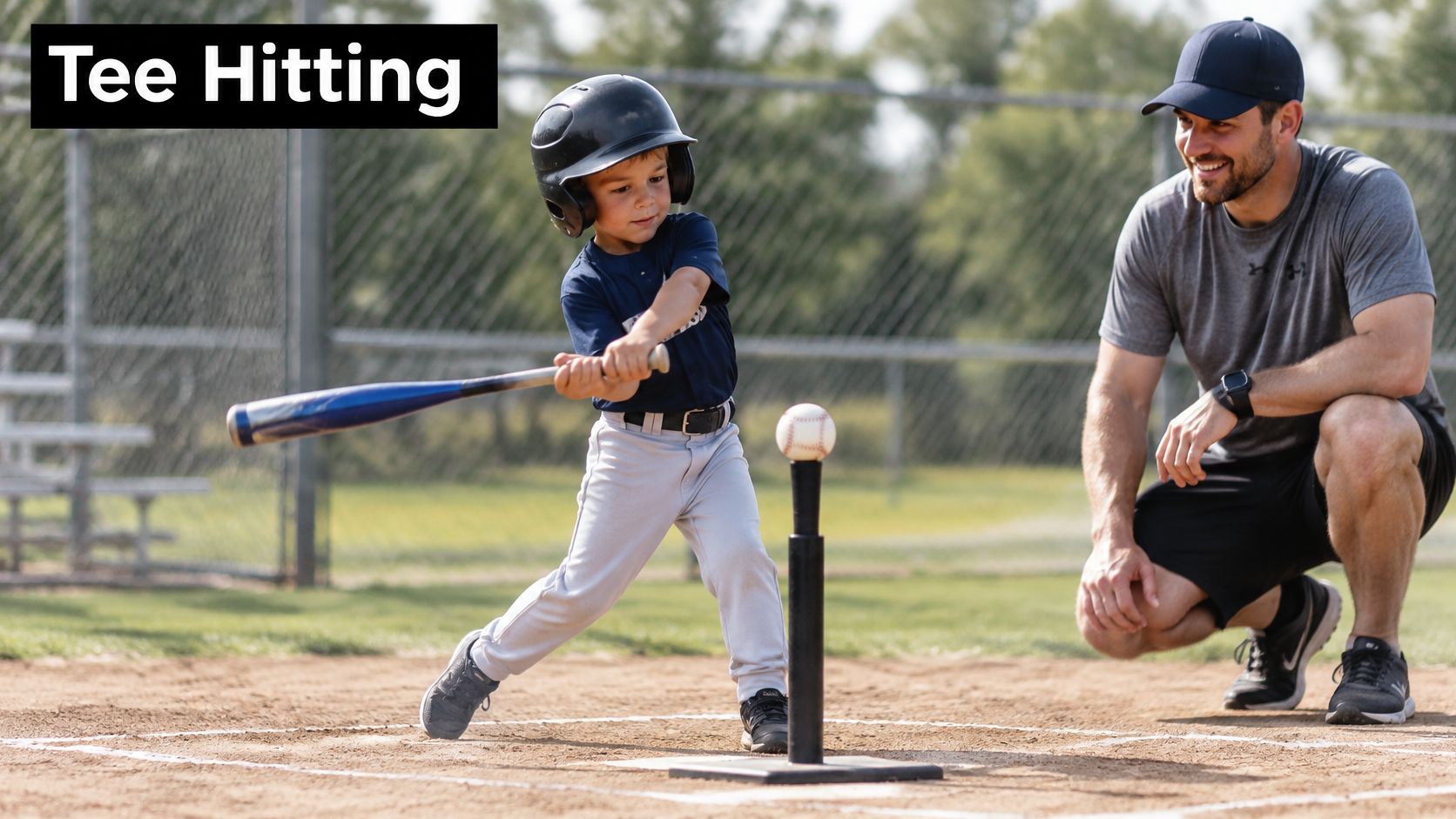
Three tees, three jobs. Set one tee at the front of the plate for stance and balance, one slightly ahead for contact point, and one aimed at a wide target zone taped to a fence for follow-through. Every child hits a ball that isn't moving, so you can fix the swing without chasing timing.
Coach the Process, Not the Distance
The preschool motor-skill framework used in early-childhood research treats striking a stationary ball from a tee as one of six object-control skills worth teaching deliberately, alongside catching, overhand throwing and underhand rolling. The same framework recommends scoring process indicators, balanced stance, eyes tracking the ball, stepping toward the target, safe follow-through, rather than ranking children by how far the ball travels.
Ball at belt height: Adjust the tee for every child. A tee set too high teaches a downward chop.
Five to eight swings, then rotate: Small counts keep attention high and lines short.
One cue per station: "Eyes on the ball" at the contact tee, "front shoulder to the pitcher" at the follow-through tee.
Praise the swing that stays balanced, even when the ball rolls three feet. A child who hears "great stance" tries again. A child who hears "swing harder" swings wilder.
For the mechanics themselves, these youth baseball hitting drills break the swing into pieces young players can copy.
2. Ground Ball Roll-and-Field
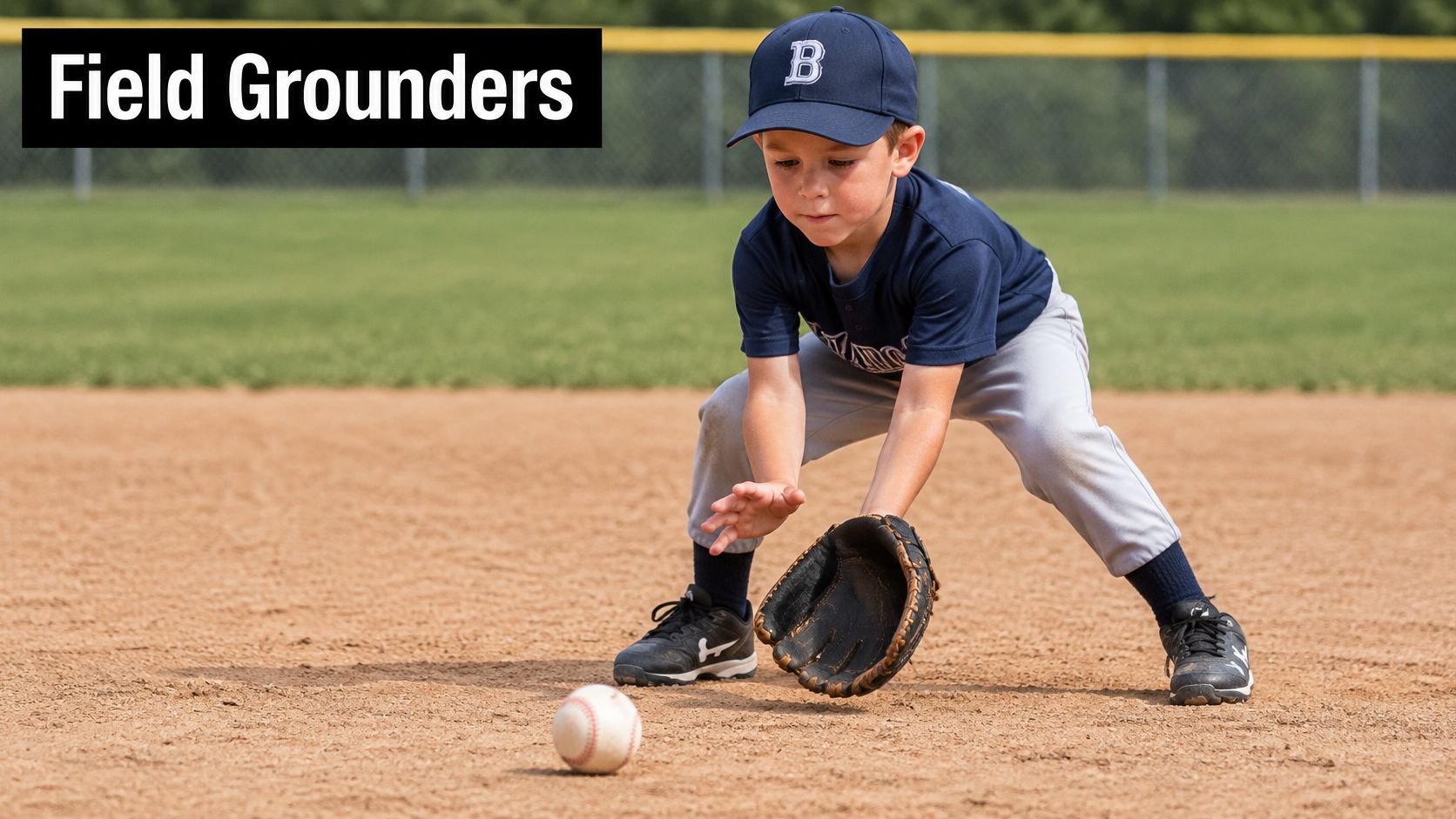
Roll the ball, don't hit it. A rolled grounder arrives slowly enough for a five-year-old to read it, drop the glove and use two hands. Kneel or stand about ten feet away, roll underhand so the ball stays on the ground, and ask for a throw back to a target.
Start with rolls straight at the chest. Once a child fields three cleanly in a row, angle the ball a foot to the left, then a foot to the right. That's the whole progression, and it lasts most of the season.
The Cue That Fixes Most Misses
Say "bend, glove down, two hands" before every roll for the first two weeks. It's three words a four-year-old can repeat back to you, and it covers the ready position, the approach and the catch in one breath.
Practical rule: Reward the child who gets in front of the ball and blocks it, even if it bounces off a shin. Positioning is the skill. The clean catch comes later.
Give them a target they can see: A hula hoop or an upturned bucket ten feet away makes the throw part of the game.
Add angle only after straight works: Side-to-side movement is a separate skill from fielding.
Keep a spare ball in your hand: One ball per pair stalls the station.
The same setup works indoors with soft safety balls and a wall as the target. For stance, footwork and glove position, these baseball fielding drills go deeper.
3. Bucket Throw
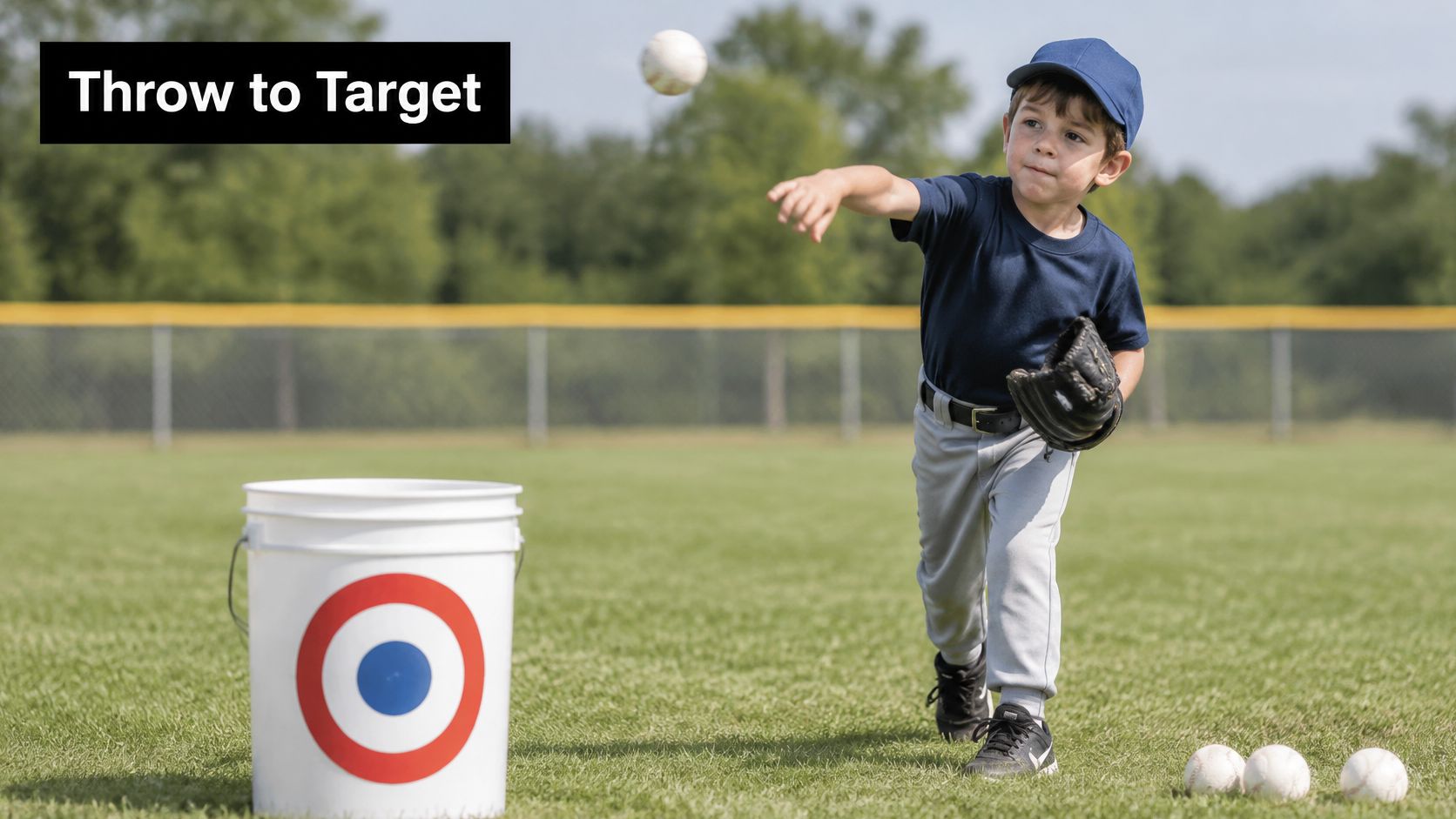
Put a bucket or a hoop against a fence and stand the child 10 to 15 feet away with three balls at their feet. The target is visible, the feedback is instant, and nobody has to explain whether the throw was accurate.
Teach the overhand motion in three pieces: point the glove hand at the target, step with the opposite foot, and let the throwing arm finish down and across the body. Then step back and let them throw.
A worked example. A four-year-old who has never thrown overhand will usually push the ball out with two hands. Move them to six feet from a hoop lying flat on the ground, ask for an underhand roll first, then one overhand throw at the same target. Accuracy arrives before distance does, every time.
Three balls per turn: A small stack at each target keeps waiting short.
Move back after three hits: If they can't hit the target from 15 feet, they're practicing effort, not aim.
Sticker per hit: Preschoolers respond to a sticker on the shirt better than a scoreboard.
Same cue every time: Point, step, throw.
If the arm path looks like a shot put, this breakdown of baseball throwing technique walks through grip, elbow position and follow-through.
4. Pop-Up Catch Drill
Toss the ball high and slightly ahead so the child has to move. That's the difference between a catch drill and a real pop-up. A ball dropped straight into the glove teaches nothing. A ball that needs two steps and a loud call teaches tracking, and tracking is what makes a child brave enough to stay under a fly ball.
Here's the drill in motion before you set it up.
Teach the Call Before the Catch
"I got it" comes first, loud and early, because two kids converging on the same ball is how bumps and bruises happen. Then the hands: glove up above the head, throwing hand ready to close over the top, eyes on the ball until it lands.
Use foam or soft safety balls for the first month. A child who gets hit once by a hard ball stops calling for pop-ups.
Toss ahead and to the side: Movement is the point, not a stationary catch.
Space the pairs well apart: Ten feet between groups prevents collisions.
Count catches out loud: Kids this age love a running tally, and it costs you nothing.
A shy five-year-old who catches two of ten today will catch six of ten in a month if the ball stays soft and the toss stays predictable.
5. Base Running Relay
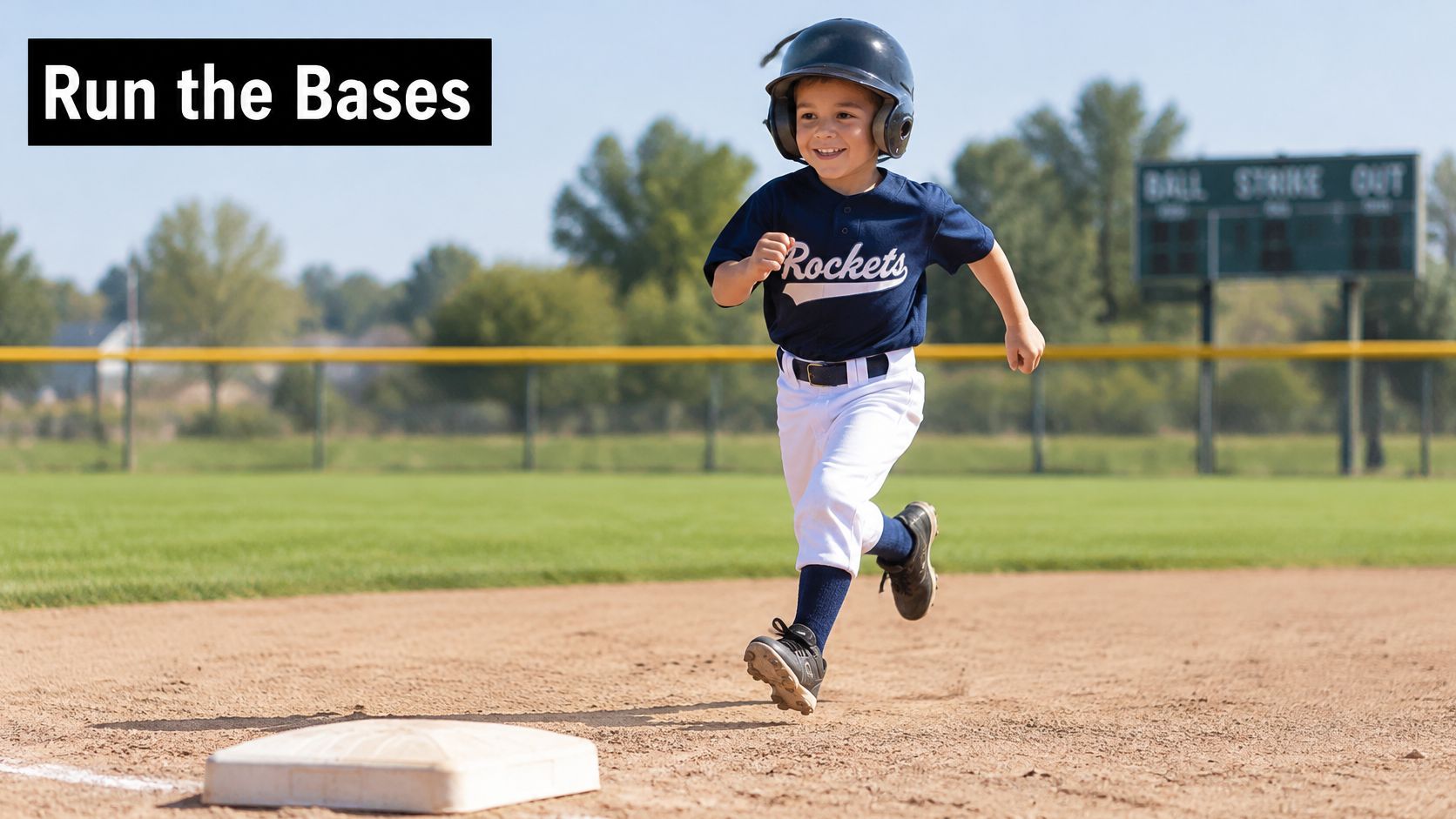
Colored bases make this station click. Two small teams line up at home, and each runner goes to first, rounds it, and stops. The route stays the same for everyone, so the child spends the rep learning where to go instead of asking.
Keep relay teams at four or five kids and run three or four runners at a time. Everyone runs every couple of minutes, and nobody stands in the outfield watching.
Running through the bag and touching every base is worth more practice than raw sprint speed at this age.
Bright cones or flat bases: A child who can see the target runs a straighter line.
Touch with a foot, not a lunge: Slow the last two steps down rather than diving.
Coach at second base: One adult standing there steers the whole relay without shouting.
Try a "beat your own time" round at the end. Each child runs the bases once while you time them, and the next week they race their own number rather than a teammate's. It keeps the station competitive without turning it into a tryout, and it shows you who's ready for the next step.
6. Freeze Tag Fielding Game
Mark a square with cones, put the kids inside it, and roll balls in from the edge. When a ball comes your way, field it and throw it back to the coach. Miss it and you freeze until a teammate brings you a ball.
That one rule does the teaching. Children field because a frozen friend is waiting, and they throw because that's how the game restarts. Explain it with a 30-second demonstration instead of a speech, then play.
Rules That Fit in One Breath
If the rules take longer to explain than the game takes to play, simplify. A missed ball freezes you, a teammate's throw unfreezes you, and everything stays inside the cones. Use soft balls and blow a whistle to reset when the energy tips into chaos.
Heat check: High-energy games are where heat sneaks up. KidsHealth's sports safety guidance puts fitted equipment, adult supervision, warm-ups, rest and sensible limits on training volume at the center of youth practice. For Houston summers that means building heat exposure gradually over roughly two weeks and stopping activity when heat and humidity turn dangerous.
Watch for dizziness, unusual fatigue, pain or a change in behavior, and pull the child out for water and shade rather than asking if they're okay.
7. Mini Scrimmage with Every Child Batting
End practice with a game that looks like baseball and plays like recess. Two small groups, one hitting from the tee, one fielding, and a rotation after three batters. Everyone bats in every inning, and nobody sits.
Go smaller than a full team. A 2-versus-2 setup, one child hitting from a tee, one fielding inside a marked cone gate, and teammates retrieving and rotating, gives every player far more touches than a nine-on-nine inning ever will. Award points for safe choices and good decisions, not just hits.
Every Child Bats, Every Inning
A study of early-childhood ball programs found that planned, play-based sessions improved overall motor competence, with reported gains of 7.1 to 10.3 percentile points in total motor competence and 17.2 to 21.0 points on aim-and-catch measures. Games do work that drills alone can't, because the child is solving a problem instead of repeating a motion.
Safety first: Helmets on every batter, on anyone in an on-deck area and on every base runner. When you introduce a catcher, that child needs headgear with a facemask and throat protection.
Try a hit-and-run round where the batter runs to a designated base after contact and the fielders make a controlled throw to a coach. Points go to the team that makes the right decision, and the scoreboard stays small.
7 T-Ball Practice Ideas at a Glance
Practice Idea | Primary Skill Taught | Best For | Energy Level |
|---|---|---|---|
Tee Hitting Stations | Swing mechanics | Toddlers and preschoolers learning basic swing mechanics | Moderate |
Ground Ball Roll-and-Field | Fielding fundamentals | Beginners learning to field ground balls | Moderate |
Bucket Throw | Throwing accuracy and arm strength | Younger players building throwing skills | Moderate |
Pop-Up Catch Drill | Ball tracking and catching | Developing confidence with high balls | Moderate |
Base Running Relay | Base order and running technique | Learning game flow and controlled running | High |
Freeze Tag Fielding Game | Fielding, throwing, and teamwork | Groups who benefit from active, playful practice | High |
Mini Scrimmage with Every Child Batting | Applying batting, fielding, throwing, and running skills | Connecting practice skills to game situations | High |
Build Your Practice Plan and Watch Skills Grow
The whistle blows and you have 45 minutes before pickup. Run the seven ideas as stations on a clock and the session plans itself. Keep every line to three children or fewer.
Start with five minutes of running to colored bases, arm circles, and high knees. Call "quick feet" so the jog stays light. Give tee stations eight minutes, five to eight swings per child, and cue "eyes on the ball, then step." For the next seven minutes, set roll-and-field on one side and bucket throws on the other, then swap the groups. Take five minutes for water in the shade. In July heat, that stop is required. Spend six minutes on pop-up catches with soft balls and tell them "watch it all the way in." Run the base relay for five minutes, freeze tag for four, and close with five minutes of mini scrimmage so every child bats.
Pack one bin for the whole season: a set of tees, a dozen soft safety balls, four flat bases, eight cones, two buckets or hoops, and a helmet for every batter. The gear should fit the child. An adult stays in charge of the field the whole time.
I would protect the tee block and the water stop first. If a station runs long, shorten freeze tag before you cut swings or shade.
Families in Humble, Kingwood, and Atascocita can find age-appropriate baseball and BlastBall at JC Sports Houston. Trained coaches lead the drills in an indoor facility for children 24 months and up. Request a free trial with your child's name, age, and favorite sport. Visit JC Sports Houston to see current programs and get started.
Comments