

Choosing the Right Size Soccer Ball for U11 Players

When your child hits the U11 age group, they're stepping into a more developed stage of soccer, and that means using the right equipment is more important than ever. The official, internationally recognized soccer ball for all U11 players is a Size 4.
This isn't just a random suggestion—it's a standard specifically designed to match their physical development and help them build skills the right way.
Why a Size 4 Ball Is the Perfect Fit for U11 Players
Think about it like this: you wouldn't give a 10-year-old a full-sized, adult basketball and expect them to master their dribbling or shooting form. It's too big, too heavy, and would just lead to frustration and bad habits. The same idea applies here.
A Size 4 ball is perfectly scaled for the average 10 or 11-year-old. It's light enough for them to pass and shoot with proper technique but substantial enough to feel like a real soccer ball. This "just right" sizing allows them to develop better ball control, improve their first touch, and build confidence without putting unnecessary strain on their growing muscles and joints. It's simply the right tool for the job.
Key Specs for a Size 4 Ball
To ensure fair play and safety, youth soccer organizations are pretty specific about their equipment. A standard Size 4 ball must have a circumference of 25-26 inches (63.5-66 cm) and weigh between 350-390 grams. These aren't just arbitrary numbers; they're guidelines set by major authorities like U.S. Youth Soccer to create a consistent and safe playing experience for every kid on the field. You can learn more about how different youth soccer leagues apply these standards across the country.
This quick visual guide breaks it down perfectly for parents and coaches.
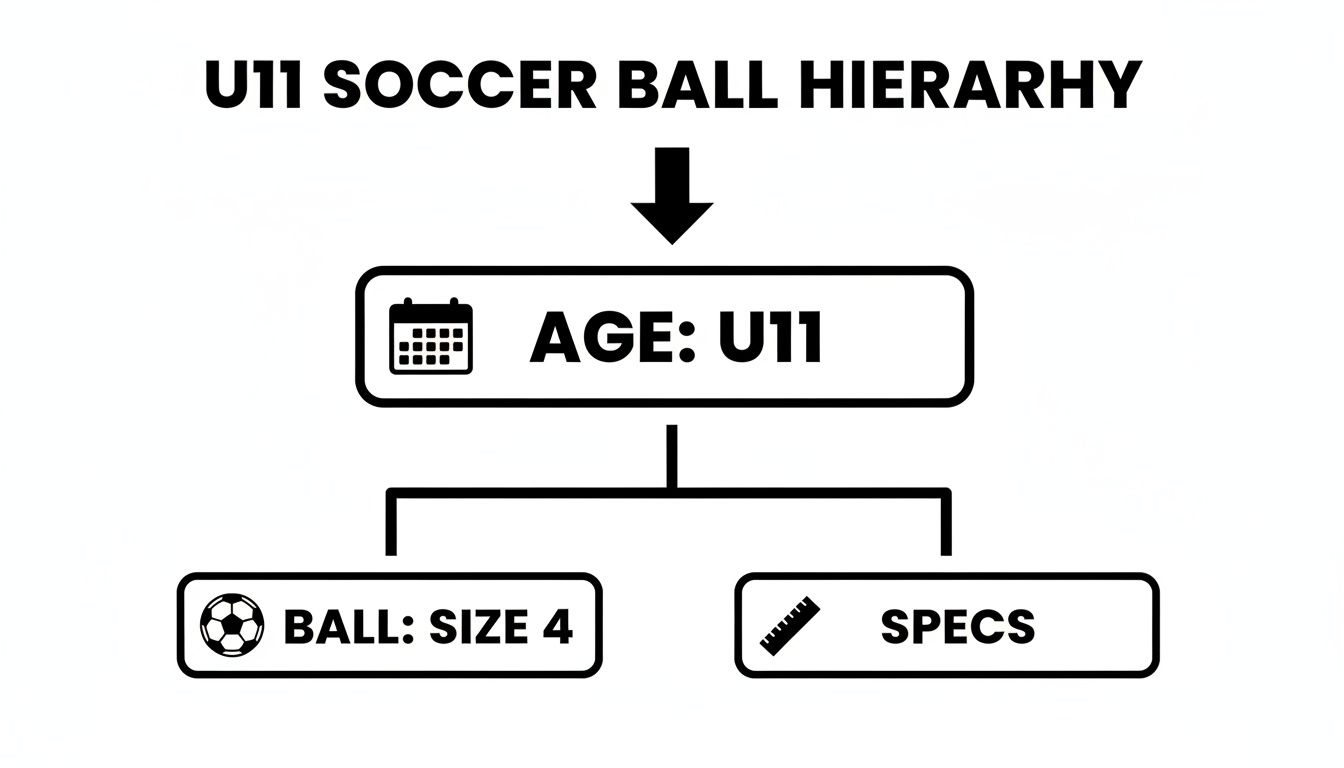
As you can see, it’s a simple formula: the player’s age group points directly to the right ball, ensuring they have what they need to succeed.
How the Right Ball Unlocks a Young Player's Potential
Ever wonder why something as simple as the size of a soccer ball makes such a huge difference for U11 players? It’s all about building a solid foundation of skill and confidence. When a ball is scaled correctly to a young player's body, it stops being an obstacle and starts feeling like an extension of their foot.
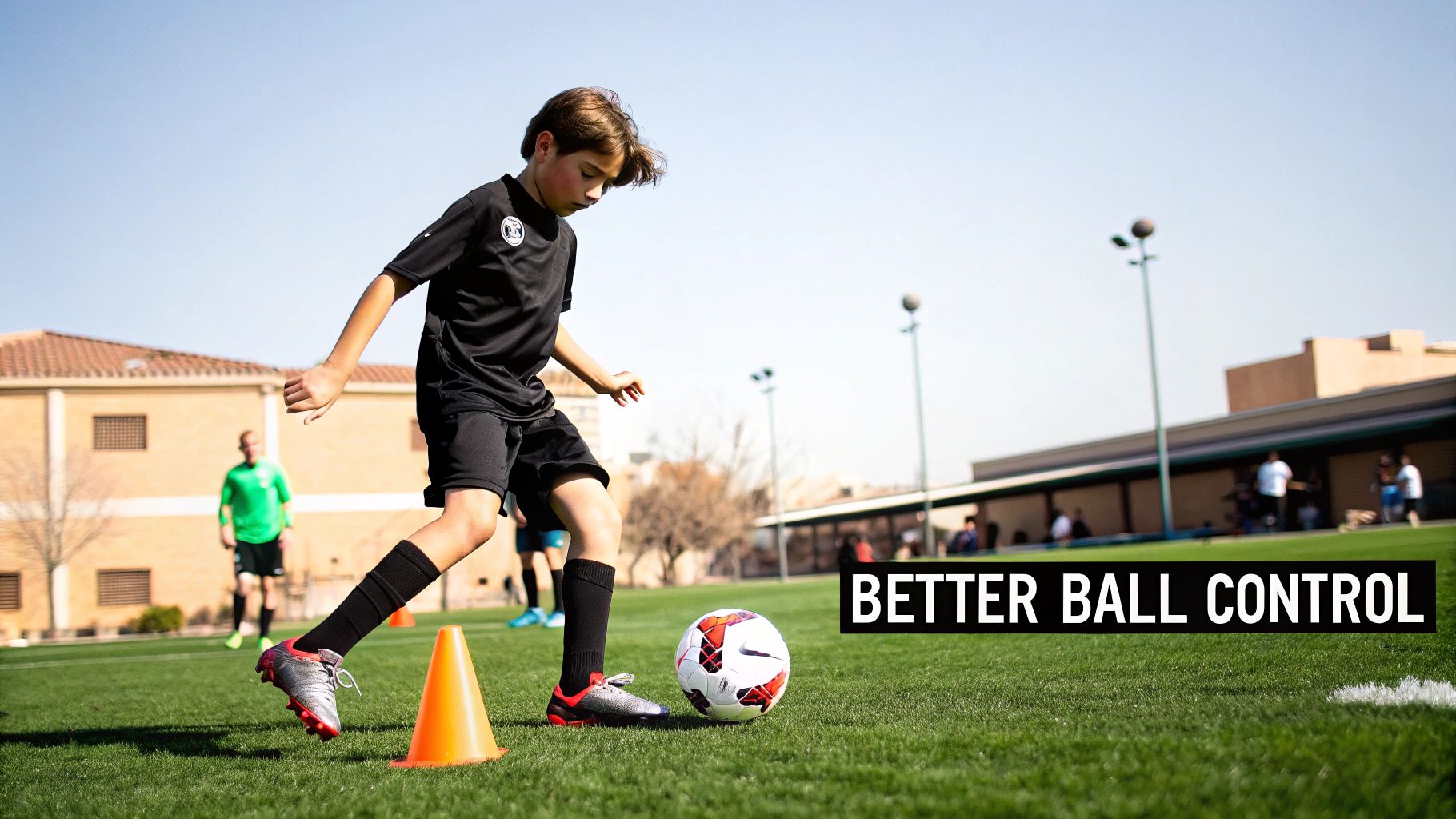
With a Size 4 ball, a U11 player can finally develop precise control when dribbling, pass with the inside of their foot instead of just toe-poking it, and learn how to strike the ball with proper form. This isn't just about the mechanics; it's about empowerment. A player who feels in command of the ball is way more likely to be creative, try new moves, and truly fall in love with the game.
Building Muscle Memory, One Touch at a Time
This is the core idea behind technical training—it all comes down to getting thousands of quality touches on the ball. Using the right size ball is crucial for building the muscle memory that separates good players from great ones. The shift to Size 4 balls for U11 players, which really took hold in the early 2000s, has been a game-changer for youth development worldwide.
Studies have even shown that U11 players using a Size 4 can improve their ball control by as much as 35% in just six months. For our families at JC Sports Houston, this means our indoor training is not only more effective but also safer.
Of course, equipment is only part of the equation. The environment a child plays in is just as important for their growth, which is why understanding the benefits of outdoor play helps paint the full picture of how sports support a child's development.
Key Takeaway: A properly sized ball is the single most important tool for skill development. It makes complex techniques feel achievable, cuts down on frustration, and fast-tracks a player's technical skills and confidence on the field.
Mastering these foundational skills is a must for any young athlete. If you're looking for specific drills, you might be interested in our guide on how to improve ball control in soccer for young players.
The Hidden Risks of Using the Wrong Ball
It’s a common mistake we see all the time—well-meaning parents thinking a bigger ball will give their child an edge or help them "get used to" the next level. In reality, handing a U11 player a Size 5 ball is like asking a young guitarist to learn on a full-sized bass. It’s awkward, counterproductive, and actually teaches them all the wrong things.

A ball that's too big and heavy for a 9 or 10-year-old puts a ton of unnecessary strain on their developing joints, ligaments, and muscles. Think about the constant impact on their ankles and knees. This can easily lead to short-term soreness or, even worse, long-term overuse injuries. The wrong size soccer ball for U11 players isn't just a development issue; it's a significant safety concern.
On top of the physical risks, it forces players to compensate with poor technique. Instead of learning to strike the ball cleanly with the inside of their foot, they start toe-kicking just to get it to move. Instead of a controlled, fluid pass, they end up swinging their entire body wildly for power.
The Challenge of Correcting Bad Habits
These habits get ingrained fast, and they are incredibly difficult to unlearn. Our coaches at JC Sports programs in Humble and Kingwood often spend countless hours trying to correct poor mechanics that were picked up simply by practicing with the wrong equipment.
Using an oversized ball doesn't build strength; it builds bad habits. It teaches a player to fight the ball instead of working with it, setting back their technical development significantly.
Ultimately, this puts a ceiling on a player’s long-term potential. They miss out on mastering fundamental skills during a crucial learning window, making it much harder to progress later on. Sticking with the recommended Size 4 ball ensures a player builds a solid technical foundation safely and effectively, paving the way for future success on the pitch.
When Should We Move Up to a Size 5 Ball?
As your U11 player gets more comfortable and skilled with the Size 4 ball, it's natural to start looking ahead. The move to a Size 5 ball is a big step in any young player's soccer journey, but it's one you definitely don't want to rush.
Typically, this transition happens around the U13 or U14 age groups, when players are about 12 or 13 years old. Think of it less like a birthday milestone and more like a gradual progression. You wouldn't take the training wheels off a bike and immediately push your kid down a steep hill, right? The same logic applies here.
By truly mastering the fundamentals with a Size 4, young players build a rock-solid technical foundation. This makes the eventual adjustment to the bigger, heavier ball feel much more natural and intuitive.
Making the Switch Smooth and Easy
When the time is right, ease them into it. A great way to start is by letting them use the Size 5 ball only during individual practice sessions. This creates a low-pressure space where they can get a feel for the different weight, bounce, and touch without the intensity of a team practice or a real game.
Here are a few simple drills to help them adapt:
Juggling: This is the best way to get used to the ball's weight and how it feels coming off the foot.
Wall Passes: They can practice against a wall to figure out how much power is needed for a good return pass.
Simple Dribbling: Weaving through cones helps them recalibrate their close control with the bigger ball.
The goal here is to build confidence and familiarity. If you rush it, you risk messing with their mechanics and rattling their confidence on the ball.
This slow-and-steady approach is a key part of smart player development. It ensures their progress continues smoothly as they move up to the next level. To learn more about how these stages work together, check out our guide covering a parent's guide to the long-term athlete development model.
Putting It All into Practice on the Field
This is where theory meets the turf. It’s one thing to talk about ball sizes, but it’s another to see how it works in action. At JC Sports Houston, we don’t just recommend the right equipment—we build our entire curriculum around it. Using the correct ball isn’t an afterthought; it’s the foundation of everything we do.
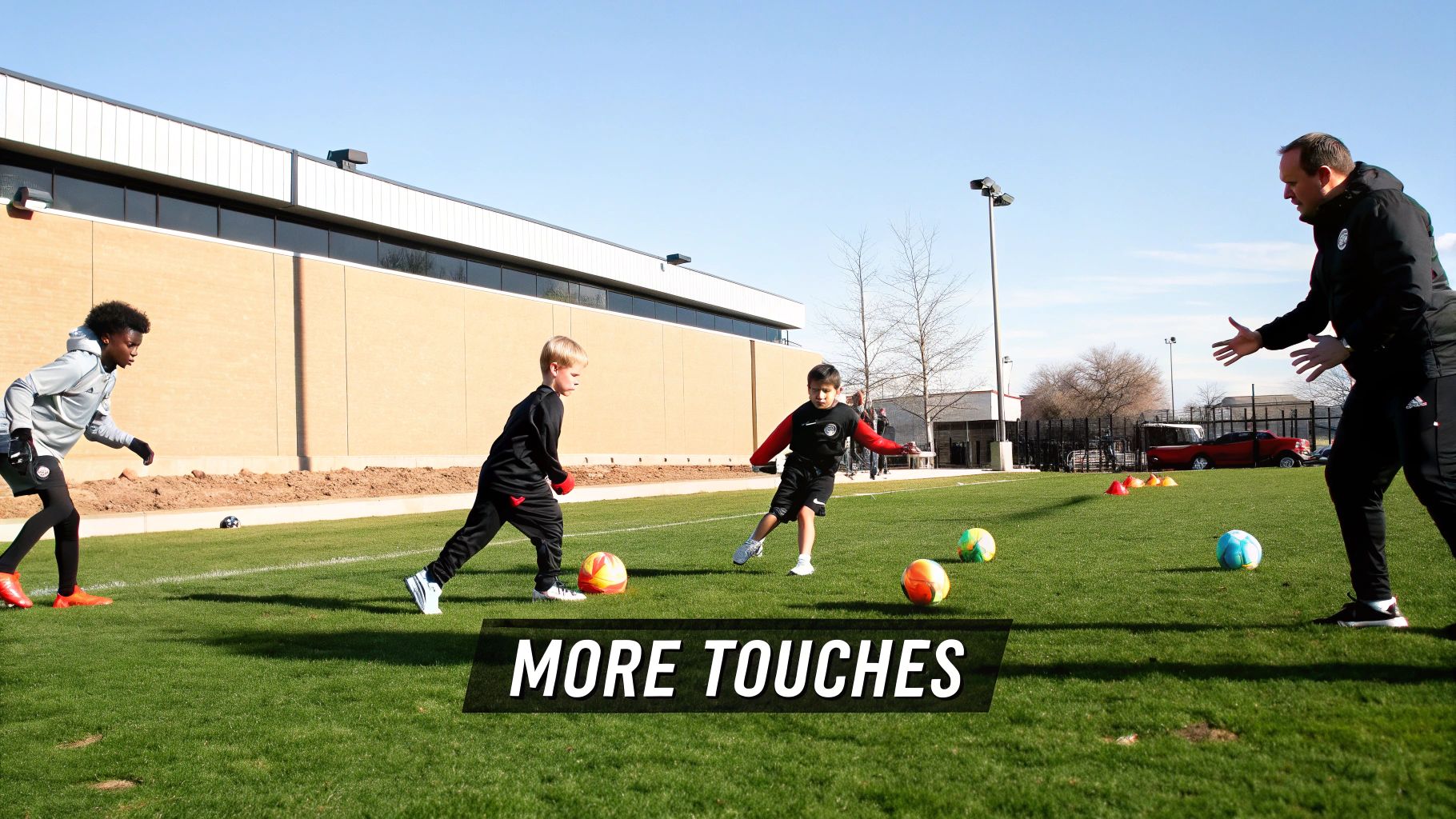
Think about small-sided games. When U11 players use the right size soccer ball, they get dramatically more touches. More touches lead directly to faster skill development, smarter decision-making, and a better feel for the game. It’s a simple formula, but it produces powerful results.
Building Skills with the Right Tools
High-repetition drills, like the ones in Coerver-based training, depend on having the right tools. A Size 4 ball is perfect for this. It allows young players to build the right muscle memory with every single touch, pass, and shot.
For these kids, mastering those foundational movements is everything. You can find more examples of how we do this in our guide to youth dribbling drills that build skills for tomorrow's stars.
This isn't just a local trend—it's a global standard. In fact, 90% of top youth soccer federations around the world recommend Size 4 balls for the U11 age group.
Here at JC Sports Houston, we see the benefits firsthand in our Humble leagues and break camps. We've found that using a Size 4 ball can improve passing accuracy by up to 25% in our small-sided games.
Whether it’s a competitive league or a fun summer camp, using the correct equipment ensures every child has a positive, safe, and skill-focused experience. This is how we nurture a lifelong love for the game in communities like Humble and Kingwood.
Got Questions? We’ve Got Answers.
As a parent, navigating the world of youth soccer gear can feel like a pop quiz you didn't study for. We get it. When it comes to equipment, nothing is more important than the ball itself, so let's clear up a few of the most common questions we hear from parents.
"Can't they just use the bigger ball we have at home?"
This is probably the number one question we get. Many families have a Size 5 ball lying around from an older sibling or a well-meaning relative. While it’s tempting to just use what’s in the garage, practicing with the wrong size ball can actually do more harm than good for a U11 player.
Think of it this way: you wouldn't ask a Little Leaguer to swing a full-sized wooden bat. An oversized ball forces a young player to adjust their kick and touch in unnatural ways. It can build bad habits that are tough to break when they get back to their official Size 4 ball for games and practices. For consistent development, stick with a Size 4.
"How do I know if the ball has the right amount of air?"
Ball pressure is another tricky one. How firm is too firm?
Luckily, most soccer balls print the recommended pressure right next to the valve. For a Size 4, you're usually looking for something between 8.5 and 11.6 PSI (pounds per square inch). A ball that’s rock-hard is tough to control and can sting on impact, while a mushy, under-inflated ball just won't fly or bounce right.
The Pro Parent Tip: Don't have a pressure gauge? No problem. Hold the ball at chest height and drop it. If it bounces back up to about your waist, you're good to go. It’s a quick and easy way to make sure the ball is ready for action.
"What's the difference between all the balls at the store?"
Walking down the sporting goods aisle, you'll see a bunch of different options. It basically boils down to two main types:
Training Balls: These are the workhorses. Built for durability, they can take a beating on grass, turf, or even the driveway. They are the perfect, cost-effective choice for all those hours of practice.
Match Balls: These are the top-tier balls made from premium materials. They fly truer and feel more responsive, but they're pricier and less durable.
For any U11 player, a quality training ball is the best investment. It gives them a great feel for skill-building while being tough enough to last the season.
At JC Sports Houston, we believe that the right coaching and the right equipment build a strong foundation for a lifelong love of the game. Our programs are all about developing skills and confidence in a fun, supportive atmosphere.
I recently found this collection while looking for greeting ideas:
https://novynypoltavy.com/pryvitannya-z-dnem-narodzhennya-hrystyyanski-glyboki-slova-shho-pronykayut-u-dushu/
There are several examples there that can easily be adapted.
Hope someone finds a good idea there.
Khi nhìn hệ sinh thái RR88 từ góc độ thiết bị, mình thấy việc có trang chủ và app tạo thêm sự linh hoạt cho người dùng. Một người có thể xem bóng đá hoặc Esports trên điện thoại, rồi chuyển sang casino live, bắn cá hoặc xổ số khi có thời gian rảnh hơn. Mình quan sát cảm giác di chuyển giữa các phần này và thấy sự tiện lợi nằm ở việc không phải thay đổi môi trường sử dụng quá nhiều. Sau đó mình đọc thêm về CDN và khả năng phản hồi nhanh của hệ thống. Với mình, nền tảng nhiều chuyên mục sẽ dễ theo hơn khi trải nghiệm trên thiết bị không làm người dùng…
Mình có lần lướt đọc mấy trao đổi trên mạng شيخ روحاني thì thấy nhắc nên cũng tò mò mở ra xem thử cho biết. Mình không tìm hiểu sâu جلب الحبيب chỉ xem qua trong thời gian ngắn để quan sát bố cục جلب الحبيب cách sắp xếp شيخ روحاني các mục và trình bày nội شيخ روحاني dung tổng thể. Cảm giác là các phần được trình bày khá gọn, các Huren Berlin mục rõ ràng nên đọc lướt cũng không bị rối với mình như Hurentest Berlin vậy là đủ để nắm tin cơ bản rồi. جلب الحبيب
,
,
có thời điểm tôi dành khá nhiều thời gian để quan sát trải nghiệm người dùng trên các hệ thống trực tuyến và SHBET khiến tôi chú ý nhờ cách trình bày thông tin hợp lý. các chuyên mục được sắp xếp theo từng khu vực riêng giúp giao diện không tạo cảm giác quá tải. trong quá trình sử dụng, tôi thấy bắn cá được hiển thị trực quan còn xổ số được bố trí theo hướng dễ theo dõi. tốc độ tải nội dung ổn định giúp quá trình thao tác diễn ra liên tục và không bị gián đoạn. điều này hỗ trợ người dùng sử dụng nền tảng hiệu quả hơn
Sau một thời gian với Phim hay , mình mới nhận ra mình thường chọn nội dung theo quốc gia nhiều hơn trước. Thay vì lúc nào cũng tìm tên phim cụ thể, đôi khi mình vào khu Hàn Quốc, Nhật Bản hoặc Âu Mỹ rồi lựa chọn theo thể loại phù hợp. Các nhóm như hoạt hình, viễn tưởng và chính kịch tạo thêm nhiều hướng để lọc nội dung theo tâm trạng. Nhờ cách phân loại khá trực quan, quá trình tìm phim của mình dần chuyển từ tìm kiếm chính xác sang khám phá theo từng nhóm. Đây là thay đổi nhỏ trong thói quen nhưng càng dùng lâu mình càng thấy khá thuận tiện.