

How to Improve Ball Control in Soccer for Young Players

If you want to improve ball control in soccer, it all boils down to one thing: consistent, focused repetition. The journey starts with mastering that all-important first touch, builds into confident dribbling with every part of the foot, and gets locked into muscle memory through high-repetition work like juggling.
Why Ball Control Is the Foundation of Great Soccer
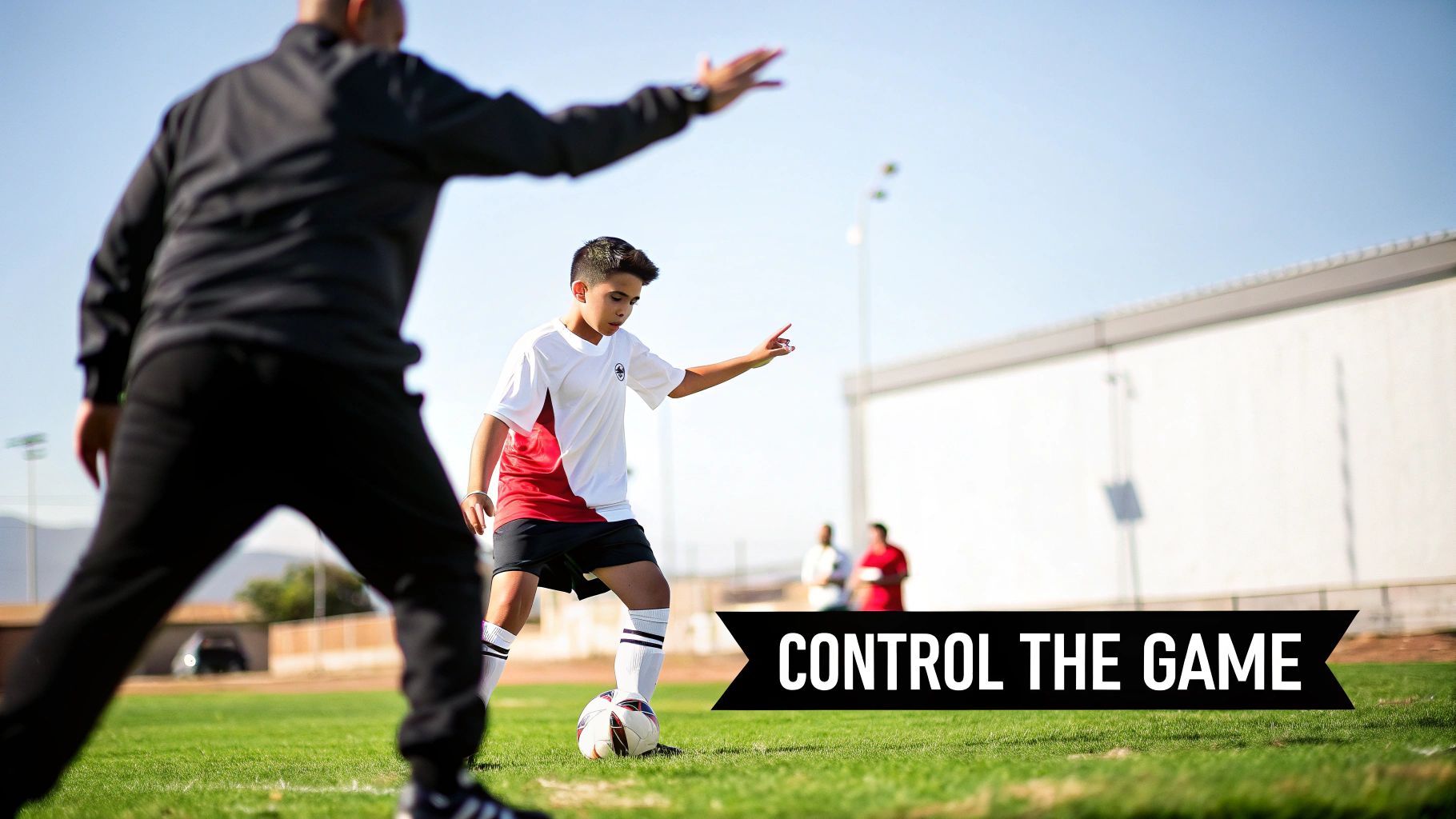
For any young player, strong ball control is the line between chasing the game and commanding it. It’s the single most important tool that unlocks every other skill on the field. Without the ability to confidently receive, protect, and move with the ball, even the most athletic player will hit a ceiling.
Think of it like the language of soccer. A player with great control can express themselves, make split-second decisions under pressure, and execute a pass or shot with precision. This mastery isn’t about flashy tricks; it’s about making the ball an extension of the body.
The Three Pillars of Ball Control
To really get to the heart of improving ball control, we have to zero in on its three core components. Each one builds on the last, creating a well-rounded and effective player who is comfortable with the ball at their feet.
First Touch: This is the skill of receiving a pass and instantly setting up the next action. A great first touch kills the ball's momentum and puts it exactly where you need it for a dribble, pass, or shot.
Dribbling: This is all about moving with the ball. It means changing speeds, switching directions, navigating tight spaces, and beating defenders—all while keeping the ball close.
Shielding: This is the art of using your body to protect the ball from an opponent. It's a non-negotiable skill for keeping possession under pressure and buying time for your teammates to get open.
"A great first touch is not about stopping the ball. It's about putting the ball exactly where you want to take your second touch."
Developing these skills takes thousands and thousands of touches. It’s how the critical mind-body connection gets built. Soccer is a perfect example of a kinesthetic learning style, where a player learns best through doing and feeling. Every touch, every dribble, every turn reinforces neural pathways until the movements become second nature.
Building Skills Through Modern Training
Modern coaching philosophies have moved past static drills. We now know that development happens best in dynamic, game-like situations. Methodologies like the Coerver Coaching program, which we’re proud to use at JC Sports Houston, are brilliant at breaking down complex moves into simple, repeatable steps. This approach ensures players build a powerful technical foundation in a fun, encouraging environment. You can read more about how Coerver-based training helps young athletes master these individual skills.
By focusing on these foundational pillars, young players don’t just learn what to do—they learn how and why. This deeper understanding transforms practice from a chore into a journey of discovery, fueling a genuine love for the game that lasts a lifetime.
Mastering the First Touch
A great first touch is a player's secret weapon. It’s what separates the good players from the great ones—that split-second ability to turn a simple pass into a genuine threat. It's the difference between reacting to the game and truly dictating its flow.
Think about it this way: a reactive first touch just stops the ball. A proactive first touch, on the other hand, directs the ball into open space, away from a defender, and perfectly sets up your next move, whether it's a dribble, pass, or shot. This is how players create time and space for themselves, even when none seems to exist.
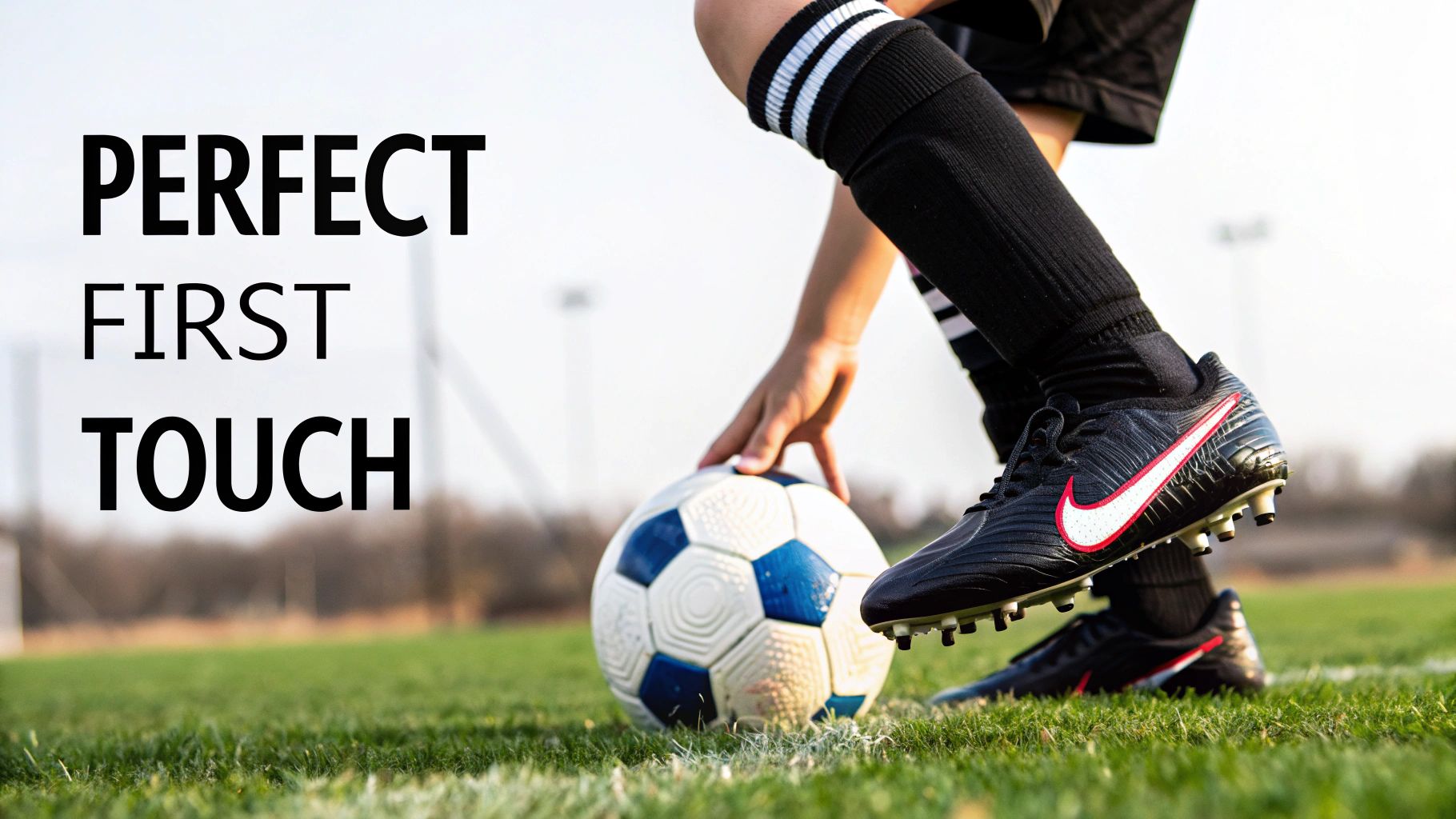
From Passive Receiving to Active Control
Mastering the first touch starts with a mental shift. Instead of just thinking, "I need to stop this ball," players should be asking, "Where do I want this ball to go?" It's a simple question, but it’s the foundation of a more intelligent, forward-thinking playing style.
To build this skill, we have to move beyond just passing against a wall. While that’s a fantastic starting point for repetition, the game is fluid. A great first touch rarely happens when you’re standing still. Players have to learn to control the ball while in motion and under pressure.
Here’s a practical drill we use to get players thinking one step ahead.
The "Receive and Turn" Drill
Set up two cones about 10 yards apart and have the player stand between them.
A partner (or a wall) passes the ball to the player.
As the ball travels, the player needs to take a quick look over their shoulder to scan for imaginary defenders or open space. This is a crucial habit to build.
Using the inside of their foot, the player's first touch should push the ball toward one of the cones, turning their body in the same motion.
They then dribble past the cone and pass back to their partner to repeat the process.
This drill ingrains the habit of opening up the body and directing the ball into space, not just stopping it dead at their feet.
Coaching Cues for a Better First Touch
For young players, simple, memorable cues are far more effective than long, complex instructions. Here are a few small, actionable tips we use in our training that kids can easily remember.
"Cushion the Ball": We tell players to think of their foot as a soft cushion. Instead of a hard kick at the ball, they should relax their ankle and let their foot absorb the ball's momentum. This stops it from bouncing away.
"Look Before You Get It": This is a constant reminder to scan the field before the ball arrives. A quick glance over the shoulder tells them where the pressure is and where the open space is, which informs their decision on where to take their first touch.
"Pick Your Spot": Challenge players to aim their first touch toward a specific target, like an open cone or a patch of grass. This turns a simple drill into a purposeful action.
You can tell a lot about a player from their first touch. A soft, controlled touch shows confidence and awareness. A panicked, hard touch often means they haven't assessed their options before the ball arrived.
Drills for Different Surfaces of the Foot
A truly versatile player can control the ball with any part of their foot, opening up more options in tight spaces. Here’s a simple progression for practicing with different surfaces.
Foot Surface | Drill Focus | Why It's Important |
|---|---|---|
Inside of Foot | Use it to receive and pass the ball across your body into a new direction. | Provides the largest surface area for control, making it ideal for accuracy and keeping possession. |
Outside of Foot | Great for a quick touch away from a closing defender. Practice touching it slightly forward and outside. | Allows a player to accelerate into space quickly without breaking stride. |
Laces (Top of Foot) | For controlling balls out of the air. Practice dropping a ball and "cushioning" it with the laces. | Essential for bringing down long passes or clearances with immediate control. |
By working on these focused drills and using simple coaching cues, young players can transform their first touch from a simple stop into a powerful tool. It’s all about making every touch count.
Developing Confident Dribbling Skills
Confident dribbling is what makes soccer so exciting. It’s not just about running with the ball—it’s the art of keeping it close, almost like it's tied to your foot with a string. This single skill is what allows a player to weave through tight spaces, take on defenders, and turn a defensive stop into a fast break.
True mastery comes when a player is comfortable using every part of both feet. A player who can use the inside, outside, and laces of their left and right foot is a nightmare for defenders. The goal is to make these movements so second-nature that they don't even have to look down, freeing them up to read the entire field.
Building Control with Cone Drills
Cones are a young player's best friend for a reason. They're the perfect tool for building the muscle memory needed for that silky-smooth close control. You can set them up anywhere, and they give instant feedback on a player's touch.
Instead of just running through them mindlessly, the focus should always be on the quality of each touch.
Here are three foundational cone drills we use all the time:
Slalom Dribbling: Set up a line of 5-6 cones, about two steps apart. Have your player weave through the cones using only the outside of their right foot on the way up and the outside of their left foot on the way back. This is fantastic for isolating specific foot surfaces and forcing those small, quick touches.
Gates: Scatter pairs of cones randomly in a small area to create several "gates." The challenge is to dribble through as many gates as possible in 30-60 seconds. This drill naturally encourages players to lift their heads to find the next target and change direction on the fly.
Figure-Eights: Place two cones about five yards apart. The player dribbles in a figure-eight pattern around them. This is all about tight turns and requires using both the inside and outside of the feet to navigate the ball smoothly.
A great dribbler doesn't just move the ball; they manipulate it. They use tiny, rapid touches in tight spots to keep it safe and then explode with a bigger touch into open space. It’s that change of pace that throws defenders completely off balance.
Key Coaching Points for Parents
You don’t need a coaching license to give your child great feedback. Focusing on a few simple cues can make a world of difference. When they're out there practicing, a few gentle reminders are all it takes.
Coaching Cue Checklist
Cue | What It Means | Why It Matters |
|---|---|---|
"Keep Your Head Up" | Encourage quick glances up between touches. | This builds field awareness, helping them spot teammates, defenders, and space. |
"Small Touches" | In traffic, the ball should never be more than a step away. | This is how you keep the ball protected and ready for the next move. |
"Bigger Touches" | When they see green grass, push the ball ahead. | This allows them to accelerate into open space and cover ground quickly. |
"Use Both Feet" | Remind them to switch feet during the drills. | This is crucial for becoming unpredictable and not having a "weak" side. |
It's so important to make these drills feel like a real game. Tell your child to imagine a defender is right on their back, forcing them to change direction and speed up suddenly. This little trick shifts practice from a boring chore into a fun, problem-solving challenge.
For a deeper dive, check out our complete guide on how to improve soccer dribbling for young players.
Applying Dribbling in Game-Like Scenarios
Once the mechanics start to click, it's time to put them to the test in more dynamic situations. This is where the real learning sticks.
A simple but incredibly effective game is "Dribble Tag." In a small grid, one person is "it" and tries to tag the others, but here’s the rule: everyone has to be dribbling a soccer ball the whole time. It forces players to keep their heads up, protect their ball, and change direction constantly—all the skills of a confident dribbler.
Another great one is the classic 1v1 to goal. Set up a small goal and have a parent or friend act as a defender (you don't even have to try that hard to start). The dribbler's only job is to use a move or a burst of speed to get past the defender and take a shot. This drill directly connects practice to the most thrilling moments in a real match. The key here is to celebrate the attempt, not just whether they score. Building the confidence to try to take on a player is just as important as the skill itself.
Building Muscle Memory with High-Repetition Drills
Confidence with the ball at your feet isn’t a gift—it’s built, one touch at a time. True ball mastery comes from high-repetition drills that hardwire the connection between a player’s brain and their feet until the movements become second nature. This is the secret sauce that makes complex skills look easy under the pressure of a real game.
The best part? You don't need a full squad or a fancy training facility to build this muscle memory. Some of the most powerful development happens when a player is just alone with a ball. A focused 10-15 minutes of daily practice with simple tools—like a few cones or even just a wall—can lead to massive gains over a season.
This diagram shows a simple progression of cone drills that isolate different parts of dribbling, moving from basic weaving to more dynamic, game-like movements.By working through each pattern, a player builds the footwork and close control needed to navigate tight spaces with confidence.
The Power of Juggling
If there's one exercise that does it all, it's juggling. It’s arguably the single best way to develop an intimate feel for the ball. Juggling teaches players how to apply the perfect amount of force, use different surfaces of their feet, and adjust their body to keep the ball alive. It’s a complete ball-control workout packed into one activity.
But here’s where a lot of young players get frustrated: they try to do too much, too soon. The key is breaking it down into small, achievable wins.
A Simple Juggling Progression
The Drop and Catch: Start simple. Hold the ball at waist height, drop it, let it bounce once, then pop it back up to your hands with your laces. Do this 10 times on your right foot, then 10 times on your left. The goal is a soft, controlled touch.
Two Touches: Once a single touch feels comfortable, go for two before catching. Drop, bounce, touch, touch, then catch. This starts building the rhythm you need for continuous juggling.
No Bounce: Now, it’s time to take the bounce away. Drop the ball and kick it straight back to your hands. Once that’s consistent, try for two juggles in a row, then three, and keep building.
The aim isn't to become a freestyle wizard overnight. It’s about getting hundreds of quality touches in a short amount of time. Setting a personal record and trying to beat it by just one every day is a fantastic way to stay motivated.
Make a Wall Your Best Training Partner
A wall is the most reliable teammate you'll ever have—it always passes the ball back. Wall work is perfect for sharpening first touch and passing accuracy through a high volume of repetition. It forces players to think fast, react quickly, and use both feet.
A wall doesn't lie. If you pass the ball with poor technique, it will come back awkwardly. If your pass is crisp and accurate, it will come back perfectly. It’s instant, honest feedback.
Here’s a simple routine that can be done just about anywhere you can find a solid surface.
A 10-Minute Wall Ball Routine
This quick session is all about developing a clean first touch and moving the ball quickly. Stand about 5-7 yards away from the wall.
Drill | Repetitions | Focus Point |
|---|---|---|
One-Touch Passing (Right) | 50 passes | Pass with the inside of your right foot. Focus on a firm, crisp return. |
One-Touch Passing (Left) | 50 passes | Repeat with your left. Stay light on your toes to adjust to the ball. |
Two-Touch Passing (Right) | 50 passes | Receive with your right, take a soft touch to control, then pass back. |
Two-Touch Passing (Left) | 50 passes | Repeat the two-touch pattern with your left. That control touch is everything. |
Alternate Feet (Two-Touch) | 50 passes | Pass right, control the return with your left, then pass back with your left. |
This whole sequence racks up 250 quality touches in a very short window. By making these high-repetition drills a habit, players build the muscle memory that translates directly to composure on the field. It’s this foundational work that lets them stop thinking about how to control the ball and start thinking about what to do with it next.
Putting It All Together in Small-Sided Games
Drills are fantastic for building technique, but small-sided games are where young athletes truly learn to play soccer. This is where the magic happens—where isolated skills like dribbling, first touch, and shielding merge into fluid, intelligent gameplay.
By shrinking the field and cutting down the number of players, you create the perfect pressure cooker for rapid development.
Think about a typical 11v11 game on a massive field. A young player might only get a handful of touches on the ball. It's easy to get lost in the crowd or just hang out on the wing, waiting for the game to come to you. But in a 3v3 or 4v4 game? There's nowhere to hide. The game finds you, constantly.
Why Less Is More for Skill Development
The beauty of small-sided soccer lies in its intensity and simplicity. It naturally forces players into situations that build confidence and composure under pressure. With fewer teammates and tighter spaces, every single player is involved in the action, making decisions and executing skills over and over again.
This philosophy is at the core of modern youth development, and it’s a huge part of our approach at JC Sports Houston. We want to create an environment where players are constantly solving problems.
For young players, small-sided games (3v3 to 5v5) can easily double or even triple their touches compared to a full-sided match. In fact, European talent development research shows these formats can boost individual ball contacts by 50–135%, along with huge increases in dribbling attempts and 1v1 duels. You can explore the research on small-sided game benefits to see the data for yourself.
Small-sided games are like a conversation with the ball. Instead of waiting for your turn to speak, you're in a constant, rapid-fire dialogue, forcing you to think and react faster with every touch.
This high-frequency engagement is how you really improve ball control. It’s the bridge between practicing a move alone and actually using it to beat a defender when it counts.
Setting Up Your Own Small-Sided Game
The best part? You don't need a perfectly lined field or official goals. A small patch of grass and a few cones are all it takes to get started.
Here are three simple game ideas you can set up with just a few friends:
1v1 to End Zones: Mark out a rectangle about 10 yards long by 5 yards wide. Instead of goals, create a 1-yard "end zone" at each end. To score, a player has to dribble the ball to a complete stop inside the opponent's zone. It's pure ball mastery and 1v1 dominance.
2v2 to Four Goals: Set up a small square field, maybe 15x15 yards, with a small cone goal on all four sides. Players can score on any goal. This forces them to keep their heads up, scan the field constantly, and learn how to switch the point of attack.
3v3 Possession Box: In a 20x20 yard grid, one team of three tries to connect a certain number of passes (say, five in a row) to score a point. The other team’s job is to win the ball back. This simple game is a masterclass in movement off the ball, communication, and keeping the ball under pressure.
These games are more than just fun—they are powerful teaching tools. They naturally replicate the chaotic, decision-making moments of a real match but in a concentrated, high-repetition format. This is how players learn to trust their technique and build the creative, confident mindset that defines a great soccer player.
How a Structured Program Takes Ball Control to the Next Level
Practicing at home is fantastic for building a solid foundation, but a structured training environment is where raw potential gets refined into real skill. This is where dedicated programs, like ours at JC Sports Houston, make a world of difference.
It’s about moving beyond just repeating drills and starting to understand the why behind every touch. Our approach, heavily inspired by the world-renowned Coerver method, provides a proven pathway for mastering individual skills. Instead of just running laps, players are in sessions meticulously designed to maximize their touches and decision-making moments in a challenging but supportive setting.
The Power of Expert Coaching
An experienced coach does so much more than show a player a new move. They see the tiny details—why a player’s first touch is getting away from them or how their balance is slightly off during a dribble. They provide that immediate, personalized feedback that can shave months off a player's learning curve.
A great coach creates an environment where players aren’t afraid to make mistakes. This freedom to experiment is where creativity and true ball mastery are born.
When our coaches design sessions where kids repeatedly receive the ball under light pressure and are challenged to play forward in just two or three touches, they're mirroring the same patterns used at the highest levels of soccer. This helps players internalize strong habits from a young age. You can even read up on the science behind these effective youth training patterns to see how it works.
Programs Designed for Targeted Growth
Structured training isn't one-size-fits-all. Different formats are designed to accelerate improvement by targeting a player's specific needs.
Private Sessions: Perfect for one-on-one attention to diagnose and fix specific technical flaws holding a player back.
Camps: Offer an immersive experience where players live and breathe soccer, leading to rapid skill gains over a short period.
Small-Group Training: Creates that competitive, game-like environment that pushes players to execute skills under pressure.
Of course, great training isn't just about what happens on the field; it also involves keeping an athlete’s body ready to perform. Learning about different athlete recovery strategies can support the consistency needed for high-level training.
Ultimately, the fastest way to unlock a player's full potential on the ball is by combining that dedicated individual work with expert-led group training. It’s the formula for success.
Answering Your Top Questions About Ball Control Training
As a coach and parent, I hear a lot of the same questions from families who are eager to help their young players improve. It's fantastic to see that level of support! Let's clear up a few of the most common ones to make sure your child’s time on the ball is both productive and fun.
How much practice is really needed?
This is easily the #1 question. The secret isn't long, grueling sessions. It’s all about consistency. A focused 15-20 minutes of daily, high-repetition work—think wall passes or juggling—is far more powerful than a single two-hour practice once a week. That’s how muscle memory is truly built without risking burnout.
When should they start structured training?
While kicking a ball around for fun can start as soon as they can walk, more structured skill development typically clicks around ages 6-7. At this stage, most kids have the coordination and attention span to really start grasping foundational techniques like dribbling and mastering their first touch.
What If My Child Gets Frustrated?
It’s going to happen. Frustration is a natural, and even necessary, part of learning something difficult. The trick is how you frame it. If a drill is causing tears, break it down into a smaller, more manageable piece. Celebrate the effort and the small wins, not just the perfect outcome.
Remember, the goal of youth soccer isn't just to create great players—it's to foster a lifelong love for the game. Keeping practice fun and positive is the most important coaching point of all.
Do we need all that expensive gear?
Absolutely not. To get started, all a child really needs is a ball and a bit of space. A brick wall can become their most reliable training partner for passing, and a few shoes or cones can instantly create an entire dribbling course. It’s about creativity, not cost.
For a deeper dive into supporting your young athlete, check out our parent's practical guide to improving overall soccer skills.
Ready to see how an expert-led, fun, and structured program can transform your child's confidence on the ball? At JC Sports Houston, we specialize in building skilled, creative players from the ground up.
Comments