

7 Drills for Tee Ball to Build Skills and Confidence

A tee-ball practice can lose its rhythm quickly. Children arrive eager to swing, run, and play, then spend too long waiting in line or become nervous when a ball moves toward them. Effective drills for tee ball solve that problem with short activities, frequent repetitions, safe equipment, and small-sided play. The progression below starts with confident contact and basic movement, then adds fielding, running, controlled movement, partner challenges, and game-like decisions.
Tee ball was deliberately created as a beginner-friendly introduction to baseball. Jerry Sacharski organized an early league game in Albion, Michigan, on June 25, 1956, and Little League now identifies Tee Ball as its entry-level division for players ages 4–7, as documented in the history of tee-ball. That age range calls for encouragement and movement, not long technical lectures. It also matches the small-group, progressive approach used by JC Sports Houston, where young players stay active while developing confidence and creative, well-rounded movement skills. Families who enjoy varied beginner activities can also explore these SoccerWares drills for beginners for ideas that transfer across sports.
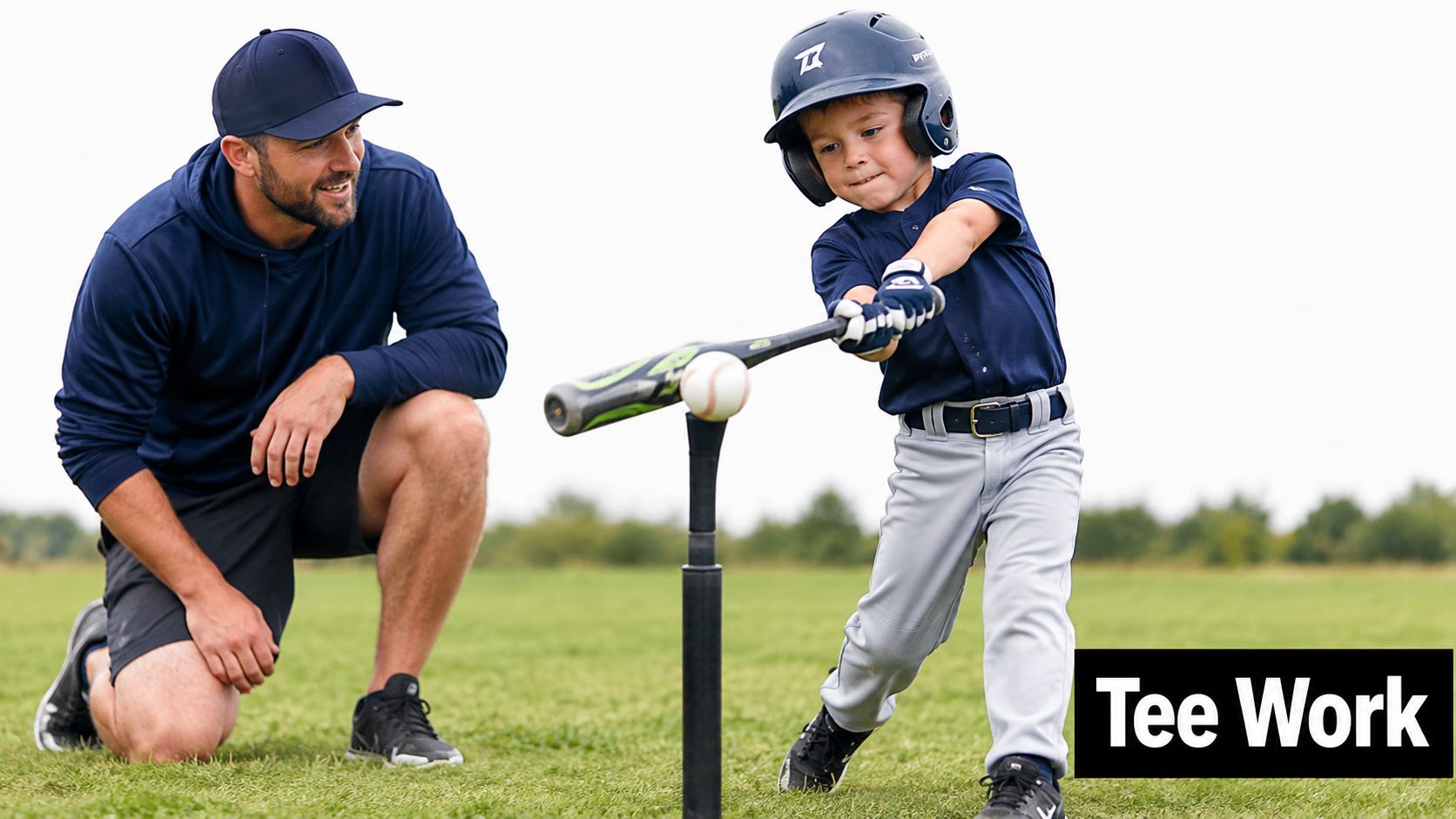
1. Tee Work and Contact Drills
Tee work gives a young player a predictable first success. The ball stays still, so the child can learn where to stand, how to hold the bat, and how to finish a balanced swing without worrying about a moving pitch. That makes it a strong starting point for ages 4–7, the entry-level age range identified by Little League's Tee Ball division.
Set the tee around the player's beltline or slightly below it. The ball should sit a little ahead of the body, allowing the hitter to make contact out front and complete the follow-through. Begin with middle-height pitches, then move the tee slightly higher, lower, inside, or outside as the child becomes comfortable. Use a safety ball or soft-core ball, and praise solid contact rather than how far the ball travels.
Make every turn active
Give each player a clear task while another child hits. One child can collect balls, another can place them in a bucket, and a third can point toward the target area. Cones can create simple targets, but don't turn every swing into a distance contest.
Little League recommends repeating a tee drill 10 times and describes a progression with a second tee placed about six inches higher behind the first to encourage a better swing path. Those figures and the positioning guidance come from Little League's tee drill instructions. Keep the cue simple: “See it, swing, finish.”
Practical rule: Celebrate a balanced swing and a brave attempt before you celebrate a long hit.
A parent can run this activity in a small space by placing a net or safe target several steps in front of the hitter. Rotate quickly, give each child a manageable number of swings, and stop while the group still wants another turn.
2. Soft Toss and Short-Distance Hitting
Once a child can make comfortable contact from a tee, add gentle movement. Soft toss introduces timing without creating the pressure of a pitched ball. The adult stands to the side and tosses underhand into a predictable hitting area, giving the child time to watch the ball from release to contact.
Start with a safety ball and a slow, repeatable toss. Say “ready” before the toss and “here it comes” as the ball leaves your hand. These words give the hitter a rhythm and help the child anticipate movement without guessing. Keep the tosses consistent at first. A poorly placed toss teaches the hitter to chase the ball, while a reliable toss builds confidence.
Progress one change at a time
Don't change speed, angle, and location together. After several comfortable contacts, alter only one feature. You might move from a central toss to a slightly inside toss, then return to the easier location before ending.
Useful progressions include:
Predictable tosses: Keep the release point and arc consistent while the child tracks the ball.
Small location changes: Move the ball slightly across the hitting area, but avoid forcing a reach.
Decision language: Ask the child to say “yes” after a swing or “not yet” when watching a toss.
Short rounds: Finish after the player has made several confident swings instead of waiting for fatigue.
A stationary tee remains valuable because it isolates swing mechanics from pitch variability, a point discussed in youth baseball coaching guidance. Soft toss should build on that foundation, not replace it. If the child begins swinging wildly or stepping away, return to the tee for a few repetitions.
For a real practice example, one parent can toss while another stands behind a net collecting balls. A second child can shadow the motion without a bat, tracking the release and calling out the cue. That keeps the group involved and reduces waiting.
3. Tee-Ball Station Rotations and Small-Sided Games
A line of children waiting for one hitter rarely produces a good practice. Station rotations solve the problem by dividing the group into small teams and giving each team a different task. While one group hits from a tee, another rolls ground balls, another practices throwing, and another runs between bases.
Mark each area with a cone, colored marker, or simple sign. Explain the order before practice begins, then use the same transition signal each time. Children don't need a complicated schedule. They need to know where to go, what to pick up, and what action starts the next activity.
Build a practice that moves
A useful station plan might look like this:
Contact station: Players hit safety balls from a tee toward a net or broad target.
Fielding station: A coach rolls gentle ground balls and receives two-hand returns.
Running station: Players move from home to first and back while following the base path.
Play station: Small groups respond to a simple hit, field, and run scenario.
The practice-planning dataset from Dugout Edge's review of youth practice plans includes 1,100+ real plans, with tee work appearing 796 times. The evidence points to tee work as a common foundation, but the practical lesson is broader. Coaches can use that foundation inside a larger practice instead of asking young players to repeat one activity for the whole session.
JC Sports Houston's small-group training approach reflects the same principle. Small groups let an instructor give clearer cues, create more repetitions, and adjust an activity without stopping everyone else.
End the rotation with a small-sided game. Use fewer players, a smaller playing area, and one simple objective, such as fielding a rolled ball and running to a cone. Children get to use the skill immediately, and coaches can reinforce effort with specific praise.
4. Base Running and Speed Drills
Base running teaches more than speed. Young players learn where to go, how to touch a base safely, and how to continue moving after contact. Start by walking the bases together. Point out the direction of travel, show the inside corner of each base, and let children practice the route before adding a race.
Use cones to create a visible path. At first, ask players to jog from home to first and stop under control. Then add second and third base. When they understand the route, introduce a relay in which each runner tags the next teammate.
Teach the turn before the sprint
A sharp turn can send a young runner off balance. Show a gentle “banana” turn around the base, where the player runs slightly wide and bends back toward the next base. Have the child walk the curve first, then jog it, then use it during a game-like run.
For more ideas about acceleration, foot placement, and playful movement, connect the activity with these speed training exercises from JC Sports Houston. The coaching cue should stay short: “Run through first.” For later bases, use “round the corner” rather than giving several instructions at once.
Try these variations:
Base path walk: Players walk and touch each base correctly.
Cone relay: Teams pass a ball or tag a teammate after completing the route.
Coach signal run: The coach calls “home,” “first,” or “stop,” and runners respond.
Decision run: A coach rolls a ball into fair territory, and the runner decides whether to continue after reaching a cone.
Don't rank children by raw speed. Praise safe turns, listening, and a strong effort to finish the route. Base running can also support standards-aligned PE units, especially when children practice direction changes, balance, and cooperation through play.
5. Fielding Fundamentals and Ground Ball Drills
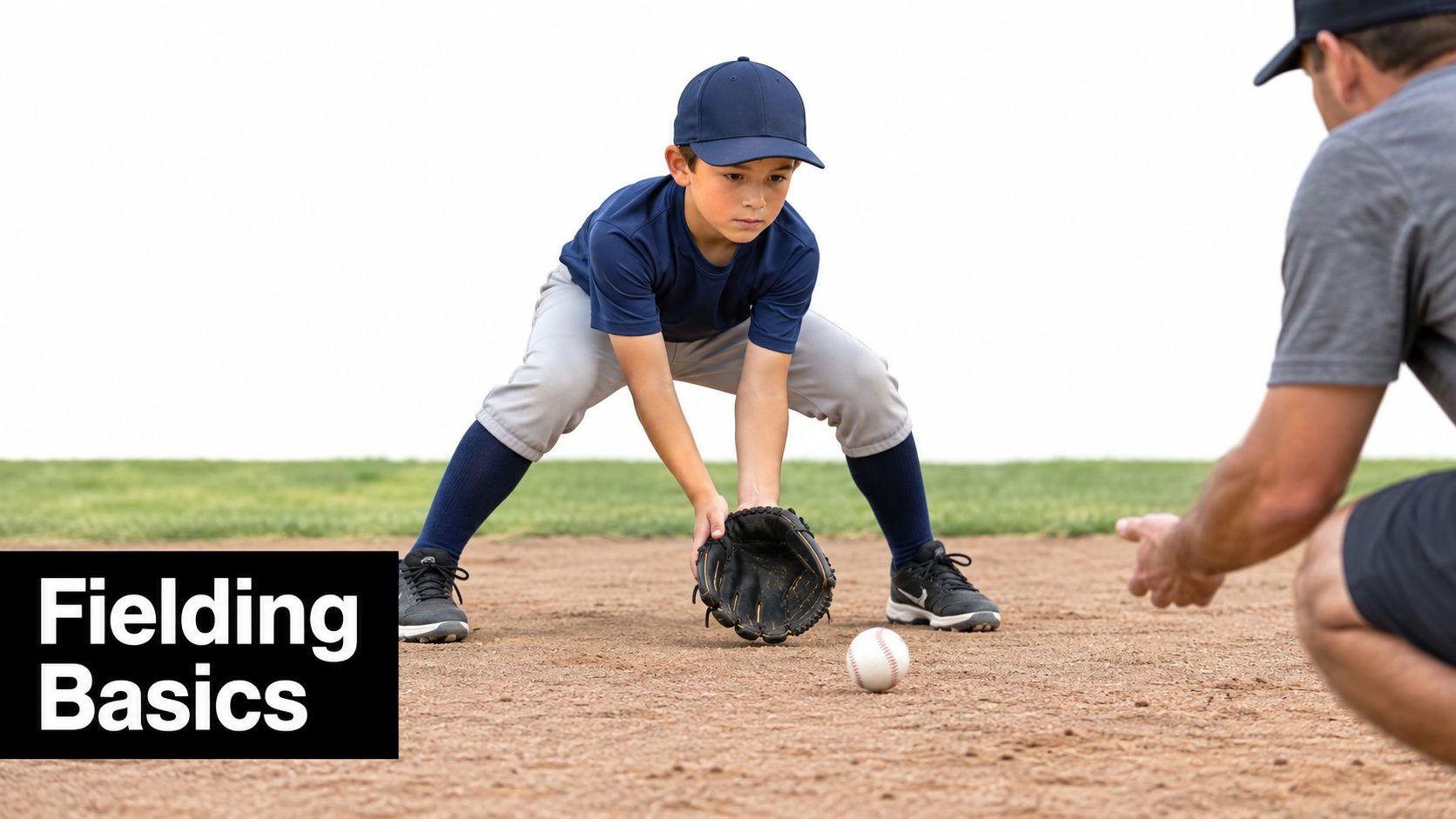
Fielding can feel intimidating when a ball arrives too quickly. Begin on the child's knees or with the coach seated several steps away, rolling a soft ball slowly across the ground. The player watches it into the glove, brings the other hand over the ball, and rolls or gently tosses it back.
Once that feels comfortable, teach the ready position. Feet should be apart, knees bent, glove open near the ground, and eyes on the ball. Demonstrate the position instead of explaining every joint. Say “low and ready,” then let the child copy you.
Move from stillness to movement
A simple sequence keeps the challenge manageable:
Roll the ball directly to the player.
Roll it slightly to the glove side.
Ask the player to take one step before fielding.
Add a target for the return throw.
Finish with a short game situation.
Use a safety ball or reduced-injury ball while children are learning. A parent can kneel and roll the ball, while a second adult stands behind the player as a safe target. Say “watch it in” rather than correcting several mechanical details at once.
The baseball training guidance for kids from JC Sports Houston connects beginner batting and fielding with age-appropriate repetition. That balance matters. A child who fields one ball successfully and wants another is learning more than a child who hears a long explanation but avoids the next attempt.
After the ground-ball work, invite players to freeze in their ready position, then return to movement. This makes the stance memorable and turns a technical cue into a game. Keep the tone light, and treat missed balls as information about the next progression rather than as failures.
6. Modified Tee-Ball Games With Continuous Play
Children need to use their skills in a game before those skills feel meaningful. A modified tee-ball game lets every player bat, run, and take a defensive position without placing the emphasis on strict scoring. The coach can keep the rules simple and guide players through each action.
Start by explaining three ideas: everyone bats, everyone plays, and the team works together. Put players in different positions during the game so they learn that baseball includes more than hitting. One child might start in the infield, move to the outfield, and later run the bases.
Keep the game easy to follow
Use a small field and a clear boundary. After a player hits from the tee, the runner follows the coach's signal. Fielders learn to move toward the ball, stop it, and return it to a designated adult or base. You can add a second runner only after the group understands the first routine.
A continuous-play format works particularly well for early tee ball because it values participation over elimination. The coach can call out positive decisions, such as moving toward a ground ball or looking for the next base. Parents should hear the same message from the sideline. Loud instructions from several adults can overwhelm a young player, so agree on a few shared cues before the game begins.
Keep the game short enough that children still have energy for the final activity. If attention drops, replace innings with quick rounds. One round might give every child a turn to hit, another might focus on fielding, and a third might include a base-running decision.
The coach's role is to make the next action obvious. Point to the base, name the fielder, and celebrate the attempt. Traditional rules can come later. Early games should help children connect a swing with movement, fielding, teamwork, and enjoyment.
7. Partner and Peer-Teaching Drills With Progressive Challenges
Partner work gives children more touches and more chances to communicate. Pair two players with a soft ball and begin with an easy task, such as rolling the ball back and forth from a short distance. One child fields with two hands, then gently returns the ball. The partners switch roles after each turn.
Choose pairs thoughtfully. Similar confidence levels can make the first round comfortable, while mixed ability pairs can work well when the more experienced child understands that encouragement matters more than speed. Demonstrate the activity, show where each player stands, and give partners one sentence to use: “Ready?” before the roll and “Nice try” after it.
Add challenges without adding confusion
Build the progression gradually:
Roll and return: Partners field and roll the ball back.
Gentle toss: Partners use an underhand toss that reaches the chest or waist area.
Target throw: One player throws toward a cone or bucket while the other retrieves.
Move and receive: The receiver takes one step left or right before catching.
Partner challenge: The pair tries to complete a clean sequence while supporting each other.
Give feedback rules that children can remember. Ask each partner to name one thing that went well and one action to try next. Keep the language positive and specific, such as “You kept your glove low” or “Try pointing your front shoulder at the target.”
Peer work also shows coaches where individual support is needed. Circulate instead of stopping the whole group. One pair might need help with catching, while another is ready for a moving challenge. Leave time for water and brief social conversation between rounds. That break helps young players reset and makes the session feel like a shared activity rather than a test.
7 Tee-Ball Drills Comparison
Drill/Activity | Implementation Complexity 🔄 | Resource Requirements ⚡ | Expected Outcomes 📊 | Ideal Use Cases | Key Advantages & Tip ⭐💡 |
|---|---|---|---|---|---|
Tee Work and Contact Drills | Very low, single-station, simple setup | Minimal, tee, bat, soft balls | Solid swing mechanics, bat control, high success rate | Beginner players (ages 4–6), individual repetition work | Builds motor patterns and confidence, start at chest height; 10–15 swings per turn |
Soft Toss and Short-Distance Hitting | Low–medium, coach-controlled tosses needed | Coach/volunteer, safety balls, short space | Improved timing, early pitch recognition, transition skills | Bridge between tee work and live pitching (ages 5–7) | Controlled moving-ball practice, begin very slow tosses and increase speed |
T-Ball Station Rotations & Small-Sided Games | Medium, multiple stations and rotation management | Multiple coaches/volunteers, cones, varied equipment | Comprehensive skill development, high engagement per session | Team practices, small-group training, mixed-ability sessions | Maximizes reps and attention, use 15–20 min cycles and clear station signals |
Base Running and Speed Drills | Low–medium, field organization and supervision | Field/space, cones/markers, optional timers | Better footwork, acceleration, base awareness | Teaching base mechanics, conditioning, game-situation work (ages 4–7) | Emphasize technique before speed, start walking bases then progress to relays |
Fielding Fundamentals & Ground Ball Drills | Low–medium, progressive difficulty, coach feedback | Gloves, soft-core balls, coach oversight | Improved glove work, footwork, throwing accuracy | Defensive foundations for young players (ages 4–7) | Use soft balls and teach ready position first; keep drills varied and short |
Modified T-Ball Games (Continuous Play) | Medium, rule modification and game flow management | Field, coaches, basic equipment; clear parent communication | High participation, many repetitions, teamwork | First-season tee-ball, inclusion-focused leagues (ages 4–6) | Prioritize fun and rotation, explain rules to parents and cap game time (45–60 min) |
Partner & Peer-Teaching Drills | Medium, pairing strategy and clear instructions required | Minimal equipment, coaches to circulate | Social skills, communication, observational learning plus skill practice | Small-group sessions, multi-sport classes, engagement-focused training | Pair strategically and demo clearly, rotate partners and use simple scoring/challenges |
Turn Repetitions Into Real Play
The most effective tee-ball practice doesn't chase advanced mechanics too soon. It builds a chain of small successes. Begin with tee contact, add gentle ground balls and basic throwing, teach the base path, introduce soft toss when the child is ready, and finish with partner challenges or a continuous-play game.
Use the same progression across a station rotation, but adjust the challenge for each player. One child may need a larger target and a slower roll. Another may be ready to move after fielding or track a soft toss from a new angle. Development isn't identical for every child, so coaches should change the task before they overload the instruction.
Tee ball has a broad participation base, with the Tee Ball USA overview describing play across every U.S. state and territory and internationally, alongside an estimated 2.2 million players. The same source lists participation as 65% boys and 35% girls, making beginner-friendly coaching important for a large and varied group of children. The practical response is not more complexity. It's more chances to move, try, recover, and try again.
Keep equipment age appropriate. Use soft or reduced-injury balls, clear boundaries, and safe distances between stations. Rotate children often, give short cues, and praise effort, decision-making, teamwork, and willingness to try. A child who chooses to move toward a ball, runs the correct base path, or encourages a partner is developing as an athlete and teammate.
For families in Humble, Kingwood, Atascocita, and nearby Houston communities, JC Sports Houston offers age-appropriate baseball activities alongside multi-sport classes, seasonal leagues, camps, and beginner-friendly programs. Its small-sided, progressive approach gives children room to build motor skills and confidence while enjoying the game. Parents can ask about a free trial and observe whether the coaching style fits their child.
JC Sports Houston provides age-appropriate youth sports programs, including baseball training and beginner-friendly league opportunities that use small-group play and progressive instruction. Visit JC Sports Houston to explore available programs and request a free trial for your child.
Comments