

Sport Classes for Toddlers: A Parent's Guide for Houston

Your 3-year-old is standing in a Houston gym with one shoe untied, watching a bright cone as if it's a brand-new invention. The coach rolls a soft ball across the floor. Your child watches it pass, takes two uncertain steps, then tries to chase it. That small attempt is the true starting point, not a perfect kick or a future team roster.
Parents in Humble, Kingwood, Atascocita, and nearby Houston communities often look for sport classes for toddlers because daily movement is hard to organize around preschool, commutes, screens, rain, and punishing summer heat. A structured class gives children a predictable reason to run, balance, throw, and interact with other children, while still leaving room for backyard play and unstructured movement.
The right class isn't a miniature competitive program. It's a movement accumulator, one useful part of a child's active day. Major early-childhood guidance recommends at least 180 minutes of physical activity daily for children ages 1–2, spread across the day and including lighter movement as well as more energetic play, as described in early-childhood physical activity guidance. A Houston class can help families build that rhythm when outdoor play feels unrealistic.
Why Houston Parents Are Searching for Toddler Sport Classes
A toddler class often begins with separation, not sport. The child clings to a parent's leg, studies the other families, and refuses the first invitation to join. A patient coach doesn't force participation. They kneel down, offer a ribbon or ball, and let the child watch until curiosity wins.
That scene is familiar to Houston parents who want screen-free, guided movement without turning every afternoon into a negotiation. Heat can make outdoor activity difficult, and busy family schedules can leave little space for an organized routine. A well-designed indoor class offers a practical setting where children can move safely, interact socially, and try activities that may be difficult to arrange at home.
Parents also want support with early motor development. They aren't necessarily chasing athletic performance. They want their child to become more comfortable running, jumping, balancing, handling objects, following simple directions, and joining a group. Those skills support everyday independence and make later playground, preschool, and recreational activities less intimidating.
Practical rule: Choose a class that adds movement to your child's week. It shouldn't replace free play, family walks, playground time, or active games at home.
A useful local starting point is this guide to sports activities for 2-year-olds, especially if you're unsure whether your child is ready to join a group. The best program will show you what a toddler can do today, then offer a gentle next step instead of demanding attention, accuracy, or enthusiasm immediately.
What a Toddler Sport Class Includes
Sport classes for toddlers are guided group sessions that use sports equipment and playful challenges to develop basic movement skills. A child might roll a ball, cross a low balance surface, chase a scarf, jump over a line, or aim at a target. Activities should change often. Toddlers need repeated practice, but long technical drills lose their attention and limit participation.
Classes may serve young toddlers through preschoolers, yet the coach should adjust activities to developmental ability. A new runner needs different equipment, instructions, and expectations from a confident preschooler who can catch, kick, or follow a short sequence of directions. Ask how the program handles mixed ages before booking.
What the class should include
A well-run session has a clear opening, several short activity blocks, and a calm finish. The coach might begin with a song, animal walks, or parachute play. Children then rotate through throwing, jumping, balance, kicking, and chasing activities before joining a simple group game.
The format can change from week to week. The standard should remain short instructions, quick turns, frequent movement, and repeated practice. Guidance for toddlers used by early-childhood programs recommends structured adult-led activity alongside unstructured active play (structured movement guidance for toddlers). A class supports that wider daily pattern. It should add movement to family play, outdoor time, and other active routines, not replace them.
What it isn't
A toddler class is not a scrimmage with winners and losers. Scoreboards, tryouts, rankings, formal positions, and scaled-down versions of older children's team practice have no place here. Coaches can introduce sports by turning their basic skills into playful challenges.
At JC Sports Houston, children may try soccer, basketball, and gymnastics-style movement in a rotating format. Variety keeps participation open. One child may avoid kicking but enjoy crawling through an obstacle, while another skips the balance station and focuses on rolling passes.
The goal is motor confidence and movement vocabulary. A class should help children collect useful movement experiences, not prove that they belong to one sport. પસંદ
Age-Appropriate Benefits Parents Can Expect
A good toddler class should build a daily movement habit, not start a competitive pipeline. Parents should see repeated chances to practise useful movements, then notice those skills appearing at home, on the playground, and during ordinary routines. A child may first walk around a low beam with help and later cross it independently. Another may miss a large, soft ball repeatedly before learning to place both hands in front of the body.
Research supports this approach. A systematic review of 30 childcare and kindergarten trials involving 6,126 preschoolers found improvements in overall motor proficiency, locomotor skills, and object-control skills, with effects ranging from small to large (systematic review of fundamental movement skill programs). The practical lesson is simple: coached repetition helps, but children should not be forced to reach the same movement milestone on the same timetable.
The milestones worth watching
Watch for changes that transfer beyond the gym. Your child might briefly hop on one foot, pedal a tricycle more smoothly, catch a beach ball against the body, or jump with both feet leaving the floor. Balance may show up as walking across a low beam, standing momentarily on one foot, or stepping over an obstacle without grabbing an adult.
Coordination grows through ordinary equipment tasks. A child may roll a ball toward a target, dribble with a foot, carry an object while walking, or alternate feet during a basic movement pattern. These are early building blocks, not polished sports skills. Coaches should praise controlled attempts and keep the task achievable enough for the child to try again.
Social progress deserves equal attention. Toddlers gradually move from playing beside others toward short periods of cooperative play. They learn to wait, accept a turn, high-five a classmate, recover after missing a shot, and return to a station after initially refusing it. Those behaviours help a class run well and make active play easier at home.
Domain | Benefit | Milestone to watch for |
|---|---|---|
Gross motor | Running, jumping, hopping, and climbing practice | Your child jumps, pedals, or changes direction with greater control |
Coordination | Combining balance with object handling | Your child rolls, kicks, catches, or carries an object more deliberately |
Confidence | Trying unfamiliar tasks with coach support | Your child raises a hand, returns to a station, or asks to try again |
Listening | Responding to short instructions and transitions | Your child stops, watches, and follows a simple movement cue |
Social development | Turn-taking and cooperative play | Your child waits briefly, celebrates another child, or rejoins after frustration |
Use class time as one part of the week. A practical preschool physical development guide can help you turn ordinary home space into a place for climbing, balancing, throwing, and movement games.
The parenting benefit is a predictable structure for encouraging effort. You can say, “you kept trying,” “you waited for your turn,” or “you found another way,” instead of making every conversation about winning. A weekly class also gives your family a visible movement dose that complements active play at home, outdoor time, and other daily routines.
Inside a Multi-Sport Class at JC Sports Houston
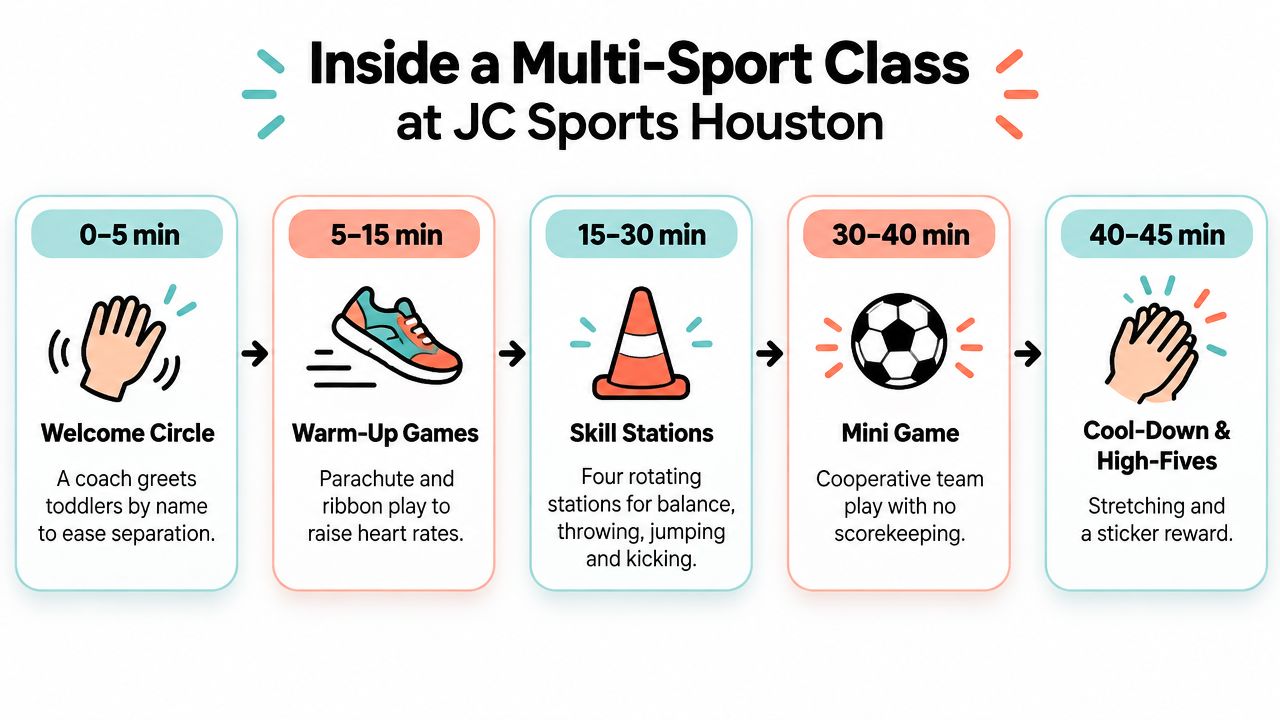
A good toddler session has a clear rhythm. Children know what comes next, yet each activity ends before attention fades. At JC Sports Houston, that can mean a welcome, warm-up games, sport-themed movement, and a cooperative finish. The purpose is to add another reliable dose of daily movement, not to start a competitive pipeline.
The opening rhythm
The first minutes help children settle. Coaches greet them by name, gather the group, and use animal walks or simple stretches to wake up the body. A hesitant child can watch, join gradually, and avoid immediate performance pressure.
Soccer-inspired movement comes next. Children dribble around cones, chase a ball, or roll it back to the coach. The coach demonstrates clearly, keeps equipment close, and gives children repeated turns. Long lines have no place in a toddler class.
Basketball follows with junior-sized balls and lowered targets. A toddler may carry, bounce, roll, or toss the ball instead of dribbling it cleanly. The coach keeps the movement goal while adjusting the task to the child's current ability.
The equipment and supervision
The room should make movement easy and reduce avoidable hazards. Padded flooring, soft foam balls, low-impact equipment, and toddler-sized objects let children explore without struggling with gear built for older players.
Class size affects how much coaching each child receives. JC Sports Houston describes a maximum eight-to-one coach-to-child ratio for its toddler setting. That gives the coach time to offer turns, redirect behavior, and simplify a task when needed. Parents generally stay on the sideline and step in when separation support is necessary, allowing children to practise independence while keeping a familiar adult nearby.
The closing block can use parachute play, free movement, and a short huddle. A definite ending helps children leave calmly instead of drifting away during a busy transition.
Coach's standard: Fundamental movement patterns come first. Sport names provide the theme, while running, jumping, balancing, throwing, and kicking build the base.
JC Sports Houston schedules repeated sessions of about 30–45 minutes, held at least twice weekly, because consistency matters more than forcing every activity into one tiring visit. Families should treat class as one movement opportunity among the week's active play, outdoor time, and everyday routines. A toddler does not need to master a sport. They need regular chances to move, try, and return.
How to Choose the Right Program for Your Child
Visit the gym before you commit. Watch the first few minutes, listen to how coaches speak, and notice whether the room feels organized or frantic. Toddlers don't need a polished performance environment. They need safe boundaries, attentive adults, and enough freedom to attempt movement without embarrassment.
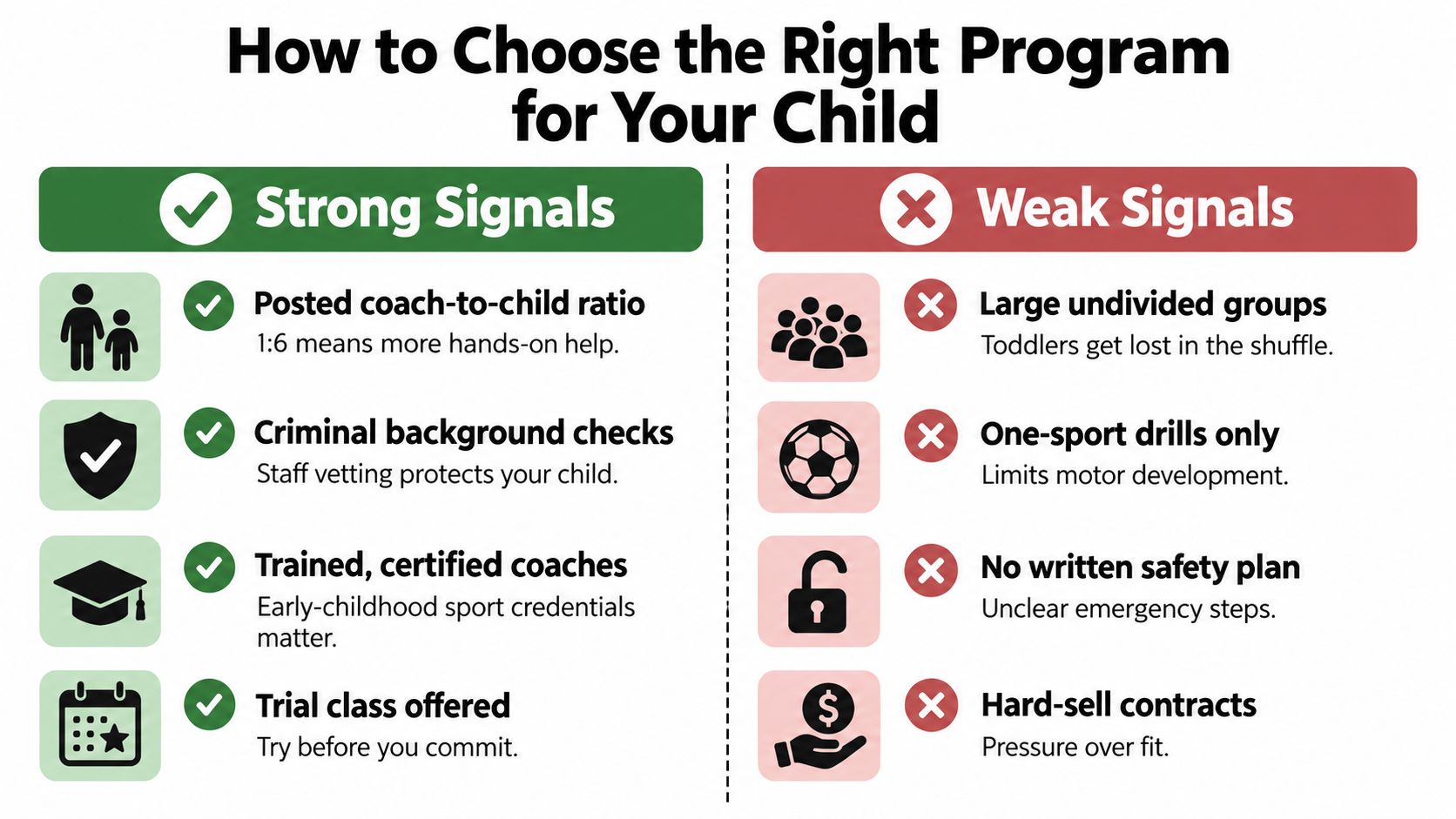
Strong signals
A credible program makes important information easy to find. Look for a written coach-to-child ratio, age-grouped classes, clear safety procedures, and a curriculum that identifies motor-skill goals instead of promising only that children will “have fun.”
Use this trial-class checklist:
Safety surfaces: Check for padded or appropriately protective flooring, clear walkways, and equipment stored away from running paths.
Equipment sizing: Look for soft balls, low targets, short obstacles, and gear small hands can control.
Class size caps: Ask how many children can enroll and whether the stated ratio applies to every session.
Coach qualifications: Confirm that coaches receive pediatric CPR and safety training, along with preparation for early-childhood instruction.
Behavior guidance: Watch whether coaches speak at eye level and redirect children calmly, without raised voices or humiliation.
Inclusion: Ask how the class supports a shy child, a child who stays close to a parent, or an energetic child who needs extra movement.
Trial policy: A trial gives your family a chance to judge fit before registration.
Weak signals
Be cautious if the program emphasizes rankings, team status, or competition for children who are still learning how to join a group. Other warning signs include large mixed-age sessions, straight-line drills with little playful variation, parents being excluded without a clear safety reason, hidden fees, hard-sell contracts, or no opportunity to observe the class.
The best first visit feels calm, structured, and welcoming. Your child may still refuse the parachute or hide behind your knees. That isn't a failure. What matters is whether the coach understands the behavior and creates a safe path toward participation.
Why Multi-Sport Sampling Beats Early Specialization
Toddlers don't need to choose a sport. They need to collect movement experiences.
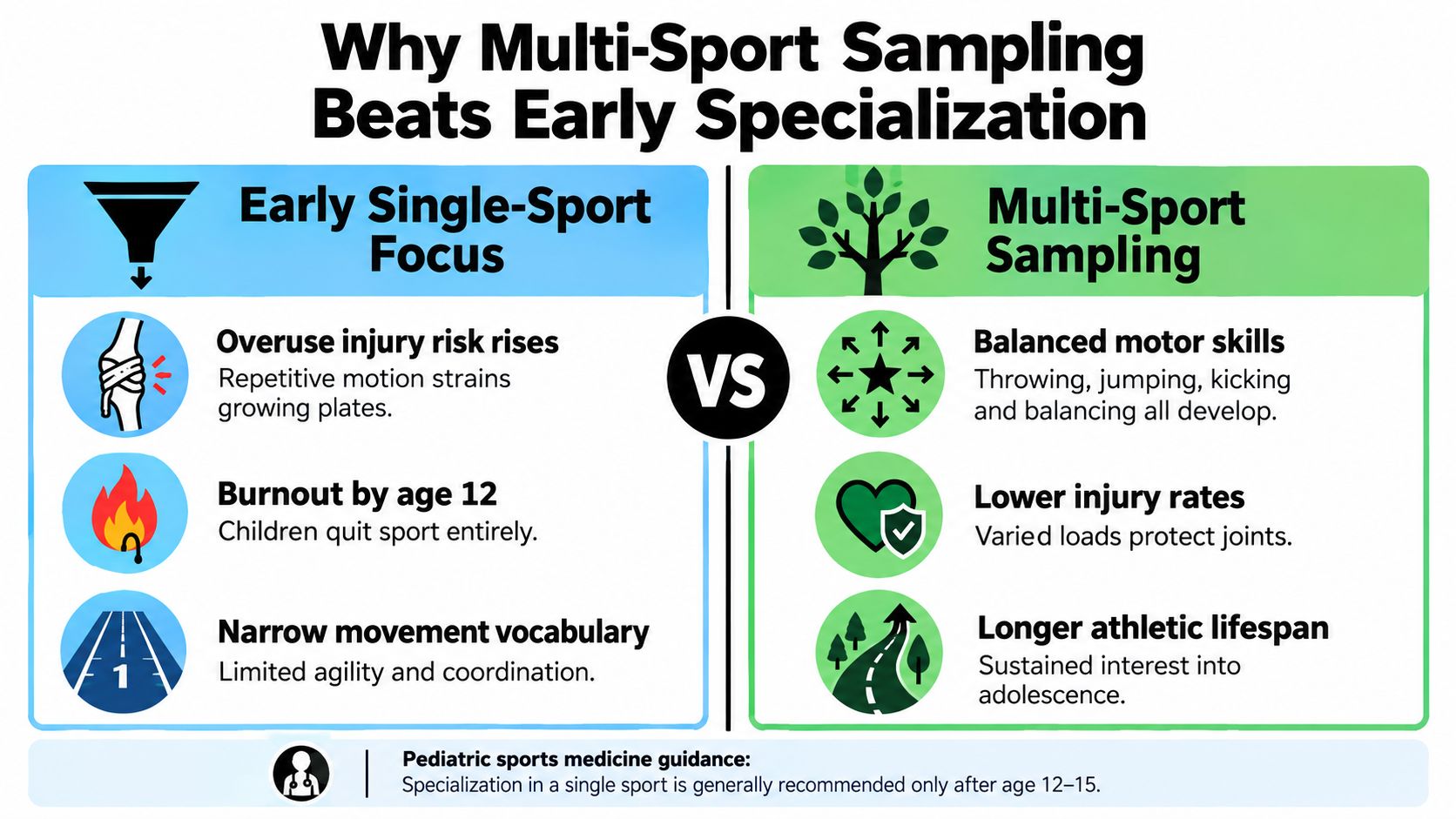
A child who spends early years only repeating one narrow skill misses chances to run, jump, throw, catch, balance, stop, turn, and change direction in different ways. At this age, soccer, basketball, gymnastics-style movement, and track-inspired games can work as different doors into the same larger goal, fundamental movement competence.
The participation picture also argues for access and variety. Research found that only about 43% of children participated in organized sports, showing that participation isn't evenly distributed (research on organized sports participation). That makes early classes most valuable when they welcome beginners and build positive associations with movement, rather than filtering children through performance expectations.
Think of early sport as a sampling menu
Multi-sport sessions let a child discover preferences without locking the family into a single identity. One week, a child may love chasing a ball. The next, they may spend the entire class balancing, crawling, or throwing beanbags. Both experiences count.
The early-years question isn't “Which sport will my child master?” It's “Which movements will help my child feel capable and curious?”
A rotating program also gives coaches more ways to adapt. If kicking frustrates a child, the coach can offer rolling. If waiting for a turn is difficult, the coach can use a parallel station. Variety creates options, and options keep a toddler engaged.
Choose a class that samples several movement themes instead of repeating one drill set. A multi-sport development overview from JC Sports Houston can help parents compare a broad introductory model with a single-sport track.
Scheduling, Registration, and Booking a Free Trial
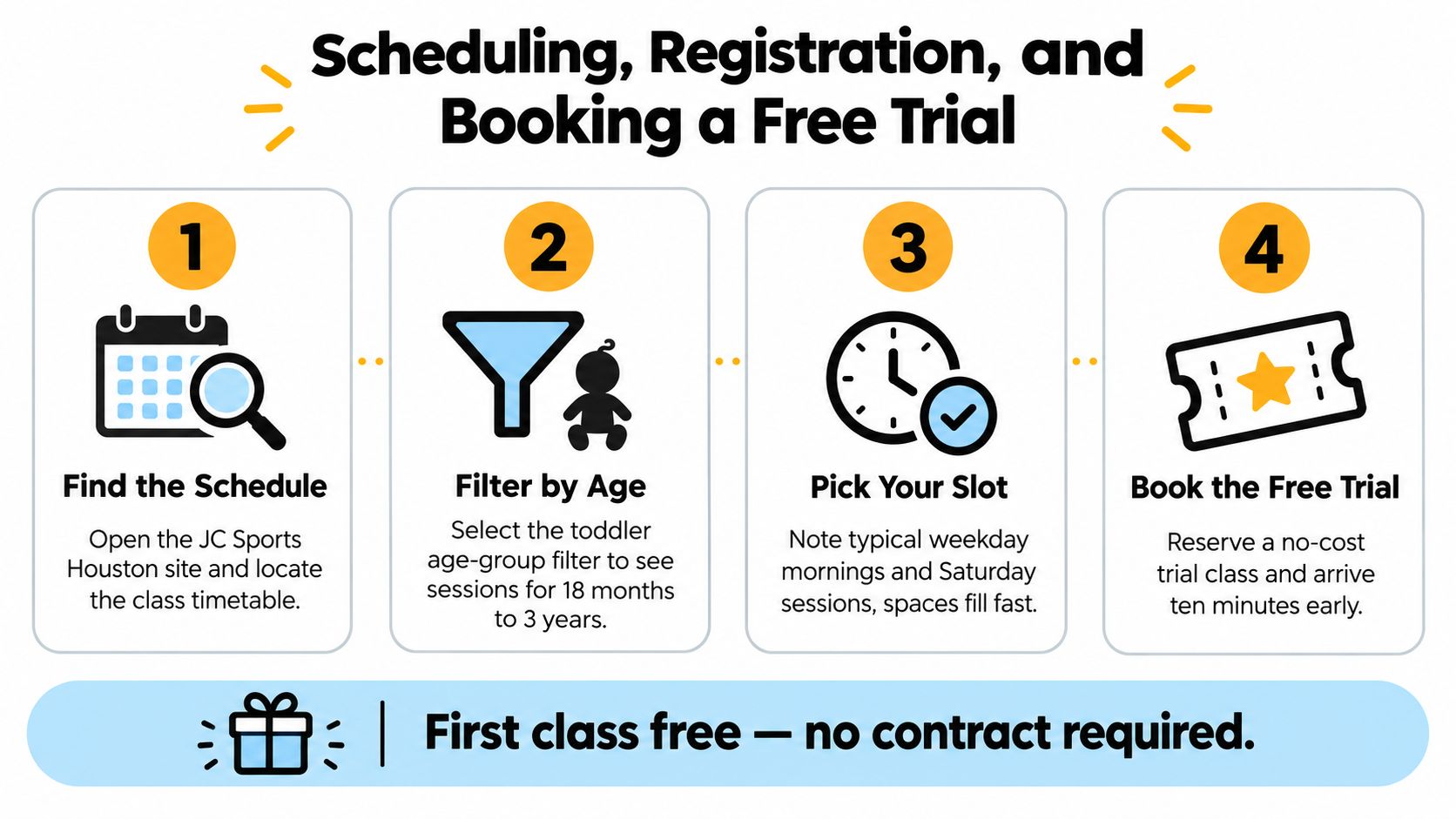
Start with the program schedule, then filter by your child's age rather than choosing the most convenient time first. A toddler who is rested and fed will usually get more from class than a child arriving during a predictable nap or meal window.
For a first booking, follow this sequence:
Find the timetable. Open the JC Sports Houston site and locate the current class schedule.
Choose the age group. Select the toddler option that matches your child's developmental stage.
Compare the routine. Check weekday and Saturday availability against naps, preschool, traffic, and your family's realistic travel time.
Register online. Create an account, select the class, submit the waiver, and look for the confirmation email.
Prepare for arrival. Bring water, comfortable indoor shoes, and grip socks if the facility recommends them. Arrive early enough to find the room without rushing.
Before paying, ask whether the program offers drop-in sessions, monthly packages, sibling discounts, multi-class discounts, make-up classes, and a clear cancellation policy. The details can change, so confirm the current terms directly rather than relying on an old parent post. Families new to online enrollment can also review the benefits of online registration before creating an account.
A free trial is the fastest way to judge the fit. Watch how your child responds to the coach, equipment, transitions, and other children. If the class feels manageable and your child shows even a little curiosity, book the next session before the preferred group fills.
JC Sports Houston offers age-appropriate toddler multi-sport classes built around rotating movement experiences, including soccer, basketball, baseball, and non-contact football activities. Visit JC Sports Houston to check the current Houston-area schedule and request a free trial, then let your child explore movement without the pressure to specialize.
Comments