

Basketball Camp for Kids: What to Expect in 2026

Your child's first basketball camp morning may feel more uncertain for you than for them. At drop-off, you might see a check-in table, color-coded name tags, coaches welcoming early arrivals, and a group of children showing every emotion from eager to shy. You may also wonder what happens after you leave, whether your child will be placed with the right players, and whether the day will involve useful instruction or just unstructured games.
A well-run basketball camp for kids should make those answers visible. Parents should understand how groups are formed, what a normal day looks like, how coaches manage workload, and what safety routines are in place. This guide walks through those practical details so you can judge a camp by its daily experience, not just by its name or advertising.
A First Look at Youth Basketball Camp
At a strong camp, the morning starts before the first drill. Staff members confirm attendance, check emergency information, answer parent questions, and direct children toward their assigned group. The name tag may show a color, number, or court assignment, but that simple system matters. It helps coaches move children safely and prevents a nervous first-time camper from wondering where to go.
Once the child joins the group, the first activity should feel welcoming rather than evaluative. Coaches may use light movement, partner passing, or a simple ball-handling game to learn who is comfortable with the ball and who needs more support. A child who has played for years and a child attending a first camp shouldn't be treated as though they have the same needs.
The rest of the day should follow a recognizable rhythm. Children need instruction, practice, water, food, social time, and recovery. They also need coaches who can explain a skill in language they understand, notice when a player is frustrated, and adjust an activity without embarrassing anyone.
Parent's view: A quality camp makes the child feel busy, included, and appropriately challenged. It makes the parent feel informed, not left to guess what happened all day.
Look beyond polished photos when comparing programs. Ask how staff divide players, who supervises transitions, what happens when a child gets hurt, and how pickup is controlled. A camp that can answer those questions clearly has probably thought through the experience beyond the basketball drills.
The long history of youth basketball camps also shows how the model has developed. NBC Camps reports that it began in 1971 with 108 campers, later growing into a program serving athletes across multiple countries. That history doesn't prove that every established camp is well run, but it does show why families should look for repeatable coaching, age-appropriate instruction, and consistent safety routines.
Age Groups, Skill Focus, and Coach-to-Player Ratios
The first question to ask isn't, “How many courts are available?” Ask, “Who will be on my child's court?” A useful camp separates children by age and then adjusts for experience. A younger beginner needs a different explanation of spacing than an experienced teenager preparing for competitive play.
Many programs use broad brackets such as 5–7, 8–10, 11–13, and 14–17, then create smaller ability groups within those ranges. The exact brackets vary, so parents should confirm the process rather than assume the age label tells the whole story. Guidance on age-appropriate basketball training progressions can help families recognize whether the curriculum matches a child's development.
For the youngest players, expect footwork, balance, ball familiarity, passing, and shooting form. Children in the middle age groups can benefit from more small-sided play, where they get frequent decisions and touches. Teenagers may work on help defense, spacing, transition choices, screening, and positionless team concepts.
A camp's ratio affects how much correction each player receives. The figures below are practical targets for evaluating attention and supervision, not universal regulations.
Age Group | Recommended Ratio | Primary Skill Focus | Group Size Target |
|---|---|---|---|
5–7 | About 1 coach to 8 players | Movement, footwork, ball control, basic shooting | Small teaching groups |
8–13 | About 1 coach to 10 players | Fundamentals, small-sided decisions, finishing | Manageable court groups |
Older teens | About 1 coach to 12 players | Tactics, competition habits, team concepts | Skill-level subdivisions |
You can also compare a camp's curriculum with practical guidance on basketball training for kids, particularly if your child is new to organized instruction.
What parents should ask before paying
Ask whether ratios apply during drills, games, lunch, and transportation between areas. Some programs advertise a favorable coaching ratio but place many children together during the busiest parts of the day.
Watch for these warning signs:
No placement process: Staff put every child into one group based only on age.
Thin supervision: One coach runs a large station while children wait for turns.
Mismatch between promise and practice: The camp advertises advanced training but offers only generalized games.
No adjustment option: Coaches can't move a child who is overwhelmed or underchallenged.
A discount won't compensate for a child spending most of the session in a line. Ask how often each player handles the ball, receives feedback, and participates in live play.
What a Typical Camp Day Looks Like
A realistic full-day camp might run from 9:00 a.m. to 3:00 p.m., with before-care or after-care available in some programs. The schedule should balance focused teaching with enough changes of pace to keep children engaged.
At arrival, coaches take attendance and direct players into a dynamic warm-up. This may include light running, mobility, balance work, and simple ball movements. The warm-up is also a social transition. Children learn names, meet their coach, and become comfortable sharing the court.
The morning learning blocks
After warm-up, the group may rotate through stations lasting roughly half an hour to three quarters of an hour. One station could focus on footwork and stopping under control. Another might teach ball-handling with both hands. A third could work on finishing from different angles.
Station rotations work because they reduce waiting and let coaches repeat a clear teaching point. A coach can correct a player's hand position, base, or pace immediately instead of trying to manage an entire full-court activity.
Late morning often moves into 3v3 or 4v4 play. Smaller games give children more opportunities to pass, cut, defend, and make decisions than they typically get in full-court 5v5. The court is less crowded, but the player is more involved.
Small-sided play isn't just a fun break from drills. It connects technique to decisions, which is where children learn when to use a skill.
Lunch should include a genuine break from intense activity, along with regular hydration opportunities. After lunch, a camp may return to skill stations before a longer scrimmage block. Coaches should use the games to reinforce the day's focus, not only declare a winner and move on.
The final portion of the day should slow down. A cool-down, stretching, recap circle, and clear pickup procedure help children finish safely. At 3:00 p.m., staff should release children only through an agreed process, checking that each player leaves with the authorized adult or approved arrangement.
Optional care can make a camp workable for families, but ask whether those periods are supervised by the same trained staff and whether they involve additional physical activity. A long day should not become an unplanned second practice.
Real Benefits Kids Take Home From Camp
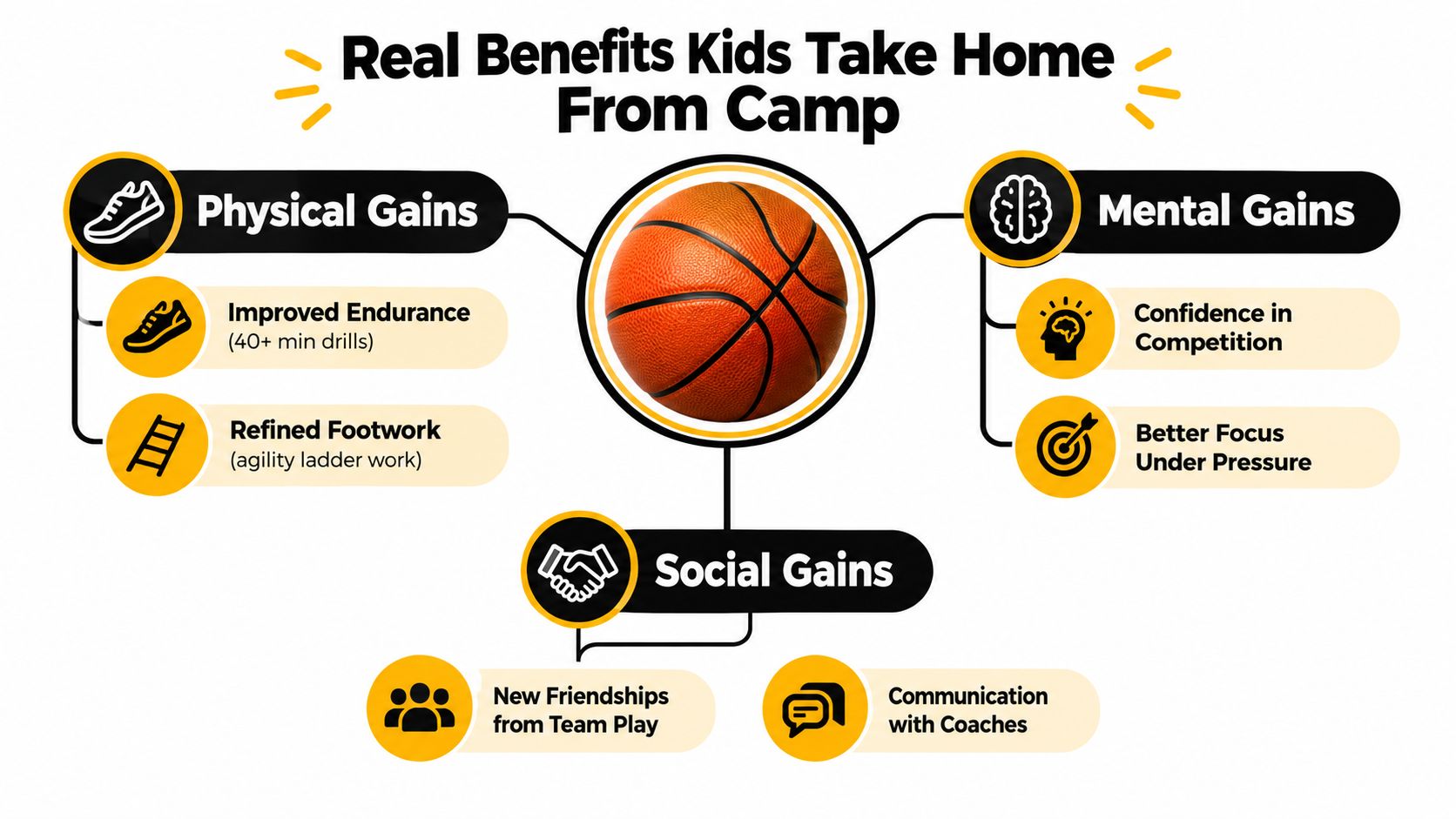
The value of camp appears in small changes rather than instant transformation. A child may finish the week stopping with better balance, using the non-dominant hand more comfortably, or recognizing an open teammate sooner. Those improvements come from repeated practice in an environment where the coach can give immediate feedback.
The physical benefit is not “getting in shape.” Children practice changing direction, landing under control, staying balanced while finishing, and moving without the ball. A child who once rushed a layup may learn to slow the final step and use the backboard. Another may become more comfortable protecting the ball while turning away from pressure.
Mental development often shows up away from the court. Repeating a skill after a mistake teaches a player to respond instead of withdraw. A coach who asks, “What did you see?” helps the child think about shot selection, spacing, and transition rather than waiting for instructions every possession.
The social payoff
Camp also creates a temporary team community. Children meet peers with similar interests, communicate with players they don't already know, and learn how to share space with different personalities. That experience can help a quiet child speak up during a drill or help an outgoing child learn to listen.
The strongest benefit is layered:
Physical: Better control, footwork, balance, and movement habits.
Mental: More willingness to try, accept correction, and recover from mistakes.
Social: New friendships, stronger communication, and greater comfort in team settings.
Parents can extend the learning without turning home into another practice facility. A short, relaxed activity based on basketball workouts at home may reinforce a camp skill, but children also need unstructured time and the freedom to enjoy the sport.
A useful test is what your child talks about afterward. “I made the winning shot” is exciting, but “I learned how to get open” or “I helped my teammate” may reveal deeper learning.
Workload, Recovery, and Injury Prevention
A camp that keeps children moving every minute isn't automatically a better camp. Young players need a progression that alternates demanding activities with recovery, hydration, and lower-intensity technical work.
Current youth basketball injury-prevention guidance identifies a neuromuscular warm-up combined with regular strength and stability work as a valuable approach. The recommended preparation includes landing mechanics, single-leg balance, trunk control, mobility, jumping, and controlled changes of direction. Basketball injury-prevention research also discusses screening areas such as ankle mobility, hip abductor strength, and lower-extremity reach distance so coaches can identify corrective needs.
A basketball-specific review recommends a 10–15 minute neuromuscular warm-up before practice or games, with multicomponent programs often used 2–3 days per week for 10–30 minutes. One program, SHRed Injuries Basketball, reported a 36% reduction in ankle and knee injuries. Those findings don't mean a camp can promise injury-free participation, but they give parents a concrete basis for asking what preparation looks like. The injury-prevention review describes the relevant components.
Camp Element | Quality Benchmark | Red Flag to Watch For |
|---|---|---|
Warm-up | Movement preparation, balance, mobility, and landing control | Immediate sprinting or intense conditioning |
Training flow | High-effort work mixed with technical and recovery periods | Continuous live play with no planned reset |
Hydration | Scheduled water access and attention to heat or fatigue | Children must wait until they ask |
Injury response | Clear first-aid lead, incident process, and parent notification | Staff can't explain who handles injuries |
Return to activity | Individual decision based on symptoms and staff judgment | A child is pushed back into play quickly |
Parents should also consider total weekly load. Children's Healthcare of Atlanta advises that children shouldn't play organized sports more hours per week than their age, while year-round single-sport participation can contribute to overuse problems. Seattle Children's guidance in the same resource emphasizes shoes, warm-ups, cool-downs, hydration, sleep, and appropriate protective equipment.
Before enrolling, tell the camp about previous ankle or knee problems, asthma, allergies, medications, and current sports commitments. A coach who asks about those details is better positioned to adjust participation than one who treats every child as interchangeable. Parents can also review dynamic stretching for basketball to understand why movement preparation should precede intense activity.
What to Pack and How to Prepare
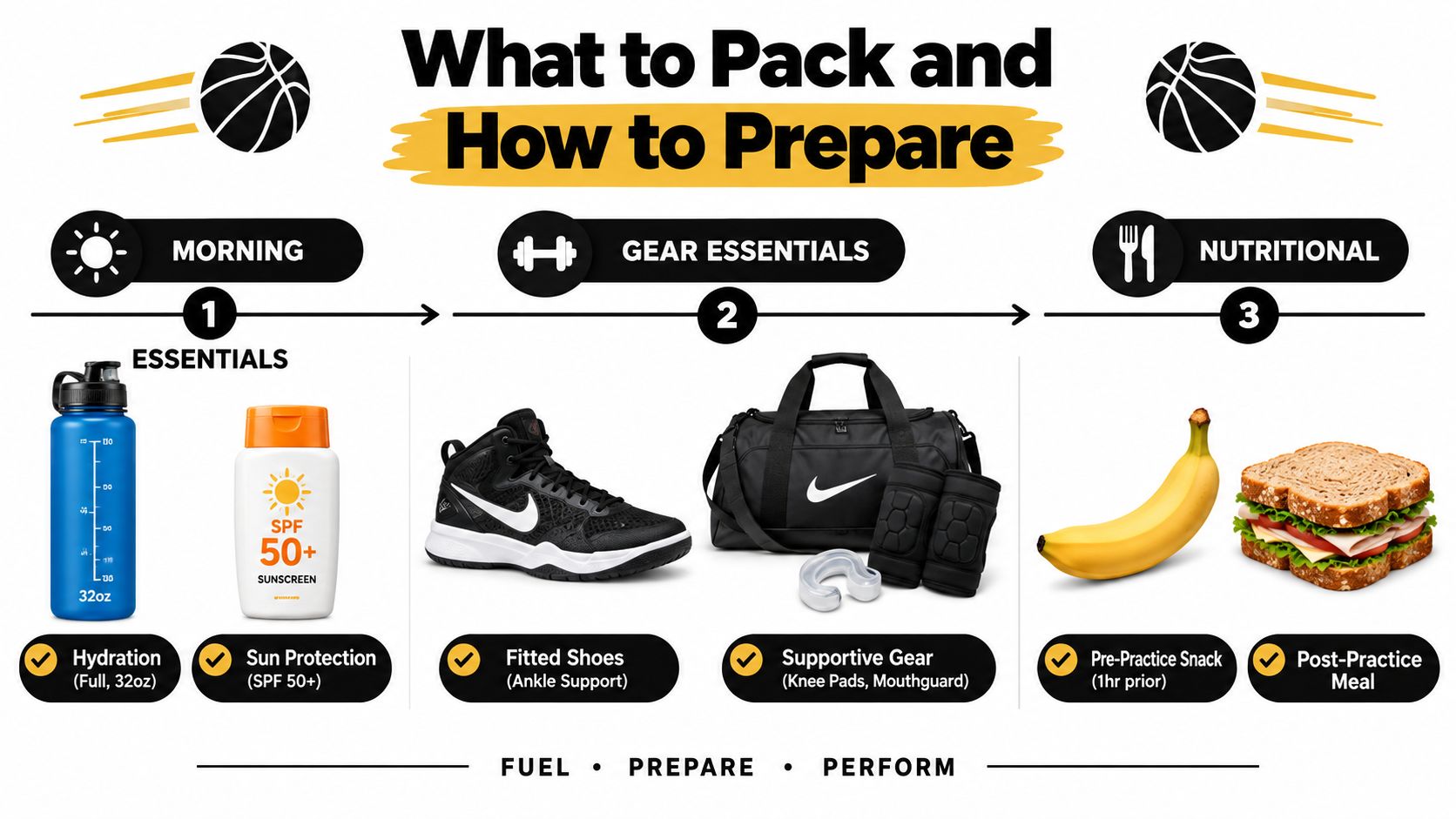
The best packing list follows the actual camp day. Start with fitted basketball shoes that feel secure during stopping and cutting, moisture-wicking socks, a labeled water bottle, a light snack, sunscreen, and comfortable layers. If the camp doesn't provide a reversible pinnie, pack one so teams can be identified quickly.
A parent may also want to include:
A spare shirt: Sweat-soaked cotton can make the ride home uncomfortable in air conditioning.
Personal medication: Follow the camp's written procedure for storage and administration.
Protective equipment: Pack a mouth guard or other approved equipment if the child uses one.
A labeled bag: Clear labels reduce lost-property confusion during busy pickup.
A small towel: It helps with sweat and gives the child a simple comfort item between sessions.
Trim fingernails the night before. Children reach, defend, and contest passes in close spaces, so short nails help protect teammates. Send your child after breakfast, dressed in breathable clothing, and with enough food to get through the day.
Prepare the first-timer emotionally
Tell a nervous child that the first morning is for meeting coaches, warming up, and learning how the group works. It isn't a tryout unless the program specifically says it is. Give them one manageable goal, such as learning a teammate's name or asking one question.
A short conversation helps:
Name the feeling: “You might feel nervous when you walk in.”
Explain the first step: “A coach will show you where to go.”
Set a simple goal: “Try the drills and tell your coach if you need help.”
Plan the pickup: “I'll be waiting at the agreed location.”
Don't send a child in brand-new shoes or with a meal they haven't tolerated before. Familiar equipment and familiar food remove avoidable distractions.
Registration, Pricing, and Free Trials
Registration should feel as organized as the camp itself. Begin with the online form, then read every waiver, medical question, pickup rule, and cancellation term before submitting payment. If the site uses broad descriptions such as “all skill levels,” ask how the staff handles a beginner and an experienced player in the same age bracket.
For 2026, camps may structure fees through early registration tiers, sibling discounts, or multi-week packages. Those labels don't tell you the final cost, so request an itemized explanation. Confirm whether the fee includes a camp shirt, snack, certificate, equipment, and supervision during the advertised hours. Extended care, lunch, private instruction, and transportation may be separate charges.
Free trial language also needs precision. One program may offer a free first-day drop-in, another a free clinic, and another a refund option after the first day. Ask which model applies, whether space must be reserved, and whether the trial includes the same coaching and schedule as a paid session.
Option | Typical 2026 Detail | Parent Tip |
|---|---|---|
Early registration | Lower introductory tier before the listed deadline | Check the actual deadline and refund terms |
Sibling discount | Reduced fee when more than one child enrolls | Ask whether it applies to every session |
Multi-week bundle | One registration covering multiple camp weeks | Confirm whether unused weeks can be transferred |
Free clinic or trial | Short introductory experience or first-day option | Ask whether registration is required |
Extended care | Additional supervision outside camp hours | Confirm staff, hours, and extra charges |
A written cancellation policy should explain refund deadlines, medical withdrawal exceptions, transfers, and waitlists. If a session sells out, ask how families are contacted when a place opens and whether payment is required immediately.
Be cautious if staff won't share coach credentials, the payment deadline is unclear, or the provider demands full payment without a written cancellation policy. A professional registration process protects both the family and the program.
Final Checklist and Common Parent Questions
By pickup time on the first day, you should know whether the camp matches your child. The coach should be able to say what the group practiced, how your child participated, and whether any adjustment is needed. A quick comment is enough at pickup, but the staff should have a reliable way to communicate concerns during the week.
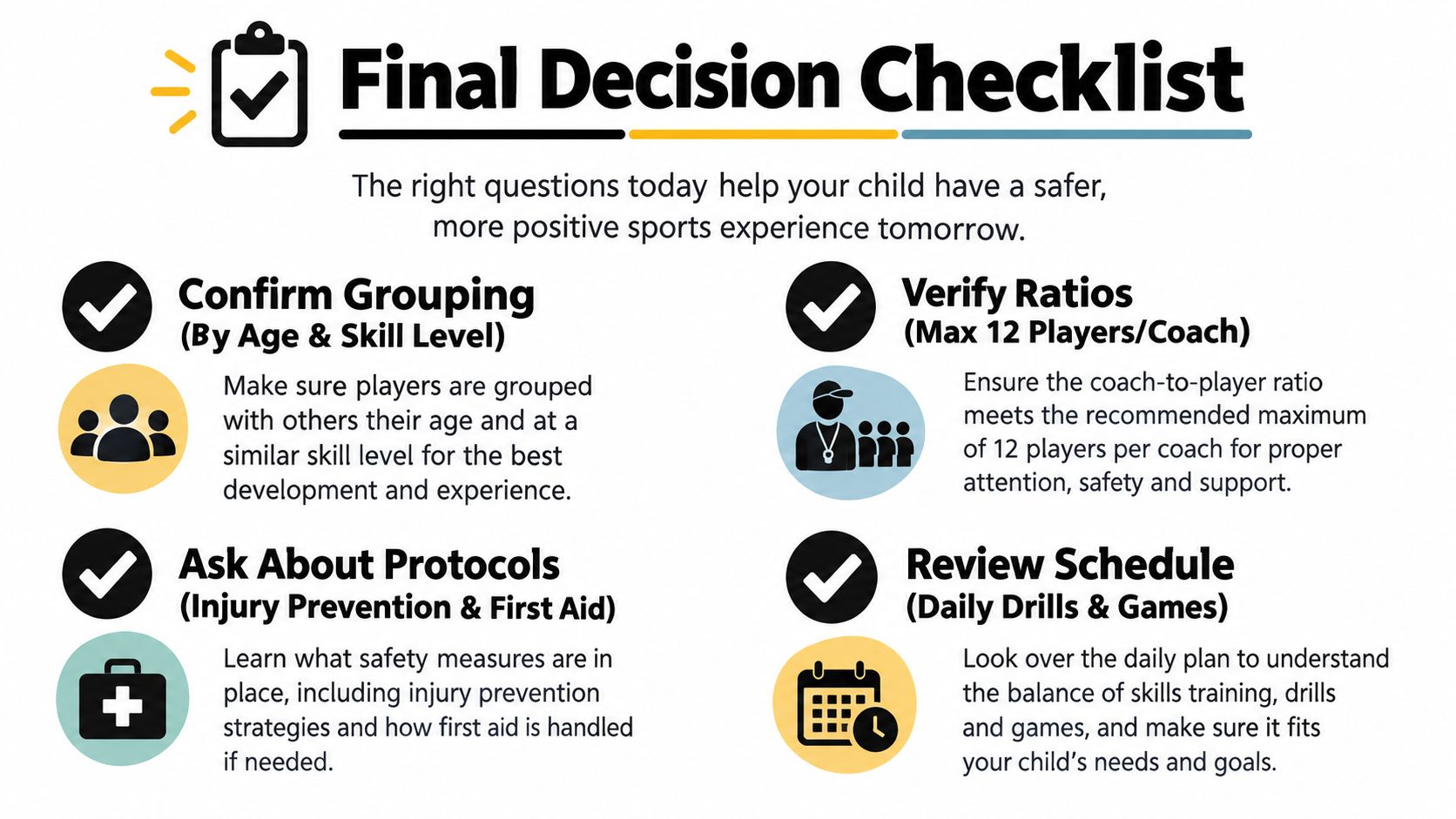
Before paying, confirm four points:
Grouping: Players are placed by age and skill, with a way to adjust placement.
Ratios: The number of coaches fits the activity and the children's experience.
Safety: Staff can explain warm-ups, hydration, first aid, injury response, and medication procedures.
Schedule: The day includes instruction, small-sided play, breaks, lunch, and controlled pickup.
Policies: Cancellation, medical withdrawal, trial, and waitlist terms are written clearly.
Questions parents commonly ask
What if my child is nervous?Tell the director before arrival. A good coach can introduce the child gradually, pair them with a welcoming teammate, and begin with familiar movement rather than competitive play.
Can my child wear an ankle brace?Usually, the coach and parent should discuss it before the session. The brace must fit inside the shoe and shouldn't cause pain or restrict safe movement.
How are allergies and medication handled?Ask who stores medication, who may administer it, and how emergency information follows the child during court transitions. Put every instruction in writing.
Can parents watch?Some camps allow viewing from a designated area, while others limit sideline access to reduce distraction. Ask before arriving rather than assuming.
What happens during rain or extreme heat?Outdoor programs should explain their indoor alternative, cancellation notice, or rescheduling policy. A vague weather policy deserves a follow-up question.
How will I hear about progress?Expect brief pickup feedback, written notes, a skills summary, or a final conversation. Ask what the camp routinely provides instead of waiting for a formal evaluation.
A basketball camp should leave your child with useful skills, positive memories, and a sensible relationship with effort and recovery. If the program can explain its groups, schedule, coaching, safety routines, and policies in plain language, you're much closer to making a confident choice.
JC Sports Houston offers age-appropriate basketball classes, basketball-inclusive sports camps, and a free trial option for children in the Humble, Kingwood, Atascocita, and surrounding Houston communities. To compare a welcoming local program with your camp checklist, visit JC Sports Houston and review the current schedule, registration details, and available programs.
Comments