

Fall Youth Sports: Ages, Costs and How to Choose

Which fall sport should your child play, or is the better question which program your child and your family can realistically enjoy? A popular league isn't automatically the right choice if practice overlaps bedtime, the fees strain your budget, or your child still needs help joining a group.
Fall youth sports work best when readiness, time and cost come before competition level. Start with a manageable commitment, understand what you're paying for, and choose coaching that helps your child want to return.
Fall Youth Sports by Age and Sport
Fall youth sports can begin with toddler movement classes and continue through high school teams. For the youngest children, the purpose is exploration, not choosing a permanent sport. Older children can gradually take on team responsibilities, more detailed instruction and competition.
Use these age bands as planning categories, not universal enrollment rules. Providers set their own eligibility, session lengths and schedules, so treat every unconfirmed commitment as a question to resolve before registering.
Fall youth sports by age band
Age band | Typical fall sports | Usual format | Typical commitment |
|---|---|---|---|
24 months to 3 years | Multi-sport and toddler activities | Small movement class with caregiver involvement | Confirm class frequency, duration and caregiver participation |
4 to 6 years | Introductory soccer, baseball and basketball | Small-sided classes or introductory leagues | Confirm whether instruction and games share a session |
7 to 9 years | Recreational soccer, baseball and basketball | Seasonal recreational league | Request the practice and game calendar |
10 to 13 years | Recreational teams, club soccer and skill academies | Team season or skill-development program | Confirm training days and whether tournaments are included |
14 to 18 years | School football, volleyball, cross-country, soccer, tennis, golf or field hockey | School team, subject to local offerings and selection | Obtain the school's practice, competition and travel schedule |
School sports aren't identical everywhere. The National Federation of State High School Associations describes fall championships across football, volleyball, cross-country and other sports, with offerings differing among state associations.
Match the activity to what your child enjoys
A child who likes chasing and kicking may enjoy soccer. A child who prefers throwing, striking and taking turns might respond to introductory baseball. Basketball offers dribbling, passing and shooting, but beginners still need equipment and instructions scaled to their abilities.
For toddlers, watch whether the coach turns movement into play. Carrying a ball, stopping on a signal and balancing inside a floor marker are meaningful activities even when they don't resemble a formal game.
Readiness check: Choose the setting where your child can participate with support, not the setting that looks most advanced.
Find your child's age row, then compare the format with their interest and your actual week. Include driving, changing clothes and getting home, not just the advertised session time. A shorter commitment that fits comfortably can be a better starting point than an ambitious schedule your family struggles to maintain.
Fall Season Timeline from Registration to Final Games
Think of the fall calendar as a sequence: registration, team confirmation, introductory practices, regular play and a final event. The exact dates belong to the provider, not to a generic seasonal calendar.
The timeline below illustrates a possible sequence rather than a confirmed local schedule.
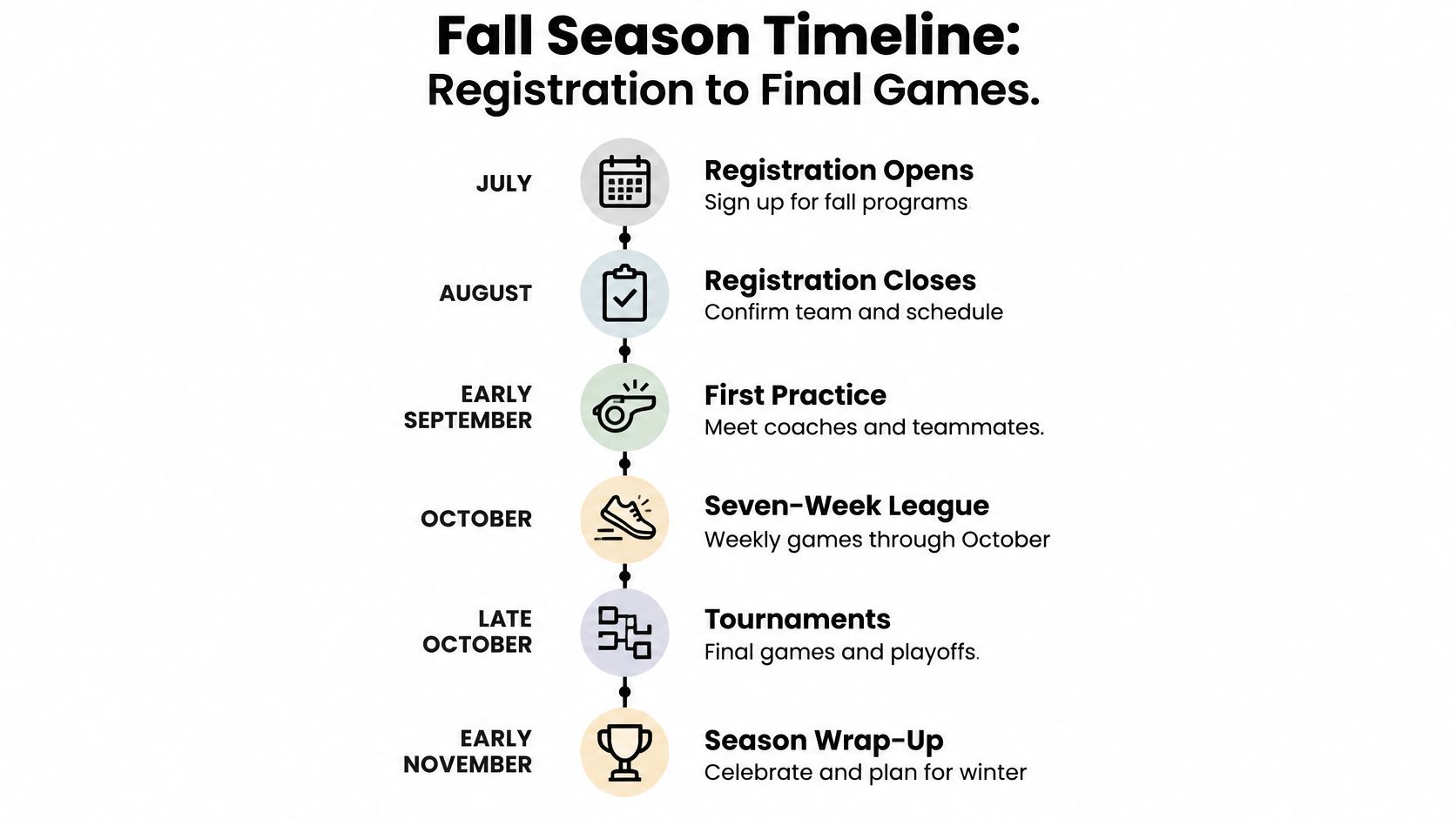
Before reserving a place, put the proposed sessions beside school events, childcare arrangements and family commitments. Our guide to what sports are in season can help you compare activities, but the program's current calendar should determine your decision.
Why the opening practices matter
Children shouldn't move straight from a quiet summer into demanding practices, games and extra conditioning. In a prospective study of 421 high-school cross-country runners, athletes who trained for eight or fewer weeks during summer had higher odds of injury during the opening month of the season, according to the British Journal of Sports Medicine study.
That finding concerns adolescent runners, not every child entering a fall class. The useful scheduling principle is still straightforward: coaches should build demands progressively rather than assume everyone arrives equally prepared.
Begin with technique: Use controlled passing, dribbling and movement games before extended scrimmages.
Build exposure gradually: Add running, cutting and jumping as children demonstrate comfortable movement.
Preserve recovery: Avoid filling every free evening with another organized workout.
Respond to warning signs: Persistent pain, limping or deteriorating movement calls for stopping and assessment, not encouragement to push through.
For younger children, shorter rotations, water breaks and changes of activity make the opening sessions more manageable. Coaches can track practice demands and ask children how they're feeling rather than judging readiness only by enthusiasm.
Before paying, confirm the start date, season length, game days, holiday interruptions and final-event expectations. Ask whether postponed games can move to a different day, because a make-up date can create a commitment you didn't originally plan for.
What Fall Sports Build and How to Keep Kids Safe
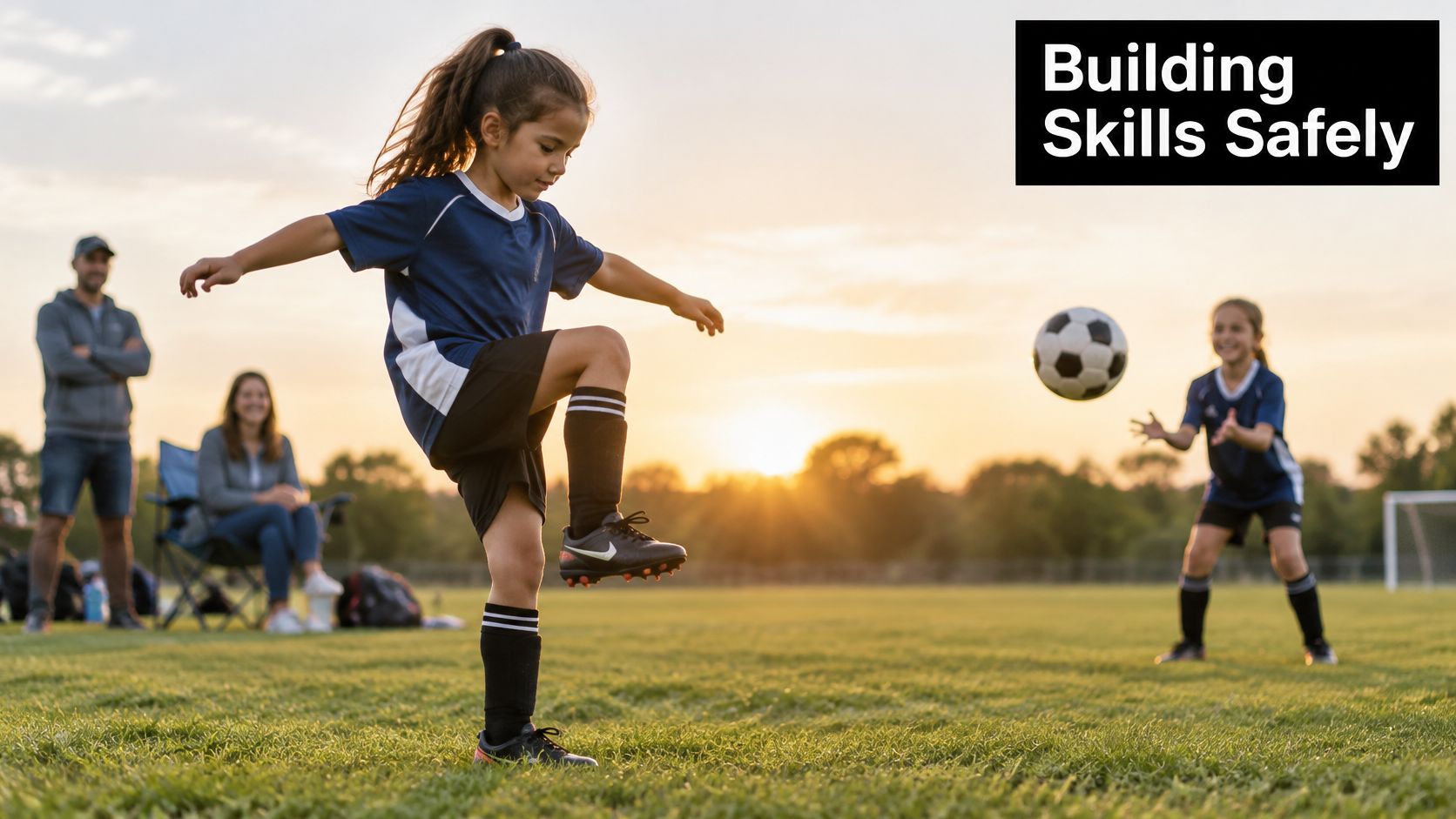
Good youth instruction gives children repeated opportunities to run, balance, catch and control their movements. It also creates small social challenges: waiting for a turn, asking for help, sharing equipment and recovering after a mistake.
Confidence doesn't require winning. A child who finally stops a moving ball or joins a partner drill has achieved something concrete. Parents can reinforce that progress by asking what felt easier, what was difficult and what the child wants to try again.
Make movement variety the starting point
Early participation doesn't need to become an exclusive commitment. Different activities let children explore different movements and discover preferences without treating a first interest as a permanent identity.
A multi-sport approach also needs restraint. Combining demanding teams isn't the same as providing varied play. Leave room for rest and unstructured activity instead of adding programs to collect more sports.
Look for a repeatable warm-up
A systematic review indexed by PubMed covering 21 controlled trials and 27,561 athletes younger than 19 found that exercise-based prevention programs reduced injuries overall by approximately 46%. Programs incorporating jumping or plyometric work showed stronger reductions, although evidence was weaker for younger children.
A practical neuromuscular warm-up teaches children to control their bodies before demanding play. Coaches can move from easy running to balance, controlled stopping, sideways movement and age-appropriate landing activities.
Balance with control: Hold a stable position rather than rushing into the next task.
Land with control: Bend through the hips and knees instead of landing stiffly.
Keep knees aligned: Encourage knees to track over toes.
Push off evenly: Watch for consistent movement rather than maximum height or speed.
Preschoolers can practice these ideas through freeze games, stepping paths and gentle hopping activities. Parents can use our sports injury prevention guide to prepare questions about how coaches adapt drills.
Physical preparation is only part of safety. Ask about supervision, emergency procedures and how concerns are reported; VolunteerBadge's resource on FCRA-compliant checks for volunteer coaches offers context for discussing screening practices without assuming a check replaces ongoing supervision.
Ask whether the warm-up happens at every practice. A preseason demonstration isn't a substitute for a routine children actually follow.
Choosing Between Classes, Leagues and Clinics
Fall program formats compared
Format | Best fit | Parent role | Ask the provider |
|---|---|---|---|
Toddler multi-sport class | First exposure to organized movement | Support transitions and follow caregiver participation rules | How are coaches trained in the curriculum? |
Seasonal league | A child who wants team games | Manage attendance and follow sideline expectations | How are practices and games distributed? |
Camp or clinic | A focused skill interest or school-break activity | Handle arrival, collection and any required on-site supervision | Are dates fixed, and what is the refund policy? |
Private session | A clearly identified skill gap | Share the goal and observe within program rules | What experience does the coach have teaching this skill? |
Choose the format before choosing the competitive level. A child can love soccer but dislike the pace or noise of a full team session. That doesn't mean soccer is wrong; a smaller instructional setting may be a better entry point.
The comparison below provides another way to distinguish the formats. Treat its age guidance as illustrative, and confirm actual eligibility directly.
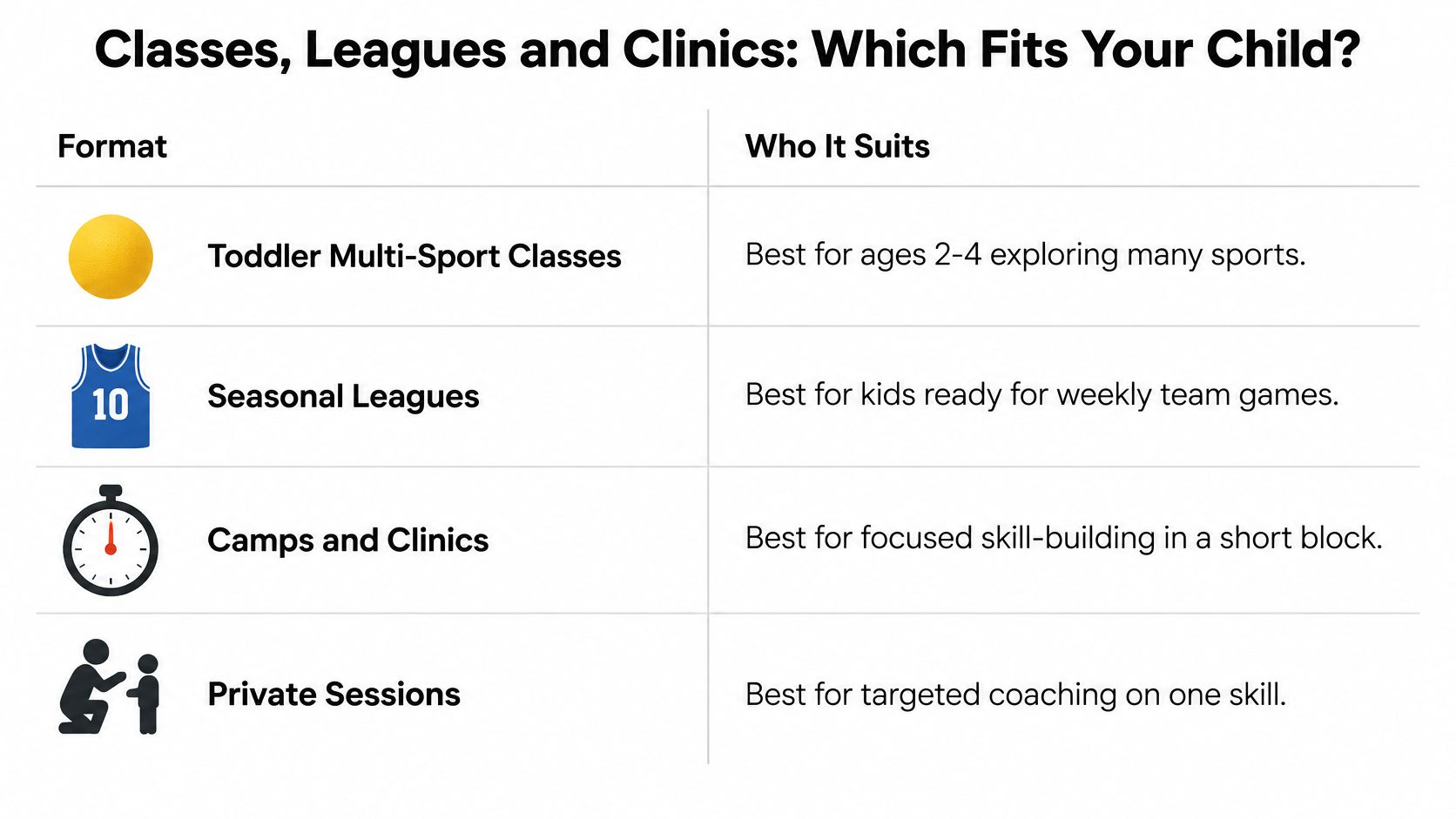
What each format asks of a child
Classes suit children who need frequent instruction, playful repetition and help following a routine. A child-centered curriculum uses games and drills to develop motor skills, self-confidence and technique rather than expecting children to perform adult-style training.
Leagues introduce shared responsibilities. Children learn to attend consistently, understand their role and respond when play doesn't go their way. Our youth sports league guide can help parents consider those expectations before enrolling.
Clinics concentrate attention on a topic, such as ball control or shooting. Private coaching is more individualized, but it should begin with a specific objective rather than a vague promise of improvement.
Take concrete questions to the director
Ask for an explanation of what children do, not just a description such as developmental or competitive.
Curriculum: What skills are introduced, and how are activities adjusted when a child struggles?
Staff preparation: How do instructors learn to teach the program?
Group organization: How many children share a coach, and what happens while others take turns?
Session balance: How much time is guided practice, and how much is gameplay?
Child support: What happens when a participant is hurt, upset or unwilling to join?
At JC Sports Houston, our teachers are experienced and trained in our curriculum. We place the child at the center of the game, using interactive games and drills to build skills and confidence.
A useful answer from any director should describe actions: how groups are formed, how drills are simplified and who speaks with a concerned parent. General enthusiasm isn't a substitute for those details.
Fall Programs Near Houston and What to Check
Families searching from Humble, Kingwood, Atascocita and nearby northeast Houston communities should compare the entire trip, not just the distance shown on a map. A convenient weekend location may be difficult to reach after school.
Local options generally fall into distinct categories. Indoor sports centers provide a controlled playing environment and instructional settings. Community organizations, including YMCA branches and parks and recreation departments, are another place to investigate recreational opportunities, while schools provide team pathways for older students.
Compare the setting, not just the sport
An indoor venue and an outdoor field create different practical demands. Ask about the playing surface, footwear, weather procedures and where caregivers wait. For a school team, clarify selection requirements and transportation responsibilities.
JC Sports Houston is a toddler and youth indoor sports center serving Humble, Kingwood and Atascocita. When comparing us with another location, use the same practical checklist rather than assuming every program operates alike.
Travel: Test the route around the actual arrival time, including school pickup.
Location: Confirm the address used for practices and games, not only the registration office.
Season calendar: Obtain the current schedule and any anticipated interruptions.
Travel expectations: Establish whether participation stays local or includes away events.
Family logistics: Check bathroom access, caregiver seating and arrangements for accompanying siblings.
Calendar test: If the journey makes dinner, homework and bedtime consistently difficult, the program may not fit this season.
A nearby beginner program can be a sensible choice even when a more intensive option is available farther away. A child doesn't benefit from a supposedly ideal program if getting there leaves everyone exhausted.
Schedules and openings can change between seasons. Confirm the current arrangements directly, and save the written details so every caregiver knows where to go and when.
What Fall Sports Really Cost Families
The Aspen Institute's nationally representative 2024 parent survey found that families spent an average of $1,016 on a child's primary sport, 46% more than in 2019. That is spending on a primary sport, not a quoted fall registration fee.
Your budget should separate required participation costs from choices that can wait. An expensive pathway isn't automatically more appropriate for a beginner.
Fall sports cost items and whether they are optional
Cost item | What it covers | Required or optional |
|---|---|---|
Registration or season fee | A place in a class or league | Required for enrollment; obtain the exact written fee |
Uniform and equipment | Required clothing, footwear and sport-specific gear | Required items follow program rules; premium upgrades are optional |
Travel tournaments | Entry fees, transport and lodging | Optional when outside the core recreational program; confirm team obligations |
Private lessons | Individual coaching | Optional |
Camps and clinics | Additional school-break or skill-focused instruction | Optional |
Price the whole commitment
Ask what registration includes before buying equipment. A ball used during instruction may already be supplied, while personal protective equipment may need to come from home. Buy for fit, function and the provider's requirements, not for branding.
Travel deserves particular scrutiny because tournament fees aren't the whole expense. Transport, meals and accommodation can turn an optional event into a substantial family commitment.
Request an itemized total: Separate enrollment, uniform, equipment and additional-event charges.
Ask about assistance: Find out whether scholarships, hardship arrangements or payment plans are available.
Explore reuse: Ask about equipment swaps and acceptable secondhand gear.
Compare recreational alternatives: Determine whether your child can meet the same immediate learning goal without a travel commitment.
Don't assume a payment plan reduces the total, or that assistance is available without approval. Get the answer in writing before relying on it.
Budget rule: Fund the core season and necessary gear first. Add extras only when your child has a clear reason to use them.
Your time belongs in this calculation too. Caregiver attendance, driving and missed work can affect affordability even when they don't appear on an invoice.
A useful spending decision answers a simple question: what will this purchase let my child do that they can't reasonably do within the basic program? If the answer is unclear, wait.
Fall Youth Sports FAQs
My child has a disability. Can they still join?
Ask about accommodations rather than accepting a general statement that everyone is welcome. Project Play reports that children with disabilities who participate in sports take part in almost one month fewer practices or competitions annually than peers without disabilities.
That difference doesn't explain any individual child's needs. Discuss communication methods, quieter spaces, accessible bathrooms, equipment adaptations and how coaches handle transitions before deciding whether the setting is suitable.
My child is shy or new to team sports. Is a league right?
Possibly, but shyness alone doesn't tell you which format will work. A child who watches carefully before joining may need a predictable introduction, a familiar partner or permission to observe briefly.
Ask whether the coach can introduce participation gradually. Small-group activities can give a hesitant child a role without requiring an immediate performance in front of the whole team.
What if my child wants to quit mid-season?
First identify the problem. Pain, bullying, confusion about instructions and ordinary frustration require different responses.
Speak with the coach or director about what can change, but don't promise your child a transfer or refund before checking the policy. At JC Sports Houston, camps, clinics and leagues carry no refunds or credits.
Are travel tournaments or private lessons necessary?
Not for a child's basic introduction to movement, teamwork and sport skills. Judge progress against the child's current goal rather than another family's spending.
An add-on makes more sense when the child can explain what they want to work on and the coach can identify how that setting will help. Advanced participation should be a deliberate choice, not an assumed requirement.
Register, Prepare and Start a Free Trial
Before submitting a registration form, turn your preferred program into a practical plan. Each step should resolve a specific uncertainty, from eligibility to who stays on site.
Match readiness to format. Choose an activity your child wants to try, then confirm that the instruction matches their present abilities.
Save the calendar. Record the opening session, season length, regular meeting days and any closures. Share it with everyone responsible for transport.
Complete guardian consent. At JC Sports Houston, a parent or legal guardian must consent to youth services. We collect children's information only as the parent or legal guardian provides it for registration and participation.
Plan to remain on site. Our sports programs aren't drop-off classes. Parents or caregivers of all participants must stay in the building during classes.
Read the applicable terms before payment. Check that you've selected the correct event and dates, and keep the confirmation for your records.
Choose whether to receive text alerts. Families who opt in to our SMS messages receive registration confirmations, reminders, schedule changes, cancellations and important notifications.
Prepare for participation. Pack water, suitable shoes, required personal gear and a change of clothes. Allow time for your child to settle before the session begins.
The preparation sequence below is a useful reminder, but confirm availability before assuming a trial place is reserved.
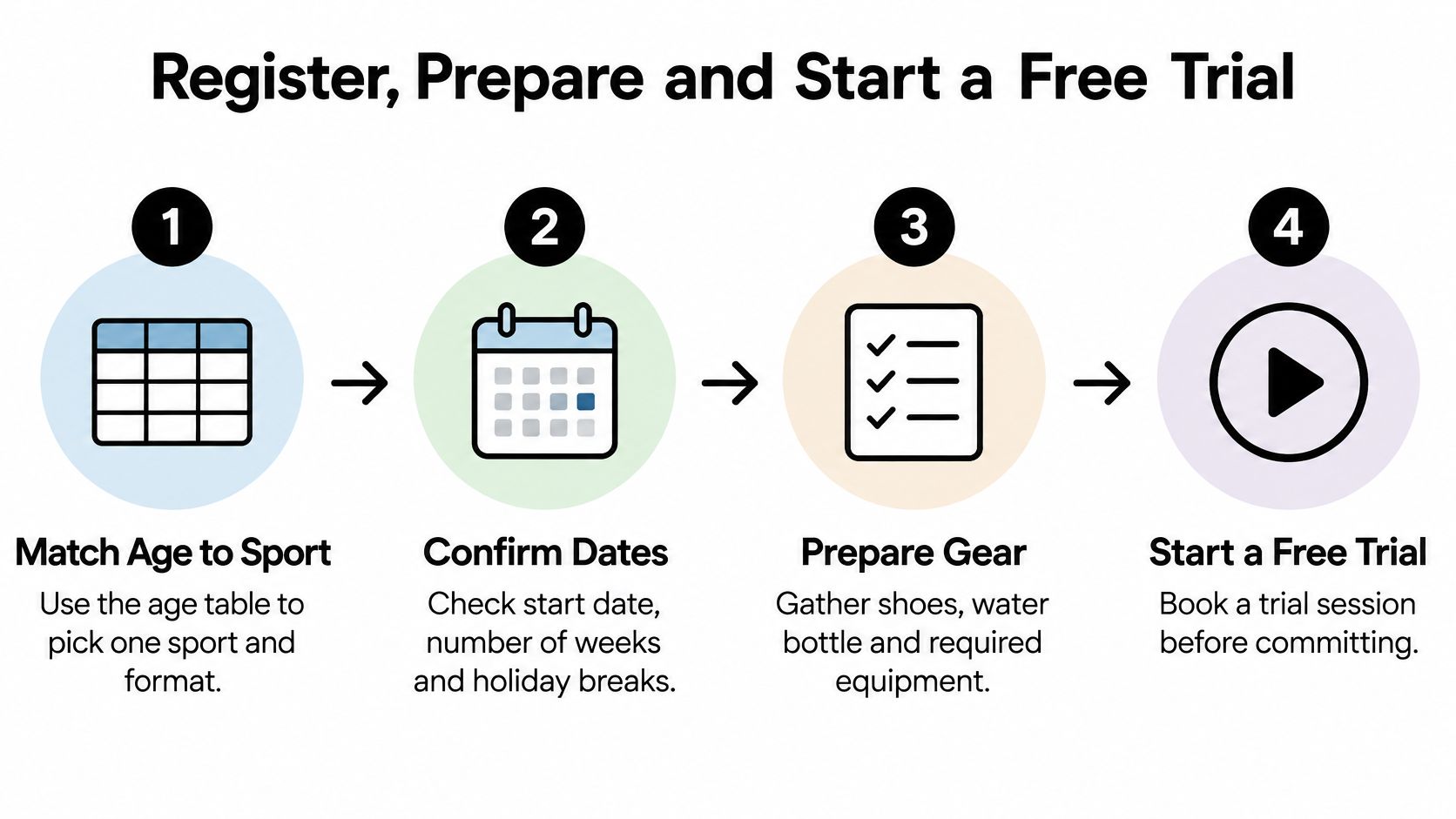
Use a trial to answer a real question
Our free trials are listed for MultiSport and soccer for ages 4 to 6, 7 to 9 and 10 to 13. Request one by completing the form with your child's name, age and favorite sport, then confirm the session arrangements before attending. Our $10 sibling discount on the second child applies only to sports classes, so don't assume it reduces league or camp charges.
During the visit, observe how your child responds to instructions, transitions and mistakes. Look for engagement rather than polished performance; a beginner needs room to learn.
Bring your checklist and discuss questions with the coach or director, including how make-up sessions work for the enrollment you're considering. If a younger sibling comes along, they may observe, but they can't walk, crawl or play with equipment in the class area.
JC Sports Houston offers age-appropriate toddler and youth sports instruction, seasonal leagues and skill-building opportunities for families in Humble, Kingwood and Atascocita. Visit JC Sports Houston to request an eligible free trial and confirm the fall option that fits your child's readiness, your calendar and your budget.

Comments