

What Makes a Good Coach in Sports: Qualities That Matter

You're standing beside the court at a trial class, watching your child hang back while other children chase the ball. The coach sounds confident, the activities look organized, and another parent says the team wins plenty of games. But you're trying to answer a different question: will this person help your child learn, feel included, and want to come back?
That's the useful starting point for understanding what makes a good coach in sports. Watch what the coach does when a child struggles, misses, interrupts, or needs a different challenge. Those ordinary moments tell you more about the learning environment than a trophy display.
The Qualities That Set Good Youth Coaches Apart
A good youth coach demonstrates clear teaching, appropriate challenge, purposeful encouragement, steady skill development, emotional safety, and inclusion. You can spot signs of each during a trial session. A win-loss record tells you little about whether the coach can help your particular child.
Start by watching the children rather than listening only to the coach. Can they begin the activity without looking lost? Are beginners involved? When something goes wrong, do they try again or turn toward the sideline?
Coaching qualities, session signs and red flags
Quality | What it looks like in a session | Red flag |
|---|---|---|
Clear communication | Short cues tied to a visible action, shown with a demonstration | Long lectures or vague praise without useful instruction |
Age-appropriate teaching | Games sized to the group, with rules changed when children struggle | Adult drills copied directly onto young children |
Encouragement | Specific praise for effort, attempts, and smart choices | Praise given only for goals or wins |
Skill development | Progression from simple to complex tasks, with frequent touches for every child | Long queues and few opportunities to practice |
Psychological safety | Mistakes treated as information, followed by a calm reset | Public shaming, sarcasm, or withdrawn attention after errors |
Inclusion | Attention spread across the group, with choices for every child | The same few players take every turn |
These qualities depend on each other. A coach can explain a drill clearly and still lose young players if the task is too difficult. Encouragement also means little if a child expects ridicule after the next mistake.
Credentials are a starting point
Relevant training deserves attention, especially where technical instruction and safety overlap. For families considering martial arts, Brazilian Jiu-Jitsu Academy Finder's guide to jiu-jitsu instructor lineage and certifications offers a useful background-check resource. Qualifications and live observation answer different questions, so use both.
A strong coach may be less polished in one area and still teach effectively overall. A confusing explanation followed by a thoughtful adjustment is different from repeated confusion that the coach ignores.
Trial-session rule: Mark each quality as seen, partly seen, or missing, and write down the behavior that earned the mark.
A single session reveals whether the signs are present. A pattern across later sessions confirms whether they're dependable. Don't dismiss a coach for an ordinary mistake, but don't excuse humiliation or unsafe conduct as an off day.
Feedback That Helps Players Improve
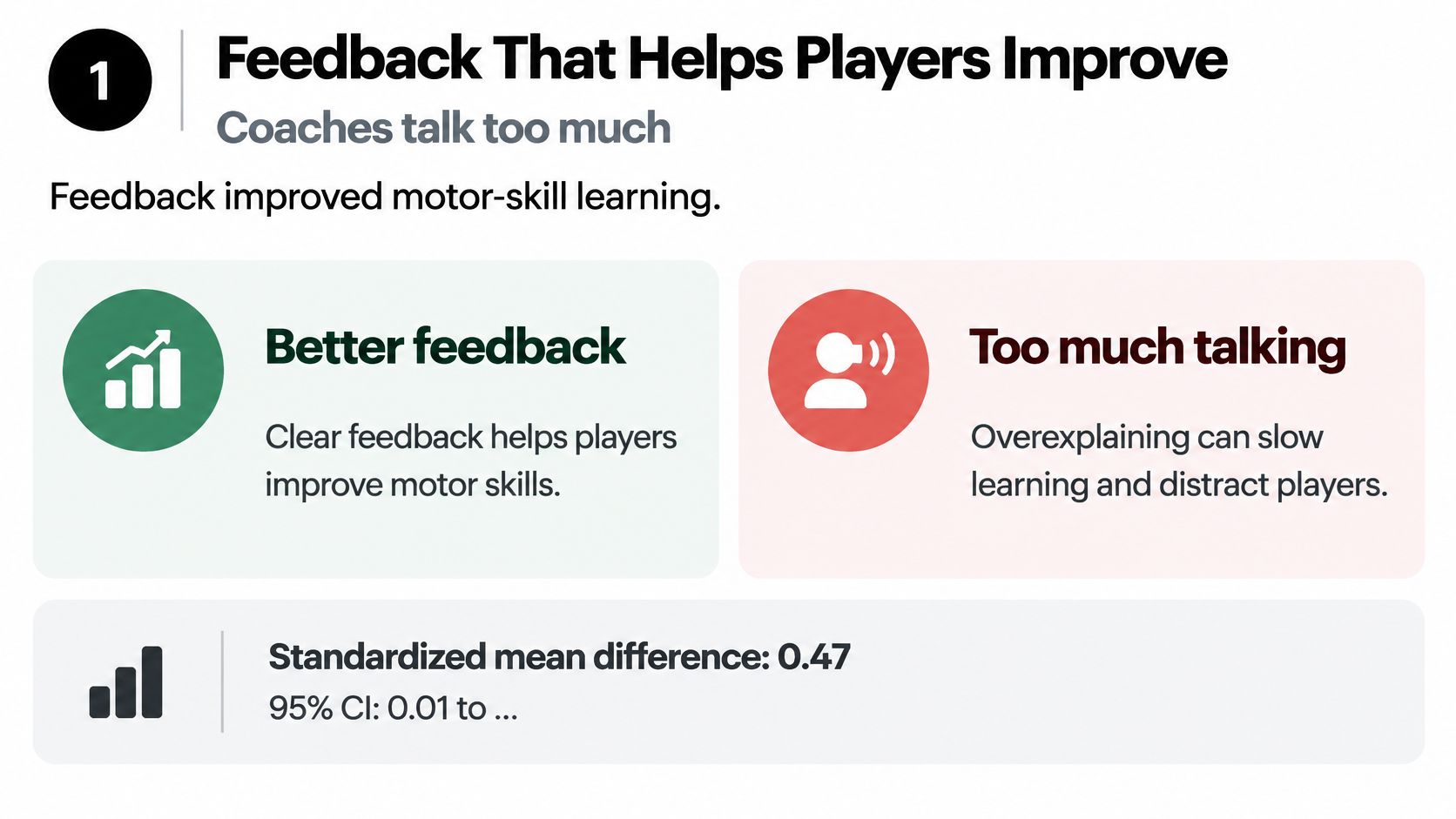
A common coaching mistake is talking too much. Continuous commentary can sound attentive while leaving children unsure which instruction matters.
A systematic review and meta-analysis of 15 physical-education studies found that feedback improved motor-skill learning, with a standardized mean difference of 0.47, for both simple and complex skills; visual, combined visual-verbal, modeling, corrective, and teacher-regulated feedback showed significant improvements, while verbal-only, evaluative, and informational feedback didn't show significant changes in the review's analyses. That doesn't mean spoken instruction is useless. It means a coach shouldn't assume that saying more produces more learning.
The distinction is between giving a child something to do and commenting on what happened.
Watch the correction become an action
Look for this coaching sequence:
Identify an observable movement. After a misplaced soccer pass, the coach draws attention to the supporting foot or hip position rather than judging the whole attempt.
Show the target pattern. The coach demonstrates the movement, or uses a suitable video clip when available. The child gets a visible reference rather than another abstract explanation.
Choose a priority cue and allow a retry. The coach asks for an adjustment, then steps back long enough to see what the child does with it.
For example, a coach might demonstrate placing the supporting foot toward the target before asking the player to try the pass again. That's more useful than announcing that the pass was poor or listing everything wrong with it.
Helpful response | Less useful response |
|---|---|
Name the movement to change | Judge the child's overall ability |
Demonstrate at a visible distance | Shout detailed instructions across the field |
Allow another attempt | Stop every attempt with more corrections |
Compare with the child's earlier effort | Compare the child with a teammate |
Check understanding through movement
Asking whether everyone understands often produces nods, not evidence. A coach can instead ask a child to demonstrate the starting position or show where the next pass should go. Kuraplan's quick checks for student understanding provide a useful classroom parallel: check what learners can do, not just whether they say they understand.
Your practical test is whether the child gets another opportunity and begins using the correction. Don't demand instant mastery. Look for a clearer attempt, a sensible adjustment, or a question that shows the player knows what they're working on.
Matching Teaching to Age and Stage
Watch the first ten minutes of any session and you can tell whether a coach planned for the children in front of them. A drill that stretches a confident ten-year-old will swamp a six-year-old still learning to control the ball. Age gives the coach a starting point for planning, and the children's responses reveal whether the plan fits. Use these age bands as practical guidance, then look for the adjustment.
Coaching focus by age band
Age band | Main focus | Good coaching emphasis | Avoid |
|---|---|---|---|
3-5 years | Movement, listening, and play | Short games, many touches, and plenty of encouragement | Long instructions, standings, and scored competition |
6-8 years | Fundamentals and coordination | Small-sided games, simple rules, and player choices | Early position specialization and heavy drill repetition |
9-12 years | Technique and game understanding | Varied practice, guided problem-solving, and introductory tactical ideas | Adult tactical lectures and early pressure on results |
13+ years | Decision-making and self-direction | Shared decisions, performance feedback, and goal setting | Treating teenagers like younger children or unexplained changes in playing time |
Each band asks something different of the adult in charge. Preschoolers need activities where moving and joining in are the whole point. Early elementary players need repetition of basic skills wrapped in simple choices. Older elementary players are ready to connect technique to game problems, and teenagers should have a growing voice in their own development.
Adjust the task before repeating the explanation
Coaching researchers describe a constraints-led approach: rather than telling a player exactly what to do, the coach changes the conditions of the activity and lets the player work out the answer. The coach can shrink the space, move the target, swap the equipment, add a defender, or rewrite a rule. The task itself becomes the teacher.
Consider a hypothetical group of seven-year-olds playing three-versus-three toward a large goal, with everyone required to pass before a shot. If one player scores without meaningful challenge, the coach could narrow that player's target or introduce defensive pressure. If the group stalls in frustration, the coach could enlarge the target and reward successful passing before expecting a finished attack. Same drill, two very different sessions.
The trade-off matters. Adding a rule can spread involvement across the group, but stack too many rules and children spend more time remembering instructions than playing. A capable coach strips complexity back out when that happens.
Look for productive struggle: children have a problem to solve, and they still believe they can solve it.
Skill progression should happen within that adjustment. A beginner might receive without pressure before facing a defender, while a more experienced teammate practices receiving on the move. Both should have frequent opportunities to act rather than wait in a queue.
Our youth soccer coaching tips offer further context for evaluating instruction on the field. After the session, ask:
Adjustment: What changed when children found the activity difficult?
Challenge: How did the coach extend the task for players who were ready?
Independence: Did children make more decisions without prompting?
Engagement: Did they keep experimenting, or stop because they felt lost?
Encouragement and a Safe Place to Make Mistakes
A coach's emotional climate deserves as much attention as the drills. A 2025 international Delphi study involving 42 scholars from 18 countries identified seven dimensions of quality youth sport, including deliberate instructional design, a safe and positive climate, and enjoyment.
Watch the coach's posture and response when a child becomes upset.
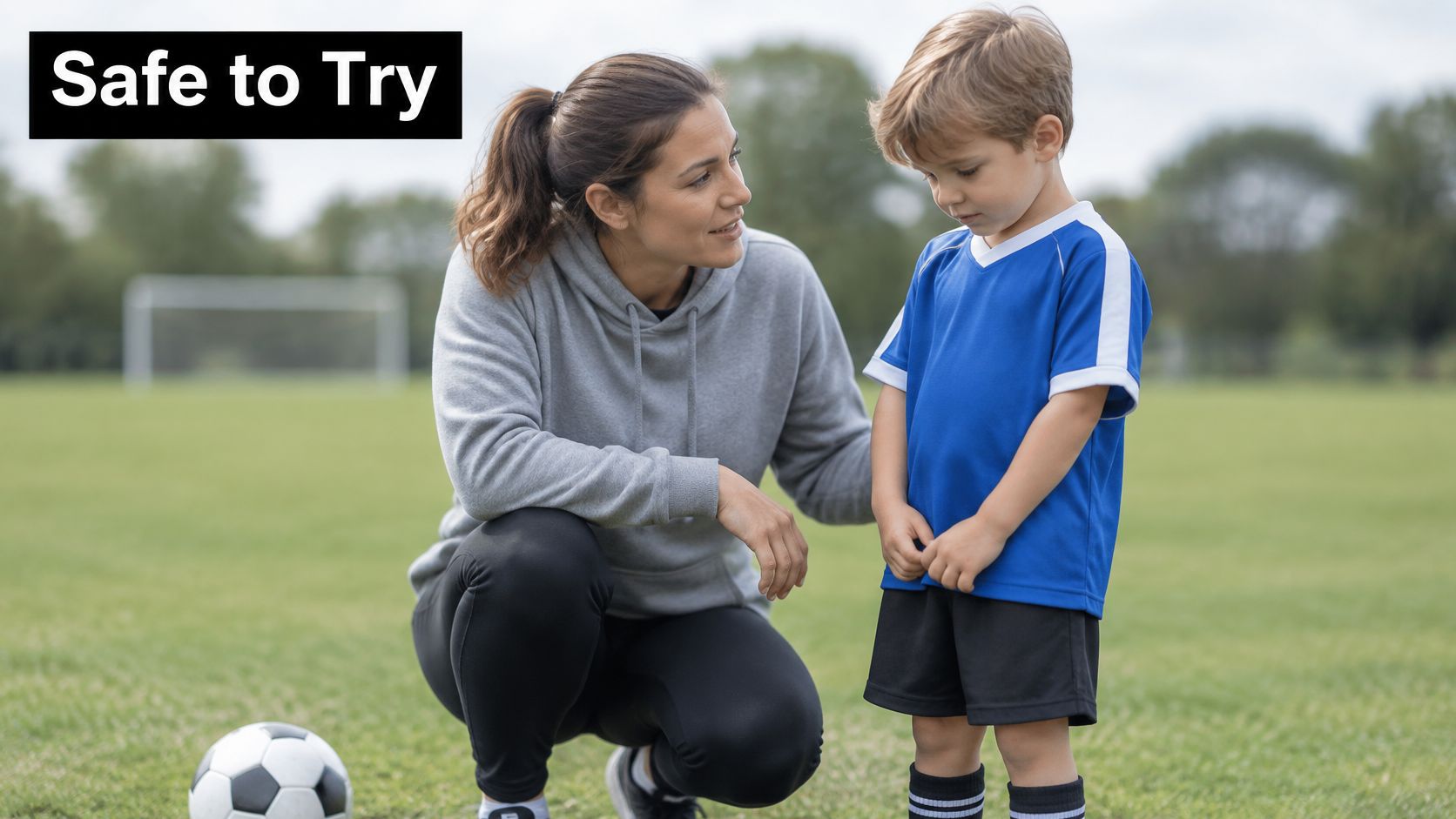
Psychological safety doesn't mean removing standards. Children still need boundaries around dangerous play, unkind behavior, and listening. The distinction is whether the coach corrects behavior calmly without making a child feel personally diminished.
Respond to the child before judging the behavior
An anxious child may become noisy, withdraw, or refuse a turn. A trauma-informed approach means considering what the behavior might communicate rather than immediately treating it as defiance. The coach can explain the expectation, offer a manageable choice, and help the child rejoin without demanding a public explanation.
Consider a hypothetical nine-year-old who misses a penalty. Sarcasm makes the mistake personal; conspicuously turning away can leave the child feeling abandoned. A better response identifies something useful in the attempt, suggests an adjustment, and makes clear that another opportunity will follow.
For parents, the important distinction is between praise that recognizes a decision and reassurance that denies what happened. The coach doesn't need to pretend the shot succeeded. They can recognize the willingness to take it.
Use the video as a prompt to consider how coaching messages land with young players.
Know the limits of a coach's role
Our guide to building confidence in sports gives families another way to consider everyday support. When a teenager's self-worth concerns extend beyond sport, Wald Behavioral Health's information about self-esteem therapy for teens is a separate resource to explore. A coach's encouragement isn't a substitute for appropriate mental-health care.
During a trial, notice whether an upset child can reconnect and participate again. Over time, assess confidence, cooperation, willingness to attend, and skill progress, not just the scoreboard.
How Inclusive Coaching Shows Up in Every Session
Technical expertise doesn't automatically make a coach inclusive. A well-designed activity can still serve only the loudest, quickest, or most experienced children if the coach overlooks who's getting opportunities.
The 2025 FEMCoach international survey collected responses from 463 coaches in 24 countries and examined inclusion environments, coach education, gender-related barriers, and pregnancy or childcare issues. Its scope is a reminder that gender equity involves the conditions surrounding participation and leadership, not whether a program recruits women as coaches.
Watch who gets to participate
For beginner girls and less confident children, belonging needs to be visible in everyday decisions. Look for these behaviors:
Attention beyond advanced players: The coach notices the beginner working, not only the player scoring.
No gender-based assumptions: Children aren't assigned roles according to presumed toughness, speed, or confidence.
Meaningful choices: Every child can influence something, such as selecting an activity variation or deciding how to solve a game problem.
Representative examples: Demonstrations and references include girls and boys rather than treating one group as the default athlete.
Intervention against exclusion: The coach responds when teammates repeatedly ignore or shut someone out.
Equal attention doesn't mean identical attention at every moment. A child learning a new movement may need extra help. The question is whether the coach returns to the wider group rather than allowing temporary support to become permanent favoritism.
Count opportunities, not compliments. A welcoming tone matters, but children also need chances to act.
For part of the session, make simple tally marks beside who receives the ball, gets corrected, answers questions, and waits. Don't calculate a score; look for repeated omissions. In private instruction, notice whether the child has choices and whether the coach adjusts to their responses.
This observation method works across soccer, baseball, basketball, camps, and leagues. Families considering disability-related support can also use our guide to soccer for children with special needs to frame questions about participation.
The goal isn't a perfectly even tally. It's an environment where quieter children have genuine opportunities to develop confidence, enjoy the activity, and choose to continue.
A Season of Coaching Put Into Practice
This illustrative composite scenario isn't a report about a particular child or program. Consider a nine-year-old beginner who passes whenever a shooting opportunity appears and asks to leave when finishing practice starts.
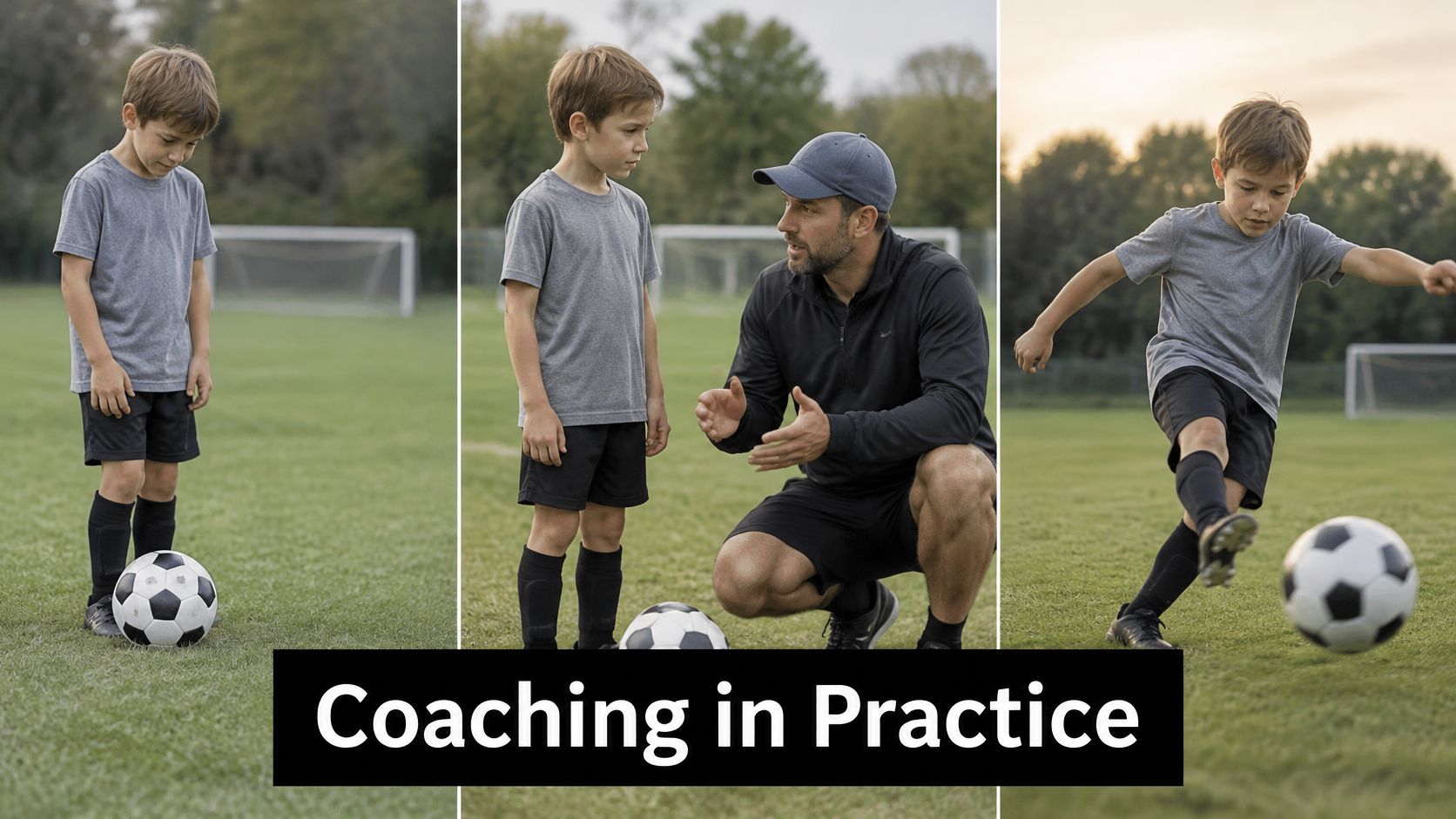
The coach begins with a small-sided game rather than immediately isolating the child for remedial work. The player gets involved in possession and eventually attempts a shot that rolls wide. The coach recognizes the decision to try, without adding a technical correction to that first hesitant attempt.
The following image illustrates the kind of close, supportive instruction a parent might observe.
Follow the decisions across the season
At a later practice, the coach offers a choice between shooting after a short dribble and finishing a partner's pass. The child chooses the dribble. That gives the coach a starting point the player is willing to attempt.
When the child is ready for instruction, the coach demonstrates where to place the supporting foot and leaves the next attempt uninterrupted. A miss follows. Instead of adding more corrections, the coach resets the ball and keeps the task manageable.
Then the child goes quiet after watching a teammate score repeatedly. The coach checks in privately, offers a return to the easier starting position, and reconnects the child with a partner.
The important decisions are easy to miss:
Restraint: The coach doesn't correct every imperfect attempt.
Responsiveness: The task changes when the child withdraws.
Progression: A scoring game appears once the player is willing to engage with it.
By mid-season in this scenario, the child attempts shots without prompting, asks where to aim, and stays for the full session. Some shots still miss.
That's a meaningful coaching outcome. The pattern is a child becoming more willing to participate and learn, not a dramatic transformation during a trial or a winning result at the weekend.
Use This Checklist at the Next Trial Session
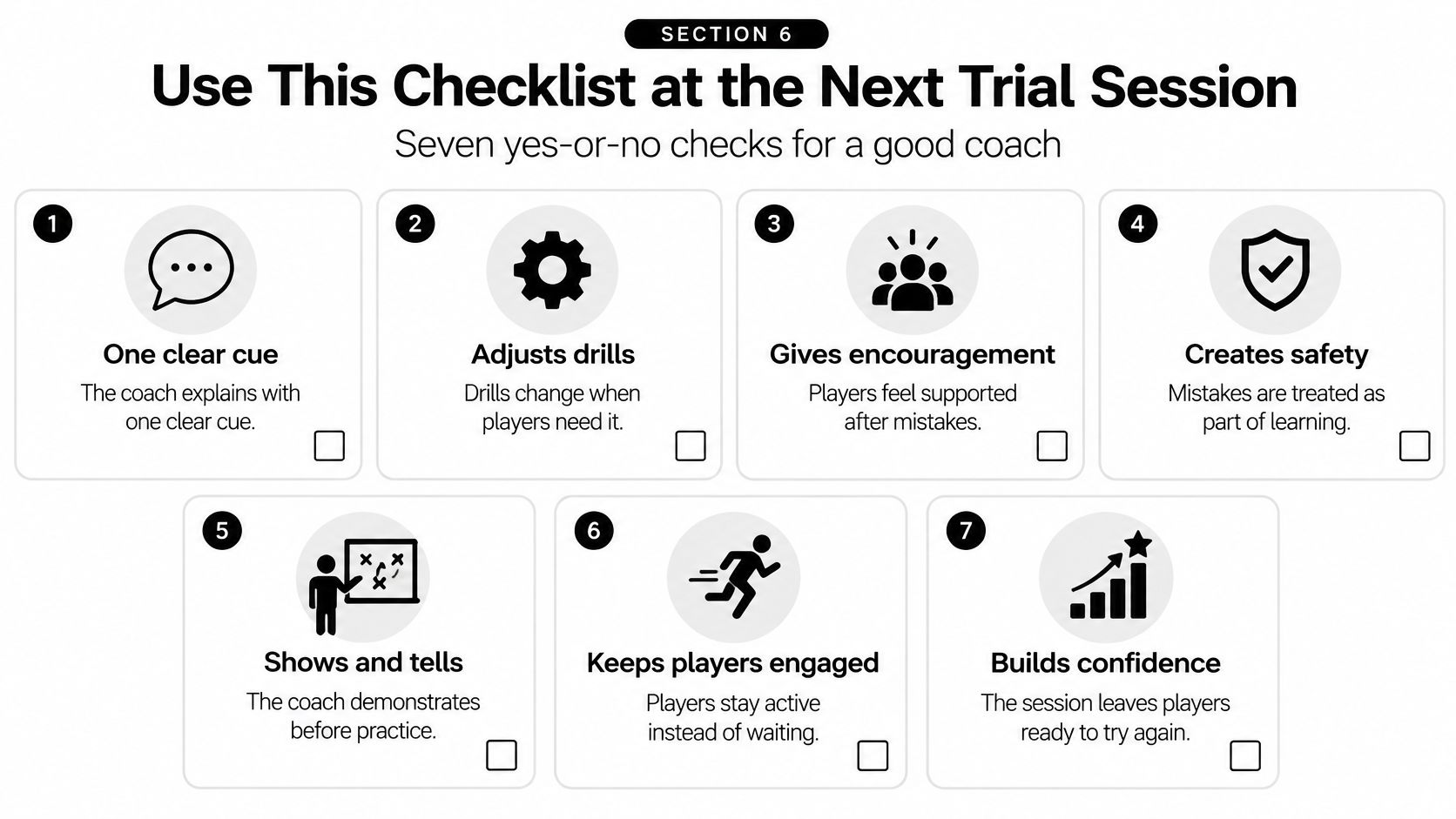
A trial session gives you roughly an hour of evidence, and a checklist turns that hour into answers instead of impressions. Write down seven questions and record yes or no beside each one, with a short example next to anything uncertain. Leave room for context, since a tired child or an unfamiliar activity can shape what you see.
Clear instruction: Does the coach explain the immediate task with a clear cue?
Adaptation: Do activities change when children struggle?
Specific encouragement: Does praise name an effort, attempt, or decision?
Calm recovery: Are mistakes followed by a composed reset?
Player voice: Does every child get a meaningful decision?
Shared attention: Does the coach engage beyond the most confident players?
Willingness to return: Does your child leave wanting another session?
Ask about what you couldn't observe
One session shows you behavior, and some answers sit behind it. At JC Sports Houston, all teachers are experienced and trained in the JC Sports curriculum, so the method behind any drill has a real explanation worth hearing. If something puzzles you or raises a concern, ask the coach or the director directly rather than guessing from the sideline.
Parents and caregivers stay in the building during classes, so the observation time is already built into your visit. Use it. Free trials are listed for MultiSport and for soccer for ages 4-6, 7-9, and 10-13. Bring the checklist, watch how the coach responds when a drill stalls, and ask about anything that remains unclear before deciding.
At JC Sports Houston, we offer age-appropriate youth sports instruction through interactive games and drills that put children at the center of learning. Book a free trial, bring your checklist, and watch how our teachers help your child participate, respond to challenges, and try again.

Comments