

Indoor Soccer Leagues: Formats, Costs and How to Choose

The standard advice about indoor soccer leagues is that they're the cheap, low-commitment alternative to club soccer: a short winter season, a small court, no travel, and a child who comes out with a better first touch.
Only part of that survives contact with a registration form. Indoor play does compress an enormous amount of decision-making into a short session, and a local season is easier to fit around a school week than a travel schedule. Whether it saves money depends on the league, the venue and the add-ons. Whether it suits your child depends on their age, their confidence and how the coach runs the room.
So treat an indoor league as three decisions stacked on each other: the format you're signing up for, the readiness of the child in front of you, and the season's cost and time commitment. Get the format wrong and everything after it feels like an expensive mistake.
Indoor Soccer League Formats Compared
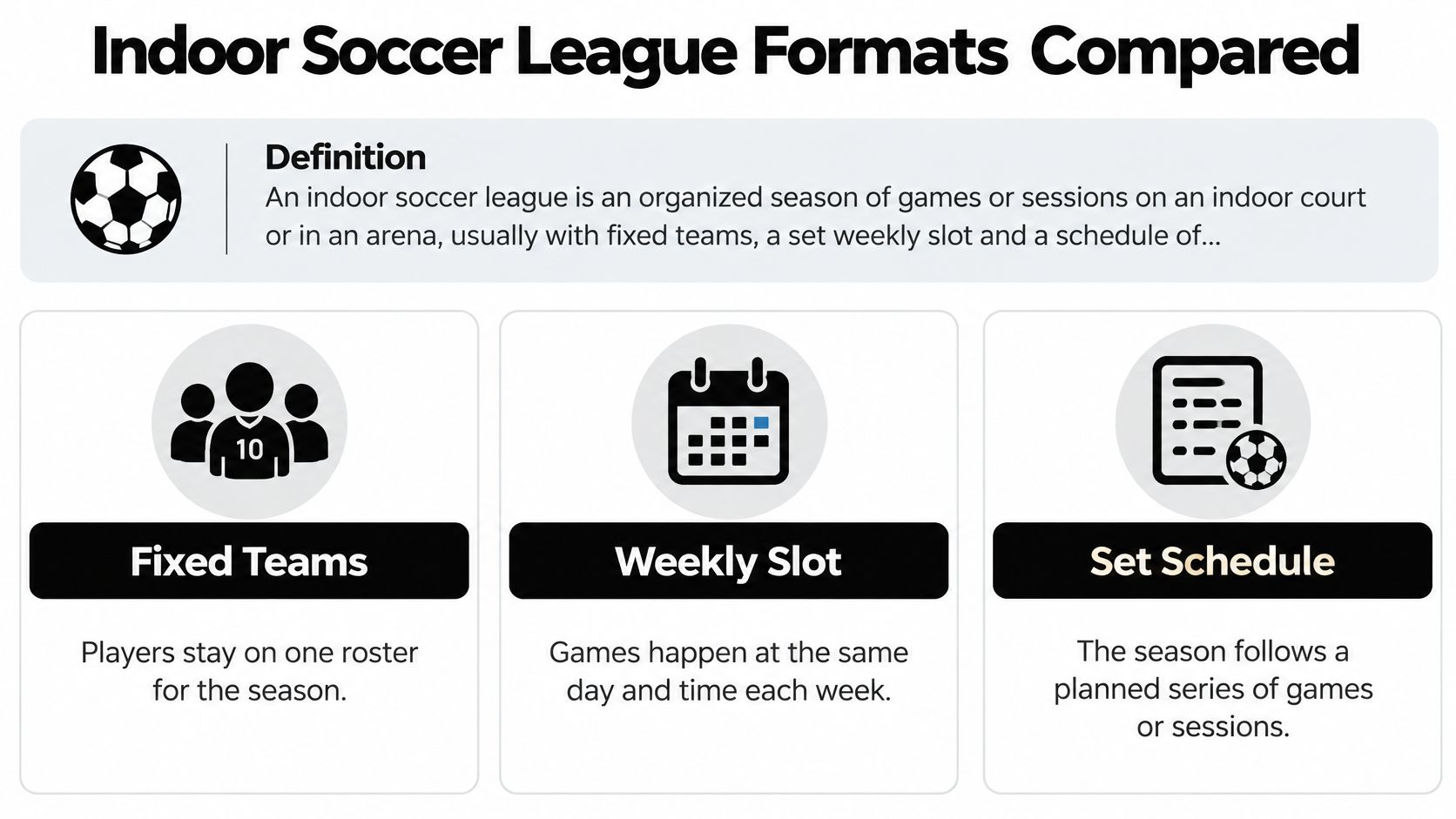
An indoor soccer league is an organized season of games or sessions on an indoor court or in an arena, usually with fixed teams, a set weekly slot and a schedule of games or a final standings table. That structure is what separates a league from a class. A class sells you sessions. A league sells you a roster, a fixture list and a position in the standings by the final week.
Three features define the shape of the season:
Most confusion comes from parents using one phrase for three different products. Futsal is the formal version: two teams of five, one of them a goalkeeper, on a court between 25 and 42 m long and 16 and 25 m wide, with markings 8 cm wide and a touchline longer than the goal line, as the futsal laws of the game published by the Turkish Football Federation set out. Substitutions run continuously rather than stopping the match.
Recreational indoor leagues borrow the small-sided idea and then set their own roster limits, court size and rule variations. The label on the flyer tells you almost nothing. The league's published rules tell you everything. Full-sided outdoor soccer is the 11-a-side game on a full pitch, and it's the benchmark most families are comparing against.
Format | Players per team | Playing space | Best for |
|---|---|---|---|
Futsal under FIFA laws | 5 including goalkeeper | 25 to 42 m long by 16 to 25 m wide | Competitive youth and adult play |
Recreational indoor league | Set by each league | Set by the league, usually a smaller court or turf field | Local, lower-pressure play |
Full-sided outdoor soccer | 11 including goalkeeper | Full pitch | Older youth and competitive pathways |
What the Smaller Space Changes
On a court that size, players receive, pass, press and make one-versus-one decisions far more often than in the full-sided game, because there's less room and less time to scan before the ball arrives. That's the whole mechanism behind every claim you've read about indoor soccer sharpening touch. It's also why a badly run indoor session feels frantic. The same compression that creates touches also creates pressure, and a coach has to manage it.
Three Questions That Sort Any League
How many players per side? Five is futsal. Seven or eight suggests a modified recreational format with more space and fewer decisions per child.
What are the court dimensions? If nobody can answer, the league hasn't thought about workload or spacing. Our guide to futsal and indoor soccer walks through how court size changes the game.
Do substitutions happen during play? A yes means rolling rotations and short rests. A no means children standing on a sideline waiting for a whistle.
Ask those three before you ask about price.
How Small-Sided Play Builds Youth Development
Count the ball contacts in an hour and the argument makes itself. A child on a full pitch can go several minutes without touching the ball. The same child on a small indoor court with four outfield teammates meets it constantly, and every meeting is a small decision made under time pressure.
Rolling substitutions are what make that pace sustainable. Under futsal laws a team starts with one goalkeeper and four outfield players, and substitutions happen while the ball is in play through a marked substitution zone, as the FIFA guide to futsal rules explains. A coach can pull a tired child, give a quiet one a two-minute block, and never stop the game to do it.
That changes what a session can teach. Instead of one long scrimmage, a coach can run short blocks with a single focus: pressing the player with the ball, defending the moment possession is lost, receiving with a defender tight on your back, or two-pass combinations in a crowded corner. Each block is short enough that a six-year-old's attention holds.
Why the bench matters: a child who sits for fifteen minutes learns nothing and notices everything. Continuous rotation keeps every player inside the game rather than beside it.
Our curriculums place the child at the center of the game, and children build motor skills, self-confidence and sports technique through interactive games and drills. That ordering matters more indoors than outdoors, because the court punishes hesitation and rewards a child who tries again quickly.
Roster size is a design choice, not a formality. FIFA competition rules permit up to nine substitutes, though recreational youth leagues can choose smaller rosters so each child receives meaningful minutes. If a league carries twelve children into a five-a-side game, ask how playing time is shared before you pay.
Goals are a poor measure of whether any of this is working. Track these instead: first touches that hold under pressure, passes completed after receiving, recoveries within a few seconds of losing the ball, and decision quality during fast transitions.
From the sideline, two things tell you more than the scoreboard. Does your child try again after a mistake, and do they move and look for the ball without being told? Those habits are exactly what small-sided soccer games are designed to build.
Age Fit, Readiness and Safety Checks
Age bands are a starting point. The child in front of you is the verdict. A confident four-year-old can hold their own in a group of six-year-olds, and a shy nine-year-old may need a beginner division where nobody is keeping score. Use the table as a map, then watch how your child moves, listens and joins a group.
Age band | Development focus | Typical format | Who it suits |
|---|---|---|---|
Ages 3 to 5 | Movement, ball familiarity, listening | Small-group, non-competitive sessions | First organized sport, shy or new children |
Ages 6 to 8 | Dribbling, passing, basic rules | Small-sided games with frequent rotations | Children building confidence with teammates |
Ages 9 to 12 | Receiving under pressure, positioning | Small-sided leagues with set schedules | Children who want regular games |
Ages 13 and up | Tactical awareness, futsal rules | Competitive or adult recreational leagues | Experienced players seeking a challenge |
The Readiness Signs That Beat a Birth Year
A child is ready for a league when three things are true. They follow a simple instruction without needing a demonstration. They can stay with one activity for a full session. They join a group without an adult holding their hand for the whole hour. If two of those are shaky, a class or a multi-sport session is a better first step than a league with fixtures and standings.
Small-sided games can increase involvement and repetitions, but the value depends on age-appropriate rules, how playing time is shared, coach behavior, the playing surface, how wall contact is handled, what is expected of the goalkeeper, and whether the competition tips into something too intense for the age. Busy seasons also ask families to fit practices, games and travel around school and work, so confirm the weekly time commitment before enrolling. That is the load a family agrees to, and it is why "beginner-friendly" has to mean something specific.
Seven Checks to Run Before You Pay
Coach training. Who runs the session, what training do they have, and have they coached this age group before?
Supervision. What is the adult-to-child ratio, and do staff stay for the entire session, including water breaks?
The play area. Is the court clearly defined, are spectators kept back, and are substitution zones marked on the floor?
Equipment. Does the ball size suit the age, and are goals secured rather than free-standing?
Concern route. Does a worry go to the coach or to the director, and how quickly should you expect a reply?
Health and injury. Who on site is first-aid trained, and how are parents told if something happens during a session?
Communication. How do cancellations, schedule changes and safety notices reach families, and how late can they arrive?
A strong answer is specific. It covers session length by age, a stated playing-time policy, how contact and wall play are handled, and how sensory needs and neurodivergent children are supported. A vague answer is a reason to ask again before you pay.
Ask this out loud: "What does a session look like for my child's age, minute by minute?" The answer tells you whether anyone has thought about attention spans or only about drills.
If your child is anxious, ask what happens in the first ten minutes and whether a parent can stay within sight. If your child is still building basic movement, ask how the coach introduces competition, whether scores are kept, and what happens when a child cries or refuses to join in. A league that can describe its plan for those moments has met them before.
Choose the session that puts repetition and enjoyment ahead of winning. A scoreboard is the least useful thing a five-year-old brings home.
One last check happens at registration, away from the court. A parent or guardian consents to the program, and the league collects a child's information only from a parent or legal guardian for registration and participation. If a concern comes up mid-season, take it to the coach or the director directly rather than a group chat.
What a Season Asks of Your Schedule
Most indoor seasons follow the same architecture: a fixed number of weeks, one or two set days, and a slot that repeats at the same time each week. That predictability is the appeal. It's also the risk, because one bad slot can cost you every Saturday in the season.
Start by writing the slot into a real week rather than an ideal one. A session that begins at 5:30 on a Tuesday collides with pickup, dinner and homework in a way that a 10 a.m. Saturday session never will. Families with two children in different programs are the ones who feel this first.
Plan on staying, too. Sports programs generally aren't drop-off classes, and at JC Sports Houston a parent or caregiver of every participant must stay in the building during the session. That's an hour of your week, not a free hour, so budget it alongside the fee.
Questions to Ask Before You Commit a Weekday
How many weeks does the season run, and when does it end? A season that finishes three weeks before a school break is easier to plan around than one that straddles it.
Which day and time, and does the slot ever move? Ask specifically about rescheduling for facility conflicts.
Are missed sessions or games made up? Get the answer in writing before the first session, not after the first absence.
What happens if a session is cancelled? Weather isn't usually a factor indoors, but facility and staffing issues are.
How are schedule changes communicated, and how far ahead? You need to know before you've already driven across town.
Then run the family test. Count every fixed weekly commitment for every child and every parent, add the new slot, and look at what's left. If the week only works on paper, it will fall apart in the middle of the season.
What a Season Really Costs Your Family
Here's the number that should sit next to any headline price. The Aspen Institute's 2024 national survey found that families spent an average of $1,016 on a child's primary sport, up 46% since 2019, while soccer spending rose 69% over the same period, according to Project Play's research. That research links rising costs to registration, facility space, travel, lodging, camps and private instruction.
Now the part indoor leagues don't advertise. Indoor soccer isn't automatically the inexpensive option. A shorter season and local scheduling can cut travel and lodging, which are often the biggest line items in club soccer. They don't cut facility rent, coaching hours, equipment or peak-time court hire, and those costs land inside the registration fee.
Expense | Typical treatment | Question to ask |
|---|---|---|
Registration fee | Usually a fixed charge | Does it cover the whole season and any trial session? |
Uniform and shin guards | Usually a family purchase | Is a uniform required, and is it provided or bought separately? |
Court shoes | Family purchase | Which indoor shoes are allowed on this surface? |
Transportation | Family cost | How far is the venue from home, and at what time of day? |
Make-up sessions or games | Set by league policy | Are missed sessions replaced, and at what cost? |
Optional private training | Optional extra | Is it needed to move up a division, or is it genuinely optional? |
Camps and clinics | Usually priced separately | Are they included in the league fee? |
Affordable Routes Worth Asking About
Ask directly, because leagues rarely advertise these on a flyer. Do you offer a payment plan? Is there a scholarship or hardship rate? Can equipment be shared or passed down, and is a beginner division available at a lower fee than the competitive one? Local recreational play is usually the least expensive entry point, and for a first season it's often the right one.
Court shoes are the expense parents most often get wrong. Indoor soccer needs a flat, thin, non-marking sole that grips a hard court and lets the foot feel the floor. Running shoes are too cushioned and too grippy, and they are the usual reason a child feels clumsy in the first session.
So can a child develop meaningfully without a club budget? For most beginners, yes. Volume of touches, a coach who teaches, and a child who wants to come back next week matter far more than the badge on the shirt.
How to Register and Prepare Your Child
Registration is a sequence, and doing it in order prevents most of the arguments that follow. Here's the order that works.
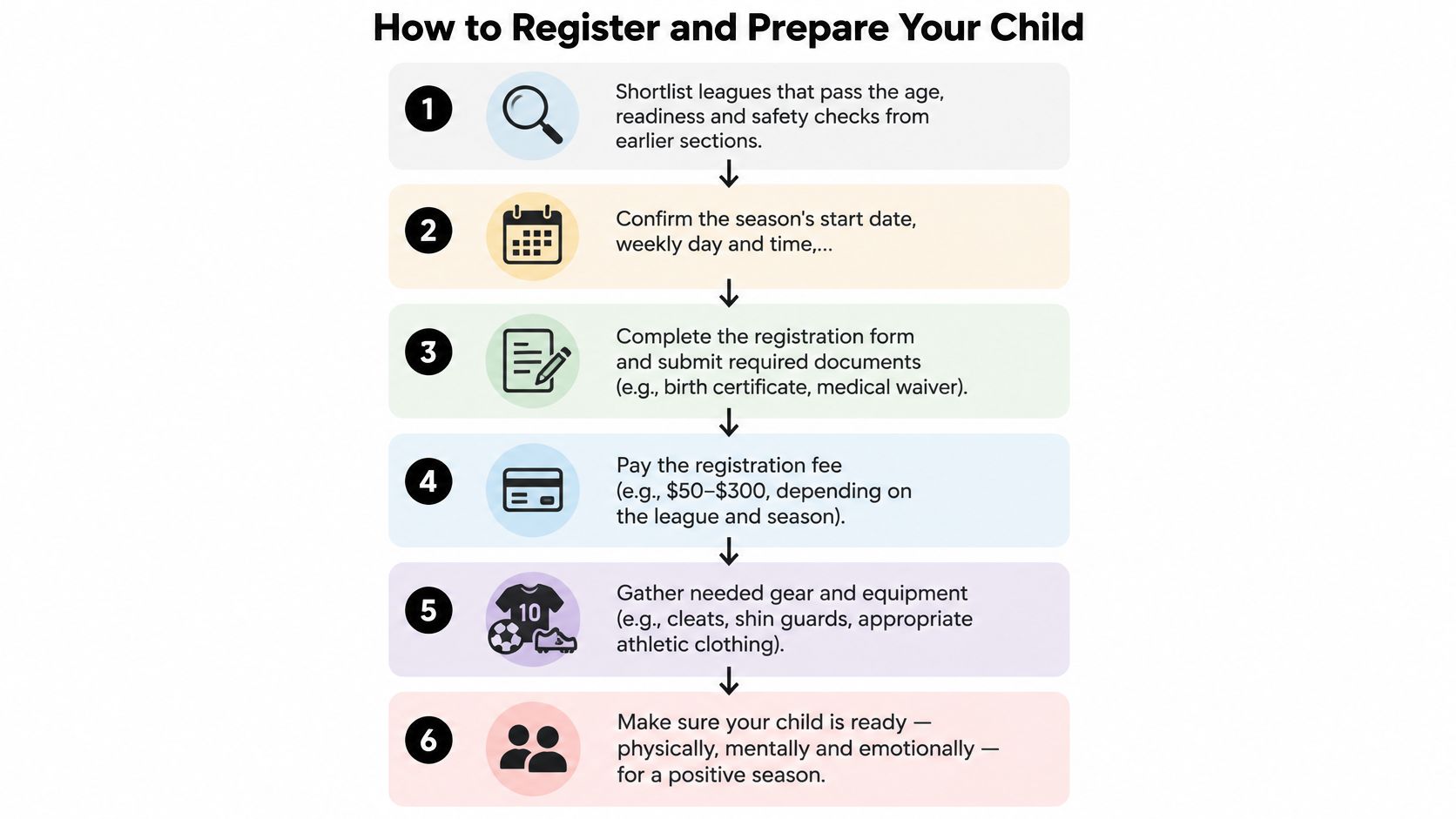
Shortlist leagues that pass the earlier checks. Age fit, readiness, safety, cost and schedule. Two or three candidates is plenty.
Confirm the season shape. Start date, weekly day and time, number of weeks, and the final session before you pay anything.
Read the refund, cancellation and make-up terms. Then put the event dates in a calendar you look at regularly.
Complete the form and sign the consents. Parents or guardians must consent to services for youth sports programs, and information about children is collected only as provided by a parent or legal guardian for registration and participation.
Confirm what the provider supplies. At JC Sports Houston we provide training equipment, soccer, football and baseball equipment, and all curriculum materials, so families bring indoor-appropriate shoes, a water bottle and comfortable clothes rather than their own gear.
Prepare the child in words, not promises. Describe the session in plain terms the night before, practise following short instructions at home, and plan a calm arrival with a familiar adult rather than a rushed dash from the car.
Watch the first session closely. What matters is the coach's response to a child who hesitates, cries or gets something wrong, not the drill on the whiteboard.
One small thing that saves a season of lost kit: label the bag before the first session. A set of soccer gear name tags means two identical water bottles and three pairs of black shin guards stop becoming a weekly search at the door of the facility.
If your child wants to see what a session looks like before walking in, watch this together.
A healthy first session has a simple signature. The child is moving for most of it. The coach is speaking to the whole group, not only the strongest players. And on the drive home, the child is willing to go back.
Confirm the League Fits Before You Enroll
Three decision rules cover most families.
If your child is anxious or still building basic movement, choose a beginner or recreational league that puts repetition and enjoyment first. Progress in the first season looks like willingness to attend, not goals scored.
If your child is ready and wants games that count, choose a league that follows futsal-style rules, publishes its roster and court details, and states how substitutions and playing time are handled. A league that can answer those questions in writing will usually handle the rest well too. If you want to know what a well-set-up space looks like before you visit one, this look at an indoor soccer facility covers court layout, wall play and where spectators should sit.
If the budget is tight, favour local recreational play, ask which expenses are optional, and treat private training and camps as additions for later seasons rather than entry requirements.
For families in Humble, Kingwood and Atascocita, JC Sports Houston is one local option. Our leagues include the MLS Go Indoor Soccer League, a Soccer League, a Baseball League and a Basketball League, all run indoors on small-sided formats. Customers who opt in to SMS messages receive registration confirmations, practice and game reminders, schedule changes and cancellations, so the communication question above has a concrete answer. One policy to check before you commit: there are no refunds or credits on camps, clinics and leagues, so confirm the event dates and times before enrolling.
The Next Step
Take the questions from this guide to whichever league you're considering, including us. Ask about players per side, court size, substitutions, session length, coach training, supervision and what the season costs once uniform, shoes and transport are counted. Enrol when the answers fit your child and your week. Not before.
Frequently Asked Questions
Can my child join mid-season? Ask whether late entries are accepted, how many weeks remain, and whether the fee is prorated. A league that prorates fairly and places a child on a team that needs numbers is usually a league that handles the joining process well.
Can my child switch divisions? Ask for the move-up rule and whether it depends on age or on skill. Most programs will move a child who is clearly in the wrong group, but the decision is easier before week three than after.
Is a trial session available? Many leagues offer one. Ask whether it's included in the registration fee or charged separately, and whether the trial counts as a place on the roster. We list free trials for multi-sport and for soccer at several age groups, and families can request one by sending the child's name, age and favourite sport.
What if my child wants to stop? Tell the coach first, since a child who wants to quit is often reacting to one specific thing that can be fixed. Then check the refund terms before the season starts, because the answer after week four is usually different from the answer before week one.
Does indoor play help outdoor skills? Yes, for first touch, passing and decisions under pressure, and those transfer to the 11-a-side game. It doesn't replace the experience of a full pitch with long switches of play and sustained running, which is why most players benefit from both over a year rather than choosing one permanently.
Is it worth asking the league about its safety policy? Yes, every time. A clear written answer about supervision ratios, first aid, wall contact and equipment is one of the cheapest signals you'll get about how a program is run.
JC Sports Houston runs year-round youth sports in Humble, Kingwood and Atascocita, with indoor leagues, seasonal camps and age-appropriate classes built around small-sided play and coached repetition rather than sideline waiting. If you're weighing an indoor season and want to see the room before you commit to a schedule, request a free trial and watch how your child responds to the coach, the court and the group. Visit JC Sports Houston to see current programs and to ask us the questions from this guide.

Comments