

Soccer Classes for Beginners: A Parent's Practical Guide

Youth sports costs rose 46% from 2019 to 2024, so families should compare total expenses, trial options, and scheduling flexibility before enrolling. Soccer classes for beginners are worth considering when they offer age-appropriate coaching, small-sided play, and a clear path to continue without forcing a major commitment.
You're probably weighing the decision from the sideline. Your child may be kicking a ball around the backyard, asking to join friends, or hiding behind your leg at every new activity. You want a class that teaches real skills, but you don't want to pay for equipment, uniforms, travel, and a season of competition before knowing whether soccer feels right.
That's the right concern. A beginner program should make the first step simple, welcoming, and financially clear. It should help your child enjoy movement, learn how to participate with others, and decide whether they want more. The best class isn't the one with the most complicated drills. It's the one your child feels comfortable returning to.
Why Your Child Should Start With Beginner Soccer Classes
The first soccer class often tells you more than the first goal. A child who has never played may spend the opening minutes watching, touching the ball cautiously, or moving in the opposite direction from everyone else. That isn't failure. It's a normal first response to a new space, a new coach, and unfamiliar expectations.
Beginner soccer classes give children a structured way to learn without being judged against experienced players. They introduce ball control, movement, listening, and teamwork in manageable steps. A thoughtful coach also gives children room to make mistakes without turning every missed pass into a correction.
The financial side deserves equal attention. U.S. families spent an average of $1,016 on a child's primary sport in 2024, while soccer averaged $910 annually, and the primary-sport average was 46% higher than in 2019, according to reported youth sports cost data. Those figures make a trial class, transparent pricing, and a realistic equipment list more than convenient extras. They're part of responsible program design.
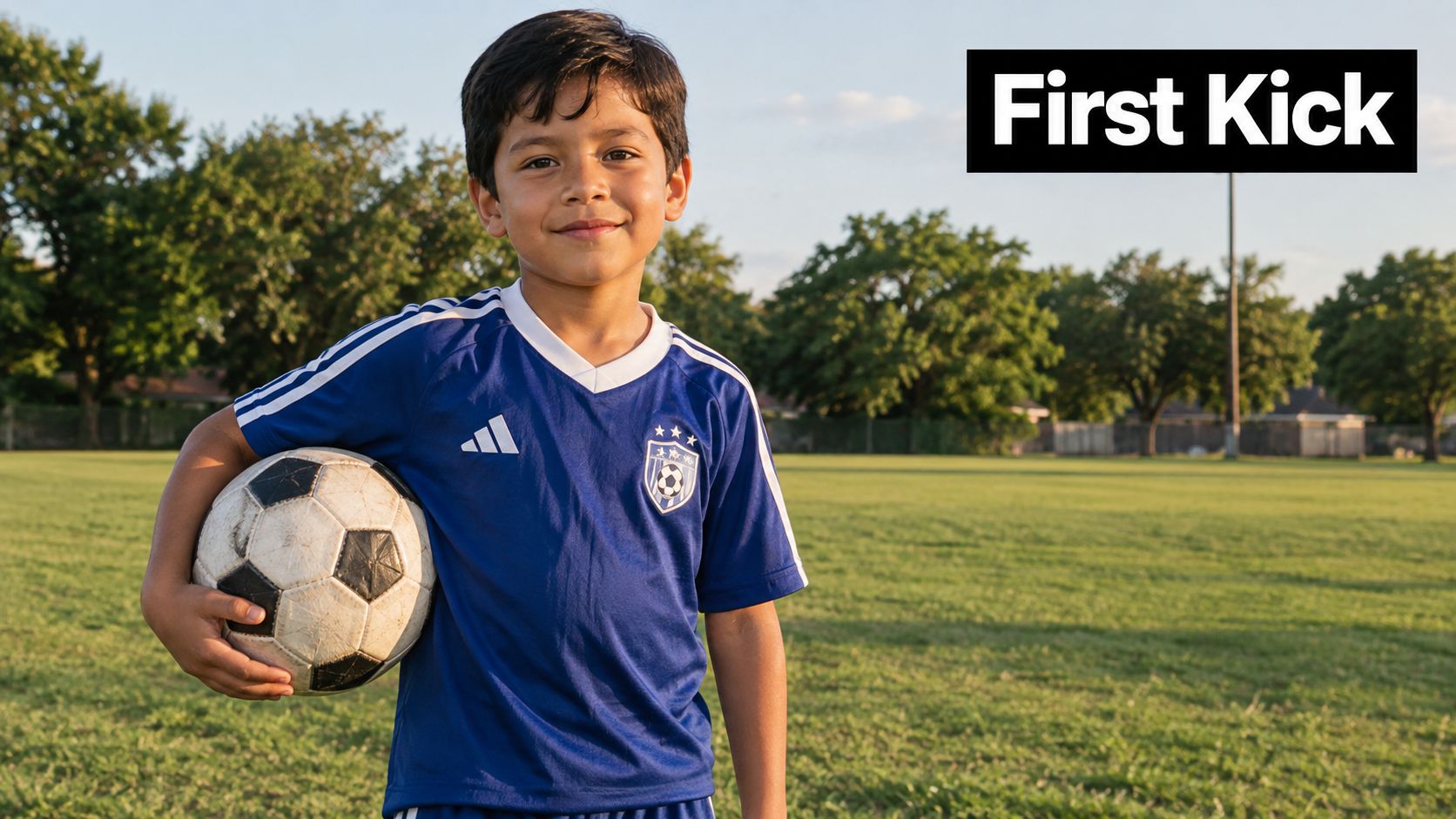
A first class should answer three questions
Does my child feel safe? The coach should welcome hesitant children, explain activities clearly, and avoid public embarrassment.
Is the class introductory? Children shouldn't spend the session standing in lines while advanced players dominate the ball.
Can our family sustain it? Ask about uniforms, required footwear, makeup options, cancellation terms, and the cost of continuing.
Participation data reinforces why entry-level options matter. Outdoor soccer participation among U.S. players aged six and older reached approximately 14.1 million in 2023, an 8.1% increase from 2022 and a 23% increase from 2018, according to U.S. soccer participation reporting. A large participation base needs more than competitive teams. It needs low-pressure doors through which new families can enter.
What Soccer Classes for Beginners Actually Teach
A good first class doesn't rush toward a full match. It builds a child's relationship with the ball and teaches movement through games that feel achievable.
Start with ball familiarity. Toddlers may roll, stop, carry, or gently push the ball while following a coach. Preschoolers can dribble toward a color, a cone, or a parent. Elementary-age beginners can practice changing direction, shielding the ball, and keeping it close while looking up.
Next comes coordination. Children learn to balance on one foot, stop safely, accelerate, slow down, and coordinate their eyes with their feet. These activities may use cones, gates, colors, or imaginative themes. The format can look playful, but the learning is deliberate. A child who learns to stop and turn is building the physical foundation for later dribbling and defending.
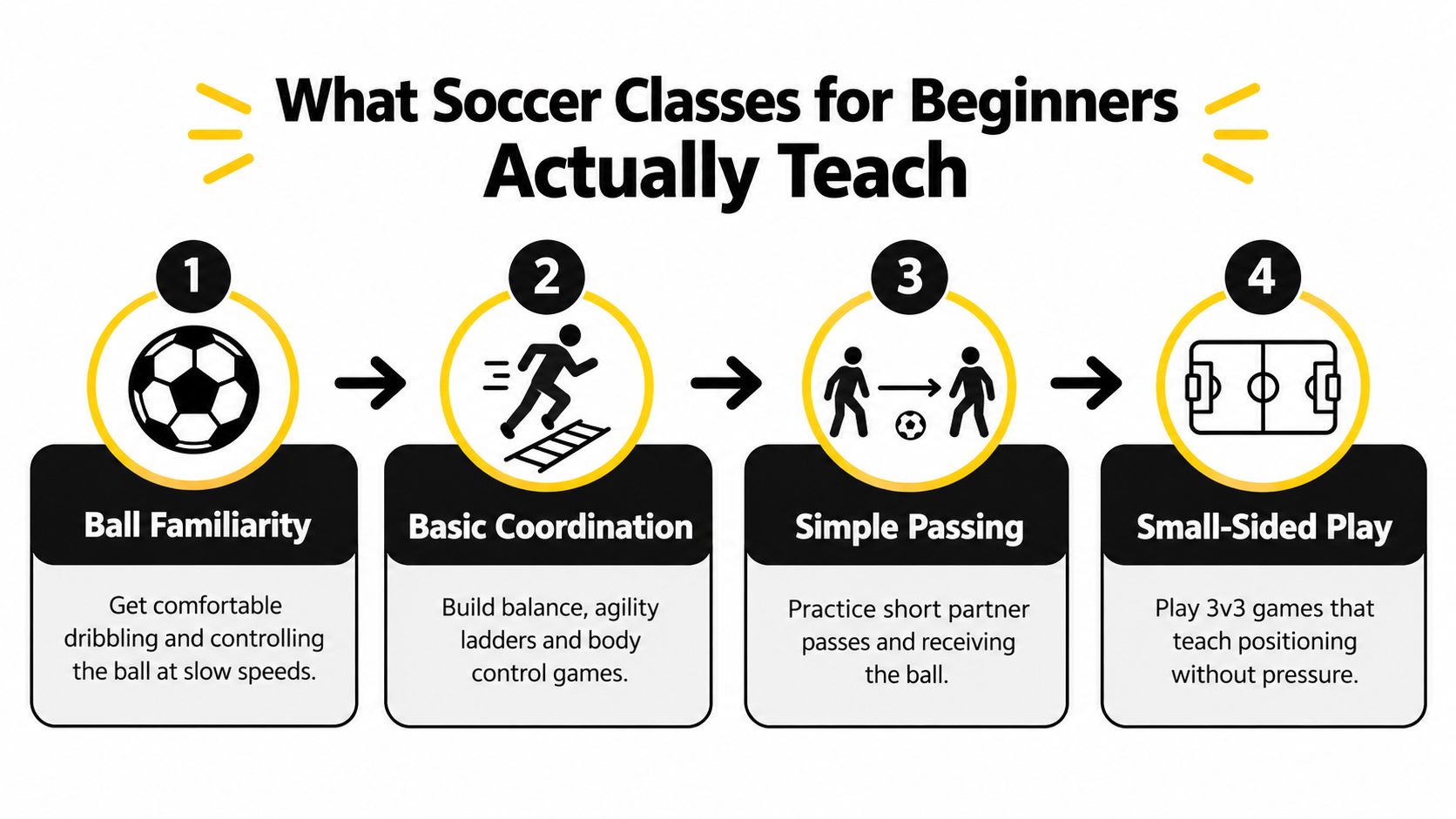
The basic progression
Passing usually starts with short distances and a stationary partner. The coach may ask children to pass through a gate, receive the ball with a soft touch, or move after passing. Young children don't need a lecture about angles. They need repeated opportunities to see where the ball goes and how a teammate responds.
Spatial awareness develops when players learn where there's open space and where another child is standing. Coaches can create this understanding with simple instructions such as “find an empty gate” or “move away from the crowd.” Older beginners can begin scanning before receiving and supporting a teammate from the side.
Teamwork enters through turn-taking, shared targets, and small games. Children learn that soccer isn't only about chasing the ball. They also learn to wait, help, communicate, and recover after losing possession.
For a useful skill-by-skill reference, parents can review what skills children need to play soccer. The main test is simple: after several sessions, your child should show more comfort moving with the ball, not merely repeat coach commands.
The Case for Small-Sided Games in Youth Soccer
Full-team play looks like soccer, but it often gives beginners too little soccer to do. In a crowded game, one child may chase the ball, another may stand far away, and several may wait for a turn that never comes. More players on the field don't automatically create more learning.
Small-sided games, such as 2v2, 3v3, or 4v4, put the child closer to the action. Players receive the ball more often, make decisions sooner, and experience the result of each choice. Research comparing youth game formats found that younger or less-experienced players benefit from greater ball involvement and perform faster attacking sequences with more individual actions in small-sided settings, as described in research on youth small-sided games.
That difference matters for a beginner. A child who gets repeated chances to dribble, lose the ball, recover, pass, and try again develops a clearer sense of cause and effect. The game becomes understandable. The child starts to recognize, “There's space over there,” or “I can try to go around this player.”
What a strong session looks like
A coach should use a smaller playing area, rotate players regularly, and avoid fixed positions that leave children waiting. The progression should become more complex only when players are ready:
Unopposed ball work, where children explore stopping, turning, carrying, and dribbling.
1v1 challenges, where they practice protecting the ball and finding a route forward.
Small-sided games, where passing, support, and defensive recovery appear naturally.
Simple constraints, such as end zones, target players, or a requirement to move after passing.
These constraints should clarify the game, not make it feel like an examination. A young child may need a visual target and a short round. An older beginner can handle more choices, but still needs frequent involvement.
Parents should ask a coach, “How much time do beginners spend in small-sided games?” Also ask whether every player gets opportunities to attack, defend, receive, and restart play. The answer will reveal more about the program than a list of advanced drills. Parents can also see how small-sided soccer games work before observing a class.
How to Judge Whether a First Class Is Developmentally Appropriate
A developmentally appropriate class leaves a child active, respected, and willing to try again. It doesn't need to produce exhaustion or immediate technical polish.
That point is especially important for preschoolers. In a representative study of 2,935 children ages two to six, weekly organized sports participation was associated with only 2.8 additional minutes of daily moderate-to-vigorous activity, but it was also associated with 40% higher odds of meeting physical-activity recommendations, according to the preschool organized-sports study. The practical lesson is clear: a class should build enjoyment and consistency, not chase intensity for its own sake.
A shy child may watch before joining. An anxious child may need a parent nearby during the opening activity. A child who struggles with transitions may respond better to predictable routines and visual demonstrations than to rapid verbal instructions. The coach's response matters more than the hesitation itself.
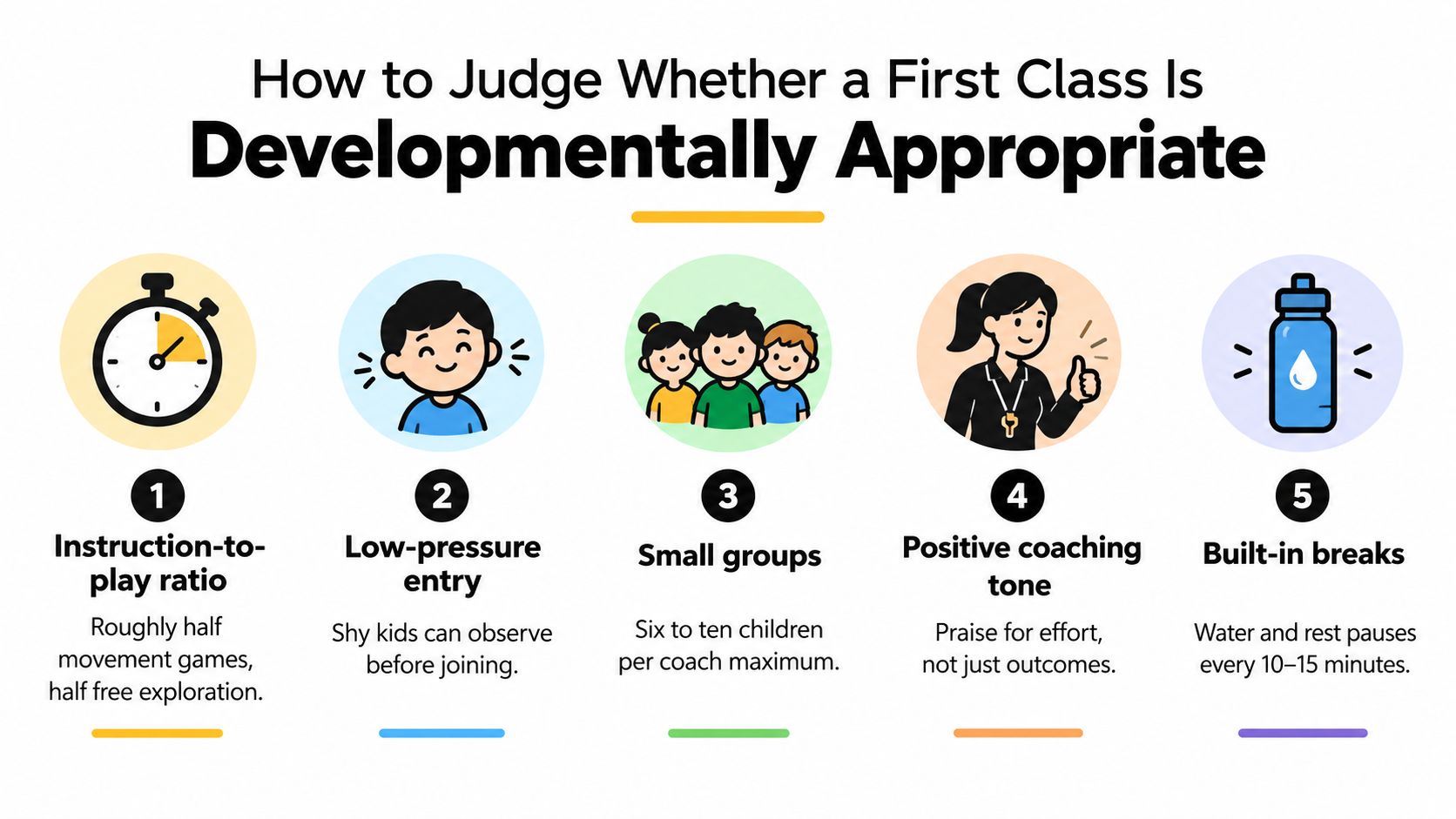
Use this observation rubric
Welcoming language: The coach greets children by name and offers an invitation rather than demanding instant participation.
Equitable involvement: The same confident players don't receive every pass, turn, or leadership opportunity.
Emotional regulation: The coach helps children recover from frustration instead of treating tears or mistakes as disruption.
Appropriate challenge: Activities are simple enough to understand but open enough for children to make choices.
Return signal: Children leave curious, proud, or eager to come back. Being tired isn't the only measure of a successful session.
Inclusion also has to be visible. Research cited by Project Play found that Latino and Black children were three times more likely than White children to stop playing soccer because they felt unwelcome. That makes coach behavior, representation, family communication, and equitable participation central quality measures, not public-relations details.
Parent's rule: Watch how the coach responds to the child who needs the most support. That response tells you more than how the coach handles the strongest player.
Coaching Approaches That Build Skills Without Suppressing Creativity
Beginners need guidance, but they shouldn't spend the entire session obeying commands. A coach who constantly shouts where to stand, when to pass, and which foot to use can make children afraid to experiment. A coach who never intervenes may create activity without helping players notice better options.
The strongest approach combines freedom, focused cues, and useful game rules. Children should have time to dribble and attempt 1v1 moves. Then the coach can shape the next round by widening a scoring gate, adding a target player, rewarding a pass before a goal, or creating an area where support becomes necessary.
A four-week study of players aged 12 to 15 found that free-play and goal-exaggeration conditions produced more dribbling, while explicit instruction combined with modified goals produced more connected passing networks, as reported in the study of coaching conditions and passing behavior. The participants were older than typical beginners, so coaches should simplify the same principle for young children.
What parents should listen for
Good cues describe an observable action:
“Look before you receive.”
“Take your first touch away from pressure.”
“Can you find a teammate at an angle?”
“Try the space beside the defender.”
Weak instruction often sounds abstract or relentless. The coach talks more than the children play, corrects every decision, or praises only goals and winning. That style may produce short-term compliance while reducing confidence.
A balanced session can devote meaningful time to playful ball mastery and 1v1 exploration, then move into small-sided games where the coach adjusts space, numbers, or scoring rules. The coach should use short demonstrations, brief rounds, and positive reinforcement for younger children.
Ask the program director, “How do you decide when to coach and when to let children solve the problem?” The answer should include experimentation, not just technique. Your child needs to learn what to do, but also to discover that trying something new is safe.
How to Choose the Right Soccer Program in Houston
Choose the program that fits your child and your household, not the one with the most impressive terminology. A technically ambitious class is a poor choice if the commute, schedule, or emotional environment makes attendance difficult.
Start with the setting. Indoor training can offer more predictable conditions when Houston weather disrupts outdoor plans. Outdoor sessions may give children more running space and a different playing feel. Neither setting is automatically better. Ask how the program handles cancellations, field status, heat, rain, and makeup sessions.
Then compare the practical details:
Age fit: A toddler needs movement games and simple choices. An elementary-age beginner can handle more ball mastery, 1v1 play, and team decisions.
Schedule fit: Weekday classes may suit families with flexible afternoons, while weekend options can work better for school and work commitments.
Equipment expectations: Ask whether athletic shoes are acceptable for the first visit, when cleats become useful, and whether the program supplies balls.
Cost clarity: Request the full price before registering, including uniforms, facility fees, league fees, equipment, and any required travel.
Trial policy: A trial lets your child experience the coach and group before your family commits to a longer schedule.
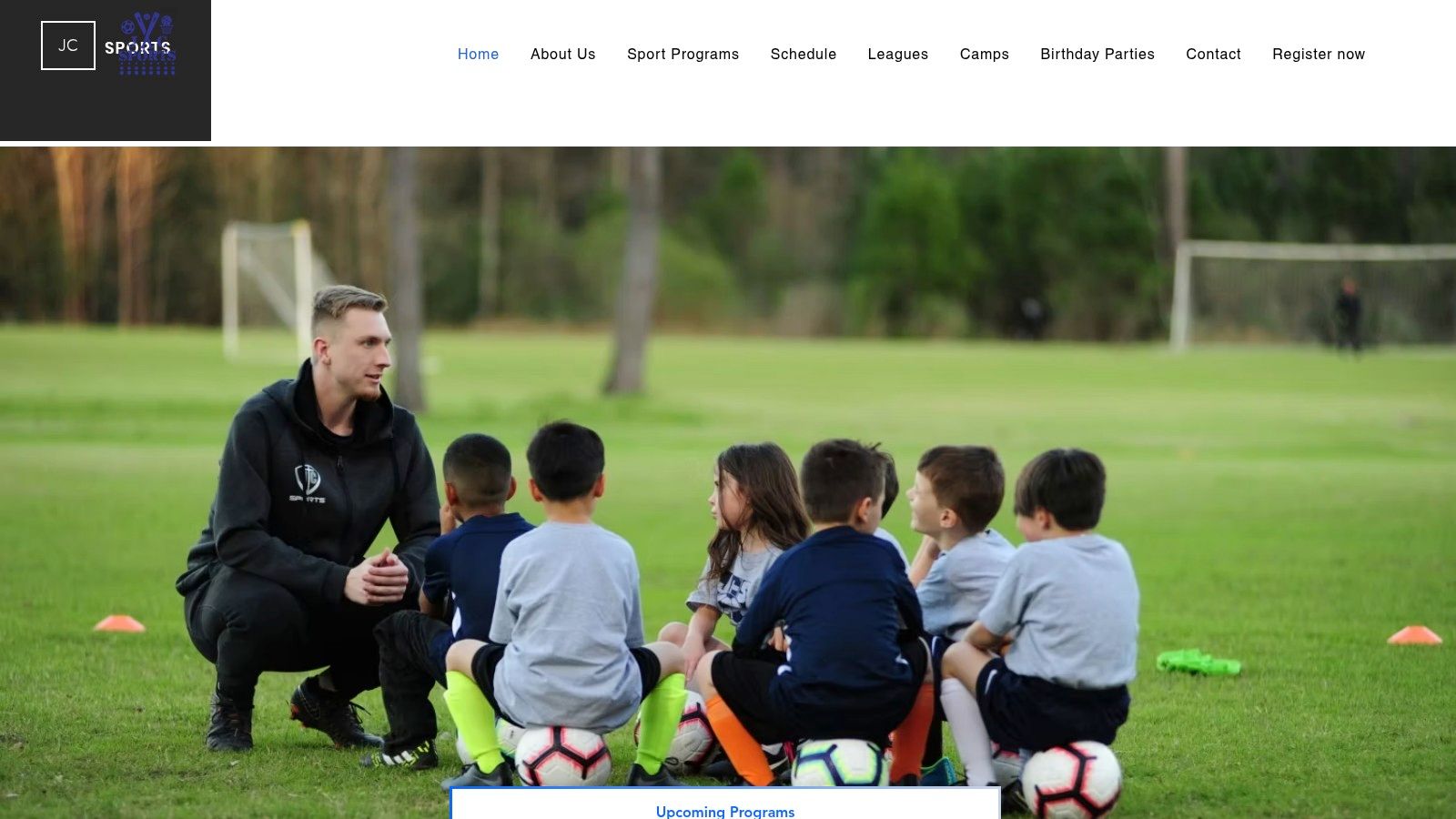
For families comparing local facilities, the soccer training center information can help clarify what a structured training environment may include. JC Sports Houston offers age-specific soccer instruction, Coerver-based training, private sessions, a girls-focused option, toddler multisport activities, leagues, camps, and a free trial for new families.
Ask these questions before paying:
How are beginners grouped?
What happens if my child refuses to participate?
How often do players use small-sided games?
What clothing and footwear are required?
What is the path from a trial class to a league?
Are prices, makeup policies, and cancellation terms available in writing?
A clear answer is a strong sign. Evasive pricing or pressure to register immediately is not.
Starting Your Child's Soccer Journey With Confidence
A successful start may look ordinary from the outside. A child arrives uncertain, watches the first activity, joins for a few minutes, and leaves talking about the one moment they controlled the ball. The next visit may bring more participation. Progress often begins with comfort, not performance.
Parents sometimes move children up too quickly because they can complete a drill. That's not enough. A child is ready for a more advanced group when they can follow the class rhythm, recover from mistakes, engage with teammates, and enjoy a suitable challenge. Repeating a beginner class isn't falling behind. It's a sensible way to build confidence and decision-making.
Participation trends show why welcoming entry points matter. In 2023, regular team-sport participation reached 39.8% among U.S. children ages six to seventeen, while the average child regularly played 1.63 sports, a decline from 2019, according to the 2024 youth sports participation report. Beginner soccer should complement a child's broader development rather than demand early specialization.
Your next step
Schedule a trial or observation before making a long commitment. Watch whether the coach includes hesitant children, whether players get frequent touches, and whether the activities match the children's ages. Ask direct questions about cost, equipment, makeup policies, progression, and emotional support.
Afterward, ask your child what felt fun, confusing, or uncomfortable. Don't judge the answer by whether they scored. A child who wants to return, feels proud of trying, and understands a little more about the game has already made meaningful progress.
JC Sports Houston provides age-appropriate soccer classes, toddler multisport activities, Coerver-based training, private sessions, leagues, camps, and a free trial for new families. Visit JC Sports Houston to compare beginner options, review practical program details, and give your child a low-pressure first experience.
Comments