

Birthday Parties Activities: 10 Sports Games for Kids

The cake is on the table, the guests have arrived, and the children are already kicking a ball toward the decorations. You've planned the food and invitations, but there's still a stretch of party time to fill. Without a clear activity, confident players can take over while quieter guests hang back.
Coach-led games give children a way into the action. A coach demonstrates, starts play, adjusts the challenge, and brings everyone back together before the game becomes frustrating. That doesn't mean running a birthday like a practice session. It means preparing enough structure that children can enjoy themselves without constantly asking what happens next.
In a global online survey of parents of children ages 2–12, 34% selected more games and activities as the single change most likely to improve their child's previous birthday party, according to Chuck E. Cheese's birthday-party survey. That's a useful planning signal, not a reason to cram the schedule.
Coach's recommendation: Choose games around the children who are coming, not just the sport your birthday child loves.
For parents comparing birthday parties activities, the useful details are practical: who can play, how to divide the guests, and where the game fits. These sports games work best with small groups, ready-to-use equipment, and permission to take a break.
1. Small-Sided Mini Soccer Tournament
Best fit: School-age children, a guest list that divides into small teams, and an enclosed turf area or level lawn with clear boundaries. For preschoolers, skip the tournament and play a friendly kick-and-score game.
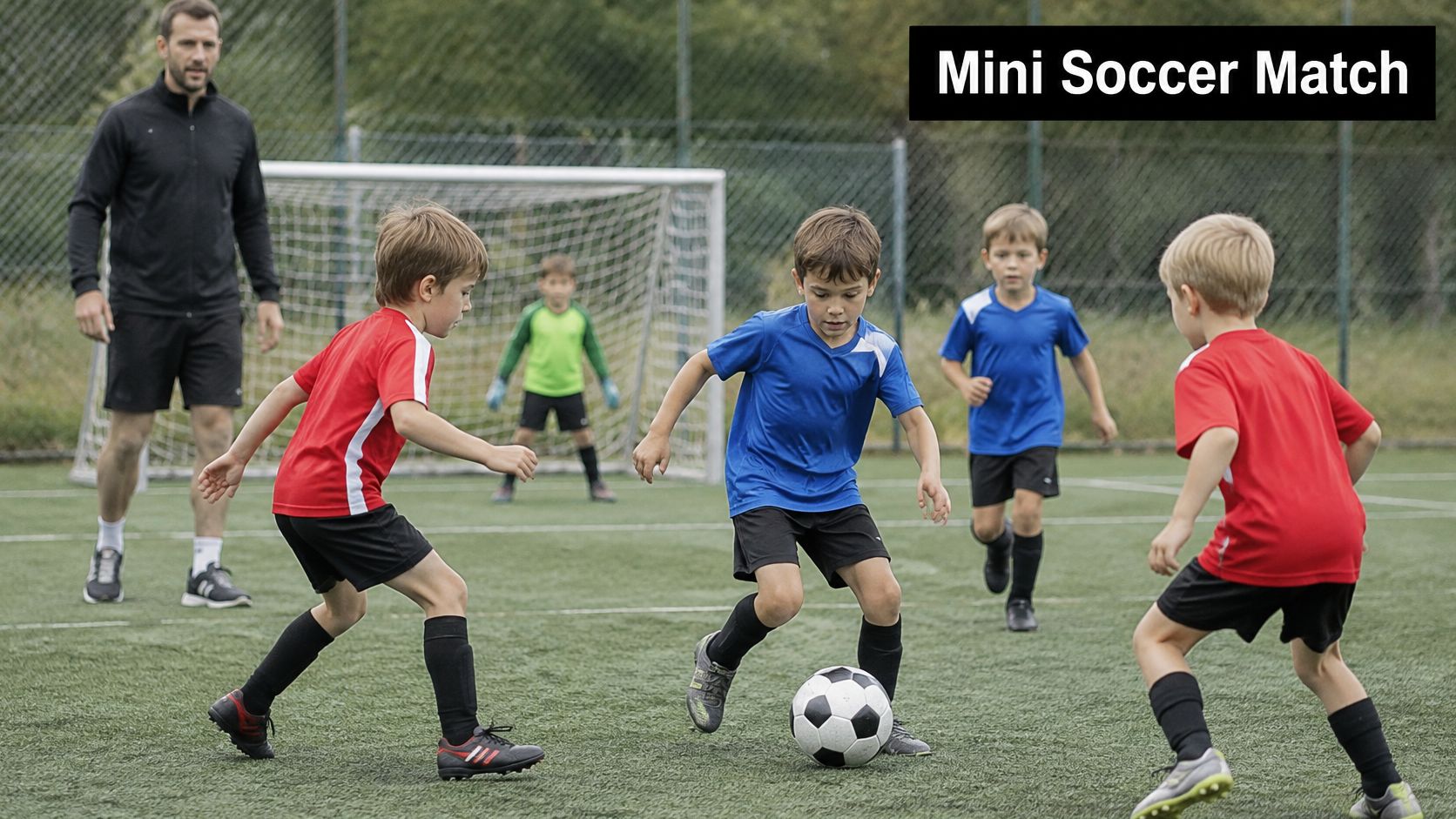
Set up cone goals, hand out contrasting pinnies, and keep spare balls beside the coach. A smaller playing area puts children close enough to participate without spending the whole game chasing a stronger player.
Make the Tournament Friendly
For a mixed-age birthday, distribute experienced players across the teams rather than grouping them together. Give beginners a simple role, such as finding open space near the goal, and rotate positions so nobody spends the party defending.
Share possession: Encourage a pass before shooting, but drop the requirement if children find it confusing.
Keep everyone involved: Use parallel games when supervision and space allow, rather than leaving a team waiting.
Finish together: End with a shared celebration instead of reserving the memorable moment for the winning side.
The trade-off is supervision. Separate fields need adults who can watch boundaries and manage restarts, not just keep score.
A knockout bracket looks exciting on paper but sidelines eliminated players. A friendly rotation is the better party format, especially when guests have different levels of soccer experience.
2. Coerver-Style Ball Mastery Stations
A child who dislikes tackling may still love making a ball stop, turn, and roll under their foot. Ball mastery stations suit preschoolers through school-age beginners, with individual spaces for a small gathering or rotating pods for a larger guest list.
Use a flat surface and spread cones far enough apart that children can move without bumping into neighboring players. Give each participant a ball where possible, rather than creating a queue behind a demonstration.
Turn Technique Into Play
Set up a toe-tap area, a sole-roll pathway, and a dribble-to-target challenge. Demonstrate each movement slowly, then let children experiment before adding a playful task such as guiding their ball through a pretend animal trail.
This demonstration can help parents visualize the footwork.
For a preschool party, replace technical names with actions: stop the ball, push it gently, then follow it. Older guests can try changing direction without knocking over cones.
The Coerver soccer training guide provides background on this skill-focused approach. For a birthday, borrow the movements without turning the activity into a technical assessment.
Reward persistence, not speed. Stickers can recognize trying an unfamiliar movement or helping collect equipment. Stations offer individual choice, but they need a coach who circulates and adjusts challenges before frustration sets in.
3. Pitch, Hit and Run Baseball Challenge
Best fit: Preschoolers using soft equipment, elementary-age beginners, and groups that can split into supervised activity pods. You'll need an open field or indoor sports area with a clearly separated hitting lane.
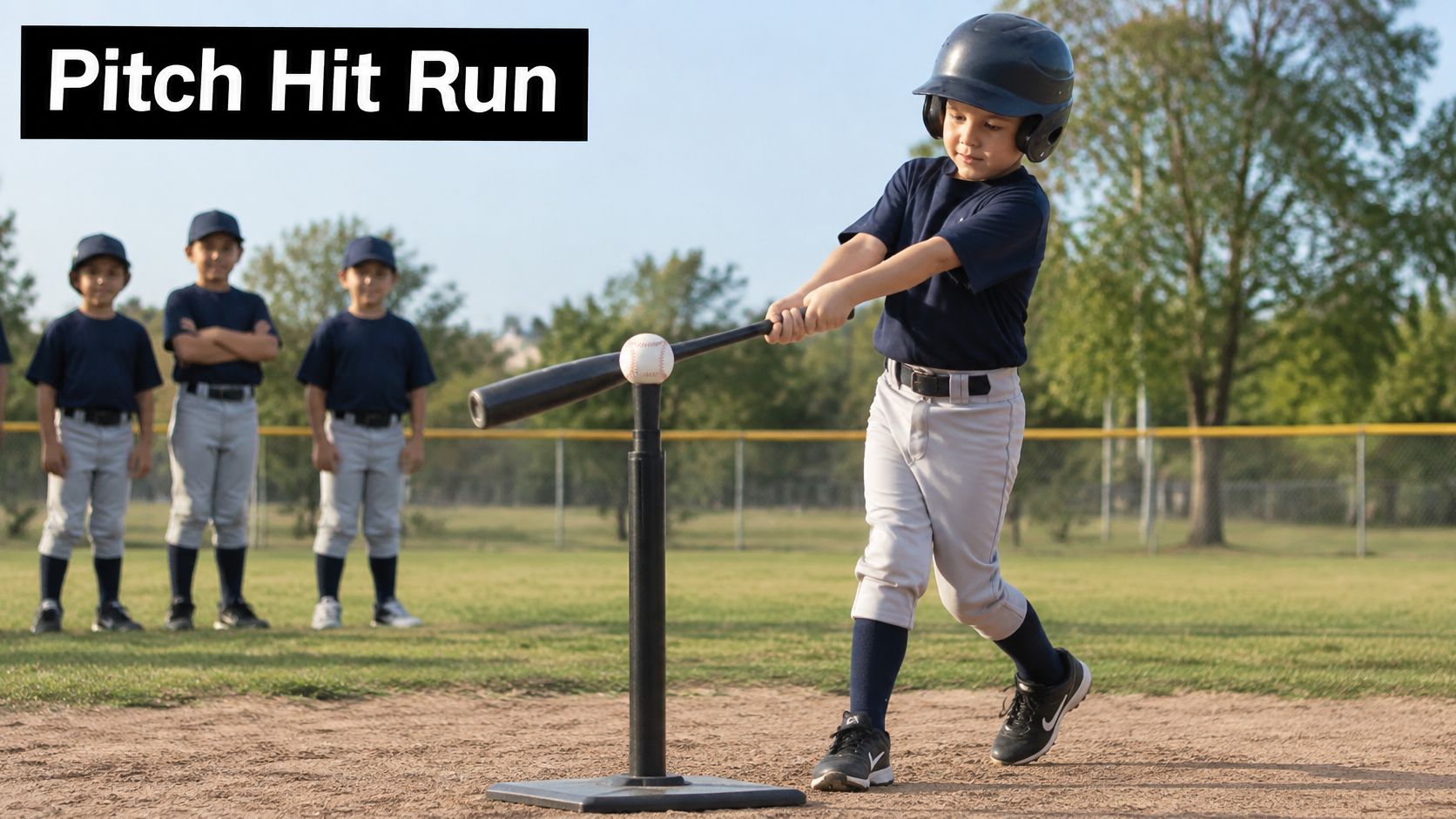
Use a batting tee, a lightweight bat, soft balls, flat bases, and a target for throwing. Treat the activity as a birthday skills circuit, not a formal competition with demanding rules.
Separate the Swing From the Queue
The coach controls the bat and calls each hitter into the marked batting area. Waiting children stay behind a visible boundary, and nobody retrieves balls until the bat is down.
Pitch: Throw a soft ball or beanbag toward a broad target.
Hit: Strike a stationary ball from a tee toward an empty landing area.
Run: Follow a marked base path without crossing the hitting lane.
For a preschool celebration, let guests practice throwing while a coach supports individual batting turns. At a school-age party, children can contribute successful attempts to a shared team score.
The bottleneck is hitting. Adding more bats without separate supervision isn't a good solution. Keep the throwing and running activities available so waiting children have something purposeful to do.
Choose a tee over soft toss when guests are unfamiliar with batting. A stationary ball removes the need to time a moving pitch.
4. Dribble and Shoot Basketball Relay
A basketball relay works when the children can handle the ball and reach the target. Use it for older preschoolers with adaptations or school-age guests, divided into short teams rather than a long queue.
You'll need a hard, level surface, widely separated travel lanes, and baskets positioned away from spectators. A small driveway can suit a cooperative shooting challenge, but it may not suit simultaneous racing.
Let the Attempt Count
Set cones along each lane. Children dribble toward the basket, attempt a shot, collect the ball, and return it to the next teammate.
For a beginner birthday group, allow carrying between bounce attempts and use a low target. More confident players can dribble with their less-practiced hand or pass to a teammate before shooting.
Don't make a child keep shooting until they score. Let the attempt count so the next guest gets a turn.
Adjust equipment: Choose a ball children can control and a basket they can realistically reach.
Control traffic: Keep the return route separate from the outward route.
Remove pressure: Let teams work toward a shared finish rather than declaring a losing side.
The relay format creates excitement, but it also creates waiting. If the line starts fidgeting, replace the race with shooting stations.
A coach should watch the whole lane, not stand beneath the hoop tracking baskets. Safe returns and fair turns matter more than the final score.
5. Multi-Sport Obstacle Course
Best fit: Toddlers and preschoolers in small supervised pods, with optional challenges for older siblings. Use a level lawn, padded activity space, or indoor sports surface with a clear route around the equipment.
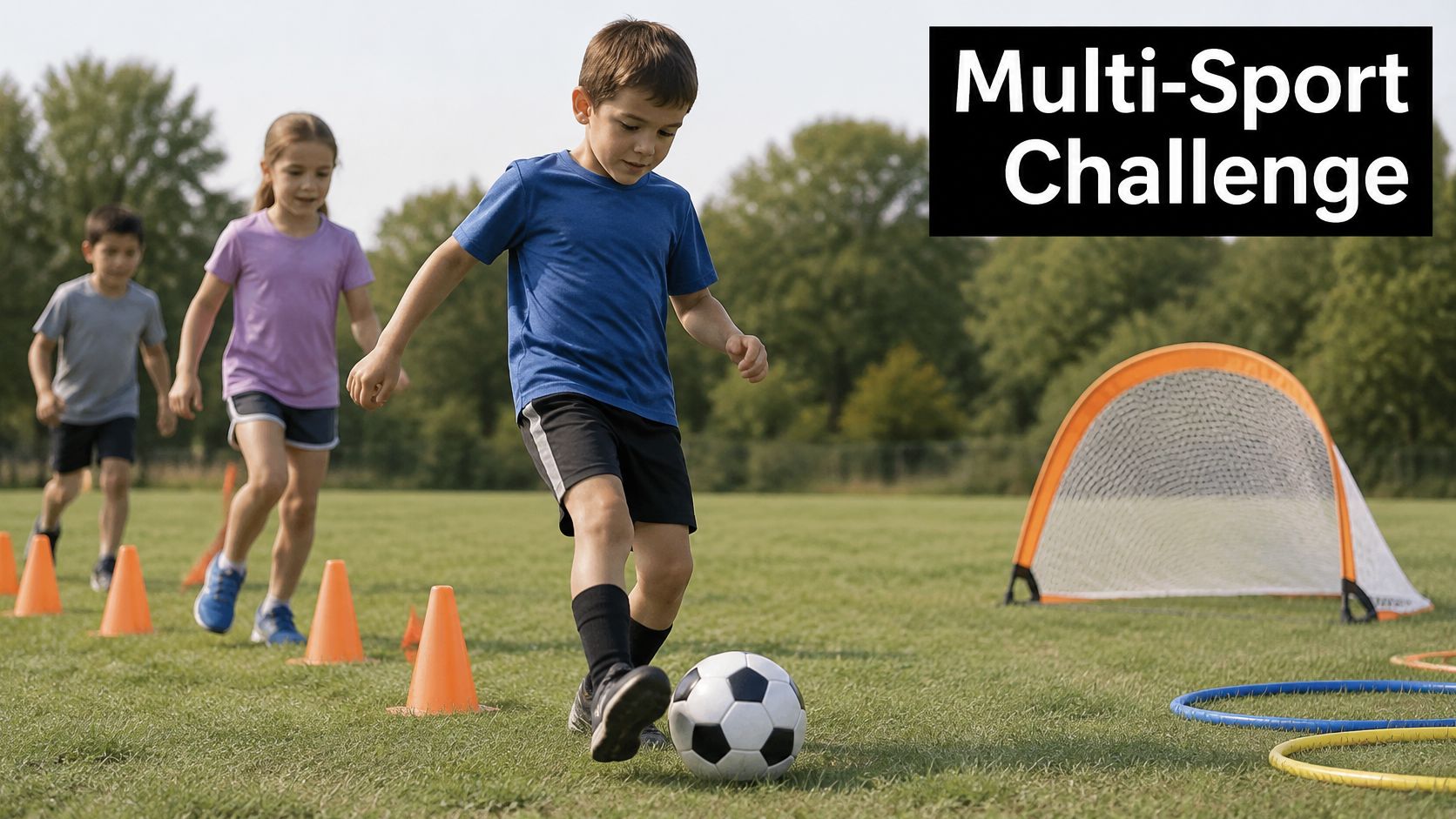
Build the course from actions children can understand immediately: walk between cones, roll a ball through a tunnel, toss a beanbag into a hoop, and kick toward a goal. Complicated obstacles usually create more explaining than playing.
Build a Route Children Can Read
Use floor arrows or matching colored cones to show where to go. Walk the route with the children before starting, and leave space between participants so a hesitant guest doesn't get rushed.
For a toddler party, make it an animal adventure. Children can step over pretend puddles, roll a ball into a bear's cave, and deliver a soccer ball to its nest.
Offer a bypass: Let children walk beside anything they don't want to crawl through or step over.
Prevent crossings: Keep the finish away from the starting queue.
Add challenge selectively: Older guests can try controlled dribbling instead of carrying the ball.
The soccer obstacle course guide offers ideas for building a ball-focused route.
Obstacle courses take more preparation than a simple target game. Set everything up before guests arrive, and remove unstable equipment rather than relying on an adult to catch a falling child.
6. Sports-Themed Capture the Flag
Best fit: School-age guests who understand boundaries and gentle tagging, with enough children for balanced opposing teams. This needs an open, unobstructed playing area, not a crowded backyard beside the food table.
Use a bright pinnie or soft object as the flag. A soccer ball can serve as a stationary objective, but carrying a soft flag is easier than running through traffic with a bulky ball.
Keep the Rules Short
Mark a central line, team bases, and an obvious outside boundary. Explain what happens after a tag before play begins, then demonstrate it with the coach.
For a soccer-themed birthday, guests can retrieve a team-colored pinnie from the opposing base. They're playing a running game with a soccer theme, so there's no need to add dribbling unless the group wants that challenge.
Tag gently: Open-hand tags only, with no grabbing clothing or blocking bodies.
Restart quickly: Tagged players return to their own base and rejoin instead of sitting in jail.
Protect the objective: Mark a no-camping area so defenders can't crowd directly around the flag.
This isn't my first choice for a toddler party. The changing directions, tagging, and competing objectives require more explanation than a simple chase-free treasure collection game.
For mixed abilities, rotate attacking and defending roles. Children who don't enjoy pursuit can help track successful returns, then rejoin when they're ready.
7. BlastBall Party Games
Give beginners a bat, a stationary ball, and a clear place to run. A simplified BlastBall-style game suits preschoolers and early elementary guests, especially when the party includes children who haven't played organized baseball.
Choose an open sports area with a marked hitting zone, a base, and space for fielders to spread out. Keep teams small enough that guests aren't standing through a long batting order.
Start With a Demonstration
The coach shows the complete sequence: hit from the tee, put the bat down, then run to the base. Fielders collect the stopped ball and return it to a designated adult rather than throwing toward the runner.
For a mixed-age celebration, older guests can act as encouraging fielding partners. Rotate that responsibility so they also get batting turns.
The BlastBall game guide explains the beginner-friendly format. At a party, keep the emphasis on recognizable actions rather than adding baseball's full set of rules.
Support hesitant hitters: Allow a practice swing and adjust the tee before the attempt.
Keep fielders involved: Give them clear starting spots and rotate those positions.
Celebrate the sequence: Recognize safe bat placement and following the base path, not just a powerful hit.
The trade-off is repetition. Guests who already play baseball may want more challenge, while beginners need predictable turns. Let experienced players aim toward a marked fielding zone without making the basic game harder for everyone else.
8. Sports Trivia and Team Cheer Challenge
Not every birthday activity needs running shoes. Sports trivia suits mixed-age groups, children taking a movement break, and guests who prefer a quieter role, using a shaded seating area or a table away from active games.
For a preschool party, hold up pictures of sports equipment and ask children to match each ball with its game. School-age teams can discuss rules, identify equipment, or suggest what a good teammate should do in a simple scenario.
Use the Break Deliberately
A Chuck E. Cheese birthday-planning survey identifies interest in more games and activities. That doesn't mean children need continuous high-intensity entertainment, so build in quieter participation rather than treating rest as wasted party time.
Ask teams to invent a name and a cheer after answering their questions. Give guests a choice of speaking, holding a team sign, or helping choose the words.
A child can belong to the team without shouting, racing, or performing in front of everyone.
Avoid making famous-player knowledge the main challenge. Guests who don't follow professional sports should still have a fair way to contribute.
The trade-off is attention: long explanations can feel like schoolwork. Use visible props, accept team discussion, and stop while children are still interested.
This also works as an arrival activity. Early guests can explore picture cards while you wait to begin the movement games.
9. Target Ball Toss and Accuracy Challenge
Accuracy games scale to a guest list better than almost any other party activity. A toddler rolling a ball into a laundry basket and a ten-year-old threading a pass through a cone gate can share the same station, and both walk away feeling successful.
Best fit: toddlers through school-age children, in a small gathering or a larger party split across separate lanes. Distances and target sizes adjust per turn, so mixed ages can share one setup.
Use buckets, floor hoops, securely attached target sheets, and soft balls or beanbags. Point every lane in the same direction with spectators behind the throwers. A child wandering in from the side is the main risk at a target station, and one shared throwing direction removes it.
Offer Different Ways to Succeed
At a preschool birthday, place broad buckets close and let children pick an underarm toss or a roll. Older guests can aim through a smaller opening or try a controlled soccer pass into a cone gate. An adult or coach at each lane can nudge the distance for each child, keeping turns quick and giving every guest a rep that challenges them.
Separate the skills: Keep kicking, throwing, and basketball shooting in distinct lanes.
Give useful feedback: "Face the target" or "slow your approach" works better than "try harder."
Retrieve together: Pause all attempts before anyone walks forward to collect equipment.
The trade-off is hygiene. Shared balls and beanbags pass through many hands, so keep snacks outside the activity area, offer handwashing with soap and water before children return from food, and use non-food rewards.
Ask caregivers privately about accommodations during planning, including concerns beyond the menu. Parents have reported children with food allergies missing party invitations, so waiting until guests arrive is already too late.
Cake-free does not mean allergy-safe. Residue on hands, equipment, or prize tables still needs a plan agreed with the child's caregiver.
10. Custom Team Jersey and Medal Ceremony
A finish matters, particularly when guests need to leave at different times. A jersey activity and medal ceremony suit every age group, provided younger children have adult help and the customization area stays separate from active play.
Use a table for decorating and an uncluttered gathering spot for awards. A small party can customize shirts together; a larger gathering is easier to manage with prepared apparel and optional name decorations.
Keep Apparel Practical
For a soccer birthday, guests might choose team colors and add their names before playing. At a basketball celebration, the birthday child can help present medals after the final group challenge.
Choose wearable materials: Use fabric markers according to their instructions and let decorations dry before wear.
Leave printing to adults: Heat-applied transfers need appropriate equipment and handling, not an unsupervised party station.
Recognize everyone: Give participation awards without ranking children by athletic ability.
If you're preparing shirts in advance, these DTF printing tips for birthday apparel can help with design planning. Keep names legible and avoid a design so crowded that the team identity disappears.
The honest trade-off is cost and preparation. Decorated pinnies or simple certificates can serve the same purpose without turning apparel into the main event.
End with a team photo for families who want to participate, then clearly announce that organized play has finished. Children can enjoy the celebration without wondering whether another competition is about to start.
How the 10 birthday party sports activities compare
Item | Best For | Setup Level | Space Needed | Equipment |
|---|---|---|---|---|
Small-Sided Mini Soccer Tournament | Active play and teamwork | Moderate | Reduced, safe playing field | Soccer balls, pinnies, goals, medals or certificates |
Coerver-Style Ball Mastery Stations | Soccer skills practice | Moderate | Several small station areas | Balls, cones, targets, scorecards or stickers |
Pitch, Hit and Run Baseball Challenge | Introductory baseball skills | Moderate | Open area with a safe throwing zone | Tee, bats, soft balls, bases |
Dribble and Shoot Basketball Relay | Energetic basketball practice | Low | Safe court or gym | Basketballs, cones, hoop |
Multi-Sport Obstacle Course | Mixed-age movement and coordination | Moderate | Open area for multiple stations | Cones, hoops, balls, bean bags |
Sports-Themed Capture the Flag | Team strategy and running | Low | Large open area with clear boundaries | Flags or balls, cones, pinnies |
BlastBall Party Games | Beginner-friendly team play | Low | Indoor or outdoor open space | Lightweight ball, optional targets and scoreboard |
Sports Trivia and Team Cheer Challenge | Rest breaks and team bonding | Low | Small gathering area | Trivia cards or slideshow, whiteboard |
Target Ball Toss and Accuracy Challenge | Accuracy practice across sports | Low | Indoor or outdoor target area | Balls, targets, scoreboard |
Custom Team Jersey and Medal Ceremony | Memorable party finale | Moderate | Small area for the ceremony and photos | Jerseys or pinnies, medals, ribbons or certificates |
Match the Games to Your Guest List and Plan Ahead
Start with your guest count, the youngest participating child, and the usable space. Then choose a small selection of activities that fit together, rather than trying to include every sport. The best plan leaves room to repeat a favorite game or slow down when children need it.
For a preschool-heavy guest list, combine a ball station, a simple obstacle course, and a shared finish. For school-age children who enjoy competition, use small-sided soccer or a basketball relay, then follow it with a quieter team challenge. Mixed-age parties need adjustable tasks, not a single difficulty level that everyone must meet.
Plan the Transitions as Carefully as the Games
Before guests arrive, put equipment beside its activity area and decide who will lead each transition. Children shouldn't have to stand beside an empty field while adults search for balls or move tables.
Prepare the next activity: Keep unused equipment contained so it doesn't distract from the current game.
Make breaks visible: Show guests where to find water and where they can sit without leaving the supervised area.
Allow an easy return: Let a child watch, help, or rejoin without explaining their choice to the group.
Ask caregivers about access needs, sensory preferences, and food requirements before the party. Share relevant information discreetly with the adults leading activities, and agree on any individual support arrangements. Don't promise that a competitive game will suit every guest just because it has simple rules.
Spend on Participation Before Extras
Prioritize appropriate equipment, enough supervision for the chosen layout, and a manageable activity schedule. Decorations can support a theme, but they won't solve a crowded hitting lane or a long queue at the basket.
If matching apparel matters to your family, browse milestone birthday shirt designs before committing to a theme. Treat shirts as an optional keepsake, not something children need in order to belong.
We offer customizable, coach-led, sports-themed birthday parties at JC Sports Houston, serving families in Humble, Kingwood, Atascocita, and nearby Houston communities. Build your shortlist around what your guests can comfortably do, then share their ages, interests, and support needs when planning the celebration.
A successful sports party isn't the one with the most rules or the busiest schedule. It's one where children understand how to join, get meaningful turns, and leave feeling included.
JC Sports Houston offers customizable, coach-led sports birthday parties that give families a structured way to celebrate through play. Visit JC Sports Houston and contact our team with your guest count, children's ages, and preferred sports to start planning your party.
Comments