

Baseball Training for Beginners: A Week-by-Week Plan

You've bought the glove, signed the registration form, and now your kid is standing in the backyard asking when practice starts. The instinct is to grab a ball and start throwing as hard as possible, because that's what baseball looks like on TV. That instinct is the one I'd slow down first.
Beginner baseball goes wrong on volume long before it goes wrong on technique. A child who throws every day for a month will usually arrive at the first game with a sore arm and a swing that only works when everything is perfect. Baseball training for beginners should build an athlete who can run, jump, balance, catch and swing, and who still wants to play next season. That's the standard I'd hold every session to.
Weekly Training Load by Age
Age | Sessions per week | Core focus |
|---|---|---|
Ages 4-6 | 1 session | Movement games, tee hitting, soft toss |
Ages 7-9 | 1-2 sessions | Short catch, fielding, base running |
Ages 10-12 | 2 sessions | Longer throws, ground balls, batting practice |
Keep the sessions short to match: 30-40 minutes for the youngest group, 45-60 minutes at ages 7-9, and about 60 minutes at ages 10-12, with at least two days each week away from throwing for the older beginners. No pitching from a mound for the 4-6 group at all. Those numbers are a coaching ceiling, not a target to hit every week.
Why more reps isn't automatically better
A 2025 rapid review on early sport specialization found that specializing early was associated with greater injury risk, poorer physical or functional performance, and worse psychological outcomes, with no consistent benefit to sport success. The same review points to multisport participation and appropriate training-volume limits as ways to reduce those risks. An evidence synthesis it covers reported that highly specialized high-school baseball players had substantially higher odds of a previous-year upper-extremity overuse injury than low-specialization players (OR 3.77).
Read that as a scheduling problem, not a talent problem. A child who plays soccer in the fall, swims in the winter and plays baseball in the spring is building hips, shoulders and coordination that a baseball-only calendar never asks for. During a growth spurt, the same throw count lands on a body that's temporarily less coordinated than it was two months ago, so I cut volume rather than push through it.
Practical rule: if your child still wants to play other sports, reports no arm pain, and still enjoys practice, the weekly load is working. If any one of those three flips, cut a session before you add a drill.
Warm-Up Routine Before Every Session
Ten minutes, every time, before the first real throw. Here's the sequence I run with beginners.
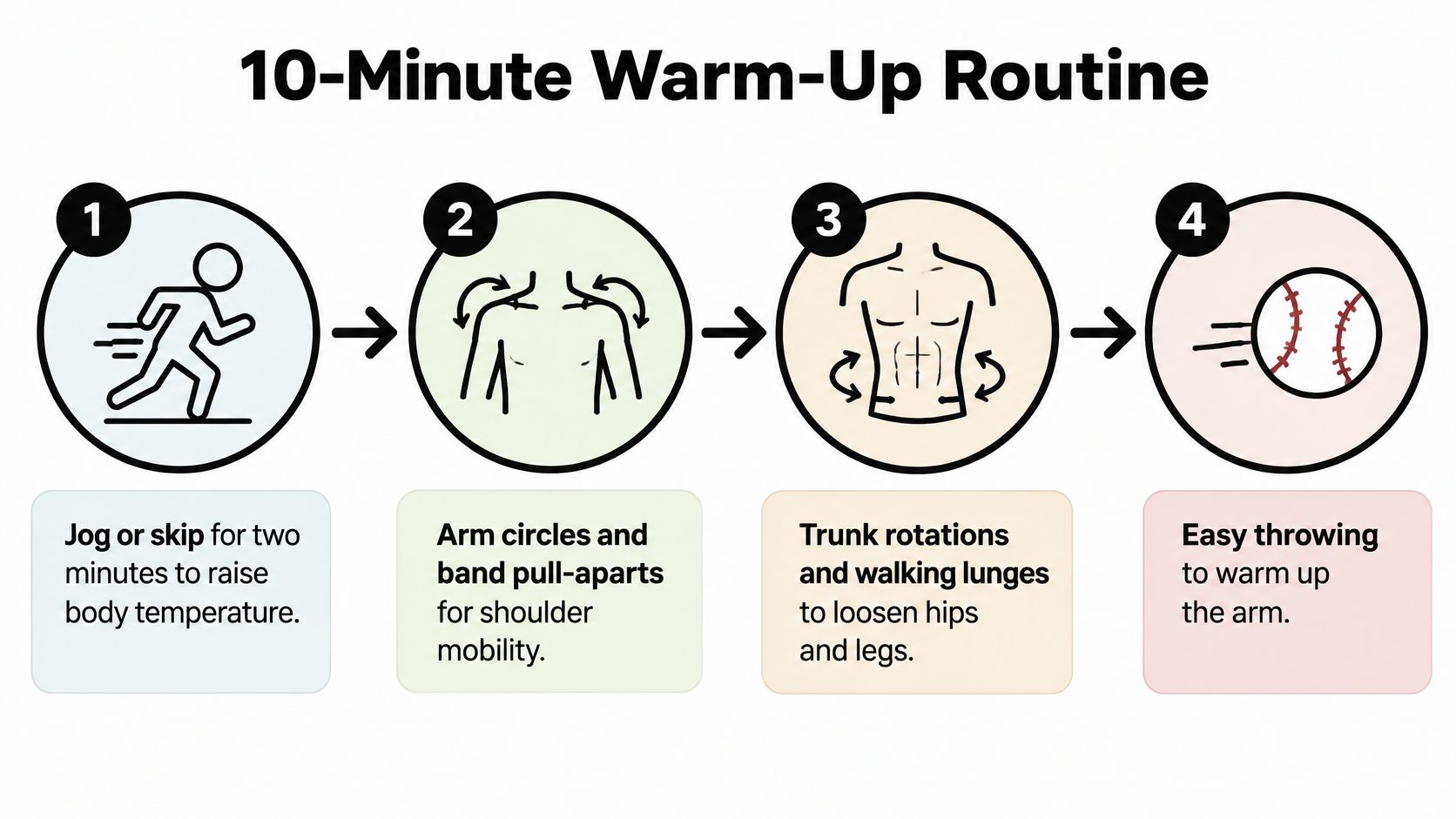
Jog or skip for two minutes. Easy pace, down the fence line and back. Warm tissue tolerates throwing better than cold tissue, and it gives you two minutes to watch how the child is moving today.
Arm circles and band pull-aparts. Ten circles each direction, then a light resistance band pulled apart at chest height. This wakes up the shoulder blade muscles that control the arm slot.
Trunk rotations and walking lunges with a reach. Standing rotations, then lunges where the child reaches the opposite hand toward the sky. Throwing power comes from the hips and torso, so stiffness there gets paid for at the elbow.
Single-leg balance holds, 30 seconds per leg. Eyes up, hands out. Every throw and every swing finishes on one leg.
Light stretching for shoulders, chest and hamstrings. Short holds, no bouncing, no forcing range.
Easy catch at about 10 feet. Soft toss, two hands, no velocity. Only after this do you back up gradually.
What the structure is buying you
A randomized controlled trial of a 10-minute preparation routine containing five stretching exercises, two dynamic-mobility exercises and two balance exercises reduced injuries by 50% versus controls. That's a large return for something that costs you the first ten minutes of practice. The same research reviews report that as many as 74% of players aged 8-18 experience some arm pain while throwing, which tells you where the main risk sits for a beginner: repetition, not collision.
The throwing progression stops the moment mechanics deteriorate. If the arm slot drops, the child starts aiming instead of throwing, or the ball starts sailing, you don't move back another ten feet. Hold the distance, cut the count, or finish with fielding and base running instead.
Stop Signs and Gear Checklist
The assumption worth challenging is that a tough kid plays through a sore arm. Soreness in a growing arm isn't a badge, it's a scheduling signal, and the parents who read it early are the ones whose kids still play at fourteen.
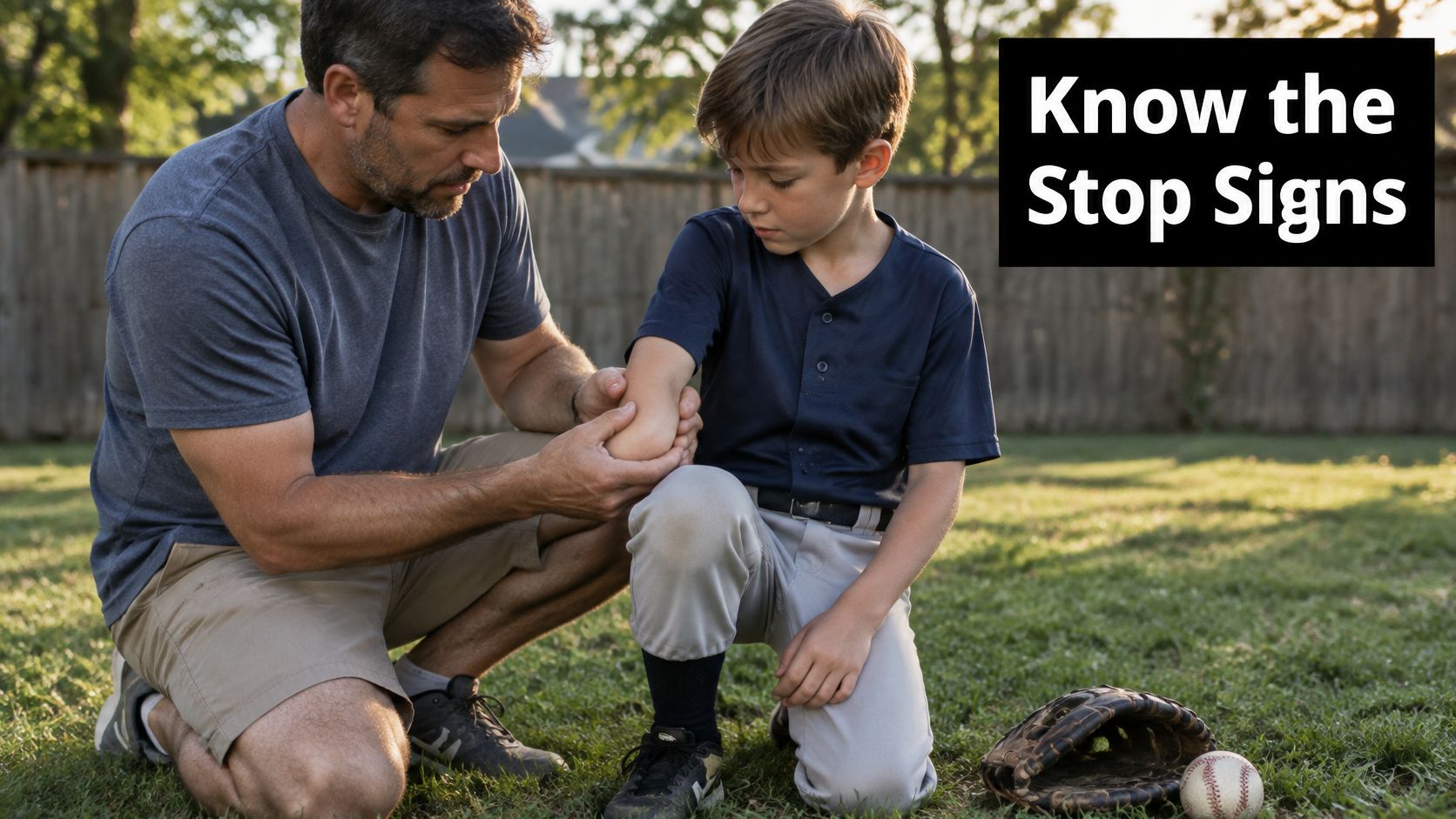
Check these after every session. Any single one ends throwing for the day and calls for a medical evaluation rather than more repetitions:
Arm pain that lasts past the session, including pain that shows up at night or the next morning.
A changed throwing motion or arm slot, especially a lowered elbow or a shortened follow-through.
A drop in accuracy that doesn't recover after a few easy throws.
Visible fatigue, meaning slumped posture, slow walks between drills, or sloppy footwork.
A child who no longer wants to play, which deserves the same seriousness as a physical symptom.
A 2024 prospective study summarized by the National Athletic Trainers' Association followed 159 asymptomatic, competitive youth baseball players and found that athletes specializing in baseball before age 13 had a higher frequency of arm injuries than those who didn't specialize. Asymptomatic is the important word: the arms that got hurt weren't complaining at the start. For a fuller picture of how load, rest and screening fit together, our guide to sports injury prevention is worth reading before the season starts.
Matching gear to the child, not the team
Buy a glove the child can close, roughly 9 to 11 inches for the youngest players, and break it in with a ball wrapped inside rather than oil and a car tire. Choose the bat by drop weight first, a lighter drop the child can swing without dumping the barrel, and check length second. A batting helmet is essential for hitting and base running, catcher's gear only for children who catch, and softer training balls for ages 4-6 so fear of the ball never becomes the lesson. Cleats with real traction beat hand-me-downs two sizes too big.
Match the equipment and the throwing distance to the child in front of you, and treat a stop sign as information, not weakness.
Skills to Teach First and in What Order
Teach the skills in the order that lets a child succeed early, not the order they appear on a scorecard. A first session should end with the child asking to do it again.
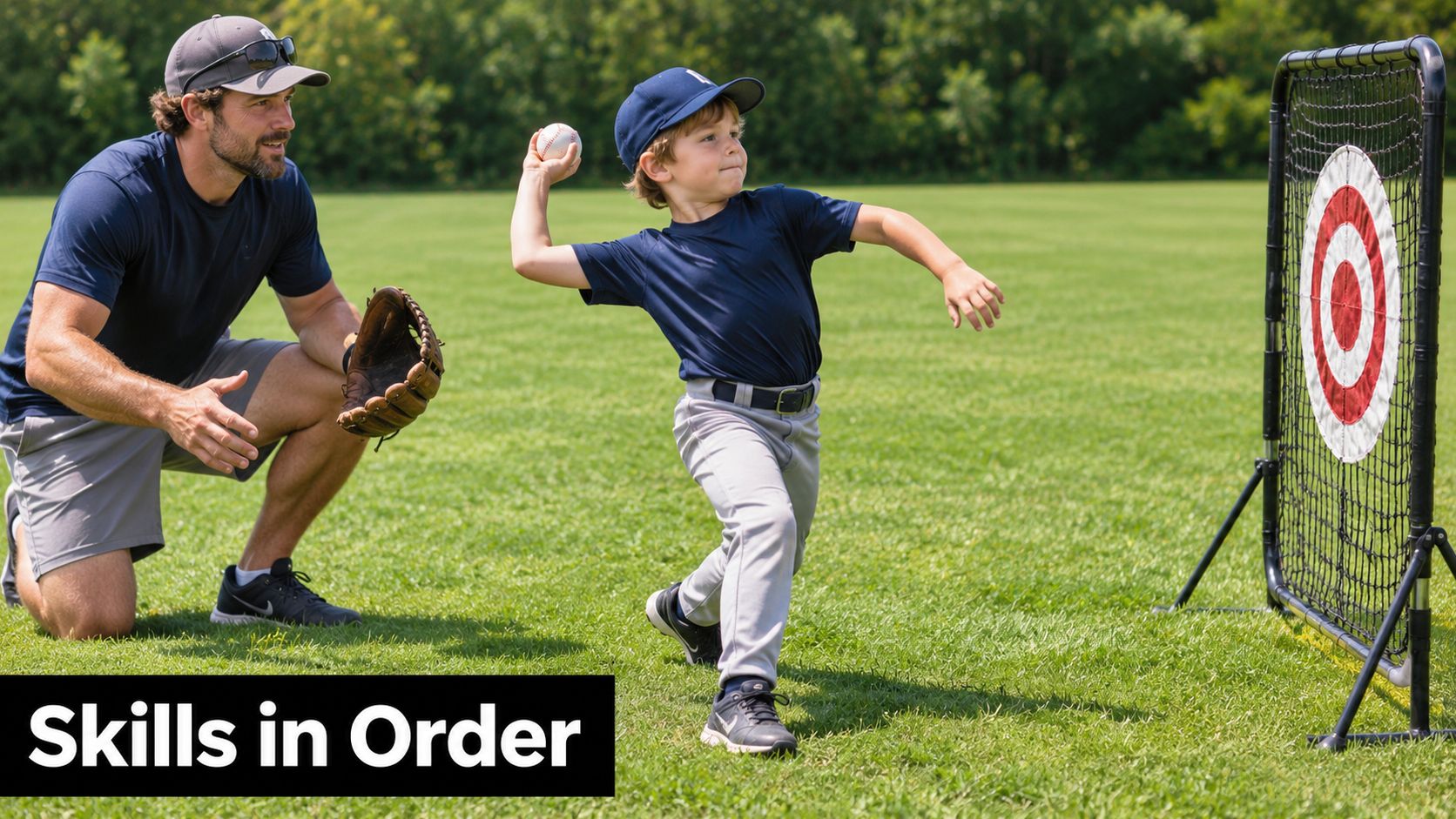
Throwing and catching, taught as one skill
Start with a steady grip across the seams and a step toward the target, at a distance where the child can hit your chest without aiming. Distance is a reward for consistency, never the goal itself. Our breakdown of baseball throwing technique covers the footwork cues in detail if you want to coach it at home. Catching comes in the same block: two hands, eyes tracking the ball into the glove, soft toss from about ten feet. Pair them so every throw has a job on the other end.
Hitting, fielding and base running
Hitting starts on a tee. Set the ball at belt height, ask for a smooth balanced swing that finishes with the belt buckle facing the pitcher, and forget batting average entirely for the first weeks. Fielding begins in a ready position with the glove down, then rolled ground balls, and only later fly balls, which are the hardest read in the sport for a young child. Base running is quick to teach and pays off immediately: run through first base, touch every bag, and round the turn wide instead of cutting the corner.
The progression I use runs from playful movement games, to partner throwing, to tee hitting, to base running, to simplified small-sided games. Optional challenges replace public ranking, so nobody's turn becomes a scoreboard.
Watch how a coach handles the first swing before you sign up for a season.
Confidence is the first metric
The 2025 MLB First Pitch evaluation involved 272 schools and more than 13,000 young people, and 84% reportedly improved their confidence to participate in sport and physical activity. Low-pressure entry points do measurable work. That's why our curriculums place the child at the center of the game, building motor skills, self-confidence and technique through interactive games and drills.
For a child afraid of the ball, use a softer ball, cut the distance in half, and let them catch with a bare-handed bounce first. For late starters and girls new to the sport, group by skill rather than age for the drill portion, keep groups small, and give feedback on one specific thing done well. Willingness to try is the score that matters in month one.
Sample Weekly Practice Plan for Kids
This is a working week for a school-age beginner in the 7-9 group: two skill sessions, one optional game, and four days of rest or free play.
Day | Session | Focus | Length |
|---|---|---|---|
Monday | Skill session | Full warm-up and tee hitting | 45-60 minutes |
Tuesday | Rest or free play | Catch with a sibling, bike riding | Optional |
Wednesday | Skill session | Short catch, ground balls, base running games | 45-60 minutes |
Thursday | Rest | No organized baseball | None |
Friday | Rest or free play | Catch or backyard tee work | Optional |
Saturday | Optional game | Scrimmage or small-sided game | 45-60 minutes |
Sunday | Rest | No organized baseball | None |
Monday is the cleanest technical day, so put the full warm-up and tee work there while the arm is fresh. Tuesday belongs to the child: a bike ride, a playground, or lazy catch with a sibling that nobody counts. Wednesday mixes short catch with rolled ground balls and base running games, which keeps the heart rate up without piling on throws.
Thursday and Sunday are genuine rest, no organized baseball at all. Friday stays loose. Saturday's scrimmage is optional, and if the child had a heavy week at school or a long tournament elsewhere, skip it without guilt.
Two scheduling rules make this work in real life. Never put a throwing session the day before a game, and move rest days freely around tests, travel and birthdays. If you'd rather build the grid than sketch it on paper, the weekly plan tools from Coachful let you lay out sessions and rest days in one view you can share with another parent.
At home: ten minutes of tee hitting or dry footwork on a rest day builds skill without adding arm load. Keep the ball on the tee, not in the air.
A successful week looks like this: the child finishes both sessions willingly, reports no arm pain, and can name one thing they did better than last week.
Track Progress and Book a First Session
Keep a four-column log in your phone's notes app. It takes thirty seconds after each session and it tells you more than any radar reading.
Sessions attended, counted, including the ones cut short.
Throws on target out of 10 tries, from a fixed distance you don't change week to week.
Pain-free days in the week, which is the number that decides whether you add or subtract load.
Enjoyment rating from 1 to 5, asked in the car on the way home, not in front of the coach.
Read the trend, not the single row. Rising attendance and enjoyment mean the program fits, even if the target column is flat. A drop in accuracy alongside pain means a rest week and a medical check, not a harder session. Distance thrown isn't in the log on purpose.
Progress for a beginner means consistent, pain-free sessions the child wants to attend.
If you're in Humble, Kingwood or Atascocita and want a coach to run that first month with you, start with a trial rather than a full season. Our free trial request form asks for your child's name, age and favorite sport. Free trials are currently listed for MultiSport and soccer for ages 4-6, 7-9 and 10-13, so ask about a baseball trial when you submit the request and we'll tell you what's available for your child's group. Our guide to finding baseball near me explains what to look for in a beginner program nearby.
One practical note: our sports programs aren't drop-off classes, so a parent or caregiver stays in the building during class. Plan the sibling's schedule around that. Check in with your coach each week, bring the log, and ask what to change.
We coach beginner baseball alongside multi-sport, soccer and basketball programs for children from 24 months up, with age-appropriate games that build motor skills, confidence and technique in an indoor setting. If your child is just starting out, request a free trial, run the first two weeks against the log above, and bring it to your first coach check-in at JC Sports Houston.
Comments