

Soccer Training Schedule Guide for Kids of Every Age

You're standing in the kitchen, looking at a calendar filled with school, homework, soccer practice, games, and perhaps another sport. Your child wants more time with the ball, but you're wondering whether another session will help or leave them tired. A good soccer training schedule answers that question by matching the work to the child, not by copying the busiest calendar in the neighborhood.
Age, maturity, playing level, school demands, sleep, and enthusiasm all matter. A toddler needs playful movement and room to stop. A school-age player can handle more purposeful practice, but still needs recovery. The right plan develops skill while protecting the child's enjoyment of the game.
What a Great Soccer Training Schedule Actually Includes
A useful schedule has four parts: how long the child trains, how often training happens, what each session is for, and when recovery occurs. If one of those pieces is missing, the calendar may look organized without being appropriate.
Start with duration. Young children rarely benefit from being held through a long, repetitive practice. A toddler's session should feel like a sequence of games, movement challenges, and short ball activities. Older children can tolerate more structure, but the coach should still divide the session into purposeful blocks instead of filling time with lines and waiting.
Frequency comes next. Two or three playful sessions in a week may be plenty for a preschooler, especially when family play and backyard kicking are included. A school-age player might have a coached technical session, a small-sided game session, and a match, with optional individual work only when energy and interest remain high.
Give every session a job
A schedule becomes easier to judge when every activity has a clear purpose:
Technique: Ball mastery, dribbling, passing, receiving, and finishing.
Game understanding: Small-sided games that require decisions, movement, and teamwork.
Physical preparation: Running, coordination, balance, speed, and agility suited to the child's stage.
Recovery: Sleep, easy movement, and days without organized soccer.
A technical session should not try to accomplish everything. One day might emphasize first touch and turning. Another might use a small-sided game to encourage scanning and passing. A match then gives the child a chance to apply those skills under pressure.
Practical rule: A full week should contain different types of work, not several copies of the same hard session.
Season structure matters too. A training week during a league season should look different from a school-break camp or an off-season period. Matches add load even when they don't appear on the practice calendar, and a child who attends another sport also needs that activity counted when the family evaluates the whole week.
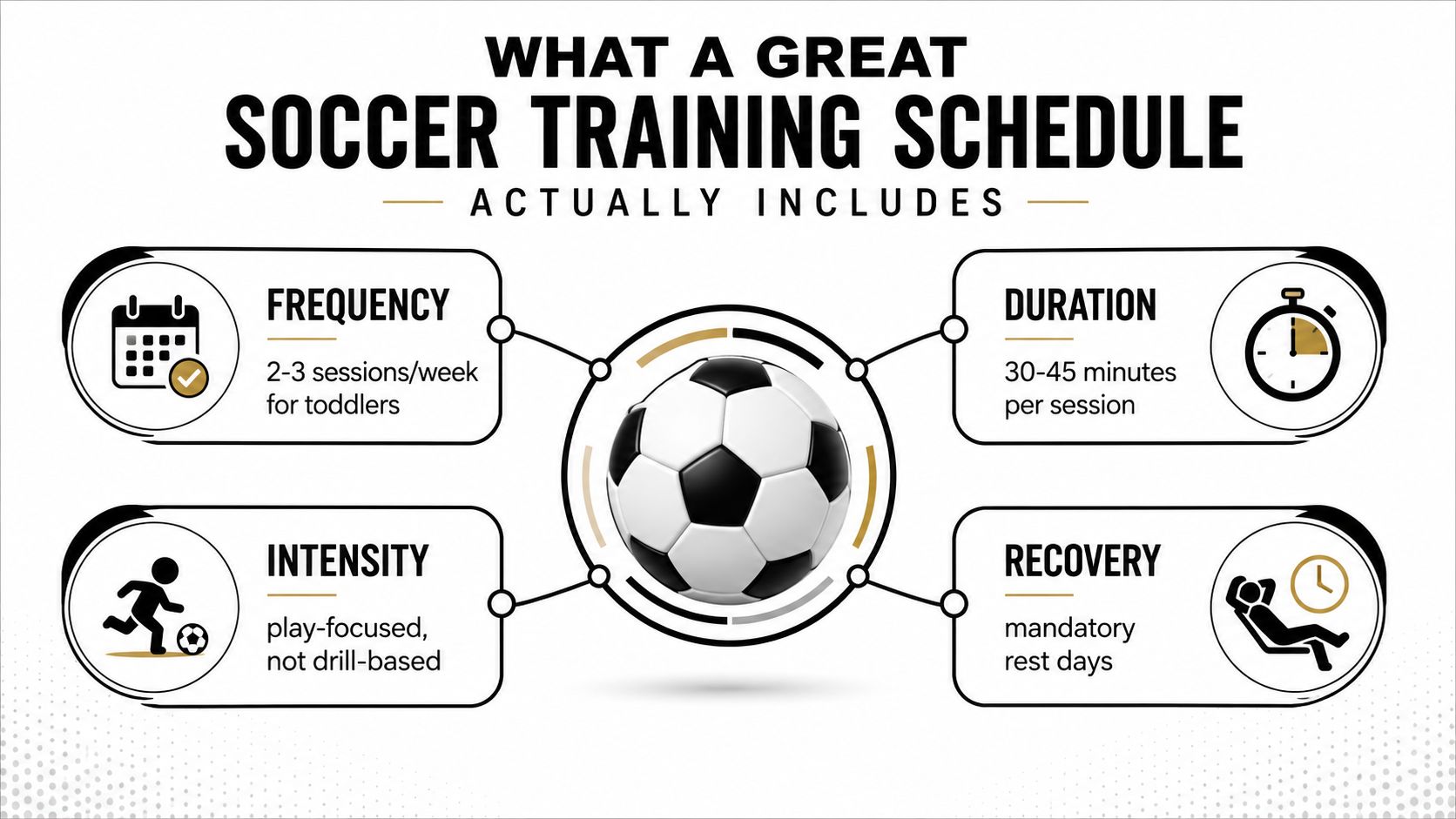
Parents can use the same test for any program. Ask: What will my child do, how long will it last, how demanding will it feel, and when will they recover? The soccer technical training guide can also help families understand why deliberate ball work belongs in a schedule, while still leaving space for free play.
The best plan isn't the one with the most appointments. It's the one your child can repeat with good energy, steady attention, and a willingness to return next week.
How Elite Academies Structure the Training Week
Professional youth academies offer a useful reference, but they aren't a template for every family. Research from a professional academy reported typical weekly training loads of 268 ± 25 minutes for U9 players, with older groups training progressively more, as described in the academy training analysis. That pattern reflects a performance pathway with coaching staff, planned recovery, and competition demands that most recreational players don't face.
One documented academy microcycle included a recovery day on Monday, training from Tuesday through Friday, a shorter Saturday session, and an official match on Sunday. The weekday sessions were typically 80 to 90 minutes, the Saturday session was 40 to 50 minutes, and the Sunday match completed the week, according to the youth soccer microcycle research.
Read the purpose behind the calendar
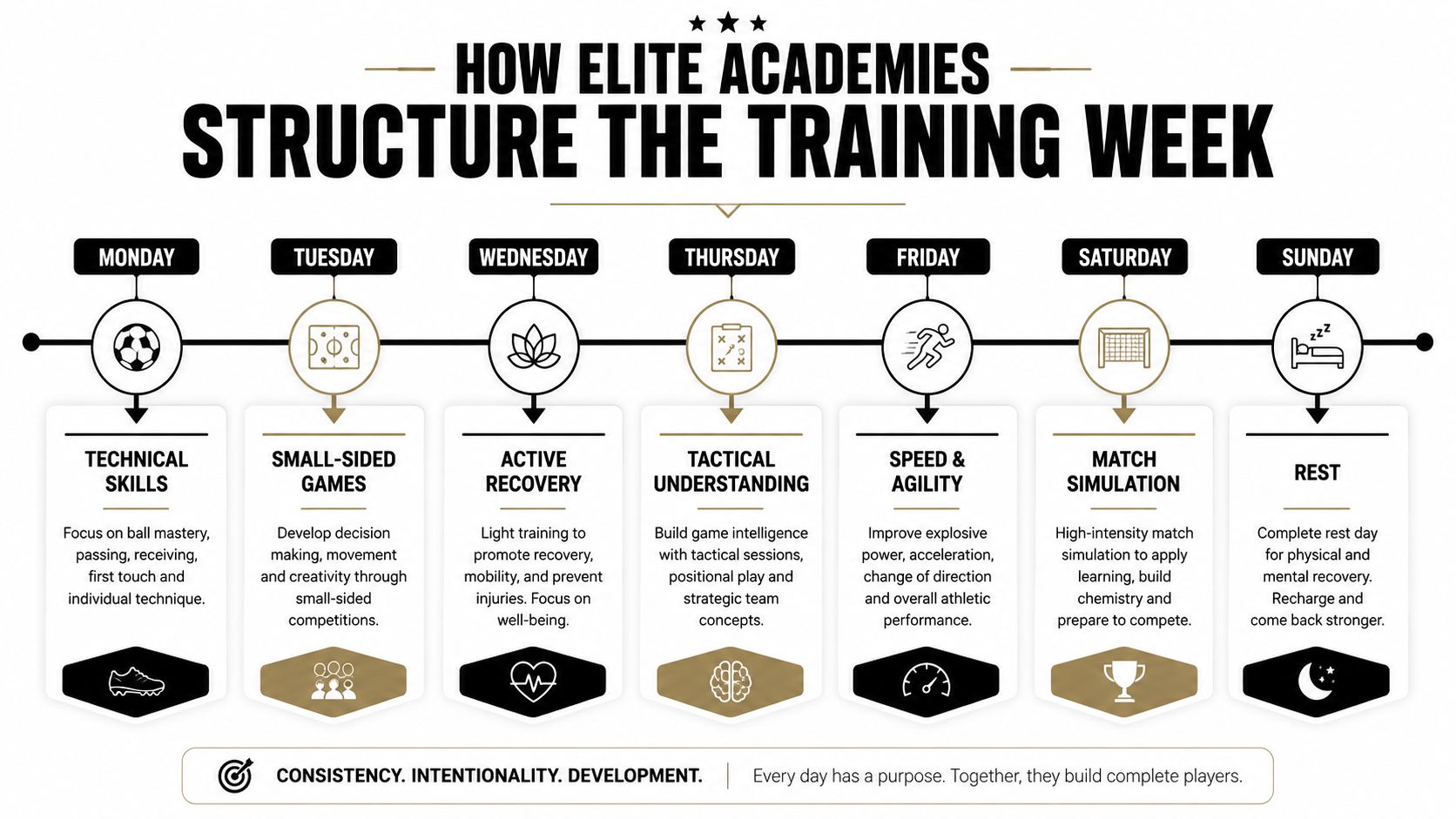
The important lesson isn't just that academy players train frequently. Coaches assign a role to each day. Technical-tactical work may occupy one session, small-sided games another, and speed, power, or match preparation a later session. Monday recovery gives players a chance to absorb the previous match before the next training block begins.
A separate elite youth study described a pattern with approximately 80 to 90 minutes on Tuesday, Wednesday, Thursday, and Friday, a shorter Saturday session, and a Sunday match, with recovery intentionally included. These examples show why a modern microcycle is built around changing demands rather than repeating maximum effort every day.
Academy-based development research also reported weekly volumes of 19 to 21 hours at ages 5 to 6, 25 to 28 hours at ages 9 to 15, and 23 to 25 hours at ages 15 to 16 in high-performance pathways, as summarized in the same academy research. Those figures describe specialized environments, not a recommendation for a local recreational child.
Don't confuse exposure with readiness
A recreational player may need fewer organized sessions and more freedom to play. A child who attends school soccer, a club practice, a weekend match, and another sport already has a demanding week, even if every individual activity seems manageable.
The same small-sided-game review supports using game-based blocks to develop speed, repeated-sprint ability, and change-of-direction performance, but it also emphasizes adjusting the plan through player numbers, pitch size, rules, and coaching instructions. Elite schedules work because the staff monitor and adjust them. Families should borrow the principle of planned variety and recovery, not the total workload.
The video below offers a visual example of how coaches can organize a purposeful training week.
If a program sells extra sessions as automatically better, ask what changes between those sessions and where recovery fits. A crowded calendar isn't proof of better development.
Sample Weekly Schedule for Toddlers and Preschoolers
Children ages two to five learn soccer through movement, imitation, exploration, and fun. They don't need a miniature academy schedule. They need chances to run, stop, turn, balance, kick, chase, and discover what the ball does.
A coached class can last 30 to 45 minutes, but the coach should change the activity before attention disappears. A session might follow this sequence:
Movement welcome: Run to colored cones, copy animal movements, or stop when the coach raises a hand.
Ball familiarity: Roll, tap, stop, push, and gently dribble the ball through a simple space.
Tiny-sided play: Use a parent, coach, or small group for a game with very few rules.
Fun finish: A shooting target, treasure hunt, bubbles, or a favorite movement game.
The child doesn't need constant correction. At this age, a successful session may be one in which the player joins willingly, tries a new movement, and leaves smiling.

A realistic week for ages 2 to 5
Day | Activity | Parent's aim |
|---|---|---|
Monday | Free backyard ball play | Follow the child's interest without directing every touch |
Tuesday | Coached multi-sport or soccer class | Let the instructor lead and observe energy |
Wednesday | Rest or ordinary outdoor play | No organized training |
Thursday | Short home game | Roll the ball, chase it, and shoot at a safe target |
Friday | Rest | Protect sleep and family downtime |
Saturday | Park play | Combine running, climbing, and occasional kicking |
Sunday | Optional relaxed ball play | Stop early if the child loses interest |
A toddler multi-sport session at JC Sports Houston can fit naturally on Tuesday for families in Humble, Kingwood, or Atascocita, while the other activities remain informal. The key distinction is that backyard play counts as movement without becoming another coached practice.
Use simple warm-ups based on games rather than stretching routines. The warm-up guide for workouts offers ideas parents can adapt, such as walking, skipping, chasing, and playful changes of direction.
Watch the child, not the clock. If they're distracted, frustrated, overheated, or asking to stop, end the activity. At this age, preserving curiosity is more valuable than completing a planned drill list.
Sample Weekly Schedule for School-Age Players
Ages six to twelve cover a wide range of coordination, maturity, confidence, and playing experience. A strong weekly plan usually combines one technique-focused session, one game-based session, and one match, then adds optional work only when the child is recovering well.
Small-sided games work especially well because every player gets repeated decisions. A review of youth interventions described effective 3v3 and 4v4 formats, with pitch sizes around 20 by 25 to 27 by 36 meters for 3v3 and 30 by 35 to 30 by 40 meters for 4v4, as reported in the review of small-sided games in young soccer players. The same review described actual game work in short bouts, often 12 to 20 minutes total, organized through repeated periods with recovery.
Build the game session carefully
For a 3v3 activity, choose a pitch within the recommended range, create two small goals or end zones, and let the players attack and defend. For 4v4, use a slightly larger space and introduce a simple condition, such as scoring after a pass or changing the point of attack.
Keep the bouts short enough for quality. The cited review describes formats such as 3x4-minute or 5x4-minute bouts, with recovery between efforts. Coaches can change the number of players, space, rules, or instructions, but they should change one variable at a time so they can see how the game responds.
Age Group | Sessions Per Week | Session Length | Primary Focus | Rest Days |
|---|---|---|---|---|
Ages 2 to 5 | 2 to 3 playful exposures | 30 to 45 minutes | Movement, ball familiarity, enjoyment | Mandatory |
Ages 6 to 8 | 2 to 3 organized sessions | Age-appropriate coached blocks | Technique and small-sided play | At least 2 |
Ages 9 to 12 | 3 organized exposures, adjusted individually | Purposeful technical, game, and match work | Decision-making, technique, coordination | At least 2 |
The table is a planning guide, not a prescription. A league match counts as a demanding soccer exposure, and another sport belongs in the total picture.
Copy-ready school-week example
Monday: Rest or easy outdoor play.
Tuesday: Technique session focused on first touch, dribbling, and turning.
Wednesday: Rest.
Thursday: 3v3 or 4v4 small-sided games with short bouts and recovery.
Friday: Rest or light ball play if the child feels fresh.
Saturday: League match.
Sunday: Family activity or complete rest.
A second technical session, including a Coerver-based program, may fit when the child is sleeping well, eager to attend, and recovering between activities. Don't add it automatically because another family does. Remove or shorten optional work when the child shows persistent soreness, declining enthusiasm, unusual irritability, or reduced concentration.
Girls' Technical Programs and the Rest Debate
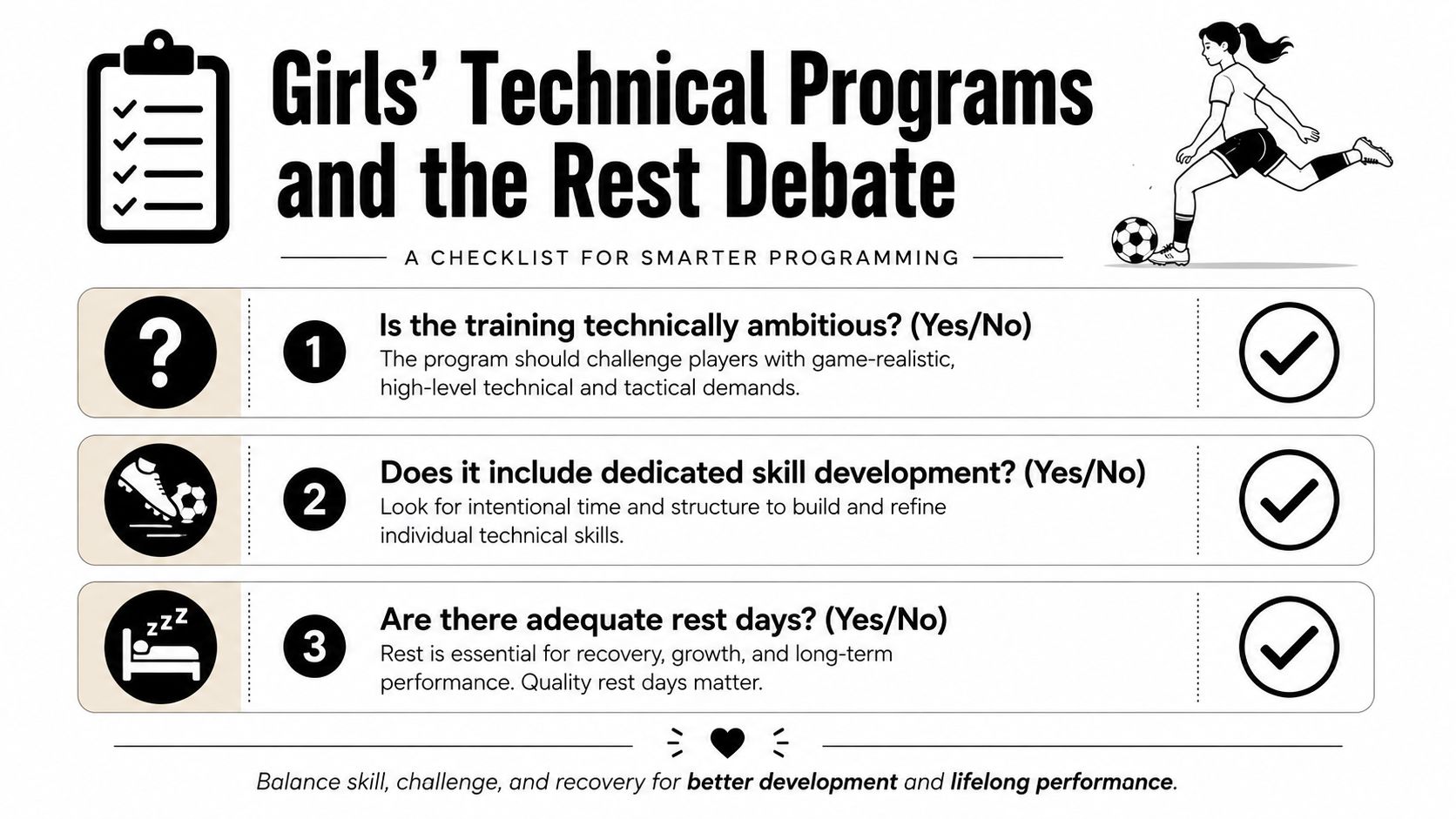
A technically ambitious girl doesn't need to choose between development and recovery. She needs a schedule that treats both as part of development. A dedicated girls' pathway, such as a Just for Girls Coerver-based option at JC Sports Houston, can provide focused ball work, but it should occupy a deliberate place in the calendar rather than becoming an extra commitment layered over every existing activity.
The first question is practical: What does the program add? If the child's team already spends most of its time in large-sided play, an individual technique session may fill a genuine gap. If the week already contains several demanding practices and matches, adding another hard session may provide little benefit.
Use these checks before enrolling:
Training purpose: Does the session develop a specific skill, such as first touch, dribbling, turning, or striking?
Child's condition: Does she arrive alert and leave energized, or does she regularly appear depleted?
Calendar load: Have you counted school, other sports, matches, camps, and travel?
Recovery space: Are there at least two genuine rest days in the week?
Medical guidance discussed in the research on youth soccer load and development recommends no more than age-in-years hours per week for adolescents, at least two rest days weekly, and less than eight months per year in one sport. These guardrails don't replace individualized medical advice, but they give families a useful starting point when a schedule begins to expand.
Same age doesn't mean same schedule
Two twelve-year-olds may have different biological maturity, sleep quality, injury history, confidence, and tolerance for training. Recent youth-soccer work supports combining subjective feedback with objective indicators when coaches adjust load, rather than relying on one number or one calendar template, as described in research on maturity and youth soccer monitoring.
Ask your child about sleepiness, soreness, mood, and motivation. Also watch how she moves. A player who loses coordination, avoids normal effort, or needs unusual encouragement may need less load, not more determination.
A year-round love of soccer doesn't require year-round hard training.
The National Institutes of Health summary referenced in the research notes links higher specialization with more daytime sleepiness and describes recovery guidance that includes one to two days off per week and at least three nonconsecutive months away from single-sport specialization each year, as reported in the NIH discussion of youth sport specialization. Families can maintain a relationship with the game through casual play, varied sports, and low-pressure movement during breaks.
A free trial or short program can help parents assess coaching style, intensity, and fit before making a longer commitment. The right choice is the one that develops technique without asking the child to ignore fatigue.
Turning Your Schedule into a Season with JC Sports Houston
A weekly plan becomes more useful when families place it inside the school calendar. Start by marking the fixed commitments, such as school, league matches, family travel, and other sports. Then add one development priority for the season, rather than trying to improve every skill at once.
For a younger child, that priority might be confidence with the ball and general coordination. For an older player, it could be first touch, dribbling under pressure, or preparation for a school season. Seasonal soccer leagues can provide a regular match rhythm, while skill-building camps during February Break, Spring Break, or Summer Break can replace normal weekly training instead of being added on top of it.
Private sessions need the same treatment. Schedule them during a period when they solve a clear need, then reduce another demanding activity if the overall week becomes crowded. A camp week should include recovery afterward, particularly when the child also plays matches or participates in another sport.
A simple seasonal planning method
Mark competition blocks: Identify league games and school-season dates first.
Choose development blocks: Add technical classes or private work where they support the season's priority.
Protect breaks: Keep rest days visible during holidays and between programs.
Review monthly: Ask whether the child is improving, enjoying the activity, and recovering normally.
Test before committing: Request a free trial to evaluate the coaching approach and session fit.
JC Sports Houston offers age-specific soccer classes, seasonal leagues, Coerver-based technical training, Just for Girls programming, private sessions, and sports camps. Families can use the online registration process, review field status before attending, and ask questions about fitting a class into the child's existing week.
The schedule should grow with the player. A toddler may begin with multi-sport movement, a school-age child may add structured technique and small-sided games, and an older player may choose a focused technical pathway. At every stage, the calendar still needs room for sleep, unstructured play, family life, and a child who sometimes wants a day off.
JC Sports Houston offers age-appropriate soccer classes, seasonal leagues, Coerver-based technical training, Just for Girls sessions, private instruction, and school-break camps for families in the Houston area. Visit JC Sports Houston to review the available options, request a free trial, and build a soccer training schedule that matches your child's age, goals, and recovery needs.
Comments