

Sports for Kids: Fun, Safe Ways to Build Confidence

That moment when your child scores their first goal or gets a high-five from a teammate? It’s more than just a picture-worthy memory—it’s a tiny, powerful building block for life. Organized sports for kids aren't just about learning the rules of a game. They're about learning resilience, teamwork, and self-belief in a structured, supportive space.
The goal isn't to chase a future athletic scholarship from day one. It's about finding an activity that brings them joy and helps them grow right now.
Why Sports Are More Than Just a Game for Kids
In a world full of screens, the need to get kids moving has never been more critical. Organized sports offer the perfect antidote, giving them a structured outlet for all that energy while doubling as a training ground for life.
Think of it this way: a playground teaches a kid how to run and climb, but a sports team teaches them why they should stop and help a friend who falls.
The lessons learned on the field, court, or diamond go way beyond physical fitness. Every practice is a chance to build discipline. Every game is a lesson in sportsmanship—learning how to win with class and, just as importantly, how to lose with grace. These are the experiences that build a strong, confident character.
Building Confidence and Social Skills
One of the biggest wins in youth sports is the incredible boost in self-esteem. When a child finally masters a new skill, like dribbling a basketball without looking down or hitting a baseball off a tee, you can see the pride on their face. That feeling of "I did it!" is a powerful internal motivator that sticks with them.
At their core, sports are filled with natural confidence-building activities for kids, helping them gain self-assurance with every new skill they learn and every challenge they overcome. These moments teach kids that effort and practice directly lead to improvement.
Sports teach children that success isn't just about the final score. It's about showing up, trying your best, and being a supportive teammate—qualities that build leaders on and off the field.
A Growing Recognition of Value
It’s clear that parents everywhere see the power of sports. The global youth sports market hit USD 37.98 billion and is expected to soar to USD 63.84 billion by 2033. That’s not just a trend; it's a reflection of a massive demand for quality programs.
This growth is fueled by a simple truth: sports are a fantastic way to improve physical health, mental well-being, and social skills in an increasingly sedentary world. This guide will give you a clear roadmap to navigate it all, helping you choose the right sport and find a program that puts your child’s growth and happiness first.
Choosing the Right Sport for Your Child's Age and Stage
Picking your child's first sport can feel like a monumental decision, but it really doesn't have to be. The goal isn't to lock them into their "forever" sport at age three. It's about matching the activity to where they are right now—physically and mentally—to make sure the experience is fun, builds confidence, and creates a positive foundation for a healthy life.
Think of it like learning to read. You don't hand a toddler War and Peace. You start with the alphabet, then simple words, and eventually sentences. Sports are the same. We begin with fundamental movements like running, jumping, and throwing before we ever get to complex rules and team strategy. Pushing a kid into a sport they aren’t ready for is a fast track to frustration. But the right activity at the right time? That’s where the magic happens.
Toddlers: Ages 2 to 3 – The Age of Exploration
At this age, a child’s world is all about discovery. Their main job is figuring out how to make their bodies work. Organized sports for kids at this stage shouldn't look like what we see on TV. The entire focus should be on playful movement and developing those crucial gross motor skills.
Multi-sport programs are absolutely perfect for this group. They introduce basic movements in a low-pressure environment where fun is the only goal.
Running and stopping: Simple games like "Red Light, Green Light" are fantastic for teaching body control.
Jumping: Hopping over soft cones or pillows builds leg strength and coordination.
Throwing and catching: Using big, soft balls helps develop hand-eye coordination without any fear of getting bonked on the head.
Success isn't about performance; it's about participation. You want a program with small classes and coaches who are more like energetic cheerleaders, celebrating every little try.
Preschoolers: Ages 4 to 5 – Learning the Basics
By four or five, kids are ready for a bit more structure. Their balance is better, they can focus for longer, and they're starting to grasp simple rules. This is the sweet spot for introducing modified versions of popular sports that boil the game down to its most fun elements.
Think of programs like BlastBall, which is essentially a simplified version of t-ball. It gets rid of strikes and outs and just focuses on the pure joy of hitting a ball and running to a base. The same goes for introductory soccer, where fun drills and mini-games teach kicking and dribbling without the pressure of a real match.
The most important question you can ask is, "Are they having fun?" For a preschooler, pure enjoyment is the ultimate measure of success. If they leave practice with a huge smile, excited for the next one, you've found the right fit.
This infographic gives a great overview of how sports help kids grow physically, socially, and emotionally.
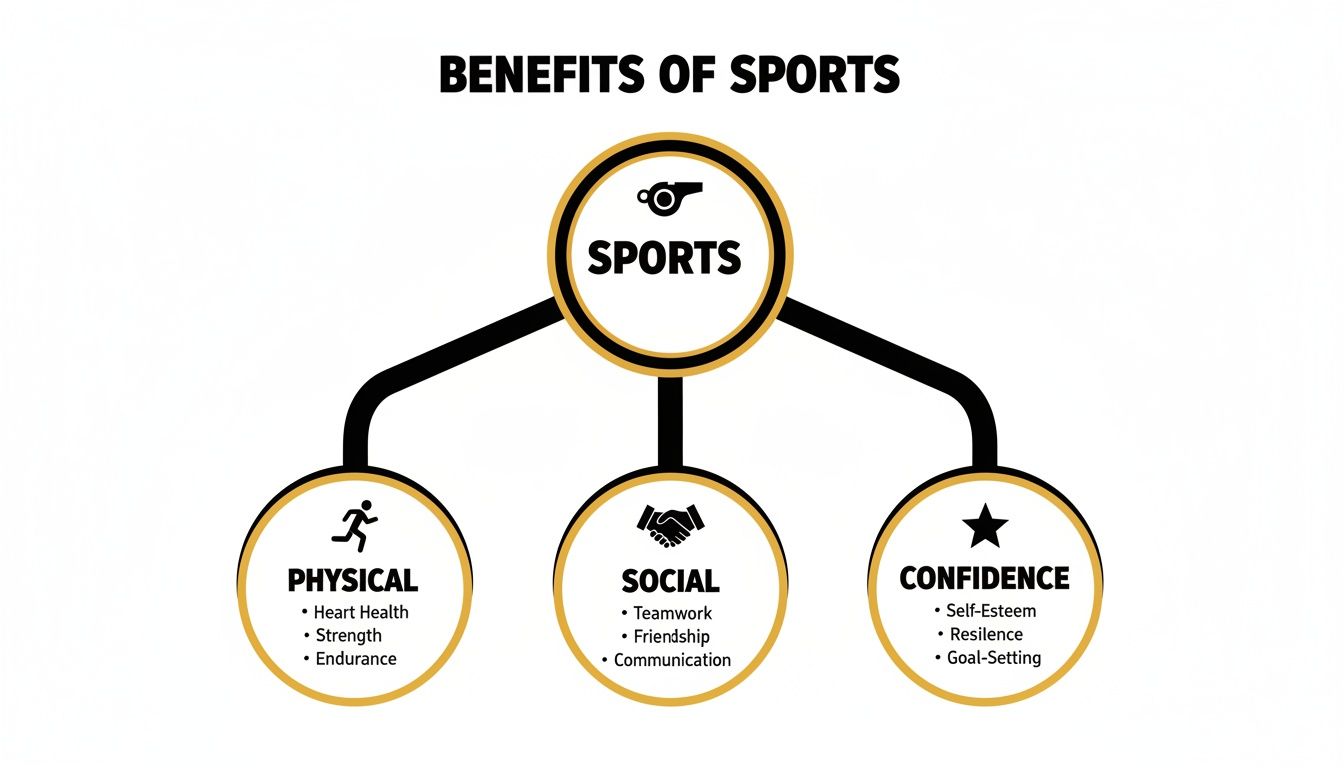
As you can see, these benefits are all connected. Nailing a physical skill gives a direct boost to a child's confidence, which in turn makes it easier for them to connect with teammates.
School-Aged Kids: Ages 6 and Up – Ready for Team Play
Once kids hit age six, most have the coordination, focus, and social skills to really dive into organized team sports. They can follow multi-step directions, understand basic strategy, and start to appreciate what it means to be part of a team. This is when sports like soccer, basketball, and baseball really open up.
At this stage, their understanding of the game deepens. They learn about positions, why teamwork matters, and how to cheer on their friends. It's also a time when they might start showing a real passion for one sport in particular. While it’s fine to let them explore that, continuing to play multiple sports is still a great way to prevent burnout and build a well-rounded athlete.
For a more in-depth look at this progression, our parent's guide to the Long-Term Athlete Development model offers an excellent framework.
To make things easier, here's a quick guide to help you find the right fit for your child's age and stage.
Age-Appropriate Sports and Skill Development Milestones
Age Group | Recommended Activities | Key Skills Developed | Ideal Program Focus |
|---|---|---|---|
Toddlers (2-3) | Parent-and-me classes, multi-sport discovery, tumbling | Running, jumping, balance, taking turns, listening | Fun, play-based exploration with positive reinforcement |
Preschool (4-5) | BlastBall, introductory soccer, dance, gymnastics | Hand-eye coordination, following simple rules, basic teamwork | Skill introduction through games, non-competitive fun |
School-Age (6+) | Soccer leagues, basketball, baseball, flag football | Strategy, advanced coordination, sportsmanship, resilience | Structured drills, teamwork, and healthy competition |
Ultimately, matching the sport to the child—not the other way around—is what sets them up for a lifelong love of being active.
What to Look for in a Youth Sports Program
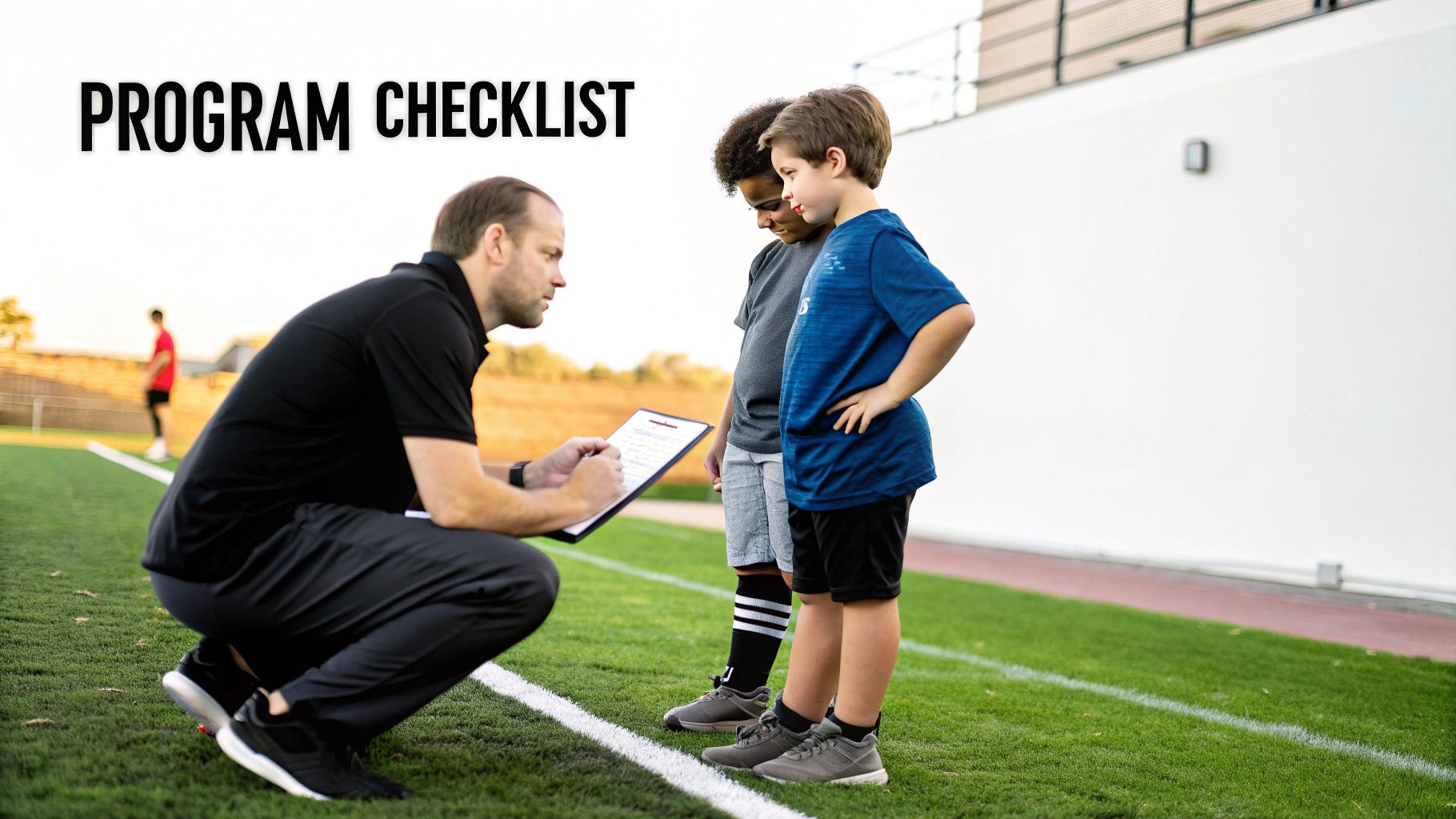
Once you’ve got a sport that clicks with your child’s age and personality, the next big step is finding the right program. This decision goes way beyond convenience or a flashy uniform. It’s about finding a place where your kid feels safe, supported, and genuinely excited to show up.
A great program can light a fire for physical activity that lasts a lifetime. On the flip side, a poor one can lead to burnout before they’ve even had a chance to see what they can do. You’re not just signing them up for a sport; you’re entrusting them to a community.
Coaching Philosophy and Positive Reinforcement
Let’s be honest: the coach is the single most important person in your child's sports journey. A great coach is a teacher and a motivator, someone who focuses on effort and improvement—not just winning at all costs. Their real job is to build confidence and nurture a love for the game.
When you're checking out a program, ask about their coaching philosophy. Listen for keywords like positive reinforcement, skill development, and fun. A coach who yells, punishes mistakes, or only cares about the final score can snuff out a child's enthusiasm in a heartbeat. The best coaches celebrate the small wins and create an atmosphere where kids aren’t afraid to try, fail, and try again.
A coach's role is not just to teach the rules of the game but to build a foundation of resilience and sportsmanship. Their words and actions shape a child’s entire perception of what it means to be an athlete and a teammate.
This positive approach is what keeps kids coming back. When a child feels encouraged, they’re far more likely to stick with it and get all the amazing long-term benefits of playing sports.
Safety Protocols and Environment
A safe environment is non-negotiable. Before you sign on the dotted line, you need to know how serious a program is about player safety. This is about more than just having a first-aid kit nearby; it’s about a comprehensive approach to keeping your child protected, both physically and emotionally.
Here are a few essential questions to get you started:
Background Checks: Does the program run thorough background checks on every single coach and volunteer?
Injury Prevention: Do coaches teach proper warm-ups, cool-downs, and techniques to minimize the risk of injury?
Emergency Plans: Is there a clear, documented plan for what to do when an injury or emergency happens?
The facility itself matters, too. While outdoor fields are great on a perfect day, we all know Texas weather is anything but predictable. An indoor, climate-controlled facility means no more cancellations for rain, brutal heat, or cold snaps. It guarantees consistent, year-round training, so skills can develop without interruption while keeping young athletes safe from the elements.
Curriculum and Class Structure
A quality youth sports program doesn’t just roll out a ball and let the kids run wild. It follows a structured curriculum designed to build skills in a logical, step-by-step way. Think of it like a math class—you have to learn addition before you can tackle algebra.
For example, a strong soccer program might use a proven system like the Coerver Method, which is all about individual skill and mastering the ball. This approach breaks down complex moves into simple, repeatable steps, building a solid foundation before ever moving on to team tactics. It ensures every child can see real progress, no matter their natural ability.
You'll also want to look at the coach-to-player ratio. Small class sizes are a game-changer, especially for younger kids. When a coach has fewer children to manage, they can give more individual attention, offer personalized feedback, and make sure everyone is actually participating. That one-on-one guidance is what truly speeds up learning and builds confidence.
The growing popularity of sports for kids makes these quality markers even more important. Recent data shows that 55% of youth ages 6-17 played organized sports, an encouraging trend that brings the U.S. closer to its national participation goals. However, programs that are transparent with pricing and offer free trials are vital for closing the participation gaps that still exist across different income levels, making sports a reality for more families. You can dive deeper into these youth sports participation trends to learn more.
How to Practice and Play at Home
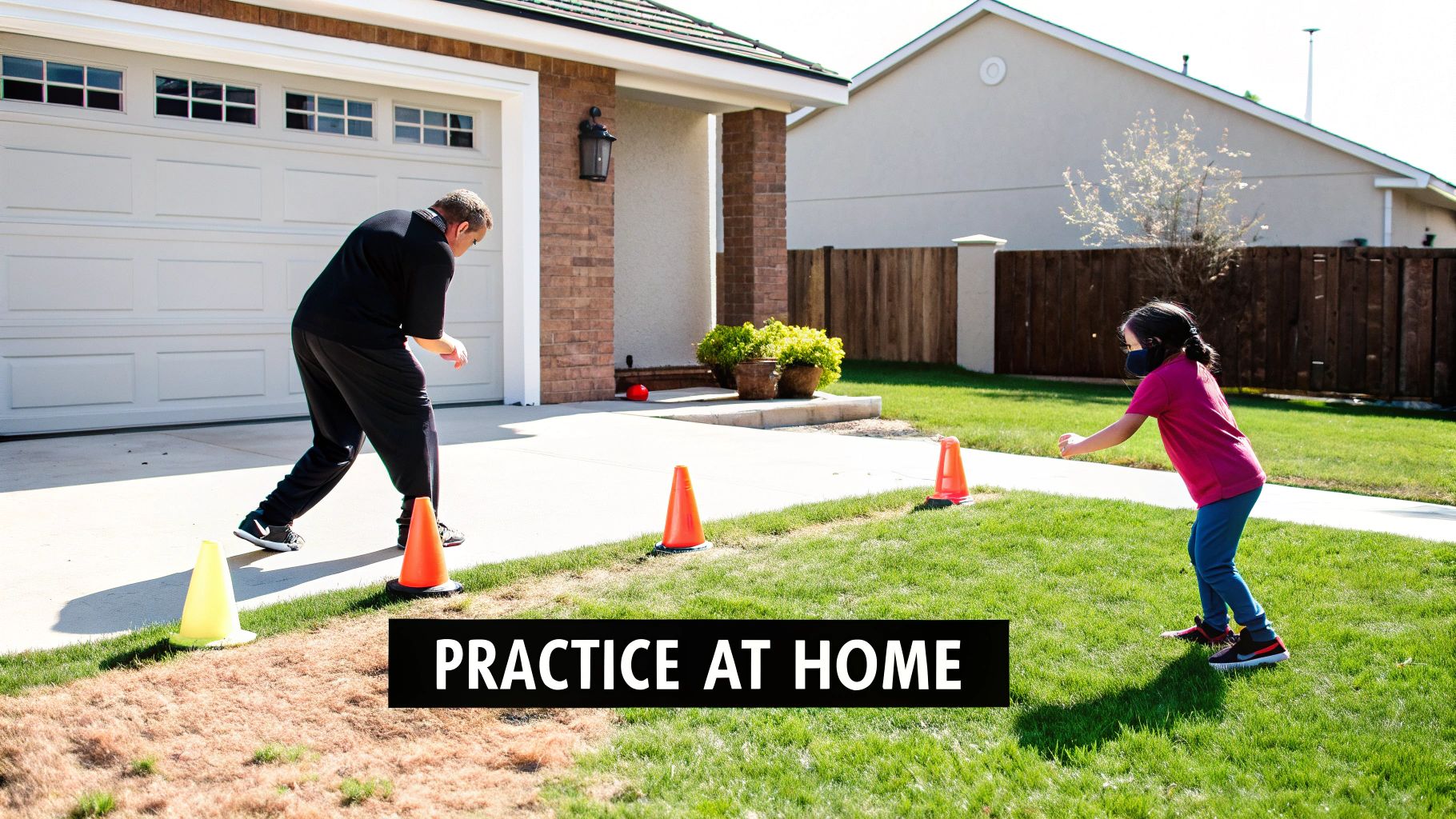
While structured classes and leagues are fantastic for building skills, the real magic happens when the fun continues at home. Reinforcing what your child learns in a program doesn't mean you need a professional setup or hours of intense drills. It’s all about blending playful practice into your daily routine to deepen their love for being active.
Think of it like learning an instrument. A weekly lesson gives them the foundation, but the real progress comes from those short, fun practice sessions between classes. Simple, low-pressure activities at home can accelerate skill development and build confidence in amazing ways. And the best part? You can get started with just a ball, some creativity, and a positive attitude.
Fun and Simple Home Activities for Toddlers
For the littlest athletes, practice should feel like pure playtime. The goal is to build those essential gross motor skills and hand-eye coordination in a way that’s full of giggles. Keep it simple, keep it short, and celebrate their effort, not the outcome.
Here are a few easy ideas to get your toddler moving:
Balloon Volleyball: An indoor classic for a reason! A balloon is slow-moving and won't break anything, making it perfect for practicing hitting and tracking objects with their eyes.
Red Light, Green Light: This old-school favorite is a masterful way to teach body control. It helps toddlers practice the crucial skills of starting, stopping, and listening to directions—all while having a blast.
Animal Walks: Ask your child to move across the room like a bear (on all fours), a frog (by jumping), or a crab. It's a silly game that secretly builds core strength and coordination.
The most important part of home play for a toddler is connection. When you get down on the floor and play with them, you’re not just a parent—you're their first and most important teammate.
Engaging Backyard Drills for Preschoolers
Preschoolers have a bit more coordination and a longer attention span, so you can introduce slightly more structured activities. This is a great age to build on the fundamentals of specific sports for kids, like soccer or basketball, but the focus has to stay on fun.
A few simple backyard activities can make a big difference:
Backyard Obstacle Course: Use pillows, toys, and cones to create a simple course. Have them run around a cone, jump over a pillow, and crawl under a blanket. This builds agility and makes fitness feel like an adventure.
Dribbling with Cones: If they're into soccer, set up a few cones (or water bottles!) and encourage them to dribble a ball around them. Don’t worry about perfect form; just celebrate them keeping the ball close.
Throwing at a Target: Grab a laundry basket or a big box. Practice throwing soft balls or beanbags into it to improve their aim and coordination.
These simple games reinforce the skills they learn in class without making it feel like work. They're just fun ways to move and play together.
Practice Routines for School-Aged Kids
For older kids, home practice can become a bit more focused, but it should still be enjoyable. This is the perfect time to work on specific skills that will help them feel more confident during their games. Just keep sessions short—15 to 20 minutes is often plenty—to prevent burnout.
A simple routine could look like this:
Playing Catch: A few minutes of catch with a baseball, football, or basketball is an incredible way to improve hand-eye coordination and just connect.
Dribbling Drills: For basketball players, dribbling with both their right and left hands for a few minutes each day is huge for building ambidextrous skill. Make it fun by adding challenges, like dribbling while walking. For more ideas, check out these fun and effective basketball drills for 8-year-olds.
Wall Ball: For soccer players, kicking a ball against a sturdy wall is a fantastic way to practice passing and receiving on their own.
By weaving these small, consistent moments of play into your home life, you show your child that being active is a natural and joyful part of every day. This partnership between formal classes and informal fun is the ultimate recipe for nurturing a lifelong athlete.
Finding the Right Youth Sports Program in Houston
Okay, so you know what makes a great program—positive coaching, a safe environment, and a curriculum that actually builds skills. But how do you find a place like that here in Houston?
The last step is connecting all those dots. You’re looking for a place where your child isn't just another name on a roster, but a kid on a journey, with coaches who are genuinely invested in their growth.
For families in our area, that’s where a center like JC Sports Houston comes in. They take all that theory about high-quality sports for kids and put it into practice every single day.
A Curriculum Built for Every Age
Let's be honest, a one-size-fits-all approach is a disaster in youth sports. A program that works for a 7-year-old will overwhelm a toddler. JC Sports gets this, offering specialized programs that meet kids exactly where they are developmentally.
For Toddlers (Ages 2-3): It's all about fun and foundational movement. Their multi-sport classes are designed to be a super positive first taste of organized activity. No pressure, just play.
For Preschoolers (Ages 4-5): Ready for a little more structure? Beginner-friendly games like BlastBall introduce the core ideas of a sport in a non-competitive, encouraging way.
For School-Aged Kids (Ages 6+): This is where skill development really takes off. Structured programs, like their Coerver-based soccer training, provide a clear path for kids to build real technical ability.
This tiered approach is key. It ensures your child is building skills progressively, not being thrown into a system they aren't ready for.
More Than Just a Weekly Class
Modern family schedules are chaotic, and a great sports program has to fit into real life. Flexibility and variety are what make sports a sustainable and enjoyable part of your child’s routine.
Beyond the regular weekly classes, JC Sports Houston offers practical solutions for busy families. Think seasonal leagues, skill-building camps during school breaks, and even custom, coach-led sports parties for birthdays.
This means your kid can dive deep into a sport during a week-long camp or get their first taste of team play in a local league. The goal is always to develop "well-rounded, creative players" through small-sided games that keep every child engaged and having fun. You can see how they put it all together by exploring JC Sports Houston's premier youth sports programs.
The sports they focus on are the ones kids are clamoring to play. National data shows basketball is the most popular youth sport in the U.S. with 29% participation, with soccer and football right behind it at 26% each. By offering top-notch programs in these high-interest sports, centers like JC Sports give kids a great shot at finding an activity they absolutely love.
Experience the Difference Firsthand
Ultimately, you can read all the websites and brochures in the world, but the only way to really know if a program is the right fit is to see it with your own eyes. It’s one thing to read about a coaching philosophy; it's another to watch a coach patiently and enthusiastically guide a group of kids.
The right program feels like a community. It’s a place where your child is excited to go, where coaches know their name, and where the focus is on personal growth and having fun.
JC Sports Houston stands by its approach and invites parents to see it for themselves. They offer a free trial class, giving your family a chance to step onto the field or court to check out the environment, the coaching style, and the overall vibe.
This no-pressure opportunity takes the guesswork out of the decision. It's the final, crucial step in finding a sports home where your child can truly thrive.
Your Top Questions About Kids Sports, Answered
Jumping into the world of youth sports can feel like learning a whole new playbook. Parents often have a ton of questions, from "When is the right time to start?" to "How do I handle it if my kid wants to quit?" We get it.
This is your go-to guide for navigating those tricky questions. Think of it as a little coaching session to help you feel confident and ready for this fun new chapter with your child.
At What Age Should My Child Start Organized Sports?
This is the big one, and the honest answer is: there's no magic number. It's less about their age and more about their individual readiness. The real goal is to introduce sports for kids in a way that feels like pure fun, not pressure.
For most little ones, that two to five-year-old window is the sweet spot for starting play-based programs. These aren't about winning or losing; they're about learning to run, jump, listen, and share space with other kids. It’s all about building a happy, positive connection with being active.
By the time they hit six or seven, most kids have the coordination and focus to start understanding the basic rules of team sports like soccer or t-ball. They can follow more complex instructions and are just beginning to get the hang of teamwork.
The key is to match the activity to where your child is right now, not where you hope they'll be. A positive first experience is worth so much more than starting early in a program they aren't ready for.
Choosing a program designed for their specific age group is crucial. It ensures the games are fun, the expectations are fair, and the focus stays right where it should be: on having a great time.
How Do I Know if My Child Is Ready for a Competitive League?
Moving from fun, casual classes to a more competitive league is a big step, and every child gets there on their own timeline. The most important thing is that the desire to compete comes from them, not from you or anyone else.
So, what should you look for? A good sign is when your child really understands the rules of the game and has a solid handle on the basic skills. They also need the emotional maturity to handle the excitement of a win and the sting of a loss without getting too overwhelmed.
Pay attention during practice. Are they most excited during the game-like scrimmages? Do they seem a little bored with the basic drills? If they're itching to put their skills to the test against other kids, that’s a pretty clear signal they might be ready for more.
When you do make the jump, look for a beginner-friendly league that focuses on developing skills and giving every kid equal playing time. This creates the perfect bridge, introducing them to competition in a healthy, supportive way.
What if My Child Wants to Quit a Sport Mid-Season?
It’s the conversation every parent dreads. Your child, who was so excited to sign up, suddenly says, "I want to quit." It happens all the time, and before you do anything, the first step is to take a breath and figure out why.
Gently ask some questions to get to the root of the problem.
Is the pressure getting to be too much? Sometimes, the fear of disappointing a coach or parent is the real issue.
Is something going on with the team? A conflict with another player or feeling left out can quickly ruin the fun.
Are they just not enjoying it? It's okay if a sport just isn't the right fit.
If it’s something small, like being bored with drills or bummed about a tough loss, encouraging them to finish the season teaches a great lesson about commitment. You can frame it as keeping a promise to their teammates. But if there’s a serious problem—like a negative coach, bullying, or your child is showing real signs of anxiety—forcing them to stick it out can do more harm than good. Protecting their well-being always comes first.
The ultimate goal is to help them build a lifelong love for being active. Sometimes, that means knowing when it's time to try something new.
How Can I Be a Supportive Sports Parent Without Being That Parent?
You are one of the biggest influences on your child's sports experience. The best way you can support them is by being positive, consistent, and loving them no matter what happens on the field. They need to know your pride isn't based on how many goals they score.
The car ride home is not the time for a play-by-play critique. Instead of pointing out mistakes, focus on their effort and attitude. A simple, powerful phrase like, "I loved watching you play today," means everything. It tells them that the real prize is their participation and hard work, not the final score.
Let the coach be the coach. Your job is to be their biggest fan. Cheer them on, celebrate the small wins, and be there to listen when they're frustrated. When you focus on the life lessons—resilience, teamwork, and effort—you help them build a love for the game that comes from within. Your positive presence is the best gift you can give them.
At JC Sports Houston, we provide a supportive, age-appropriate environment where every child can discover the joy of sports. From our multi-sport toddler classes to our competitive youth leagues, our expert coaches are dedicated to building skills and confidence. Experience our positive approach firsthand by signing up for a free trial class.
Comments