

Your Guide to Youth Basketball Training Programs in Houston

You might think playing pickup games at the park is enough, but a structured youth basketball program is where kids truly learn the game from the ground up. It’s a dedicated space for them to get age-appropriate coaching in everything from dribbling and shooting to teamwork, setting them on a real path for growth and a genuine love for the sport.
Building the Foundation, One Dribble at a Time
Moving beyond just rolling out a ball and letting kids play, today’s best youth basketball training programs are more like a structured apprenticeship for young athletes. Think of it like learning an instrument—you have to practice scales and chords before you can play a real song. In the same way, these programs break down the game into its core skills to build a solid, lasting foundation.
This approach ensures that young players don't just copy what they see on TV but actually understand the mechanics behind every move. It’s all about teaching the "why" behind the "how," so the skills stick.
From Fun-Driven to Fundamental-Focused
For our youngest ballers, usually in the 3-5 age range, the goal isn't to create the next NBA star overnight. The real focus is on making basketball a blast while introducing basic motor skills. Sessions are packed with energetic games that subtly teach coordination, balance, and how to listen to a coach. This might look like learning to dribble with two hands or simply running and stopping on command. It’s all about play with a purpose.
As kids get a bit older, typically around ages 6-12, the curriculum starts to get more specific. This is where we introduce key basketball techniques—things like the correct form for a layup, the proper defensive stance, and the fundamentals of passing to a moving teammate.
A well-designed youth basketball program doesn't just teach skills; it builds confidence. Each small victory—like making that first basket or finally mastering a new dribble—becomes a building block for self-esteem on and off the court.
Age-Appropriate Skills and Strategy
A great program knows you can't teach advanced strategy to a first-grader. Just like in school, the curriculum has to be age-appropriate. The concepts taught to a 12-year-old will be far more advanced than what a 7-year-old is ready for.
This progressive learning model breaks down like this:
Early Elementary (Ages 6-8): Here, we introduce basic rules, simple team concepts like spacing the floor, and foundational skills like the triple threat position.
Upper Elementary (Ages 9-12): The focus shifts to more advanced techniques. This includes learning basic offensive plays, understanding defensive positioning, and getting a feel for the flow of a real game.
For families in our local communities like Humble, Kingwood, and Atascocita, putting your child in a structured program is about so much more than winning games. It’s about giving them the tools for long-term athletic development, teaching them resilience, and sparking a lifelong passion for being active and working as a team.
What Kids Learn at Each Age
Just like a child learns to crawl before they can walk, their basketball journey follows a natural, step-by-step progression. Any great youth basketball program understands this. The curriculum isn't random; it's carefully designed to introduce the right skills at the right time, so kids feel successful and stay excited about the game instead of getting overwhelmed.
The goal isn't just to teach drills. It's to build a genuine love for the sport, starting from the very first time they pick up a ball. This journey starts with pure, energetic fun and slowly builds into a real understanding of skills, strategy, and teamwork.
This timeline gives you a great visual of that journey, showing how the focus shifts from foundational fun to specific skills and, eventually, to understanding the game's strategy.
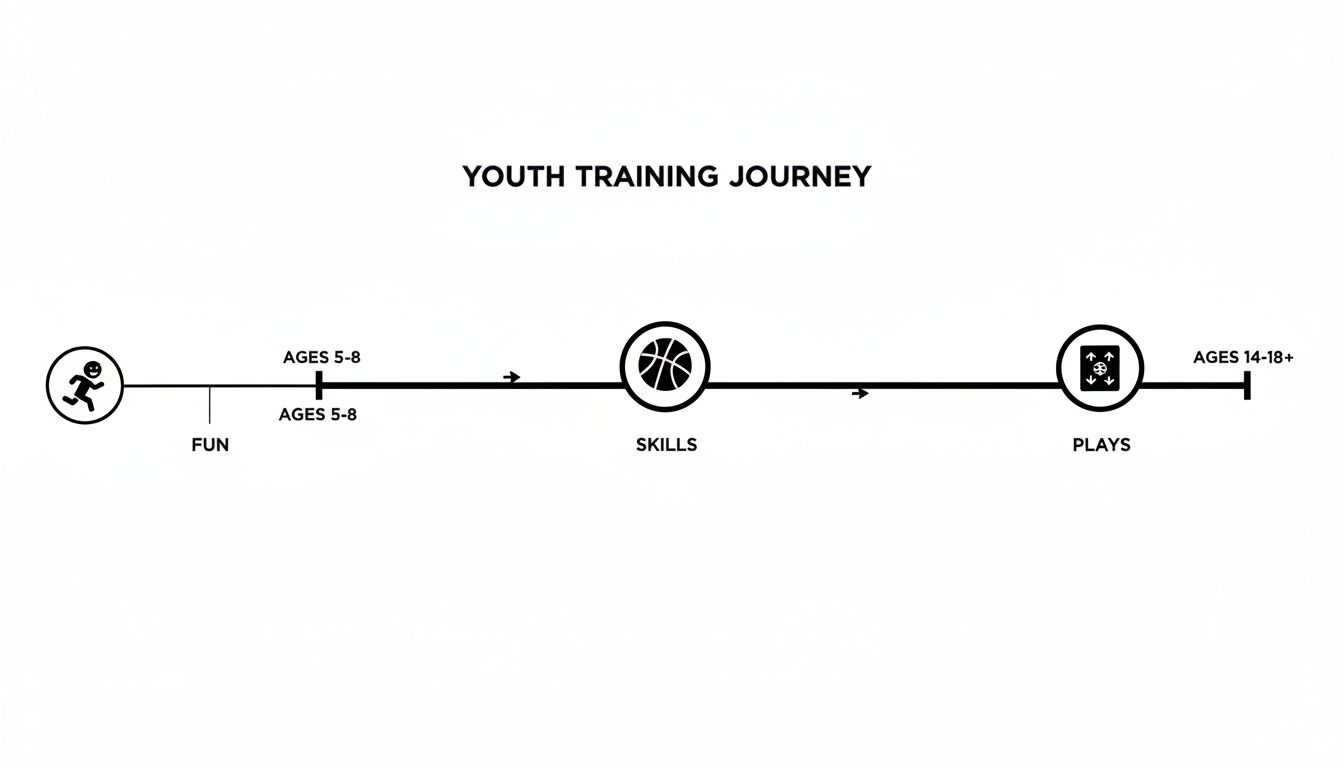
As you can see, each stage builds directly on the last one. This layering ensures young athletes develop a complete and confident skill set over time.
Ages 3 to 5: Foundational Fun and Motor Skills
For the little ones, the basketball court is more of a playground than a competitive arena. At this age, it’s all about developing gross motor skills in a playful, super-encouraging environment. Think of it as learning the body's ABCs before trying to write a sentence.
Coaches use creative, high-energy games to teach fundamental movements. A simple game of "red light, green light" isn't just for laughs; it teaches kids how to start and stop on a dime—a skill they'll definitely need later on. Dribbling is usually done with two hands, and shooting is all about the pure joy of getting the ball into a lowered hoop.
At this stage, we’re focused on:
Basic Coordination: Running, jumping, and stopping with some control.
Listening Skills: Following simple, one-step instructions from a coach.
Social Interaction: Learning to share space and take turns with other kids.
Positive Association: Making sure basketball equals fun, excitement, and play.
Finding the right program is key. For parents looking into options for this age group, our guide on quality basketball programs for 4-year-olds has some great tips on what to look for.
Ages 6 to 8: Building the Skill Toolkit
Once kids hit early elementary school, their ability to listen and process more specific instructions really takes off. This is where those foundational movements start to look like real basketball techniques. The program becomes a bit more structured as we introduce the core building blocks of the game.
Coaches start explaining the "why" behind the movements. Instead of just bouncing the ball, kids learn to dribble with their heads up to see the court. They’re introduced to proper shooting form—the classic "BEEF" (Balance, Eyes, Elbow, Follow-through) method usually makes its first appearance here.
Ages 9 to 12: Introducing Strategy and Team Concepts
By the time players are in upper elementary and middle school, they're ready for more complex ideas. Their bodies and minds have matured, allowing coaches to introduce real strategy and teamwork. The focus shifts from "What am I doing?" to "What is our team doing?"
Training sessions start to include basic offensive plays and defensive principles. Players learn about spacing the floor to open up passing lanes and why moving without the ball is so important. Drills become more dynamic, mimicking game-like situations where kids have to make quick decisions.
Key skills at this level include:
Defensive Stance: Learning that athletic posture needed to stay in front of an opponent.
Team Offense: Understanding simple plays where everyone has a role.
Basketball IQ: Starting to read the court, anticipate what’s next, and make smarter choices.
Advanced Dribbling: Adding crossovers and other moves to get past defenders.
This natural progression ensures that by the time they hit their teens, they don’t just know how to play basketball—they know how to think like a basketball player.
To make it even clearer, here’s a quick breakdown of how skills typically progress across these age groups.
Basketball Skill Progression by Age Group
Age Group | Primary Focus | Key Skills Learned |
|---|---|---|
3-5 | Fun & Gross Motor Skills | Basic coordination, running, stopping, listening, sharing, two-hand dribbling. |
6-8 | Fundamental Basketball Skills | One-hand dribbling, basic shooting form (BEEF), passing, simple rules of the game. |
9-12 | Team Concepts & Strategy | Defensive stance, offensive plays, basketball IQ, spacing, advanced dribbling. |
This table provides a great snapshot, but remember every child develops at their own pace. A good program will meet them where they are and help them grow from there.
The Lifelong Benefits of Basketball Training
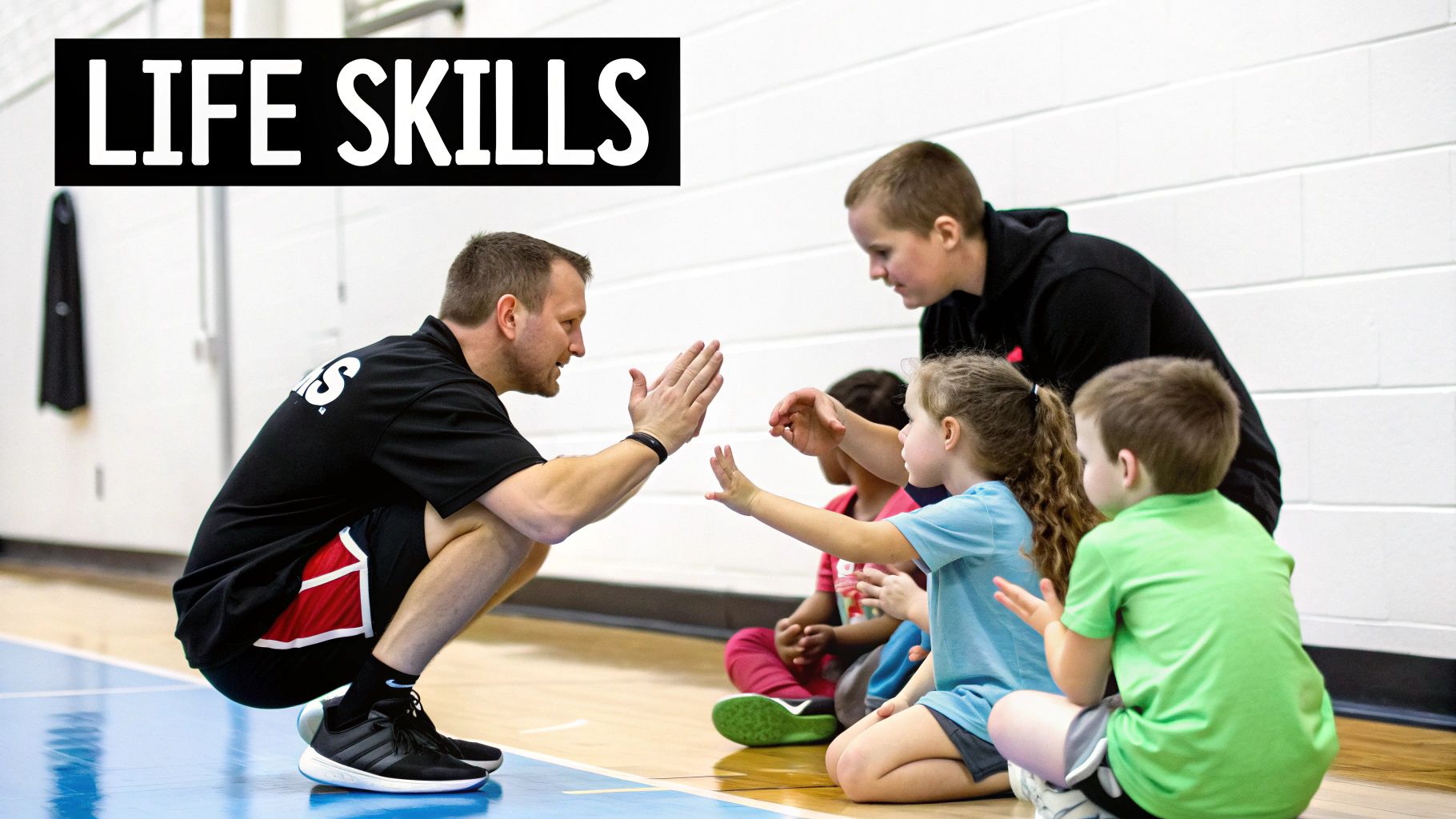
When your child joins a youth basketball program, they’re learning a lot more than just how to dribble and shoot. They’re picking up essential life skills that will stick with them long after the game is over. Every drill, every pass, every play is a lesson in communication, trust, and teamwork.
It’s a powerful way to learn how to work with others toward a common goal—a skill they'll use in the classroom, in friendships, and one day, in their careers.
Teamwork, Communication, and Sportsmanship
On the court, there's no hiding. Small-sided games force kids to think on their feet, make quick decisions, and rely on their teammates. It’s where they learn to listen, adapt, and cheer each other on—even during a fast-paced game.
Collaboration: Drills teach kids how to cooperate and perform under a little bit of pressure.
Communication: Passing exercises make clear and quick communication second nature.
Sportsmanship: Kids learn how to win with humility and lose with grace, building character along the way.
It’s not just talk, either. Statistics show that this kind of engagement works. In 2023, youth sports participation hit 55.4% for kids aged 6-17, which translates to a massive 27.3 million young athletes learning these lessons. What's more, kids who receive quality training are 25% less likely to drop out of sports by high school. You can learn more about these youth sports participation findings here.
Physical and Mental Advantages
Beyond the social skills, the physical and mental gains are huge. Drills designed to improve hand-eye coordination don't just make a better basketball player; they build a better all-around athlete. As kids push through challenging exercises, they're building mental toughness without even realizing it.
Improved Coordination: Better agility and coordination give kids an edge in any physical activity they try.
Discipline and Focus: Sticking to a practice routine sharpens their ability to concentrate and stay on task.
Resilience: Learning from a missed shot or a mistake on the court teaches them to bounce back and try again.
Mastering a new drill teaches persistence that serves beyond basketball.
Think about a simple drill where a coach introduces a new move. At first, it’s awkward. But with each attempt, the child gets a little closer. That process—failing, adjusting, and trying again—is where real persistence is born. Cheering for a teammate who finally makes the shot builds genuine camaraderie. These are the moments that count.
Those lessons follow them right off the court.
In the Classroom: The communication skills learned during a game translate directly to group projects at school.
At Home: The discipline it takes to show up for practice often helps with homework habits.
In Life: The resilience gained from bouncing back from a tough loss prepares them for all of life's little setbacks.
Investing in a quality training program is really an investment in your child's character. You’re giving them a foundation of focus, respect, and grit that will last a lifetime.
At JC Sports Houston, we put a huge emphasis on small-sided games because we know it amplifies these benefits. Our experienced coaches don't just teach the X's and O's; they guide each session to build both skills and character. Signing up for a trial class is a great way to see how these lessons can boost your child’s confidence and teamwork firsthand.
Ultimately, a great youth basketball program is about so much more than the sport itself. It's an investment in your child's future.
How to Choose the Right Program
Trying to pick the right youth basketball program can feel like you're learning a whole new playbook. There are group clinics, private lessons, seasonal leagues, and intense camps—so how do you know which one is the perfect fit for your child?
The secret is matching the program to your kid's personality, goals, and current skill level.
Think of it this way: group clinics are like a classroom. They are fantastic for building social skills, understanding how a team works, and getting reps in game-like scenarios. On the flip side, private training is like getting one-on-one tutoring—it’s perfect for zeroing in on a specific weakness, like shooting form, or just fast-tracking their overall development.
Neither is better than the other; they just serve different purposes on your child’s journey in sports.
Group Clinics Versus Private Lessons
There’s a good reason group sessions are the backbone of youth sports. The global basketball training market hit around USD 1.5 billion in 2023, and group sessions accounted for a whopping 60% of that. Kids love them because they're social and dynamic. In a group, they learn to compete, communicate, and work together—skills that are valuable way beyond the court.
For a deep dive into the types of programs available right here in our area, check out our guide to premier youth sports programs at JC Sports Houston.
Private lessons, though, offer a laser focus that a group setting can’t always match. If your child is a bit hesitant or needs to really dial in a specific technique, the direct attention from a coach can make a huge difference, fast. Often, the best path is a mix of both. A kid might play in a group league for the team experience and add a few private sessions to sharpen their individual skills.
Key Questions to Ask Any Program
Before you commit, you have to do a little homework. A quality program will be open, honest, and happy to answer your questions. Arming yourself with the right info helps you see past the slick marketing and find out what they're really all about.
Here’s a quick checklist of must-ask questions for any coach or director:
What is the coach-to-player ratio? You want to see a low number, like 1 coach for every 8-10 players. This ensures every child gets the attention they need.
What is your coaching philosophy? Is the focus on having fun and building skills, or is it all about winning? For young athletes, a positive, developmental approach is almost always the right call for long-term growth.
What are your safety protocols? Ask about staff background checks, first-aid training, and how they keep the facility safe.
Can we watch a session or do a trial class? Nothing beats seeing it for yourself. Watching the coaches and kids in action is the best way to feel out the program's vibe and teaching style.
A program's real value isn't just in the drills. It's in the environment. Look for a place where the coaches are encouraging, the kids are engaged, and the focus is on getting better, not being perfect.
You can also get a feel for a program's professionalism by looking at things like their uniforms and gear, which often feature quality custom embroidery logo services.
Comparing Camps, Clinics, and Leagues
Knowing the difference between these formats will help you pick the right commitment level for your family. Each one is built for a different purpose.
Program Type | Best For | Key Features |
|---|---|---|
Seasonal Leagues | Game experience and teamwork | A structured schedule of practices and games over several weeks. |
Intensive Camps | Rapid skill improvement | Held over a few days in a row (like spring break) with a deep dive into fundamentals. |
Weekly Clinics | Consistent skill-building | Ongoing, regular sessions focused on specific skills without the pressure of league games. |
At the end of the day, choosing the right program is about finding a place where your child feels supported, challenged, and excited to play basketball. When you compare the options and ask the right questions, you can make a great choice that helps them succeed and build a genuine, lifelong love for the game.
What to Expect at JC Sports Houston
Choosing a new program for your child is a big decision, and we know you want to peek behind the curtain before you commit. For families in Humble, Kingwood, and Atascocita, JC Sports Houston isn't just another place to practice—it's where we build smarter, more confident players.
We've moved past the old-school approach of standing in lines for repetitive, static drills. Our entire philosophy is built around one simple idea: kids learn best by playing. That's why we center our training on small-sided games. This isn't just about making it more fun; it’s a proven method for getting kids more touches on the ball, forcing them to make more decisions in real-time, and accelerating their understanding of the game.
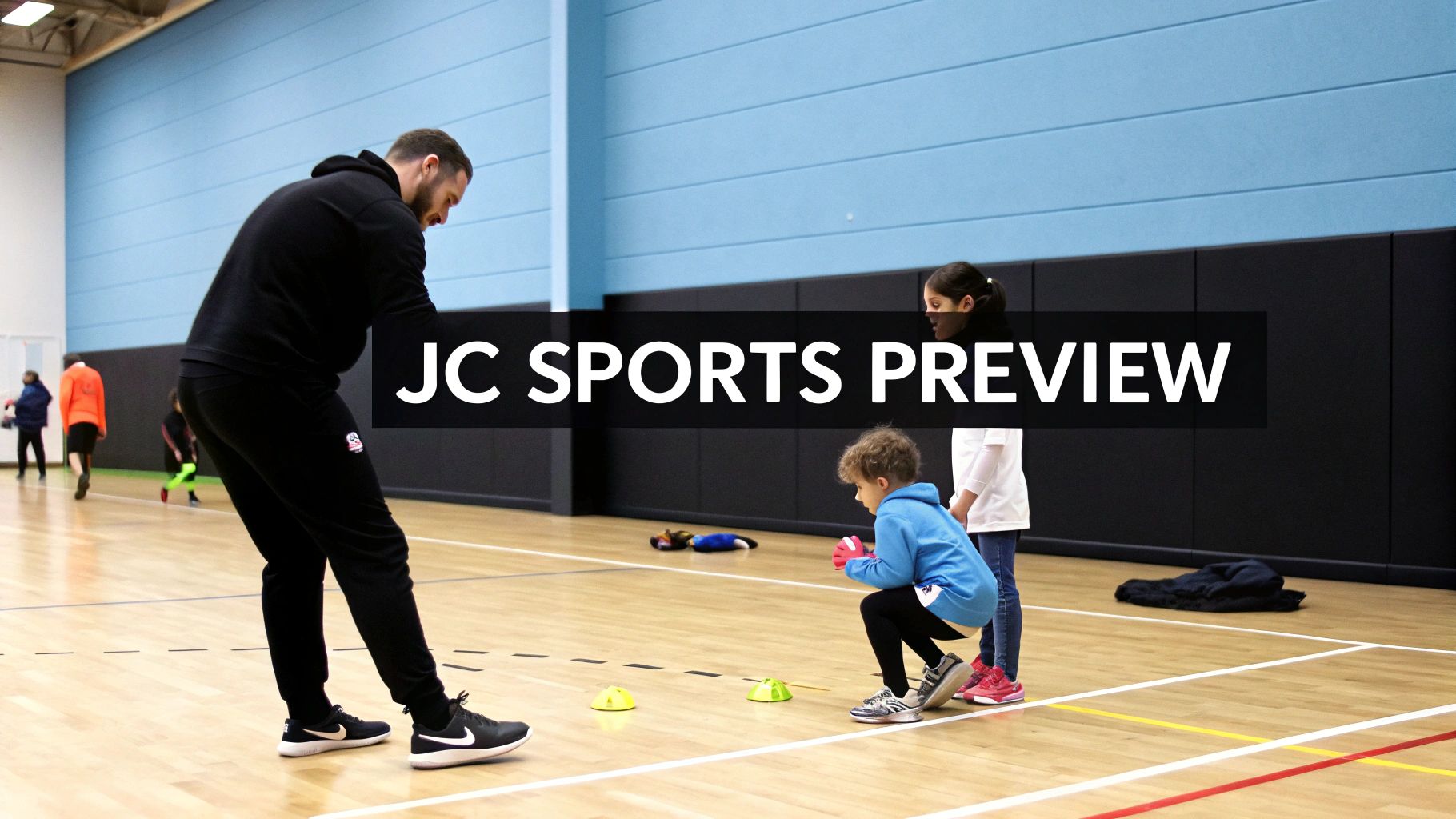
The results speak for themselves. Studies show this style of play can boost a young athlete's decision-making skills by as much as 35%. With 80% of parents looking for structured activities to keep their kids active, and North America holding 40% of the global basketball training market, we’re proud to offer a program designed to deliver real development.
A Look Inside a Typical Session
Every time your child steps onto our safe, indoor court, they're walking into a session designed for maximum engagement and growth. Our experienced, encouraging instructors are there to guide them every step of the way.
Here’s a quick rundown of how a class usually flows:
Dynamic Warm-ups: We get things started with fun, movement-based activities that prime their bodies for action while sharpening coordination and agility.
Skill-Building Drills: Next, we zero in on the fundamentals—dribbling, passing, and proper shooting form. Our drills are designed to meet every child where they are and build from there.
Small-Sided Games: This is where the magic happens. The bulk of the session is spent in game-like scenarios where kids immediately apply what they've learned, fostering quick thinking and teamwork.
This structure keeps kids energized, learning, and excited to come back week after week.
Your First Step is Simple
We get it—family life is busy. That’s why we’ve made getting started with our youth basketball training programs as straightforward as possible.
We want every family to feel confident in their choice. Our goal is to provide a transparent, welcoming experience from the very first click to the first day on the court.
You can handle the entire registration process online, whenever it’s convenient for you. We believe in clear, transparent pricing with no hidden fees, so you always know exactly what to expect. And for kids ready for more competitive action, you can also explore our dedicated Houston youth basketball league.
Best of all, we invite every new family to schedule a free trial class. It's the perfect no-pressure opportunity for your child to experience our coaching style firsthand and for you to see if JC Sports Houston is the right fit for your young athlete.
Common Questions About Youth Basketball Programs
Choosing the right path for your young athlete brings up a lot of questions. We get it. To help you feel confident in your decision, we’ve put together answers to the most common questions we hear from parents just like you.
What Is the Best Age to Start Basketball Training?
Honestly, there’s no single "best" age. Every child is on their own unique timeline. That said, programs that focus on fun and basic motor skills can be fantastic for kids as young as 3-4 years old. The goal here isn't to create the next superstar, but to build coordination, balance, and a positive feeling about being active.
More formal, skill-focused basketball training usually clicks for kids around ages 5-6. At this point, most children have the attention span and physical development to start grasping core concepts—like dribbling with one hand, understanding basic rules, and getting the hang of shooting form. The most important thing is finding a program that keeps it fun and builds them up, not one that throws them into intense competition right away. A great first experience is everything.
Will My Beginner Child Fall Behind?
This is a huge worry for parents, but let me put your mind at ease: a resounding no. Any quality youth basketball program is built to welcome beginners with open arms and support kids at every skill level. A great coach knows how to create an encouraging space where every single child can grow at their own speed.
Think of it like a great classroom—the teacher doesn't expect every student to be at the same reading level. They provide the right support for each one.
In a developmental program, a child's main competition is who they were last week. The focus is on personal progress and skill acquisition, not comparing them to other players on the court.
Our coaches are experts at tweaking drills and giving that one-on-one encouragement a new player needs. The entire environment is designed to help newcomers learn the fundamentals and build confidence, so they feel successful and excited to come back—not stressed out or left behind.
What Equipment Does My Child Need to Start?
Getting started is way simpler (and cheaper!) than most parents realize. For most beginner programs, the must-have list is pretty short. Your child really only needs two things to be ready for their first day.
Comfortable Athletic Clothing: Basic shorts and a t-shirt that they can move freely in are perfect.
Supportive Sneakers: While there are tons of basketball-specific shoes out there, any good pair of athletic sneakers with solid support will work just fine for beginners.
Most programs, including ours here at JC Sports Houston, provide all the basketballs, cones, and other training gear. One thing you will want to have is a good water bottle—staying hydrated is key! You might want to check out these top picks for squeeze sports water bottles. Down the road, you might decide to get a basketball for at-home practice, but it's definitely not required for day one.
How Much Practice Time Is Needed Each Week?
For young athletes, especially those under 10, the secret sauce is consistency, not intensity. Pushing too hard too soon is the fastest way to lead to burnout and make a child fall out of love with the sport.
One or two practices a week is the sweet spot. It's enough time to learn and repeat new skills to see real progress, but it doesn't overwhelm their schedule. This leaves plenty of room for schoolwork, other hobbies, and just being a kid.
A little extra work at home can also make a huge difference, as long as it's fun. Just 15-20 minutes of dribbling in the driveway a few times a week can do wonders for their confidence and ball control. At the end of the day, the goal is to build a lifelong love for the game, so practice should always feel more like play than a chore.
At JC Sports Houston, we’ve designed our programs to answer these questions with action, creating a supportive, skill-building environment for every child who walks through our doors.
Comments