

8 Fun & Effective Basketball Drills for 2nd Graders (2026 Guide)
- cesar coronel
- Jan 24
- 14 min read

Welcome, parents and coaches! If you're searching for the best ways to introduce basketball to a 7 or 8-year-old, you've landed in the right place. At this age, the primary goal isn't to create the next superstar overnight but to build a strong, positive foundation with the sport. Success is measured in fostering a genuine love for the game, developing fundamental motor skills, and, most importantly, having a ton of fun. This guide breaks down eight essential basketball drills for 2nd graders, each designed to be engaging, age-appropriate, and highly effective.
We'll cover everything from basic dribbling and shooting to team-based passing and defensive stances. You will find clear instructions, practical coaching tips, and creative ways to keep young players motivated and excited to hit the court. By focusing on skill development through structured play, we can help them build confidence that extends far beyond basketball. Beyond athletic prowess, a well-rounded 2nd grader also benefits from structured learning that inspires curiosity. Consider exploring a comprehensive ready-to-use lesson plan for 2nd grade to complement their physical development. Let's get started on building those core skills.
1. Dribbling Cone Weave Drill
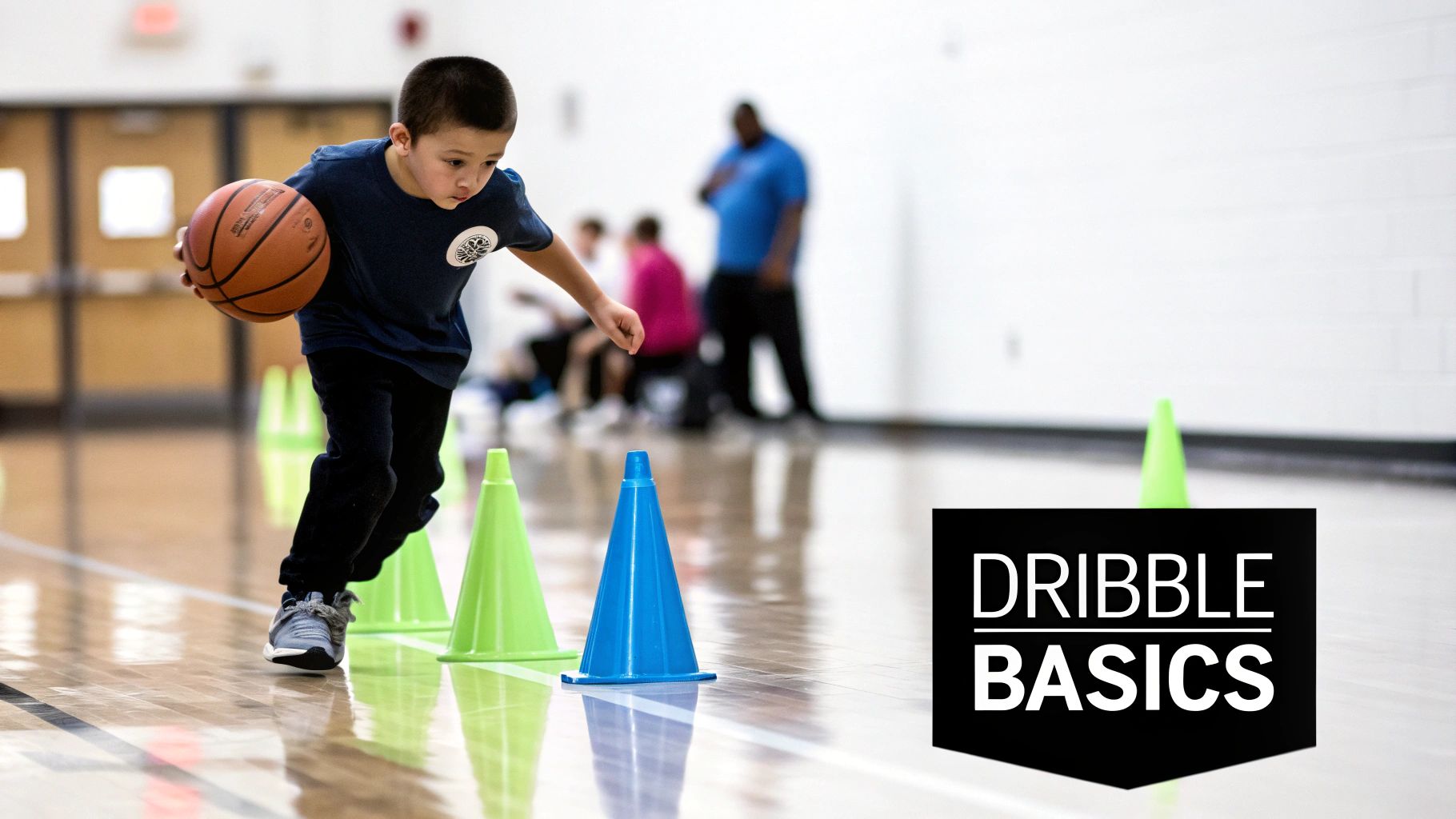
The Dribbling Cone Weave is a cornerstone of fundamental basketball drills for 2nd graders. It focuses on developing essential ball control, hand-eye coordination, and dribbling while on the move. By navigating through a series of cones, young players learn to protect the ball and change direction without losing their dribble, building a strong foundation for more complex skills.
This drill is critical at the 2nd-grade level because it establishes proper dribbling mechanics in a controlled, low-pressure environment. It builds a player's confidence and comfort with the basketball, making them more prepared for game-like situations. It’s a staple in youth basketball programs everywhere, from the seasonal leagues at JC Sports Houston to community center classes across the Greater Houston area.
How to Set It Up
Arrange the Cones: Place 5-8 cones in a straight line, about 3-4 feet apart. For a variation, arrange them in a zigzag pattern to practice sharper turns.
Starting Position: The player begins at the first cone with a basketball.
The Weave: The player dribbles the ball, weaving in and out of each cone until they reach the end. They should focus on using their fingertips, keeping their head up, and maintaining a low, athletic stance.
Actionable Tips for Success
Start Slow: Encourage slow, deliberate dribbles at first. Speed will come naturally as control improves.
Use Both Hands: Have players go through the cones using only their right hand, then only their left. This is vital for developing symmetrical skills.
Make it Fun: Use colorful cones, play upbeat music, or turn it into a timed challenge. Celebrating personal bests is a great motivator for this age group.
This simple yet effective exercise is one of many foundational activities for young players. You can discover more engaging activities in this guide to beginner basketball dribbling drills for young athletes.
2. HORSE Shooting Game
The game of HORSE is a classic and wonderfully engaging way to introduce shooting concepts to young athletes. It transforms repetitive shooting practice into a fun, competitive game that improves accuracy, develops range, and builds confidence. Players take turns making shots from various spots on the court, and if a shot is made, the other players must replicate it. A miss earns a letter, and the last player to spell "HORSE" wins.
This game is a perfect fit within basketball drills for 2nd graders because it gamifies skill development, teaching resilience and sportsmanship in a low-stakes environment. It encourages creativity and challenges players to attempt shots they might not otherwise try, building a versatile skill set. This timeless game is a staple in youth programs, from NBA camps to the summer basketball camps found throughout the Houston region.
How to Set It Up
Establish the Order: Decide which player will shoot first. This player is the "leader."
Take the First Shot: The leader chooses a spot on the court and takes a shot.
Follow the Leader: If the leader makes the basket, every other player must attempt the exact same shot. If a player misses, they get the letter "H." If the leader misses their initial shot, the turn passes to the next player, and no one receives a letter.
Continue the Game: The game continues with players earning letters (O-R-S-E) for each missed replication shot. The first player to spell HORSE is out.
Actionable Tips for Success
Adjust the Hoop: For 2nd graders, lower the hoop to 8 or 9 feet instead of the regulation 10 feet. This promotes proper shooting form rather than just heaving the ball.
Encourage Close Shots: Start with shots from close range, around 5-10 feet from the basket, to build a foundation of success before moving further out.
Mix It Up: Encourage a variety of shots-layups, bank shots, and short jumpers-to keep the game engaging and develop a wider range of skills.
Focus on Fun: The primary goal is to have fun. Celebrate creative shots and good sportsmanship just as much as made baskets.
This game is an excellent way to keep young players motivated and excited about practice. For more ideas to keep your child engaged, check out these fun and effective basketball drills for 8-year-olds.
3. Chest Pass Partner Drill
The Chest Pass Partner Drill is a foundational exercise for teaching 2nd graders the most common and effective pass in basketball. It involves two players passing the ball back and forth using the chest pass, which focuses on developing upper body strength, hand-eye coordination, and the crucial skill of teamwork. Players learn to generate power from their chest and extend their arms fully, establishing the proper mechanics for accurate passing.
This drill is essential for young players because it introduces the concept of cooperation and communication on the court. It moves beyond individual skills like dribbling and teaches them how to work with a teammate to advance the ball. Mastering this fundamental pass is a prerequisite for more complex offensive plays, and it’s a core component of youth development programs, including those taught at JC Sports Houston, which prioritize building a well-rounded skill set.
How to Set It Up
Partner Up: Have two players stand facing each other, about 6-8 feet apart.
Starting Position: One player begins with the basketball, holding it with both hands at their chest, elbows out.
The Pass: The player steps forward with one foot while pushing the ball directly toward their partner's chest, extending their arms fully. The receiving player catches the ball with both hands and repeats the motion back.
Actionable Tips for Success
Focus on Form: Emphasize the "push" motion from the chest, not a throw. The goal is a crisp, direct pass. Use verbal cues like "step and pass" to reinforce the mechanics.
Follow Through: Teach players to finish with their palms facing out and their fingers pointing at their partner. This "follow-through" motion ensures accuracy and proper technique.
Make it a Game: Challenge partners to see how many consecutive passes they can complete without dropping the ball. This adds a fun, competitive element that keeps them engaged and focused on precision.
4. Four Corner Passing Drill
The Four Corner Passing Drill is a fantastic team-oriented exercise for young players, shifting the focus from individual skills to cooperative play. It teaches the fundamentals of passing accuracy, catching readiness, and court awareness in a simple, structured format. Players are positioned at four corners and pass the ball in a sequence, learning rhythm, timing, and the importance of being a reliable target for their teammates.
This drill is particularly valuable for 2nd graders as it introduces the concept of spacing and moving without the ball. It builds a foundational understanding of team offense and communication, which are crucial for game situations. Youth basketball programs, from AAU teams to international FIBA academies, use variations of this drill to instill the core principles of teamwork and ball movement from an early age.
How to Set It Up
Create a Square: Use four cones or floor markers to create a square, with each cone about 10-15 feet apart.
Position Players: Have one player stand at each of the four cones. If you have more than four players, they can form lines behind each cone.
Start Passing: Begin with one basketball. The first player passes to the next player in a designated direction (e.g., clockwise). The sequence continues around the square.
Actionable Tips for Success
Vary the Passes: Dedicate different rounds to specific pass types. Start with chest passes, then switch to bounce passes, and finally introduce two-handed overhead passes.
Communicate Clearly: Encourage players to make eye contact and call out the name of the person they are passing to. This builds good communication habits.
Make it a Challenge: Time the players to see how many consecutive passes they can complete in 60 seconds without dropping the ball. This adds a fun, competitive element that enhances focus.
This exercise is one of the most effective basketball drills for 2nd graders for developing teamwork. For more ways to improve your child's passing and court sense, explore the skill-building programs offered at JC Sports Houston.
5. Lay-Up Line Drill
The Lay-Up Line Drill is arguably the most important scoring drill for young athletes. It focuses on the layup, a fundamental close-range shot off the backboard, teaching players the proper footwork and hand-eye coordination needed to finish at the rim. Players form a line and take turns driving to the basket for a layup, building muscle memory for the most common shot in basketball.
This drill is essential for 2nd graders because it builds the confidence and technique required to score in a game. Learning how to properly execute a layup from both sides of the basket is a foundational skill that translates directly to game performance. This classic drill is a staple in every level of basketball, from youth programs at JC Sports Houston to the daily warm-ups of professional teams.
How to Set It Up
Form a Line: Have players form a single file line on the right side of the basket, just outside the painted lane (the “block”).
Starting Position: The first player in line has a basketball. A coach or another player stands under the basket to rebound.
The Layup: The player takes one dribble toward the basket, steps with their inside foot (left foot on the right side), jumps off that foot, and shoots the layup with their outside hand (right hand), aiming for the top corner of the backboard square. After shooting, they go to the end of the opposite line (if running two lines) or rebound their own ball.
Actionable Tips for Success
Lower the Hoop: For 2nd graders, a standard 10-foot hoop is too high. Lower it to 8 or 9 feet to ensure they can practice proper form and experience success.
Emphasize Footwork: Chant the simple steps: "Right, left, up!" for a right-handed layup, and "Left, right, up!" for a left-handed one. Start without a dribble to focus solely on the steps.
Practice Both Sides: Once they are comfortable on their dominant side, have them switch to the other side of the basket to develop their weaker hand. This is a crucial step in creating well-rounded players.
Stay Positive: Layups are tricky at first. Celebrate every make and offer encouragement for every attempt. Keep the drill short, around 5-10 minutes, to maintain focus and ensure high-quality repetitions.
6. Defensive Stance and Close-Out Drill
The Defensive Stance and Close-Out Drill introduces 2nd graders to the most crucial aspect of team play: defense. It focuses on teaching the foundational defensive position, footwork, and the proper technique for approaching an offensive player with the ball. Players learn to be ready, balanced, and controlled, which is the bedrock of preventing shots and creating turnovers.
This drill is vital for 2nd graders as it shifts focus from solely handling the ball to understanding the game's other half. It instills discipline and the importance of effort without the ball, core tenets taught in youth basketball programs. Learning proper defensive posture early prevents bad habits and builds a player’s confidence in their ability to contribute on both ends of the court.
How to Set It Up
Positions: One player starts on offense with a basketball at the three-point line, and one player starts on defense inside the paint.
The Action: The coach or another player passes the ball to the offensive player. As the ball is in the air, the defender must "close out" by quickly approaching the offensive player.
Proper Form: The defender should take quick, choppy steps, stay low, and have their hands up to contest a potential shot. They must stop a step or two away to avoid fouling and maintain a balanced defensive stance: feet wide, knees bent, and ready to move.
Actionable Tips for Success
Shadow First: Have players practice the close-out movement without a ball first. This helps them focus purely on their footwork and body positioning.
"Hands Up, Palms Out": Constantly reinforce the "hands up, palms out" command to build the habit of contesting shots and deflecting passes.
Praise the Effort: Defense is all about effort. Enthusiastically praise good defensive stances, quick feet, and active hands, regardless of whether the offense scores. This makes playing defense fun and rewarding.
7. Knock-Out Shooting Game
The Knock-Out Shooting Game is a classic, high-energy activity that transforms repetitive shooting practice into a thrilling competition. This game is one of the most effective basketball drills for 2nd graders because it teaches them how to shoot under pressure, improves their shooting form, and keeps them fully engaged. The goal is to make a basket to stay "in" while trying to "knock out" the player in front of you.
This competitive drill is perfect for the 2nd-grade level as it introduces a fun, game-like element to skill development. It builds not just shooting accuracy but also resilience and good sportsmanship. The fast-paced nature of Knock-Out holds the attention of young athletes, making it a favorite in youth basketball camps and school P.E. classes, including the dynamic programs we run at JC Sports Houston.
How to Set It Up
Form a Line: Have all players form a single-file line at a designated shooting spot. For 2nd graders, this should be close to the basket, like the free-throw line or even closer.
Start the Game: The first two players in line each get a basketball. The first player shoots. As soon as their ball hits the rim or goes in, the second player can shoot.
The Knock-Out: If a player makes their shot, they get their ball and go to the end of the line. If the player behind them makes a basket before they do, the first player is "knocked out" and steps out of the game for that round. The game continues until only one player is left.
Actionable Tips for Success
Adjust the Hoop: Lower the basketball hoop to 8 or 9 feet. This makes it more accessible for 2nd graders and helps them develop proper form instead of just heaving the ball.
Start Close: Begin with shots from just 3-5 feet away to build confidence and ensure a high success rate. Gradually move the line back as skills improve.
Keep Rounds Quick: Aim to complete a full round in 3-5 minutes to match young attention spans. Play multiple rounds so different kids have a chance to win.
Encourage Re-Entry: To keep everyone involved, allow knocked-out players to rejoin the game after sitting out for one round or one minute.
8. Small-Sided Games (2v2 or 3v3 Basketball)
Transitioning from structured drills to game play is a crucial step, and small-sided games like 2v2 or 3v3 basketball are the perfect bridge. This approach involves modified games on a smaller court with fewer players, which maximizes each child's involvement. It’s an essential method for teaching 2nd graders how to apply skills like dribbling, passing, and shooting in a dynamic, game-like context without the chaos of a full 5v5 game.
This methodology is a cornerstone of modern youth sports development because it increases the number of touches each player gets on the ball. This high level of engagement accelerates learning and builds confidence. Top youth development programs, including the seasonal leagues at JC Sports Houston and FIBA's official youth guidelines, champion this approach. It allows young athletes to learn spacing, decision-making, and teamwork in a fun, active, and highly effective environment.
How to Set It Up
Define the Space: Use a half-court or create a smaller playing area with cones. Lower the hoop to an age-appropriate height, typically around 8 feet.
Form Teams: Create small teams of two or three players. It's best to rotate teams frequently to ensure balanced play and give kids a chance to play with everyone.
Start the Game: Begin with a simple inbound pass. Play for short periods, such as 8-10 minute games, to maintain focus and energy.
Actionable Tips for Success
Simplify the Rules: Initially, be lenient with rules like traveling or double-dribbling. Focus on participation and fun, gradually introducing more rules as skills develop.
Use the Right Equipment: A smaller size 5 basketball is easier for 2nd graders to handle, control, and shoot.
Celebrate Effort: Emphasize teamwork, good passes, and defensive effort just as much as scoring. Positive reinforcement for trying hard builds a love for the game.
Keep it Moving: Provide frequent, short water breaks and offer quick positional tips during stoppages to help players understand spacing and movement.
Small-sided games are one of the most effective basketball drills for 2nd graders because they teach the game by playing the game. For more insight into structured training, explore this guide to youth basketball training programs in Houston.
2nd Grade Basketball: 8-Drill Comparison
Drill / Game | Implementation Complexity 🔄 | Resource Requirements ⚡ | Expected Outcomes ⭐ | Ideal Use Cases 📊 | Key Advantages 💡 |
|---|---|---|---|---|---|
Dribbling Cone Weave Drill | Low — simple setup, scalable progressions | Low — cones, ball(s), small gym space | ⭐⭐⭐ — ball control, bilateral dribbling, timing | Warm-ups, skill stations, beginner groups | Builds fundamentals quickly; easy to assess and adapt |
HORSE Shooting Game | Low–Medium — simple rules, needs fair adjustments | Very low — ball and hoop only | ⭐⭐ — shooting confidence and varied shot practice | Shooting practice, small groups, fun end-of-session game | Engaging competitive format; adjustable difficulty |
Chest Pass Partner Drill | Low — pair work with progressive distance | Low — one ball per pair, minimal space | ⭐⭐⭐ — passing mechanics, bilateral coordination | Early skill teaching, partner stations | Immediate partner feedback; safe, cooperative practice |
Four Corner Passing Drill | Medium — multiple players, timing and communication | Low–Medium — cones, 4–8 players, optional extra balls | ⭐⭐⭐ — passing accuracy, spacing, rhythm | Group drills, team coordination, transition work | Involves whole group; scalable variations; game realism |
Lay-Up Line Drill | Low — linear rotation, coach or rebounder feed | Medium — functional hoop (may lower), ball, rebounder | ⭐⭐⭐⭐ — finishing, footwork, close-range scoring | Finishing practice, high-rep scoring drills | High repetition that translates directly to game scoring |
Defensive Stance & Close-Out Drill | Medium — technique-focused, needs coaching cues | Low — cones, space, optional ball | ⭐⭐⭐ — defensive stance, footwork, controlled close-outs | Defensive fundamentals sessions, pre-game work | Establishes defensive habits; reduces fouling risk |
Knock-Out Shooting Game | Low — simple, fast-paced with elimination element | Low — ball, hoop, space for line | ⭐⭐ — pressure shooting practice, high engagement | Large-group sessions, motivation, quick reps | Highly engaging; builds pressure performance skills |
Small-Sided Games (2v2 or 3v3) | Medium–High — requires management and rule tailoring | Medium — half-court, multiple balls, rotations | ⭐⭐⭐⭐ — decision-making, spacing, many touches | Game-application, skill integration, developmental play | Maximizes touches; realistic game learning; high engagement |
Take the Next Step at JC Sports Houston
You now have a powerful playbook of fun, effective, and age-appropriate basketball drills for 2nd graders. From the foundational Dribbling Cone Weave to the dynamic excitement of Small-Sided Games, each activity is designed to build skills incrementally while keeping young players engaged and motivated. We've explored how simple tools like cones and a partner can transform a driveway into a training ground for dribbling, passing, shooting, and defense.
The journey from a beginner to a confident player is built one drill at a time. The key is not to master everything overnight but to celebrate the small victories along the way. Did your child make their first layup? That's a huge win. Did they successfully complete a chest pass with the correct form? That deserves praise. Consistent, positive reinforcement is the fuel that will ignite a lifelong passion for the game.
The True Goal: More Than Just Basketball
Remember, the drills outlined in this article accomplish far more than just teaching basketball fundamentals. They are vehicles for developing crucial life skills that will serve your child well beyond the court.
Building Resilience: When a shot misses in a game of HORSE or Knock-Out, your child learns to reset, refocus, and try again. This process teaches them how to handle minor setbacks with a positive attitude.
Enhancing Communication: The Four Corner Passing Drill and partner passes aren't just about moving the ball; they're about non-verbal cues, eye contact, and working in sync with a teammate.
Developing Discipline: Consistently practicing a defensive stance or running a layup line drill teaches focus and the importance of repetition in mastering a skill.
These foundational lessons in teamwork, listening, and perseverance are the true trophies your child will earn. The basketball skills are the wonderful bonus.
From Driveway Drills to Team Triumphs
Practicing at home is an incredible start, establishing a strong foundation and building confidence. When your child is ready to apply these skills in a structured, supportive, and high-energy team environment, JC Sports Houston is here to guide them. Our programs are specifically designed for young athletes, focusing on the same principles we've discussed: age-appropriate challenges, skill progression, and, most importantly, fun.
Our experienced coaches in the Humble, Kingwood, and Atascocita areas specialize in translating fundamental basketball drills for 2nd graders into game-ready skills. We utilize small-sided games to maximize participation and ensure every child gets plenty of touches on the ball. We believe in creating a positive atmosphere where kids feel safe to try, fail, and grow without pressure. This approach fosters not just skilled players, but happy and confident kids who truly love the sport.
Ready to see how our expert-led programs can elevate your child's skills and passion for basketball? Join the JC Sports Houston family and give your young athlete the supportive, high-energy environment they need to thrive on and off the court. Visit our website to explore our basketball leagues and sign up for a free trial class today! JC Sports Houston
Comments