

Agility Training for Kids Fun Drills That Build Skills

Your child sees the cones, hears the whistle, and takes off in the wrong direction. A moment later, they're laughing, trying again, and asking to be the coach. That scene is more useful than a perfect ladder pattern because young athletes learn agility through decisions, balance, and playful problem-solving, not through fast feet alone.
Good agility training for kids helps children stop, start, turn, balance, coordinate their bodies, and respond to what's happening around them. The right approach changes with age. Toddlers need imaginative movement, younger school-age children need simple patterns and body control, and older children can handle more reactive, sport-specific challenges.
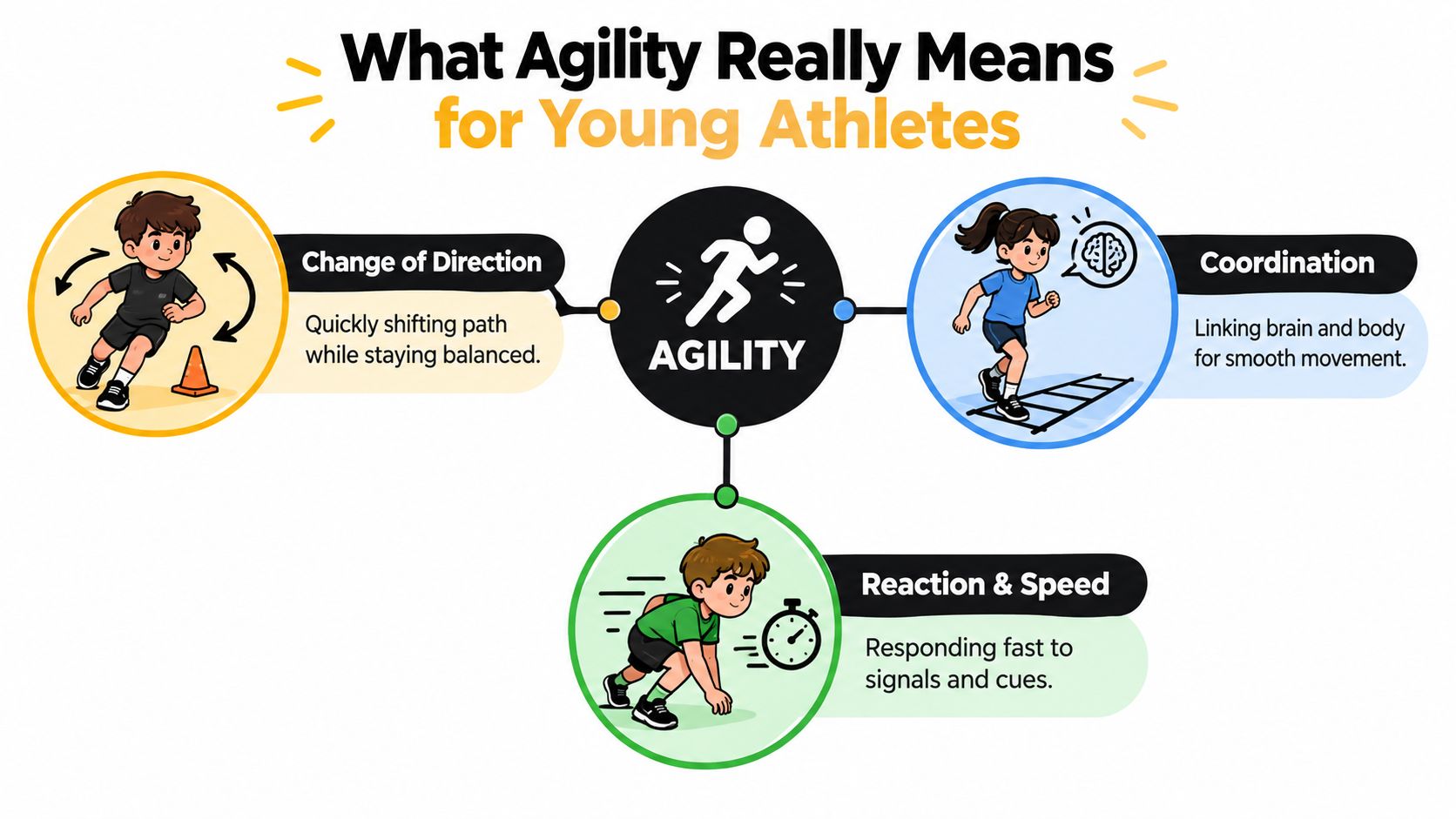
What Agility Really Means for Young Athletes
A parent on the sideline may describe agility as “being quick.” A coach sees more. The child who reaches a loose ball, slows down without falling, turns around a defender, and accelerates into open space is combining several skills at once.
Agility has three connected parts:
Change of direction: Shifting a path while staying balanced and controlled.
Coordination: Linking the brain and body so the arms, legs, eyes, and trunk work together.
Reactive movement: Responding to a visual, verbal, or game cue instead of following a memorized route.
That combination supports confidence. A child who can control a landing or recover from an awkward step is more willing to try a new movement. In soccer, that might mean turning away from pressure. In basketball, it might mean defending a moving player. In everyday play, it can mean running, stopping, and changing direction without fear.
Why fast feet aren't enough
A ladder can teach rhythm and foot placement, but it can't teach every part of game agility. A child may complete an “in-in-out-out” pattern quickly and still struggle to decelerate, look up, or react when another player moves.
Small-sided games solve that problem naturally. With fewer players and a smaller playing area, children get more chances to turn, shield, accelerate, stop, and make decisions. The coach can shape the environment with simple rules, such as scoring after a change of direction or using a color cue to choose a target.
Practical rule: If a drill looks impressive but doesn't improve balance, decision-making, or movement control, it probably needs to be simplified or replaced.
Age matters, but age alone doesn't determine readiness. A confident five-year-old may enjoy a simple chase game, while an easily overwhelmed eight-year-old may need fewer choices and more repetition. The coach's job is to provide a challenge that encourages success without removing the joy of movement.
A 2022 systematic review of youth agility development included 41 reports, made up of 23 observational studies, 14 experimental studies, and 4 secondary-research references. Its conclusion was practical: agility is trainable in young people, but improvement depends on the underlying qualities being developed. That supports JC Sports Houston's focus on developing well-rounded, creative players rather than producing children who can only follow preset cone routes.
Age Appropriate Agility Progressions From Toddlers to School Age
The progression should move from exploration to control, then from control to reaction. Start with a pattern the child understands, give them time to own it, and only then add a signal, opponent, ball, or decision.
Toddlers and preschoolers from 3 to 5
At this age, agility looks like a movement story. Use soft cones, floor spots, or brightly colored household objects with plenty of space between them.
Animal trail: Ask children to move like bears, frogs, penguins, or crabs between two markers. Keep each attempt short and demonstrate one movement at a time. The cue is “quiet feet” or “show me your balance,” not “go as fast as possible.”
Follow-the-coach weaving: Walk or jog slowly through a loose line of cones while children copy your path. Change direction gradually and use simple language such as “turn,” “freeze,” and “go.” Avoid complicated patterns and don't expect consistent left-right awareness yet.
Treasure island: Place spots around the floor and call out a color or animal. The child travels to the matching spot, freezes, and holds a stable shape. This introduces reaction without overwhelming the child with several choices.
Use brief rounds followed by water, a story, or a new game. Stop when movement becomes careless or the child loses interest. For this group, enjoyment and body awareness matter more than completing a fixed number of repetitions.
Early elementary children from 6 to 8
Children can now handle more structure, but the challenge should remain predictable. Research summarized in a meta-analysis of youth core stability and agility training found that trunk control can contribute meaningfully to agility outcomes. In practice, that means teaching children to keep their torso organized while their feet move.
Spot-to-spot shuttles: Set two or three destinations. Have the child move forward, shuffle sideways, backpedal carefully, and return to the starting point. Coach “bend before you turn,” “keep your chest tall,” and “push the ground away.”
Low ladder patterns: Begin with walking or marching through the ladder, then add a light jog. Use one pattern for several attempts before changing it. Lower and moderate amounts of variation are often easier for young children to learn than constant external reactions, so don't add a whistle, ball, opponent, and new pattern at the same time.
Balance and reach game: Stand on one leg and reach a hand toward different colored spots. Keep the standing knee soft and the foot grounded. This supports the control needed before more demanding cuts and hops.
Parents looking for additional movement ideas can pair this progression with speed training exercises, while keeping the emphasis on form and fun.
Older children from 9 to 12
Older children can begin to connect agility with sport decisions. Start with planned patterns, then add a cue or a partner.
Reactive cone choice: Place three colored cones ahead. Call one color late enough that the child must look, process, and redirect, but not so late that they panic. Coach a low center of mass, short steps before the turn, and a controlled first step out.
Mirror movement: Work with a partner inside a clearly marked area. One child leads with side steps and short forward movements, while the other mirrors without making contact. Keep the leader's movements controlled, then switch roles.
Ball-based decision course: Dribble, carry, or roll a ball toward a target, then respond to a direction cue. A soccer player might cut around a cone and pass through a gate. A basketball player might change hands before turning. The sport element gives the movement a reason.
Sample Weekly Sessions You Can Run at Home or on the Field
A useful session has a beginning, a focused middle, and a game that lets children apply the skill. The exact activity can change, but the order matters. Children should be warm, alert, and technically sound before they face faster decisions.
A 25-minute home or backyard session
Minutes 1 to 5, warm-up: Use animal walks, skipping, side steps, arm circles, and freeze poses. Keep moving continuously at an easy pace. The aim is to prepare joints and attention, not create fatigue.
Minutes 5 to 13, main block: Set up a cone zigzag with wide turns. Walk through it once, jog through it twice, then let the child choose the route while you call “left,” “right,” or “freeze.” If the child loses balance, widen the cones and slow the pace.
Minutes 13 to 20, small-sided game: Play “gate hunter.” Create several passing or running gates and give the child a point for moving through a different gate after each turn. With a ball, use a gentle dribble or roll. Without a ball, add a chasing parent who moves slowly and safely.
Minutes 20 to 25, cool-down: Finish with breathing, gentle stretching, and a balance challenge. Ask the child which turn felt easiest and which one they want to practice next time.
A 45-minute field or gym session
Begin with 8 minutes of tag and mobility, followed by 12 minutes of a three-station circuit. Stations might include low hurdles, a short shuttle, and a reaction ball or partner cue. Keep groups moving, but preserve enough space for each child to stop safely.
Use the next 15 minutes for a small-sided game. In soccer, a two-versus-two game with end gates creates repeated turns and accelerations. In basketball, a limited-space keep-away game can prompt defensive slides and quick changes of direction. The rules should reward awareness, not reckless speed.
Reserve 5 minutes for a technical reset. Pick one cue, such as “slow down before the turn,” and let every child practice it in a simple pattern. End with 5 minutes of walking, stretching, and review.
A 2022 study of 63 prepubertal children aged 9.2 ± 0.5 years compared multi-jumps, sled towing, and uphill running across 8-week programs. The groups were 20, 21, and 22 children, respectively, and all showed statistically significant gains in jumping and velocity or agility performance after the training period, as reported in the child-focused experimental study. The lesson isn't that every child needs sleds or hills. It's that organized movement blocks can produce meaningful changes when coaches apply them consistently.
For a soccer-specific version of this approach, use agility training for soccer as a supplement to games rather than a replacement for them.
Equipment Space and Safety Essentials for Kids Agility
You don't need a professional training room to create a useful agility setup. You need a surface that allows children to grip, stop, and turn, plus enough space to prevent one child's route from crossing another's.
Compare the setup before buying gear
Option | Useful for | Watch out for |
|---|---|---|
Indoor gym floor | Consistent footing, small-sided games, weather-proof sessions | Slippery dust, crowded routes, hard falls |
Backyard grass | Softer movement environment and open play | Holes, wet patches, uneven ground |
Cones and floor spots | Visual targets and simple routes | Hard or heavy objects that children can trip over |
Low foam hurdles | Hopping, stepping, and rhythm | Hurdles that are too high or difficult to move around |
Household markers | Low-cost color and direction games | Furniture corners, loose rugs, and unstable objects |
Use athletic shoes that fit securely and match the surface. Check laces, remove loose rugs indoors, and inspect grass before every session. A parent should stand where the whole route is visible, especially when children are jumping, racing, or sharing equipment.
A small kit can include flat cones, colored spots, a soft ball, and one low hurdle. If footwear support is a concern, parents can also review expert-picked kids insoles as one resource, while remembering that insoles don't replace properly fitted shoes or professional assessment.
Safety depends on design
Agility can improve control, but the training environment also changes how much risk a child encounters. One school-injury study found injuries increased alongside higher balance and agility, likely because more coordinated children were exposed to more risk situations. The same verified summary notes that later meta-analyses found multicomponent warm-ups can reduce sports-related injuries by about 46% and improve running speed, balance, and landing technique when designed well.
That distinction matters. Don't tell children that agility alone makes them safe. Instead, teach warm-up habits, deceleration, soft landings, spacing, and awareness. Stop the session if a child develops persistent pain, unusual limping, dizziness, or movement that deteriorates with fatigue.
How to Measure Progress Without Over Testing
A stopwatch can be useful, but it shouldn't become the main character in a child's training. Young athletes often improve first in ways a timer misses. They may turn with less hesitation, keep their balance after a stop, listen more carefully, or choose a better route in a game.
Track one movement-quality marker, one decision marker, and one enjoyment marker. For example, note whether a child completes a shuttle without extra steps, responds correctly to a color cue, and asks to repeat the game. Recheck after a meaningful training block rather than testing at every session.
A randomized school-based trial involving children aged 6 to 10 reported statistically significant pre and post improvements in several outcomes, including motor proficiency and agility. The agility result was p=0.0003. The program used low-to-moderate intensity, planned contextual-interference training, which supports a simple coaching principle: repeated, organized practice gives you more useful information than random activity.
Simple Agility Progress Markers by Age Band
Age Band | Marker to Watch | What Progress Looks Like |
|---|---|---|
3 to 5 | Follow-me weaving and freeze shapes | The child changes direction without stopping completely and can hold a stable pose |
6 to 8 | Spot shuttle and balance reach | The child uses shorter, more controlled steps before turning and needs fewer reminders |
9 to 12 | Reactive cone or ball course | The child sees the cue earlier, chooses the correct route, and accelerates without losing control |
Keep notes brief. Write the date, activity, one successful behavior, and one adjustment for next time. If a child is faster but falls more often, the program hasn't improved in the way that matters. If the time stays similar while turns become smoother and the child makes better decisions, that's valuable progress.
For games that target response to cues, reaction time exercises can provide ideas, but don't turn every activity into a test. A child should leave feeling capable, not judged.
How JC Sports Houston Builds Agility Into Every Program
At JC Sports Houston, agility fits inside the activity instead of sitting apart as a line of generic cone drills. A toddler may practice stopping, balancing, and following a movement cue during a multi-sport class. A school-age player may develop turning, footwork, and reaction through Coerver-based soccer, Just for Girls training, BlastBall, or a seasonal league.
The setting matters. Small-sided play gives children more involvement and more decisions, while trained staff can adjust space, rules, and movement demands for the group in front of them. That approach aligns with the facility's motto, “Developing well rounded, creative players,” because agility should help children solve movement problems, not copy a pattern.
Programs also extend beyond regular classes. Families can choose seasonal soccer, baseball, and basketball leagues, February Break and Spring Break and Summer Break Camps, private sessions, or coach-led sports-themed birthday parties. The indoor environment helps maintain a consistent place to move, and the registration process includes program information, policies, pricing, and field-status updates.
A first session should feel approachable. Parents can explain what their child enjoys, mention any relevant movement concern, and ask how the coach scales the activity. New families may request a free trial to experience the coaching style before choosing a regular program.
JC Sports Houston offers age-appropriate multi-sport classes, soccer training, leagues, camps, and small-sided indoor programs that build agility through balance, reaction, coordination, and creative play. Visit JC Sports Houston to request a free trial, review current programs, and find a practical starting point for your child.
Comments