

Indoor Soccer Facility Guide for Parents: What to Check

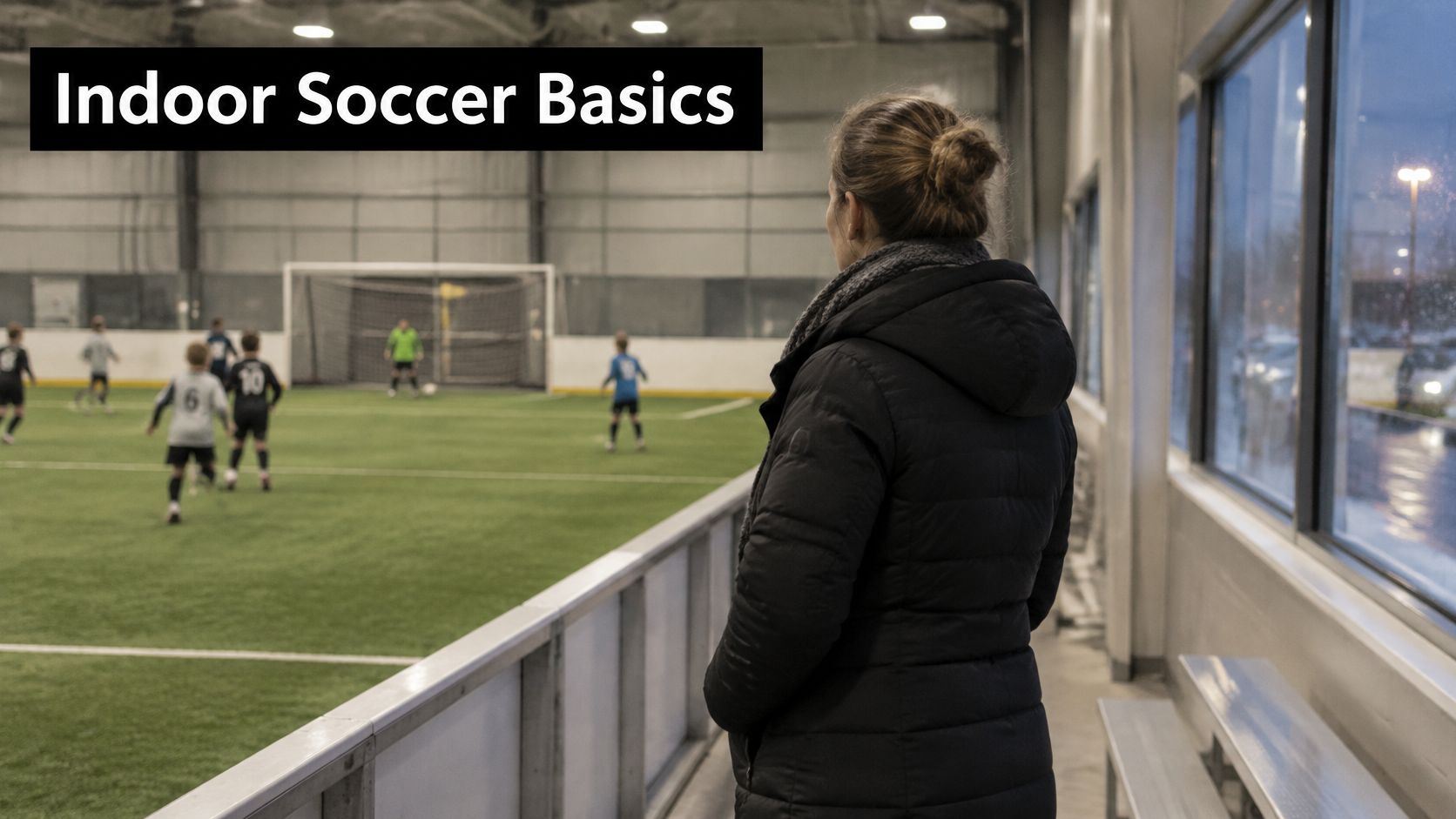
You're standing beside an indoor field on a January evening, still wearing your winter jacket. Outside, the grass is wet and cold. Inside, your child is watching a game through the netting, and you're wondering whether this could be the place where practice finally becomes a dependable part of the week.
The roof is reassuring, but it doesn't answer every question. Before enrolling, you'll want to know what your child will do, how staff manage a busy building, and what you'll pay beyond the advertised class fee.
What an Indoor Soccer Facility Is
An indoor soccer facility is an enclosed venue where children or adults can train and play on a dedicated surface. Some fields have perimeter boards; others use netting or marked boundaries. Programs can include introductory classes, technical instruction, recreational leagues, and camps.
For a young child, the experience shouldn't be an outdoor match moved under a roof. Coaches can divide the space into smaller playing areas, adapt the rules, and organize activities around the children's stage of development. A preschooler learning to stop a ball needs a different session from an older player practicing how to escape a defender.
Indoor soccer also has an established American history: RSSSF's historical account records U.S. indoor matches as early as 1885, six-a-side competition during the 1920s and 1930s, and the National Soccer League's inauguration of what it describes as the first full U.S. indoor season on January 1, 1950, with twelve teams playing over thirteen consecutive Sundays, including playoffs.
Understand the format before enrolling
Indoor soccer and futsal aren't interchangeable labels. Ask which surface, ball, boundaries, and rules the program uses. Our explanation of futsal and indoor soccer can help you recognize the differences when comparing classes.
A fixed indoor calendar makes planning easier, although building closures and operational cancellations can still happen. Look beyond weather protection and organize your decision around three questions:
What will my child learn? Ask for a concrete learning goal, not just an activity list.
How will staff teach and protect them? Observe instruction, supervision, and building conditions.
What does participation cost? Compare the full commitment, not only the first payment.
Facility Features to Compare Side by Side
Take this checklist on a tour, preferably while a class similar to your child's is running. An empty field can show you the layout, but an active session shows you how staff use it.
Start at ground level. Artificial grass is a surface system, not just a green carpet. Ask about the installed product, cushioning, seams, inspections, and repair process.
The FIFA Quality Programme for Football Turf evaluates turf through laboratory product testing and testing of the completed installation, covering playing performance, player safety, durability, and quality assurance. That's a useful distinction: documentation about a turf product alone doesn't tell you the condition of the field you're standing on.
Facility features checklist for parents
Feature | What good looks like | Red flag |
|---|---|---|
Playing surface | Tested synthetic turf with appropriate shock-absorbing underlay or engineered infill, consistent seams, and a documented maintenance schedule | Worn patches, loose infill, lifted seams, or no maintenance records |
Coaches | Trained in a documented curriculum and experienced with young children | Coaches who cannot describe what each session teaches |
Group size and stations | Small groups with several purposeful stations running at once | Large groups with long waits between touches |
Age-specific classes | Separate sessions for toddlers, beginners, and older children | One session mixing very different developmental stages |
Equipment and materials | Balls, training equipment, and curriculum materials supplied by the facility | Families must buy specialized gear before trying a class |
Schedules and make-ups | Published calendar, written make-up policy, and real-time field status | Vague cancellation rules and no reliable way to check the schedule |
Ventilation and air | Staff can explain fresh-air operation and monitoring during busy sessions | Staff treat a cool room or a pleasant smell as proof of healthy air |
A red flag is a reason to pause enrollment and seek a clear answer. A lifted seam needs attention before children play over it; an unclear make-up policy needs clarification before you sign.
Ask for evidence, not reassurance
For the surface, ask to see the maintenance log and how staff report damage. Check whether transitions at gates and field edges lie flat. Don't assume that a particular turf label guarantees protection from injury.
For coaching, request an example session plan. A director should be able to connect an activity to a skill, such as changing direction while keeping the ball close, and explain how the coach simplifies it for a beginner.
Tour rule: Ask to see the field, the ventilation setup, and the coach's curriculum, not just the lobby.
We provide training, soccer, football, and baseball equipment, along with all curriculum materials. For personal items such as footwear and protective gear, confirm the requirements for the particular activity before buying anything.
Programs by Age and Goal
Start with your child's age and immediate goal, rather than the most advanced-sounding program name. Is your child learning to follow directions in a group, trying different sports, or working on a soccer skill they already understand?
Age-appropriate participation can begin at 24 months and up. That doesn't mean toddlers should receive a smaller version of advanced training. Early movement, listening, and comfortable participation are worthwhile goals in their own right.
This program map separates those early foundations from later training choices.
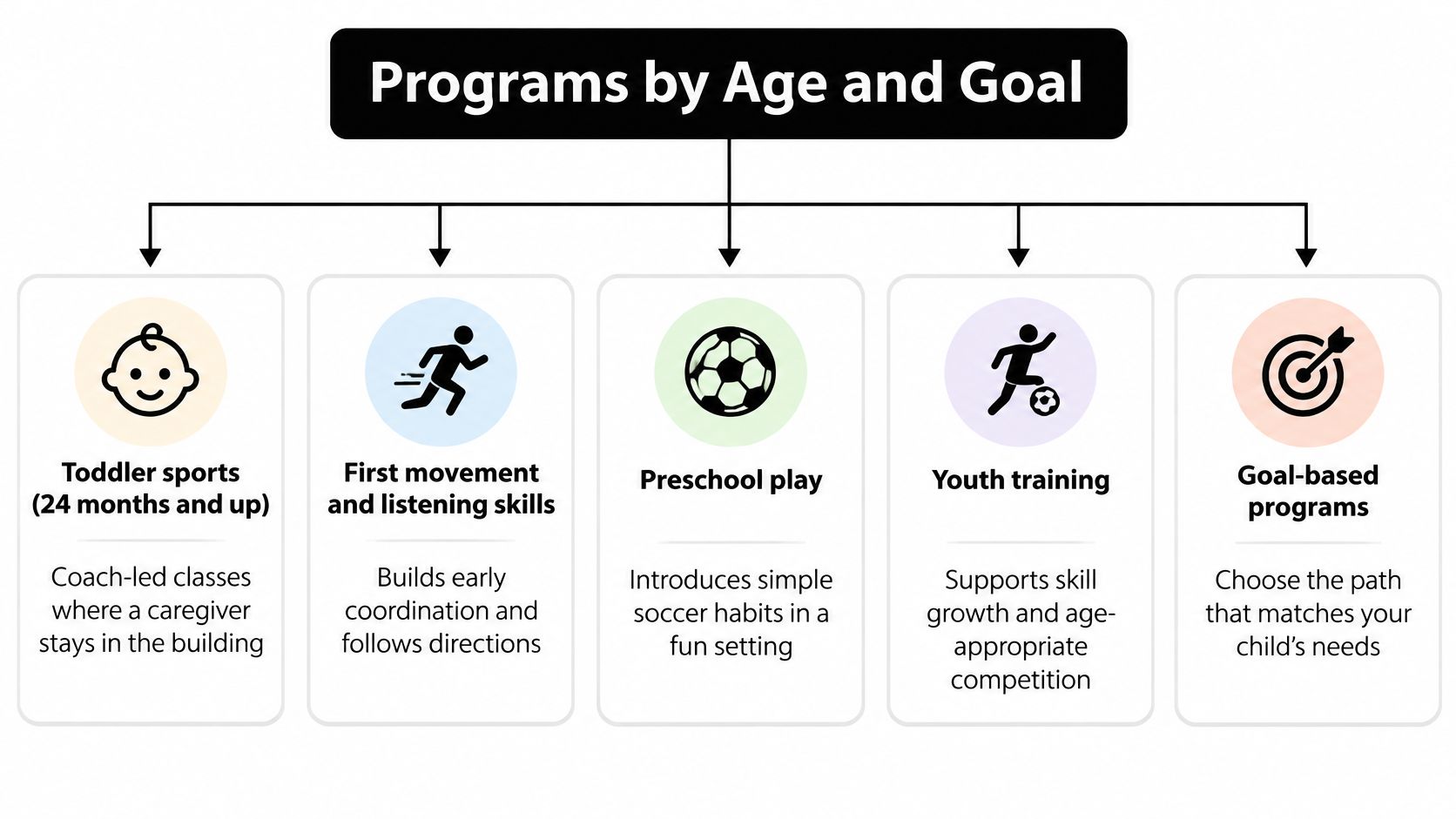
Indoor soccer facility programs by age and goal
Program | Best for | Format |
|---|---|---|
Toddler sports | Children 24 months and up building first movement and listening skills | Coach-led class with caregiver in the building |
Multi-sport class | Children trying several sports before choosing one; confirm the class's age band | Rotating sport skills in one class |
Soccer by age group | Children ages 4–6, 7–9, and 10–13 developing technique with age-matched peers | Small-sided games and drills |
Coerver soccer | Players seeking individual technical development; confirm placement | Progressive ball-mastery curriculum |
Just for Girls soccer | Girls who want a dedicated training environment; confirm age eligibility | Coerver-based sessions |
Seasonal leagues | Children ready for organized play across a season; confirm division eligibility | Soccer, baseball, and basketball leagues |
School-break camps | Children seeking activities during school breaks; confirm each camp's ages | February, Spring, and Summer Break camps |
Private sessions | Players needing individual correction; confirm suitability with the coach | One-to-one or small-group coaching |
Birthday parties | Children celebrating through coach-led play; confirm activities for the guests' ages | Customizable sports-themed party |
Choose the next useful challenge
For first movement and listening skills, look for activities that build early coordination and following directions. Preschool play can introduce simple soccer habits in a fun setting, without making success depend on understanding a match.
Youth training should support skill growth and age-appropriate competition. A child who enjoys dribbling but freezes when an opponent approaches may need guided games more than another isolated ball drill.
Goal-based programs let you choose a path that matches your child's needs. Multi-sport participation leaves room to explore; technical instruction gives more attention to soccer movements; a league adds teammates, opponents, and game routines.
If terms such as recreational, developmental, and competitive are confusing, use our guide to youth soccer levels to prepare placement questions.
The video below offers another way to get familiar with the sports setting before a visit.
Choose a class your child can participate in now, with room to grow. Don't treat private instruction, advanced training, or league play as required upgrades just because they appear on the registration menu.
How Small-Sided Play Builds Real Skill
Watch a compact game with a few children on each team. A child receives the ball, notices an opponent, chooses a direction, and tries again after losing possession. Compare that with a crowded drill where the same child spends much of the session waiting behind teammates.
The important difference is involvement, not just field size. A smaller game gives the coach opportunities to help children connect a movement with a decision: when to dribble, where to move, or whether a teammate is available.
An umbrella review of small-sided soccer games identifies 3v3 and 4v4 as generally recommended formats for maximizing technical engagement and aerobic load, and describes youth research in which 25 sessions of tactical and small-sided or conditioned games improved U-12 offensive and defensive decision-making time and perceptual-motor defensive skills.
Those findings don't promise identical results for every child. They support a practical coaching choice: give children meaningful opportunities to perceive, decide, and act instead of treating attendance as development.
Match the space to the learning task
Toddlers and beginners need manageable spaces, simple instructions, and frequent feedback. A coach might ask children to guide their ball into an open gate, then add a gentle challenge once they understand the task.
Older players need opportunities to scan, transition after possession changes, and move at greater speed. Keeping every age group in the same tiny grid can remove the very challenges an older player needs.
Our guide to small-sided soccer games explains how these activities can work in practice. The useful question isn't whether a session contains games, but whether the coach designs those games around a learning purpose.
Look for progress you can describe
Ask the coach what they observe:
Player-to-ball ratio: Can children practice independently when the task calls for it?
Touches and active minutes: Are children involved, or mostly waiting?
Decisions and shots: Do players recognize opportunities, not merely follow instructions?
Changing challenges: How does the session develop as children become more capable?
Our teachers are experienced and trained in the JC Sports curriculum. We place the child at the center of interactive games and drills, using age-appropriate exercises from around the globe to introduce soccer, football, and baseball skills.
A useful progress update describes what your child can do with less help, not only whether they completed the activity.
Air Quality and Health Checks That Matter
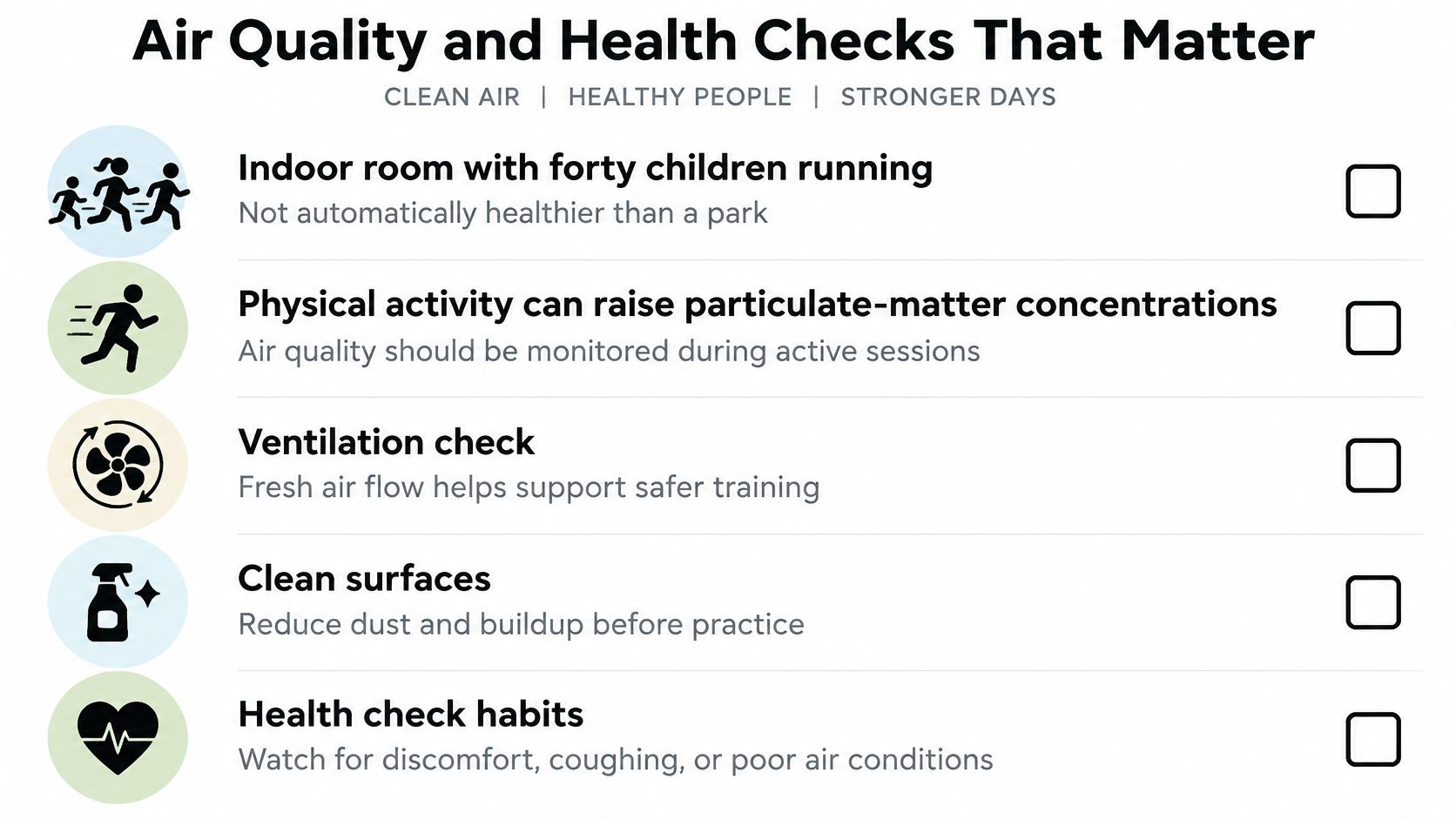
Moving indoors trades one set of conditions for another. You escape outdoor heat, rain and pollen-heavy days, and in return the building takes over the job of supplying fresh air, controlling dust and managing how many bodies share the room. A crowded indoor space is not automatically healthier than a park, and the trade is candid: you give up open sky for a system that has to be run well.
Cooling and ventilation do different work, and confusing them is the most common mistake parents make on a tour. Air conditioning lowers temperature and largely recirculates the same indoor air. Ventilation removes indoor air and draws outdoor air in. A lobby can feel pleasantly cool while the playing area is under-ventilated, so treat a comfortable thermostat reading as half of the answer.
A 2025 study of children's and youth sports facilities reported high carbon-dioxide levels and insufficient air exchange during peak occupancy, and recommended mechanical ventilation with real-time monitoring.
Read that finding as a prompt for better questions rather than a verdict on every venue. A quiet mid-morning tour tells you little about the hour when two classes overlap and parents line the walls. Ask staff to describe their busiest session, or arrange to see one.
Because a parent or caregiver stays in the building during classes at JC Sports Houston, you can judge the air for yourself during real conditions rather than relying on an empty-room walkthrough.
Ask about the busiest session
Use this checklist while children are exercising, in the thick of a session rather than before opening.
Ventilation measurement: How does staff check that outdoor-air delivery matches actual use of the building?
Visible monitoring: Are carbon-dioxide readings available during classes, and who responds when readings rise?
Filter maintenance: Which filters does the system use, and can staff show the replacement schedule?
Dust and cleaning: How are turf debris, dusty surfaces, odors and cleaning products managed?
Crowded conditions: What changes when spectators and overlapping groups increase occupancy?
Response responsibility: Who can pause an activity or move children when someone raises a concern?
A wall display works like any tool: its value depends on placement, upkeep and whether anyone acts on it. Ask where the monitor sits, how it is maintained and what staff do when the number climbs. A reading nobody responds to is decoration.
Separate air management from product marketing
Facilities sometimes add devices marketed for odor or air treatment, including commercial ozone generators. A product listing is no evidence that a device suits a room full of exercising children, and odor-control equipment should not be treated as a stand-in for outdoor-air ventilation in an occupied class.
Ask the director to explain any air-treatment equipment: what it does, when it runs, whether children are in the room while it runs and whose professional guidance supports that use. Choose a venue on its ventilation and housekeeping answers rather than on an advertised purifier.
Health priority: A fresh scent is not proof of healthy air, and a cool room does not answer the ventilation question.
If your child has a respiratory condition, discuss participation needs with their clinician and share the relevant instructions before class. If discomfort or breathing concerns arise, stop participation and seek appropriate help rather than waiting for the session to end.
For concerns during a session, JC Sports directs parents and caregivers to the coach or director. Ask how that conversation works in a crowded room and how staff document follow-up, so a raised issue is tracked rather than forgotten by the next class.
What a Full Season Really Costs
The average U.S. sports family spent $1,016 on a child's primary sport in 2024, 46% more than in 2019, according to the Aspen Institute's Project Play family-spending survey.
That's a national spending figure, not an indoor soccer quote or a target for your budget. More expensive programming isn't automatically a better developmental fit. For a beginner, an affordable class they can attend consistently may be more useful than an ambitious package that strains the family schedule and finances.
Request an itemized commitment
Ask for the amount payable over the entire enrollment period, with required and optional charges separated.
Enrollment and clothing: Identify registration, uniforms, and required personal equipment.
Additional instruction: Separate camps, clinics, leagues, and private coaching from ordinary class tuition.
Attendance rules: Read make-up eligibility, booking restrictions, and what happens after a missed session.
Discounts and assistance: Confirm sibling eligibility and ask whether trial or financial-assistance options exist.
Optional extras: Mark merchandise, special events, and extra sessions clearly so they don't become assumed necessities.
Our contracts run month to month, for six months, or for twelve months from the Contract Start Date, and renew automatically for subsequent months unless cancelled by the client or JC Sports LLC. Before signing, obtain the current cancellation procedure and notice period in writing; don't assume that stopping attendance ends billing.
Full-season cost scenarios to build
Scenario | Items in the total |
|---|---|
Recreational only | Registration, uniform, one league or class |
Developmental with private sessions | Registration, uniform, group classes, private sessions, equipment |
Camp-based during school breaks | Registration, uniform, February, Spring, and Summer Break camps, plus the financial effect of the make-up policy |
Fill these totals using a written quote. Include a uniform only where required, and confirm which camps are offered for the dates you need.
For the recreational route, resist adding private coaching before identifying a specific need. For developmental training, ask what the individual session will address that the group class cannot. For camps, compare the days you can realistically attend rather than buying a package just because it appears cheaper per day.
A good budget leaves room for your child to enjoy participation without making every session feel like an investment they must justify.
Questions Parents Ask Before Enrolling
Can a shy child join a group class?
Yes, shyness alone isn't a reason to rule out participation. Choose an introductory setting and ask how the coach welcomes a child who needs time to observe before joining.
Is turf safe for very young children?
No surface can guarantee injury-free play. Ask the director to explain the installed surface system, show its maintenance record, and identify how staff handle damaged areas before children use them.
Can my child switch programs mid-season?
Get the class-transfer and proration rules in writing before paying. A conversation about a possible move isn't the same as a contract allowing it, so confirm any change and its billing effect.
Are girls-only sessions a separate level?
A dedicated girls' environment describes the group, not necessarily its difficulty. Ask about entry skills, coaching goals, and placement rather than assuming the label means beginner or advanced.
What should I bring to a first class?
Bring water and your registration confirmation, and confirm the footwear and protective-equipment requirements for that activity. Don't buy specialized shoes until staff have explained what works with the actual playing surface.
Before buying gear: Separate what your child must bring from what the facility supplies.
What if my child enjoys the trial but struggles afterward?
Tell the coach what changed, such as a new group, fatigue, or difficulty understanding instructions. Ask for a manageable adjustment before concluding that your child dislikes the sport; the issue may be the setting or task rather than soccer itself.
Book a Free Trial Near Humble, Kingwood or Atascocita
For families in Humble, Kingwood, and Atascocita, the practical choice is a facility you can reach consistently and a class your child is ready to join. We serve these communities as a toddler and youth indoor sports center.
Use the trial visit to test your routine as well as the coaching. Check the journey at the time you'd normally attend, where you'll wait, and how easily you can communicate with staff.
Make the visit useful
Shortlist suitable programs. Choose by age, comfort in groups, and the skill your child wants to learn, rather than the most advanced label.
Request a free trial. Free trials are listed for MultiSport and soccer for ages 4–6, 7–9, and 10–13. Confirm the appropriate placement before attending.
Tour during activity. Take the feature checklist and ask the director about ventilation, supervision, and the route for health concerns.
Read before committing. Check the notice period, automatic renewal terms, and full written cost.
Choose your notifications. If you opt in to our SMS messages, you can receive schedule changes, cancellations, reminders, and important alerts.
Plan to stay: our sports programs aren't drop-off classes, and parents or caregivers of all participants must remain in the building during class. That time also gives you an opportunity to notice whether your child is engaged, comfortable, and willing to return.
Email info@jcsportshouston.com this week to request a trial and confirm what to bring. Include your child's age, interests, and any participation questions so the conversation starts with their needs.
JC Sports Houston offers age-appropriate toddler and youth sports programs, soccer training, seasonal leagues, and school-break camps for local families. Visit JC Sports Houston to explore the options and request a free trial, then bring your coaching, air-quality, and full-season cost questions to the visit.
Comments