

Basketball Drills for 6 Year Olds: Fun Practice Plans

Your six-year-old is chasing a ball around the driveway, and you're standing there wondering if cones and laps will fix the chaos. They won't. At this age, a game beats a long line of the same move, a short round beats a drill that drags on, and a few early successes are what bring a child back tomorrow.
The U.S. Centers for Disease Control and Prevention recommends that children ages 6–17 accumulate at least 60 minutes of moderate-to-vigorous physical activity every day, plus vigorous, muscle-strengthening, and bone-strengthening activity on at least 3 days a week. The same guidance asks for activity that is age-appropriate, enjoyable, and varied. A playful driveway session can feed that hour. A lecture on footwork usually doesn't.
You need one ball, shoes or cones for lines, and a bucket, laundry basket, or tape square if you don't have a hoop. The six games below are red light dribbling, a figure-eight around the legs, a partner chest pass, bucket shooting, dribble tag, and follow the leader. For a 15-minute session, pick a listening warm-up, one ball-control game, and one short contest. Stop while your child still wants another turn.
1. Red Light, Green Light Dribbling
Call green light and your child dribbles inside the driveway lines. Call red light and both hands hug the ball, knees bent, eyes up. Listening and stopping fall apart first once another kid shows up, so this game trains those habits before you chase fancy moves.
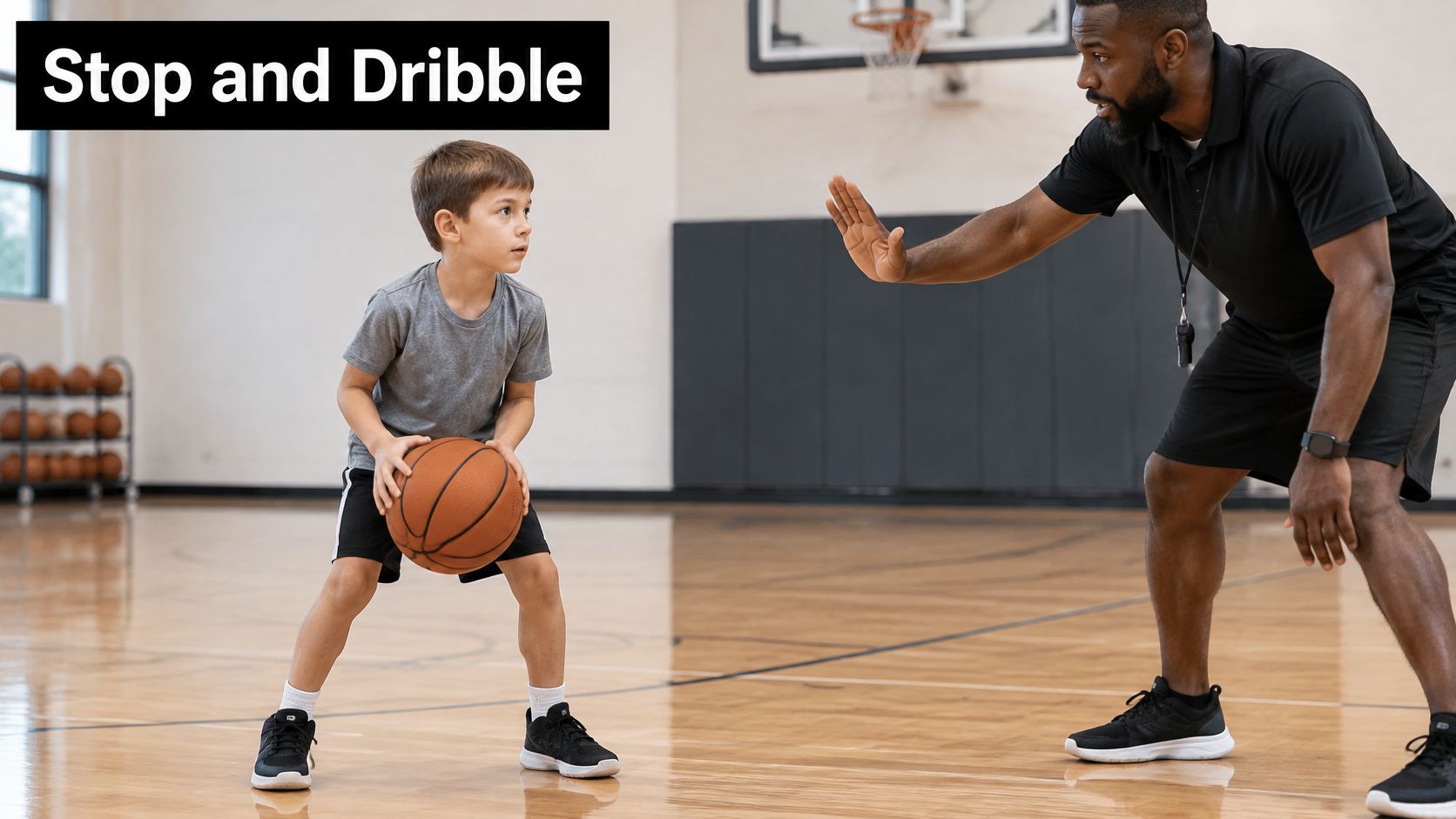
How the calls get harder
Start with the ball still. Your child bounces once, catches with two hands, and waits. When the freeze looks balanced, let them walk on green. Add "switch hands" only after the stop is clean. I use one cue per round. Stop and switch in the same breath usually dumps the ball.
Listening cue: On green, say "left hand" for a few bounces, then "right hand." Don't chase speed.
A home round is simple. Mark a small box with shoes. Play about 45 seconds. Sip water. Play again with the hand call. Praise the freeze at the hip, not the child who sprints farthest.
Practical rule: Keep each round to about 30 to 60 seconds. Attention fades before fitness does.
A Western Kentucky University honors thesis on youth coaching supports stations of roughly 3 to 6 minutes, one clear cue, a soft or age-appropriate ball, and success judged by controlled reps and eyes up, not by how fast anyone moves.
What works: Lots of touches and a clear stop.
What doesn't: Sitting a child out for a missed catch.
Trade-off: You stay the traffic light, so you can't film and coach at the same time.
If a neighbor joins, both dribble. You own the calls so nobody argues.
2. Figure-Eight Dribble Around the Legs
Feet wide, ball weaving around the legs, hand switch between the knees. Say it as a snake game, not as homework. The low path is what later helps a dribble through traffic, but only if the ball stays under the knees instead of bouncing off a shin.
Rhythm before speed
Show it in slow motion: around the right leg, between the feet, around the left leg, back through. Count "one, two, switch" out loud so the hands have a beat. Bend the knees. If the ball climbs to the waist, the pattern is too fast.
Weak-hand cue: After five clean loops, start the next loop on the non-favorite hand. Same count, slower bounce.
Turn ten clean figure-eights into a tiny contest, then reset. A bounce off the shoe doesn't end the game. It restarts the count at one. That rule keeps a frustrated child in the rep instead of quitting at miss number three.
This clip shows the hand path at a pace you can copy before you speed anything up.
Continuous dribbling is the hard version. If your child can't yet push the ball, let them carry it around the legs in the same shape, then add one bounce per loop. Carrying builds the map. Bouncing builds the control. Skipping the carry usually means the ball lives on the floor.
Two minutes is plenty. Pair it with red light in the same session only if the first game still feels fun. Stacking both at full effort turns coordination work into a slog.
3. Partner Chest Pass
Stand about three giant steps apart, not six, until the ball arrives without a lob. Both hands sit behind the ball, elbows stay in, and a small step goes toward the partner. The receiver's hands are up before the pass leaves, because six-year-olds catch with their body if you don't give the hands a job.
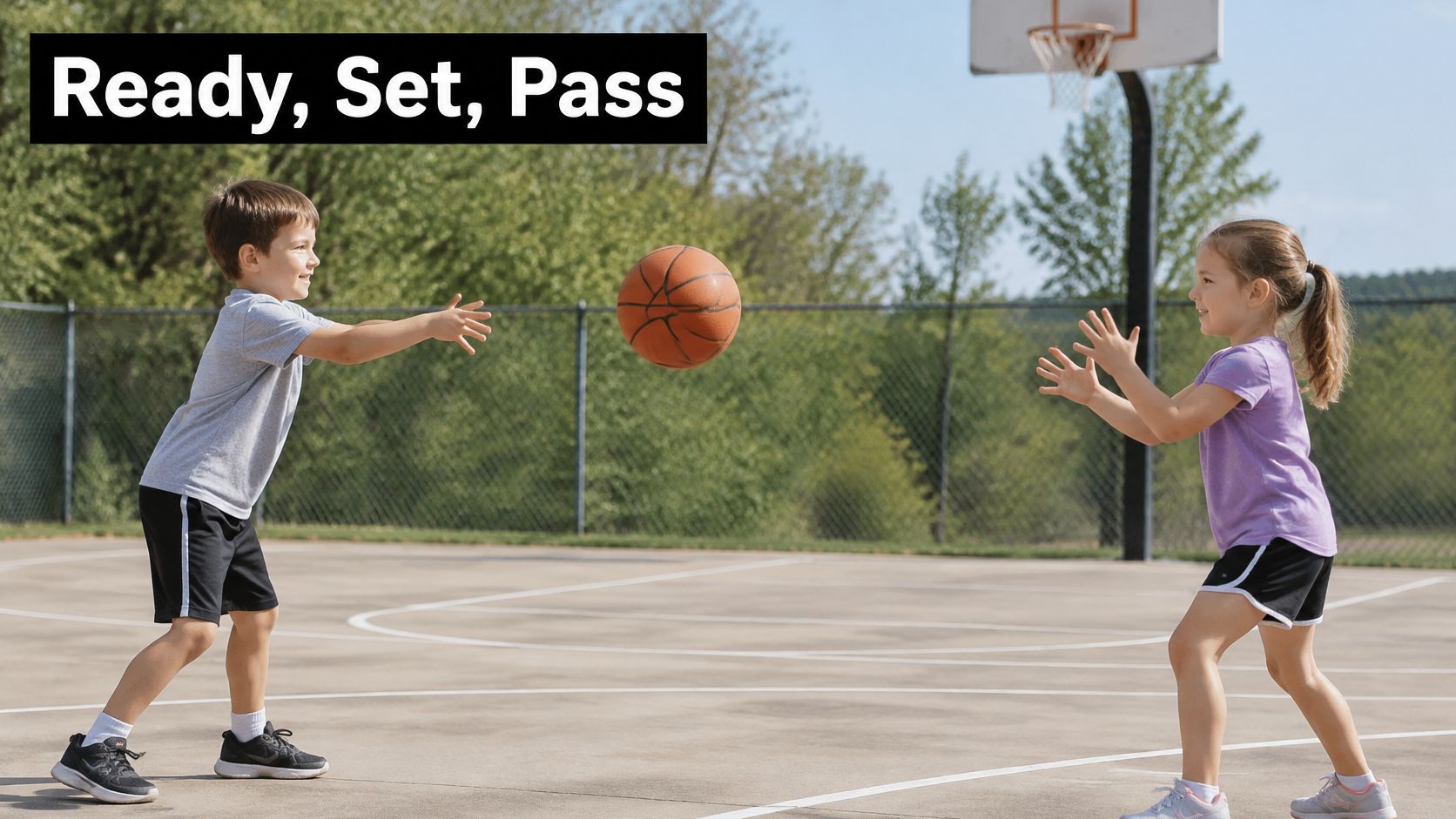
A pass they can finish
Use a lighter or smaller ball. Have each child say "ready" before the throw so nobody fires at a turned head. Start close. Move back one shoe-length only after several catches in a row. Pair kids of similar size when you have two. If it's just you, kneel so the target isn't at adult chest height.
Listening cue: Call "ready, step, push." Three words, same order, every pass. Extra coaching talk during the throw gets ignored.
Score a point for a catch with two hands, not for distance. Ten good catches, then a water break. If misses pile up, shorten the gap before you fix the elbows. Distance is the usual villain, not effort.
Early passing only sticks if it shows up in a tiny game. A simple give-and-go to a cone, like the ideas in beginning basketball plays, is enough. Don't add cuts, screens, or a full-court pattern. One pass, one step toward a target, reset.
A pass your child can catch is a better teacher than a perfect motion that hits the grass.
What doesn't work is a passing line where one child waits while the other performs. Trade after every throw. Both kids stay in the ball.
4. Bucket Shooting with Two Hands
No hoop, no problem. A laundry basket, a taped square on a wall, or a bucket on a chair is a legal basket for a six-year-old. Feet, hands, and eyes line up. The shot is a two-hand push from the belly, not a one-hand heave copied from TV.
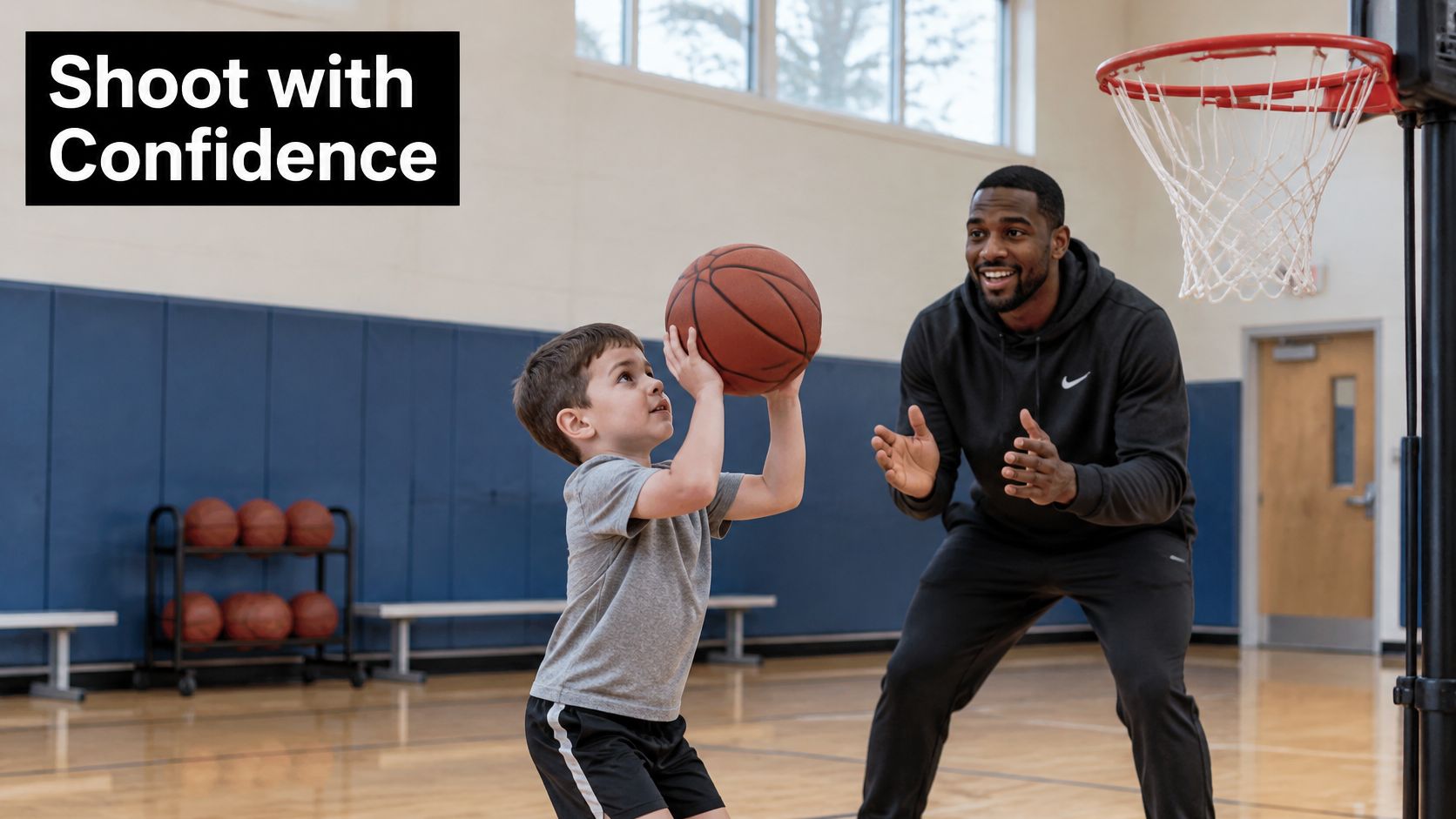
Close target, quick turns
Stand close enough that the first few shots can go in. A size 3 ball, or the lightest ball you own, keeps the push in the hands instead of the shoulders. Call the pocket: ball at the belly, eyes on the bucket, push up and out. Celebrate the straight push even when it rims off a plastic edge.
Weak-hand cue: Both hands stay on the ball. If one hand starts shoving, reset to a two-hand hold before the next shot. One-hand form can wait.
Rotate fast. Two shots, then the next child, or you rebound and hand it back. A line of kids staring at one shooter is where attention dies. If you're solo, five shots, a silly dance, five more.
Household targets matter because access isn't even. The Project Play State of Play 2025 participation trends note that in 2024 the gap in regular sports participation between children from households earning under $25,000 and those from households earning $100,000 or more reached 20.2 percentage points, up from 13.6 points in 2012. A bucket in the living room still builds the habit. Rolled socks work indoors if a ball is too loud.
More shooting games that stay playful are collected in fun basketball shooting games. Keep this station under a few minutes. Volume of misses is not a teaching tool.
5. Sharks and Minnows Dribble Tag
One or two sharks have no ball. Everyone else dribbles inside a small box. A tag means freeze with the ball, knees bent, until a teammate is close enough to say "unfreeze." Nobody walks off to the side. Sitting out is how this game goes wrong.
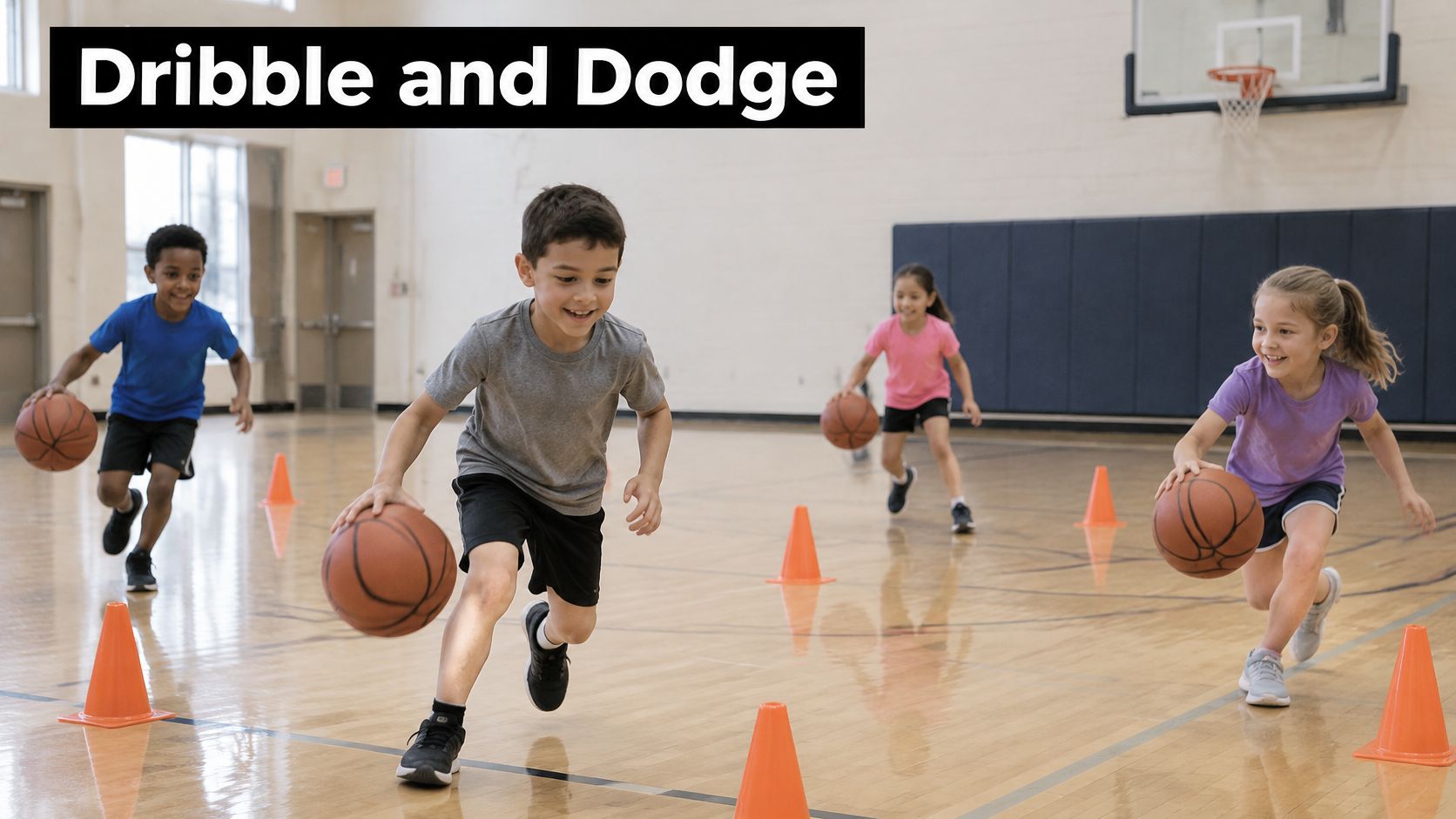
Pressure without panic
Cones or shoes mark a space small enough that you can see every dribble. Sharks start with a walk, not a sprint. Rotate the shark every round so the fastest kid isn't the only hunter. Call a weak-hand round: dribble only with the left, and sharks must tag the ball arm gently, not the body.
Play 2 to 4 minutes, then change one thing. Wider space, or a second shark, not both. Possessions, or in this case dribbles, restart the second a ball leaves the box.
Smaller games create more touches than a full lineup. A review of youth small-sided basketball on PubMed Central found that among adolescent players, 3v3 formats produced more ball contacts than 5v5. For six-year-olds, shrink that idea further: 1v1 or 2v2 space, simple rules, and no full-court five-a-side. The teen studies are a hint, not a workout plan for your driveway.
Kindergarten-friendly tag ideas in fun basketball games for kindergarteners fit the same box. If you only have one child, you are the slow shark. Your job is almost-tags, not wins.
Count purposeful changes of direction, not baskets. A child who looks up and turns is doing the drill even if the tagger never catches them.
6. Follow the Leader Movement Dribble
You walk, skip, zigzag, and freeze. Your child copies with a ball, or with a pretend ball if the dribble collapses. Three or four moves, then stop. Longer chains turn into guesswork, and guesswork feels like failure.
Let them lead
A clean chain for a first session: walk and bounce, skip without the ball, zigzag back, two-hand freeze. Music helps the rhythm if the yard isn't too loud. Slow the song, or your feet, for a child still patting the ball into their shoes.
Listening cue: Call the move before you do it. "Walk. Skip. Freeze." The voice is the map. The body is the check.
Hand the leader role to your child for one chain. They pick the silly step. You copy it badly on purpose, then clean it up. That swap builds confidence faster than another perfect demo from you.
Change one thing when a child gets stuck: slower feet, a bigger ball catch, or a turn as leader. Don't add a fifth move.
Participation isn't the same for every child. Project Play research reports that children with disabilities who play sports take part in almost one month fewer practices or competitions a year than peers without disabilities, and that girls' regular sports participation reached 37% in 2024. Offer an emerging version (carry the ball), a developing version (one bounce per step), and a ready version (continuous dribble). Same path, different ball demand. A child who is frustrated needs a shorter chain, not a speech about effort.
Three minutes, then you're done with this game. It is a warm-up, not the whole practice.
How the six drills compare at a glance
Use the time column for one station, then stop or rotate while the game is still fun.
Drill | Age Range | Time at One Station | Equipment Needed |
|---|---|---|---|
Red Light, Green Light Dribbling | 5 to 7 years | About 3 to 6 minutes | One ball per child; cones or boundary markers optional |
Figure-Eight Dribble Around the Legs | 5 to 8 years | 2 to 5 minutes | One ball per child |
Partner Chest Pass | 5 to 7 years | 5 to 10 minutes | One ball per pair; cones or distance markers optional |
Bucket Shooting with Two Hands | 5 to 7 years | 5 to 10 minutes | Lower hoop or bucket; size 3 ball; cones |
Sharks and Minnows Dribble Tag | 5 to 8 years | 2 to 4 minutes | One ball per child; cones or boundary markers; pinnies optional |
Follow the Leader Movement Dribble | 5 to 7 years | About 3 minutes | One ball per child; music player and cones optional |
Short sessions are the point. Two clean stations beat six rushed ones, and a bored six-year-old will tell you when the drill has gone long.
Turning Six Drills Into a Weekly Basketball Habit
A week that sticks is short on purpose. Two or three days, about 15 minutes, is enough beside normal play. Day one: follow the leader for three moves, red light for two short rounds, then sharks or you-as-shark until the giggles get loud. Day two: figure-eights for two minutes, chest passes until ten clean catches, then bucket shots from one close spot. Day three: mix a weak-hand red light with a freeze-tag game and stop early.
Praise the stop, the eyes, and the try. Rotate partners when you have them so the same child isn't always the passer or the shark. If misses stack up, move closer or slow the call. Appropriate challenge beats a longer checklist.
At our indoor center in Humble, Kingwood, and Atascocita, basketball sits alongside other youth sports, and sessions stay game-based rather than lap-based. Parents or caregivers stay in the building, which makes it easy to watch the same cues you used in the driveway. A free trial form asks for your child's name, age, and favorite sport, so we can place them with the right group.
Keep a ball by the door. The best session is the one your six-year-old asks to repeat.
JC Sports Houston offers youth basketball, multi-sport classes from 24 months up, and seasonal leagues built around short games, dribbling, passing, and small-sided play. If you want those basketball drills for 6 year olds coached indoors while you watch, request a trial and tell us your child's name, age, and favorite sport. Visit JC Sports Houston to see class times and start that request.
Comments