

10 Sports Team Building Activities for Youth in 2026

It's the first Saturday of the season in Humble. Children are standing in a line, someone's kicking a cone, and parents are trying to work out who knows whom. The coach has learned a few names, but the players still look to an adult whenever something goes wrong.
That's the moment to give them a job they can solve together. Not a speech about teamwork. A passing game, a shared obstacle course, or a quick challenge that makes one child notice what another child needs.
Good sports team building activities combine a shared task with a small win. Children practice asking for help, handling mistakes, and making room for someone else while they're moving. A cheer or matching shirt can support that connection, but it can't replace it.
Start With Participation, Not Presentation
If families want a team keepsake, Custom Mark team building merchandise is an option to explore after players have chosen their identity together. Keep purchases optional so belonging never depends on buying something.
The activities below suit soccer, baseball, basketball, and multi-sport groups around Humble, Kingwood, and Atascocita. Some work during the game. Others become opening rituals or closing reflections. Start with the version children can manage, then add difficulty without losing the cooperation.
1. Small-Sided Games (3v3 and 4v4)
A crowded scrimmage lets confident players take over while newcomers chase the action. Smaller teams make each teammate easier to notice. Use them early in practice, before children settle into familiar friendship groups.
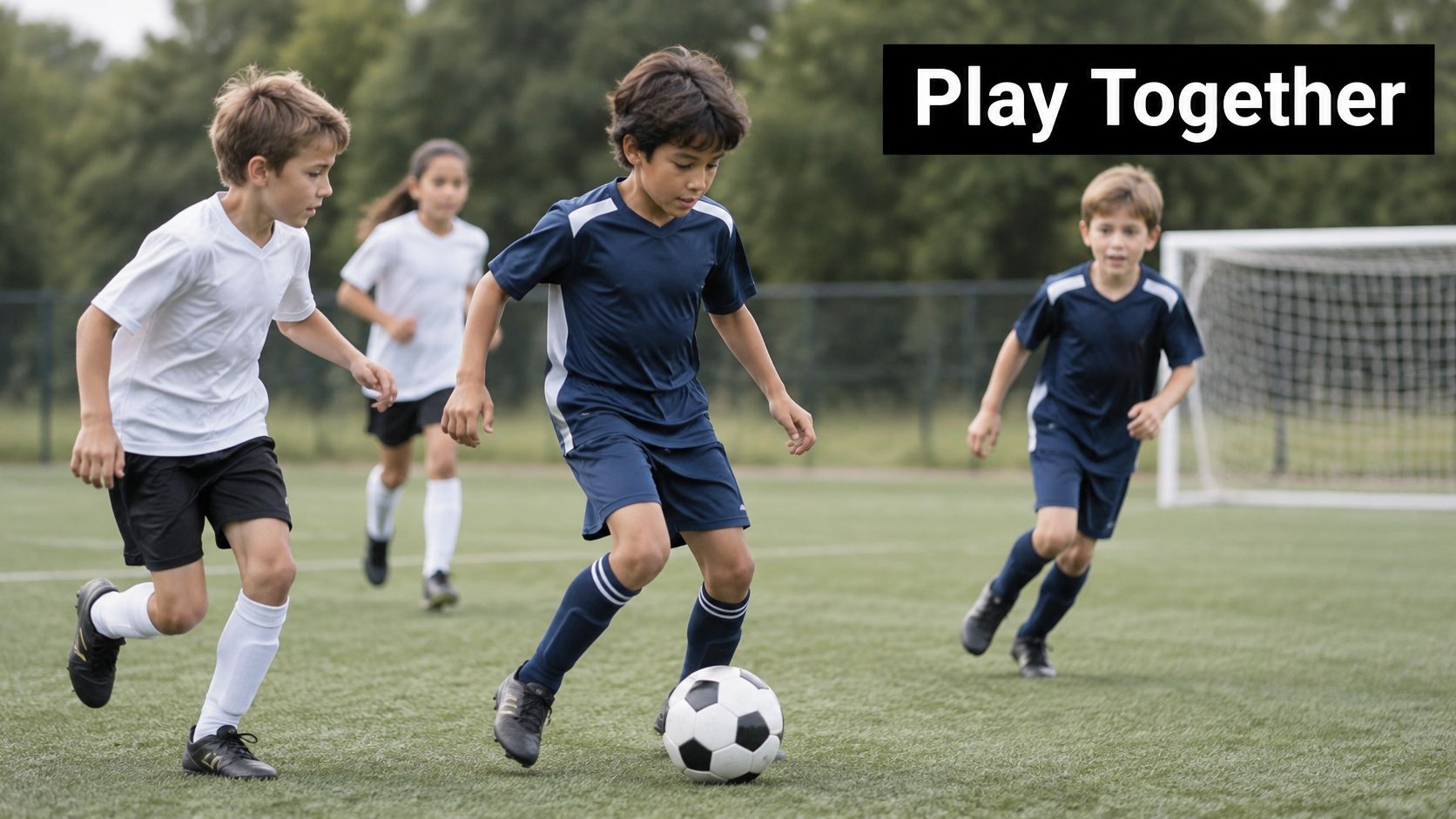
During setup, mark compact playing areas with flat cones, place spare balls nearby, and assign balanced teams rather than letting captains pick. Demonstrate the boundary and restart, then get moving.
For preschoolers, use wide scoring gates and allow the coach to help restart play. For older children, ask players to notice who hasn't received a pass and find a safe opportunity to include them. Don't require every player to touch the ball before every goal if that makes the game stop constantly.
Reward Support, Not Just Scoring
Try a soccer game where you recognize a player who moves into space to help a trapped teammate. In basketball, praise the child who offers a passing option rather than crowding the ball.
A meta-analysis of cohesion and performance in sport found a statistically significant moderate-to-large relationship between cohesion and athletic performance. That's a reason to coach shared decisions, not just individual execution.
Coaching cue: Help the player with the ball.
Rotate teammates between rounds, but leave groups together long enough to solve something before changing them.
2. Rondo (Keep-Away Circle)
Run a rondo when players are arriving with plenty of energy but aren't communicating yet. Arrange a loose circle of cones, put passers around the outside, and place a defender inside. The outside group keeps possession together.
Start with a generous space. If children can't complete a pass, enlarging the circle won't always help, because the passes also become longer. Bring receivers within comfortable range and give the defender a slower movement rule instead.
Preschool adaptation: Roll a soft ball by hand while an adult acts as a gentle interceptor. Let children stop the ball before sending it.
Older-player adaptation: Use feet for soccer or bounce passes for basketball. Add a touch restriction only after the group can maintain possession comfortably.
Shared challenge: Ask the group to improve its own passing sequence rather than beat another circle.
Coaching cue: Make yourself easy to pass to.
Keep the Defender Role Neutral
Don't automatically send the child who makes a mistake into the middle. That can turn an ordinary error into public punishment.
Rotate defenders at natural breaks instead. If a receiver misses a pass, ask whether the passer sent a manageable ball and whether another teammate offered support. The bonding comes from treating possession as everyone's responsibility, not finding the weakest link.
3. Partner Ball Mastery Drills (Coerver-Style Pairs)
Partner work is useful when a child will talk to a teammate but won't speak in a full-team huddle. Set out paired working spaces with a ball and enough room to turn without colliding.
Begin with a simple exchange: control the ball, perform a turn, and pass it back. The waiting partner watches, offers encouragement, and prepares to receive. The guide to Coerver soccer training provides context for using ball-control work within a technical-development approach.
Make the pair responsible for a comfortable exchange, not matching ability perfectly. Similar skill levels can help, but a patient partner may matter more than an equally quick one.
Give the Observer a Useful Job
For preschoolers, let partners copy a gentle sole roll or stop-and-pass movement. An adult can help children take turns without rushing them.
Older players can create a short movement sequence, teach it to their partner, and adjust it together. For example, one child might suggest an inside turn while the other changes the receiving angle so the pass is easier.
Practical rule: A partner isn't a spare coach. Ask children to offer one helpful observation, not a running commentary on every mistake.
Coaching cue: Give your partner a ball they can use.
Change partners across practices. Keep a familiar pairing available for a nervous newcomer, then broaden connections once the child feels settled.
4. Cooperative Relay Races
The fastest child shouldn't be able to win this relay alone. Set up parallel routes with cones, soft balls, and a clear return area, then give the whole group a shared task.
For example, teammates move the equipment from one end of the space to the other, with everyone contributing before the group finishes. Children can carry, roll, dribble, or guide according to the version you choose.
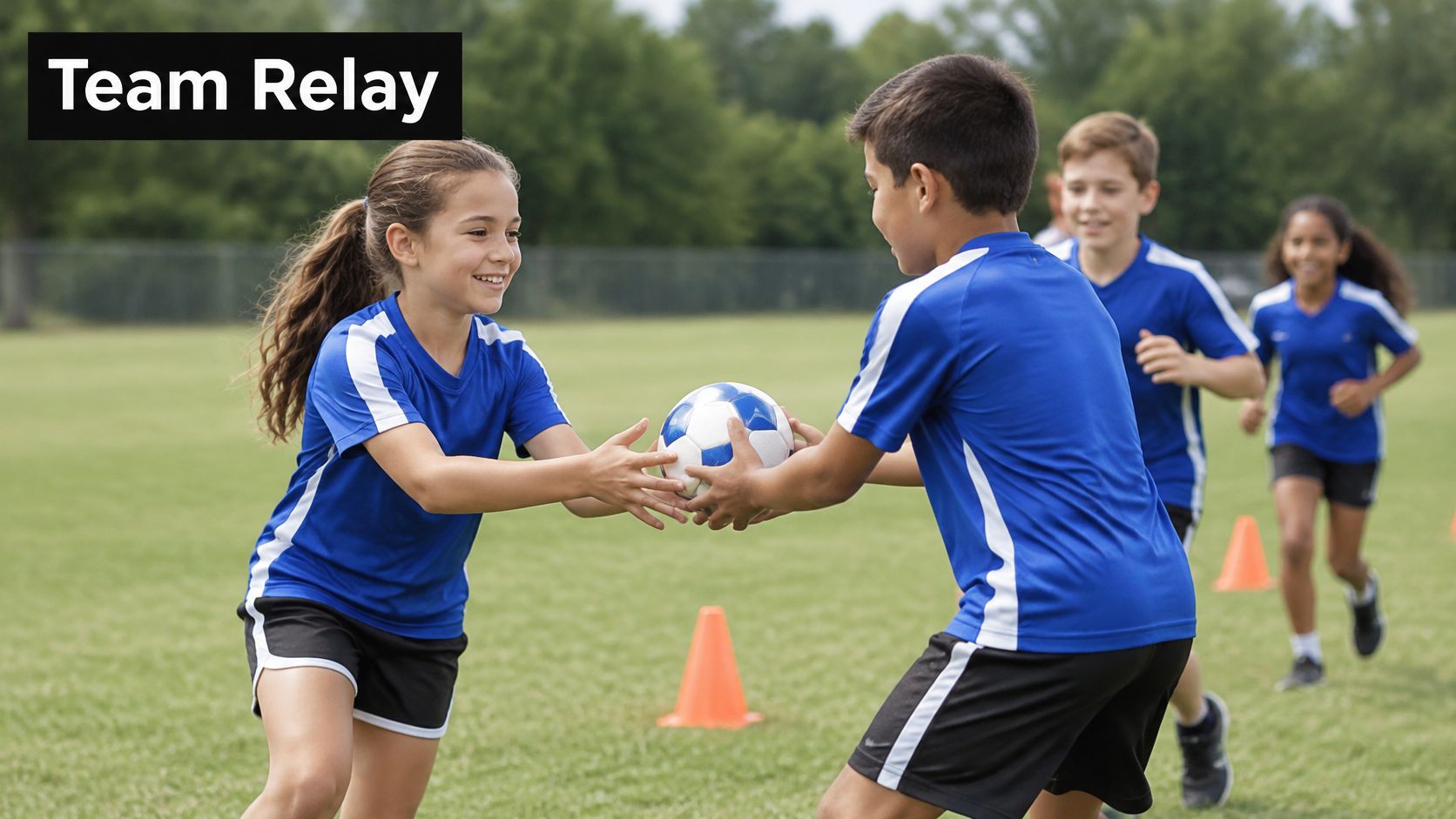
Give players a planning huddle before their attempt. Ask where they'll wait, how they'll exchange equipment, and what they'll do if a ball gets away.
For younger children: Use a straight route and let a partner walk alongside. Avoid complicated exchanges.
For older children: Add a choice of routes or a rule requiring different movement methods.
For mixed abilities: Offer equivalent ways to contribute without making one child the permanent helper.
Canadian government reporting found that parents viewed an excessive emphasis on winning as an exclusion barrier and preferred skill development, participation, and enjoyment, according to the sport participation and inclusion report.
Coaching cue: We finish when everyone finishes.
Don't make teammates wait while someone struggles. Teach them to encourage, retrieve loose equipment safely, and help the group reset without blame.
5. Capture the Flag
Capture the Flag works as a closing challenge when children still have energy for strategy. It's less useful when they're already tired and ignoring boundaries.
Before play, mark team territories, a visible center line, and flag zones away from walls or equipment. Use fabric flags or soft markers, not objects children might swing. Walk the boundary together and demonstrate safe tagging.
Keep tagged players involved. Have them return to their starting area and rejoin rather than sit in a jail waiting for rescue.
Make Strategy Accessible
For preschoolers, remove tagging entirely. Let teams collect objects from a shared central area and bring them home together.
Older players can assign temporary attacking, defending, and communication roles. Rotate those jobs so the strongest runners don't always attack and quieter players don't always guard the base. If strategy talk becomes dominated by a confident child, ask each teammate to suggest a possible route.
The planning element also connects with classroom games that build cooperation, especially when children must listen before acting.
Coaching cue: Tag gently, then give space.
Stop immediately for grabbing, pushing, or guarding so closely that a player can't move safely. If contact keeps escalating, switch to a non-contact collection game. The activity isn't worth preserving at the expense of trust.
6. Team Huddle Goal-Setting and Reflection
A huddle earns its place when players leave knowing what to try. It loses its value when the coach delivers another lecture.
Before practice, gather children where they can hear without shouting and choose a visible teamwork behavior. Helping a teammate restart after a mistake is more useful than an abstract instruction to show respect.
The National Recreation and Park Association youth-sports report found that 98% of surveyed agencies agreed their programming emphasizes positive communication, teamwork, respect, and leadership. Turn those broad aims into actions children can recognize.
Opening prompt: Ask how players can help someone who gets stuck.
Closing prompt: Ask who noticed a teammate helping.
Next-step prompt: Ask what the group wants to try again.
For preschoolers, demonstrate the behavior and let children point, gesture, or name a teammate. Older children can suggest the focus and explain whether their plan worked.
Keep the reflection shorter than the experience children are reflecting on.
Coaching cue: Name the action, not the best player.
For example, recognize someone who returned a loose ball so another group could continue. Don't turn the circle into a popularity vote or force children to reveal feelings publicly. Passing on a speaking turn should be acceptable.
7. Team Identity Rituals (Team Names, Cheers, and Handshakes)
Use an identity ritual when a group is new, returning after a break, or welcoming another player. It gives children an easy way to join without needing to prove their athletic ability first.
Offer manageable choices for a team name, then let players decide. Build a simple gesture or sign-off around it, and demonstrate it before the first game begins.
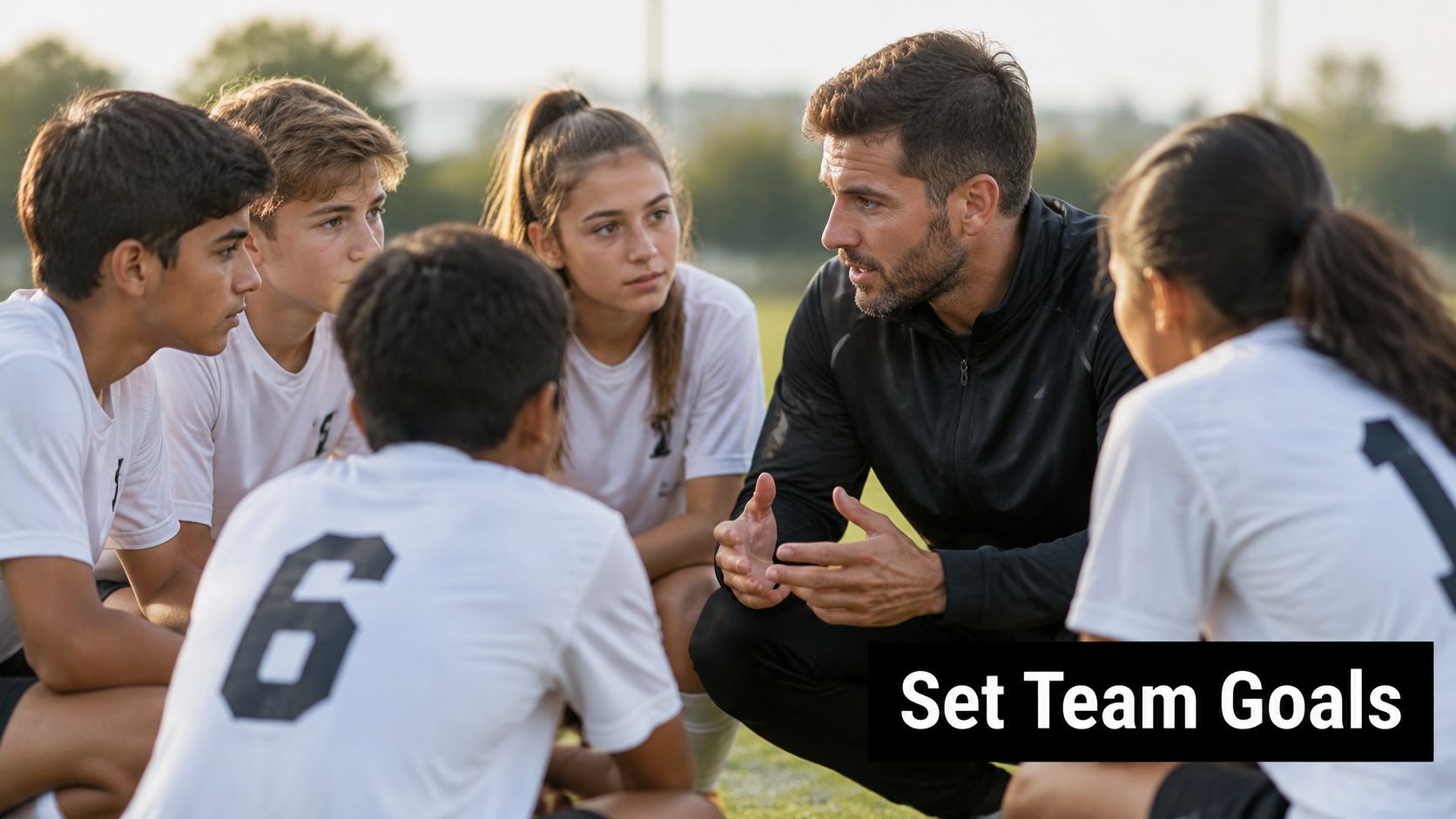
A preschool group might choose an animal movement with a wave. Older children might invent a brief call-and-response or a no-contact handshake sequence. Let them create something they'll use, rather than copying a professional team's routine.
Keep Belonging Optional to Perform
Coaching cue: Everyone can join in their own way.
A child who dislikes shouting can make the gesture. A child who avoids touch can wave instead of high-fiving. Don't interpret either choice as poor team spirit.
Rotate who starts the ritual, and teach it again when someone joins. An inside joke that nobody explains can exclude a newcomer just as easily as a cheer can include them.
After a difficult game, keep the same sign-off. If the ritual happens only after wins, children may start treating membership as something they earn through results rather than something the group shares.
8. Obstacle Course Challenges
Set up an obstacle course while children complete a familiar arrival activity. Use flat markers, low obstacles, hoops, and soft balls, with clear travel lanes and no blind crossings.
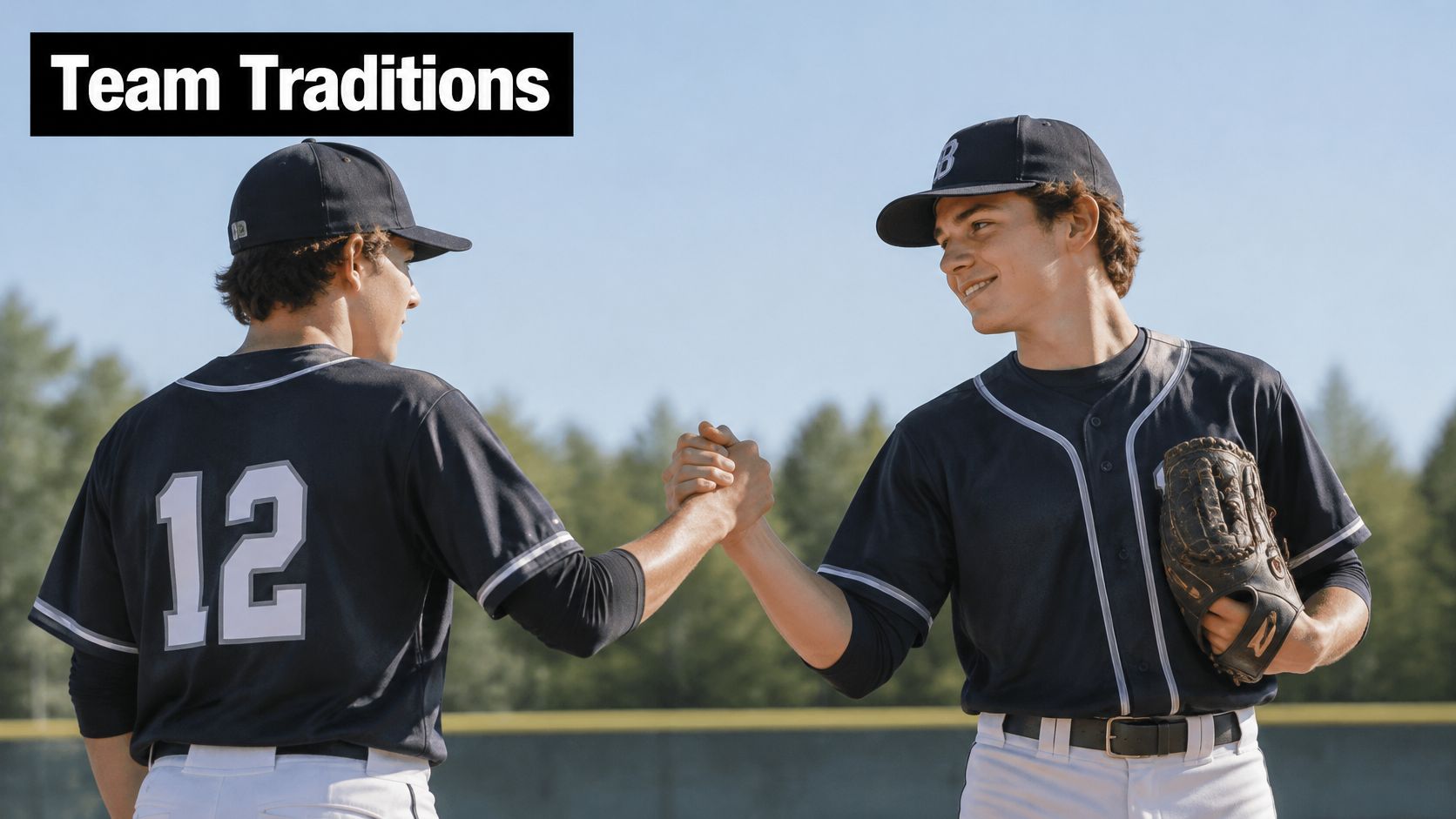
Make the finish a shared destination rather than a podium. The same cooperative attitude belongs in baseball, where teammates also need to support each other between turns.
For preschoolers, try stepping over a low marker, walking between cones, and rolling a ball through a gate. Older players can plan a route, carry shared equipment, or guide a partner verbally while both keep their eyes open.
The guide to agility training for kids offers related movement ideas. Keep the team-building version focused on helping everyone succeed together, not just moving faster.
Build Help Into the Route
Ask teammates to explain the next station or retrieve a loose ball from outside the travel lane. Don't let them pull, lift, or physically steer another child.
Coaching cue: Clear the landing space before the next person goes.
Use the video as an additional activity resource.
If children queue at a difficult station, simplify it or duplicate the route. Long waiting lines turn a cooperative movement challenge into another exercise in standing still.
9. Multi-Sport Rotation Day
A child who leads in soccer may become the beginner at a basketball station. That change gives teammates a practical reason to explain, encourage, and accept help.
Lay out distinct areas for passing, throwing, striking from a tee, and ball control. Keep loose balls contained and place striking activities away from walking routes. Introduce each station before groups spread out.
For preschoolers, offer simple exploration with a shared task, such as rolling balls into a target area together. Older children can solve a sport-specific challenge, then explain it to the next group.
Change the leader: Let a different child explain each station.
Recognize helpful behavior: Praise a clear demonstration or patient restart.
Protect beginner status: Don't let experienced players mock unfamiliar technique.
The guide to the benefits of playing multiple sports provides further context for a varied sporting experience.
Coaching cue: Teach your teammate, then let them try.
A systematic review of youth-sport participation found statistically significant improvements in health and well-being compared with nonparticipation. That supports making participation worthwhile, but it doesn't mean a rotation day guarantees those outcomes.
Keep explanations brief and equipment ready. Too many stations can create more transitions than play, so choose activities you can supervise safely.
10. Buddy Welcome Challenge
Run this activity whenever a child joins, returns after an absence, or looks disconnected. Don't save team bonding for opening day.
Prepare a familiar passing or target game, then pair the arriving child with a patient teammate. The buddy explains the boundary, demonstrates the task, and helps the newcomer join the group. Keep responsibility with the coach rather than making another child manage behavior or safety.
Give Both Children a Contribution
A preschool newcomer might choose the ball color while their buddy demonstrates rolling. An older newcomer can choose a starting position, suggest a team name for the round, or explain a game they already know.
Coaching cue: Show them how to join, not how good you are.
Avoid introducing the child as someone who needs special help. Everyone should take turns being the person who explains and the person who learns.
Access matters: A welcome routine should work even when a child can't attend every session.
Congressional testimony on youth-sport access identifies transportation, scheduling, safety, and nearby facilities as participation barriers. Don't add social penalties when a family already struggles to get there.
Finish by bringing the pair into a larger game. A buddy system should open the group, not leave newcomers permanently separated from it.
Team Building Activities at a Glance
Item | Primary Benefit | Equipment Needed | Best For |
|---|---|---|---|
Small-Sided Games (3v3 and 4v4) | Builds involvement, communication, and decision-making | Ball and small playing area | Young players developing skills in game situations |
Rondo (Keep-Away Circle) | Improves passing, awareness, and teamwork | Ball and small playing area | Practicing possession and quick decisions |
Partner Ball Mastery Drills (Coerver-Style Pairs) | Develops individual technique and partner trust | One ball per pair | Repetitive skill practice in pairs |
Cooperative Relay Races | Builds communication and inclusive teamwork | Ball and simple course markers | Mixed-ability groups and team challenges |
Capture the Flag | Develops strategy, communication, and teamwork | Flags or clear markers for team bases | High-energy group play in a bounded area |
Team Huddle Goal-Setting and Reflection | Strengthens accountability and team communication | No equipment needed | Setting shared goals and reflecting together |
Team Identity Rituals (Team Names, Cheers, and Handshakes) | Builds belonging and team pride | No equipment needed; optional team symbols | New teams, seasonal leagues, and camps |
Obstacle Course Challenges | Builds coordination, motor skills, and cooperation | Cones, hoops, mats, or other course equipment | Active, adaptable group challenges |
Multi-Sport Rotation Day | Builds broad athletic skills and encourages sport discovery | Equipment for each selected sport | Introducing children to varied sports and activities |
Turn One Activity Into a Season-Long Team Routine
Choose a pair of activities for your next few practices and keep them recognizable. Small-sided games plus a closing huddle make a useful starting combination. Cooperative relays plus a welcome ritual may suit a younger group that's still learning how to share space and equipment.
Repeat the basic setup before adding more rules. Children need opportunities to use a helpful behavior again, not just hear praise for it once. A familiar game also lets the coach spend less time explaining and more time noticing who needs support.
A meta-analysis published in Frontiers in Psychology found that team-building interventions produced a moderate positive effect on cohesion, with an effect size of 0.65. That's encouraging, but it isn't a promise that any particular game will transform a youth team.
Watch for Behaviors You Can Actually See
Look beyond noise and excitement. A loud practice isn't necessarily a connected one, and a quiet child may be contributing thoughtfully.
Communication: Players offer useful information instead of blaming after mistakes.
Participation: Newer or less-confident children receive opportunities to contribute.
Recovery: Teammates help restart play when something goes wrong.
Leadership: Different children explain, encourage, and make decisions.
End each session with a short huddle about an action someone noticed. Use that observation to choose the next practice's focus. If children still argue over turns, don't add a more elaborate competition. Simplify the task and practice sharing responsibility.
Families can also collect team highlights with EventUploader, provided parents agree on what is shared and who can access it. Include helpful passes, encouragement, and brave first attempts rather than only goals or standout performances.
For families in Humble, Kingwood, and Atascocita, a structured program can offer a way to try this approach before committing. Requesting our free trial asks for the child's name, age, and favorite sport. During the visit, watch how the child joins, responds to mistakes, and connects with other players, not just whether they perform the skill correctly.
JC Sports Houston offers age-appropriate youth sports programs, including multi-sport classes, soccer, baseball, and basketball, with interactive games that develop confidence and technique. Visit JC Sports Houston to request a free trial and find a setting where your child can practice being a teammate while learning the sport.
Comments