

8 Ball Activities for Toddlers to Try

Your toddler grabs a ball and does everything except the thing you expected. They carry it like treasure, sit on it, roll it under the couch, then run after it laughing. That's normal, and it's a strong place to start.
The best ball activities for toddlers begin with play, not perfect technique. Soft equipment, short turns, visible targets, and lots of repetition help toddlers build confidence while their coordination catches up. Ball play also follows a real developmental path. A widely used early learning progression maps skills such as rolling a ball at 12 to 15 months, underhand throwing by 15 to 18 months, kicking forward by 21 to 24 months, and catching a large ball later in toddlerhood through the preschool years, which is one reason ball play shows up so often in early movement programs (early motor milestone progression for ball skills).
If your child likes movement but loses interest fast, that doesn't mean ball play isn't working. It usually means the setup needs to be simpler, softer, and more playful. Many families pair ball games with other movement ideas like these sensory and music activities for kids to keep the whole routine light and engaging.
The list below moves from easy exploration and rolling toward kicking, sharing, and simple sport-readiness patterns. Each activity includes a home or class setup, what it supports, a safety check, and one easy way to change it when your toddler is ready for more.
1. Soft Ball Rolling and Chase Games
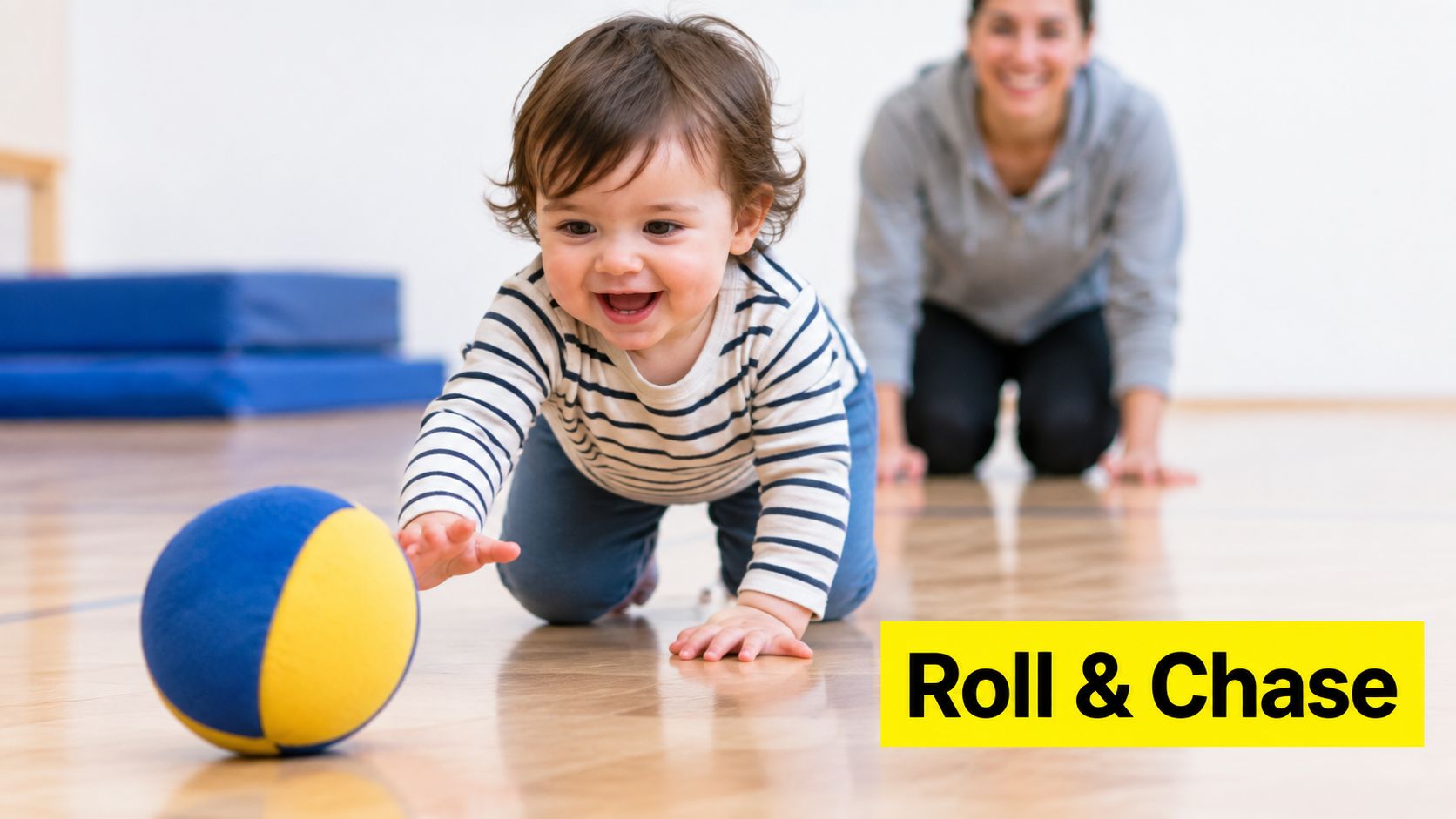
Rolling is where many toddlers first learn that they can make a ball move on purpose. That simple back-and-forth builds timing, visual tracking, and body control without asking for too much at once.
For home, sit on the floor facing your child and roll a soft foam or fabric ball a short distance. In a class, make two clear rolling lanes so children can take turns without balls crossing everywhere. Bright colors help, and so does a clear stopping point like a wall, couch cushion, or taped line.
How to Set It Up
A toddler doesn't need a formal game to learn from rolling. Try one of these simple versions:
Parent roll-back: Sit facing your child and roll the ball gently to their hands or legs.
Wall roll chase: Roll the ball toward a wall so it comes to rest instead of speeding away.
Tunnel roll: Roll the ball under a chair or through a cardboard box tunnel and let your toddler crawl after it.
If you're choosing equipment for this stage, balls for toddlers should be easy to grip, soft on impact, and large enough that they don't become a mouthing hazard.
Practical rule: If a toddler spends more time chasing than touching the ball, make the space smaller and the ball softer.
Rolling games support weight shifting, reaching, stopping, and changing direction. Those are early movement pieces that show up later in kicking, catching, and group games. For a child who's just turning one, the win might be corralling the ball with both hands. For an older toddler, it might be pushing with more direction instead of random force.
Safety Check and Easy Variation
Use a clear floor area and remove hard furniture edges, loose rugs, or anything breakable in the rolling lane. Small hard balls aren't a good match for young children, especially toddlers who still mouth objects.
To make it easier, use a larger foam ball and shorten the distance. To make it harder, ask your child to roll to a target like a laundry basket turned on its side.
2. BlastBall Introduction Program
Some toddlers light up when an activity feels like a real sport, but still need equipment that moves slowly and gives them quick success. That's where a BlastBall-style setup works well.
Use an oversized soft ball, a child-safe bat or paddle, and a large target or base. At home, you can hit from a tee into open space. In a coached setting, children can rotate through hitting, carrying or tossing the ball, and running to a marker. The key is that the game feels active right away, without long explanations.
Why This Format Works for Beginners
BlastBall blends familiar sport ideas into one easy pattern. A toddler gets to hit something off a tee, throw or carry a ball, then move toward a clear destination. That creates a satisfying cause-and-effect sequence, and toddlers usually stay with it longer than they stay with isolated drills.
A class leader might set up one station with a tee, another with a big bucket to throw into, and another with a soft kicking target. A birthday party or camp can use the same rotation with short turns so children keep moving instead of standing in line.
Success matters more than form in early ball play. If the child makes contact, smiles, and wants another turn, the activity is doing its job.
Safety Check and Easy Variation
Keep bats, paddles, and tees low and within easy reach. Spread children out so only one child swings in a lane at a time, and keep the waiting group well outside the striking area.
For a simpler version, let the child tap the ball off the tee with their hand instead of a bat. For a richer version, ask them to hit, run to a spot, then toss the ball into a target before coming back. That adds sequencing without turning play into a test.
3. Ball Toss and Target Games
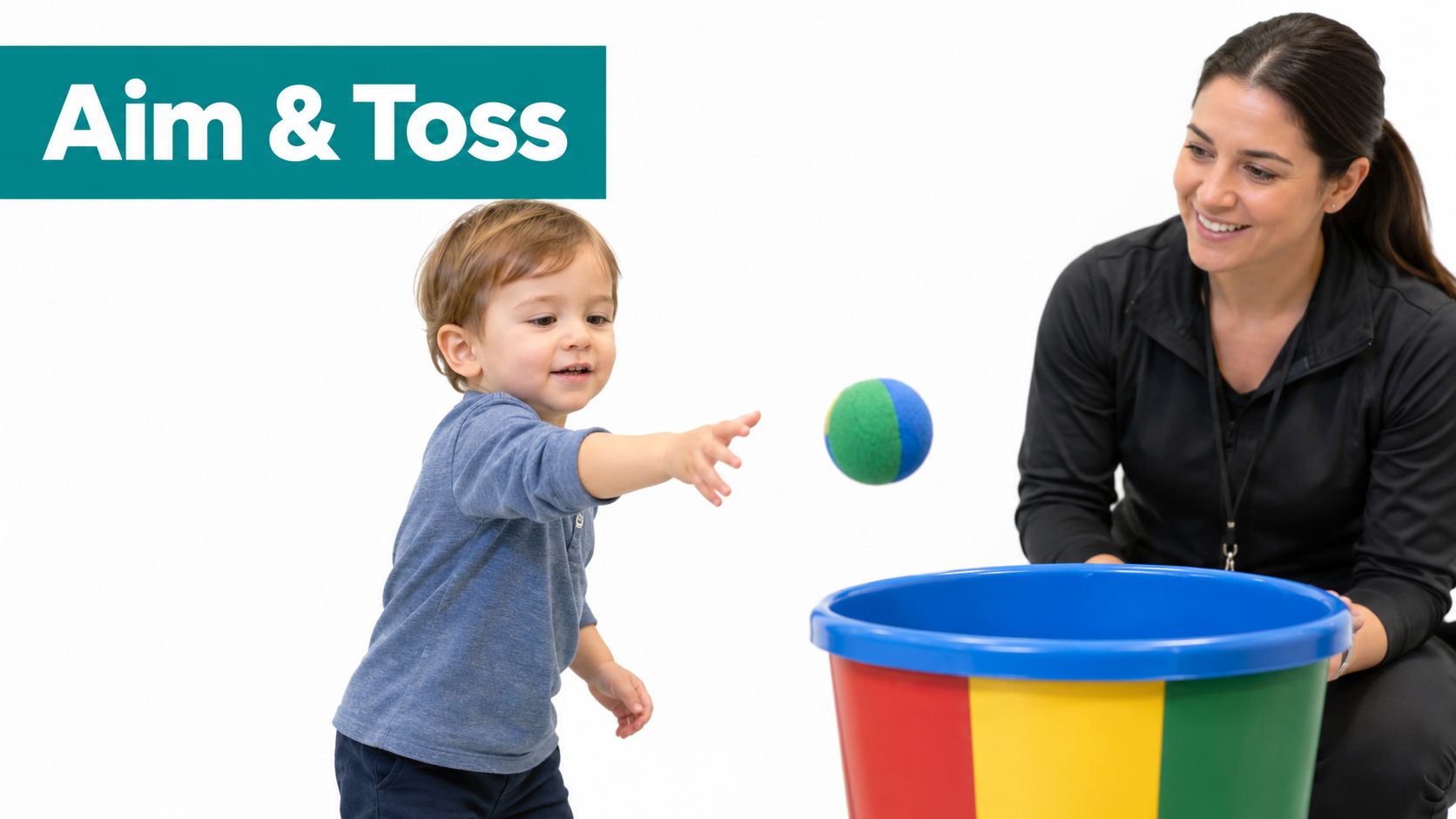
Tossing at a target gives toddlers a clear reason to throw. “Throw the ball” is abstract. “Throw it into the bucket” makes sense.
Set out a laundry basket, wide bin, hula hoop propped against a wall, or a low net. Stand close enough that success happens often. At home, this can be part of cleanup. In a class, create a few color-coded stations so children can move after several tries instead of waiting too long.
What Toddlers Practice Here
This kind of throwing game asks for more control than random tossing. A child has to look, judge space, move the arm, and release at roughly the right time. That's a lot of coordination packed into one playful action.
You can keep the setup simple:
Low bucket toss: Place a wide bucket nearby so the child can drop or gently toss in.
Wall hoop throw: Tape a hoop or make a circle target on the wall at a low height.
Color match toss: Ask the child to throw the blue ball into the blue bin and the red ball into the red bin.
Structured ball work can support meaningful motor growth when children repeat these movements regularly. One preschool intervention built around ball-game activity reported significant gains in fine motor integration, general fine motor skills, bilateral coordination, balance, and body coordination after the program (preschool ball-game motor intervention findings).
Safety Check and Easy Variation
Use only soft balls and keep the target stable. If the bucket tips every throw, toddlers get distracted from the movement pattern and focus on the noise and chaos instead.
For an easier start, let your child stand almost next to the target and drop the ball in. For more challenge, move the target a bit farther away or place one target on each side so they practice throwing across the body in both directions.
4. Ball Dance and Movement Games
Some toddlers respond better to rhythm than instructions. Add music, and suddenly carrying, lifting, passing, and stopping with a ball feels natural.
Try this in an open room with one soft ball per child. Play a song with a steady beat and prompt simple actions like “hold the ball high,” “tap it on your knees,” or “walk with your ball and freeze.” In a class, this works well at the start because children can join even if they're shy about throwing or kicking.
Movement With a Ball, Not Performance
The ball gives toddlers something to organize their movement around. Instead of wandering, they have an object to carry, protect, roll, or present during a freeze. That often helps children stay engaged without needing constant correction.
If you want ideas that fit this style, creative movement can pair beautifully with soft-ball activities.
Try a few playful prompts:
Freeze hold: Dance while holding the ball, then freeze when the music stops.
Body part tap: Tap the ball on shoulders, knees, tummy, or toes.
Pass and turn: Roll or hand the ball to a parent, coach, or classmate, then spin once.
When a child invents a safe new way to move with the ball, count that as progress. Creativity and control often grow together.
Safety Check and Easy Variation
Give each child enough personal space so no one gets bumped during spinning or quick stops. High-bounce balls can move too fast for children under five, so stick with foam, vinyl, balloon, or other slower options for this kind of music game.
Make it easier by using one repeated action for a whole song. Make it richer by adding simple direction changes like forward, backward, and sideways while carrying the ball.
5. Cooperative Ball Games and Parachute Activities
Toddlers usually learn better with another person than beside another person. Cooperative ball games make that visible. The child isn't just moving a ball. They're learning to wait, watch, and respond to others.
A small parachute, bed sheet, or large lightweight cloth works well. Place one or two soft balls on top and have children hold the edges while an adult leads. At home, a parent and child can use a towel. In class, keep the group small so each child gets enough action.
Shared Movement With a Clear Job
This setup teaches timing in a very physical way. Lift together and the ball rises. Lower together and it settles. If one child pulls too hard, everyone sees what changed.
Simple jobs help toddlers join in:
Ball watcher: Follow the ball with your eyes and point where it's going.
Two-hand holder: Keep both hands on the cloth edge.
Count helper: Lift on a spoken count with the group.
Guidance for early-childhood ball activities recommends lightweight soft vinyl or high-density foam balls, small groups of three to four children, and buffer space between active lanes. The same guidance also points to active daily routines and teacher-led movement sessions, which is one reason ball stations work so well in early-childhood programs (early-childhood ball activity setup guidance).
Safety Check and Easy Variation
Start with the cloth still, then add small lifts. Don't overload the surface with too many balls, and keep everyone standing or kneeling in stable positions.
For a home variation, sit on the floor with a towel between two people and roll the ball back and forth across it. For older preschoolers, add a goal like keeping the ball on the parachute while walking one or two steps together.
6. Ball Obstacle Course and Agility Circuits
Once a toddler can roll, carry, and toss with some confidence, combining those actions into a route becomes exciting. An obstacle course turns separate skills into one movement story.
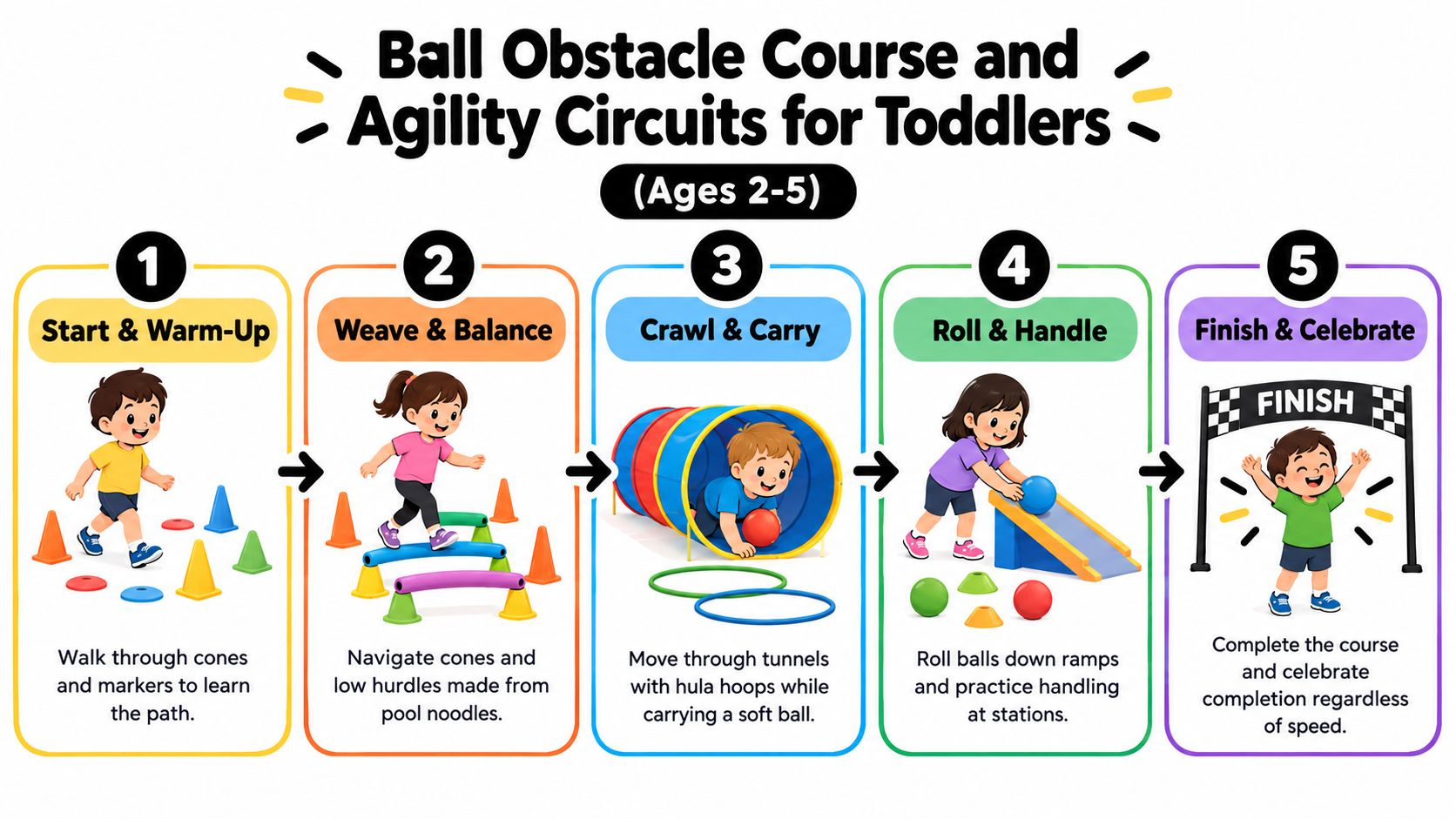
Set up a short path with cones, floor dots, cushions, a tunnel, or taped lines. Ask the child to carry a ball to one station, roll it through a gate, step over a cushion, then place it into a basket. This works in a hallway, living room, gym lane, or indoor sports space.
To picture the flow, this kind of visual can help adults set up the stations in order.
One Ball, Several Jobs
Obstacle courses help toddlers connect balance, planning, and direction. The ball acts as a focus object, which often keeps the child moving through the sequence with less prompting.
A few easy station ideas:
Carry and step: Carry the ball while stepping over two low objects.
Roll and crawl: Roll the ball through a short tunnel, then crawl after it.
Place and jump: Set the ball in a basket, then do a small jump or big step to finish.
If you want more ideas for linking movement stations, agility training for kids can inspire age-appropriate routes and progressions.
This short demo style is useful when you're planning a circuit for mixed ages.
Safety Check and Easy Variation
Keep obstacles low, stable, and easy to see. Toddlers don't need speed here. They need enough room to think with their bodies.
A newer preschool study also supports this general principle. A structured, play-based motor intervention produced greater gains in fundamental movement skills and overall motor competence than usual preschool activities, which reinforces the idea that design matters in ball play, not just access to a ball (play-based preschool motor intervention findings).
For beginners, use just two stations. For confident movers, make one station directional, such as rolling the ball around a cone instead of straight ahead.
7. Kicking and Ball Striking Games
Kicking often feels like the first “real sport” skill to families, but toddlers need time to figure out balance before power. A stationary ball is usually the best teacher.
Place a large soft ball on the ground near a wall target, a line of cones, or a cardboard box goal. Let the child walk up and kick without worrying about form language. In a group, give each child their own ball when possible so they can repeat the movement often.
Building Direction Before Power
A good toddler kick is often small, off-center, and joyful. That's fine. The important part is that the child begins to line up the body, swing one leg, and recover balance after contact.
Try these versions:
Knock the box: Kick the ball to tip over a lightweight cardboard box.
Goal line kick: Kick over a taped line or between two cones.
Follow the roll: Gently roll the ball across the floor and let the child stop it, then kick.
Independent safety guidance for young children warns against small hard balls and notes that high-bounce balls can move too fast for children under five. Softer options, including balloon-based adaptations used in early-childhood activity toolkits, lower impact while still supporting hand-eye coordination and gross motor practice (age-appropriate child safety guidance for ball play).
Choose a ball that slows the game down. Toddlers learn more when they can see, reach, and recover.
Safety Check and Easy Variation
Use plenty of open floor space and keep bystanders out of the kicking lane. Bare feet or grippy shoes can work better than slippery socks on indoor floors.
To simplify, place the ball against a wall so it can't roll away before the kick. To add challenge, let the child try with the other foot or aim between wider and narrower targets.
8. Sensory Ball Play and Exploration Activities
Not every child wants to start with throwing or kicking. Some want to squeeze, pat, mouth, carry, or inspect a ball first. That sensory step isn't extra. For many toddlers, it's the entry point.
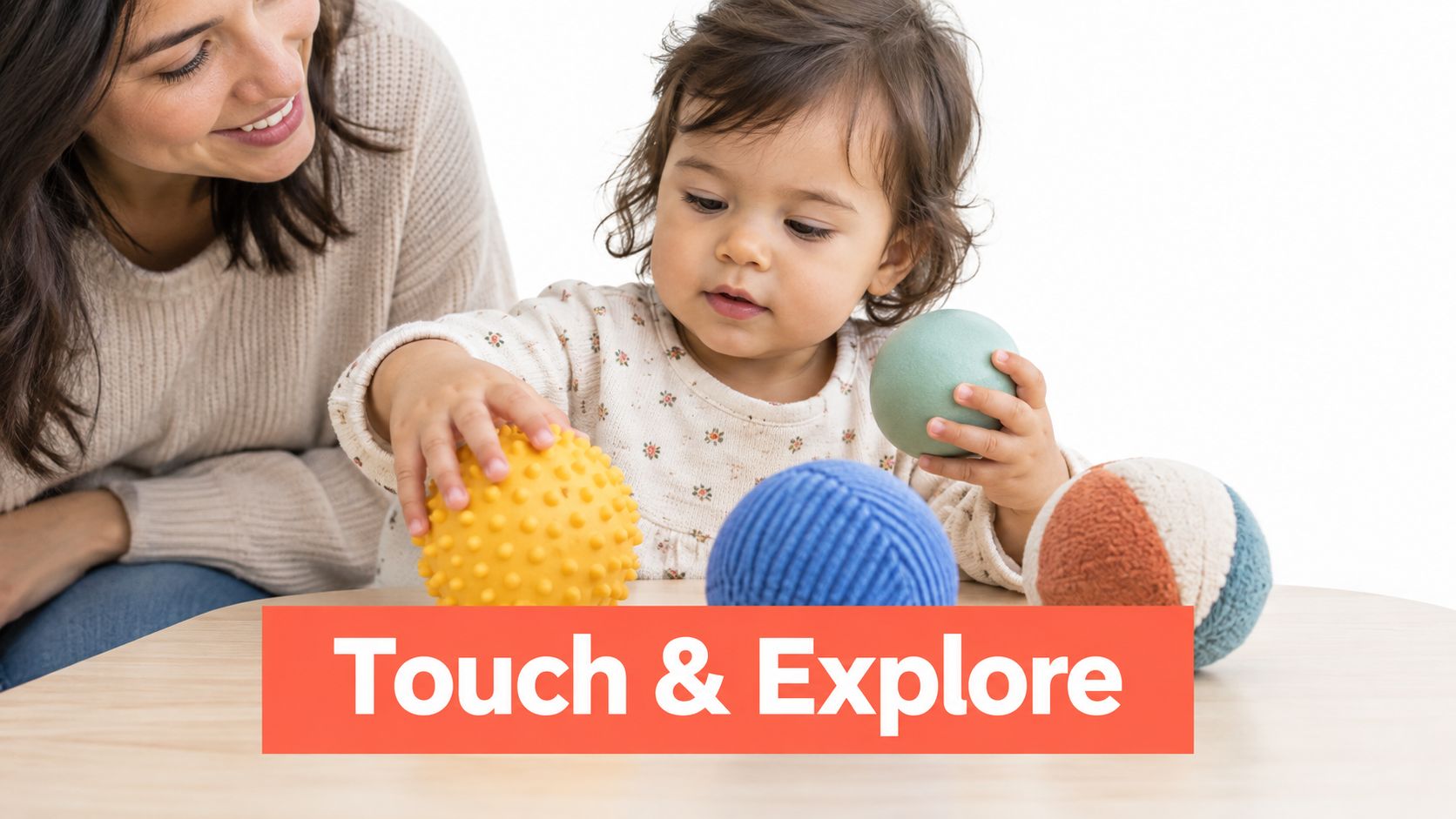
Set out a basket of balls with different textures and sizes, such as smooth foam, soft vinyl, fabric, nubby sensory balls, and a balloon. Place them on a mat or low table and let your toddler choose. In a class, use this as an arrival station for children who need a calmer start.
Let the Child Notice First
Sensory ball play doesn't need many instructions. You can narrate what the child is discovering without turning it into a lesson. “That one is squishy.” “This one rolls faster.” “You found the bumpy one.”
A few simple invitations work well:
Texture match: Put similar textures together and let the child sort by feel.
Squeeze and drop: Squeeze the ball, then drop it into a container.
Hidden ball search: Partly cover a ball with a scarf or cloth and let the child find it.
This kind of open-ended setup also pairs nicely with non-sport gifts and quiet play materials, like a creative gift for ages 3 to 10, for families building a varied play shelf at home.
Safety Check and Easy Variation
Watch closely if your toddler still mouths objects. Choose larger soft balls that can't fit fully into the mouth, and check seams or peeling surfaces before each session.
If your child seems unsure, offer only two or three ball choices at first. If they're eager, add a simple movement invitation after exploration, like rolling the favorite ball to you or carrying it to a bin across the room.
8 Toddler Ball Activities Comparison
Activity | Implementation Complexity 🔄 | Resource Requirements ⚡ | Expected Outcomes ⭐ | Ideal Use Cases 📊 | Key Advantages 💡 |
|---|---|---|---|---|---|
Soft Ball Rolling and Chase Games | Low, minimal setup | Minimal: soft foam/fabric balls, small open area | Gross motor control; hand-eye coordination | Intro toddler classes; 12–24 months | Very safe; easy to scale; high engagement |
BlastBall Introduction Program | Medium, structured rules and flow | Specialized: tees, oversized slow balls, large targets | Confidence; multi-sport exposure | Beginner programs, parties, 18 months–4 years | Immediate scoring success; highly engaging |
Ball Toss and Target Games | Low–Medium, simple stations | Buckets/targets, lightweight balls, clear throw zones | Throwing accuracy; upper-body control | Skill stations, preschool classes, parties | Visual feedback; adjustable difficulty |
Ball Dance and Movement Games | Low–Medium, music coordination | Music player, balls, open space | Rhythm; body awareness; creativity | Warm-ups, creative movement classes, camps | Encourages expression; builds social bonds |
Cooperative Ball Games & Parachute Activities | Medium–High, coordinated group control | Large parachute, multiple soft balls, ample space | Teamwork; turn-taking; spatial awareness | Group cohesion sessions, multi-sport classes | Strong social-emotional benefits; highly engaging |
Ball Obstacle Course & Agility Circuits | High, complex setup & safety management | Obstacles (cones, tunnels, ramps), varied balls, space | Multi-skill development; balance; endurance | Structured classes; skill progression (2–5 yrs) | Measurable progress; adaptable difficulty |
Kicking and Ball Striking Games | Low–Medium, stance & progression coaching | Large soft soccer balls, low targets, open area | Lower-body coordination; directional kicking | Soccer intro; pre-league prep; 18 months–5 years | Prepares for soccer; bilateral development |
Sensory Ball Play & Exploration Activities | Low, requires organization of materials | Wide variety of textured balls, labeled storage | Tactile discrimination; fine motor control | Sensory sessions, inclusive classes, 12 months–5 years | Supports sensory needs; low-pressure exploration |
Turn Ball Play Into a Confident Routine
The easiest way to make ball activities for toddlers work is to choose one activity that fits your child right now, not the child you hope to see next month. A younger toddler or a child who's cautious with movement may do best with sensory exploration or gentle rolling. A child who loves to run might connect faster with chasing, kicking, or a short obstacle route.
Repeat the same activity several times before changing it. Toddlers usually don't get bored because an activity is too familiar. They get more confident because it's familiar. When a game starts going smoothly, change just one part. Use a new target, a different texture, a longer roll, or an extra step in the course.
Keep the equipment soft and appropriately sized. Remove tripping hazards, fragile objects, and hard-edged furniture from the play zone. Stay close enough to supervise every session, especially with children who still mouth toys or who move quickly without much stopping control. It also helps to end while your child is still engaged, not after they're frustrated or overtired.
Parents often ask whether ball play is really doing anything beyond burning energy. In practice, it gives toddlers repeated chances to organize their bodies around an object. They learn to track, reach, stop, turn, shift weight, and use both sides of the body together. That's useful whether your child eventually loves soccer, baseball, basketball, or active play at preschool and home.
For families near Humble, Kingwood, Atascocita, and nearby Houston communities, coached options can make this easier to try. JC Sports Houston offers age-appropriate multi-sport classes, beginner-friendly BlastBall, and a safe indoor environment where young children can explore ball play with guidance. If you're not sure what your toddler is ready for, a free-trial option can be a practical way to see how they respond in a structured but playful setting.
The main goal isn't early performance. It's comfort, repetition, and the feeling that moving with a ball is fun enough to try again tomorrow.
If you want guided ball activities for toddlers in a coached setting, JC Sports Houston offers multi-sport classes, beginner-friendly BlastBall, and an indoor space where young children can practice rolling, throwing, kicking, and movement games at their own level. Families in Humble, Kingwood, Atascocita, and nearby areas can learn more or request a trial visit at JC Sports Houston.
Comments