

Basketball Skills Camp: What It Is and Who It's For

You've found a basketball skills camp that looks promising, but the brochure raises more questions than it answers. Is your child ready? Will the coaches teach real fundamentals or just organize games? And will the new skills still be there once the camp ends?
Those questions matter because camp choice is a developmental decision, not just an age decision. A well-matched program gives children the right amount of challenge, instruction, movement, and encouragement. A poor match can leave a beginner overwhelmed or an experienced player bored. The aim isn't to find the most impressive brochure. It's to find a setting where your child can learn, participate, and keep practicing afterward.
What a Basketball Skills Camp Actually Is
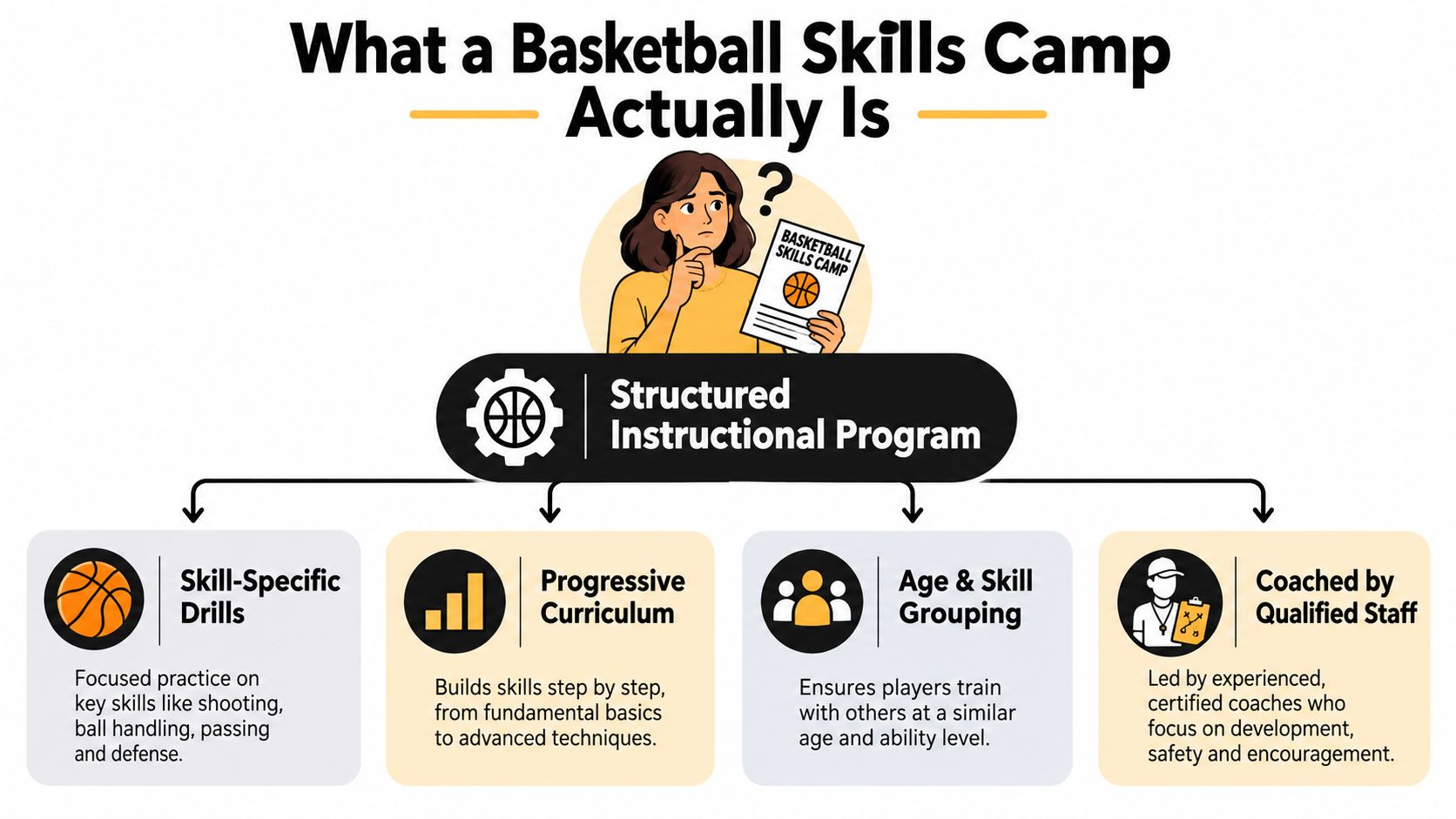
A basketball skills camp is a structured instructional program built around individual development. Coaches teach ball handling, footwork, passing, shooting, finishing, defense, and decision-making through planned drills. Team results, tournament standings, and winning a scrimmage may appear in the schedule, but they aren't the central measure of the program.
Basketball camps have a long history in the United States. The Campbell Basketball School was founded in 1956 by Campbell head coach Fred McCall and Wake Forest coach Horace “Bones” McKinney. Its first session included 125 boys, and the program later expanded to accommodate as many as 2,000 youngsters in one summer, according to the Campbell basketball record book. The camp is also described there as the nation's oldest summer basketball camp in continuous operation.
The age bands are only a starting point
Programs often group children roughly like this:
Ages 5 to 8: Coaches focus on movement, balance, coordination, ball familiarity, and enjoyment. Games may involve rolling, carrying, stopping, changing direction, and learning basic basketball language.
Ages 9 to 12: Instruction usually becomes more technical. Children work on footwork, layups, passing angles, shooting form, defensive stance, and simple choices under pressure.
Ages 13 to 17: Older players may receive position-specific instruction, advanced decision-making work, and conditioning appropriate to their development.
Those ranges aren't rules. A nine-year-old beginner may need the same patient introduction as a younger camper, while an experienced eight-year-old may be ready for more challenging activities.
A skills camp differs from a team camp, travel team, and recreational league. A team camp prepares an existing group to communicate and execute together. A travel team provides continuing competition and roster-based development. A recreational league usually balances instruction with games. A skills camp gives your child concentrated teaching without requiring a season-long team commitment.
Parent perspective: Ask what your child will practice repeatedly, not only which games appear on the schedule.
A Typical Day and Drill Progression
A first day often begins with arrival and check-in around 8:30 a.m., followed by a dynamic warm-up. Coaches might ask children to jog, backpedal, shuffle, stop on command, and mirror a partner. The purpose isn't to tire them out. It prepares their bodies and gives the staff an early look at coordination, confidence, and listening skills.
What the stations look like
A coach may divide the court into stations so children spend less time standing in line:
Ball-handling ladders: Players use right-hand and left-hand dribbles, crossovers, changes of pace, and protective positioning. Beginners may keep their eyes forward for short periods. Advanced players may react to a defender or a coach's signal.
Form shooting: Children begin close to the basket, working on balance, hand placement, elbow alignment, and a controlled follow-through before moving farther away.
Mikan layups: Players alternate finishes near the basket to develop footwork, touch, and comfort using both sides.
One-on-one closeouts: A defender starts away from the ball, closes under control, and works to stop a drive without reaching.
Small-sided games: Three-on-three play gives children a chance to use the morning's skills while reading space, teammates, and defenders.
A useful camp doesn't treat every child identically. Coaches can shorten the passing distance, lower the target, reduce defensive pressure, or allow more time for beginners. More advanced players may face a live defender, a shot-clock-style constraint, or a requirement to make a decision before shooting.
How the week develops
Day one should feel like an introduction. Children learn routines, court boundaries, coach signals, and basic technique. Later sessions can add movement, defenders, changing speeds, and choices. By the final day, a player may be asked to use a crossover to create space, pass after a help defender steps over, or select between a layup and a kick-out pass.
Parents should ask for the planned maximum group size and coach-to-player ratio. Younger beginners generally need closer supervision and more individual feedback than older experienced players. A director who can explain how groups are formed is giving you more useful information than one who only promises “high-level training.”
If a family wants to preserve action photographs from the day, a practical sports photography guide for professionals can help with court positioning, lighting, and timing without distracting from the children's activity.
What the Research Says About Skill Gains
The research supports structured practice, but it doesn't support the idea that a camp guarantees a complete transformation. One 12-week basketball basic-skills intervention involved 40 female children in Turkey, with 90-minute sessions twice weekly. Researchers reported significant pretest-to-posttest gains across all measured gross-motor parameters, with p<0.05, as described in the published intervention paper.
A separate 10-week basketball workshop used ecological-dynamic and problem-based principles. It reported statistically and clinically significant improvements in motor coordination and problem-solving among lower-secondary students whose baseline motor-coordination scores were at or below the 25th percentile, according to the program description and supporting material.
Study Focus | Age Group | Reported Improvement | Notes |
|---|---|---|---|
Basic basketball skills and gross-motor development | Female children | Significant gains across measured gross-motor parameters, p<0.05 | The intervention lasted 12 weeks, with consistent twice-weekly sessions |
Game-like, problem-based basketball practice | Lower-secondary students | Statistically and clinically significant gains in motor coordination and problem-solving | Participants began at or below the 25th percentile in motor coordination |
Off-season basketball training | Teenage basketball players | Significant improvements in dribbling, scoring, passing, and rebounding | The control group declined during the same period, as reported in the academic study |
What parents should take from this
These findings show why repetition, progression, and active decision-making matter. They don't tell you that a child will become a dramatically better game player after a short camp. The studies also differ in participants, duration, exercises, and measurement methods, so parents shouldn't treat them as a direct promise about every camp.
A short program may improve familiarity, confidence, movement quality, or a specific technique. More durable sport performance requires continued practice and opportunities to use the skill against real defenders. The most valuable question isn't only, “What will my child learn this week?” It's, “How will the coaches help my child continue using it afterward?”
Is Your Child Ready for a Basketball Skills Camp
Calendar age gives parents a rough reference, but it doesn't tell you whether a child is ready to spend meaningful time in a group, listen to an unfamiliar coach, or recover from mistakes. Two children of the same age can have very different attention spans, coordination, confidence, and interest.
Public camp guidance commonly places organized basketball camps around age six, while other guidance suggests that many children aren't ready until ages 8 to 10, depending on attention and coordination, as discussed in this parent guide to basketball camps. Treat that range as context, not a deadline.
A practical readiness check
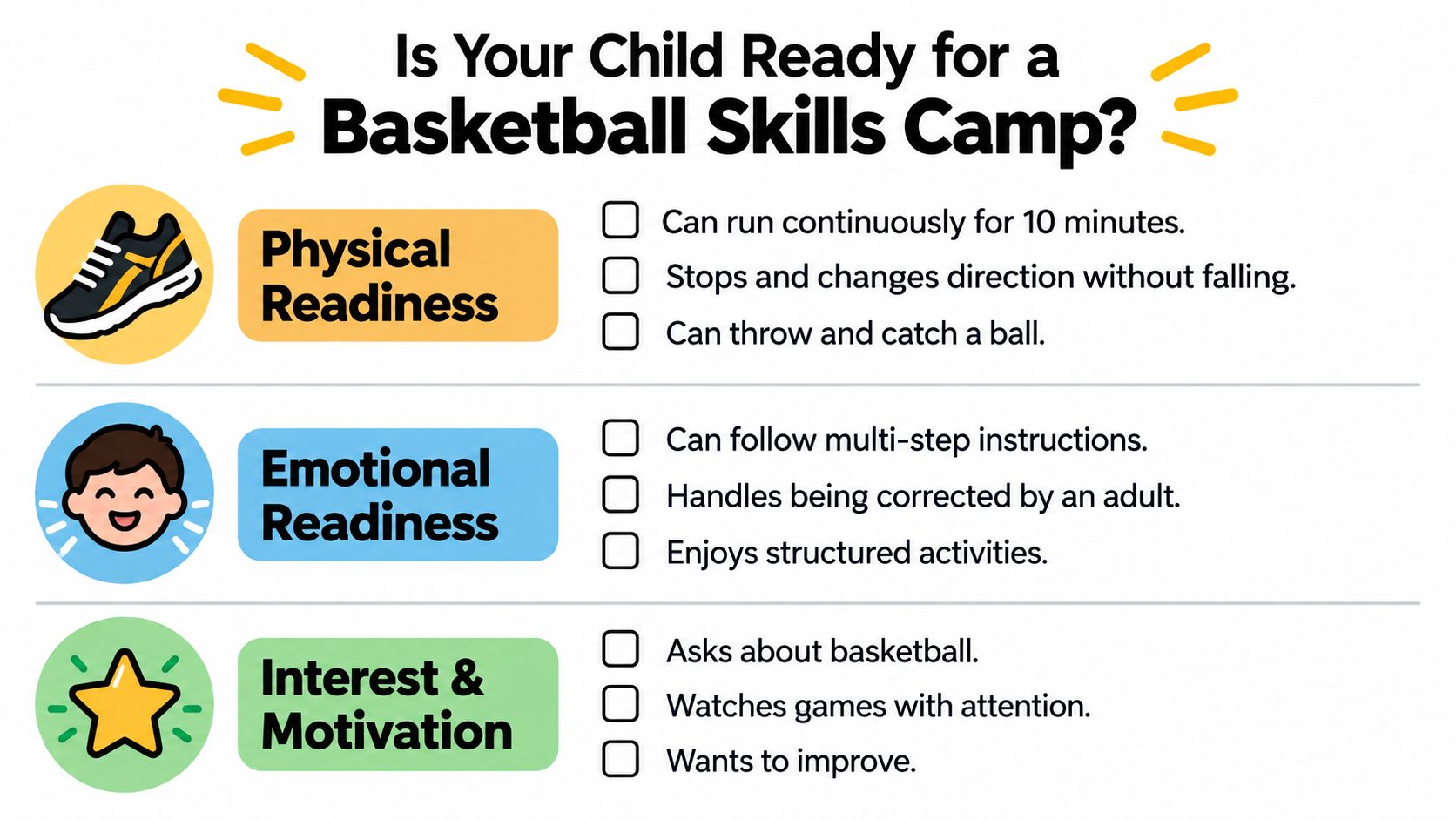
Before enrolling, observe whether your child can:
Handle movement: Run, stop, change direction, throw, and catch without becoming distressed.
Follow coaching: Listen to a two-step instruction from an unfamiliar adult and try it without needing constant one-on-one prompting.
Join a group: Participate around peers without becoming overwhelmed by noise, correction, or shared equipment.
Show personal interest: Ask to play, watch basketball voluntarily, or show curiosity about improving.
The signs matter more than a birthdate. A child may be physically capable but emotionally uncomfortable in a loud gym. Another may lack formal basketball experience but be ready because they enjoy structured group activities and respond well to encouragement.
A recent injury, fear of the environment, or strong parental pressure deserves attention. Don't use camp to force interest that isn't there. A one-day trial or drop-in session can reveal whether the setting fits before you commit to a longer program. For a younger child, parents may also find it useful to review guidance on basketball camps for five-year-olds.
A “not yet” answer isn't failure. It may mean your child needs a shorter session, a quieter introduction, or more informal play first.
Camp Formats Compared for Different Goals
The right format depends on what you want the experience to accomplish. A child seeking a first sports experience needs a different setting from a travel player trying to refine a position.
Format | Typical Length | Best For | Coach-to-Player Ratio | Watch Out For |
|---|---|---|---|---|
Day camp | Often a full school-day schedule over a short camp period | First-time campers, broad skill exposure, and social development | Ask the director for the maximum group size | Long days can overwhelm younger children if breaks and ability groups are unclear |
Specialty skills clinic | A half-day, evening, weekend, or short focused program | Players addressing a known weakness, such as shooting or ball handling | Confirm whether instruction is genuinely small-group | A narrow topic may not transfer unless coaches include game decisions |
Overnight or resident camp | A residential program lasting multiple weeks | Committed players seeking immersion and independence | Ask how groups are supervised on and off court | The intensity and separation from home may be unsuitable for a first-time camper |
Position-specific or elite camp | A selective advanced program | Travel-team athletes seeking specialized development or showcase exposure | Ask whether selection is based on ability, age, or invitation | Beginners may receive little useful instruction in an advanced group |
Match the format to the child
A broad day camp is usually the gentlest entry for a child who wants novelty and a social experience. A specialty clinic makes sense when a player can name a specific challenge, such as struggling to finish with the non-dominant hand. Residential programs require both basketball commitment and comfort away from home.
Selective camps deserve particular caution. “Elite” doesn't automatically mean better instruction for your child. A player who still needs basic footwork may progress more in a supportive fundamentals group than in a fast session designed for advanced athletes.
The simple decision rule is: novelty seeker, day camp; gap-fixer, clinic; serious player, overnight or elite. Adjust that rule for readiness, not just ambition.
How to Choose the Right Camp for Your Child
You can learn a great deal from one phone call. Ask questions that reveal how the camp operates on the court, not questions that invite a polished sales answer.
Start with the people
Ask who leads the sessions, what coaching experience they have, whether staff members receive background checks, and whether the head coach will be present on court. A recognizable name on a website doesn't tell you who will correct your child's footwork.
Next, ask how the camp groups players. Ability-based groups often work better than age-only groups because a beginner needs different instruction from an experienced player of the same age. Ask whether groups can change if a child is misplaced.
Inspect the setting and the safety plan
Look for an indoor court with safe flooring, appropriate equipment, water access, and ventilation. Younger children may benefit from adjustable hoops, while all campers need an environment where staff can see and respond to problems quickly.
Request the written policy for injuries, concussions, heat illness, emergency contacts, and parent communication. Ask who contacts you if your child is hurt, how incidents are documented, and whether qualified medical support is present.
A detailed schedule should show instruction, breaks, games, and pickup procedures. A clear trial, cancellation, or refund policy also signals that the operator expects families to make an informed choice.
Call script: “How many players will be in my child's group, who will coach them directly, and what happens if my child is struggling or gets hurt?”
Watch for red flags:
Unclear staffing: The camp won't publish who is coaching or supervising.
Missing safety details: There's no visible waiver, emergency process, or injury communication plan.
Pressure to pay immediately: Staff discourage questions or demand full payment before explaining policies.
No usable schedule: The program promises fun and improvement without showing what children do.
A video can help you understand how instruction looks in practice.
Families comparing local instruction can also review basketball classes for kids to see how regular classes differ from a short camp experience. Above all, trust what you observe during a trial session over a brochure promise.
Making the Gains Stick After Camp Ends
The most useful camp question is what happens after camp ends. A child may leave excited, but excitement fades if the family has no simple way to practice the movements and decisions introduced during the program.
Use a short two-week plan rather than trying to recreate an entire camp. Keep sessions focused, stop before frustration takes over, and record what happened in a simple notebook or fridge log.
Week one builds clean habits
Schedule three short practices with a rest day between demanding sessions when possible:
Ball handling: Work through stationary right-hand and left-hand dribbles, crossovers, and changes of pace. Finish with movement from one point to another.
Shooting form: Start close to the basket. Prioritize balance, a quiet guide hand, and a held follow-through. Count made shots rather than rushing through attempts.
Defensive footwork: Practice stance, slides, controlled closeouts, and stopping without crossing the feet.
A useful session might include 50 made shots or 100 controlled repetitions, but the target should fit the child's age and attention. The number only matters if the movement remains deliberate.
Week two adds decisions
Replace some isolated repetitions with simple game situations. Play small-sided three-on-three when possible, or use one-on-one drives and closeouts in a driveway or gym. Add free-throw pressure by setting a calm routine, recording makes, and asking the child to reset after a miss.
At the end of the second week, use a modest skill check. Record a dribble course time, note how the child changes hands under control, and count made free throws out of 10. Don't turn the result into a judgment. Use it to decide what to practice next.
Common regression traps include stopping as soon as camp energy disappears, skipping footwork because shooting feels more exciting, and replacing active play with screen time. A visible log helps parents support consistency without hovering over every repetition.
For additional ideas that work in limited space, families can use this guide to basketball workouts at home. The best after-camp plan is the one your child can repeat.
Parent FAQs on Basketball Skills Camps
What does my child actually need to bring?
Start with athletic shoes that fit securely, comfortable socks, clothing that allows movement, and a labeled water bottle. Pack any medication or medical information the camp requires. For home practice, a properly fitted basketball is more useful than expensive signature sneakers because it lets the child handle and shoot with appropriate control.
How should I evaluate safety?
Ask whether the camp has a written concussion process, heat-illness policy, emergency contact procedure, and clear rules for reporting injuries. Find out who contacts parents, whether staff receive first-aid training, and whether qualified athletic trainers or other medical personnel are present. If the director gives vague answers, keep asking until you understand exactly what happens.
Is camp worth the screen-time trade-off?
For many children, a camp week replaces some gaming or passive screen time with movement, coaching, and peer interaction. The value isn't just physical. Children also practice listening, handling correction, sharing space, recovering from mistakes, and communicating during games. Balance still matters, but active participation can offer a meaningful alternative to a week spent mostly indoors and alone.
What should I do if I have a concern?
Start with the camp's designated coach or director. Send a calm message with your child's name, the day and activity involved, what you observed, and what response you're requesting. Ask for a conversation rather than assuming intent.
Escalate when staff dismiss a safety issue, fail to communicate about an injury, or repeatedly ignore a clearly stated concern. Keep the tone factual and collaborative. A responsible director should want specific information because it helps the staff support your child more effectively.
JC Sports Houston offers basketball training, leagues, camps, and clinics with age-appropriate fundamentals and small-sided play for children in the Houston area. If you're looking for a developmental setting that can help your child prepare for camp or continue practicing afterward, visit JC Sports Houston to explore current programs and request a free trial.
Comments