

Baseball Fielding Drills: Youth Practice Plans for 2026

A young player watches a ground ball roll toward them, takes a hesitant step, and then reaches with the glove after the ball has already passed the best fielding position. On the next play, a fly ball goes up, but nobody calls for it. The player wants to make the play, yet isn't sure where to move, how to set the glove, or what to do after the catch.
Effective baseball fielding drills solve those problems in order. Players first learn body position and clean reception, then add movement, throwing transitions, communication, and game decisions. The best practice plan isn't the one with the most complicated exercises. It's the one that gives young players manageable repetitions and a clear next step.
The eight drills below work for short home sessions, team practices, and local youth programs. You can use softer balls and shorter distances for beginners, then add speed, angles, pressure, and decision-making as players gain confidence. The aim is confident, well-rounded defenders, not early specialization. Families can also explore enterprise baseball swag programs when they want team identity to support a broader youth-sports experience.
1. Ground Ball Fielding Progression
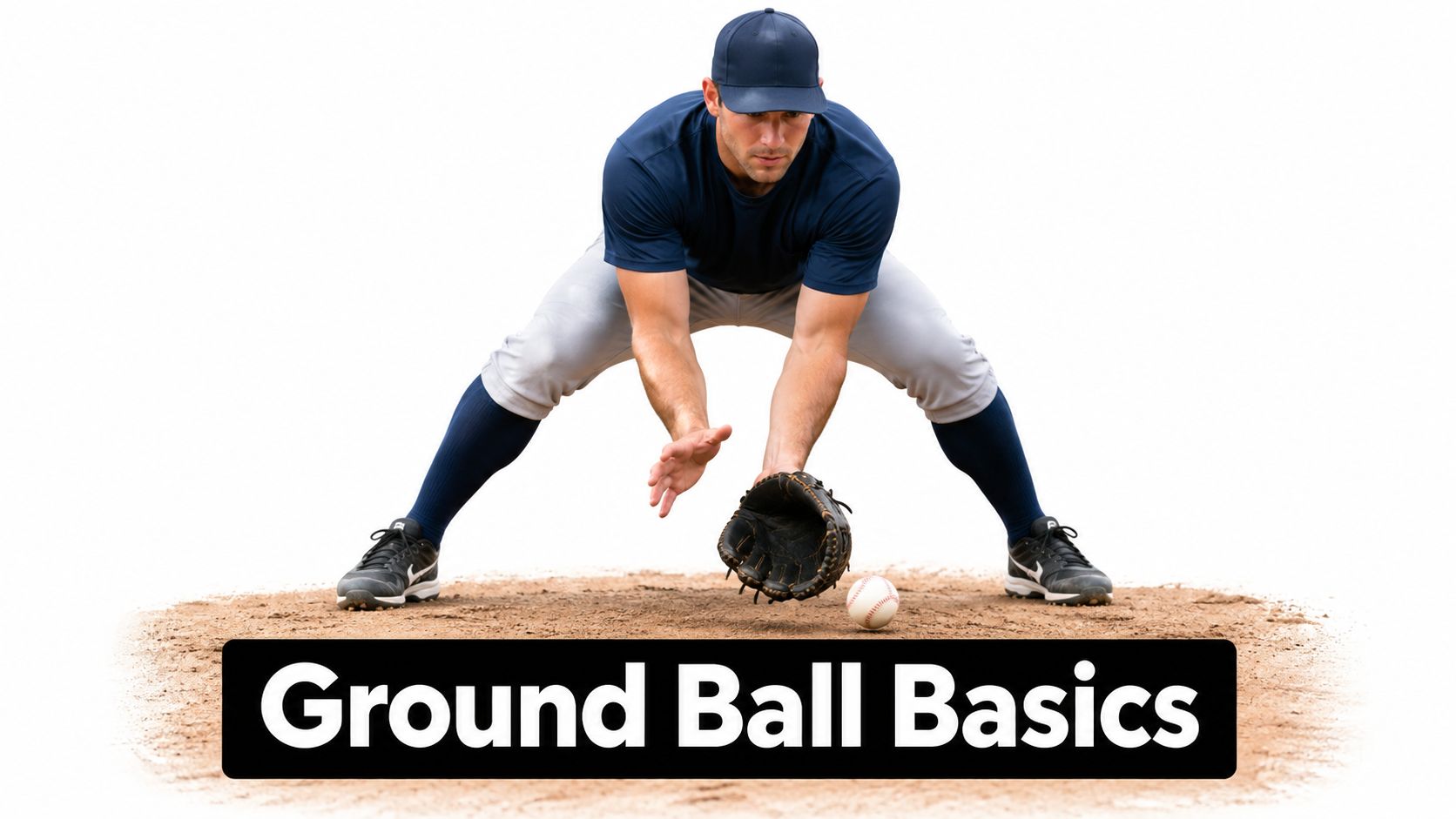
A young fielder often tries to catch a ground ball with the glove alone. Teach the whole body to work together instead. From a balanced ready position, the player bends the knees, keeps the chest over the ball, and lowers the glove in front. Roll the ball slowly from a short distance. The player moves the feet first, receives the ball softly, brings it toward the throwing side, and sets up the throw.
For beginners, use a softer training ball or tennis ball, plus two cones to mark the starting point and target area. The gentler ball gives children time to learn the movement without bracing for a hard impact. Once they handle stationary rolls comfortably, send balls slightly to the forehand and backhand sides. Add slow rollers only after the player can approach under control.
A youth instruction progression described by Major League Baseball fielding drill guidance uses compact cone layouts, repeated rolls, and short approach distances. The resource also describes outfield work with balls set at 15 feet, then 10 feet, and closer spacing, along with practice blocks for ready-position work, coach-rolled ground balls, and pop-up catching. Short spaces let families create many repetitions without needing a full field.
Coaching cues and progression
Give one cue at a time:
“Glove early”: Place the glove down before the ball reaches the player.
“Chest over it”: Keep the body behind the ball when possible, like a shield that blocks a ground ball.
“Soft hands”: Relax the glove hand and receive the ball instead of stabbing at it.
“Exchange quickly”: Move the ball to the throwing hand only after securing it.
Watch for a tall stance, reaching across the body, looking at the glove instead of the ball, or rushing the throw. Rotate players through infield spots so they learn to adjust their feet and body angle rather than repeat one fixed position.
For a short home practice, roll several balls, then finish with a field-and-throw to a nearby target. Change the roll direction after a few clean repetitions. Parents can review baseball training for kids for more structured practice ideas.
2. Fly Ball Tracking and Positioning
A young outfielder often freezes when a ball rises overhead, then runs directly toward the spot where it appears to be falling. This drill teaches a better sequence: read the flight, turn efficiently, choose an angle, and arrive under control before making the catch.
Begin with the player in a balanced ready position, knees soft and eyes on the coach. Use gentle tosses that land slightly to one side. The player turns, runs to the ball, then shortens the final steps to get underneath it. Two hands are appropriate for many early catches because they give the player a wider target and a second point of control.
Give one movement problem at a time. Ask, “Where is the ball taking you?” before adding speed. A younger player can first track a ball over a short run, then handle a higher pop-up, a ball moving across the body, and finally a deeper drive. Baseball fielding drill guidance from a youth training resource also describes compact outfield progressions that let players repeat the turn, route, and controlled arrival without needing a full-size field.
With two or more players, establish simple communication. The fielder with the clearest route calls, “I got it,” while a teammate yields with “take it.” The call should come early, before both players reach the same space. Once the catch is reliable, add a throw to a cutoff target. This connects the catch to the next defensive choice.
What to watch
First step: Turn and move decisively. Several hesitant steps usually create a poor route.
Eyes: Keep the head steady and track the ball rather than staring at the glove.
Body position: Slow down under the ball instead of reaching while sprinting.
Communication: Use a clear call and know where the next throw belongs.
The common mistake is making every repetition a full-speed chase. Use controlled tosses first, then introduce soft pop-ups, line drives, and deeper balls as the player improves at judging flight. For a short practice, give each player several routes, add a call on every catch, and finish with a throw toward the cutoff target. Families can adapt this outfield work in an indoor setting by reviewing indoor baseball training, especially when the goal is to practice routes, communication, and catching without a full field.
3. Double Play Fundamentals
A double play depends on more than a quick throw. The middle infielders must know who covers the base, where the feed should arrive, how to receive it, and how to avoid the runner. Teach the movement without pressure first. One player rolls or flips a ball to the covering infielder, who catches, touches the base, turns away from the imagined runner, and throws toward first.
Begin with footwork only. The player covering second can practice stepping to the base, receiving an imaginary feed, and moving toward the safest throwing lane. Then add a ball. Only after the exchange is comfortable should you introduce a runner or a faster ground ball. Young players need to learn that a clean out is more important than a rushed, unsafe attempt.
Safety comes first: Teach players to protect their landing space, keep their eyes on the ball, and avoid placing themselves directly in the path of a sliding runner.
Vary the feed. A short underhand toss requires a different body adjustment from a firm throw received near the chest or a ball that pulls the fielder away from the bag. Rotate players through shortstop, second base, and the receiving role so they understand what their teammate needs.
A simple progression
No-ball footwork: Practice the approach, base touch, turn, and throwing direction.
Controlled feeds: Add short tosses from predictable angles.
Ground balls: Let the fielder make the decision after reading the ball.
Live pressure: Add a runner only when the movement is safe and repeatable.
For younger players, simplify the drill to a force play. The fielder fields the ball, steps on the base, and makes a controlled throw to a target. Older or more experienced players can work on timing, communication, and different feed angles. Stop the action when a player becomes unsafe or loses awareness. Correct the movement, then repeat it at a slower pace.
4. Relay and Cutoff Throwing
A relay drill teaches the defense to turn one throw into a coordinated play. The outfielder fields the ball and throws toward an infielder positioned between the outfield and the base. The cutoff player squares the shoulders, gives a visible target, catches the ball, and quickly sends it to the correct base or holds it when the runner can't advance.
Start with cones marking the outfielder, relay player, and target base. Before the first throw, explain the situation in plain language. The coach might say that a runner is trying to advance, then identify the base that matters. Players should know where the ball is going before it arrives.
Use clear communication. The relay player can call for the ball, while another fielder gives the destination. If the throw is too far off line, the relay player should move to the ball rather than wait in a fixed spot. If the play has changed, the player should communicate the new decision loudly.
A useful indoor variation can be built around indoor baseball near me training options, especially when weather or field access makes full-distance work difficult. The same communication habits apply in a gym, turf area, or small practice space.
Build the decision, not just the throw
Stationary start: Players learn where to stand and how to show a target.
Moving catch: The outfielder approaches a rolled or thrown ball before making the relay throw.
Base scenario: The coach names the runner location and target base.
Decision finish: The relay player chooses whether to throw through or hold the ball.
For players still learning the game, use one runner and one target. Older players can handle different runner locations, but don't add several decisions at once. A successful relay requires a good throw, a useful position, a loud call, and awareness of the next play. Praise the communication and decision even when the throw isn't perfect.
5. One-Hop Fielding and Exchange Drill
One-hop balls are difficult because the fielder must judge the bounce while preparing for a quick exchange. The answer isn't to make every throw hard. Start with a controlled roll that bounces once before reaching the glove. The player watches the ball all the way in, lowers the glove to the expected hop, secures it, and moves the ball toward the throwing hand.
Use softer balls when introducing the drill. Stand close enough to create a predictable bounce, then change the angle slightly. The player should learn to adjust the feet rather than reach with a rigid glove. If the ball bounces too high or too far away, reset the drill and make the next repetition easier.
Receiving before releasing
Ask the player to pause briefly after the catch. That small pause confirms that the ball is secure and prevents a hurried exchange from becoming an error. Once the reception is reliable, remove the pause and add a target throw.
“Move your feet to the hop, then let the glove receive the ball.”
Common mistakes include guessing the bounce, catching with the glove too high, turning the head away, and starting the throwing motion before the ball is under control. Use different angles only after the player can handle a straight-on one-hop ball.
For an individual home practice, a parent can roll from several short positions while the player works toward a cone target. For a team station, one player rolls, one fields, and one receives the throw. Rotate often so players stay active. The drill becomes more challenging when the coach changes the release point, not merely by throwing harder.
A game application might start with a slow ground ball that produces an awkward hop. The player fields it, makes a clean exchange, and throws to the base that the coach names. That final decision keeps the exercise connected to real defense.
6. Crow Hop and Throwing Mechanics
The crow hop links a moving fielding play to a balanced throw. It helps the player gather momentum without losing direction. Begin without a ball. Have the player take a small approach step, replace the feet under the body, point the front shoulder toward the target, and finish with a controlled throwing motion.
Don't teach the entire movement at full speed immediately. First, use dry repetitions. Then add a stationary throw. After that, roll a ball to the player, ask for a clean pickup, and let the player use the footwork before throwing. The throwing arm shouldn't outrun the lower body.
The drill works for outfielders making a long throw and for infielders moving through a play. Keep the target close at first. Accuracy and balance matter more than distance. A player who throws far while falling away from the target is practicing a habit that's difficult to fix later.
Three checkpoints
Gather: The feet come together under control instead of crossing wildly.
Align: The front shoulder and hips move toward the target.
Finish: The player follows through and stays balanced after release.
A younger player can use a simplified replacement step and a short throw. An experienced player can field balls from different angles and transition at game pace. Keep throwing distances safe, provide enough space between players, and stop the drill if fatigue changes the mechanics.
For a parent-led session, place a target on a fence or use a partner several steps away. Have the player complete dry footwork, then field and throw. One clear cue, such as “gather to target,” is easier for a young player to apply than a long explanation about every part of the arm action.
7. Backhand and Glove-Side Fielding
Backhand plays extend a fielder's range, but they should begin with footwork rather than dramatic glove stretches. Start the player in a ready position and roll the ball slowly to the glove side. The player moves laterally, lowers the body, presents the glove in front, and keeps the throwing hand ready to secure the ball.
The first objective is a controlled stop. Don't ask a beginner to make a long dive or throw immediately. Once the player can move to the ball and keep it in front, add a quick exchange and a short throw. The coach can vary the roll slightly so the player learns to adjust rather than predict the exact path.
A useful cue is “move first, reach second.” Players often reach with the glove while their feet remain planted. That creates a difficult body position and makes the ball appear farther away than it is. Encourage short lateral steps, a low center of gravity, and a head that stays close to the line of the ball.
Make range work age-appropriate
For younger players, use a soft ball and a shorter roll. Celebrate a controlled stop even when the player doesn't make a perfect throw. For more experienced players, change the starting position, add a slow roller, or ask the player to choose between securing the ball and making a quicker play.
Use cones to create a manageable movement lane. Roll one ball to the forehand side, then one to the backhand side, and return to the ready position after each attempt. This reset teaches the player to prepare for the next ball instead of admiring the previous play.
Video can help a player see whether the first step is moving toward the ball or away from it. Keep the review simple. Show one successful repetition and one opportunity to improve, then return to the drill. The aim is better movement and confidence, not a performance test.
8. Soft Hands and Reception Drill
A first baseman often receives throws that arrive high, low, wide, or slightly behind the ideal target. This drill teaches the player to present the glove, adjust the feet, and receive the ball without fighting it. The same skill helps every position because fielders regularly catch throws that aren't perfectly located.
Set up a cone to show the receiving position beside the base. Begin with slow, accurate throws to the chest. The player watches the ball into the glove, keeps the throwing hand nearby, and maintains balance. Then send throws to either side, first low and then higher, so the player learns to move the glove and body together.
Relaxed grip pressure matters. A stiff glove can cause the ball to rebound, while a soft receiving motion helps absorb the throw. The player shouldn't lunge before knowing where the ball is going. Have the feet adjust first, then extend the glove toward the catch point.
Add the difficult throws gradually
Chest-high throws: Build confidence in the basic receiving position.
Low throws: Teach the player to lower the body and keep the glove under the ball.
Wide throws: Encourage a controlled stretch while maintaining contact with the base.
High throws: Help the player track the ball and prepare for a safe catch.
Short hops: Add a quick reaction only after the basic receive is reliable.
For younger players, use a softer ball and shorter throws. A partner can intentionally vary the target without throwing hard, allowing the receiver to learn adjustment. For older players, add a ground ball to another fielder before the first baseman receives the throw. That connects fielding, exchange, and reception in one sequence.
The common mistake is treating every ball as a glove-only challenge. Good receiving starts with body position, footwork, eyes, and communication. The player should tell the thrower where the target is and reset after each repetition.
8-Drill Baseball Fielding Comparison
Drill | 🔄 Implementation Complexity | ⚡ Resource Requirements | 📊 Expected Outcomes ⭐ | 💡 Ideal Use Cases | ⭐ Key Advantages |
|---|---|---|---|---|---|
Ground Ball Fielding Progression (Infield Focus) | Low → Moderate: progressive steps, easily scalable | ⚡ Low: balls, gloves, small space | 📊 Builds reliable mechanics; reduces fielding errors | 💡 Youth fundamentals, warm-ups, large-group drills | ⭐ Fundamental skill-building; highly adaptable |
Fly Ball Tracking and Positioning (Outfield Focus) | Moderate: timing and movement skills required | ⚡ Moderate–High: open field, hitter/coach, weather-dependent | 📊 Improves reads and catches; lowers miscommunications | 💡 Outfield sessions, camps, game-scenario practice | ⭐ Enhances tracking, angles, and communication |
Double Play Fundamentals (Turn Two Drill) | High: precise timing and multi-player coordination | ⚡ Moderate: several players, live feeds, coach supervision | 📊 Faster, cleaner double plays; stronger middle-infield chemistry | 💡 Intermediate/advanced infield work, pre-season reps | ⭐ Improves feeds, pivots, and pressure handling |
Relay and Cutoff Throwing (Communication Drill) | Moderate: choreography and situational decision-making | ⚡ Moderate: multiple players, cones, full field space | 📊 Reduces extra-base advancements; better relay accuracy | 💡 Team defensive practice, outfield–infield coordination | ⭐ Builds team cohesion and strategic positioning |
One-Hop Fielding and Exchange Drill | High: fast exchanges and technical receiving | ⚡ Moderate: partners, quality balls, experienced coach | 📊 Greater control on one-hop plays; faster releases | 💡 Advanced infield sessions, specialty academy work | ⭐ Develops elite soft hands and exchange speed |
Crow Hop and Throwing Mechanics (Transition Drill) | Moderate: technical footwork and timing to master | ⚡ Low–Moderate: open area, throwing partners, video optional | 📊 Increased throw distance and accuracy; better arm health | 💡 Long-throw development, outfield relays, arm programs | ⭐ Boosts velocity and protects shoulder mechanics |
Backhand and Glove-Side Fielding (Range Extension Drill) | High: lateral agility and precise footwork required | ⚡ Moderate: cones, space, coach-led repetitions | 📊 Expands defensive range; closes gaps on glove-side plays | 💡 Shortstop/2B advanced training, range-extension clinics | ⭐ Dramatically improves range and position versatility |
Soft Hands and Reception Drill (First Base Focus) | Low → Moderate: repetition-focused, easy progression | ⚡ Low: throwing partners, balls, base | 📊 Fewer errors on throws; improved scooping and reception | 💡 First-base skill work, youth fundamentals, warm-ups | ⭐ Increases receiving consistency and team confidence |
Turn Eight Drills Into a Smarter Practice
Parents and youth-program leaders don't need to teach all eight drills in one practice. Pick a small group that supports one defensive theme. A beginner session might combine soft hands, simple ground balls, and basic crow-hop footwork. An intermediate session can add backhands, one-hop exchanges, and fly-ball tracking. A team session can finish with relays and simplified double-play communication.
A short practice works best when every player knows the next action. Set the equipment out first, mark safe throwing lanes with cones, and keep the coaching language consistent. Players learn faster when they hear the same cue during a home session and a team practice.
The training baseball market was valued at USD 2.64 billion in 2025 and is projected to reach USD 3.64 billion by 2032, according to training baseball market projections. That market context reflects growing interest in equipment that supports reaction, agility, and repeated defensive work. For a youth coach, the practical lesson is simple: choose equipment because it improves safe, useful repetitions, not because it looks advanced.
Beginner 20-minute session
Use a soft ball, a glove, cones, and a nearby throwing target.
Soft hands: Begin with controlled chest-level receives and low throws.
Ground balls: Roll from a short distance and emphasize glove position and body alignment.
Crow-hop footwork: Practice the step pattern without a ball, then add short throws.
Finish: Let the player choose the drill they enjoyed most and repeat it with one coaching cue.
A youth fielding resource describes 20-minute blocks that include ready-position work, coach-rolled ground balls, and pop-up catching, which supports using a compact fielding session rather than treating defense as an occasional add-on. Keep the pace active, but stop before tired mechanics replace good mechanics.
Intermediate 30-minute session
Start with ground balls and a short throwing warm-up. Then move to backhand plays, one-hop exchanges, and fly-ball tracking. Give the player a decision after each reception, such as naming the target base or throwing to a cutoff cone.
Use one progression at a time. For example, backhands can begin with slow rolls, move to lateral rolls, and finish with a short throw. One-hop work can begin with predictable bounces and then use different angles. Fly balls can progress from short tosses to balls that require a turn and a controlled run.
Team communication session
Divide the group into small stations. One station can work relays with cones marking the outfielder, cutoff player, and target. Another can practice the force-play portion of a double play without a runner. A third can handle ground balls while players call the intended play before the coach rolls the ball.
Indoor facilities are useful when teams need compact, repeatable practice areas. The indoor baseball training facility market reached USD 4.12 billion in 2024 and is projected to grow to USD 7.65 billion by 2033, according to indoor baseball training facility market projections. The same source describes settings that use artificial turf, agility ladders, and rebound walls to simulate defensive actions. Those spaces can help programs maintain movement and repetition when outdoor conditions aren't reliable.
Safety should shape every plan. Baseball injury-prevention guidance highlights broader safety practices, including teaching players to recognize obstruction risks, as explained by baseball injury-prevention guidance from OrthoInfo. Coaches should provide safe throwing distances, avoid crowded lanes, use age-appropriate equipment, and reduce intensity when players lose balance or concentration.
Praise the decision, not only the successful play. Tell a player, “You moved behind the ball,” “You called early,” or “You chose the safe throw.” Those comments show young defenders what to repeat. When families in Humble, Kingwood, Atascocita, and surrounding Houston communities want structured support, JC Sports Houston offers age-appropriate youth programming in a safe indoor environment and allows new families to request a free trial.
JC Sports Houston offers youth baseball training with fielding instruction for ground balls, fly balls, outfield play, and two-hand receiving. Visit JC Sports Houston to explore age-appropriate programs, indoor training options, and a free trial for your player.
Comments