

Coerver Soccer Summer Camp Guide for Houston Families

You're staring at summer schedules, comparing camp flyers, and trying to decide whether a recognizable soccer name means better development or just a higher price. For a Humble, Kingwood, or Atascocita family, the practical question is straightforward: will a Coerver soccer summer camp give your child something they won't get from regular team training or a general recreational camp?
Coerver is built around ball mastery, individual creativity, and 1v1 play, not just free-play scrimmages. That makes it a strong option for some players and a poor fit for others. Your decision should come down to your child's age, current motivation, tolerance for repetition, summer schedule, and what you expect one concentrated week to accomplish.
Why Houston Parents Are Looking at Coerver This Summer
Houston parents usually reach this decision after noticing a specific gap. Their child enjoys soccer but loses the ball under pressure, avoids taking on defenders, or needs more confidence with the first touch. A general camp may keep the player active, but it might not spend enough time isolating the technical problem.
A Coerver camp takes a narrower route. The organization describes its method as focused on individual skills, ball mastery, and 1v1 play, a direction that began with a coaching philosophy different from many programs available when the organization was founded in 1984. Coerver's history and methodology explain why the name is associated with technical development rather than a broad summer activity program.
Start with the player, not the flyer
Before you register, answer three questions:
What does your child need most? More touches, more confidence, better finishing, or an enjoyable soccer environment?
How does your child respond to repetition? Some players love repeating a move until it feels natural. Others need more variety and free play.
What happens after camp? A technical week has more value when your child can keep practicing the skills through local training, backyard work, or team sessions.
Houston conditions matter, too. A convenient location, clear pickup procedures, shade, water breaks, and an indoor backup plan can matter as much as the curriculum. A technically strong camp that creates a difficult daily commute may become a poor family decision by the middle of the week.
Coerver has operated as part of a broader international youth-soccer system for decades. Its reported 2021 return of summer camps included 292 camps, 13,964 campers, and activity across 18 European countries, according to the organization's summer-camp update. That scale supports the idea that this is an established training model, but it doesn't prove that every child will make a dramatic leap after one week.
Parent rule: Choose a technical camp because its daily work matches your child's needs, not because the logo looks familiar.
The Coerver Method and What Makes It Different
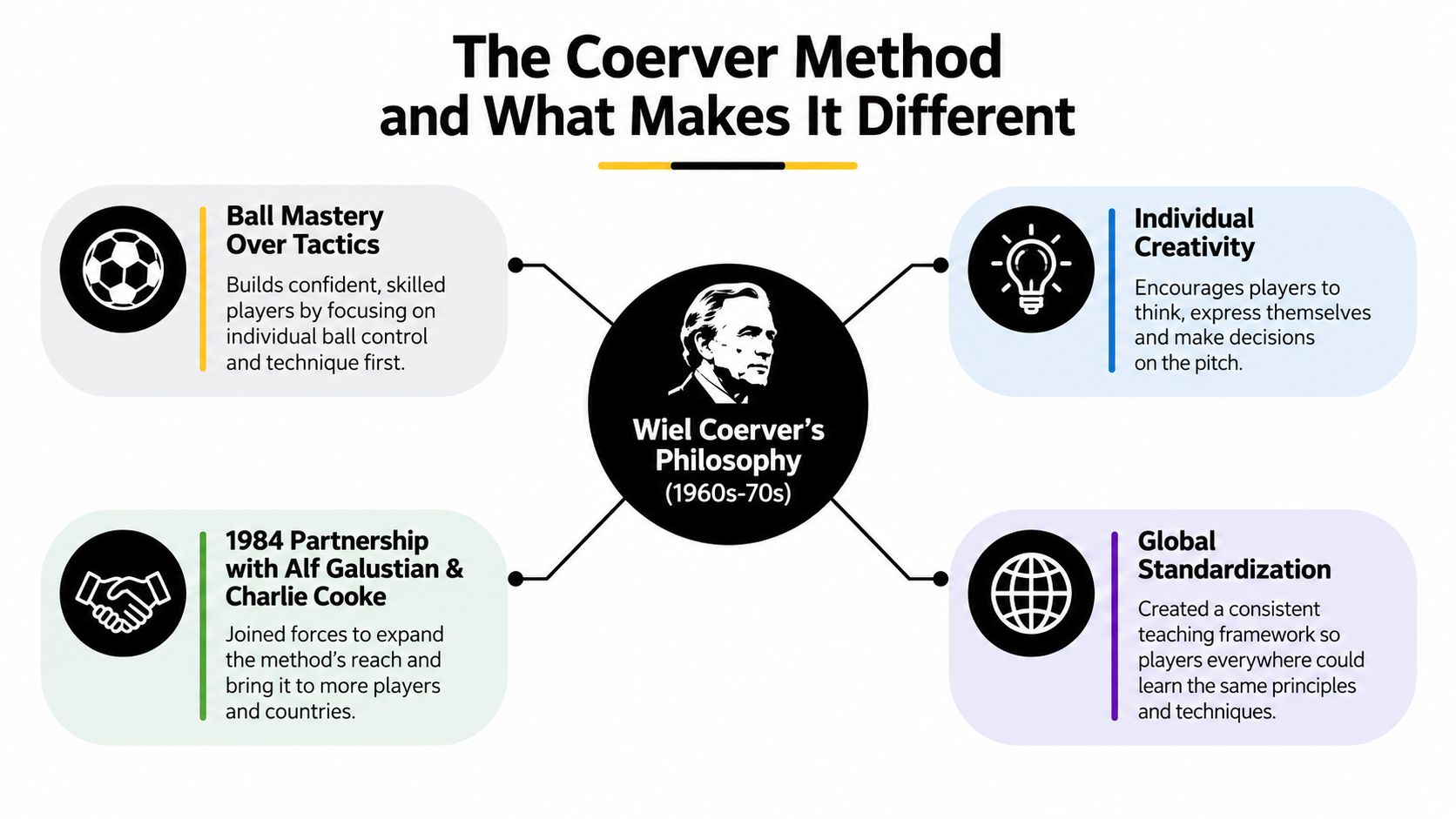
If your child spends a week repeating technical actions, will that solve a real need or just add another summer activity? That is the Houston parent's decision. Coerver training puts individual control and 1v1 play ahead of broad team tactics, so its value depends on whether your player needs concentrated work with the ball.
The method traces back to Dutch coach Wiel Coerver. The organization was founded in 1984 by Alf Galustian and former Chelsea player Charlie Cooke, with Coerver's ideas as its inspiration. Its public description centers on individual technique and 1v1 ability. That establishes the training focus, not a guarantee of dramatic improvement after one camp.
What players actually practice
Ball mastery comes first. Players use both feet and different surfaces for toe taps, inside-outside touches, drag-backs, and changes of direction. The goal is practical control. A player should keep the ball close while moving, scanning, and preparing for the next action.
Coaches then build 1v1 work in stages. A child may learn the mechanics without pressure, repeat the move in a channel, and finally try to beat a defender in a small-sided game. That progression shows whether the technique works when timing, balance, and an opponent matter.
Finishing connects the skill work to the scoreboard. Players receive, adjust their body position, and finish from changing angles instead of treating shooting as a separate drill.
This structure distinguishes Coerver from a general skills clinic. Public camp materials describe progressive work in ball mastery, receiving and passing, 1v1 attacking, speed of thought, finishing, and group play, with small-sided games transferring technique into decisions under pressure. A Coerver camp curriculum description sets out that sequence.
For a Houston family, the value is the practice design, not the logo. A high-repetition week makes sense when your child enjoys focused work and needs more confident control. It makes less sense if your player needs variety, free play, or a consistent local program that continues after camp.
Review JC Sports Houston's Coerver soccer training overview alongside the camp details, then compare the actual schedule, coaching, and follow-up opportunities before registering.
What a Coerver Camp Day Actually Looks Like
A good camp day should feel organized without becoming mechanical. At drop-off, coaches typically check players in, establish groups, and begin with movement rather than sending everyone straight into a full scrimmage. The warm-up prepares the body and gives coaches an early look at coordination, comfort, and energy levels.
The first major block is usually ball mastery. Expect a focused period built around foot surfaces, toe taps, inside-outside touches, foundations, and changes of direction. The coach demonstrates the action, players repeat it, and the group receives corrections while the ball stays at each player's feet.
Repetition must lead somewhere
The 1v1 station is where the session becomes more demanding. Players learn a move, practice the setup and exit, and then try it against a defender in a controlled channel. Coaches should watch the details: Is the player approaching with control? Is the move performed far enough from the defender? Does the player accelerate after the change of direction?
Small-sided games provide the test. Instead of waiting in a long line for a turn, players should have repeated chances to receive, dribble, pass, defend, and make decisions. The day's move may appear in a 3v3 or 4v4 activity, but coaches shouldn't force it into every play. The goal is to help players recognize when the technique makes sense.
Hydration and shade breaks are part of the training plan, especially in Houston. A sensible schedule alternates concentrated technical work with lower-load activities, water, snacks, and recovery. Parents should ask how coaches handle heat, fatigue, and changes in field conditions before enrollment.
The finishing rotation often closes the technical portion. Players may work on receiving before a shot, turning away from pressure, or finishing after a dribble. The final match gives them one more opportunity to apply the day's ideas.
Here's what pickup should tell you:
A useful recap: Your child can name a move or skill worked on that day.
Visible coaching: Staff can explain what they corrected, not just say that the players had fun.
A realistic ending: Cool-down, equipment collection, and a calm pickup process matter after a demanding session.
Watch this short visual example before you talk with your child about expectations:
Age Groups and Realistic Skill Outcomes
Age grouping changes the work. A younger player needs coordination, confidence, and frequent success. An older player can handle more pressure, more complex combinations, and more demanding decisions. Treating every age as though it needs the same session is a warning sign.
The available Coerver material specifically connects the camp model with players ages 4–14, targeting technical repetition and decision-making in the same session design. That doesn't mean every child in that range should attend the same type of program. A four-year-old and a fourteen-year-old need different coaching language, work-rest patterns, and expectations.
Age Group | Session Focus | Realistic 1-Week Outcome |
|---|---|---|
4–6 | Foot skills, coordination, confidence, and comfort with the ball | More willingness to touch and move the ball, plus better familiarity with basic foot actions |
7–10 | Ball mastery, receiving, passing, introductory 1v1 moves, and small-sided play | More controlled touches, greater comfort trying a move, and improved confidence in simple pressure situations |
11–14 | Advanced combinations, 1v1 decisions, finishing, and technique under pressure | Better technical sharpness, more purposeful attacking choices, and a clearer link between a move and the game situation |
For most players, the 7–10 age band is the clearest Coerver fit. Children in this range can absorb a structured technical sequence while still benefiting from playful competition. The older group can gain a useful reset, especially after an inactive stretch, but the player must be willing to work rather than treat camp as a casual scrimmage.
The youngest players may enjoy the environment, but don't confuse enjoyment with a guaranteed transformation. Public camp material emphasizes repetition, confidence, and “1,000+ touches every day,” as shown on a Coerver Ohio summer-camp page. That language describes the program's emphasis, not independent proof of a measurable one-week outcome.
A camp can create better habits quickly. It can't replace months of patient practice.
For a broader view of how age affects training expectations, see this guide to soccer age groups.
Coerver Camp Versus Ongoing Training Versus Rec Camp
These three options solve different problems. A one-week Coerver camp is a high-repetition technical sprint. Ongoing Coerver training provides progression and spaced practice. A recreational camp prioritizes activity, social connection, and a welcoming introduction to the sport.
The right choice depends on what you want the week to do.
Use the comparison honestly
Option | Best use | Main strength | Main limitation |
|---|---|---|---|
One-week Coerver camp | A focused summer reset or technical push | Concentrated repetition and a clear skill theme | A compressed week doesn't provide the same spacing as ongoing practice |
Ongoing Coerver training | Steady technical development | Coaches can revisit, refine, and progress skills over time | Requires a continuing schedule and family commitment |
General recreational camp | Fun, activity, and social participation | Lower-pressure environment with broader play | Technique may receive less focused attention |
If your child is preparing for tryouts, has lost confidence in 1v1 situations, or needs more time on the ball than team sessions provide, the summer camp makes sense. If your family wants durable improvement, ongoing training is the stronger foundation because players can revisit the same actions after forgetting, adapting, and testing them in games.
A recreational camp is not a lesser choice. It's often right for a child who is still deciding whether soccer belongs in the weekly routine, or for a player who values friends and variety more than repeated technical work. Don't pay for a demanding technical week if your child will resent every drill.
The public information supports the structure and scale of the Coerver approach, but it doesn't provide independent outcome data showing how a single week compares with local small-sided camps or regular weekly training. That gap matters. Ask the director what progress coaches document, what players practice after camp, and how the staff evaluates whether the week achieved its purpose.
What to Pack and How to Prepare Your Player
Houston summer preparation starts with heat management. Pack for sweat, sun, and a long active day, not just for the soccer drills.
Use this checklist:
Cleats: Send familiar footwear. Don't introduce expensive new cleats on the first morning.
Shin guards: Pack the equipment your child already uses comfortably.
Two labeled water bottles: Label both bottles and make sure your child knows where they are.
Light snack: Choose something easy to eat during a short break.
Sunscreen: Apply it before arrival and follow the camp's policy for reapplication.
Extra clothing: A second training shirt, extra socks, and a water-resistant bag help when the first kit is soaked.
Hat: Use it during downtime and pickup rather than during active play if the facility permits it.
Your child also needs a briefing. Explain that the day will include ball work, small games, instruction, breaks, and a final match. That helps younger players understand that a technical camp isn't continuous free play.
Start hydration the day before. The morning bottle can't compensate for a child who arrives tired and behind on fluids. Keep breakfast familiar, confirm the drop-off window, and label the ball if the camp allows players to bring one.
For a more detailed equipment reference, use this soccer camp packing guide. The night before camp should feel boring and organized. That's a win.
Humble, Kingwood, and Atascocita Logistics
The field decision comes after the soccer decision. Families in Humble, Kingwood, and Atascocita should confirm the exact facility, arrival procedure, parking instructions, pickup window, and weather policy before paying a deposit. Don't rely on a neighborhood name alone. A camp advertised for one community may still require a drive that complicates work, siblings, and afternoon traffic.
Ask the site director for the current details in writing:
Registration: When does enrollment open and when does the session close?
Payment: Is a deposit required, and when is the remaining balance due?
Cancellations: What happens if your child withdraws before camp?
Make-ups: Does the program offer a make-up option for weather or absence?
Trial opportunities: Can a new family request a free trial before committing?
Weather: What triggers a delay, cancellation, indoor move, or shortened session?
Heat procedures: How often do players get water and shade breaks, and how does staff respond to signs of heat illness?
Houston weather can change the plan quickly. Afternoon thunderstorms, high humidity, and dangerous heat require coaches to adjust activity, not just push through the schedule. An indoor backup location can protect the training week, but parents should confirm whether the indoor space supports ball work or only general activities.
A local facility that offers an indoor environment can also simplify the family calendar. You may be able to combine the camp with vacation, tournament travel, and recovery days without building the whole summer around one outdoor site. Still, don't stack a demanding camp immediately beside a tournament without considering your child's energy and sleep.
Your final logistics test is simple: can you describe the morning drop-off and afternoon pickup without guessing? If not, call before registering. Clear answers about location, policies, and weather are part of the product.
Is a Coerver Summer Camp the Right Fit for Your Child
My strongest recommendation goes to the 7–10 player who wants more ball mastery and whose parent is prepared to follow the camp with continued practice. That age group often has enough coordination to benefit from the method and enough enthusiasm to repeat skills without turning every session into a negotiation.
The 11–14 player can benefit as a technical tune-up, especially when touches have become rusty during the off-season. But older players need a clear bridge from moves to decisions. If the camp only teaches tricks without asking when and why to use them, the player will collect moves rather than improve as a soccer player.
I'd be more selective with the 4–6 group. A young child who loves the ball and enjoys structured instruction may have a good experience. A casual player who mainly wants friends, movement, and play may receive just as much value from a recreational program with less technical pressure.
One week won't make a player. It can sharpen habits, build confidence, and give a motivated child a useful technical routine. The public material supports the program's longevity, global reach, and structured curriculum, but it doesn't prove a guaranteed improvement from one camp session.
Ask one question before you pay: “What will my child be able to do more consistently by the end of the week, and how will your coaches show me that?” A good answer names observable skills, explains how coaches track them during activities, and gives your family something specific to practice afterward. A vague promise about becoming a better player isn't enough.
JC Sports Houston offers Coerver-based soccer training and indoor summer camp options for boys and girls, with programs serving families in Humble, Kingwood, Atascocita, and nearby communities. Visit JC Sports Houston to review current camp details, ask about a free trial, and decide whether the program fits your child's development plan.
Comments