

Basketball Practice for 5 Year Olds: Fun Skill Games

A five-year-old walks onto the court, grips a full-sized basketball with both hands, and looks up at a hoop that feels impossibly high. After a few missed shots, the child stops moving, watches older players, and decides basketball is “too hard.” That scene usually says more about the equipment and coaching approach than the child's ability.
Basketball practice for 5 year olds works best when it looks like active play with a ball, not a shortened version of an adult practice. At this age, children are developing balance, coordination, body control, and confidence. The right session gives them repeated chances to run, stop, jump, throw, catch, dribble, and celebrate small successes.
Why Most Early Basketball Practices Miss the Mark
The familiar mistake is easy to understand. A parent brings a child to the court, points toward the basket, and starts giving instructions about shooting form, spacing, defense, and passing lanes. The child tries to follow along, but the ball is too large, the rim is too high, and the instructions require more body awareness and attention than the child has developed.
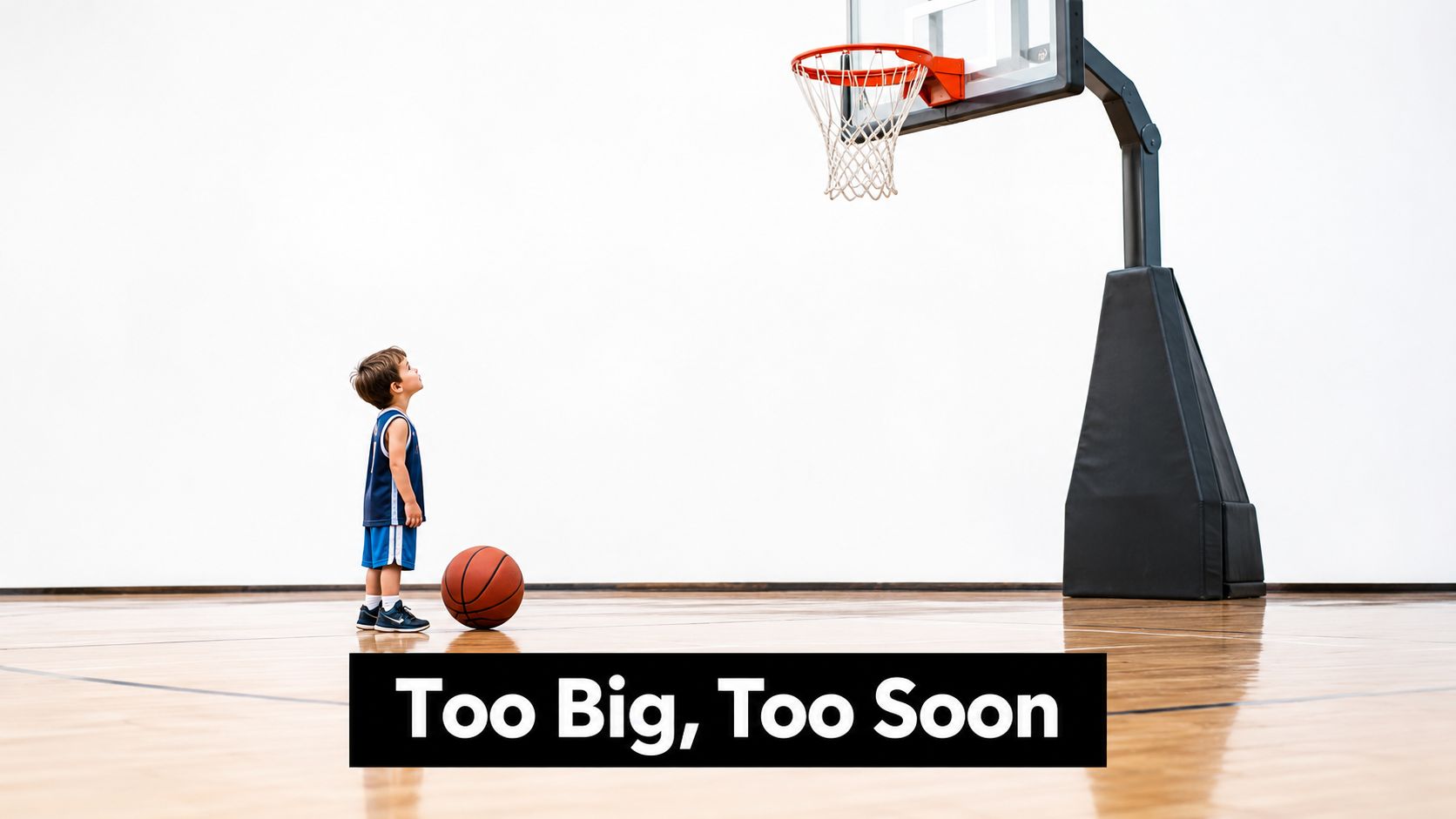
A better approach starts with a developmental reality. Children aged 5 to 7 have largely unrefined sensory-perceptive abilities, so FIBA youth coaching guidance recommends games that develop running, jumping, changing direction, throwing, and catching rather than analytical instruction in formal basketball fundamentals. The guidance also supports adapted equipment, because a smaller ball and lower ring let children experience success without fighting the size of the court. Read the FIBA youth coaching guidance for the developmental reasoning behind this approach.
What the child is actually learning
A five-year-old who runs to a cone, stops under control, turns, and tosses a ball toward a target is learning several skills at once. The child is judging distance, organizing the body, shifting weight, controlling force, and responding to a simple instruction. Those abilities later support dribbling, passing, shooting, and defending.
Formal tactics ask the child to think about several things at once. A playful movement game narrows the task to something the child can understand immediately: “Run to the blue cone,” “freeze when the coach says stop,” or “roll the ball through the gate.” The activity still builds basketball readiness, but it doesn't demand adult-style analysis.
Practical rule: At five, measure progress by better stopping, turning, throwing, catching, and ball control, not by points scored.
Competitive drills can also create poor habits when they arrive too early. A child who spends a long time chasing a basket may throw the ball with both hands, lean backward, or rush every movement. A child who first learns to balance, stop, pivot, and handle the ball in simple games has a stronger platform for later technique.
The aim isn't to create a miniature point guard. It's to help the child leave the gym wanting to move again. Confidence grows when the child gets frequent, achievable challenges and feels that mistakes are part of the game rather than evidence of failure.
How to Structure a 30-Minute Practice Session
A five-year-old's practice should feel like organized play, not a shortened adult workout. The child is building balance, coordination, stopping, turning, and ball control, so the session should change activities before attention and confidence drop. Prepare the next game while the current one is still running. Youth practice guidance recommends keeping each drill under 10 minutes, maintaining movement and transitions, and using 30 minutes as an appropriate practice length for young children. See the youth basketball practice guidance for the session-length recommendation.
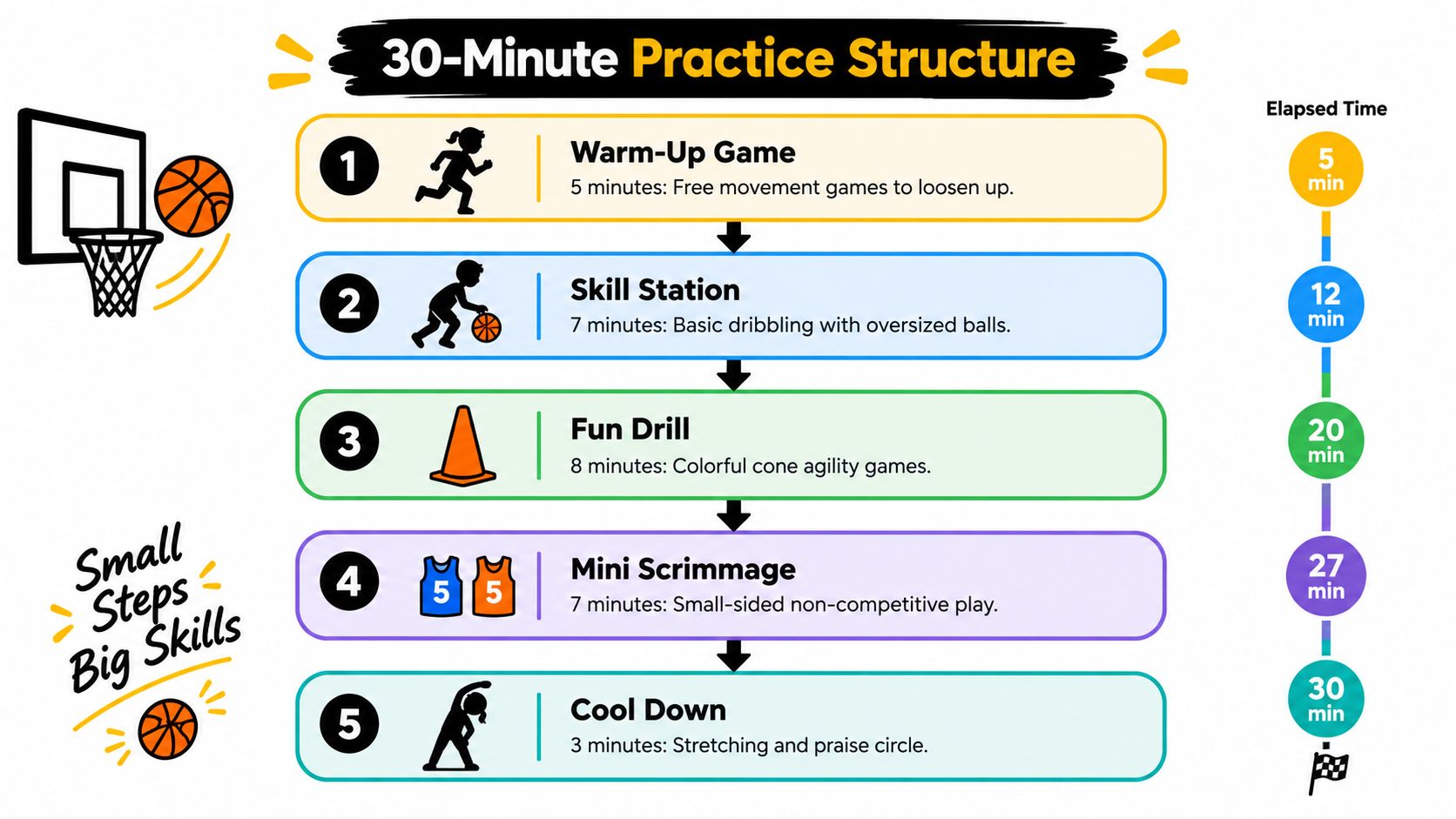
Use this sequence as a flexible guide:
Warm-up game, 5 minutes. Start with movement before technique. Play red light and green light without a ball, animal walks, cone races, or a color-touch game. The goal is to raise energy and help the child listen while moving.
Ball familiarity, 7 minutes. Let the child carry, roll, tap, and gently toss the ball. Try touching it around the waist, moving it from one hand to the other, or bouncing it once and catching it. Keep the hands busy and the demonstration brief.
Movement skill game, 8 minutes. Set out cones or floor markers, then ask the child to run, stop on two feet, turn, and reach a new target. Add the ball only when the movement is comfortable. Rolling it around a cone, collecting it, and throwing toward a nearby target connects motor control with basketball readiness.
Small-sided play, 7 minutes. What can the child do with one adult or a very small group? Give the game one purpose, such as moving the ball between two lines or passing before a shot. Remove complicated rules, and pause only when a correction will help the child continue.
Cool-down and praise, 3 minutes. Slow the pace with easy stretches, breathing, and a short review. Name the action you saw, such as, “You stopped with both feet today.” Specific feedback gives the child a clear success to repeat.
Transitions shape the session as much as the activities. Place cones and balls in advance, use the same short signals, and demonstrate instead of giving a long explanation. If attention fades, change the game. If the child remains engaged, repeat a favorite activity with a new target or direction.
A visual demonstration can help parents see how a short practice flows:
The schedule is a guide, not a test. A successful practice may end with the child asking to play again, even when the final activity is shorter than planned.
Three Foundational Drills for Young Beginners
The first drills should make the child comfortable with movement and the ball. A useful youth development framework for ages 5 through 8 highlights the triple-threat position, jump stops and pivoting, stationary dribbling with both hands, jogging while dribbling with the head up, basic shooting mechanics away from the rim, and bounce or chest passing. Its six-skill framework for young players is helpful, but five-year-olds should experience those skills through short games rather than lectures.
1. Move and freeze
Place a few safe markers on the floor. Ask the child to move toward a marker, then freeze on two feet when you clap. Once stopping becomes familiar, add a turn, a jump, or a change of direction. You can finish by having the child pick up the ball and hold it in a balanced stance.
This drill builds body control before it asks for dribbling. Watch for feet that keep moving after the signal, knees that lock, or a child who turns by crossing the feet awkwardly. Don't correct every detail. Demonstrate a quiet stop, praise the attempt, and let the child try again through the game.
2. Ball explorer
Give the child a smaller ball and create a series of challenges. Roll it around the feet, tap it from hand to hand, bounce it once and catch it, then try a stationary dribble with the preferred hand. Switch hands when the child is ready, but don't insist on equal control immediately.
The goal is familiarity and coordination, not a polished dribble. Young beginners often slap at the ball, look down constantly, or chase it after an uncontrolled bounce. Lower the challenge by allowing a catch between bounces, standing still, or using a gentle roll. Raise it by asking the child to look at a parent's hand signal while continuing to bounce.
3. Pass through the gate
Make a small gate with two cones, shoes, or soft objects. Sit or kneel a short distance away and roll or bounce the ball through the opening. Take turns, celebrate accurate passes, and gradually change the angle. If the child can manage it, introduce a gentle chest pass with two hands.
This game teaches aiming, force, receiving, and cooperation without requiring a full court. Keep the target generous. A narrow gate may turn the activity into repeated failure, while a wide target gives the child useful repetitions and a reason to watch the ball.
For more playful ideas that fit this age group, parents can also use these fun basketball games for kindergarteners. Avoid turning any drill into an elimination contest. When a child misses, just retrieve the ball and restart the game.
Choosing the Right Equipment for Little Hands
Equipment can either invite participation or make every task feel out of reach. A full-sized ball demands more hand strength and control than many five-year-olds possess, while a standard-height hoop can turn a simple shot into an exhausting heave. The child may appear uncoordinated when the actual problem is that the equipment doesn't match the child.
FIBA guidance recommends a size 3 ball for under-6 players and low rings around 6 to 8 feet, matching equipment to preschool size and coordination. Those adaptations make it easier for children to hold the ball, control the release, and see a realistic result from their effort.
Choice | What it creates | Better use |
|---|---|---|
Smaller, lighter ball | More control during rolls, catches, passes, and early dribbles | Ball familiarity and basic handling |
Lower adjustable hoop | A reachable target and a more natural throwing action | Close shooting games and confidence |
Full-sized ball | Greater fatigue and more two-handed pushing | Older players or occasional exploration |
Standard-height hoop | A difficult target that can encourage forceful throws | Demonstration only, not the main practice target |
A lower ring doesn't mean the child is avoiding real basketball. It lets the child connect movement with outcome. As strength and coordination develop, the hoop can be raised gradually. The important question is whether the child can attempt the action with control rather than just launch the ball upward.
Build a safe home setup
Choose a flat surface with clear space around the child. Remove hard obstacles, check that portable equipment is stable, and keep passing and throwing games away from windows or parked vehicles. Indoors, soft balls may be appropriate for early catching and target games. Outdoors, inspect the surface for loose gravel, standing water, or trip hazards before starting.
A simple equipment bag can also make practice easier to repeat. Families who carry balls, cones, water, and spare clothing may find a purpose-built option such as a custom basketball backpack for HR teams useful as an organizational resource, even though the bag itself won't improve a child's technique.
Parents comparing ball options can review this guide to balls for toddlers. Select the ball that the child can lift, catch, and move without straining. The right setup removes unnecessary difficulty so the child can focus on trying, adjusting, and enjoying the activity.
Building a Weekly Progression Plan for Skill Development
Young children don't need a complicated training calendar. They need regular exposure with enough variety to keep the activity fresh and enough repetition for movements to become familiar. A practical week can alternate focused play with lighter movement rather than asking the child to repeat the same drill every day.
Try this flexible pattern:
First session, movement and stopping. Play running games, jump stops, turns, and balance challenges. Finish with a few ball rolls or catches.
Second session, ball control. Explore stationary bouncing, hand switches, carrying, rolling, and moving toward a target. Keep the activity playful and stop before control breaks down.
Third session, active rest. Go for a walk, play tag, visit a playground, or choose another activity that involves climbing, running, and throwing. The child still develops useful movement without another formal practice.
Fourth session, passing and shooting games. Use a low target, short passes, and generous scoring zones. Celebrate a controlled pass or balanced attempt as much as a made basket.
Fifth session, choice day. Let the child select a favorite game, then add one small challenge, such as using the other hand or stopping at a marker.
Research supports the value of structured preschool basketball exposure. One 12-week mini-basketball program improved physical fitness, particularly speed-agility and muscular strength, while another study found significant gains in fundamental movement skills compared with conventional physical education. The findings are summarized in this preschool mini-basketball research review.
Progression should mean changing one demand at a time. Move from rolling to bouncing, from standing to walking, or from a large target to a slightly smaller one. If the child loses enthusiasm or control, return to the easier version without framing that adjustment as failure.
Creating a Positive and Supportive Environment
The adult's reaction often determines whether a mistake becomes useful feedback or a reason to quit. A five-year-old may miss a pass, dribble off a foot, or forget the instruction within moments. That isn't defiance or laziness. It's normal learning at an early stage.
Use language that describes effort and action. Say, “You kept your eyes up while you moved,” or, “You tried that pass with two hands.” Avoid making every activity about whether the ball went in. A child who receives praise only for scoring may decide that missed shots mean the practice was unsuccessful.
Children repeat activities that make them feel capable, connected, and curious.
Keep corrections brief. Demonstrate the movement, give the child one idea to try, and return quickly to play. Instead of saying, “You're holding the ball wrong,” try, “Let's make your hands soft and catch it close to your body.” The second instruction gives the child something physical to do.
Let the game stay social
Take turns, use shared targets, and let the child help choose colors or rules. A parent can intentionally miss a pass, celebrate the child's recovery, or ask the child to invent a new way to travel between cones. These small choices give the child ownership without handing over the whole session.
Sportsmanship also belongs in early practice. Simple habits such as waiting, encouraging a partner, returning the ball, and accepting a missed attempt help children understand what sportsmanship means. Those habits matter whether the child is playing at home, joining a class, or entering a league later.
The most valuable result isn't a point total. It's a child who feels comfortable moving, willing to try a new skill, and excited to return to the court. Build basketball around that response, and formal technique can develop on a foundation of confidence rather than pressure.
JC Sports Houston offers age-appropriate basketball training for children ages 5 and up, including dribbling, shooting, passing, teamwork, and small-sided games. Visit JC Sports Houston to explore beginner-friendly programs and request a free trial for your child.
Comments