

7 Spring Break Camps for 5 Year Olds in Houston

If you're trying to line up spring break care for a 5-year-old, the hard part usually isn't finding a camp. It's finding one that fits your child as they are right now. Some 5-year-olds are ready for a full, active day with group instruction and fast transitions. Others still do better with shorter blocks, quieter reset time, and a setting that feels closer to preschool than elementary school.
That matters because holiday care isn't a niche need. In England, 39% of children ages 5 to 7 used some form of childcare during school holidays in 2025, which helps explain why spring break programs for younger kids are so common and so varied. Around Humble, Kingwood, Atascocita, and nearby Houston neighborhoods, the comparison points are simpler: age rules, activity fit, commute, pickup timing, supervision, and how much prep the camp creates for your family each morning.
This roundup compares seven Houston-area options, including JC Sports Houston, with a focus on what families usually need to know before they click register. You'll find published details where they're available, and clear notes on what to confirm directly with each provider when the website leaves gaps.
If your child is right on the edge between “ready” and “maybe not yet,” it also helps to look at everyday independence first. These age-appropriate chore ideas are a useful gut-check for how your 5-year-old handles routines, follow-through, and simple self-help tasks.
1. JC Sports Houston
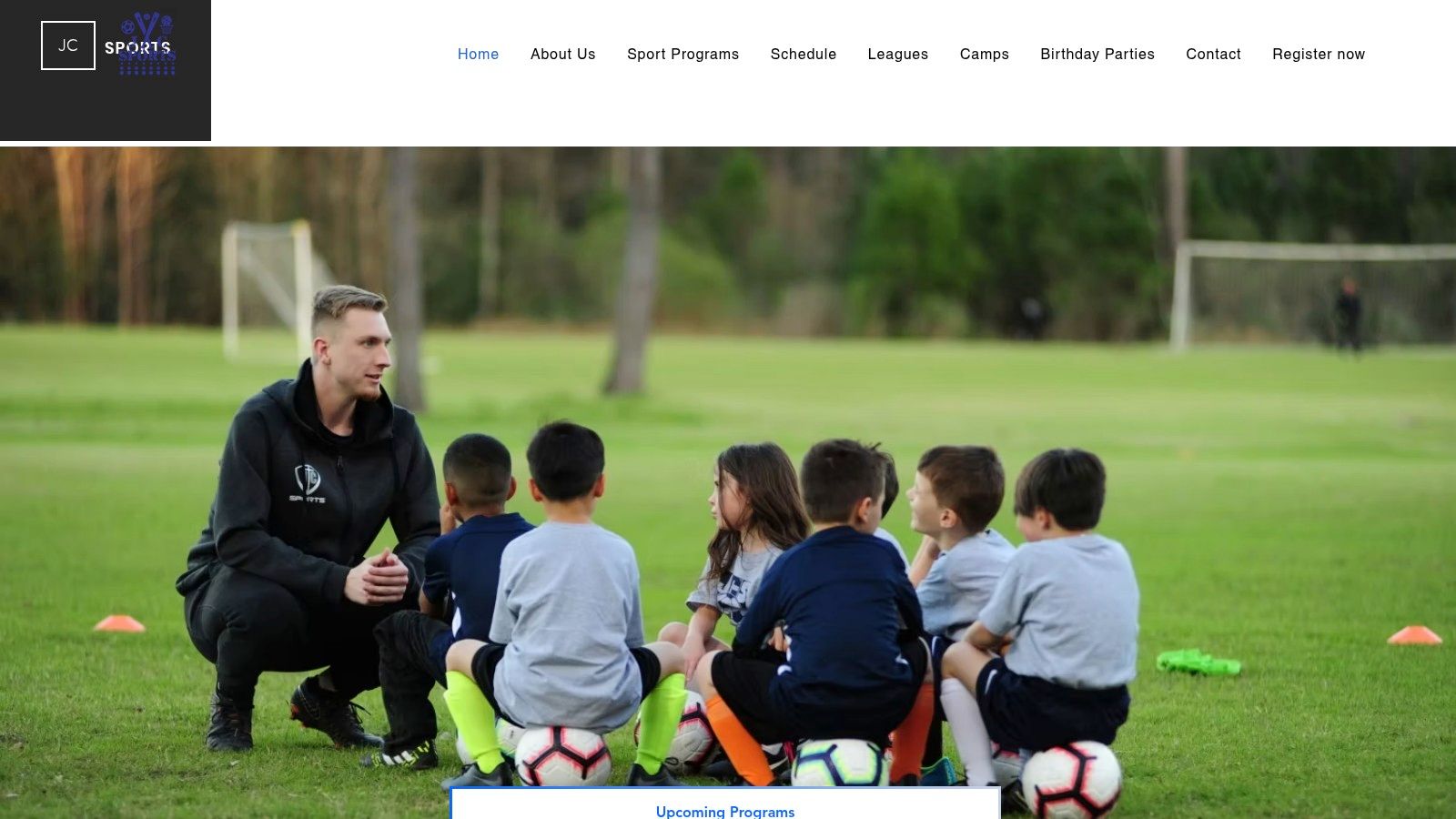
For families in Humble, Kingwood, and Atascocita, JC Sports Houston stands out because it feels built around the exact parent problem spring break creates. You need coverage, but you also want a camp day that doesn't overwhelm a younger child. JC Sports Houston's overall program mix points in the right direction for that age: sports-based, coach-led, development focused, and local enough that the commute doesn't become its own headache.
The center offers camps alongside soccer training, private lessons, beginner BlastBall, multi-sport toddler classes, and seasonal leagues. That matters for 5-year-olds because a camp usually works best when the provider already knows how to teach younger kids in smaller skill steps, not just entertain a mixed-age group for a few hours.
Why it fits younger campers
JC Sports Houston's coaching approach is built around progressive instruction, small-sided play, and confidence building. For a 5-year-old, that's a better fit than a loose “run around until pickup” format. The camp isn't just about burning energy. It's better viewed as structured movement with coaching.
The sports angle also gives parents an easy read on fit. If your child likes balls, races, relay-style games, and learning by doing, this is usually a stronger match than a camp centered on crafts or desk-based activities. If you're comparing options, their spring break sports camp page is the right place to start.
Practical rule: For a first camp at age 5, choose the setting that matches how your child already plays well. Don't use spring break to force a totally new environment unless the logistics are much better.
What parents should like
There are several practical advantages here that matter more than glossy camp themes:
Local convenience: Families in the northeast Houston side don't have to commit to a long cross-town drive.
Indoor setting: A safe indoor facility helps with weather swings and keeps the day predictable.
Easy next step: Online registration, clear policies, and field-status updates reduce guesswork.
Try-before-you-commit feel: A free-trial request option, when available, gives cautious families a lower-pressure way to get familiar with the coaching style.
If you run a club or follow youth program operations closely, the bigger picture is familiar too. Good organizations win repeat families by making communication and logistics easy, not just by running fun drills. That's part of why tools that improve sports-program workflow, like how EventUploader helps clubs, are getting attention across youth organizations.
Trade-offs to confirm
The biggest drawback is simple. Pricing isn't posted in the plan details here, so you'll need to check the current registration page or contact the program directly for rates, availability, and exact spring break hours. Families farther outside Humble, Kingwood, and Atascocita may also find the single-location setup less convenient than a multi-site operator.
One more reason JC Sports Houston is worth a serious look for this age: younger children are already part of the established camp market. A U.S. camp-sector survey reported that 12.81% of day camp participants were age 5 or younger, so the issue usually isn't whether a 5-year-old can do camp. It's whether the camp is intentionally adapted for that age.
2. Kids In Action
Families in Kingwood often start here because the location is practical before anything else. Kids In Action has Kingwood and Spring sites, and that alone can make the difference between a camp you can use and one that looks good online but falls apart at pickup time.
Its appeal for 5-year-olds is the broad activity mix. Instead of one narrow theme, the program combines age-grouped activities, indoor and outdoor play, STEAM elements, crafts, and on-site experiences. For a younger child who gets bored with too much repetition, that variety can help the day move smoothly.
Best for families who need all-day variety
This isn't the option I'd put first for a child who only wants sports or only wants nature. It's stronger for children who do well rotating through different types of activities and for parents who want school-break coverage from a provider already used to handling full-day care rhythms.
The facilities also matter here. A gym, playground, water play, and foam-machine style fun give the camp more ways to reset energy during the day, which is often what keeps a 5-year-old from melting down by early afternoon.
Good fit: Children who enjoy switching between movement, crafts, play, and group activities.
Less ideal fit: Children who need a highly specialized interest area to stay engaged.
Best parent use case: Families who prioritize nearby full-day coverage over a niche theme.
What to verify before registering
The main limitation is information transparency. Pricing isn't publicly posted in the planning notes here, so you'll need to ask directly about current rates, schedule, and whether non-enrolled families get the same registration access as current families. Programs like this can fill quickly, especially when they already serve local families year-round.
A full-day camp for a 5-year-old only works if the operational details work for the parent. Ask about lunch, rest breaks, bathroom support, pickup flexibility, and what happens when a child gets overwhelmed.
If your child still needs a lot of one-on-one prompting for transitions, that's the question to settle before enrollment. The activity menu may look great, but the day has to match your child's stamina and independence level.
3. USA Ninja Challenge Humble
Some 5-year-olds don't need a “fun variety” camp. They need to climb, balance, jump, hang, and move for most of the day. That's where USA Ninja Challenge in Humble has a clear edge.
This option is especially appealing for energetic kids who tend to struggle in seated settings. The camp format centers on obstacle-based movement, agility work, and confidence-building challenges. For a child who lights up around climbing structures and physical problem-solving, that can be a much better match than a traditional school-break program.
Strong age entry point
A practical plus is that the camp accepts children starting at age 5. That takes some guesswork out of the eligibility question that parents often run into with spring break camps for 5 year olds. The same provider also runs regular classes for 4- to 5-year-olds, which gives families a useful way to test the environment before committing to a break-week camp.
That trial logic matters more than many parents expect. The American Academy of Pediatrics advises families to think about a child's comfort away from home, personality, and readiness for camp, and that's especially relevant when you're talking about a newly 5-year-old rather than an experienced elementary camper. One reviewed camp FAQ source also highlighted how tightly many programs enforce age cutoffs and how often families are really deciding between full-day, half-day, or no camp at all for a young child, not choosing from interchangeable options, as summarized in this camp readiness discussion.
Where it works best
Best match: High-energy kids who enjoy climbing, racing, and physical challenges.
Helpful local advantage: Humble proximity makes it easier for nearby families.
Possible mismatch: Children who prefer quiet, art-heavy, or slower-paced days.
The biggest thing to confirm is the exact spring break schedule. The site points families to camp offerings, but if dates, prices, and half-day versus full-day details aren't obvious when you check, contact the gym before assuming anything. For younger campers, that schedule detail is the difference between “perfect” and “can't make it work.”
4. Rowland Ballard
If your child likes tumbling, obstacle elements, and gym-based play, Rowland Ballard gives you one of the more structured local options. The Kingwood and Atascocita locations are a real plus for northeast Houston families who want something nearby without driving across town for every drop-off and pickup.
This camp leans more scheduled than free-form. That's often a positive for 5-year-olds, especially those who do better when the day has a clear rhythm and instructors move the group through planned rotations.
The schedule is easier to compare
One thing Rowland Ballard does well is publishing practical details. Families can review camp hours, the age range, and added options like aftercare directly on the camp pages. For busy parents, that clarity saves time.
The listed school-year camp format includes gymnastics or ninja-style movement, games, crafts, and open gym time. That blend tends to work well for children who want active play but still benefit from built-in transitions and a few quieter pieces across the day.
Best fit: Kids who enjoy gym movement and a clear camp routine.
Useful logistics: Two convenient area locations and optional aftercare.
Watch-out: The core day may be shorter than some working parents need unless aftercare is added.
Quality matters more than theme
Parents often focus on whether a camp sounds fun. The more reliable predictor of satisfaction is usually how the camp is run. A peer-reviewed study on sport child camps found that management commitment to service quality, staff quality, food, and the physical environment were key predictors of parent satisfaction, while participants cared strongly about safety, food, fun, and service recovery.
That lines up with what parents should ask Rowland Ballard, or any active camp for younger kids. Who takes children to the bathroom area when needed? How are injuries handled? What happens if a child shuts down and won't rejoin the group? Those are the operational questions that tell you whether a 5-year-old will thrive there.
5. Houston Arboretum and Nature Center
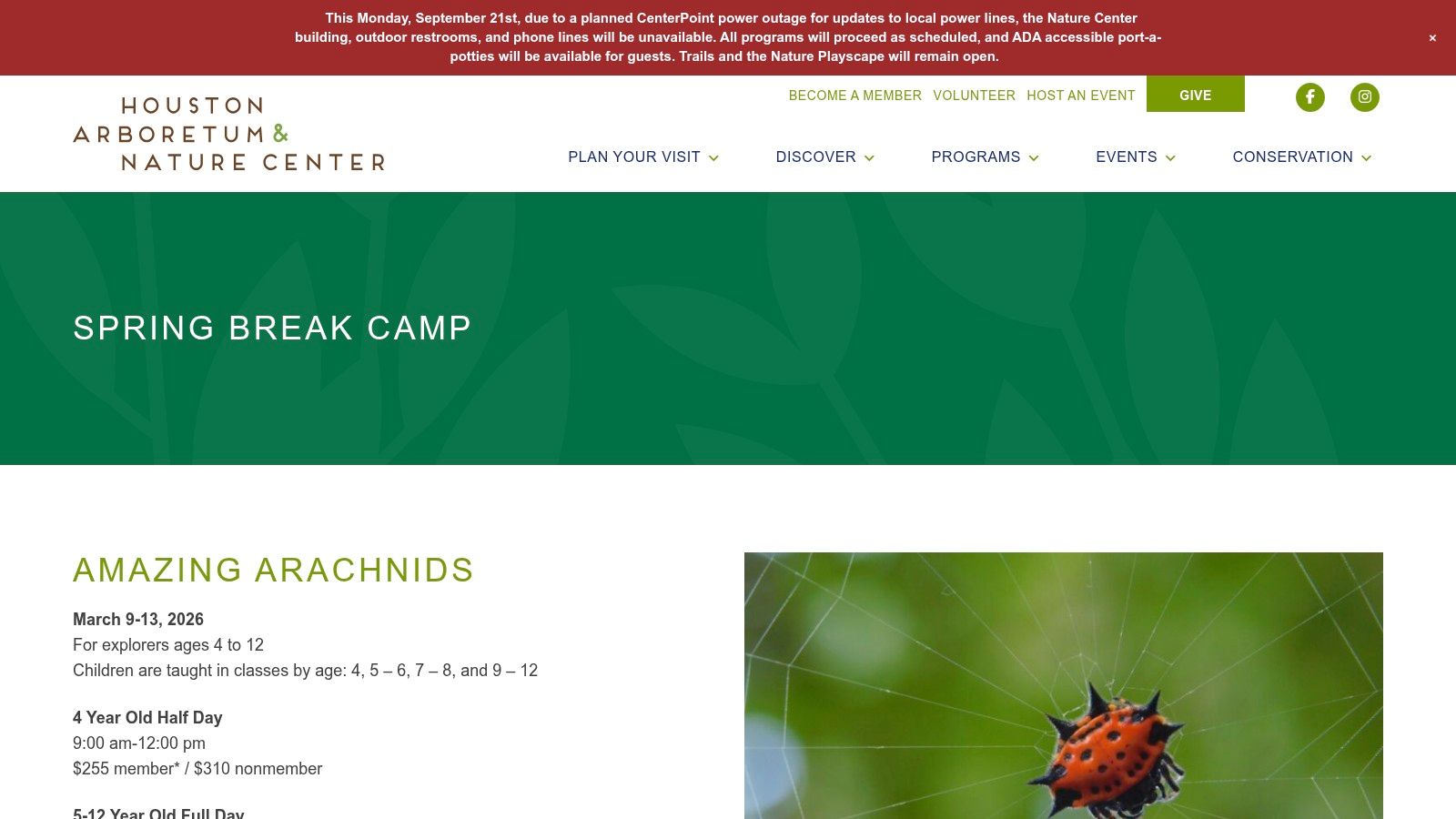
For a child who loves bugs, trails, dirt, sticks, and asking “what's that?” every few minutes, the Houston Arboretum is one of the most interesting spring break choices in the city. It offers a dedicated 5 to 6 age group, which is exactly the kind of detail parents should look for when comparing spring break camps for 5 year olds.
The age grouping matters because 5-year-olds usually need a different pace from older elementary campers. Outdoor education can be excellent at this age, but only when the instruction and expectations are scaled down appropriately.
A thoughtful early-learner nature option
The camp combines hikes, hands-on science, games, and live animal experiences. That's a strong mix for children who learn best by touching, moving, and observing instead of sitting through instruction. Parents who want a break week that feels enriching without being academic in the school sense will probably like this format.
There is a commute trade-off. From Humble, Kingwood, or Atascocita, the Memorial-area location may be a serious drive. That doesn't automatically rule it out, but it does raise the bar. The camp has to be special enough for your child, and manageable enough for your week, to justify the time in the car.
Parent filter: If the drive is long, the camp should either solve childcare beautifully or match your child's interests unusually well. Otherwise, local convenience usually wins.
Families planning a lower-key week might also like a backup list of spring break activities for families in case they decide a full camp schedule is too much for their child this year.
What to ask before you commit
Check the daily outdoor exposure, what happens in bad weather, what children need to bring, and how staff handle bathroom breaks on the move. Also ask whether your child needs to be especially independent with transitions and personal care.
For some children, nature camp is magical. For others, it can be tiring in a way that doesn't show up until day two. That's not a flaw in the program. It's just part of matching the camp to the child. Some parents also find that broader outdoor routines benefit regulation and attention, which is one reason resources about how nature helps autistic kids resonate with families comparing outdoor settings.
6. Houston Botanic Garden
Houston Botanic Garden's Spring Break BotaniCamp is a smart option for kids who are curious, sensory-oriented, and interested in plants or outdoor discovery, but who also benefit from having an indoor home base. That's an underrated advantage during spring weather, when a fully outdoor day can feel great one day and exhausting the next.
The most important eligibility point is straightforward. This camp is open to children currently in Kindergarten through 5th grade, so a 5-year-old can attend only if they're already in Kindergarten. For many families, that single rule will immediately sort this option into yes or no.
Good for curious Kindergarteners
BotaniCamp's appeal is the combination of inquiry-driven programming and manageable structure. Children get outdoor exploration, but the indoor base gives the day more containment than a purely trail-based camp. For younger campers, that often helps with energy regulation and smoother transitions.
This can be a better fit than a high-intensity sports camp if your child likes asking questions, examining small details, and doing hands-on activities at a calmer pace. If you're still weighing broader local options, this roundup of camps in Houston, Texas can help you compare category by category.
Best fit: Kindergarteners who enjoy nature, sensory learning, and guided exploration.
Major gatekeeper: Enrollment is limited to current K to 5 students.
Planning plus: Published schedule details make family planning easier.
Commute is the real trade-off
For Humble, Kingwood, and Atascocita families, southeast Houston may be farther than you'd want for a four-day camp unless the theme is a particularly strong fit. That's the main practical drawback.
Before registering, confirm daily drop-off and pickup windows, what campers should wear, lunch expectations, and how much of the day is spent outside versus indoors. For a younger child, those details shape the experience more than the theme title does.
7. Kidventure

Kidventure is the polished, multi-site option in this list. If your main goal is to find a well-developed early-childhood camp model with clear dates, published tuition, and extended-care style convenience at many sites, it deserves a close look.
For 5-year-olds, the key detail is its age-specific structure. Kidventure offers a Discoverers program for ages 3 to 5 and an Explorers program for K to 5, which gives parents some flexibility depending on the child's age and school status.
Strong for parents who want clear planning info
Kidventure tends to work well for families who want fewer unknowns on the registration side. Published dates, tuition, and site choices make comparison easier than with providers that require a call or inquiry form just to answer basic planning questions.
The camp day format also suits working families. Curbside drop-off and optional later care can make the difference between a camp that sounds nice and one you can use all week.
Reliable pickup procedures, predictable hours, and clear policies are often the features parents value most, even when camp marketing emphasizes enrichment.
That isn't just a preference. Public camp materials often require parents to manage lunch, snacks, strict pickup controls, and no on-site parent presence, while not always answering late-workday or contingency questions clearly. That operational gap is one reason holiday coverage remains such a practical family issue, as reflected in this discussion of school-break childcare logistics and camp usability.
Main drawback for northeast Houston families
The biggest downside is location fit. Many Kidventure sites are more convenient for families closer to central Houston, West U, or inside-the-Loop neighborhoods than for Humble-area households. Depending on which site you choose, the commute may be the deciding factor.
This is also the option where parents should weigh budget carefully. Even when a camp is thoughtfully designed, it has to line up with your actual week, your driving bandwidth, and how your child handles a fuller day.
7-Program Comparison: Spring Break Camps for 5-Year-Olds
Program | Complexity (🔄) | Efficiency / Resource Needs (⚡) | Expected Outcomes (⭐ / 📊) | Ideal Use Cases | Key Advantages (💡) |
|---|---|---|---|---|---|
JC Sports Houston | 🔄🔄 | ⚡⚡ | ⭐⭐⭐⭐ · Technical skill + creativity 📊 | Skill-focused youth soccer & multi-sport development | Coerver-based curriculum; small-sided coaching; free trial; community credibility |
Kids In Action (Kingwood & Spring) | 🔄 | ⚡⚡ | ⭐⭐⭐ · Broad play & STEAM exposure 📊 | Nearby full‑day care during school breaks | Age‑split groups; robust facilities; sessions aligned to local ISDs |
USA Ninja Challenge – Humble | 🔄🔄🔄 | ⚡⚡ | ⭐⭐⭐⭐ · Agility, coordination, confidence 📊 | Energetic kids who prefer obstacle/active camps | High‑energy obstacle curriculum; local convenience; trial classes available |
Rowland Ballard (Kingwood & Atascocita) | 🔄🔄 | ⚡⚡ | ⭐⭐⭐⭐ · Gymnastics skills & structure 📊 | Families wanting structured, gym‑based full‑day camps | Published pricing/hours; aftercare & sibling discount; two locations |
Houston Arboretum & Nature Center | 🔄🔄 | ⚡ | ⭐⭐⭐⭐ · Nature literacy & hands‑on science 📊 | Families seeking outdoor, curriculum‑based nature camps | Experienced educators; detailed parent logistics; live‑animal encounters |
Houston Botanic Garden – BotaniCamp (K–5) | 🔄🔄 | ⚡⚡ | ⭐⭐⭐⭐ · Plant‑science, sensory inquiry 📊 | K–5 students (5‑year‑olds in Kindergarten) interested in nature | Published schedule/prices; indoor base for variable weather; small groups |
Kidventure – Spring Fest (multiple locations) | 🔄 | ⚡⚡⚡ | ⭐⭐⭐⭐ · Creativity & age‑appropriate exploration 📊 | Families wanting clear logistics, multiple site options | Published dates/tuition; multiple Houston sites; extended care options |
Choose With Confidence and Register Early
The best spring break camp for a 5-year-old usually isn't the camp with the flashiest theme. It's the one that clears four practical filters without creating new stress at home.
Start with age and readiness. Confirm that your child meets the camp's exact age or grade rule, then think about stamina, separation comfort, bathroom independence, and how they handle transitions. One study of youth sport camps reported an average post-camp satisfaction score of 4.36 out of 5, with continuing participants at 4.43 and non-continuing participants at 4.32. For parents, the takeaway isn't to chase a perfect score. It's that small experience differences can matter when you want a child to feel good enough to return.
Next, look at commute and pickup reality. A great camp across town can become the wrong camp if drop-off collides with work or pickup leaves no buffer for traffic. For families in Humble, Kingwood, and Atascocita, a nearby option often beats a more specialized one because the week stays calmer.
Then compare activity fit. Sports camps, ninja gyms, gymnastics camps, nature camps, and broad day camps all ask different things from a 5-year-old. The right question isn't “Which camp is best?” It's “Which camp matches how my child already succeeds in a group?”
Use this quick shortlist method before registering:
Confirm eligibility: Check age cutoffs, grade requirements, potty or independence expectations, and whether half-day or full-day options exist.
Check schedule fit: Verify drop-off, pickup, aftercare, and what happens if you're late.
Ask supervision questions: Find out how staff handle bathroom help, snack time, injuries, emotional upsets, and children who need a quiet reset.
Review family workload: Ask what to pack, whether lunch is required, what clothing works best, and whether there are strict refund or attendance rules.
Close the information gaps: If pricing, dates, or policies aren't obvious, call or email before you assume.
One more practical note: holiday childcare patterns can shift from year to year. In England, children ages 5 to 7 spent a median of 9.0 hours per week in formal childcare in 2025, down from 14.8 hours in 2024. Even though that's not Houston-specific, it reinforces a familiar reality for local parents: families keep adjusting care choices based on schedules, affordability, and what works for the child that season.
Before you register anywhere, verify current dates, times, pricing, availability, supervision details, health policies, pickup rules, and required forms directly with each provider. If you're near Humble, Kingwood, or Atascocita, JC Sports Houston is one of the most convenient local options to investigate first because families can review the website, use the online registration process, check field-status updates, and request a free trial when available.
JC Sports Houston gives local families a practical spring break option built around age-appropriate sports instruction, movement, and confidence building for younger kids. If you're in Humble, Kingwood, Atascocita, or nearby Houston communities and want a camp that feels both active and local, visit JC Sports Houston to review current programs, registration details, and availability.
Comments