

Basketball for Beginners: A Parent's Complete Starter Guide

A child arrives at a first basketball practice holding a ball that looks almost as large as their torso. The hoop seems impossibly high, the court feels enormous, and after a few missed shots, the child decides they “aren't good at basketball.” Most parents have seen some version of this moment.
The problem usually isn't talent. Basketball for beginners works best when the equipment, practice goals, coaching style, and game format match the child's stage of development. This guide follows the decisions parents face in order, from understanding the game and choosing early skills to planning practices, correcting shooting habits, evaluating programs, and finding a sensible next step in Northeast Houston.
Why Basketball Is the Ideal First Team Sport
Basketball gives a beginner several ways to participate before they can do any one skill confidently. A child can run into space, stop, change direction, catch a pass, attempt a shot, or help a teammate. Those actions build a broad movement foundation without requiring the child to be tall, strong, fast, or highly coordinated on day one.
The sport also offers immediate feedback. A ball either reaches a teammate or it doesn't. A player either stays balanced while stopping or loses control. A made basket feels rewarding, but a good pass, smart cut, or successful defensive stop can also give a beginner a clear sense of progress.
That accessibility helps explain basketball's broad participation base in the United States. Among U.S. youth ages 6–14, 14.4 million played basketball, equal to 39% of that age group, and more than 11 million participants made it the most popular team sport for ages 12–17, according to an academic review of youth sports participation. For families, that means children can often find school, recreation, club, or community settings where they can learn progressively.
Start with the right expectation
A first practice shouldn't feel like an audition. A five-year-old who can't dribble through a crowded gym isn't behind. They're still learning how to control their body, track a moving object, and understand where to stand.
Parents can measure early progress through small signs:
Body control: The child can run, stop, and turn without falling into other players.
Attention: They can listen to a short instruction and try it.
Ball confidence: They're willing to touch, catch, carry, bounce, and pass the ball.
Team comfort: They begin looking for a teammate instead of only chasing the ball.
Enjoyment: They want to return, even after mistakes.
Basketball's history also supports its simple entry point. Dr. James Naismith invented the game in December 1891 as an indoor activity for cold weather and wrote the first 13 rules at the start. Later changes, including metal hoops with nets, the NBA's founding, basketball's Olympic debut, and the introduction of the 24-second shot clock, helped create a standardized game built around repeatable actions such as handling, passing, shooting, and spacing, as described in this history and rules overview from Basketball Australia.
The best beginning is not the most advanced drill. It's a setting where the child can move often, touch the ball regularly, understand the task, and leave feeling capable.
Basketball Rules and Positions Explained Simply
A parent doesn't need to memorize every rule to follow a youth game. Start with the basic question: which team has the ball, where is the team trying to go, and what caused play to stop?
A team scores by sending the ball through the opponent's hoop. A shot made from closer range is worth two points, while a shot made from beyond the three-point line is worth three points. At younger levels, the exact scoring situation may vary, but the basic objective remains the same: create a good shot, defend the other team, and keep possession when possible.
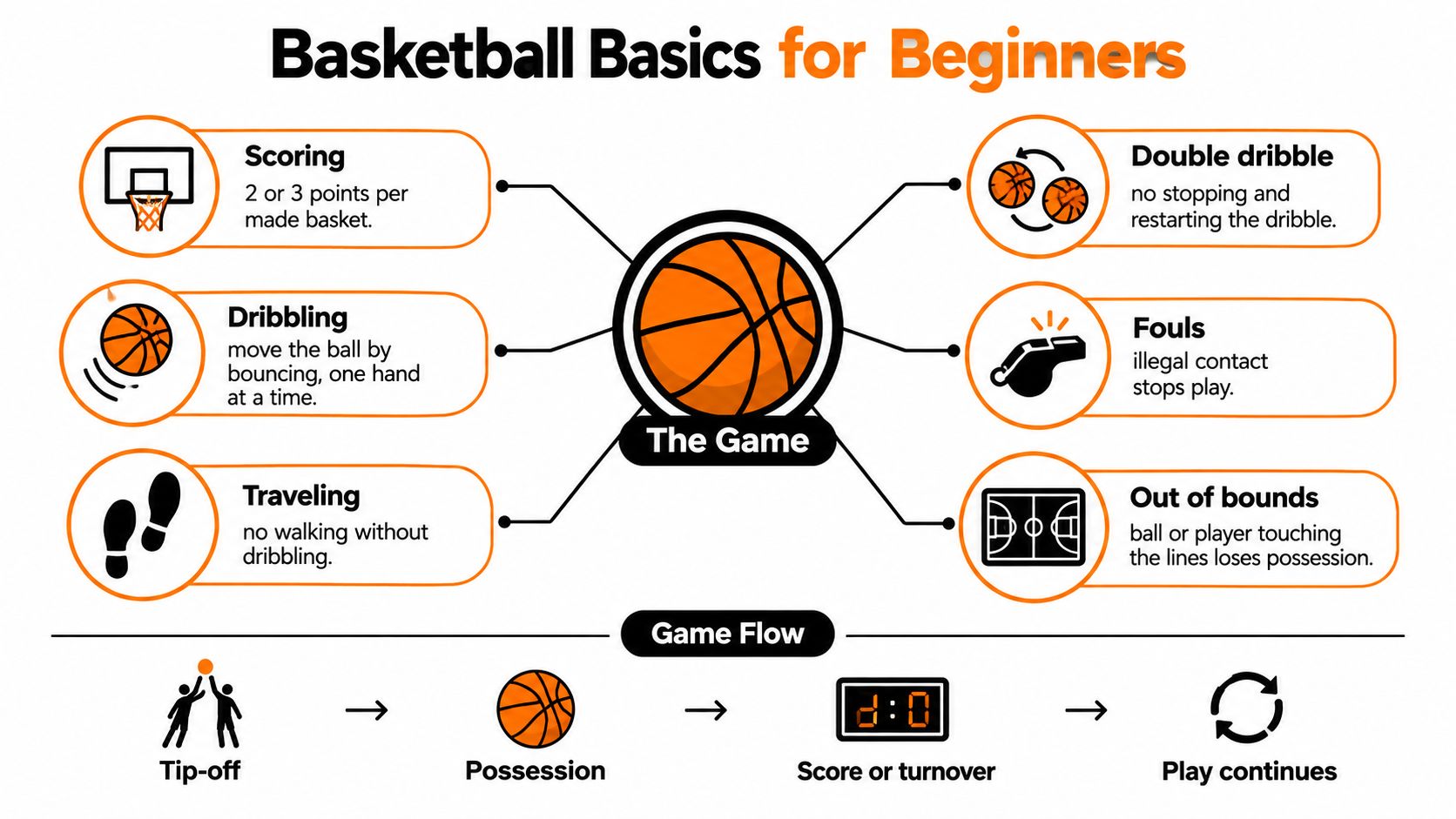
The rules parents see most often
Dribbling: A player moves while bouncing the ball with one hand at a time. They can change hands, but they must keep the ball connected to a controlled bounce.
Traveling: A player can't walk or run while holding the ball without dribbling. Young players often take extra steps because they're focused on the hoop, so coaches usually correct this gradually.
Double dribble: A player can't stop dribbling, hold the ball, and then start dribbling again. They can pass or shoot after stopping.
Out of bounds: The ball is out when it touches the boundary line or the floor outside the court. Possession usually changes after that.
Fouls: Illegal contact, such as pushing, hitting, or holding, can stop play. Beginners often need time to learn the difference between normal contact and a foul.
Possession: A team keeps the ball until it scores, loses it, commits a violation, or sends it out of bounds.
A game flows in a simple loop: one team has possession, players move and pass, someone shoots, and play continues after a basket, miss, steal, violation, or foul. You don't need to call every mistake from the sideline. Ask your child what happened, then let the coach teach the correction.
Positions are court jobs, not permanent labels
Traditional basketball uses five positions, but young players shouldn't be locked into one role too early. Use three broad ideas instead:
Ball handler: Usually brings the ball up and helps the team begin its attack. Think of this player as a traffic controller who sees where teammates are going.
Wing: Plays toward the sides of the court, cuts toward the basket, receives passes, and helps defend.
Post or big: Plays closer to the basket, rebounds, screens, and protects space near the hoop.
A child may try every role during a practice. That variety helps them learn the whole game and prevents early labels such as “you're only a center” from limiting development.
Small-sided play makes these ideas easier to learn. In a three-on-three game, each player has more opportunities to receive the ball, defend, make a decision, and recover from an error than they might in a crowded five-on-five game. The court feels less congested, and the coach can see each child's choices more clearly.
Parent translation: “Move into open space, help your teammate, protect the basket, and try again when the ball changes hands.”
That sentence is enough to help a beginner understand the purpose of the game without turning the first practice into a lecture.
Age-Appropriate Skills and Motor Skill Progressions
A beginner's skill ladder should start with the body, not the basketball. Before a child can dribble around a defender, they need to accelerate, stop under control, shift direction, and keep their eyes up. These are locomotor and balance skills, and they support every later basketball action.
A useful progression looks like this:
Move well: Run, stop, turn, shuffle, and jump safely.
Control the body with the ball: Hold a balanced stance, protect the ball, and recover after a bounce.
Handle while moving: Dribble slowly, change direction, and respond to a visual cue.
Share possession: Pass accurately, catch with soft hands, and move after passing.
Finish close to the basket: Use balanced footwork and a repeatable shooting motion.
Make decisions: Choose whether to dribble, pass, shoot, cut, or defend.
The order matters because a child who loses balance while stopping will struggle to change direction with a dribble. A child who can't catch comfortably may avoid passing. A child who has to throw the ball with both hands from far away can't focus on release mechanics at the same time.
Progress by readiness, not comparison
For a young preschool beginner, a successful session may involve carrying the ball, rolling it, chasing it, bouncing it with help, and learning to stop on a signal. The emphasis should be movement, confidence, and playful control, not formal positions or complex plays.
For an early school-age player, practice can add stationary dribbles, walking dribbles, simple changes of direction, chest passes, defensive stance, and close-range shots. The child should still have frequent chances to move rather than wait for a turn.
For an older beginner, coaches can combine skills. A player might dribble around a cone, look up, pass to a teammate, relocate, and defend the next possession. The standard rises through decision-making, not by immediately demanding difficult moves.
Dribbling illustrates why this progression works. One youth study found that structured variations in dribbling exercises produced a statistically significant improvement in dribbling ability, with p = 0.023, while arm strength, speed, and hand-eye-foot coordination were identified as key physical contributors in the study, as reported in this youth dribbling research paper.
What parents should watch
Look for control under a small challenge. Can the child keep the ball while walking past a cone? Can they stop without immediately losing it? Can they pass to a partner and move to a new spot?
For a practical explanation of how coordinated movement supports early development, parents can also review this guide to basketball training for kids. The central principle is simple: add movement and decisions only after the child can perform the basic action with reasonable control.
Don't use highlight-reel moves as a progress chart. A beginner who keeps their head up, protects the ball, and makes a sensible pass is building a stronger base than a player who can perform a flashy move without balance.
Simple Drills and a Beginner Practice Plan That Works
A good beginner practice keeps the child active and gives every drill a clear purpose. You don't need a large equipment bag or advanced coaching experience. A ball, a safe space, a wall or partner, and a few cones or floor markers are enough.
Begin with body-to-ball control. Ask the child to stand with knees bent and move the ball around their waist, knees, and shoulders. Then add gentle hand-to-hand transfers and low bounces. These activities help the child feel where the ball is without asking them to travel yet.
Move into a walking dribble. Place cones in a line and ask the player to walk around them with the right hand, then the left. Keep the path wide enough that the child can look forward. Once control holds, add a signal to stop, change direction, or switch hands.
For a passing activity, stand a comfortable distance apart and use chest passes. Count accurate catches rather than passes thrown quickly. If a partner isn't available, the child can pass to a wall target and catch the rebound with ready hands.
Close-range shooting should come after the child is warm. Begin near the basket, focus on balance and a soft finish, and move back only when the motion stays relaxed. A parent can say, “Reach toward the basket,” rather than giving several corrections at once.
Parents looking to strengthen general movement patterns can supplement court work with master soccer footwork drills. Footwork transfers across sports, especially when children practice stopping, changing direction, and coordinating their feet with an object.
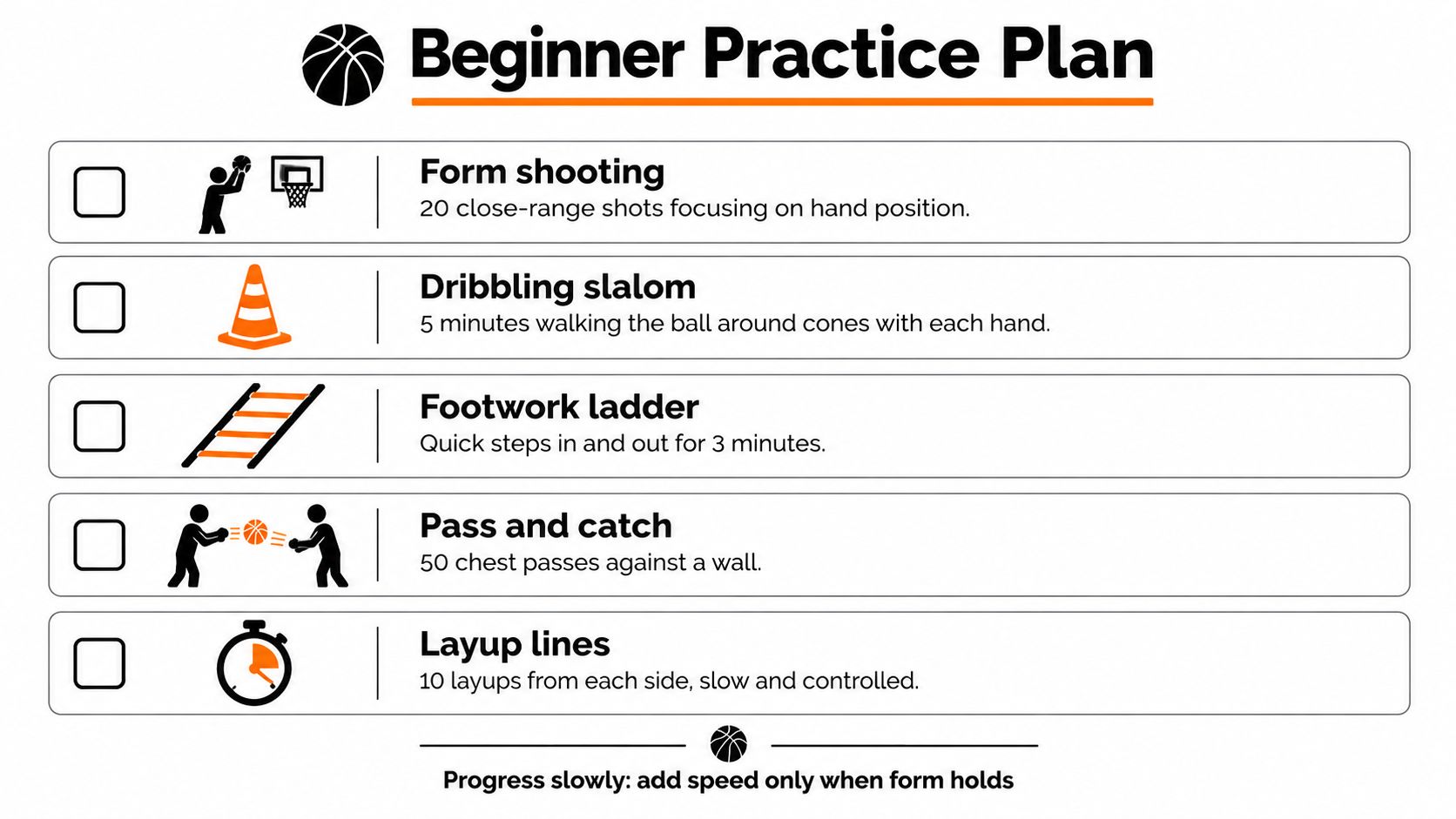
A repeatable practice structure
Youth coaching guidance favors short practices, small-sided games, and just one or two skills per session, rather than long lectures or lines of waiting players. USA Basketball youth guidance also emphasizes age-appropriate practice lengths and limited weekly game load for younger children, as summarized by Breakthrough Basketball's coaching guidance.
Time Block | Activity | Coaching Focus |
|---|---|---|
Opening | Movement warm-up with stops, turns, and balance games | Safe body control |
Skill block | Stationary and walking dribbles | Soft fingertips and eyes up |
Partner block | Chest passes, catches, and pass-and-move | Step toward the target |
Finishing block | Close-range shooting and controlled layups | Balance before distance |
Game block | Small-sided play | Space, sharing, and decisions |
Keep the practice flexible. If the child's form collapses, reduce the challenge instead of repeating the same error at higher speed. If the player is waiting in line, change the setup so they can dribble, shadow a movement, or practice a footwork pattern while another child takes a turn.
For more focused dribbling ideas, parents can use this resource on how to improve basketball dribbling. End with a short game whenever possible. The game gives the skill a reason, and the child learns that basketball is more than completing drills correctly.
The video below can provide another visual reference for beginner practice ideas.
Getting the Equipment Right Before Bad Habits Form
A child who struggles to shoot doesn't automatically need more shots. They may be using a ball that is too large, aiming at a hoop that is too high, or standing so far away that they must push the ball with both hands.
That compensation can look like poor effort, but it is often a setup problem. The child leans backward, launches the ball with the chest, adds too much force, or lets the off-hand steer the release. Repeating the same shot from an unsuitable distance can make the movement feel familiar without making it technically sound.
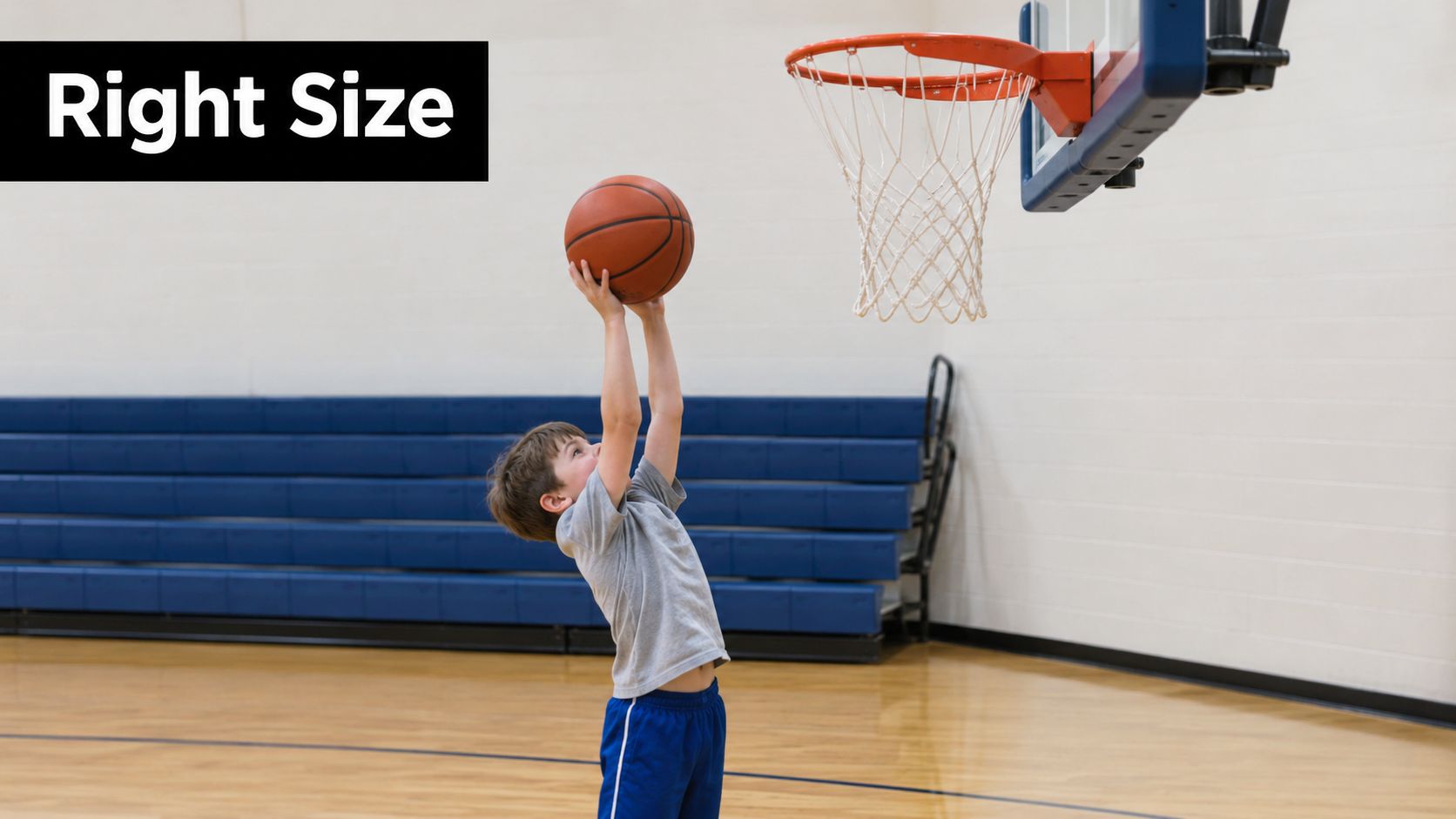
Match the challenge to the child
Use a basketball the child can hold and control comfortably. The exact choice depends on the program, the child's size, and the equipment available, so ask the coach what the class uses before buying a ball for home.
A lower practice hoop can help young children experience a natural release. If a home hoop isn't adjustable, move the child closer to the basket and treat the activity as form practice, not distance shooting. A laundry basket, soft target, or wall target can also support safe movement and aiming when a regulation hoop isn't suitable.
Comfortable athletic shoes matter because beginners spend much of their time stopping, turning, and changing direction. Cones are useful but optional. Floor spots, small household objects that cannot cause trips, or painted court lines can create movement targets.
Shooting quality depends on release angle, release velocity, release height, and body alignment, according to biomechanics research on shooting mechanics. Helpful alignment cues include the index finger, wrist, elbow, and toes facing the basket, with a natural elbow path close to the body, as described in this biomechanics review of basketball shooting.
Build the shot close to the hoop
Start close enough that the player can lift the ball smoothly without straining. Watch for a balanced stance, a quiet guide hand, and a finish that points toward the target. If the child must jump forward or throw the ball from the chest, shorten the distance or lower the target.
Practical rule: If the equipment forces the child to change the motion, change the equipment or distance before asking for more effort.
A parent's job is to create conditions where good movement is possible. Coaches can then refine the release, footwork, and decision-making as the child gains strength and coordination.
How to Choose a Basketball Class, Coach, or Camp
The right program should make the child active, understood, and appropriately challenged. A busy gym isn't automatically a good gym, and a highly competitive environment isn't automatically better for a beginner.
Start by asking what a typical session looks like. Do children spend most of the time standing in lines, or do they rotate through activities with a ball in their hands? Does the coach teach one clear idea, demonstrate it, and then watch children try it? Can the coach adjust a drill when a child is overwhelmed?
Compare the main program formats
A recreation league gives children a regular team setting and an introduction to games. It suits a child who enjoys social play and can tolerate learning in a group. Ask whether practices include skill instruction or focus mainly on scrimmages.
A skill class usually offers more direct teaching and repetition. This can help a cautious beginner or a child who needs extra ball confidence before joining a league.
Private training provides individual attention, but it should still include movement, decisions, and age-appropriate games. A private session shouldn't become a long stream of technical corrections.
A school-break camp can be a useful introduction when the schedule, group size, and teaching approach fit the child. Confirm whether the camp welcomes complete beginners and how coaches manage different ability levels.
Parents can use this basketball classes for kids guide when comparing structured options, then ask each provider the same practical questions.
Green flags and warning signs
Look for:
Progressive instruction: The coach builds from simple movement to ball skills, passing, finishing, and play.
Frequent touches: Children practice in pairs, small groups, or stations instead of waiting for one turn.
Age-appropriate expectations: The language, court size, practice demands, and game rules suit the children.
Specific feedback: Coaches correct one useful detail, such as “bend before you stop,” instead of shouting general instructions.
Small-sided play: Children get opportunities to make decisions rather than hide in a crowded full-court game.
Clear communication: Staff can explain what beginners are learning and how parents can support it.
Be cautious when coaches spend most of the session talking, use drills far beyond the group's level, or measure success only through winning. A child who smiles, tries again, and understands the next challenge is showing better development than a child who wins while rarely touching the ball.
If possible, observe a session or request a trial before committing. Notice whether the coach learns children's names, protects safety, and treats mistakes as part of learning. The best match depends on temperament as much as age. A social child may enjoy a league, while a hesitant child may first need a smaller skill group.
Parent FAQs and Your Next Steps in Northeast Houston
How young is too young to start?
There isn't one perfect starting age. Very young children can explore running, stopping, carrying, rolling, catching, and gentle bouncing in a playful environment. They don't need formal plays, full games, or pressure to shoot from a regulation distance.
For preschoolers, judge the program by its tone and design. A good session uses simple instructions, frequent movement, and activities that let children succeed without forcing them to imitate older players.
How often should a beginner practice?
Practice should be regular enough to build familiarity but short enough that the child remains engaged. A brief activity at home can be useful when it feels like play. Stop before frustration becomes the main memory of the session.
Quality matters more than packing the week with difficult training. Young players need recovery, free play, and opportunities to develop general movement skills alongside basketball.
Do games or drills matter more?
Children need both, but they serve different purposes. A drill isolates a movement so the child can feel it. A small-sided game gives that movement a reason, such as finding space, protecting the ball, or passing to an open teammate.
If a child practices only drills, they may not know when to use the skill. If they play only games, they may repeat the same uncontrolled habits. A balanced program teaches briefly, gives many touches, and then lets children solve simple problems in play.
When should a beginner join a league?
Consider a league when the child can participate in a group, follow basic safety instructions, and recover emotionally after mistakes. They don't need polished dribbling or reliable shooting.
Ask whether the league introduces team play gradually. A three-on-three format can give beginners more involvement than a crowded game, especially when coaches continue teaching during competition. The right league should treat games as another learning environment, not as a test of whether a child belongs.
Families in Humble, Kingwood, Atascocita, and surrounding Houston communities can compare local classes, seasonal leagues, and school-break camps by using the criteria above. Look for age-appropriate instruction, small-sided opportunities, skill-building, and a clear path from first movement activities to organized team play.
A free trial can make the decision easier because your child can experience the coach, the group, the space, and the pace before your family commits. Watch for the details that matter most: Is your child moving? Are they receiving encouragement and useful corrections? Do they leave curious about returning?
Basketball can become a lifelong activity when the first experiences feel welcoming. The early objective isn't a perfect jump shot. It's a child who feels comfortable with the ball, enjoys playing with others, and believes that mistakes are a normal part of getting better.
JC Sports Houston offers age-appropriate basketball programs, including beginner-focused instruction and team play for young children in the Northeast Houston area. Visit JC Sports Houston to explore available classes, leagues, camps, and the option to request a free trial for your child.
Comments