

Youth Baseball Pitching Camps: A Parent's Guide

Your child comes home from practice excited because the radar gun showed a faster pitch. You feel proud, but you also wonder whether the session included too much throwing, whether the mechanics were sound, and whether another camp would help or just add more stress to a growing arm. Those are the right questions.
The best youth baseball pitching camps don't treat velocity as the main product. They teach repeatable movement, manage workload, build recovery habits, and help players understand how to compete without chasing maximum effort every day. A camp that can't explain how it protects young arms isn't worth your registration fee, no matter how impressive its facility or marketing looks.
What a Modern Pitching Camp Should Be
A child can leave camp with a faster radar reading and still receive poor instruction. Parents should judge a program by how it manages throwing volume, teaches efficient mechanics, and protects the arm across the full season. Velocity matters only when the player can produce it with repeatable movement and recover properly.
Youth pitching camps have grown from informal summer instruction into a recognized part of player development. The roots reach back decades. In 1959, former Brooklyn Dodgers catcher Mickey Owen founded a baseball camp that later expanded to an 80-acre complex in Missouri. By 1988, it had served more than 16,000 campers from 24 countries, according to the Los Angeles Times account of the camp's history. Organized instruction was already reaching young players internationally before the modern travel-ball system developed.
The market is broad, but the participation figures use different definitions. One count reports 4.8 million youth ages 6 to 17 in organized baseball in 2022. A broader estimate that includes casual play reaches 7.7 million youth ages 6 to 17. Both figures come from Business of Baseball's youth participation analysis, so parents should treat them as methodology-based estimates rather than one precise total.
Camps serve several different players
Some children attend because they enjoy pitching and want focused instruction. Others are position players improving throwing control, while a smaller group is preparing for more competitive baseball. Those athletes need different drills, throwing volumes, and coaching language.
A quality camp teaches players how to apply instruction beyond the session. They should understand their movement, complete an appropriate warmup, recognize fatigue, and follow recovery habits. Coaches should also explain when to reduce effort or stop throwing. Repeated maximum-effort throws without those safeguards are a warning sign.
Parent standard: Ask what your child will learn when the radar gun is turned off. The answer reveals more about the camp than its velocity claims.
Specialized instruction can build confidence and improve mechanics, but a pitching-focused schedule can also concentrate stress on the arm. Review the camp alongside team practices, games, private lessons, showcases, and other overhead throwing. Choose a program that accounts for the player's entire workload, not one that adds volume without a recovery plan.
Age-Specific Benefits and Skill Progression
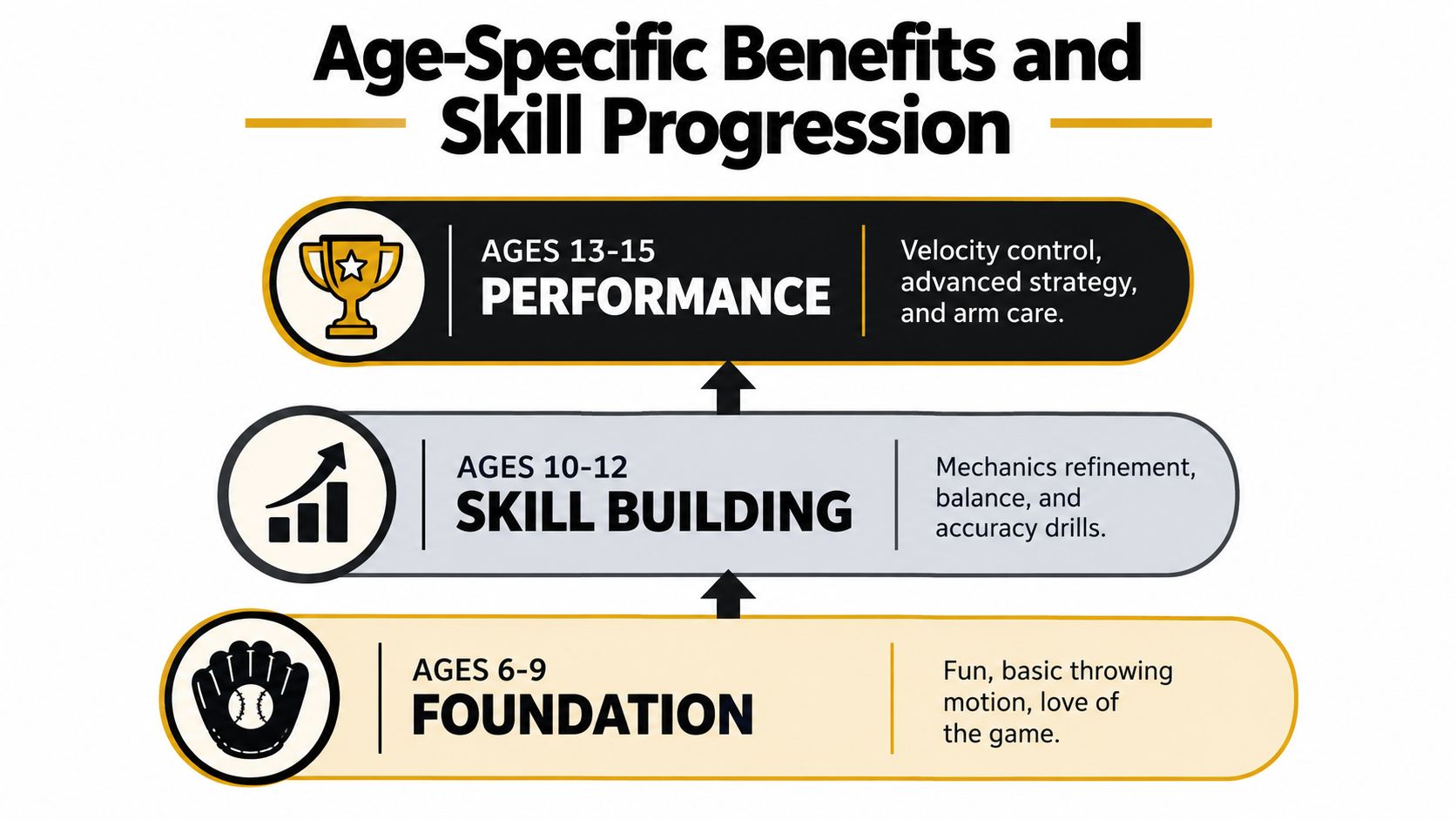
A young pitcher who arrives chasing a faster radar reading may need better balance, movement control, and recovery habits. Camps should build those foundations before adding competitive demands. Children develop strength, coordination, and throwing skill at different rates, so coaches must adjust the curriculum instead of pushing every athlete through the same progression.
Foundation comes before specialization
For younger players, camp should remain athletic and enjoyable. Basic throwing motion, balance, catching, movement games, and simple accuracy challenges matter more than pitch design. Coaches should teach children to move toward a target, use the lower body, finish under control, and repeat movements without turning every throw into a test.
Players in the middle development stage can refine mechanics. Instruction may address stride direction, trunk rotation timing, posture, balance, and consistent arm-slot patterns. Repeatable movement supports long-term arm health better than a single hard throw that the player cannot reproduce safely.
Older youth pitchers can handle more detailed instruction, but advanced work still needs limits. Fastball mechanics should come before changeup development, and complex pitch work should follow efficient basic movement. The youth pitching injury review emphasizes early instruction in fundamental throwing and fastball mechanics before introducing the changeup.
Match the camp to the child
A nine-year-old who wants more velocity may need foundational movement work. A physically mature older player may be ready for tactical instruction, but that does not permit unlimited bullpen sessions or repeated maximum-effort throws. Parents should judge a camp by how well it protects mechanics under workload, not by how often it displays a radar gun.
Look for these placement standards:
The intake process asks about experience: Coaches should learn the player's age, team workload, injury history, and pitching role.
Groups are divided by development: Age alone is insufficient, but beginners and advanced pitchers should not receive identical work.
The program teaches recovery: Players should learn arm care, rest, and how fatigue changes mechanics.
The coach watches movement first: Video feedback, balance, stride direction, and repeatability should come before velocity readings.
Choose the camp that adjusts instruction and throwing demands to the player's current ability, total workload, and capacity to maintain healthy mechanics.
Inside a Typical Camp Curriculum and Daily Schedule
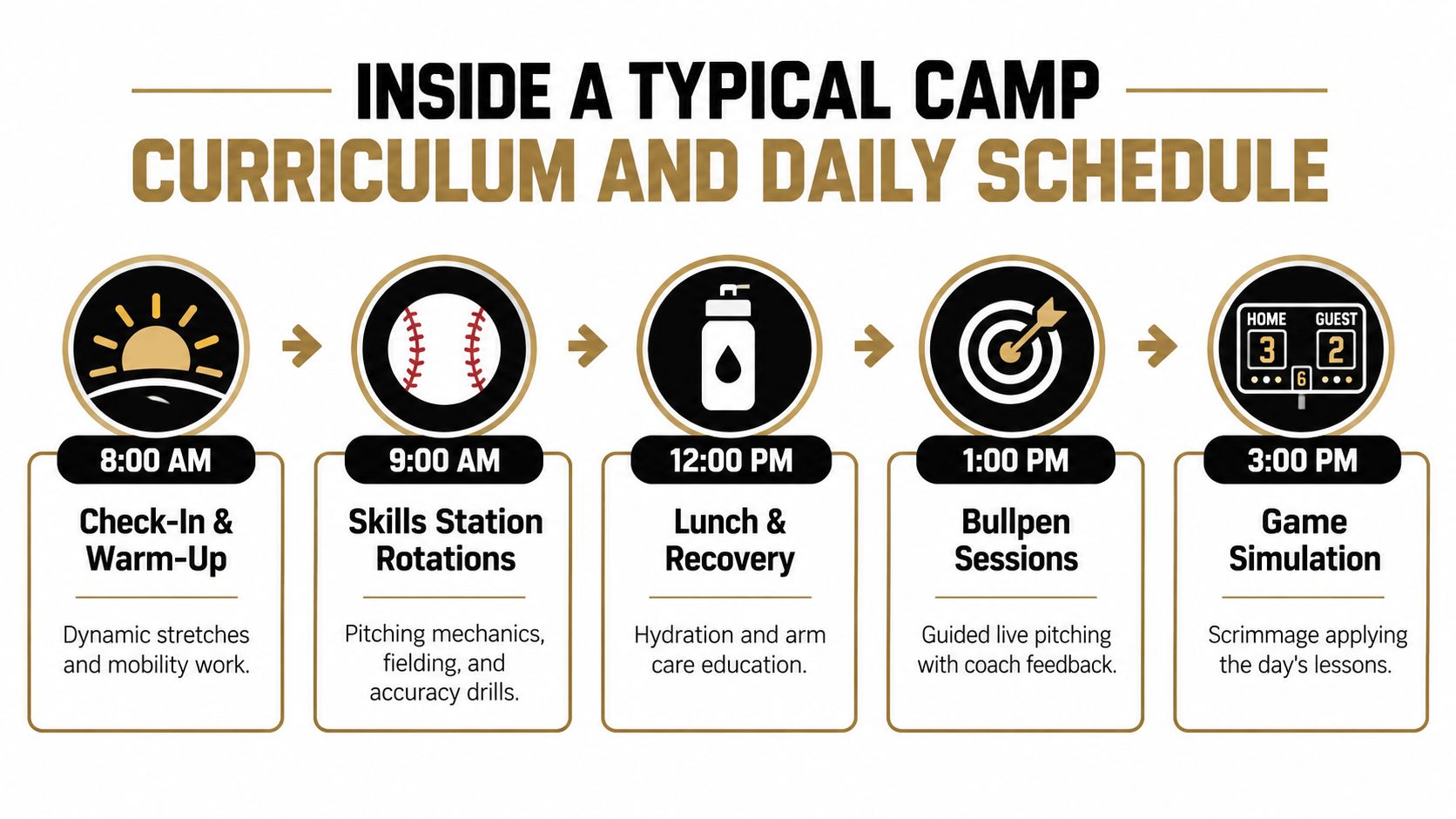
A full camp day should include much more than bullpen work. The strongest schedule alternates physical activity with instruction, observation, recovery, and lower-intensity skill development. That structure gives coaches more opportunities to teach without asking young pitchers to throw through fatigue.
What the day should accomplish
A sensible day can begin with check-in, dynamic movement, mobility work, and a coach-led readiness check. Players then rotate through mechanics, fielding, accuracy, and athletic stations. Those stations keep the day active without making every minute a throwing event.
Lunch should be treated as recovery time, not wasted time. Coaches can teach hydration, sleep habits, resistance-band routines, and the difference between normal training effort and pain that requires attention.
A guided bullpen belongs later in the schedule only if the player is fresh enough to maintain quality mechanics. Coaches should set an individual throwing plan in advance, track pitches, and stop a session when movement quality deteriorates. A game simulation can be useful, but it should apply the day's learning without becoming an unplanned high-volume competition.
A practical schedule test
Parents don't need an identical timetable at every facility. They do need to see a clear relationship between activity and workload.
Warm-up: Dynamic movement and mobility prepare the athlete without exhausting the arm.
Skill stations: Players learn mechanics, accuracy, fielding, and athletic movement through varied work.
Recovery education: Hydration and arm-care instruction make rest part of the curriculum.
Bullpen work: Coaches supervise a defined throwing block with feedback and pitch tracking.
Competition: A scrimmage or simulation should reinforce decisions and execution, not reward reckless effort.
The camp should also explain what happens between sessions. If children attend multiple days, coaches need a plan for rest, throwing limits, and adjustments when a player arrives sore or tired.
A bucket of balls is not a curriculum. If the schedule gives more detail about showcase readings than about recovery and stopping rules, choose another program.
Evaluating Camp Safety and Coaching Credentials
A child can leave a pitching camp throwing harder and moving worse. Parents should judge a program by how it protects the arm under fatigue, not by how often staff display radar-gun readings. Workload management, mechanical feedback, and a clear response to pain should come before velocity development.
Use workload limits as a minimum standard
Youth pitching guidance sets these daily maximums:
Age group | Daily max pitches | Key safety focus |
|---|---|---|
Ages 7 to 8 | 50 | Short throwing blocks, technique, and required rest |
Ages 9 to 10 | 75 | Track all pitches and stop before fatigue changes mechanics |
Ages 11 to 12 | 85 | Coordinate camp work with games and team practices |
Ages 13 to 16 | 95 | Manage total seasonal volume and competitive exposure |
These limits and related rest guidance appear in the clinical review of youth pitching workload recommendations. The guidance also advises no more than 8 competitive pitching months per year and calls for an offseason rather than continuous, year-round throwing.
Treat the daily maximum as a ceiling, not a target. A responsible coach will not use every available pitch just because a guideline permits it. The workload includes game pitches, innings during the season, months pitched, warm-up throws, bullpens, showcases, and other overhead throwing. Ask the camp to account for the player's outside commitments before assigning additional work.
Ask questions that expose the safety system
Before registering, ask the director to explain the program in plain language.
Who records pitches? Staff should track competitive and instructional throws that count toward the day's workload.
What stops a session? The answer should include fatigue, pain, declining mechanics, and the player's individual limit.
How are rest days enforced? The camp should explain recovery between throwing sessions and its plan for consecutive camp days.
What happens when a player reports pain? Throwing should stop, the parent should be notified, and the child should follow an appropriate medical process.
Who evaluates mechanics? Coaches should explain how they assess stride direction, trunk rotation timing, arm-slot consistency, and progression.
How large are the groups? Smaller groups give coaches more opportunities to see movement changes and correct them promptly.
A prospective cohort of pitchers ages 9 to 12 found that throwing more than 75 pitches in a game was associated with a 35% increase in elbow pain, according to a prospective study of pitch counts and elbow pain in youth pitchers. Use that finding as a reason to reject camps that push children toward game-like fatigue under the label of instruction. Arm safety should outrank a temporary velocity increase.
Walk-away rule: If a camp cannot explain how it counts pitches, schedules recovery, and responds to pain, do not enroll your child.
Facility practices also deserve inspection. Shared spaces should have sensible cleaning, equipment-handling, hydration, and illness procedures. Parents comparing busy venues can review sanitation advice for sports venues while assessing the facility's routine.
Use sports injury prevention guidance to compare warm-up, recovery, and injury-response practices. Credentials matter, but a certificate does not prove that a coach manages workload well. Watch staff when a child is tired, misses a target, or reports arm pain. Their response reveals whether the camp protects long-term mechanical health or just chases harder throws.
Packing Essentials and Enrollment Considerations
A child arrives with a sore arm after a tournament, and the camp still plans a full day of high-effort throwing. Your packing list cannot fix that program. Choose camps that protect workload and mechanics first, then pack for comfort, hydration, sun exposure, and supervised arm care. Leave radar-focused or unsupervised maximum-effort equipment at home.
Build the bag around the day
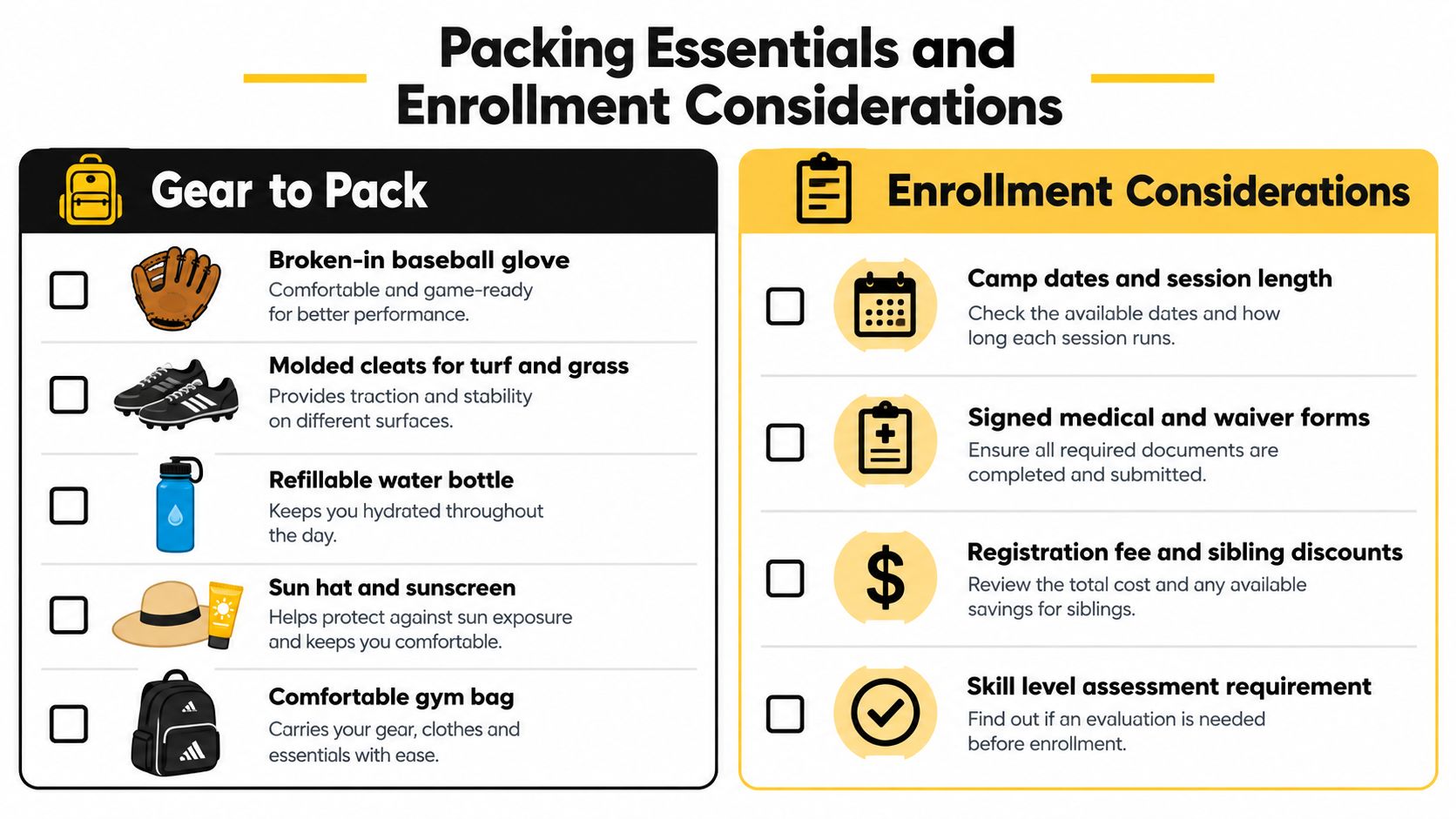
A broken-in glove lets the player focus on receiving and fielding rather than stiff leather. Molded cleats should match the facility's surfaces, and a refillable water bottle supports regular hydration.
Pack a hat, sunscreen, spare athletic clothing, comfortable footwear for breaks, and a gym bag the child can carry independently. Resistance bands may support prescribed arm-care exercises, but a coach or medical professional should direct their use. Bands never replace rest.
Bring a parent-side folder with medical information, emergency contacts, medication instructions, insurance details, and signed waivers. Report current soreness, recent tournaments, and other throwing commitments before the first session. Ask how the camp will adjust activity when those factors increase arm stress.
Read the enrollment terms carefully
Registration pages should identify dates, session length, age or skill requirements, cancellation rules, supplied equipment, and items families must bring. Ask whether lunch, shirts, evaluations, photographs, or optional activities cost extra. A higher fee does not prove better instruction, and more hours at the facility do not automatically create more value.
Prioritize coaching that limits repetitive throwing, schedules recovery, and develops mechanics without chasing a temporary velocity increase. A shorter program with attentive instruction can serve a young pitcher better than a long schedule built around fatigue.
Before committing, review the youth sports registration information for forms, dates, and registration logistics. Confirm that staff understand your child's current team schedule and can explain how camp workload fits the rest of the season. If they cannot answer clearly, choose another program.
Local Spotlight JC Sports Houston Pitching Programs
Parents in Humble, Kingwood, Atascocita, and nearby Houston communities have a practical reason to examine community-based instruction before choosing a high-pressure showcase camp. A local program can make it easier to observe coaching, ask direct questions, and connect camp work with a child's regular sports schedule.
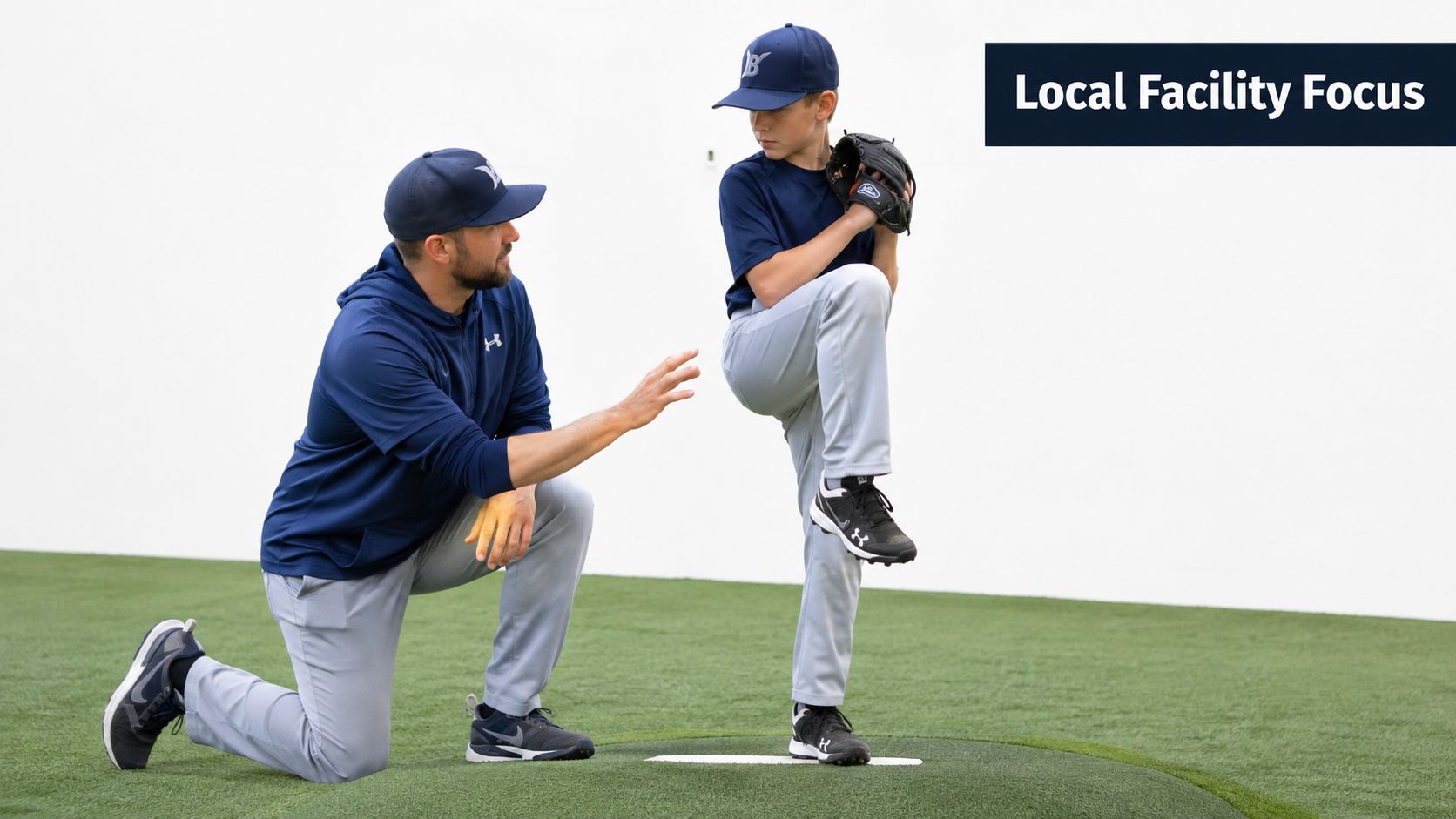
JC Sports Houston presents youth sports through age-appropriate instruction, small-sided play, and progressive skill development. Its broader offerings include baseball development, and its Sluggers Plus program includes hitting instruction such as coach-pitch hitting. That makes the facility relevant for families looking for a balanced introduction to baseball rather than a pitching-only environment built around constant velocity testing.
What parents should look for locally
The facility's model emphasizes confidence, motor skills, creativity, and sport-specific technique across youth programs. For a young player, that approach can support throwing development without making the child's identity depend on becoming a pitcher immediately.
JC Sports Houston also offers seasonal camps connected to school breaks, including Spring Break and Summer Break options. Families should still ask the same safety questions outlined earlier. A welcoming facility doesn't remove the need to confirm pitch tracking, rest periods, group structure, medical procedures, and how coaches respond to soreness.
Indoor space can provide scheduling convenience and a controlled training environment, but it shouldn't become an excuse for nonstop throwing. Parents should request the daily plan and ask which activities are low intensity, which involve overhead throwing, and how coaches adapt the session for a child arriving from another practice or tournament.
A free trial can help families judge the coaching relationship before making a longer commitment. Watch whether instructors give specific feedback, whether children remain engaged, and whether the staff values good movement and decision-making as much as hard contact or fast throws.
The following video can help families understand the type of coach-led youth sports environment they may want to experience firsthand.
Use the visit to evaluate fit, not to search for a guaranteed outcome. The right local program should help a child become a more coordinated, confident, and thoughtful athlete while keeping pitching in proportion to the rest of the player's development.
Frequently Asked Questions About Pitching Camps
How much pitching is too much at camp?
A child has thrown too much when workload exceeds the camp's plan, rest periods, or technical quality. Count every throw that day, including bullpen work, warm-ups, team practice, games, private lessons, and tournament activity. A camp should fit into the player's yearly throwing schedule, not operate as a separate exception.
Public guidance recommends at least 2 to 3 months away from overhead throwing and about 4 months away from competitive pitching each year, as described in the clinical review recommending 2 to 3 months away from overhead throwing. Ask the director how the program supports those rest periods and adjusts work for a child who arrives fatigued.
Can my child attend multiple camps in one summer?
Yes, if the combined schedule provides real recovery and the directors coordinate throwing demands. Camps with limited throwing may fit together. Two pitching-heavy programs can create excessive exposure, even when each one follows its own daily limits.
Get the actual schedule before registering. Ask how many days include bullpens, scrimmages, live hitters, or other overhead work. Avoid consecutive camps until you know the total throwing load.
Is radar-gun velocity a useful measure?
Velocity can help assess an older, properly trained player, but it should not drive your camp decision. A radar reading cannot show whether the delivery was repeatable, whether fatigue changed the mechanics, or whether the player can locate pitches.
Look for balance, stride direction, trunk timing, consistent arm slot, command, recovery habits, and confidence. A responsible coach uses measurements as one observation. The camp should improve movement and control, not turn every session into a speed test.
How should camp fit around tournaments?
Build the full calendar first. Include games, warm-ups, travel, practices, lessons, and rest days before adding camp sessions. Tournament weekends can create physical and mental stress even when a child does not pitch every inning, so share the schedule with the camp director in advance.
Families preparing for demanding event weekends can also review how to handle long sports tournaments. Keep high-volume pitching camps away from heavy competition periods.
What should my child do if the arm hurts?
Stop throwing immediately and tell the coach and parent. Pain is a safety signal, not a test of toughness. A child should never hide it to finish a drill or protect a roster position.
The coach should record the concern, remove the player from throwing, and recommend appropriate medical evaluation when needed. If staff dismiss soreness or pressure athletes to continue, choose another program.
JC Sports Houston offers age-appropriate baseball development, seasonal break camps, and coach-led instruction in an indoor community setting serving Humble, Kingwood, Atascocita, and surrounding Houston areas. Visit JC Sports Houston to review current programs, request a free trial, and ask how the facility manages throwing volume and arm care before enrolling.
Comments