

How to Build Confidence in Sports for Kids

A child can spend ten minutes juggling a soccer ball in the backyard, then avoid touching it when the game starts. A young basketball player may make clean passes throughout practice but hand the ball away the moment a defender approaches. Parents often call this a motivation problem, while coaches may assume the child needs more technical work.
Often, the underlying issue is a confidence gap, not a talent gap. The child has enough ability to perform, but not enough evidence, preparation, or emotional safety to trust that ability under pressure. Confidence in sports isn't created by telling a hesitant athlete to “be confident.” It's built through carefully chosen repetitions, manageable challenges, supportive feedback, and adults who know when to encourage and when to step back.
When a Capable Kid Acts Like They Cannot Play
The pattern appears every week in youth training. A child looks lively during the warm-up, beats a cone, completes a passing sequence, and laughs with teammates. Then the activity becomes competitive. Someone keeps score, a parent moves closer to the sideline, or a coach watches without saying a word. Suddenly, the child stops calling for the ball.
At home, that same nine-year-old might juggle confidently. In a match, they take one touch and immediately pass backward. A seven-year-old basketball player may shoot accurately in an empty gym but refuse to take an open shot once defenders are present. The child hasn't forgotten the skill. They've started treating every decision as a test of whether they belong.
The confidence gap has recognizable signs
Look for these behaviors:
Permission seeking: The player repeatedly looks toward a coach or parent before acting.
Avoidance: They move away from the ball, decline an open opportunity, or choose the safest pass every time.
Fast exits: They release the ball before pressure arrives, even when they have space.
Mistake spirals: One error changes their body language and affects the next several plays.
Practice-game separation: Their ability appears in drills but disappears in realistic play.
These signs don't prove a child lacks confidence, but they tell you where to investigate. Ask whether the task is too difficult, whether the child expects criticism, or whether the activity gives them enough successful experiences to trust their decisions.
A 2013 systematic review of youth sport participation identified higher confidence among the recurring positive psychological outcomes reported across the included studies, alongside self-esteem, social skills, competence, and fewer depressive symptoms. Confidence appeared in three studies, while self-esteem appeared in six, so confidence is a recurring benefit rather than an automatic result of just showing up in the review of youth sport participation.
Coach's observation: A hesitant player rarely needs a louder speech. They usually need a smaller first challenge that produces evidence they can feel.
The practical target is simple: help the child perform at their practice level when the setting becomes more demanding. That happens when adults turn belief into a habit built from action, rather than hoping praise will carry the athlete through pressure.
The Mindset Shift That Makes Confidence Coachable
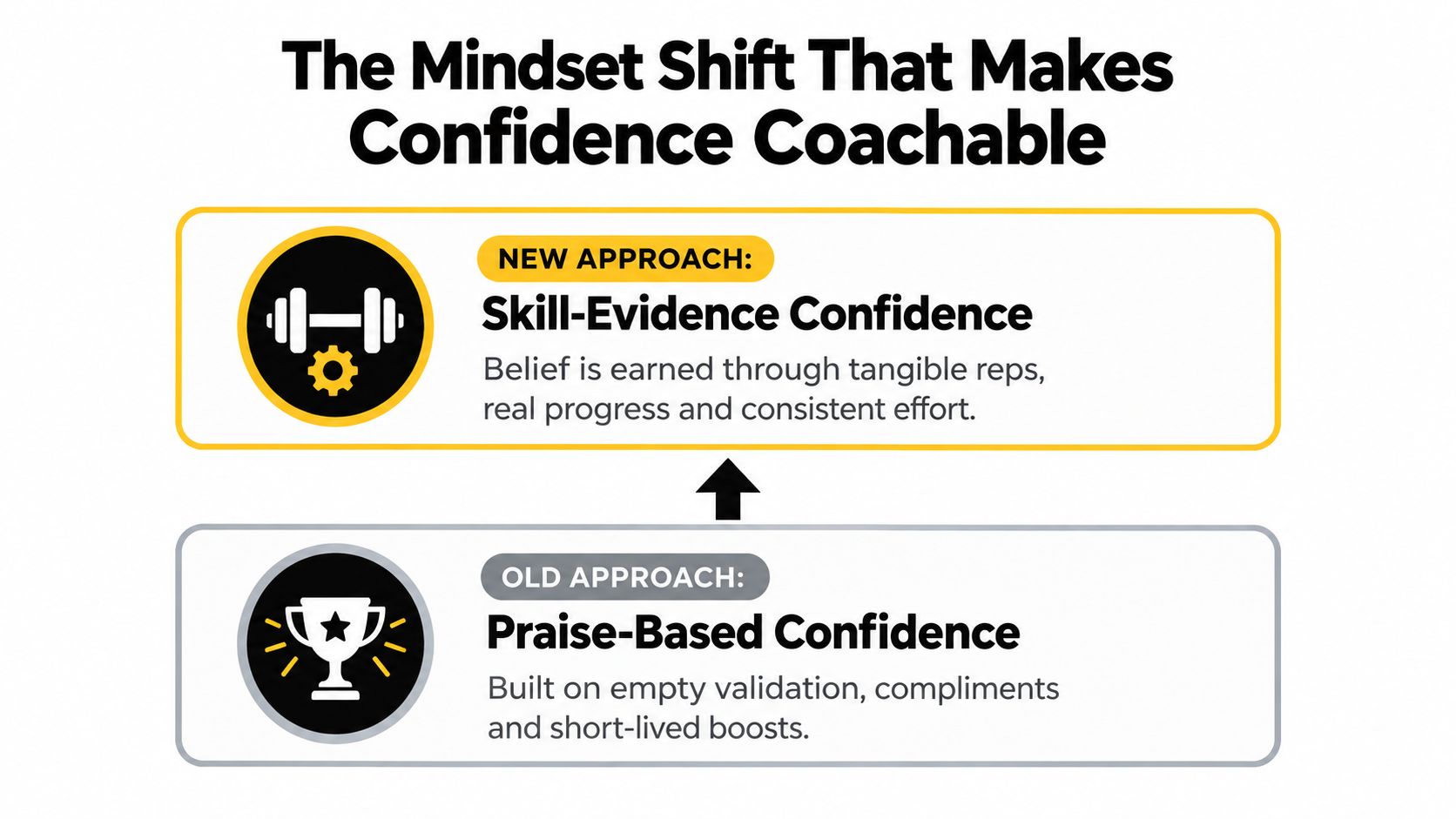
Most adults reach for praise first. “You're great,” “You can do this,” and “Go out there and be confident” sound supportive, but they don't give a child anything concrete to rely on when the first mistake arrives.
A stronger approach builds skill-evidence confidence. The child learns to think, “I know what to do because I've practiced this successfully,” rather than, “I hope I perform well enough today.” The first statement points to preparation. The second depends on an outcome that hasn't happened yet.
Build the ladder in order
I use a mastery-to-pressure progression. Each stage gives the athlete a reason to trust the next one.
Unopposed mastery: Start with a simple, repeatable skill. A player might receive and pass without a defender, dribble through wide gates, or shoot from a comfortable distance. Keep the task easy enough that success becomes familiar.
Light pressure: Add a partner, a small target, a gentle time limit, or a choice between two options. The athlete still has room to think.
Variable pressure: Introduce defenders, changing directions, noise, limited touches, or a moving score. The child now has to adapt instead of repeating a script.
Competitive pressure: Use a realistic game where mistakes are expected and decisions matter.
The exact repetition count isn't sacred. The principle is. Don't ask an athlete to solve a game problem before they've experienced the underlying skill working in simpler conditions.
Sport confidence has several parts, including belief in physical skill, decision-making, and resilience. Expert guidance identifies performance accomplishments, coaching, social support, and preparation as important confidence sources, which is why a progression works better than motivational language alone in this sport-confidence review.
A 2024 study of 1,659 teenagers who regularly played football found positive correlations between participation and collective self-esteem, self-esteem, and sport trait confidence. Yet participation alone didn't significantly predict sport trait confidence. The result matters: children gain confidence more reliably when they feel capable, included, and supported within the team environment in the study of football participation and confidence.
That changes the adult script. Replace “You need to score” with “Show me your first good decision.” Replace “Don't be nervous” with “Take your breath, find your space, and make the next action.” Process first, outcome later.
The video below offers another way to think about confidence as a trainable part of performance.
Age-Appropriate Drills and Small-Sided Play That Build Success
A confidence drill should give a child frequent chances to act, succeed, and try again. I call this success density. Younger or less experienced players need a high flow of manageable decisions, not long lines followed by one difficult attempt.
Ages four to six
Use activities that keep the ball close and make participation obvious:
Catch and roll back: The child catches a soft ball, rolls it to a partner, receives it back, and repeats. Progress to a gentle throw when catching looks relaxed.
Balloon volleyball: Keep a balloon in the air with a partner. There's no need to punish a miss. Restart quickly and celebrate the next contact.
Animal movement games: Players move like frogs, bears, or crabs toward a ball, then perform a simple action. Change activities often so every child stays involved.
Two-versus-two mini-games: Use small goals and a compact area. Smaller teams mean more touches and fewer chances to hide.
Ages seven to nine
Give children a personal challenge rather than comparing them with teammates. Try themed juggling, such as alternating feet or using a thigh and foot, then record each child's own best effort. Set up cone gates with a time target, but let players repeat the route until they find a rhythm.
In a three-versus-three game, add a two-touch condition or a rule requiring a pass before a shot. These constraints create decisions without making the game feel like a lecture. Coaches can use small-sided soccer games for ideas on adjusting space, player numbers, and rules.
Ages ten to twelve
Older children can handle more tactical information. Rotate through position-specific stations, then use four-versus-four plus two floaters to create passing options. In a conditioned scrimmage, award a point for completing a sequence of actions, not only for scoring. That rewards the behavior you want to see when the scoreboard isn't cooperating.
Age Band | Drill Type | Success Target | Design Rule |
|---|---|---|---|
Four to six | Catching, movement, two-versus-two games | Frequent contacts and simple choices | Keep restart time short |
Seven to nine | Juggling, cone gates, three-versus-three | Repeatable personal improvement | Add one constraint at a time |
Ten to twelve | Stations, floaters, conditioned games | Successful decisions under variation | Reward the sequence, not only the finish |
The useful adjustment rule is straightforward:
If a drill produces hesitation, shrink the space, lower the difficulty, or add a partner until success returns.
This principle also applies outside soccer. Coaches planning youth striking sessions can compare their progression with this guide for gym owners on teen boxing, especially when deciding how to introduce technical work before live pressure.
A Confidence-Focused Session Plan You Can Run This Week
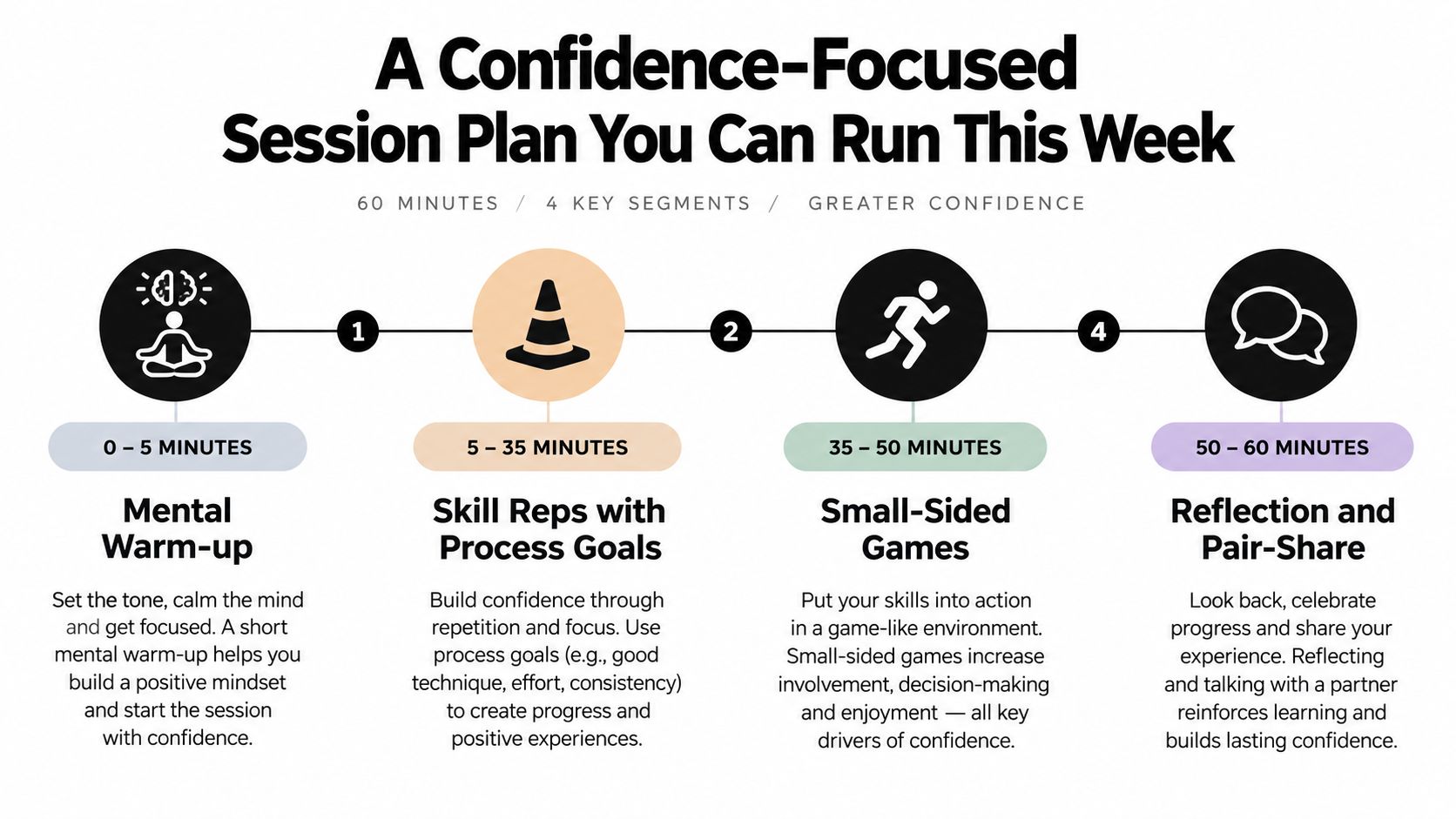
A confidence-focused practice doesn't need unusual equipment. It needs a deliberate order. The session should begin with emotional readiness, move through familiar skills, create repeated decisions, and finish by helping athletes notice their own evidence.
The 60-minute session card
Minutes 0 to 5, mental warm-up
Ask each player to choose one process goal. Examples include “scan before I receive,” “use my left foot,” or “call for the ball.” Pair athletes and have them share one thing they did well at the previous practice. Keep the answers specific and brief.
Minutes 5 to 35, technical work
Choose skills the group already performs successfully. Start with low variability, then add one constraint. You might reduce the space, use fewer defenders, or set a touch limit that encourages a clean first action. If the group struggles, remove the newest constraint rather than giving a longer explanation.
Minutes 35 to 50, small-sided games
Use three-versus-three or four-versus-four instead of a full-sided scrimmage. Give every player repeated chances to receive, decide, communicate, and recover from an error. Pause only when the same problem affects the whole group. Otherwise, let the game provide information.
Minutes 50 to 60, reflection and pair-share
Each athlete names one evidence moment. It could be a brave pass, a recovery run, a clear call, or a calm response after losing possession. Then ask what they'll repeat next time.
For younger children, shorten explanations and make the process goal physical, such as “soft hands” or “eyes up.” For newer groups, keep the first game less crowded and remove scoring if it causes players to hide. Coaches who need help organizing a repeatable practice can use tools that generate client session outlines, then adapt the outline to the team's actual skill level.
The key is to avoid selecting drills because they look advanced. Select them because the athletes can succeed, understand the task, and make enough decisions to collect useful evidence. A confidence-building activities resource can supplement the session with additional games that keep reflection and participation at the center.
Feedback and Progress Tracking That Actually Builds Belief
“Great job” may feel positive, but it rarely tells a hesitant player what they did correctly. Useful feedback names the behavior, connects it to a choice or effort, and gives the athlete a clear next action.
Instead of saying, “Good shot,” say, “You created space before shooting, then kept your eyes on the target. Try that same setup again.” Instead of, “Nice pass,” say, “You looked up before receiving, so you saw the open teammate early.” The child leaves with a repeatable behavior, not just a pleasant feeling.
Use a three-column evidence sheet
A small notebook or printed page can contain:
Skill | Evidence | Next Rep |
|---|---|---|
Receiving under pressure | Took the first touch away from the defender | Scan before the next pass |
Shooting | Chose an open shot instead of passing automatically | Set feet before release |
Communication | Called for the ball clearly | Use the call earlier |
Keep the sheet focused on actions. Don't turn it into a grade or a running record of mistakes. A child who can point to several specific decisions begins to see confidence as something they can influence.
Situation | Weak Feedback | Strong Feedback |
|---|---|---|
Soccer player loses possession | “Forget it.” | “You tried to turn forward. Recover quickly and look for the next pass.” |
Basketball player misses a shot | “That was a bad shot.” | “You created space. Next time, set your feet before releasing.” |
Multi-sport practice | “You're a natural.” | “You stayed with the task after it became difficult.” |
Mental skills training can reinforce this process. A recent review describes imagery, positive self-talk, and reflection as tools that can support confidence, emotional control, and responses to perfectionism. One practical routine asks athletes to record effort, success, and a small improvement, known as the ESP technique in the sports-psychology review.
Parents should keep the ride home short and open. Ask, “What felt good?” or “What did you try?” If the child doesn't want to talk, respect that. Support means making room for the athlete's experience, not conducting a second coaching session in the car.
Game-Day Preparation That Protects the Confidence You Built
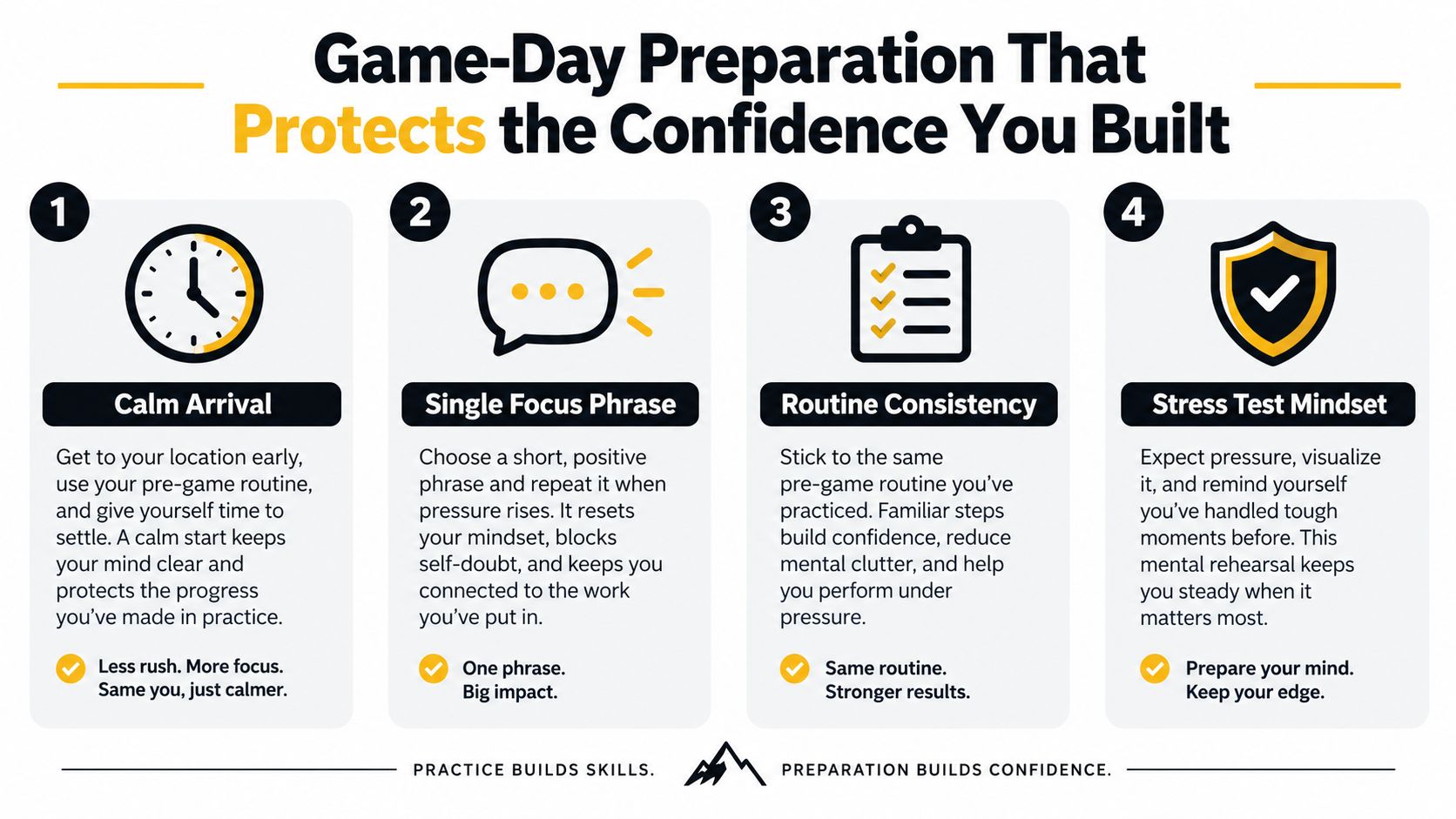
Game day is a stress test of preparation, not a fresh start. A child shouldn't need a brand-new motivational speech because the opponent is stronger or a parent is watching. The routine should feel familiar enough to protect the work done during practice.
Use a simple arrival routine
Give the child a calm arrival window. Avoid rushing from the car into tactical instructions. Let the athlete settle, get equipment ready, and choose one process goal to write on a wristband, shoe tag, or small piece of tape.
The goal might be “first touch away,” “talk early,” or “run after mistakes.” Before stepping onto the field or court, ask for two slow breaths. Keep the language short:
“You don't need to prove everything today. Find your first action and repeat your goal.”
During the game, coaches can help a shrinking player by clarifying the immediate role. A quick substitution isn't always a punishment. It can provide a reset, a drink, and one clear cue before the athlete returns. On the bench, avoid replaying the error. Say, “Your next job is to check your shoulder,” or “Look for the open teammate.”
Parents have an important boundary to hold. Don't shout a stream of technical instructions from the sideline, question every decision, or make the result stand in for the child's identity. The evidence on parent involvement points toward autonomy-supportive parenting, moderate involvement, encouragement after losses, and task-focused climates as more helpful than pressure or overinvolvement in guidance on parents and children in youth sport.
After the game, ask three questions in order:
What did you try?
What worked?
What's one thing to bring back next week?
If the team lost, keep the result in its proper place. A loss may provide useful information about decisions, communication, or preparation. It doesn't define the child's character, potential, or place in the sport.
Putting It Together and Getting Started
Confidence grows faster when the adults around a child use the same language and progression. A four-week starter plan gives families and coaches a manageable way to begin without changing everything at once.
A four-week starting cycle
Week one, establish evidence. Choose one skill, set a baseline through observation, and begin the three-column tracker. Ask the child to identify a process goal before practice.
Week two, add small-sided play. Use compact games where the child gets frequent decisions. Keep the challenge at a level where the group can achieve the intended action consistently, then adjust space or rules when hesitation returns.
Week three, introduce light pressure. Add a time limit, an opponent, or a short competitive scenario. Pair the activity with the familiar pre-game script, so pressure becomes part of preparation rather than a surprise.
Week four, review and adjust. Read the tracker with the athlete. Identify which behaviors now appear more naturally and choose the next challenge. A short parent-coach conversation can keep expectations aligned.
Families in Humble, Kingwood, Atascocita, and nearby Houston communities can look for programs that reinforce this progression through age-appropriate instruction. JC Sports Houston offers foundational multi-sport classes for younger children, sport-specific training and clinics for school-age players, small-sided games, and individual instruction. For a child who needs a quieter environment to collect skill evidence, one-on-one coaching sessions can provide focused repetitions before the athlete returns to group pressure.
Common questions from parents
What if my child regresses after a bad game? Treat the game as information, not a verdict. Return briefly to a successful version of the skill, then rebuild the challenge without making the setback the center of every conversation.
How long does confidence take to stick? It becomes more stable as the child repeatedly experiences preparation, action, and recovery. Look for behavior changes, such as asking for the ball sooner or responding to errors more quickly, rather than waiting for a child to announce that they feel confident.
Is praising effort enough? Not by itself. Effort praise helps most when it identifies what the child did and connects that behavior to the next opportunity. “You kept moving after the turnover, so do that again” is more useful than general approval.
This Saturday, choose one familiar skill, create a simple version the child can succeed at, and write down one evidence moment afterward. Then ask only, “What did you try?” and listen to the answer.
JC Sports Houston uses age-appropriate drills, small-sided play, progressive instruction, and sport-specific training to help children build technique and confidence together. Visit JC Sports Houston to explore programs, camps, leagues, and trial options for your child in the Houston area.
Comments