

Soccer Coaching Philosophy That Builds Real Players

A parent stands at the sideline of a U6 scrimmage, watching six children move as one busy swarm around the ball. The coach doesn't shout about defensive shape or demand that someone hold a position. Instead, the coach kneels, smiles, and asks one child what she could try next. The parent may wonder whether the coach has a plan.
The plan is the philosophy.
A strong soccer coaching philosophy explains what children should learn, how they should experience the game, and which decisions matter most when the score, the weather, or the parents' expectations create pressure. It turns broad values into field behavior, parent conversations, and program language that people can understand.
What a Soccer Coaching Philosophy Really Means
A soccer coaching philosophy is the consistent set of beliefs a coach brings to every drill, game, correction, and conversation. It answers a simple question before it answers a technical one: what are we trying to build in this player?
A session plan tells you what happens on Tuesday. A style of play describes how a team behaves in possession or defense. A win-loss record records an outcome. Philosophy sits underneath all three. It helps a coach decide whether a drill gives players enough decisions, whether a correction protects confidence, and whether a match result should change the learning priorities.
The three jobs of a philosophy
A useful philosophy does more than sound thoughtful on a website.
It filters practice decisions. If you value creativity, you won't spend the whole session correcting every imperfect pass. You'll create situations where players must choose between dribbling, passing, or protecting the ball.
It sets parent expectations. Families should know whether the program values equal involvement, position rotation, technical repetition, enjoyment, competition, or some deliberate combination.
It keeps development honest. A coach with clear principles has something to return to when winning tempts the team to use only the strongest players, clear the ball every time, or abandon experimentation.
Practical rule: If a philosophy can't change what a coach says or does on the field, it's a slogan, not a working philosophy.
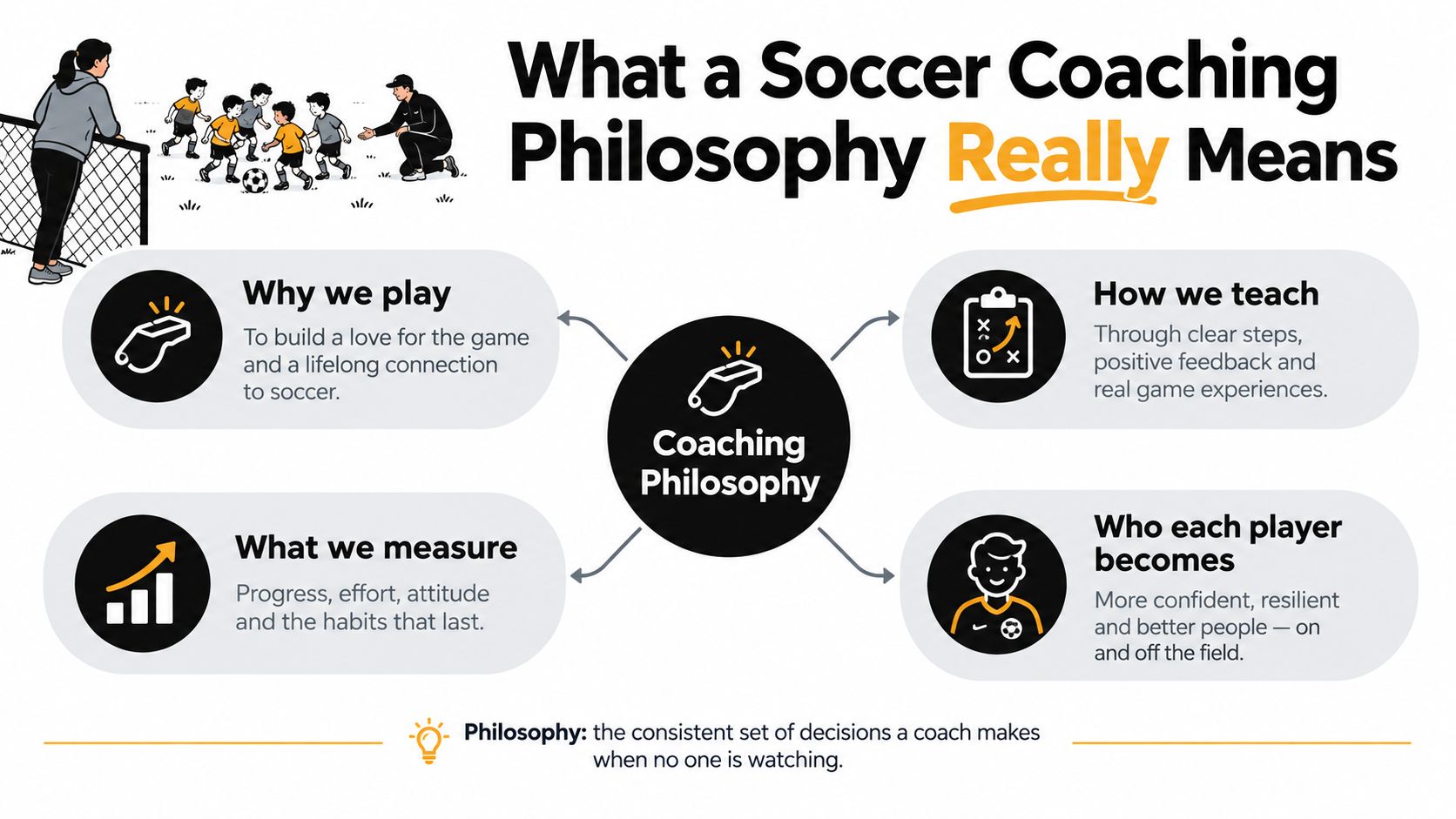
The principles later in this guide turn that definition into action. They address technical growth, creativity, game design, age-appropriate progression, and the individual child. They also provide language for preschool programs, school-age teams, girls' programs, parent onboarding, and coach handbooks.
A philosophy won't remove every difficult decision. It will make those decisions more consistent, explainable, and useful for the players in front of you.
How Modern Youth Soccer Coaching Philosophy Took Shape
Youth soccer didn't always place the child's learning at the center. Many programs borrowed adult structures, organized young players into fixed positions, and treated the weekend result as the clearest evidence of quality. That approach can produce an organized team, but organization isn't the same as individual development.
The technical shift gained a clear identity through the Coerver tradition. Wiel Coerver's work in the late 1970s emphasized ball mastery and 1v1 ability, and Alf Galustian and Charlie Cooke founded Coerver Coaching in 1984 to develop skilled, confident, creative players rather than relying only on team tactics. Coerver Coaching reports reaching over 1 million grassroots players and operating in 44 countries, illustrating how a player-centered technical method became scalable across different soccer environments (the history of Coerver-style coaching).
From adult models to child-centered learning
The U.S. Soccer National Youth License, created in 1995 as a full residential week, was described as one of the first child-centered coaching courses in the world. Its content connected coaching philosophy with cognitive development, age-specific learning, and game-based activity design. Evaluations found significant gains in several areas of coaching efficacy, including motivation, game strategy, and character building, while technique efficacy didn't show the same gain. That distinction matters. Coaches may already know how to demonstrate a skill, yet still need help designing environments that develop judgment, motivation, and behavior (evaluation of the U.S. Soccer National Youth License).
A results-first session often leaves recognizable clues:
Players wait in long lines while one child performs.
Cones replace opponents for most of the practice.
Coaches give the answer before players can read the problem.
Young teams spend too much time in adult-sized structures.
A mistake earns immediate correction instead of another opportunity.
The modern alternative doesn't reject competition. It changes what competition is used to reveal. Scores show what happened in one match. Repeated decisions show what a player is learning. The practical principles below grew from that shift, especially the use of small-sided, game-like activities that give children more chances to act.
Small-sided soccer research supports this direction. Smaller formats and less space per player increase decisive technical actions such as dribbles, crosses, shots, and other ball contacts. A one-touch rule can increase involvement too, but it can also increase errors and lost possession, so constraints need to match the players' level (systematic review of small-sided soccer games).
The Five Core Principles Every Youth Philosophy Should Cover
A philosophy becomes credible when parents can see it in a session. These five principles give coaches a practical test. For each one, ask: what would I change on the field if I really believed this?
Technical development through purposeful repetition
Players need repeated contact with the ball, but repetition should have a reason. Begin with a short individual ball-mastery block, then connect the movement to pressure, direction, or a decision. A coach might demonstrate a sole roll, inside cut, or change of pace briefly, then give players time to repeat it before adding a defender.
The player shouldn't spend the whole activity copying a movement with no opponent in mind. The coach can progress from control, to choice, to application in a small game.
Say this: “Try the move again, then look up and decide where your next touch should take you.”
Creativity over conformity
A creative player sometimes loses the ball while attempting something valuable. At U8, a disguised pass that fails can show more learning than a safe pass made without looking. The coach's job is to distinguish careless effort from courageous problem-solving.
Praise the intention first, then help the player improve the execution. “You saw the defender leaning and tried to play around her. What could make the pass harder to read next time?” gives useful feedback without teaching fear.
Say this: “I like that you tried to solve the problem. Let's find another way to make it work.”
Small-sided play
Small-sided games create more decisions than static lines and isolated turns. A 3v3 game can give children frequent chances to receive, dribble, defend, support, and recognize space. A 4v4 format can keep the game compact and active, while a larger 7v7 game asks players to manage more space and may reduce individual involvement for younger or less experienced players.
The exact format should serve the learning target. If the target is receiving under pressure, use a game that brings pressure quickly. If the target is finding width, create goals or channels that make width meaningful.
Research syntheses report a significant beneficial effect of small-sided games on technical execution compared with controls, with a reported effect size of ES = 0.59 and a 95% confidence interval from 0.29 to 0.89 (meta-analysis of small-sided games and technical execution). The lesson isn't to chase a particular format. It's to design games that create the actions you want players to practice.
Say this: “The game is your teacher today, so look for the next decision instead of waiting for my instruction.”
Age-appropriate progression
A U6 player may need to explore movement, stopping, turning, and joyful contact with the ball. A U14 player can handle more complex choices involving teammates, opponents, space, and transition. Giving both groups the same practice because it looks professional usually means giving one group the wrong challenge.
Progression can change through space, opposition, rules, speed, information, or responsibility. It doesn't always mean making an exercise harder in the same way.
Say this: “Today's challenge should stretch you, not overwhelm you.”
Player-centered coaching
Player-centered coaching doesn't mean letting children do anything they want. It means the coach designs the problem, observes the response, and uses questions and adjustments to help players understand the game.
Instead of shouting “Pass now,” ask, “What did you see before you received the ball?” Instead of stopping every attack, allow the player to experience the result of a choice, then revisit it. The coach still teaches. The coach avoids becoming the remote control for every player.
Say this: “Tell me what you noticed, then tell me what you might try next.”
Sample Philosophy Statements by Age and Audience
A philosophy statement should sound like the program it describes. Preschool language should feel welcoming and simple. School-age language can name decisions and development. A girls' program should make confidence, belonging, and creative risk-taking visible rather than assuming those values are understood.
Program | Core Emphasis | Sample Statement | Tone |
|---|---|---|---|
Toddler and preschool | Fun, movement literacy, first touches | “We help young children enjoy movement through playful soccer activities. Players explore running, stopping, turning, kicking, and sharing space while building comfort with the ball. Coaches keep activities short, welcoming, and age-appropriate so every child leaves wanting to play again.” | Warm, reassuring, simple |
School-age | Technical confidence, decisions, growth over scores | “We develop confident players who can control the ball, recognize space, and make decisions under pressure. Training uses purposeful repetition and small-sided games, while matches give players opportunities to try, adapt, and learn. We measure progress by growing competence and problem-solving, not by standings alone.” | Clear, developmental, specific |
Girls' program | Confidence, creative risk, safety to fail | “We create a supportive soccer environment where girls can be bold with the ball, communicate with confidence, and take creative risks without fear of embarrassment. Coaches challenge every player while respecting her stage of development, helping her build technical ability, resilience, and a lasting connection to the game.” | Encouraging, direct, empowering |
The preschool statement focuses on participation and movement because a young child's first task is to feel at home in the activity. The school-age version names technical and tactical behaviors because players can begin connecting actions to game problems. The girls' statement makes psychological safety explicit, which helps families understand that challenge and care belong together.
These statements share the same DNA: age-appropriate instruction, meaningful contact with the ball, player agency, and enjoyment with purpose. A weekly schedule should support those promises, not contradict them. Coaches can use a sample soccer training schedule as a practical reference when turning values into a repeatable rhythm.
Putting the Philosophy to Work in Sessions, Camps, and Parties
A philosophy becomes believable when the activity design makes the values obvious. A coach doesn't need elaborate equipment. The coach needs a clear purpose for each block and enough flexibility to respond to the players.
A 60-minute weekly session
A useful weekly session can follow this rhythm:
Arrival play: Let players enter a 3v3 or small possession game as soon as they arrive. They begin making decisions instead of standing in a line.
Technical station: Use a Coerver-inspired ball-mastery activity. Demonstrate briefly, then let players practice turns, feints, and changes of direction. Add a defender or target once the movement has meaning.
Targeted small-sided game: Reward one behavior, such as receiving across the body, supporting the ball carrier, or completing a sequence before scoring. Keep the rule simple enough that players can still play.
Free play: Remove the constraint and observe what carries over. Ask questions rather than directing every action.
Closing circle: Ask each player to name one thing they noticed, attempted, or learned.
The coach can adjust the challenge without abandoning the philosophy. If players struggle to complete passes, enlarge the space or remove a restriction. If they avoid dribbling, create a scoring bonus for beating a defender. The game should expose the next learning opportunity.
Half-day camps
A camp needs variety without becoming a collection of unrelated activities. Start with a shared ball-mastery theme, rotate through technical stations, then use themed scrimmage challenges that ask players to apply the skill. End with a team huddle where players identify a helpful teammate action or a problem they solved.
Stations can include turning through gates, passing to moving targets, 1v1 channels, and finishing games. A final World Cup-style game can bring energy to the closing period, provided the format still gives every player regular involvement. For more ideas on game design, see these small-sided soccer games.
Birthday parties
A birthday party can honor the same principles while keeping the mood festive. Begin with a welcome game, move into dribbling relays with simple choices, then use mini World Cup matches and finish with a penalty shootout. Give the host child a visible role, such as choosing team colors or starting the next game, without turning the event into a long ceremony.
Every guest should have a ball often enough to stay engaged. Short games, quick rotations, and clear demonstrations work better than lengthy explanations. The result is a party where the birthday child feels celebrated and every player gets to move, decide, and enjoy the game.
Talking With Parents the Way Your Philosophy Demands
Parent communication isn't an administrative add-on. It is one of the places where a program proves whether its philosophy is real. A written welcome letter should explain what coaches are building, what families may see during matches, and how parents can support learning from the sideline.
Use concrete language from the beginning:
“We value technical growth, creative decisions, age-appropriate challenge, and enjoyment. Players may rotate positions, try unfamiliar roles, and make mistakes while learning. We'll talk about progress through behaviors and habits, not only through the score.”
Difficult conversations become easier when the coach names the purpose instead of defending a decision.
When a parent asks why a player is in goal:“Your child is trying a different role so she can read the game from another angle, practice handling pressure, and understand what teammates need. We're not labeling her as a goalkeeper. We're broadening her experience.”
When a parent focuses on the scoreboard:“I understand that the result matters to your family. We're also watching whether players recognize space, recover after losing the ball, and attempt solutions. Those are the behaviors we're building. You can help by asking what your child noticed or enjoyed, rather than only asking whether the team won.”
When development looks like regression:“Your child is attempting harder actions, so the mistakes are more visible right now. We're tracking whether she keeps trying, sees more options, and recovers faster. The temporary messiness is part of learning a more demanding skill.”
Repeat a small set of cues throughout the season:
“We develop players, not just lineups.”
“Mistakes give us information.”
“Position rotation builds understanding.”
“Ask what your child saw.”
“Progress can look messy before it looks polished.”
Measuring Whether the Philosophy Is Actually Working
A coach doesn't need a complicated assessment system. A notebook, clipboard, or session-end note can reveal whether the stated philosophy appears in player behavior.
Skill evidence
Watch for better first touches, more controlled dribbling in traffic, and passes that reach useful spaces. Record the situation, not just the result. “Received with pressure and kept possession” tells you more than “good passing.”
Game-day behavior
Look for players who scan before receiving, communicate with teammates, recover after losing the ball, and choose between dribbling and passing with less prompting. These signs show that technical work is becoming game understanding.
Psychosocial markers
Notice whether a child returns to play after a mistake, stays engaged during a difficult activity, asks questions, and shows excitement about coming back. A player who tries a new move after an earlier failure may be demonstrating meaningful progress even if the move doesn't work yet.
A technical-development resource such as technical development in youth soccer can help coaches organize skill priorities, but the notebook should remain personal and practical.
At the end of each month, ask:
Did every player receive meaningful opportunities to act?
Did the activities create decisions rather than only repetitions?
Did my corrections increase understanding or merely stop mistakes?
Did I communicate the same priorities to parents and players?
Are players returning, attempting new ideas, and solving more problems independently?
Trophies may arrive, but they aren't the main test. A philosophy is working when players become more capable, more willing to try, and more connected to the game.
Ready-to-Use Language for Coaches and Program Marketing
Shared language keeps a program aligned. Place the longer statement on the website and registration pages, use the shorter versions in program descriptions, and include the commitment statement in the coach handbook.
House philosophy, approximately 60 words
“At JC Sports Houston, we develop well-rounded, creative players through purposeful technical practice, small-sided decision-making, age-appropriate movement, psychological safety, and a lasting love of the game. For Houston families, that means coaches create active sessions where children get meaningful touches, try solutions, learn from mistakes, and grow as confident athletes and supportive teammates.”
Toddler and preschool version
“Our youngest players learn through movement, games, music, and playful soccer activities. Coaches build comfort with running, stopping, turning, kicking, and sharing space while keeping every activity welcoming, active, and appropriate for early childhood.”
School-age version
“School-age players develop technical confidence and game understanding through purposeful repetition and small-sided play. Coaches encourage players to recognize space, make decisions, take responsible risks, and measure growth through learning rather than scores alone.”
Girls' program version
“Our girls' soccer environment helps players build confidence, technical ability, communication, and creative courage. Coaches provide challenge and support together, so every player can try, make mistakes, ask questions, and grow into her own way of playing.”
Coach commitment
“I will design sessions that give players meaningful decisions, explain the purpose behind activities, protect the right to learn through mistakes, and adapt my coaching to the child in front of me.”
Parent welcome email
“Welcome to the program. Our coaches will focus on technical growth, creative decisions, age-appropriate challenge, and enjoyment. You may see players rotate roles or attempt actions that don't always succeed. Please ask what your child noticed, tried, or enjoyed, and contact us when you need context about the learning process.”
Flyer or party tagline
“More touches, more creativity, more reasons to love the game.”
Put the house philosophy on the program page, the age-specific versions beside registration options, and the coach commitment in onboarding materials. Use the welcome email before the first session. Consistent wording makes it easier for every coach and family to recognize the same principles in practice.
JC Sports Houston offers age-appropriate soccer training, Coerver-based technical programs, girls' sessions, camps, leagues, private instruction, and coach-led sports parties for families in Humble, Kingwood, Atascocita, and nearby Houston communities. Visit JC Sports Houston to explore programs or request a free trial and experience how player-centered coaching looks on the field.
Comments